
 Megalopyge lanata (Stoll, 1780) (Lepidoptera: Megalopygidae): first record of injury to Byrsonima crassifolia (L.) Kunth (Malpighiaceae) in Brazil
Initially described as Malpighia crassifolia L.s in 1821 (Tropicos, 2019), the tree was later redescribed as Byrsonima crassifolia (L.) Kunth (Malpighiaceae), popularly known as “murici” is a perennial tree that occurs in the northeast, north, and southeast regions of Brazil (Oliveira et al., 2017). This plant is two to six meters high with a diameter at breast height of 15 to 25 centimeters, simple and short-petiolate leaves, acute apex, ferruginous hairs on the abaxial leaf parts, and flowers with five yellow petals in elongated racemes (Ferreira, 2005; Maldini et al., 2011).
Byrsonima crassifolia fruits are consumed fresh or in ice creams, jellies, juices, liqueurs, pulps and sweets, and the oil from its seeds in cooking, cosmetics, and medicine (Garritano et al., 2010; Arruda et al., 2013; Monteiro and Pires, 2016).
In Brazil, the fruit flies Anastrepha fraterculus (Wiedemann, 1830), Anastrepha obliqua (Macquart, 1835), Anastrepha striata Schiner, 1868, and Bactrocera carambolae Drew & Hancock, 1994 (Diptera: Tephritidae) damage and making unviable the consumption of fruits besides larvae of Neosilba bella Strkis & Prado 2006 and Neosilba zadolicha McAlpine & Steyskal, 1982 (Diptera: Lonchaeidae) that feed on the fruits of this plant, causing injuries and making them unfit for any consumption (Pereira et al., 2008; Adaime et al., 2012; Jesus-Barros et al., 2012, 2015).
Herbivory by caterpillars reduces the productivity of agricultural and forestry crops (Urretabizkaya et al., 2010). Population outbreaks on cultivated plants and dermatological accidents increase the importance of Lepidoptera insects (Repplinger and Hahn, 2019). Megalopyge lanata (Stoll, 1780) (Lepidoptera: Megalopygidae), known as the stinging or scab caterpillar and widely distributed in the Neotropical region (Dyar and Strand, 1913), was recorded in Brazil, Colombia, Ecuador, French Guiana, Suriname, Trinidad and Tobago, and Venezuela (South America), Costa Rica, Honduras, and Panama (Central America), and Mexico (North America) (Laurence, 2000; GBIF Secretariat, 2023). Caterpillars of the initial instars of M. lanata scrape the leaf surface, and those of the others completely defoliate shrubs and woody trees (EMBRAPA, 2015). The primary means of controlling M. lanata is done, especially with pyrethroid insecticides (Agrolink, 2023).
Bristles protect caterpillars of this insect against parasitoids and predators, and their contact with the skin causes burns on humans and animals (Cardoso and Haddad Junior, 2005). This is common, reducing the mobility of the limb affected and, consequently, the productivity of farmers and agricultural workers (Sánchez et al., 2019). Poisoning by M. lanata caterpillars includes skin reactions such as local pain and burning, edema, and erythema (Hossler, 2010).
This work aimed to record the first injury report by M. lanata on B. crassifolia plants in Brazil, in addition to its first report in the state of Alagoas.
Caterpillars and other life stages, identified as belonging to the Megalopygidae family, were observed on B. crassifolia plants in a smallholder's crop with 20 trees, in the municipality of Arapiraca, state of Alagoas, Northeastern Brazil (09°49’23” S; 36°36’48” W and altitude of 264 m) at an average temperature of 24.2 °C and rainfall of 80.75% (INMET, 2022).
Several stages of these moths were photographed, such as egg masses, caterpillars, pupal chambers and moths, using a Moto G9 Plus 2020 cell phone.
The caterpillars were collected with entomological tweezers, stored in Falcon tubes (50 mL) in 70% ethyl alcohol, and deposited in the Entomological Collection of the Universidade Federal dos Vales Jequitinhonha e Mucuri (UFVJM) Campus JK in Diamantina, Minas Gerais, Brazil without voucher numbers. Photographs of this moth were sent to taxonomist Prof. Olaf Hermann Hendrik Mielke, Departamento de Zoologia, Universidade Federal do Paraná (UFPR), to confirm the species.
The caterpillar infesting and damaging B. crassifolia (Figure 1A) plants in the Agreste region of the Alagoas state, Northeast Brazil, was identified as M. lanata. The record of M. lanata expands the number of insects reported on B. crassifolia plants. Egg masses, caterpillars of different instars, and pupal chambers attached to the trunk and moths were observed on B. crassifolia plants (Figure 1B-F).
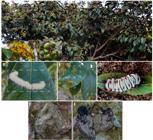
Byrsonima crassifolia (L.) Kunth (A); egg mass (B); early instar caterpillars scraping (C) and other instars defoliating the host plant (D), pupal chamber (E) and couple of Megalopyge lanata (Stoll, 1780) (F).
The presence of egg masses, caterpillars of different instars, and pupal chambers attached to the trunk and M. lanata moths on B. crassifolia plants suggests the complete life cycle of this insect in a new host plant in the Agreste ecoregion of the Alagoas state, Northeast Brazil expanding the area of occurrence of this insect, a pest of fruit plants and with medical and public health importance due to accidents by contact of humans and animals as causing edema, erythema, intense pain, and drowsiness and progressing to bradycardia in an 11 year old child in the municipality of Uberlândia, state of Minas Gerais, Brazil (Silva et al., 2011). Observations of the site, leaves, twigs, and trunks before handling them and gloves can reduce accidents caused by contact with M. lanata caterpillars, especially during fruit collection gardening activities or in wild environments (Brasil, 2023). Caterpillars of the genus Megalopyge are polyphagous and recorded in shrubs and woody trees of the genera Acer spp. (Sapindaceae), Carya spp. (Juglandaceae), Citrus spp. (Rutaceae), Ficus spp. (Moraceae), Malus spp. (Rosaceae), Morus spp. (Moraceae), Quercus spp. (Fagaceae) and Ulmus spp. (Ulmaceae) in different regions of the world (Diaz, 2005). In Brazil, M. lanata caterpillars defoliated shrub plants, such as Anacardium occidentale L., 1753 (Anacardiaceae), Byrsonima sericea D.C., 1824 (Malpighiaceae), Citrus spp. (Rutaceae), Caryocar brasiliense Cambess, 1828 (Caryocareaceae), Coffea spp. (Rubiaceae), Clusia hilariana Schltdl, 1833 (Clusiaceae), Erythroxylum ovalifolium Peyr, 1858 (Erythroxylaceae), Erythroxylum subsessile (Mart.) O.E. Schulz, 1907 (Erythroxylaceae), Gossypium sp. (Malvaceae), Hura crepitans L., 1753 (Euphorbiaceae), Mangifera indica (Anacardiaceae), Manilkara subsericea (Mart.) Dubard, 1915 (Sapotaceae), Persea americana Mill, 1768 (Lauraceae), Prunus persica (L.) Batsch (Rosaceae), Psidium guajava L., 1753 (Mirtaceae), Pyrus spp. (Rosaceae), Spondias tuberosa Arr. Cam., 1816 (Anacardiaceae), Terminalia catappa L., 1767 (Combretaceae) and Vitis spp. (Vitaceae) (Barros et al., 1993; Neves and Carvalho, 2005; Flinte et al., 2006; Silveira et al., 2008; Gontijo et al., 2009; Matiello et al., 2010; Polar et al., 2011; Agrolink, 2023). Furthermore, M. lanata defoliates plants of Musa paradisiaca L., 1753 (Musaceae) and P. americana in Colombia (López-Galé et al., 2022; Rojas López, 2018); Citrus spp. (Rutaceae) in Suriname; Coffea spp. (Rubiaceae) and P. americana (Lauraceae) in Trinidad and Tobago (Laurence, 2000), Conocarpus erectus L., 1753 (Combretaceae), Lagerstroemia indica (L.) Pers. (Lythraceae) and Terminalia catappa L., 1767 (Combretaceae) in Panama (Aiello, 2011); and Rhizophora mangle L., 1753 (Rhizophoraceae), Roupala montana Aubl, 1775 (Proteaceae), and Swietenia macrophylla King, 1886 (Meliaceae) in Puerto Rico (Janzen and Hallwachs, 2010).
The period of occurrence of the M. lanata outbreak in the Agreste region of the state of Alagoas occurred in winter and differs from reports of species of the genus Megalopyge, with outbreaks during spring and autumn in tropical areas and late summer and early autumn in temperate regions with two generations per year (Diaz, 2005). The record in the Alagoas state expands the area of occurrence of M. lanata after its report in the North (Acre, Amazonas, Pará, and Roraima states), Northeast (Bahia, Maranhão, Pernambuco, Piauí, and Rio Grande do Norte states), Southeast (Espírito Santo, Minas Gerais, Rio de Janeiro and São Paulo states), Central-West (Goiás, Mato Grosso, and Mato Grosso do Sul states) and South (Paraná and Santa Catarina states) of Brazil (GBIF Secretariat, 2023).
The record of M. lanata caterpillars feeding on B. crassifolia increases the number of insects damaging this plant in Brazil. The presence of M. lanata in the Alagoas state, Northeast Brazil, expands the area of its occurrence and alerts the local community to avoid accidents to humans and animals with caterpillars of this species.
Acknowledgements
To the taxonomist Prof. Olaf Hermann Hendrik Mielke do Departamento de Zoologia, Setor de Ciências Biológicas (UFPR), for confirming the identification of the moth species. To “Coordenação de Aperfeiçoamento de Pessoal de Nível Superior (CAPES), Conselho Nacional de Desenvolvimento Científico e Tecnológico (CNPq) – Financial code – 01, Fundação de Amparo à Pesquisa do Estado de Minas Gerais (FAPEMIG)” and “Programa Cooperativo sobre Proteção Florestal (PROTEF) of the Instituto de Pesquisas e Estudos Florestais (IPEF)”.
References
-
ADAIME, R., STRIKIS, P.C., SOUZA-FILHO, M.F., LIMA, C.R. and LASA, R., 2012. First report of Lonchaeidae (Diptera) infesting fruits of Byrsonima crassifolia in Brazil. Revista Colombiana de Entomologia, vol. 38, no. 2, pp. 363-364. http://doi.org/10.25100/socolen.v38i2.9020
» http://doi.org/10.25100/socolen.v38i2.9020 -
AGROLINK, 2023 [viewed 12 August 2024]. Megalopyge lanata [online]. Available from: https://www.agrolink.com.br/problemas/lagarta-de-fogo_486.html
» https://www.agrolink.com.br/problemas/lagarta-de-fogo_486.html -
AIELLO, A. [online], 2011 [viewed 12 December 2023]. Available from: http://striweb.si.edu//results.php
» http://striweb.si.edu//results.php - ARRUDA, I.N.Q., PEREIRA-JUNIOR, V.A. and GOULART, G.A.S., 2013. Produção de cerveja com adição de polpa de murici (Byrsonima spp.). Revista Eletrônica Interdisciplinar, vol. 2, no. 10, pp. 129-136.
- BARROS, L.D.M., PIMENTEL, C.R.M., CORREA, M.P.F. and MESQUITA, A.L.M., 1993. Recomendações técnicas para a cultura do cajueiro anão precoce Fortaleza: Embrapa Agroindústria Tropical, vol. 1.
-
BRASIL. Ministério da Saúde, 2023 [viewed12 December 2023]. Animais peçonhentos/acidentes por lagarta [online]. Brasília. Available from: https://www.gov.br/saude/pt-br/assuntos/saude-de-a-a-z/a/animais-peconhentos/acidentes-por-lagartas#:~:text=As%20lagartas%20do%20g%C3%AAnero%20Lonomia
» https://www.gov.br/saude/pt-br/assuntos/saude-de-a-a-z/a/animais-peconhentos/acidentes-por-lagartas#:~:text=As%20lagartas%20do%20g%C3%AAnero%20Lonomia - CARDOSO, A.E.C. and HADDAD JUNIOR, V., 2005. Accidents caused by lepidopterans (moth larvae and adult): study on the epidemiological, clinical and therapeutic aspects. Anais Brasileiros de Dermatologia, vol. 80, pp. 573-578.
-
DIAZ, J.H., 2005. The evolving global epidemiology, syndromic classification, management, and prevention of caterpillar envenoming. The American Journal of Tropical Medicine and Hygiene, vol. 72, no. 3, pp. 347-357. http://doi.org/10.4269/ajtmh.2005.72.347 PMid:15772333.
» http://doi.org/10.4269/ajtmh.2005.72.347 - DYAR, H.G. and STRAND, E., 1913. Megalopygidae, Dalceridae, Epipyropidae Berlin: W. Junk, vol. 16.
-
EMPRESA BRASILEIRA DE PESQUISA AGROPECUÁRIA – EMBRAPA, 2015 [viewed 12 December 2023]. Pragas [online]. Available from: http://www.ceinfo.cnpat.embrapa.br/arquivos/artigo_2313
» http://www.ceinfo.cnpat.embrapa.br/arquivos/artigo_2313 - FERREIRA, M.G.R., 2005. Murici (Byrsonima crassifolia (L.) Rich.). Porto Velho: Embrapa Rondônia, pp. 1-2.
-
FLINTE, V., ARAUJO, C.O., MACEDO, M.V.D. and MONTEIRO, R.F., 2006. Insetos fitófagos associados ao murici da praia, Byrsonima sericea (Malpighiaceae), na Restinga de Jurubatiba (RJ). Revista Brasileira de Entomologia, vol. 50, no. 4, pp. 512-523. http://doi.org/10.1590/S0085-56262006000400012
» http://doi.org/10.1590/S0085-56262006000400012 - GARRITANO, G., JORGE, C.A. and GULIAS, A.P.S.M., 2010. Murici. In: R.F. VIEIRA, T.S.A. COSTA, D.B. SILVA, F.R. FERREIRA and S.M. SANO, eds. Frutas nativas da Região Centro-Oeste do Brasil. Brasília: Embrapa Recursos Genéticos e Biotecnologia, pp. 236-246.
-
GBIF SECRETARIAT, 2023. GBIF backbone taxonomy: Megalopyge lanata (Stoll, 1780). Copenhagen. http://doi.org/10.15468/39omei
» http://doi.org/10.15468/39omei - GONTIJO, F.S., CORRÊA, D., CAMARGO, A.J.A. and COSTA, P.T., 2009. Dados preliminares sobre as taxas de herbivoria do pequi (Caryocar brasiliense) e pequi-anão (Caryocar brasiliense spp. intermedium Camb., Caryocareaceae) em plantio experimental. In: Resumos do IV Encontro de Jovens Talentos da Embrapa Cerrados, 2009, Planaltina. Planaltina: Embrapa Cerrados, pp. 78-79.
-
HOSSLER, E.W., 2010. Caterpillars and moths: part II. Dermatologic manifestations of encounters with Lepidoptera. Journal of the American Academy of Dermatology, vol. 62, no. 1, pp. 13-28. http://doi.org/10.1016/j.jaad.2009.08.061 PMid:20082887.
» http://doi.org/10.1016/j.jaad.2009.08.061 -
INSTITUTO NACIONAL DE METEOROLOGIA – INMET, 2022 [viewed 28 December 2023]. Arapiraca - AL [online]. Available from: https://portal.inmet.gov.br/
» https://portal.inmet.gov.br/ -
JANZEN, D.H. and HALLWACHS, W., 2010 [viewed 28 December 2023]. Dynamic database for an inventory of the macrocaterpillar fauna, and its food plants and parasitoids, of Area de Conservacion Guanacaste (ACG), Northwestern Costa Rica [online]. Philadelphia: University of Pennsylvania. Available from: http://janzen.sas.upenn.edu
» http://janzen.sas.upenn.edu -
JESUS-BARROS, C.R., ADAIME, R., OLIVEIRA, M.N., SILVA, W.R., COSTA-NETO, S.V. and SOUZA-FILHO, M.F., 2012. Anastrepha (Diptera: Tephritidae) species, their hosts and parasitoids (Hymenoptera: Braconidae) in five municipalities of the state of Amapá, Brazil. The Florida Entomologist, vol. 95, no. 3, pp. 694-705. http://doi.org/10.1653/024.095.0320
» http://doi.org/10.1653/024.095.0320 -
JESUS-BARROS, C.R., CRUZ, O.M. and ADAIME, R., 2015. Byrsonima crassifolia (Malpighiaceae): new alternative host to carambola fruit fly in Brazil. Biota Amazônia, vol. 5, no. 3, pp. 117-118. http://doi.org/10.18561/2179-5746/biotaamazonia.v5n3p117-118
» http://doi.org/10.18561/2179-5746/biotaamazonia.v5n3p117-118 - LAURENCE, G.A., 2000. The insect pests of coffee. Journal of the Agricultural Society of Trinidad and Tobago, vol. 89, pp. 19-20.
-
LÓPEZ-GALÉ, Y., CARRASCAL-PÉREZ, F., PULGARÍN DÍAZ, J.A., BURBANO-FIGUEROA, O. and ARCILA CARDONA, A., 2022. Insectos fitófagos associados a plantaciones de aguacate (Persea americana Mill.) en la región Caribe Colombiana. Revista Colombiana de Entomologia, vol. 48, no. 2, pp. 5-10. http://doi.org/10.25100/socolen.v48i2.11693
» http://doi.org/10.25100/socolen.v48i2.11693 -
MALDINI, M., MONTORO, P. and PIZZA, C., 2011. Phenolic compounds from Byrsonima crassifolia L. bark: phytochemical investigation and qualitative analysis by LC-ESI MS/MS. Journal of Pharmaceutical and Biomedical Analysis, vol. 56, no. 1, pp. 1-6. http://doi.org/10.1016/j.jpba.2011.03.032 PMid:21571480.
» http://doi.org/10.1016/j.jpba.2011.03.032 - MATIELLO, J.B., SANTINATO, R., GARCIA, A.W.R., ALMEIDA, S.R. and FERNANDES, D.R., 2010. Cultura de café no Brasil: manual de recomendações. Varginha: Fundação Procafé.
-
MONTEIRO, D.C.B. and PIRES, C.R.F., 2016. Avaliação da estabilidade físico-química de geleias de murici armazenadas sob diferentes condições de temperatura e luminosidade. Revista Desafios, vol. 3, no. spe, pp. 87-98. http://doi.org/10.20873/uft.2359-3652.2016v3nespp87
» http://doi.org/10.20873/uft.2359-3652.2016v3nespp87 - NEVES, O.S.C. and CARVALHO, J.G., 2005. Tecnologia da produção do umbuzeiro (Spondias tuberosa Arr. Cam.). Lavras: Universidade Federal de Lavras.
-
OLIVEIRA, R.L.C., SCUDELLER, V.V. and BARBOSA, R.I., 2017. Use and traditional knowledge of Byrsonima crassifolia and B. coccolobifolia (Malpighiaceae) in a Makuxi community of the Roraima savana, northern Brazil. Acta Amazonica, vol. 47, no. 2, pp. 133-140. http://doi.org/10.1590/1809-4392201600796
» http://doi.org/10.1590/1809-4392201600796 -
PEREIRA, J.D.B., LEMOS, L.N., DEUS, E.G., SOUZA-FILHO, M.F. and SILVA, R.A., 2008. Novo hospedeiro de Anastrepha spp. (Diptera: Tephritidae) no Brasil. O Biológico, vol. 70, no. 2, pp. 160. http://doi.org/10.1590/S1519-566X2005000600003
» http://doi.org/10.1590/S1519-566X2005000600003 - POLAR, P., COCK, M.J. and SEALES, T.L., 2011. Painful encounters with caterpillars of Megalopyge lanata (Stoll), (Lepidoptera: Megalopygidae) in Tobago, Trinidad and Tobago, West Indies. Living World, Journal of the Trinidad and Tobago Field Naturalists’ Club, vol. 2011, pp. 1-5.
- REPPLINGER, D.J. and HAHN, I.H., 2019. Arthropods. In: L.S. NELSON, M.A. HOWLAND, N.A. LEWIN, S.W. SMITH, L.R. GOLDFRANK and R.S. HOFFMAN, eds. Goldfrank’s toxicologic emergencies 11th ed. New York: McGraw-Hill Education, pp. 1540-1559.
- ROJAS LÓPEZ, A.K., 2018. Sistema productivo de plátano Hartón (Musa paradisiaca) para contribuir con el fortalecimiento de la producción agrícola de las comunidades rurales e indígenas de Arauquita (Arauca). Bogotá D.C.: Universidad de La Salle. Tesis de Grado en Ingeniería Agronómica.
-
SÁNCHEZ, M.N., SCIANI, J.M., QUINTANA, M.A., MARTÍNEZ, M.M., TAVARES, F.L., GRITTI, M.A., FAN, H.W., TEIBLER, G.P. and PEICHOTO, M.E., 2019. Understanding toxicological implications of accidents with caterpillars Megalopyge lanata and Podalia orsilochus (Lepidoptera: Megalopygidae). Comparative Biochemistry and Physiology. Toxicology & Pharmacology : CBP, vol. 216, no. 1, pp. 110-119. http://doi.org/10.1016/j.cbpc.2018.11.011 PMid:30448590.
» http://doi.org/10.1016/j.cbpc.2018.11.011 - SILVA, J.J., LIMONGI, J.E., ROSCOE, E.H. and MORAES, R.H.P., 2011. Acidente humano por Megalopyge lanata (Lepidoptera: Megalopygidae) em área urbana do município de Uberlândia, MG, Brasil. Revista de Patologia Tropical, vol. 40, no. 4, pp. 362-366.
-
SILVEIRA, V.R., MONTEIRO, R.F. and MACEDO, M.V., 2008. Larvas de insetos associadas a Clusia hilariana Schltdl. (Clusiaceae) na Restinga de Jurubatiba, RJ, Brasil. Revista Brasileira de Entomologia, vol. 52, no. 1, pp. 57-61. http://doi.org/10.1590/S0085-56262008000100010
» http://doi.org/10.1590/S0085-56262008000100010 -
TROPICOS, 2019 [viewed 13 October 2024]. Byrsonima crassifolia (L.) Kunth. Saint Louis: Missouri Botanical Garden. Available from: www.tropicos.org/Name/19500795?tab=synonyms
» www.tropicos.org/Name/19500795?tab=synonyms - URRETABIZKAYA, N., VASICEK, A. and SAINI, E., 2010. Insectos perjudiciales de importancia agronómica: I. Lepidópteros. Buenos Aires: Inta Ediciones.

