 Performance of lambari-do-rabo-amarelo Astyanax bimaculatus (Linnaeus, 1758) fed diets based on adult black soldier fly meal: analysis of its effectiveness as a substitute for fish meal
Abstract
This study evaluated the performance of the lambari-do-rabo-amarelo Astyanax bimaculatus fed diets containing BSF adult fly meal, replacing fishmeal. Two hundred juveniles were distributed in 20 tanks, with five levels of substitution (0%, 12.5%, 25%, 37.5%, and 50%) for 45 days. The diets were isoproteic and isoenergetic, provided to the animals three times a day. The results showed that the increased substitution impaired the fish's performance, with the highest weight gain in the treatment without substitution (0%). Feed conversion, protein efficiency, and energy efficiency decreased due to the high chitin content of the adult fly. It is concluded that BSF fly meal is not advantageous for the lambari-do-rabo-amarelo.
Keywords:
alternative proteins; aquaculture; feed efficiency; nutritional impact
Resumo
Este estudo avaliou o desempenho do lambari-do-rabo-amarelo Astyanax bimaculatus alimentado com dietas contendo farinha de mosca adulta de BSF, substituindo a farinha de peixe. Duzentos juvenis foram distribuídos em 20 tanques, com cinco níveis de substituição (0%, 12.5%, 25%, 37.5% e 50%), por 45 dias. As dietas foram isoproteicas e isoenergéticas, fornecidas aos animais três vezes ao dia. Os resultados mostraram que a substituição aumentada prejudicou o desempenho dos peixes, com o maior ganho de peso no tratamento sem substituição (0%). A conversão alimentar, eficiência proteica e energética diminuíram, devido ao alto teor de quitina da mosca adulta. Conclui-se que a farinha de mosca de BSF não é vantajosa para o lambari-do-rabo-amarelo.
Palavras-chave:
proteínas alternativas; aquicultura; eficiência alimentar; impacto nutricional
1. Introduction
The lambari-do-rabo-amarelo Astyanax bimaculatus (Linnaeus, 1758) is an omnivorous and small-sized fish species, native to rivers and lakes in Brazil (Santos et al., 2022). Used both as bait in sport fishing and as a snack in bars, the lambari has a high production potential, with 661,019 kg recorded in 2019 and São Paulo is the largest producer, with 236,350 kg (Tuna et al., 2020). With the expectation of continuous growth in this production, it is necessary to provide high-quality feed, rich in proteins, amino acids, carbohydrates, lipids, and vitamins suitable for each stage of development (IBGE, 2021; Hardy and Kaushik, 2021).
When the provided diet meets these nutritional specifications, the results are evident: good health and high production performance, leading to increased production and disease prevention (Rodrigues et al., 2013). However, offering low-quality food can impair the animals' performance, negatively affect the environment, and result in an unfavorable cost-benefit relationship (Fernandes et al., 2022).
To minimize potential losses in production, studies are being conducted with alternative ingredients that provide high-quality food at a reduced cost. Various plant and animal-based ingredients have been studied, with a focus on the black soldier fly (BSF) Hermetia illucens (Linnaeus, 1758), which has been tested in several fish species (Cornélio, 2022; Luthada-Raswiswi et al., 2021).
The BSF transforms organic waste into biomass rich in proteins (30% to 60%) during its larval phase, similar to fish meal (Oliveira et al., 2023; Fowles and Nansen, 2019). Studies indicate that up to 70% of fish meal can be replaced by BSF larvae meal (Devic et al., 2018). Furthermore, the pre-pupal phase of BSF also offers nutritional benefits for fish. Although the adult phase of the black soldier fly is not commonly used directly as feed, it plays an important role in the ecological balance by serving as food for other animals and providing nutritional value, especially in terms of protein supplementation and sustainability (Makkar et al., 2014).
Studies on BSF mainly focus on the larval stage due to its higher nutrient accumulation, but other stages, such as the adult stage, also show potential for exploration (Arru et al., 2019). However, the adult phase of the black soldier fly is not yet widely used as a feed substitute (Oliveira et al., 2023). In this context, it is essential to test the adult phase of the black soldier fly and understand the best way to incorporate it into fish diets. Therefore, this study aimed to evaluate the performance of the yellowtail lambari fed diets based on adult black soldier fly meal to assess its effectiveness as a fishmeal substitute.
2. Material and Methods
The experiment lasted 45 days between March and May 2024. It was conducted in the aquaculture sector of the Laboratório de Nutrição e Produção de Espécies Ornamentais (LNPEO), at the Instituto Federal do Espírito Santo (IFES), Campus Alegre. The experimental procedure was approved by the Ética no Uso de Animais (CEUA - IFES) under No. 23149.003729/2023-53.
The experiment used two hundred juvenile lambari-do-rabo-amarelo with the following initial averages (±SD): total length = 6.17±0.2 cm, standard length = 3.69±0.2 cm, height = 1.35±0.1 cm, and weight = 1.65±0.1 g. The animals were distributed in 20 rectangular 72-liter asbestos tanks, with 10 juveniles per tank. The experimental units consisted of a water recirculation system with independent inlets and outlets. The filtration system had a capacity of 300L.
The water exited the experimental unit and passed through physical and biological filtration, after which it was directed to a return tank, where a pump with a flow rate of 8m3/h recirculated and heated the water, with the temperature controlled by a 300W thermostat. The system's recirculation occurred 30 times a day, and each experimental unit renewed its volume approximately every 45 minutes, totaling 32 renewals throughout the day.
The experimental design was completely randomized, with five treatments and four repetitions. The treatments consisted of five diets, each with a different level of replacement of fishmeal with BSF adult fly meal (0%, 12.5%, 25%, 37.5%, and 50%). The diets were isoproteic and isoenergetic, with 3600 kcal of digestible energy/kg and 36% crude protein (as shown in Table 1). Feeding was performed three times a day, at 08:00, 12:00, and 16:00, with food provided until the animals were satisfied.
Percentage composition of the ingredients of the experimental diets with the substitution of adult black soldier fly meal for fish meal.
The adult BSF flies were donated by the company Ullicens Br, preserved in their natural state, and upon arrival at LNPEO, they were dried in a forced-air oven at 65 °C for 24 hours. The materials were then ground and sieved through a 0.5 mm mesh and analyzed for crude protein (CP) and gross energy (GE) content using the Kjeldahl method and a bomb calorimeter, which helped in formulating the experimental diets. The analysis results showed 66.20% CP and 5,360.77 kcal/kg of GE.
The diets were formulated and calculated using the Supercrac software (version 6.1). The ingredients were ground in a Tecnal knife mill (model TE 150/1) and sieved through a 0.5 mm mesh. After grinding, the ingredients were homogenized and pelletized in an electric C.A.F. meat grinder with an 8 mm disk. After pelletizing, the feeds were air-dried and then ground again in a manual mill with 0.5 mm sieves.
The physicochemical parameters of the water were analyzed during the experimental period, with measurements taken at the same time every day. Water temperature (current, maximum, and minimum) was measured daily using a digital thermometer (Supermedy® SM100±1 °C); dissolved oxygen was monitored daily with a digital oxygen meter (Instrutherm® MO 920±0.4); pH was measured every three days using a digital pH meter (Lorben® PH-009±0.1); and total ammonia was analyzed every two days with a photometer (Akso® AK43±0.1). The average values obtained during the experiment were (±SD): current water temperature 27.8±0.9 °C, maximum water temperature 28.2±1.0 °C, and minimum water temperature 27.2±1.0 °C; dissolved oxygen 5.8±0.6 mg/L; pH 7.0±0.2; and total ammonia 0.0002±0.0003 mg/L.
At the end of the experimental period, the juveniles were fasted for 24 hours and then anesthetized with eugenol (0.12 mL.L-1) for individual measurement of weight (g), total length (mm), standard length (mm) and height (mm). Through these variables, weight gain (WG), feed intake (FI), apparent feed conversion (AFC), specific growth rate (SGR), protein efficiency rate (PER), energy efficiency rate (EER) and survival rate (SUR) were determined as follows: WG = (Wf - Wi (g)), where Wf = final average weight (g) and Wi = initial average weight (g); FI = (feed provided - feed leftover) / number of animals; AFC = (FI / WG); SGR = ((lnWf - lnWi) / Tf) X 100, where Tf = feeding period (days); PER = (WG / (FI X % CP of the diet)) X 100; EER = (BG / (EI X % GE of the diet)) X 100, where BG = biomass gain and EI = energy input; and SUR = (Ni/Nf) X 100, where Nf = number of live fish at the end of the performance period and Ni = number of initial fish at the beginning of the period.
The data related to the evaluated parameters were subjected to the Shapiro-Wilk normality test and the Levene's test for homoscedasticity. Subsequently, an ANOVA was performed to check for significant differences between treatments. When significant differences were indicated, a Tukey test was conducted for multiple comparisons, with a significance level of 5% (α = 0.05). Additionally, polynomial regression analyses were carried out to model the relationship between the variables and the substitution level.
3. Results
The weight variable tended to decrease with the increase in the substitution of the feed with BSF adult fly meal, but without a constant linear effect. The highest weight was observed with 0% substitution of BSF adult fly meal. The best results for total length and standard length were obtained with 37.5% substitution of BSF adult fly meal, with total length ranging from 5.42±0.10 to 5.59±0.08 and standard length from 4.36±0.06 to 4.50±0.10, showing a quadratic relationship. The height values were similar across the BSF adult fly meal levels, but were highest at 50%, ranging from 1.46±0.03 to 1.52±0.02, also following a quadratic trend (as shown in Table 2).
Means for final performance variables as a function of the level of substitution of fish meal by adult black soldier fly meal in experimental diets.
The feed intake (FI) showed no significant differences between the levels of BSF adult fly meal (see Figure 1a). However, the weight gain (WG) showed differences (see Figure 1b), with the two variables exhibiting distinct behaviors across the treatments. The minimum efficiency for FI was 30.7%, while for WG it was 44%. The results for Average Feed Conversion (AFC) were not ideal for the analyzed life stage of the lambari-do-rabo-amarelo, indicating a growth effect that suggests the fish were not utilizing the feed efficiently (see Figure 1c).
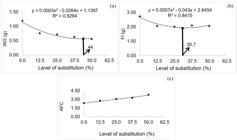
Means for final performance variables as a function of the level of substitution of fish meal by adult black soldier fly meal in experimental diets: (a) weight gain (WG); (b) feed intake (FI); (c) apparent feed conversion (AFC).
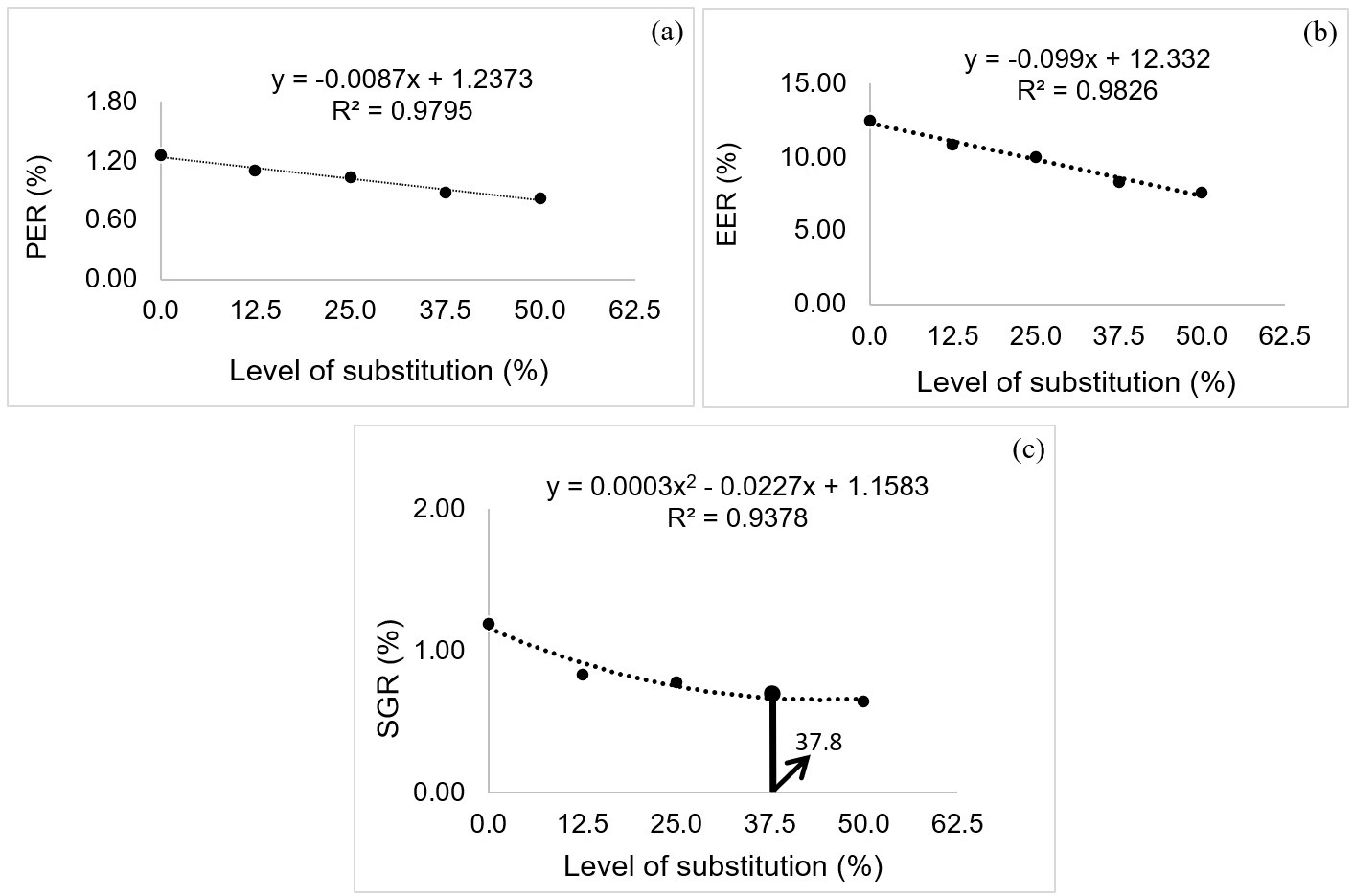
The Protein Efficiency Ratio (PER) (See Figure 2a) and the Energy Efficiency Ratio (EER) (See Figure 2b) did not show good efficiency for protein and energy, respectively. Consequently, the Specific Growth Rate (SGR) reached a minimum value of 37.8%. The SGR significantly differed between the levels of replacement of adult BSF meal at 12.5%, 25%, 37.5%, and 50% (See Figure 2c).

Means of final performance variables as a function of the level of replacement of fish meal by adult black soldier fly meal in experimental diets: (a) protein efficiency rate (PER); (b) energy efficiency rate (EER); (c) specific growth rate (SGR).
4. Discussion
Several internal and external factors may have influenced the results of weight, height, total length, standard length, and survival rate (see Table 2). These factors include the quality and nutritional composition of the protein ingredient used in the inclusion of BSF adult fly meal, which can directly impact the weight/length ratio and potentially decrease the survival rate, leading to mortality over time (Satake et al., 2009; Marchioro and Baldisserotto, 1999).
Regarding FI, feed utilization may be linked to digestibility and the presence of antinutritional factors in different types of meal, such as those arising from the fly production methodology or the amount of chitin present (Carneiro, 1990; Ribeiro et al., 2012). These factors can negatively affect fish performance, leading to slow growth, altered behavior, and reduced conversion efficiency (Ommani and Chizari, 2010). Despite this, it was expected that the fish would consume enough to yield good conversion results.
The level of WG observed in this study is consistent with values reported in other studies. For instance, replacing fishmeal with prepupa BSF meal resulted in good performance at substitution levels between 25% and 75% for the same fish species (Kamarudin et al., 2021). Additionally, similar results were observed for Nile tilapia Oreochromis niloticus (Linnaeus, 1758), with no negative effects on WG at dietary levels up to 50% (Muin et al., 2017).
The WG variable is influenced by the quality of the protein in the feed and the animal's ability to utilize that protein. Increasing protein levels does not necessarily guarantee positive performance results, as low-quality proteins may have low digestibility, preventing the animal from using it effectively (Smith, 1971; Feiden et al., 2009).
The reduction observed in the (AFC) in this study with the increased substitution by BSF dult fly meal contradicts the results obtained with BSF larval meal, which showed better AFC results (Limbu et al., 2022). The use of BSF adult fly meal did not perform well for AFC, which may be attributed to the higher chitin content at this stage, with both factors potentially affecting the nutritional value of the meal and its subsequent use in diets (Roubach et al., 2002; Reis and Dias, 2020).
The present results for SGR contrast with those obtained using larval BSF meal for trout, which showed no significant effect (Dumas et al., 2018). Similarly, no significant differences in SGR were observed when fishmeal was replaced with BSF meal in diets for suruvi Pseudoplatystoma corruscans (Spix and Agassiz, 1829) (Costa, 2023).
The nutritional value of the BSF adult fly meal, combined with the ingredients of the basal diet, may have increased the levels of gross energy (GE) and crude protein (CP) in the tested diets. This increase in both variables could have led to a reduction in feed intake (FI), which, in turn, caused a decrease in protein efficiency (PER) and energy efficiency (EER), ultimately resulting in a decline in specific growth rate (SGR) as the level of substitution with BSF adult fly meal increased.
The results of the present study indicate that it is not interesting to use meal made from adult black soldier flies, as its use as a substitute for the original protein source may be interfering with the performance of lambari-do-rabo-amarelo.
Acknowledgements
We would like to thank the Fundação de Apoio à Pesquisa do Espírito Santo (FAPES) for funding the research; and the Laboratório de Nutrição e Produção de Espécies Ornamentais (LNPEO) and the Instituto Federal do Espírito Santo (IFES), Campus Alegre, for providing the infrastructure.
References
- ARRU, B., FURESI, R., GASCO, L., MADAU, F.A. and PULINA, P., 2019. The introduction of insect meal into fish diet: the first economic analysis on european sea bass farming. Sustainability, vol. 11, no. 6, pp. 1697. .
- CARNEIRO, D.J., 1990. Efeito da temperatura na exigência de proteína e energia em dietas para alevinos de pacu, Piaractus mesopotamicus (Holmberg, 1887) São Carlos: Universidade Federal de São Carlos, 59 p. Tese de Doutorado em Ecologia e Recursos Naturais.
-
CORNÉLIO, J.P.S., 2022. O uso de ingredientes alternativos na ração para tambaqui (Colossoma macropomum): uma revisão. Research, Society and Development, vol. 11, no. 12, e291111234587. http://doi.org/10.33448/rsd-v11i12.34587
» http://doi.org/10.33448/rsd-v11i12.34587 - COSTA, W.B., 2023. Farinha de mosca-soldado-negra (Hermetia illucens) em dietas para juvenis de suruvi (Steindachneridion scriptum) Florianópolis: Universidade Federal de Santa Catarina, 54 p. Dissertação de Mestrado em Aquicultura.
- DEVIC, E., LESCHEN, W., MURRAY, F. and LITTLE, D.C., 2018. Growth performance, feed utilization and body composition of advanced nursing Nile tilapia (Oreochromis niloticus) fed diets containing Black Soldier Fly (Hermetia illucens) larvae meal. Aquaculture Nutrition, vol. 24, no. 1, pp. 416-423. .
- DUMAS, A., RAGGI, T., BARKHOUSE, J., LEWIS, E. and WELTZIEN, E., 2018. The oil fraction and partially defatted meal of black soldier fly larvae (Hermetia illucens) affect differently growth performance, feed efficiency, nutrient deposition, blood glucose and lipid digestibility of rainbow trout (Oncorhynchus mykiss). Aquaculture, vol. 492, pp. 24-34. .
- FEIDEN, F.A., SIGNOR, A.A., BOSCOLO, W.R., SIGNOR, A. and REIDEL, A., 2009. Exigência de proteína de alevinos de piavuçú. Ciência Rural, vol. 39, no. 3, pp. 859-865. .
-
FERNANDES, L.N., MELO, L.M. and LIMA, M., 2022. As implicações da senciência de peixes: qual é o impacto do bem-estar animal na piscicultura e na qualidade da carne? Revista Principia: Divulgação Científica e Tecnológica do IFPB, vol. 61, no. 1, pp. 108-125. http://doi.org/10.18265/1517-0306a2021id6723
» http://doi.org/10.18265/1517-0306a2021id6723 - FOWLES, T.M. and NANSEN, C., 2019. Artificial selection of insects to bioconvert preconsumer organic wastes. Agronomy for Sustainable Development, vol. 39, no. 3, pp. 31. .
- HARDY, R.W. and KAUSHIK, S.J., 2021. Fish nutrition 4th ed. London: Elsevier, 905 p.
-
INSTITUTO BRASILEIRO DE GEOGRAFIA E ESTATÍSTICA – IBGE, 2021 [viewed 14 november 2024]. PPM: Pesquisa Pecuária Municipal [online]. Available from: https://www.ibge.gov.br/estatisticas/economicas/agricultura-e-pecuaria/9107-producao-da-pecuaria-municipal.html
» https://www.ibge.gov.br/estatisticas/economicas/agricultura-e-pecuaria/9107-producao-da-pecuaria-municipal.html - KAMARUDIN, M.S., ROSLE, S. and MD Yasin, I.S.M., 2021. Performance of defatted black soldier fly pre-pupae meal as fishmeal replacement in the diet of lemon fin barb hybrid fingerlings. Aquaculture Reports, vol. 21, pp. 100775. .
- LIMBU, S.M., SHOKO, A.P., ULOTU, E., LUVANGA, S.A., MUNYI, F.M., JOHN, J.O. and OPIYO, M.A., 2022. Black soldier fly (Hermetia illucens, L.) larvae meal improves growth performance, feed efficiency and economic returns of Nile tilapia (Oreochromis niloticus, L.) fry. Aquaculture, Fish and Fisheries, vol. 2, no. 3, pp. 167-178. .
- LUTHADA-RASWISWI, R., MUKARATIRWA, S. and O’BRIEN, G., 2021. Animal protein sources as a substitute for fishmeal in aquaculture diets: a systematic review and meta-analysis. Applied Sciences, vol. 11, no. 9, pp. 3854. .
- MAKKAR, H.P., TRAN, G., HEUZÉ, V. and ANKERS, P., 2014. State-of-the-art on use of insects as animal feed. Animal Feed Science and Technology, vol. 197, pp. 1-33. .
-
MARCHIORO, M.I. and BALDISSEROTTO, B., 1999. Sobrevivência de alevinos de jundiá (Rhamdia quelen QUOY e GAIMARD, 1824) à variação de salinidade da água. Ciência Rural, vol. 29, no. 2, pp. 315-318. http://doi.org/10.1590/S0103-84781999000200021
» http://doi.org/10.1590/S0103-84781999000200021 - MUIN, H.H., TAUFEK, N.M., KAMARUDIN, M.S. and RAZAK, S.A., 2017. Growth performance, feed utilization and body composition of Nile tilapia, Oreochromis niloticus (Linnaeus, 1758) fed with different levels of black soldier fly, Hermetia illucens (Linnaeus, 1758) maggot meal diet. Iranian Journal of Fisheries Science, vol. 16, no. 2, pp. 567-577.
-
OLIVEIRA, K.J.P., VIANA, M.L., RODRIGUEIRO, M.M.S., MOLLO NETO, M., OLIVEIRA, K.S.M., MORAIS, F.J.O., FLORINDO, D.N.F., ALMEIDA, L.R., GABRIEL FILHO, L.R.A., BRAGA JUNIOR, S.S. and SANTOS, P.S.B., 2023. Utilização de resíduos na alimentação das larvas de Moscas Soldado Negro (Hermetia Illucens): revisão sistemática da literatura. RECIMA21-Revista Científica Multidisciplinar, vol. 4, no. 5, e442989. http://doi.org/10.47820/recima21.v4i5.2989
» http://doi.org/10.47820/recima21.v4i5.2989 -
OMMANI, A.R. and CHIZARI, M., 2010 [viewed 26 Octuber 2024]. Strategies for sustainable aquaculture: designing for the future [online]. Available from: https://www.researchgate.net/publication/228793212
» https://www.researchgate.net/publication/228793212 -
REIS, T.L. and DIAS, A.C.C., 2020. Farinha de insetos na alimentação de não ruminantes, uma alternativa alimentar. Veterinária e Zootecnia, vol. 27, pp. 1-17. http://doi.org/10.35172/rvz.2020.v27.428
» http://doi.org/10.35172/rvz.2020.v27.428 -
RIBEIRO, P.A.P., MELO, D.C., COSTA, L.S. and TEIXEIRA, E.A., 2012 [viewed 26 October 2024]. Manejo nutricional e alimentar de peixes de água doce [online]. Belo Horizonte: VetUFMG. Available from: https://vet.ufmg.br/ARQUIVOS/EDITORA/20131002140549.pdf
» https://vet.ufmg.br/ARQUIVOS/EDITORA/20131002140549.pdf - RODRIGUES, A.P.O., BERGAMIN, G.T. and SANTOS, V.R.V., 2013. Nutrição e alimentação de peixes. In: A.P.O. RODRIGUES, A.F. LIMA, A.L. ALVES, D.K. ROSA, L.S. TORATI and V.R.V. SANTOS, eds. Piscicultura de água doce: multiplicando conhecimentos. Brasília: EMBRAPA, pp. 171-213.
-
ROUBACH, R., GOMES, L.C., CHAGAS, E.C. and LOURENÇO, J.N.P., 2002 [viewed 26 October 2024]. Nutrição e manejo alimentar na piscicultura [online]. Brasília: EMBRAPA, pp. 9-15. Available from: https://www.infoteca.cnptia.embrapa.br/bitstream/doc/674011/1/Doc23.pdf
» https://www.infoteca.cnptia.embrapa.br/bitstream/doc/674011/1/Doc23.pdf -
SANTOS, R.P., FRANÇA, C.L., SOUSA, W.D.R., SILVA, J.M., PINHEIRO, T.F. and TEIXEIRA, E.G., 2022. Efeito da frequência alimentar sobre o crescimento do lambari, astyanax bimaculatus (Characiformes, Characidae). Research, Society and Development, vol. 11, no. 9, e42611925666. http://doi.org/10.33448/rsd-v11i9.25666
» http://doi.org/10.33448/rsd-v11i9.25666 -
SATAKE, F., ISHIKAWA, M.M., HISANO, H., PÁDUA, S.B. and TAVARES-DIAS, M., 2009 [viewed 26 October 2024]. Relação peso-comprimento, fator de condição para parâmetros hematológicos de dourado Salminus brasiliensis cultivado em condições experimentais [online]. Brasília: EMBRAPA, pp. 5-19. Available from: https://www.infoteca.cnptia.embrapa.br/bitstream/doc/574003/1/BP200951.pdf
» https://www.infoteca.cnptia.embrapa.br/bitstream/doc/574003/1/BP200951.pdf -
SMITH, R.R.A., 1971. A method for measuring digestibility and metabolizable energy of fish feeds. Progressive Fish-Culturist, vol. 33, no. 3, pp. 132-134. http://doi.org/10.1577/1548-8640(1971)33[132:AMFMDA]2.0.CO;2
» http://doi.org/10.1577/1548-8640(1971)33[132:AMFMDA]2.0.CO;2 -
TUNA, F., TAKATA, R., RODRIGUES, J., MORAES-E-SILVA, R., COUTINHO, C.E.R., MESQUITA, E.F.M. and CALIXTO, F.A.A., 2020 [viewed 26 October 2024]. Características morfométricas do lambari-do-rabo-amarelo Astyanax bimaculatus (Linnaeus, 1758) e rendimento do produto. In: Anais do Congresso Brasileiro de Ciência e Tecnologia de Alimentos [online], 2020, São Paulo. Florianópolis: CBCTA. Available from: https://proceedings.science/cbcta-2020/trabalhos/caracteristicas-morfometricas-do-lambari-do-rabo-amarelo-astyanax-bimaculatus-li?lang=pt-br
» https://proceedings.science/cbcta-2020/trabalhos/caracteristicas-morfometricas-do-lambari-do-rabo-amarelo-astyanax-bimaculatus-li?lang=pt-br