 Larvicidal and oviposition deterrent activities of Pongamia pinnata (L.) Pierre and Vitex trifolia (L.) leaves extracts against mosquito (Aedes aegypti Linnaeus 1762)
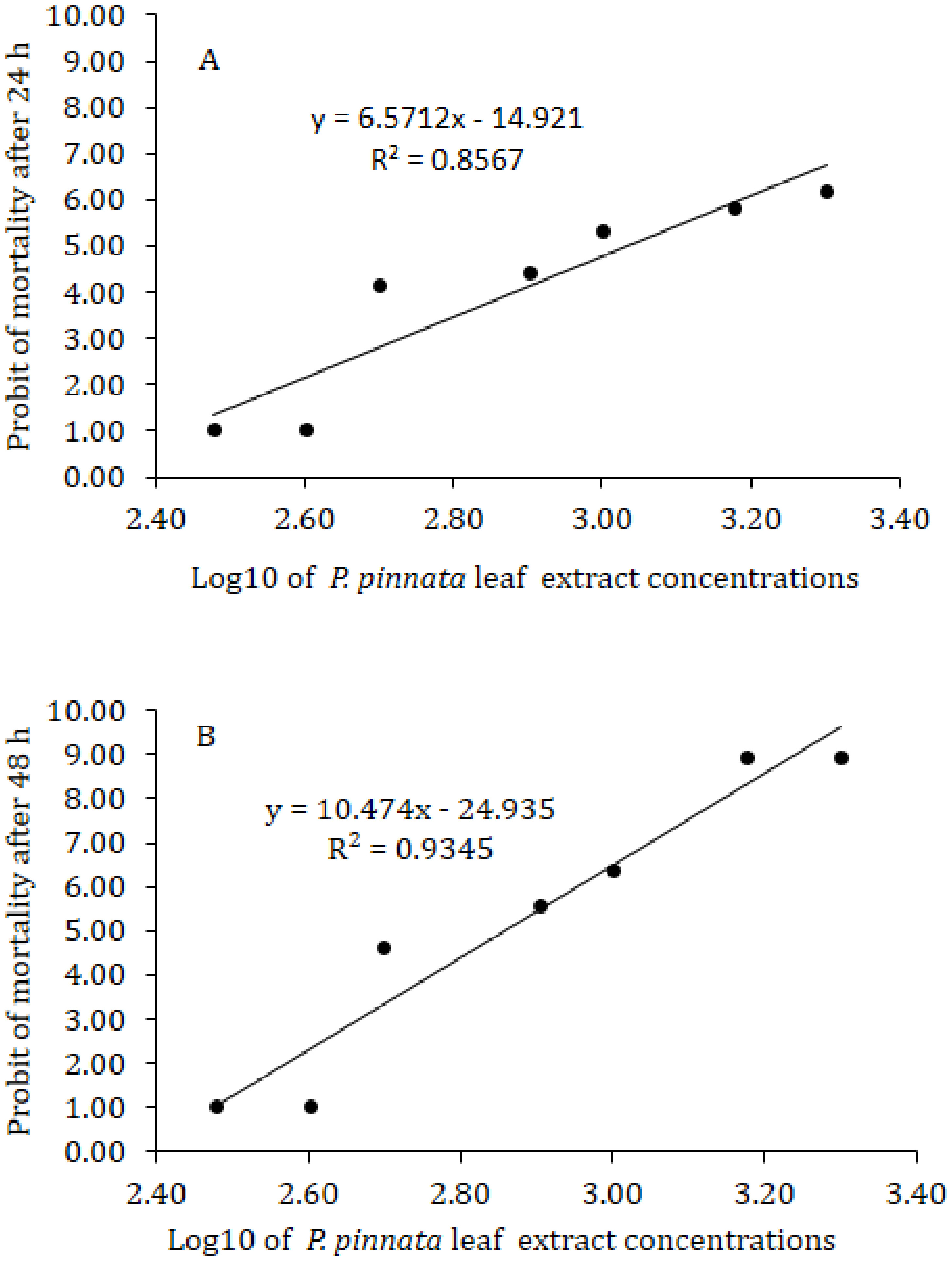
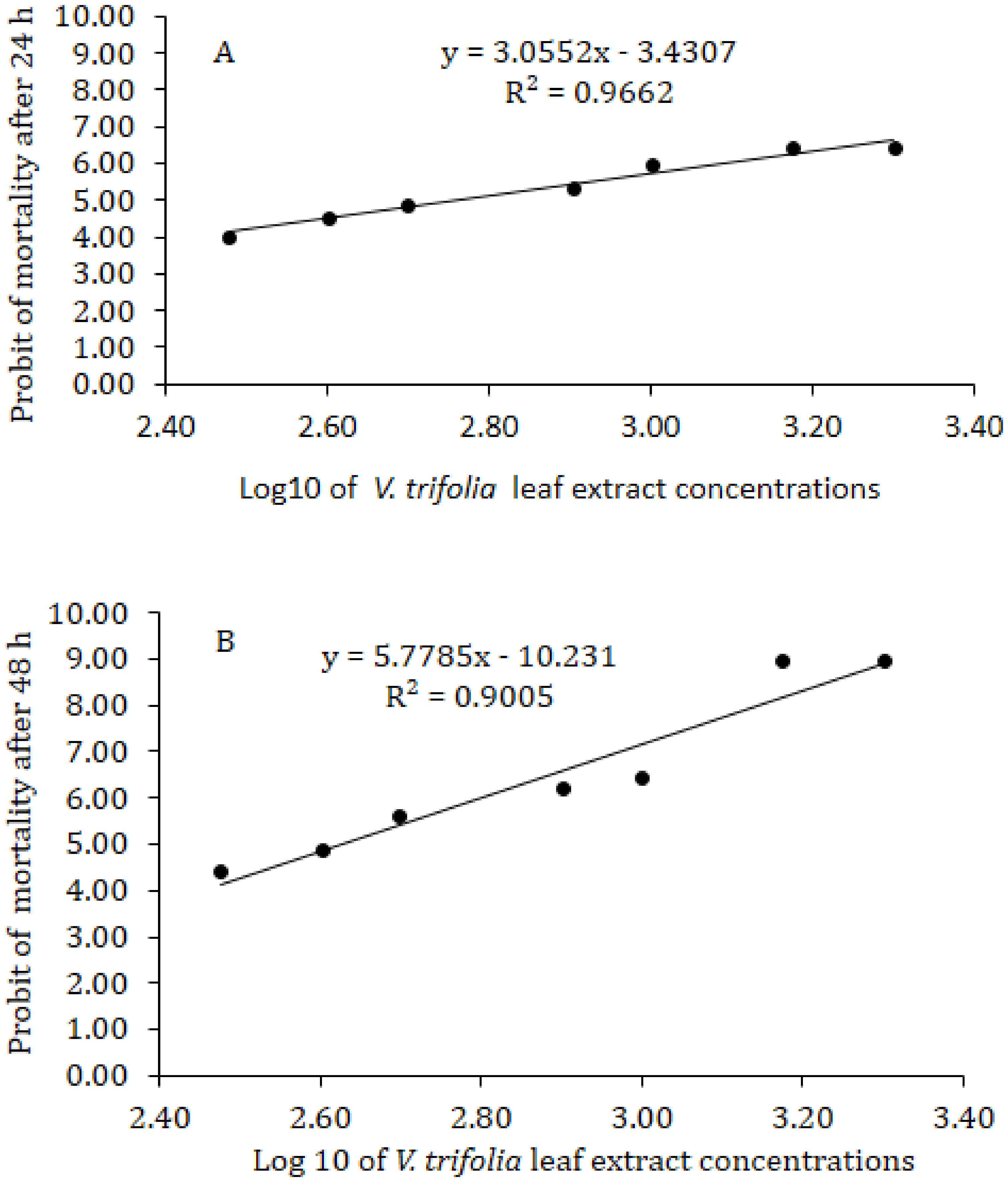
The Aedes aegypti mosquito is the main vector of several dangerous diseases, including dengue fever (DF), chikungunya, Japanese encephalitis, West Nile fever, and yellow fever. Pongamia pinnata and Vitex trifolia are two multipurpose plant species that can be used for mosquito control. The present research aims to analyze the larvicidal and oviposition deterrent activities of P. pinnata and V. trifolia leaf extracts against Ae. aegypti. Pongamia pinnata and V. trifolia leaves were extracted using methanol, and the extracts were screened for phytochemical compounds. The extracts were tested for larvicidal and oviposition deterrent activities against Ae. aegypti at concentrations of 300, 400, 500, 800, 1000, 1500, and 2000 ppm with triplicates. Positive control (0.02% temephos) and negative control (0.01% Tween-80 in 0.5% aqueous acetone) were included. For larvicidal activity, 25 third-instar larvae were exposed to each test solution, and mortality was recorded after 24 and 48 hours. Lethal concentration 50% and 90% (LC50 and LC90) were calculated using Probit analysis. For oviposition-deterrent activity, 25 gravid female mosquitoes were placed in test cages. Eight ovitraps were placed in each cage, one for P. pinnata and another for V. trifolia test solutions. The number of eggs was counted under a dissecting microscope at 3 and 6 days. Results showed that both P. pinnata and V. trifolia leaf extracts contained phenols, tannins, flavonoids, steroids, alkaloids, and saponins. Terpenoids were only found in V. trifolia leaf extract. Larval mortality increased with increasing extract concentration. The highest larval mortality of 88% and 92% was achieved with concentrations of 2000 ppm and 1500 ppm for P. pinnata and V. trifolia extracts, respectively. The LC50 and LC90 after 24 hours of P. pinnata leaf extract were 891.41 ppm and 1252.25 ppm respectively while for V. trifolia leaf extract were 648.67 ppm and 1627.19 ppm respectively. Oviposition deterrent activity of P. pinnata leaf extract ranged from 7.02% - 19.33% at 300 – 2000 ppm, whereas V. trifolia leaf extract was 91.16 - 95.81% at 1500 – 2000 ppm. In conclusion, both P. pinnata and V. trifolia methanol leaf extracts exhibited dose-dependent larvicidal activity. Pongamia pinnata leaf extract showed low oviposition deterrent activity, with a mean of 11.59% at 300 – 2000 ppm. Vitex trifolia leaf extract showed high oviposition deterrent activity of 91.16 - 95.81% at 1500–2000 ppm.
Keywords:
mortality; ovitrap; probit; repellency; vector
 Thumbnail
 Thumbnail