 Associations between dietary energy and protein levels and reproductive indices of Podocnemis expansa females in Amazonian farms: a long-term observational study
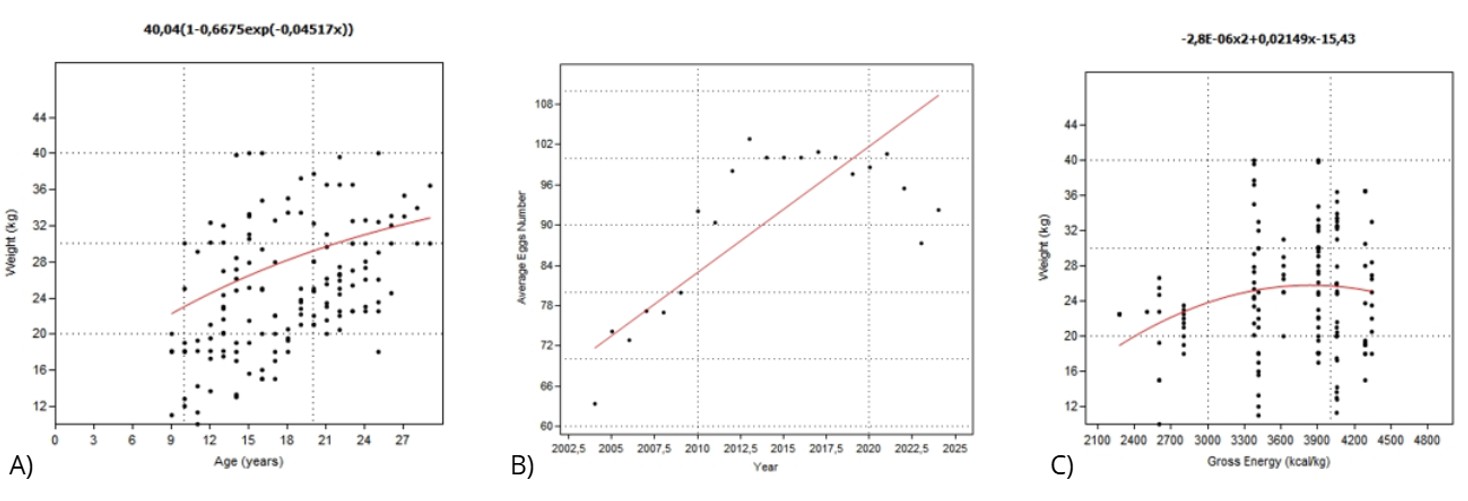
The present study evaluated the possible associations between gross energy (GE) and crude protein (CP) levels in the diet and the reproductive indices of Podocnemis expansa females maintained in captivity in the state of Amazonas, Brazil. Retrospective data from 2004 to 2024 were analyzed, originating from 20 licensed rural properties, totaling 131,127 breeding females observed throughout the period (1,902 to 7,429 per year; 374.65 ± 287.46 females/farm/year). The analyzed indicators included average female weight (24.4 ± 7.1 kg), number of nests (2,240 nests; mean = 14.4 nests/breeder/year), average number of eggs (92.9 ± 14.3 eggs/nest), hatchling production (139,427 hatchlings; equivalent to 3.5 ± 7.2 hatchlings per female), hatching rate (62.9 ± 26.9%), and hatchlings per nest (60.1 ± 26.8). Positive correlations were observed between female weight and the number of nests, eggs, and hatchlings. Diets with higher GE levels (3,000-3,900 kcal/kg) and CP levels (30-39%) were consistently associated with improved reproductive indicators, including body weight, number of nests, eggs, and hatchlings. However, given the observational nature of the dataset and the heterogeneity among farms, these findings should be interpreted as associations rather than causal effects.
Keywords:
Amazon; animal nutrition; conservation; chelonians; Podocnemis expansa
 Thumbnail