 Associations between dietary energy and protein levels and reproductive indices of Podocnemis expansa females in Amazonian farms: a long-term observational study
Abstract
The present study evaluated the possible associations between gross energy (GE) and crude protein (CP) levels in the diet and the reproductive indices of Podocnemis expansa females maintained in captivity in the state of Amazonas, Brazil. Retrospective data from 2004 to 2024 were analyzed, originating from 20 licensed rural properties, totaling 131,127 breeding females observed throughout the period (1,902 to 7,429 per year; 374.65 ± 287.46 females/farm/year). The analyzed indicators included average female weight (24.4 ± 7.1 kg), number of nests (2,240 nests; mean = 14.4 nests/breeder/year), average number of eggs (92.9 ± 14.3 eggs/nest), hatchling production (139,427 hatchlings; equivalent to 3.5 ± 7.2 hatchlings per female), hatching rate (62.9 ± 26.9%), and hatchlings per nest (60.1 ± 26.8). Positive correlations were observed between female weight and the number of nests, eggs, and hatchlings. Diets with higher GE levels (3,000-3,900 kcal/kg) and CP levels (30-39%) were consistently associated with improved reproductive indicators, including body weight, number of nests, eggs, and hatchlings. However, given the observational nature of the dataset and the heterogeneity among farms, these findings should be interpreted as associations rather than causal effects.
Keywords:
Amazon; animal nutrition; conservation; chelonians; Podocnemis expansa
Resumo
O presente estudo avaliou as possíveis associações entre os níveis de energia bruta (EB) e de proteína bruta (PB) na alimentação e os índices reprodutivos de matrizes de Podocnemis expansa mantidas em cativeiro no estado do Amazonas, Brasil. Foram analisados dados retrospectivos de 2004 a 2024, provenientes de 20 propriedades rurais licenciadas, em um total de 131.127 matrizes acompanhadas em todo período (1.902-7.429/ano; 374,65±287,46 fêmeas/fazenda/ano), abrangendo indicadores como peso médio das matrizes (24,4±7,1 kg), número de ninhos (2.240 ninhos ; média= 14,4 ninhos/criador/ano), média de ovos (92,9±14,3 ovos/ninho), produção de filhotes (139.427 filhotes; média=911,3±2.542,5 filhotes/criador/ano), taxa de eclosão (62,9±26,9%) e filhotes por ninho (60,1±26,8). Houve correlações positivas entre o peso e o número de ninhos, ovos e filhotes. Dietas com níveis mais elevados de energia bruta (3.000-3.900 kcal/kg) e proteína bruta (30-39%) foram consistentemente associadas a melhores indicadores reprodutivos, incluindo peso corporal, número de ninhos, ovos e filhotes. No entanto, dada a natureza observacional do conjunto de dados e a heterogeneidade entre as fazendas, esses achados devem ser interpretados como associações e não como relações causais.
Palavras-chave:
Amazônia; nutrição animal; conservação; quelônios; Podocnemis expansa
1. Introduction
The Amazon region has historically been a potential supplier of food and other extractive products, with its wildlife being highly valued in local cuisine. Together with fish, it represents an important source of animal protein in the region, which tends to generate intense anthropogenic pressure on local fauna (Campos-Silva et al., 2018). Amazonian chelonians are among the most exploited animals, and the Giant South American river turtle, Podocnemis expansa (Schweigger, 1812), has been the most sought after by hunters, riverside dwellers, and Indigenous peoples (Campos-Silva et al., 2018; Andrade et al., 2022). P. expansa occurs naturally, ranging from the eastern Andes to the Orinoco basin (Forero-Medina et al., 2021), and it is considered a delicacy in northern Brazil. Both the animal and its eggs are heavily predated during the nesting season, when they can be easily captured on nesting beaches. As the largest freshwater turtle in South America, the species can reach 75-109 cm in length and weigh about 60-90 kg (Alves-Júnior et al., 2012; Forero-Medina et al., 2021; Brito et al., 2025).
Among the main ex situ conservation measures is the promotion of commercial breeding in farms licensed by environmental agencies, discouraging poaching and illegal trade by providing a legal supply of turtles and their by-products (Andrade, 2008). The Amazon turtle (P. expansa) and the yellow-spotted river turtle (Podocnemis unifilis) show potential for productive exploitation, with good adaptability to captivity and high market value products (Andrade et al., 2021). The breeding of wild animals has aroused increasing interest among producers seeking alternative production systems (Dantas Filho et al., 2020). More than 90% of legally licensed wildlife farms in Amazonas are dedicated to P. expansa (Andrade, 2008; Andrade et al., 2021), which is also the most illegally traded wild animal in fairs, markets, and restaurants (Andrade et al., 2022). Currently, breeding is regulated by Normative Instruction No. 007/2015 (Brasil, 2015), although legal production remains insufficient to meet local demand (Brazil et al., 2025). The turtle farming emerges as a conservation strategy with the potential to reduce pressure on natural populations (Garcez et al., 2021).
According to Andrade et al. (2021), Amazonas has the highest number of registered chelonian farms in Brazil, with 29 currently licensed (having reached 85 by 2011), representing 80% of the national total. These farms house 150,762 animals, with an average production of 8,553 hatchlings per year. The species is the fifth most farmed aquatic organism in the state, behind Colossoma macropomum, Brycon amazonicus, Arapaima gigas, and Piaractus brachypomus, with approximately 3 tons/month of legally farmed turtles being sold in Manaus (12-21 tons/year; more than 3,000 animals/year) (Andrade et al., 2021). Although there is information on the nutritional requirements of hatchlings and juveniles of P. expansa and P. unifilis (Duncan and Marcon, 2009; Garcez et al., 2021), little is known about the nutritional needs of breeding females in captivity.
Adjustments in the gross energy (GE) and crude protein (CP) levels of diets may influence the reproductive indices of P. expansa females in captivity, as nutritional factors have already been identified as determinants of growth in different life stages of the species (Andrade, 2008; Castro et al., 2022). Investigating suitable nutritional alternatives can improve productive indices in breeding farms (Dantas Filho et al., 2020). Furthermore, optimizing the diet of breeding females can reduce production costs and increase the output of hatchlings destined for rearing and fattening, completing the production cycle in licensed farms (Duncan and Marcon, 2009; Andrade et al., 2021). Therefore, the objective of this study was to investigate associations between dietary GE and CP levels and the productive and reproductive performance of P. expansa females raised in captivity, using long-term observational data.
2. Material and Methods
The data used in this study were obtained from the analysis of records from chelonian breeding farms licensed by the Brazilian Institute of the Environment and Renewable Natural Resources (IBAMA) and from the database of the Wildlife Laboratory at the Federal University of Amazonas (UFAM), which monitored reproduction in commercial chelonian breeding farms between 2004 and 2024. These data were collected and organized from 20 rural properties located in the metropolitan region of Manaus (Manaus, Iranduba, Manacapuru, Rio Preto da Eva, Itacoatiara, and Presidente Figueiredo), in the state of Amazonas, Brazil. The P. expansa breeding stock evaluated at the breeders had similar origins and ages, stemming from offspring donated by IBAMA in 1995 and 1996, coming from the Purus River and the Branco River (a tributary of the Negro River), respectively. The area of the tanks or dams and the stocking density varied among the different farms evaluated.
The data were organized by farm and by year, allowing for time-series analyses and the assessment of variations among different production systems. For each property, information was collected on the following productive and reproductive indicators: total number of breeders and females, average female weight (kg), total number of nests per year and per female (percentage of adult females that nested), total number of hatchlings produced per year, and average number of hatchlings per nest and per female. The variables nests and hatchlings per female were adopted in order to standardize these indices as an indicator of productivity per matrices, since the total number of matrices varied between breeding farms. In parallel, the nutritional profile of the diets provided to the breeders was recorded, with emphasis on the mean levels of GE, expressed in kcal/kg, and CP, expressed as a percentage. To estimate the GE and CP values of each diet, the composition of the feeds (information from package labels) or of the ingredients provided (based on the nutritional tables of Rostagno et al., 2024) was verified.
This study was observational nature, based on information gathered from this time series of reproductive data. Its aim was to investigate long-term associations, rather than establish causal relationships, between the estimated nutritional values of the provided diet and the recorded reproductive indices. Initially, the data were tabulated and organized by aggregated property, year, and crude protein (CP) and gross energy (GE) levels. Then, descriptive analysis was performed to estimate the means, standard deviation, maximum, and minimum of the evaluated productive and reproductive variables. The normality and homoscedasticity of these variables were also verified (Shapiro-Wilk and Levene tests).
Due to the observational nature of the study, two statistical approaches were adopted: first, a correlational approach, which sought to evaluate the possible relationships between the estimated values of the feed provided and the variables. Second, because this was not a controlled experimental trial, but rather the analysis of a historical series of field data, with the possible influence of non-homogeneous or unmeasured environmental variables (beaches, management, density, precipitation), mixed models were chosen. ANOVA with repeated measures data over time was used when the assumptions of normality and independence were met, or GLMM (Generalized Linear Mixed Models) or GAMM (Generalized Additive Mixed Models) with random effects for farm and year, in the case of non-normal distributions (Poisson, Binomial).
Pearson correlation analyses (normal variables) and Spearman correlation analyses (non-parametric variables) were performed between the estimated levels of PB and EB and the productive and reproductive variables. When a significant relationship was identified (p < 0.05; moderate: 0.3 ≤ |r| < 0.7; strong: |r| ≥ 0.70), regression analysis (linear, polynomial, or nonlinear) was conducted. Multivariate principal component analyses (PCA and graphical biplot scatter) were also performed. Subsequently, the analysis was performed using GLMM (Generalized Linear Mixed Models) or GAMM (Generalized Additive Mixed Models) with random effects for farm and year, which also allowed for the evaluation of non-normal distributions and the modeling of clustered data structures (repeated measures of production per farm over the years). Random effects (1|Farm) + (1|Year) were used, allowing the model to estimate the overall variation between farms and years, adjusting for measures that are not independent (temporal heterogeneity). For counts (nests, hatchlings), NB/Poisson was used (with overdispersion and/or zero-inflation checking), and for hatching rate, a binomial model with numerator/denominator (Hatchlings vs Eggs) was used.
Finally, to evaluate the effects of CP and GE, farms were grouped into CP ranges (25-29%; 30-39%; 40-45%) and GE ranges (2,250-2,900; 3,000-3,900; 4,000-4,500 kcal/kg), and comparisons among groups were performed using repeated measures ANOVA (split-plot) with Tukey’s test (5%) for parametric data, and the Kruskal-Wallis test when assumptions were not met. Analyses were conducted in R (v4.1.3), PAST, and Minitab. Although covariates such as female age, stocking density, and environmental variation (e.g., rainfall) were conceptually relevant, they could not be consistently incorporated due to limitations of the historical dataset; thus, models accounted primarily for farm and year, and results should be interpreted with caution regarding unmeasured environmental and management effects.
3. Results
Initially, 87 IBAMA-registered chelonian farms were identified; 58 (66.7%) received stock, 40 were analyzed (29 active), and only 20 (50%) reached the reproductive stage. First nests appeared in 2003-2004, mostly from 9-10-year-old females. Most farms were in Greater Manaus (Manaus 55%, Manacapuru 20%, Iranduba 10%, Rio Preto da Eva 5%, Itacoatiara 5%). The tanks averaged 1.9±3.6 hectares (0.02-12 ha), and the stocking densities were 0.09±0.11 animals/m2 (0.002-0.4 animal/m2). Diet profiles varied across 20 farms (Table 1): GE ranged 2,275-4,337 kcal/kg and CP 25-45%. Higher GE (>4,000) typically coincided with higher CP (≥39%) (Spearman rs = 0.52; p < 0.00001). All used extruded fish feed (28-40% CP); 55% also used by-products (fish trimmings, poultry viscera, fruits/vegetables). Diets with animal by-products were associated with the highest protein/energy.
Gross energy and crude protein levels of the diets provided for Podocnemis expansa breeders managed in free-range environments on farms in Amazonas, Brazil.
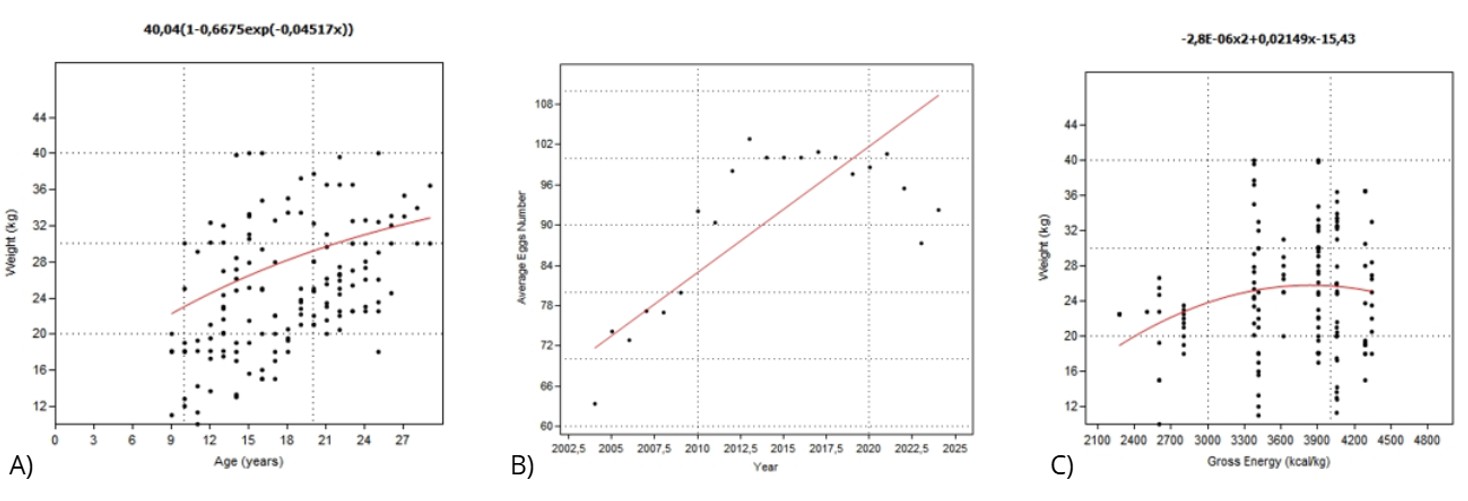
From 2004 to 2024, 131,127 breeding females were recorded throughout the period (1,902 to 7,429 per year; average: 374.65 ± 287.46 per farm) (Table 2). Mean body weight was 24.4 ± 7.1 kg, increasing significantly over time (16.5 → 25.9 → 36.4 kg; p < 0.001), consistent with age-related growth (Figure 1A). Weights ranged from 10.05 kg (9-10 years) to 69 kg (~42 years). A total of 2,240 nests were recorded, fluctuating from 9 in the beginning (2004: 2.2 ± 1.4 nests/farm/year) until 328 (2014: 41 ± 98.4). Mean nests/farm/year did not differ by year (14.4) but fell in very rainy years (e.g., 2022: 6.0 ± 5.6). Eggs averaged 92.9 ± 14.3 per nest (50-119) and increased across years (63.3 → 114.2; Kruskal-Wallis p < 0.00001; R2 = 0.92; Figure 1B).
Average and total productive and reproductive indices of Podocnemis expansa matrices managed in captivity environments on each farm in each year (reproductive cycle) in Amazonas, Brazil.

A: Von Bertalanffy nonlinear model - age x weight growth curve of P. expansa females in captivity, Amazonas, Brazil; B: Linear regression between year of production and average number of eggs in P. expansa nests in captivity, Amazonas, Brazil; C: Polynomial regression between gross energy levels and weight of P. expansa females in captivity, Amazonas, Brazil.
Hatchling output totaled 139,427 (911.3 ± 2,542.5/farm/year), lower in early (2004: 526; 131.5 ± 82.9) and very rainy years (2022: 249; 124.5 ± 4.9; hatching 36.3 ± 34.1%), contrasting with peaks in 2014 (25,035) and 2015 (20,911). The mean annual hatching rate was 62.9 ± 26.9%. Age wasn’t correlated with nests (p = 0.94), hatchlings (p = 0.97), or hatching rate (p = 0.89). Hatchlings per nest averaged 60.1 ± 26.8 (max 103.3), with tendency to better years in 2010 and 2017 and the lowest in 2022; but the differences were not significant (p = 0.862). On average, only 4.7 ± 4.3% of females nested annually (range 0.2-80%), and hatchlings/female averaged 3.5 ± 7.2 (max 72.3), being relatively stable, although there have been years with an average of more than 10 hatchlings/matrice/farm (12.8±6.1).
Coefficients of Pearson correlations showed some significant relations between matrices ↔ eggs (r = 0.92), nests ↔ eggs (r = 0.99), and nests ↔ hatchlings (r = 0.96). Female weight correlated moderately with age (r = 0.46), nests (r = 0.31), eggs (r = 0.32), and hatchlings (r = 0.32). The hatching rate was moderately correlated with the number of hatchlings (Spearman: p<0.005; r=0.35). PCA highlighted the relations between age (13.99%), weight (12.95%), and nests (12.35%); biplot indicated moderate positive links of age/weight with nests/eggs/hatchlings and a strong link between hatching rate and hatchlings per nest, but with protein/energy relationships were weak.
Linear regression models (p<0.0001; R2 = 21%) and non-linear regression models (Von Bertalanffy curve; p<0,01; Akaike index=6818) were estimated for the age x weight relationship (Figure 1A). In multiple regression, higher GE was associated with heavier females (p < 0.02), but the polynomial fit was weak (R2 = 0.05%). No regressions with GE/CP for nests, hatchlings, hatching, nests/female, or hatchlings per female/nest, though trends suggested more nests/female with higher GE (p < 0.08) and more hatchlings/female with higher CP (p < 0.07). The low explanatory power observed in several regression models (e.g., R2 values close to zero for GE effects) reinforces that dietary variables alone are insufficient to explain reproductive variability in this system. This suggests that other unmeasured factors, particularly environmental and management-related variables, likely play a dominant role in shaping reproductive performance.
In the analysis of the data using alternative GLMM (Generalized Linear Mixed Models) or GAMM (Generalized Additive Mixed Models) models with random effects for farm and year, appropriate for count variables, including Poisson and Negative Binomial regressions with a quadratic term, the results obtained demonstrated that the direction of the effects, their magnitude, and the biological interpretation remained essentially unchanged compared to the correlational and regression models used previously. Consistently, the effect sizes were small, and the explanatory power of the models remained low in all specifications tested. As methodological limitations, it was observed that the database used for the nutritional analyses does not contain hierarchical identifiers (such as farm or year at the individual observation level) that allow for the appropriate specification of mixed models with random effects. Although GLMM and GAMM approaches were explored to account for clustering by farm and year, limitations in the dataset structure (lack of fully hierarchical identifiers) restricted their full implementation. Therefore, these models were used primarily as robustness checks, and results should be interpreted cautiously.
Grouped analyses (Table 3) for repeated measures ANOVA showed: higher CP tended to be associated with increased body weight (40-45% CP: 26.7 ± 6.9 kg) and more nests (30-39% CP: 24.9 ± 59.3) and eggs (2,342 ± 5,723), and significantly more hatchlings (1,793 ± 4,576; p < 0.03). Although the highest hatching rate (70.1 ± 23.6%; p < 0.01) and hatchlings/nest (66.6 ± 24.1) were correlated at 25-29% CP. For GE, 3,000-3,900 kcal/kg was associated with heavier females (26.3 ± 6.9; p < 0.01; Figure 1C), more nests/female (7.8 ± 11.5; p < 0.006), and hatchlings/female (5.5 ± 9.7; p < 0.003), whereas the best hatching rates were linked at 2,250-2,900 kcal/kg (hatching 68.9 ± 18.2%; hatchlings/nest 67.9 ± 21.5; both p < 0.001). Together, CP and GE were associated with performance, notably via body weight and hatchling output.
Effect of dietary crude protein (CP) and gross energy (GE) levels on the productive and reproductive indices of Podocnemis expansa matrices managed in captivity at the Amazonas, Brazil.
4. Discussion
In wild populations of P. expansa in Brazil, clutch sizes range from 94.42 to 106.7 eggs/nest, with hatching rates of 66-94.63% and 70.4-88.98 live hatchlings (Alves-Júnior et al., 2012), whereas lower values were observed in captivity in the present study (92.9±14.3 eggs/nest; 62.9±26.9%; 60.1±26.8 hatchlings/nest), likely due to smaller and younger breeders and suboptimal artificial beach conditions (e.g., wetter substrate, inadequate granulometry, higher organic matter) as reported by Catique (2011) and Andrade et al. (2021). Hatching success is influenced by sediment characteristics, incubation duration, and nesting period (Ferreira Júnior & Castro, 2010), and may be further reduced by nest translocation practices common in captivity (44.7-71.7%; Andrade, 2008; 2015), also observed in natural conditions (Gomes and Ferreira Júnior, 2011). However, as this study is observational and based on heterogeneous farm conditions, factors such as management, environment, stocking density, and breeder age were not controlled, so associations between diet and reproductive indices should not be interpreted as causal.
Overall, evaluating the associations of GE and CP on the productive and reproductive indices of P. expansa females indicated that, from a nutritional standpoint, GE levels in the 3,000-3,900 kcal/kg range and CP levels between 30-39% were correlated with the best outcomes, higher female body weight, more nests, greater hatchling production, and more hatchlings per female. Higher protein levels were more directly associated with heavier animals and increased production of nests and hatchlings, whereas intermediate energy levels were likewise linked to heavier females. However, better reproductive success per nest (hatching rate and hatchlings per nest) was associated with more restrictive diets featuring lower protein and energy values, indicating that, beyond nutrition, other environmental or management factors can strongly influence reproductive indices in captivity.
Previous studies, primarily with P. expansa hatchlings and juveniles in captivity, also reported positive relationships between higher protein and energy levels and animal performance, as observed here. Sá et al. (2004) found that first-year P. expansa hatchlings fed diets (50% animal protein and 50% vegetable protein) with higher CP (>27%) achieved superior growth and weight gain. Andrade (2008), across several experiments, concluded that turtle hatchlings and juveniles require diets with high protein (36-42% CP) and energy (3,500-4,500 kcal/kg). Likewise, Castro et al. (2022) reported that when P. expansa hatchlings were fed different protein levels (5.8% to 40.1% CP), the largest and heaviest animals received the highest protein levels (35-40%), indicating that captive turtles are highly demanding in terms of protein and energy during hatchling and juvenile phases. Andrade et al. (2021) and Garcez et al. (2021) further observed that, in commercial P. expansa operations in the Amazon, animals grew faster and reached higher body weights when fed animal-origin by-products and diets with high protein (40-45% CP) and energy (4,000-4,500 kcal/kg GE).
According to Luz et al. (2003), who worked with chelonian breeders in Goiás, Rondônia, Pará, and Acre, fish feeds containing 28-30% protein are the diets most commonly used; the author emphasizes that inadequate captive management can delay growth and/or cause developmental problems, including severe and irreversible physical deformities. Garcez et al. (2021) also observed that both subadult turtles (7-9 years) and adults from breeding stocks (10-12 years and >12 years) raised in captivity in Amazonas showed higher average body weights when fed higher-protein diets with animal-origin protein (17.4 kg and 18.6-36 kg) than when fed lower-protein diets based on plant protein (5.5 kg and 17.3-19 kg).
Araújo et al. (2013), studying the mud turtle (Kinosternon scorpioides), demonstrated that nutritional levels directly influence reproductive performance in captivity, with animals fed moist diets containing animal protein showing superior results, higher laying frequency, and thicker eggshells than those fed only vegetable protein. Similarly, the present study found significant yet moderate correlations between female body weight and reproductive variables such as the number of nests (r = 0.31), eggs (r = 0.32), and hatchlings (r = 0.32), as well as a strong association between age and mean eggs per nest (p < 0.00001; R2 = 0.92; Figure 1B), indicating that older and heavier females are more fecund. This pattern is consistent with findings in wild P. expansa (Portelinha et al., 2013), P. sextuberculata (Haller & Rodrigues, 2006), and has also been observed in captive P. expansa (Lopes, 2021), where larger females produced more numerous, heavier eggs and larger hatchlings with higher survival rates.
Other factors, such as population density, nutritional status, age, and climatic variables, should be considered in reptile studies. Catique (2011) and Andrade et al. (2021) found strong relationships between nesting-beach characteristics (height, width, slope, sand color, grain size, and moisture) and the number of nests, hatchlings, and the hatching rate of P. expansa in captivity and in the wild. In the present study, we found evidence that increases in body weight and age are associated with more eggs per nest. This supports the view that reproductive success depends not only on the accumulation of body reserves but also on the qualitative adequacy of the diet. Portelinha et al. (2013) suggested that as adult P. expansa females increase in size, they also store more absolute energy for reproduction. Moreover, our data indicate that larger females invest not only in producing more eggs but also in producing heavier eggs and hatchlings with higher survival rates, as described by Gomes and Ferreira Júnior (2011). However, we found no relationship between body size and relative clutch mass.
The strong association between the number of nests and the number of hatchlings indicates that oviposition is the main determinant of productivity, suggesting that management strategies promoting egg laying could enhance hatchling production. Unlike typical livestock that show a production peak followed by a decline, turtles increase egg number, egg mass, and hatching success with age and growth. Lopes (2021) found that larger P. expansa females in captivity produced more and heavier eggs, larger hatchlings, and higher hatching rates, with significant relationships between body length (P = 0.019; R2 = 35.63%) and weight (P = 0.009; R2 = 42.15%). Similarly, Portelinha et al. (2013) reported significant correlations between body size, weight, and clutch size, reinforcing that larger females contribute more effectively to reproductive output.
Production fluctuations over the years, with more marked declines in 2012, 2021, and 2022, suggest that factors beyond nutrition (e.g., nesting-beach variation, climate, and management) also influenced performance. Even so, grouping farms by CP and GE ranges showed that diet was associated with effects on productive and reproductive indices, enabling the identification of nutritional ranges associated with relatively higher reproductive performance under the observed field conditions. These results have practical implications for Amazonian breeding farms: standardizing diets within the identified ranges can reduce interannual variability, increase production predictability, and simultaneously support both economic sustainability and species conservation through chelonian farming (cheloniculture).
GE levels in the 3,000-3,900 kcal/kg range and CP levels of 40-45% were correlated with heavier females, while intermediate CP (30-39%) was more directly associated with greater production of nests, eggs, and hatchlings. Intermediate GE (3,000-3,900 kcal/kg) was linked to higher productivity in nests and hatchlings per female. By contrast, the best hatching rates and hatchlings per nest were associated with diets with lower protein (25-29% CP) and lower energy (2,250-2,900 kcal/kg), suggesting that a more nutritionally restrictive diet may yield higher reproductive efficiency.
This apparent paradox may be explained by physiological and behavioral adjustments during the P. expansa reproductive cycle. The synchrony between reproductive activity and river dynamics, with alternating hydrological regimes, floods, and recessions, is recognized by native Amazonian peoples and has been systematized by scientists (Ferreira Júnior & Castro, 2010; Freneau et al., 2017). During the flood season, Amazonian turtles remain in lakes, accumulating energy and protein reserves used for egg production. Years with larger floods tend to increase the duration and area of flooded forest, allowing females to feed more and produce more eggs, raising the number of nests in the following cycle by up to 32-41%, whereas very rainy summers reduce hatching rates (Andrade et al., 2022). At the start of the recession, turtles migrate to the main river channel and then to nesting sites, where they remain until they climb the beaches to lay (Freneau et al., 2017). In this final pre-laying phase, they feed very little or not at all, undergoing a period of dietary restriction (Garcez et al., 2020).
Garcez et al. (2021) and Lopes et al. (2022) documented similar phases of the P. expansa reproductive cycle in captivity, apparently synchronized with rainfall, solar radiation, and temperature. Vitellogenesis occurred during the rainy season (March-May), mating in May-July, and during the dry season basking, in August and laying from late August to October. In assessing reproductive hormones in captive P. expansa, Lopes (2021) observed estradiol peaks during vitellogenesis in both females and males. Biochemical parameters, like cholesterol and triglyceride levels, also vary in females. The basking phase (August) also showed a decline in blood glucose, indicating fasting in the final stages of the cycle up to laying, as seen in nature.
These physiological and hormonal changes across the reproductive cycle likely explain variation in CP and GE requirements. Higher protein and energy are needed during the rainy period to support body mass gain and vitellogenesis, whereas lower CP and GE, or temporary feed restriction, during laying may improve hatching rates and hatchlings per nest, supporting a two-diet strategy for breeders. However, enhanced hatching success may also be more closely related to favorable nesting beach characteristics (higher elevation, medium-texture sand, low moisture), as reported by Catique (2011) and Andrade et al. (2021). Although environmental variables were not assessed, lower dietary energy levels coincided with farms with higher beaches and better hatching rates (p < 0.003; r = −0.38). Thus, the present study should be interpreted as a hypothesis-generating investigation, providing empirical evidence from long-term field data that can guide future controlled experimental studies specifically designed to test these hypotheses.
5. Conclusion
This study demonstrates that dietary GE and CP levels are associated with variation in reproductive performance of P. expansa females in captivity. Diets within intermediate ranges (GE: 3,000-3,900 kcal/kg; CP: 30-39%) were consistently linked to relatively higher body weight and reproductive output under field conditions. However, due to the observational nature of the dataset and the presence of multiple uncontrolled environmental and management factors, these associations should not be interpreted as causal. Instead, these findings provide a basis for hypothesis generation and highlight the need for controlled experimental studies to validate nutritional requirements for females.
Data Availability Statement
The data are available upon request from the corresponding author of this article.
References
-
ALVES-JÚNIOR, J.R.F., LUSTOSA, A.P.G., BOSSO, A.C.S., BALESTRA, R.A.M., BASTOS, L.F., MIRANDA, L.B. and SANTOS, A.L.Q., 2012. Reproductive indices in natural nests of giant Amazon river turtles Podocnemis expansa (Schweigger, 1812) (Testudines, Podocnemididae) in the Environmental Protection Area Meanders of the Araguaia river. Brazilian Journal of Biology = Revista Brasileira de Biologia, vol. 72, no. 1, pp. 199-203. https://doi.org/10.1590/S1519-69842012000100024 PMid:22437402.
» https://doi.org/10.1590/S1519-69842012000100024 - ANDRADE, P.C.M., 2008. Criação e manejo de quelônios no Amazonas: projeto diagnóstico da criação de quelônios no Estado do Amazonas Manaus: IBAMA/Pró-várzea/Aquabio, 528 p.
- ANDRADE, P.C.M., 2015. Manejo comunitário de quelônios: Projeto Pé-de-Pincha Manaus: Editora e Gráfica Moderna, 325 p.
- ANDRADE, P.C.M., GARCEZ, J.R., LIMA, A.C., DUARTE, J.A.M., ANÍZIO, T.L.F., RODRIGUES, W.S., OLIVEIRA, A.B. and ALVES, H.R.B., 2021. Panorama da Quelonicultura no Brasil - uma estratégia para conservação das espécies e geração de renda. Aquaculture Brasil, no. 1, pp. 32-40.
-
ANDRADE, P.C.M., OLIVEIRA, P.H.G., LIMA, A.C., DUARTE, J.A.M., AZEVEDO, S.H.S., OLIVEIRA, A.B., ALMEIDA, C.D., SILVA, E.B., GARCEZ, J.R., PINTO, J.R.S., SILVA, L.C.N., MONTEIRO, M.S., RODRIGUES, W.S., ANÍZIO, T.L.F., PONTES, A.L.B., TEIXEIRA, R.L., SILVA, J.M., DUNCAN, W.L.P. and VOGT, R.C., 2022. Community-based conservation and management of chelonians in the Amazon. Frontiers in Ecology and Evolution, vol. 10, pp. 1-24. https://doi.org/10.3389/fevo.2022.769328
» https://doi.org/10.3389/fevo.2022.769328 -
ARAÚJO, J.C., ROSA, P.V., PALHA, M.D.C., RODRIGUES, P.B., FREITAS, R.T.F. and SILVA, A.S.L., 2013. Effect of three feeding management systems on some reproductive parameters of Scorpion mud turtles (Kinosternon scorpioides) in Brazil. Tropical Animal Health and Production, vol. 45, no. 3, pp. 729-735. https://doi.org/10.1007/s11250-012-0281-3 PMid:23054808.
» https://doi.org/10.1007/s11250-012-0281-3 - BRASIL. Instituto Brasileiro do Meio Ambiente e dos Recursos Naturais Renováveis - IBAMA, 2015. Instrução Normativa nº 07, de 30 de abril de 2015. Institui e normatiza as categorias de uso e manejo da fauna silvestre em cativeiro, e define, no âmbito do IBAMA, os procedimentos autorizativos para as categorias estabelecidas. Diário Oficial da República Federativa do Brasil, Brasília, DF, 6 maio. Seção 1, p. 55-59.
-
BRAZIL, M.V.S., CHAVES, W.A., VIDAL, M.D., TAVARES, A.S. and WILCOVE, D.S., 2025. The potential and limitations of turtle farming to contribute to conservation in the Brazilian Amazon. Biological Conservation, vol. 304, pp. 111055. https://doi.org/10.1016/j.biocon.2025.111055
» https://doi.org/10.1016/j.biocon.2025.111055 - BRITO, E.S., VALADÃO, R.M., MALVÁSIO, A., FREITAS, A.F.F., MUNIZ, F.L., MOLINA, F.B., SOUZA, F.L., MOURA, G.J.B., COSTA, H.C., BASSETTI, L.A.B., FRIOL, N.R., BRESSAN, R.F., ROCHA, S.B., GOMIDES, S.C., MARQUES, T.S. and PORTELINHA, T.C.G., 2025. Quelônios Continentais e Crocodilianos do Brasil Recife: Agência Estadual de Meio Ambiente do Estado de PE, 346 p.
-
CAMPOS-SILVA, J.V., HAWES, J.E., ANDRADE, P.C.M. and PERES, C.A., 2018. Unintended multispecies co-benefits of an Amazonian community-based conservation programme. Nature Sustainability, vol. 1, no. 11, pp. 650-656. https://doi.org/10.1038/s41893-018-0170-5
» https://doi.org/10.1038/s41893-018-0170-5 -
CASTRO, I.C., ANDRADE, P.C.M., MONTEIRO, M.S., DUARTE, J.A.M. and MEDEIROS, P.A., 2022. Use of by-products and waste in the manufacture of artisanal feed for hatchlings of giant South American turtle (Podocnemis expansa) and yellow-spotted river turtle (Podocnemis unifilis) and in Jurua community breeding systems. Rev. Agroecossistemas, vol. 14, no. 2, pp. 22-44. https://doi.org/10.18542/ragros.v14i2.11604
» https://doi.org/10.18542/ragros.v14i2.11604 - CATIQUE, T.S., 2011. Caracterização e influência do substrato de áreas naturais e artificiais de reprodução da tartaruga da amazônia Podocnemis expansa e tracajá Podocnemis unifilis na Amazônia Manaus: Universidade Federal do Amazonas, 51 p. Monografia (Agronomia).
-
DANTAS FILHO, J.V., PONTUSCHKA, R.B., FRANCK, K.M., GASPAROTTO, P.H.G. and CAVALI, J. 2020. Cultivo de quelônios promove conservação e o desenvolvimento social e econômico da Amazônia. Revista Ciência e Saúde Animal, vol. 2, supl. abril, pp. 9-31. https://doi.org/10.6084/m9.figshare
» https://doi.org/10.6084/m9.figshare -
DUNCAN, W. and MARCON, J., 2009. Enzymes of energy metabolism in hatchlings of amazonian freshwater turtles (Testudines, Podocnemididae). Brazilian Journal of Biology = Revista Brasileira de Biologia, vol. 69, no. 2, pp. 319-325. https://doi.org/10.1590/S1519-69842009000200012 PMid:19675933.
» https://doi.org/10.1590/S1519-69842009000200012 -
FERREIRA JÚNIOR, P.D. and CASTRO, P.T.A., 2010. Nesting ecology of Podocnemis expansa (Schweigger, 1812) and Podocnemis unifilis (Troschel, 1848) (Testudines, Podocnemididae) in the Javaés River, Brazil. Brazilian Journal of Biology = Revista Brasileira de Biologia, vol. 70, no. 1, pp. 85-94. https://doi.org/10.1590/S1519-69842010000100012 PMid:20231963.
» https://doi.org/10.1590/S1519-69842010000100012 -
FORERO-MEDINA, G., FERRARA, C.R., VOGT, R.C., FAGUNDES, C.K., BALESTRA, R.A.M., ANDRADE, P.C.M., LACAVA, R., BERNHARD, R., LIPMAN, A.J., LENZ, A.J., FERRER, A., CALLE, A., APONTE, A.F., CALLE-RENDÓN, B.R., CAMILO, C.S., PERRONE, E., MIRAÑA, E., CUNHA, F.A.G., LOJA, E., DEL RIO, J., FERNANDEZ, J.L.V., HERMÁNDEZ, O.E., DEL AGUILA, R., PINO, R., CUEVA, R., MARTINEZ, S., BERNARDES, V.C.D., SAINZ, L. and HORNE, B.D., 2021. On the future of the giant South American river turtle Podocnemis expansa. Oryx, vol. 55, no. 1, pp. 73-80. https://doi.org/10.1017/S0030605318001370
» https://doi.org/10.1017/S0030605318001370 -
FRENEAU, G.E., SÁ, V.A., FRANCI, C.R., VIEIRA, D. and FRENEAU, B.N., 2017. Gonadotrophic, prolactin, corticosterone, and gonadal hormones levels over 15 months in Giant Amazon River Turtles - Podocnemis expansa (Schweigger, 1812) (Testudines: Podocnemididae), in captive conditions. Brazilian Journal of Biology = Revista Brasileira de Biologia, vol. 77, no. 2, pp. 347-355. https://doi.org/10.1590/1519-6984.04515 PMid:28492802.
» https://doi.org/10.1590/1519-6984.04515 - GARCEZ, J.R., ANDRADE, P.C.M. and SOARES, M.G.M., 2020. Composição da dieta de três espécies de quelônios (Podocnemis spp.) no rio Juruá, Amazonas. Igapó - Revista de Educação, Ciência e Tecnologia do IFAM, vol. 14, pp. 60-72.
-
GARCEZ, J.R., OLIVEIRA, A.B., ANDRADE, P.C.M. and DUARTE, J.A.M., 2021. Criação comercial e comunitária de quelônios no estado do Amazonas. In: B.O. MATTOS, J. PANTOJA-LIMA, A.T. OLIVEIRA and P.H.R. ARIDE, orgs. Aquicultura na Amazônia: estudos técnico-científicos e difusão de tecnologias Ponta Grossa: Atena, pp. 13-30. https://doi.org/10.22533/at.ed.0422115032
» https://doi.org/10.22533/at.ed.0422115032 -
GOMES, A.S. and FERREIRA JUNIOR, P.D., 2011. Management and relocation of nests of Podocnemis expansa (Schweigger, 1812) (Testudines, Podocnemididae) on the Crixás-Açu River, Brazil. Brazilian Journal of Biology, vol. 71, no. 4, pp. 975-982. https://doi.org/10.1590/S1519-69842011000500017
» https://doi.org/10.1590/S1519-69842011000500017 - LOPES, T.S., 2021. Descrição do perfil hormonal de matrizes e reprodutores de tartaruga-da-Amazônia (Podocnemis expansa, Schweigger, 1812) em cativeiro no Amazonas Manaus: Universidade Federal do Amazonas, 144 p. Dissertação de Mestrado em Ciência Animal e Recursos Pesqueiros.
- LOPES, T.S., DUNCAN, W.P. and ANDRADE, P.C.M., 2022. Ciclos reprodutivos e hormônios sexuais em tartarugas. Scientia Amazonia, vol. 11, no. 1, pp. CB28-CB47.
-
LUZ, V.L.F., STRINGHINI, J.H., BATAUS, Y.S.L., PAULA, W.A., NOVAIS, M.N. and REIS, I.J., 2003. Morfometria do trato digestório da tartaruga-da-Amazônia (Podocnemis expansa) criada em sistema comercial. Revista Brasileira de Zootecnia, vol. 32, no. 1, pp. 10-18. https://doi.org/10.1590/S1516-35982003000100002
» https://doi.org/10.1590/S1516-35982003000100002 -
PORTELINHA, T.C.G., MALVASIO, A., PIÑA, C.I. and BERTOLUCI, J., 2013. Reproductive allometry of Podocnemis expansa (Testudines: Podocnemididae) in Southern Brazilian Amazon. Journal of Herpetology, vol. 47, no. 2, pp. 232-236. https://doi.org/10.1670/11-288
» https://doi.org/10.1670/11-288 - ROSTAGNO, H.S., ALBINO, L.F.T., CALDERANO, A.A., HANNAS, M.I., SAKOMURA, N.K., COSTA, F.G.P., ROCHA, G.C., SARAIVA, A., ABREU, M.L.T., GENOVA, J.L. and TAVERNARI, F.C., 2024. Brazilian tables for poultry and swine: food composition and nutritional requirements 5th ed. Viçosa: Federal University of Viçosa Press.
-
SÁ, V.A., QUINTANILHA, L.C., FRENEAU, G.E., LUZ, V.L.F., BORJA, A.L.R. and SILVA, P.C., 2004. Crescimento ponderal de filhotes de tartaruga gigante da Amazônia (Podocnemis expansa) submetidos a tratamento com rações isocalóricas contendo diferentes níveis de proteína bruta. Revista Brasileira de Zootecnia, vol. 33, no. 6, pp. 2351-2358. https://doi.org/10.1590/S1516-35982004000900022
» https://doi.org/10.1590/S1516-35982004000900022
*
e-mail: joaopaulorufino@live.comEditor: