 Ultrastructural response of Beta vulgaris L. epidermis and stomata to water stress using scanning electron microscopy
Abstract
In order to counteract the negative effects of water scarcity on plant growth, the application rate of KPA was evaluated in pots with limited irrigation. The aim was to enhance water retention in the growing medium to ensure crop viability under reduced water supply. The objective of this study was to evaluate ultrastructural changes in the epidermis and stomatal apparatus of Beta vulgaris, as well as to determine their physical parameters under water-deficient conditions. A completely randomized experimental design was used to organize and analyze the data on physical characteristics. The experiment was divided into four sample groups: M1, M2, M3, and M4. The results were processed using InfoStat software and revealed significant differences among the plant groups in two of the three physical characteristics studied. Treatments M1 and M4, which included KPA, showed an overall improvement in the plant’s physiological and morphological responses, outperforming treatments M2 and M3. In contrast, M3, which did not receive KPA, exhibited morphological adaptation to water stress. At the ultrastructural level, KPA allowed the plants to maintain epidermal integrity and stomatal function, demonstrating its crucial role in preserving plant physiology under stress conditions.
Keywords:
Beta vulgaris L; ultrastructural analysis; water stress
Resumo
A fim de neutralizar os efeitos negativos da escassez de água no crescimento das plantas, avaliou-se a taxa de aplicação de KPA em vasos com irrigação limitada. O objetivo era aumentar a retenção de água no substrato de cultivo para garantir a viabilidade das culturas sob abastecimento hídrico reduzido. O objetivo deste estudo foi avaliar as alterações ultraestruturais na epiderme e no aparelho estomático da Beta vulgaris, bem como determinar seus parâmetros físicos em condições de déficit hídrica. Utilizou-se um delineamento experimental inteiramente casualizado para organizar e analisar os dados sobre as características físicas. O experimento foi dividido em quatro grupos de amostras: M1, M2, M3 e M4. Os resultados foram processados utilizando o software InfoStat e revelaram diferenças significativas entre os grupos de plantas em duas das três características físicas estudadas. Os tratamentos M1 e M4, que incluíram KPA, apresentaram uma melhora geral nas respostas fisiológicas e morfológicas da planta, superando os tratamentos M2 e M3. Em contrapartida, o M3, que não recebeu KPA, exibiu adaptação morfológica ao estresse hídrico. No nível ultraestrutural, o KPA permitiu que as plantas mantivessem a integridade epidérmica e a função estomática, demonstrando seu papel crucial na preservação da fisiologia vegetal sob condições de estresse.
Palavras-chave:
Beta vulgaris L.; análise ultraestrutural; estresse hídrico
1. Introduction
The growing scarcity of water resources globally poses a critical challenge to modern agriculture, making it imperative to optimize the efficiency of irrigation water use, particularly in intensive production systems such as container or pot vegetable cultivation. The implementation of materials with water retention properties in the growing medium represents an effective strategy for improving water availability in the rhizosphere, facilitating more controlled and efficient absorption by the plant root system. Plants are sessile organisms that frequently face unfavorable growing conditions, such as drought, salinity, cold, freezing and high temperatures, which inhibit their growth and crop development (Ullah et al., 2021). This approach becomes even more relevant when considering projections that indicate lower water availability and a higher incidence of droughts in major food-producing regions over the coming decades (Bertolino et al., 2019). Water stress is the most significant limiting factor for increasing crop yields. This effect is exacerbated by the fact that most crops of strategic interest are grown in rainfed systems, which makes them particularly vulnerable to water shortages (Zgallai et al., 2024). The increase in soil drought events threatens the yields of beet (Beta vulgaris L.) and other staple foods in agricultural production in Central Europe (Lebrun et al., 2022).
The evaluation of beet response to water stress was carried out under controlled greenhouse conditions, an environment that allows for the precise manipulation of key environmental factors to simulate and study the effects of water deficit. These substrates are designed to maintain an optimal balance of water, mineral nutrients, and air, which are fundamental conditions for healthy root system development and efficient production of leaf biomass or fruit (Criscione, 2024).
These hydrogels are useful in increasing the water holding capacity, water intake, and overall soil health thus promoting the idea of sustainable agro-ecosystems (Ali et al.,2024). Hydrogels reduce water loss and boost water-use efficiency (Muhammad et al., 2025). Agricultural hydrogels are water-retaining granules that expand to many times their original size when they come into contact with water (Patra et al., 2022). Recently, the use of absorbent polymers and hydrogel in agriculture has demonstrated several benefits for soil amendments, saving water content, reducing the consumption of soil nutrients, minimizing the negative impacts of dehydration and moisture stress in crops (Elshafie and Camele., 2021). The study demonstrated the essential role of soil ameliorants, including polyacrylate polymers and humic acids, in enhancing sugar beet yields and improving soil properties under water-limited conditions in the sandy soils (Ismail et al., 2025). Describes how to optimize the swelling, gel properties, and long-term water retention capabilities of Na-CMC/PAAm hydrogels to manage water stress in sugar beet plants using techniques such as changing the composition, synthetic conditions, and chemical modification (El-diehy et al., 2025).
The objective was to analyze micromorphological changes in the epidermis and stomatal apparatus, linking them to the physical characteristics of the beet crop. The experimental design incorporated water stress variables and mixtures of organic substrates in order to compare the physiological response to the application of absorbent polymers (KPA)
2. Materials and Methods
2.1. Experiment
A study was conducted under greenhouse conditions to evaluate the growth of beet (Beta vulgaris L., cv. ‘Early Wonder’) under water stress. The plants were grown in 4 L pots (21.0 cm × 16.4 cm) and divided into four experimental groups: M1, M2, M3, and M4. The composition of the substrate for each group is detailed in Table 1. The experiment was conducted in a greenhouse located in Huacho, Peru, at an altitude of 50 m above sea level and at the following geographical coordinates: Latitude -11.12 and longitude -77.61.
In April 2024, the environmental conditions inside the greenhouse at a height of 2 meters were as follows: an average temperature of 22.49 °C, relative humidity of 76.35%, and wind speed of 2.83 m/s. In addition, precipitation of 0.22 mm/day was recorded (NASA, 2024).
2.2. Factor of study
The experiment included two main factors: substrate composition and the addition of potassium polyacrylate (KPA). The substrate was prepared from a mixture of agricultural soil (the analysis of which is shown in Table 2) and Klamix 45 peat (medium-textured, pH-neutral, and nutrient-free).
The potting soil was left in the sun for 10 days, turning it daily, to disinfect it. The peat and soil were mixed and blended to ensure even distribution before being poured into the pots. The KPA solution was prepared by dissolving 8 grams of KPA polymer in 250 ml of water. 125 ml of the KPA solution was added to a depth of 12 cm in the pot.
2.3. Application of water stress
To induce water stress in the plants, an automated drip irrigation system was implemented. The irrigation frequency was 1 minute every 25 days for a period of 75 days, starting from the first day of transplanting. Leaf samples were taken from each plant for ultrastructural analysis. Samples were collected in the morning to minimize the effects of daytime transpiration. Leaves from the same physiological position were selected to ensure sample uniformity.
2.4. Preparation of samples for electron microscopy
-
a) Washing and preliminary preparation: The beet leaves were thoroughly washed with distilled water to remove any surface residue.
-
b) Cell fixation and post-fixation: To preserve the cellular architecture, standard chemical fixation protocols were applied. First, glutaraldehyde was used as a protein cross-linking agent to stabilize tissue morphology. Subsequently, post-fixation was performed with osmium tetroxide, which stabilizes membrane lipids and acts as a contrast agent to optimize the visualization of biological structures (Kim, 2020).
-
c) Gradual dehydration: Following the fixation stage, the samples underwent a gradual dehydration process using an ascending series of concentrations of absolute ethanol.
This step is vital for removing intracellular water and preparing the samples for drying. To prevent structural collapse and deformation of the delicate epidermal cells and stomata, critical point drying (CPD) was used. The equipment used was an EMS 850 critical point desiccator. This method, which uses liquid carbon dioxide as a transition fluid, is the gold standard in biological sample preparation due to its ability to remove liquid without generating surface tension, which is essential for visualizing the original topography of the epidermis (Murtey and Ramasamy, 2016)
-
d) Finally, the dry samples were coated with an ultrathin layer of gold using cathodic sputtering. This metallic coating was important for increasing the electrical conductivity of the sample surface, which allowed for effective dissipation of the electron charge generated by the SEM beam. SPI Supplies equipment was used for metallization. This surface electroneutrality was essential for maximizing secondary electron emission and obtaining high-resolution, high-contrast images that allowed for accurate characterization of the microtopography of the epidermis and the morphology of the stomata under water stress conditions.
2.5. Statistical analysis
The data were organized and analyzed using a simple method called Completely Randomized Design. To see if there were significant differences between the results of the groups, the statistical test of Analysis of Variance was used. A difference was considered significant if the probability was less than 5%. The analysis was performed using the InfoStat program, and to specifically compare which groups were different from each other, Duncan's test was used with the same 5% error level.
3. Results and Discussion
3.1. Soil analysis
The substrate, composed of a mixture of soil and peat in volumetric proportions specified in Table 1. The chemical analysis of the soil is shown in Table 2 for the crop used for the experiment.
The soil used as part of the substrate for the pots has an organic matter (OM) content of 1.2%, which is low and negatively affects the soil's ability to retain water and nutrients. The content of the macronutrients N, P, and K in the soil was also low, according to the soil analysis reference values from Portal Frutícola (2018).
Soils have different capacities to retain and make water available to plants. These values are expressed through water coefficients: field capacity and wilting point (Sánchez, 2007).
According to the Guide of the Agricultural Technology Institute of Castile and León (ITACYL, 2013), to interpret the results of Table 2, from the soil sample analyses, its N, P, and K content is categorized as low values.
3.2. Evaluation of the physical characteristics of sugar beet
To assess the impact of adding KPA to the substrate on the physical characteristics of the beets, an analysis of variance was performed on the collected data. The results, analyzed using InfoStat software, revealed significant differences among the plant groups for two of the three physical characteristics studied (see Table 3).
3.3. Ultrastructural analysis of the epidermis and stomata
An ultrastructural analysis of the epidermis and stomata of beet leaves was performed to evaluate their morphological response to induced water stress. The experiment was divided into four sample groups: M1, M2, M3, and M4. Each group was treated with or without hydrogel, as detailed in Table 1. The necessity to balance water-loss and CO2-uptake has played a key role in the evolution of plants, and is increasingly important in a hotter and drier world (Haworth et al., 2021). Guard cells are specialized pairs in the leaf epidermis that form stomata for gas exchange between the interior of the plant and the surrounding atmosphere, and are morphologically distinct from other leaf cells; they adjust stomatal opening by modifying turgor pressure in response to internal or environmental signals (Outlaw , 2003)
Examination of M1 at 3000x magnification (Figure 1) revealed a heterogeneous surface morphology, with the leaf surface presenting predominantly smooth areas interspersed with slightly undulating, rough, and folded areas. This variable topography was interpreted as an adaptive response to the water conditions of the growing environment, suggesting cell turgor retention. This finding is consistent with the literature documenting similar morphological changes in different plant species subjected to water stress. In this regard, Tyree and Sperry (1988) explain how plants adapt their anatomy and physiology to cope with water scarcity. Similarly, Luna et al. (2015), his work summarizes the morphological and physiological strategies that plants use to survive drought, such as reducing leaf area, stomatal closure, and changes in the cuticle. Stomata with oval openings were observed, indicating active stomatal regulation. The partial opening of these stomata was interpreted as an adaptive mechanism to optimize CO2 assimilation while minimizing water loss through transpiration, a crucial strategy under conditions of moderate water stress. The variability in stomatal response observed on the leaf surface underscores the complexity of the plant's physiological adaptation mechanisms.

The M1, examined at a magnification of 6000x (Figure 2), revealed significant morphological and functional characteristics. An individual stomata had an aperture of approximately 3.215 µm. The partial opening of this stomata, rather than a complete closure, suggests active regulation by the plant, balancing transpiration and photosynthesis while conserving water in a restrictive environment. The surface of the adjacent epidermal cells was smooth, indicating adequate cell turgidity. The observation of stomata in different states (open and closed) in the same sample demonstrates the plant's ability to dynamically adapt to fluctuations in environmental humidity.

The inclusion of KPA in the substrate of sample M1 is crucial, as it contributed to water retention and, consequently, to the mitigation of water stress. His work is a key reference for understanding the science behind these materials and their use in water conservation in crops (Behera and Mahanwar, 2019). This was reflected in the good condition of the epidermis and the efficient regulation of gas exchange, facilitating a more effective adaptive response. Stomatal closure is the generalized response to conserve water, and heterogeneity in its execution is due to multiple factors, such as the uneven distribution of the signaling hormone abscisic acid (ABA) and variations in hydraulic conductance at the micro-local level. The plant hormone abscisic acid (ABA) is believed to play a key role in drought-induced stomatal closure (Agurla et al., 2018). This differential response allows the plant to maintain a dynamic balance; by keeping some stomata open, it continues to absorb a minimal amount of carbon dioxide for photosynthesis, ensuring survival and growth in suboptimal conditions while minimizing water loss. (Viana et al., 2019; Sack and Buckley, 2017; Tardieu and Simonneau, 1998).
Examination of M2 at 3000x magnification (Figure 3) revealed the presence of two stomata with openings of varying degrees, one of which was more closed than the other. This variability in stomatal opening was interpreted as dynamic regulation by the plant, allowing it to achieve an optimal balance between transpiration and photosynthesis in response to environmental conditions. The surface of the epidermal cells adjacent to the stomata had a uniform and smooth texture, with a low particle density. The smooth texture of these cells indicated a state of good turgidity, suggesting that the plant maintained adequate hydration despite water stress conditions.

At a magnification of 6,000x (Figure 4), a stoma with an aperture of 3.699 µm was observed. The stomatal aperture indicated ongoing transpiration and photosynthesis, suggesting that the plant was responding to the prevailing growing conditions. In leaves, small pores allow water to escape as vapor and CO2 to enter for photosynthesis. Of all the water absorbed by plants, less than 5% remains in them for growth and subsequent storage. The surrounding surface of the epidermis was smooth, indicating adequate cell turgor. Particles adhering to the leaf surface were also observed; these could be environmental residues that slightly affect photosynthetic efficiency by partially obstructing the stomata.

Sample M2 exhibited larger stomata than sample M1, with openings of 3.699 µm and 3.215 µm, respectively. This difference in stomatal morphology was interpreted as a possible adaptation to a less restrictive irrigation regime or greater water retention capacity in the substrate. According to the study by Franks and Farquhar (2007), plants can adjust stomatal development, including size and density, to optimize gas exchange and water use efficiency in response to environmental conditions. The authors of a study on leaf stomatal responses to water availability found that “stomatal size decreased obviously with water deficit” (Xu and Zhou, 2008); this means that larger stomatal size is associated with a less restrictive irrigation regime or greater water availability. In addition, the leaf surface of sample M2 had a less rough texture than that of M1, suggesting a lower degree of water stress (Valverde-Otárola and Arias, 2020).
They mention that severe water stress causes plants to close their stomata to prevent water loss, thus reducing their stomatal conductance. This helps the plant survive, but it also limits its ability to photosynthesize and grow. This result could be attributed to the combination of a higher proportion of peat and the action of the hydrogel, which together facilitated better moisture retention and, therefore, mitigation of water stress in the plant. In addition, Dixit et al. (2002) indicate that water availability (mitigated by the hydrogel) directly influences stomatal regulation and gas exchange.
Microscopic observation at 3000× magnification of sample M3 (Figure 5) revealed the stomatal and cellular morphology. The stomata, structures specialized in gas exchange, showed a state of partial closure, a physiological defense mechanism. This closure is crucial for plant survival, especially in environments with low water availability. Under drought stress, plants undergo several anatomical and morphological changes at the cell and organ levels to cope with stress conditions. In the early phases of drought stress, plants normally maintain water balance by boosting water intake via the root system and decreasing water loss via stomatal closure to prevent transpiration (Hussain, 2023, as cited in Yavas et al., 2024).

For M3 at 6000x (Figure 6), a stomata with a considerable opening (4.305 μm) was observed. The surrounding surface showed a smooth and homogeneous texture, with few adhering particles. The significant stomatal opening suggests that the plant maintained a considerable rate of transpiration and photosynthesis, indicating adequate cell turgidity and effective water stress management. By altering their water status and turgor, these cells control the diameter of the stomatal pore, acting as critical mediators between carbon dioxide uptake and leaf water vapor loss This finding suggests that, despite potentially stressful conditions, the plant was able to optimize CO2 assimilation. Unlike M1 and M2, both with hydrogel, M3 could be showing morphological adaptation to water stress, as evidenced by the greater opening of the stomata. This is consistent with a plant strategy to maximize gas exchange under conditions of reduced water availability. The larger size of the stomata could reflect an effort to maintain photosynthesis and transpiration. According to Roelfsema and Hedrich (2005), it has been demonstrated that stomata regulate water loss (transpiration) and carbon dioxide absorption, which directly links water regulation to leaf health and function.

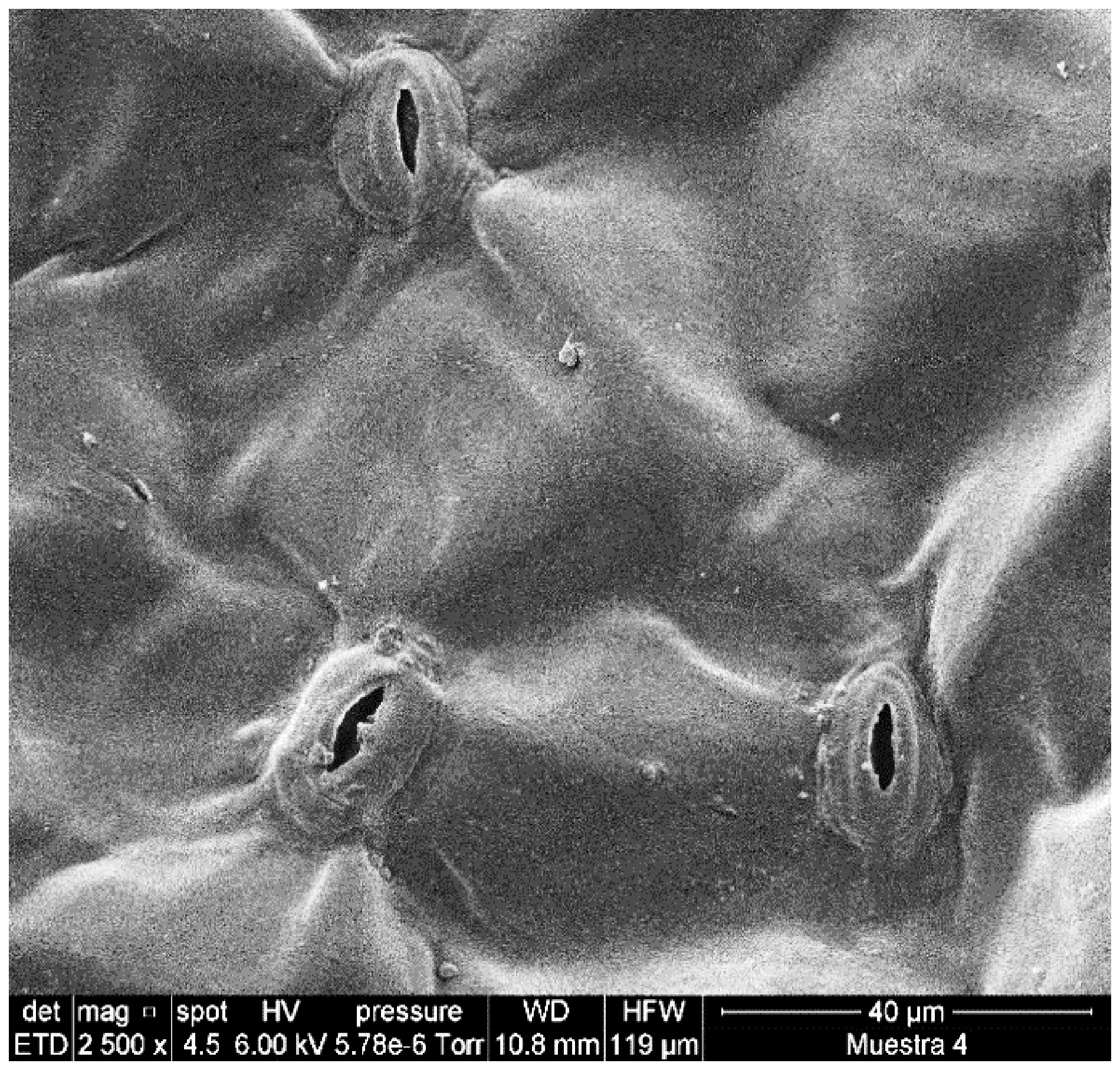
At 2500x magnification, the micrograph of sample M4 (Figure 7) revealed a leaf surface with predominantly closed stomata. This observation was interpreted as an adaptive response to minimize water loss through transpiration, a crucial mechanism in environments with limited water availability. The surrounding leaf surface exhibited a smooth texture, suggesting adequate cell turgidity despite water stress. At a magnification of 6000x (Figure 8), a stomata with an opening of approximately 1.521 µm was observed, which was notably narrow compared to other samples. The surface surrounding the stomata remained smooth with adhering particles. This reduced stomatal opening indicated restrictive regulation of gas exchange, consistent with a water conservation strategy in response to severe dehydration conditions. A study by Doheny-Adams et al. (2012) observed that, although stomatal density is not always altered by water restriction, there are reductions in the size of the stomata.

This confirms that stomatal size is a plastic morphological characteristic that adapts to the water conditions of the environment. The smooth texture of the surface suggested that the plant maintained turgidity and cell structure, reflecting an acceptable state of health despite stress. Under conditions of high transpiration and low soil water availability, water demand may exceed supply, causing a reduction in water potential and a loss of cell turgidity (wilting). (Barratt et al., 2021). M1 and M2, which contain hydrogel, show more open stomata, indicating better transpiration and photosynthesis management thanks to the hydrogel that maintains moisture. In contrast, M4 has more closed stomata (1.521 µm), reflecting a more restrictive adaptation to water stress due to the absence of hydrogel, focused on conserving water.
In the case of sample M3, also without hydrogel, more open stomata are observed, suggesting less severe water stress or better adaptation to conditions without hydrogel. However, the more closed stomata in M4 indicate a more conservative response, pointing to more extreme water stress conditions. Beetroot showed strong plasticity in its adaptation to drought thanks to mechanisms of evasion (restricted development of leaves and storage roots), tolerance, and thermal dissipation (Stagnari et al., 2014).
4. Conclusion
The application of KPA to the substrate in M1 and M4 of the Beta vulgaris crop proved to be an effective strategy for mitigating the negative effects of induced water stress, compared to the results obtained in M2 and M3. Unlike M1 and M4, both with KPA, M3 could be showing morphological adaptation to water stress. The results show a comprehensive improvement that encompasses the effect of substrate properties on the physiological and morphological response of the plant. KPA improved the water and physical properties of the substrate, which translated into better crop yield. At the ultrastructural level, the hydrogel allowed the plants to maintain the integrity of the epidermis and the functionality of the stomata, demonstrating its crucial role in preserving plant physiology under stress conditions.
Acknowledgements
The authors would like to thank José Faustino Sánchez Carrión National University for its collaboration and for providing the facilities necessary to carry out some research activities.
Data Availability Statement
Research data is available upon request.
References
-
AGURLA, S., GAHIR, S., MUNEMASA, S., MURATA, Y. and RAGHAVENDRA, A., 2018. Mechanism of stomatal closure in plants exposed to drought and cold stress. Advances in Experimental Medicine and Biology, vol. 1081, pp. 215-232. https://doi.org/10.1007/978-981-13-1244-1_12 PMid:30288712.
» https://doi.org/10.1007/978-981-13-1244-1_12 -
ALI, K., ASAD, Z., AGBNA, G.H.D., SAUD, A., KHAN, A. and ZAIDI, S.J., 2024. Progress and Innovations in Hydrogels for Sustainable Agriculture. Agronomy, vol. 14, no. 12, pp. 2815. https://doi.org/10.3390/agronomy14122815
» https://doi.org/10.3390/agronomy14122815 -
BARRATT, G., SPARKES, D., MCAUSLAND, L. and MURCHIE, E., 2021. Anisohydric sugar beet rapidly responds to light to optimize leaf water use efficiency utilizing numerous small stomata. AoB Plants, vol. 13, no. 1, pp. plaa067. https://doi.org/10.1093/aobpla/plaa067 PMid:33442465.
» https://doi.org/10.1093/aobpla/plaa067 -
BEHERA, S. and MAHANWAR, P., 2019. Superabsorbent polymers in agriculture and other applications: A review. Journal of Polymer & Composites, vol. 7, no. 1, pp. 1-14. https://doi.org/10.1080/25740881.2019.1647239
» https://doi.org/10.1080/25740881.2019.1647239 -
BERTOLINO, L., CAINE, R. and GRAY, J., 2019. Impact of stomatal density and morphology on water-use efficiency in a changing world. Frontiers in Plant Science, vol. 10, pp. 225. https://doi.org/10.3389/fpls.2019.00225 PMid:30894867.
» https://doi.org/10.3389/fpls.2019.00225 -
CRISCIONE, K., 2024 [viewed 21 September 2025]. Explorando la interconectividad entre las propiedades hidráulicas del sustrato sin suelo y la morfología de las raíces de las plantas [online]. Baton Rouge: Louisiana State University and Agricultural and Mechanical College. Disertación doctoral. Available from: https://repository.lsu.edu/gradschool_dissertations/6608
» https://repository.lsu.edu/gradschool_dissertations/6608 -
DIXIT, V., PANDEY, V. and SHYAM, R., 2002. Chromium ions inactivate electron transport and enhance superoxide generation in vivo in pea root mitochondria (Pisum sativum L. cv. Azad). Plant, Cell & Environment, vol. 25, no. 5, pp. 687-693. https://doi.org/10.1046/j.1365-3040.2002.00843.x
» https://doi.org/10.1046/j.1365-3040.2002.00843.x -
DOHENY-ADAMS, T., HUNT, L., FRANKS, P.J., BEERLING, D. and GRAY, J., 2012. Genetic manipulation of stomatal density influences stomatal size, plant growth and tolerance to restricted water supply across a growth carbon dioxide gradient. Philosophical Transactions of the Royal Society of London. Series B, Biological Sciences, vol. 367, no. 1588, pp. 547-555. https://doi.org/10.1098/rstb.2011.0272 PMid:22232766.
» https://doi.org/10.1098/rstb.2011.0272 -
EL-DIEHY, M., FARGHAL, I., AMIN, M., GHOBASHY, M., NOWWAR, A. and GAYED, S., 2025. Radiation-assisted tailoring of swelling behavior and water retention of Na-CMC/PAAm hydrogels for enhancing Beta Vulgaris under drought stress. Scientific Reports, vol. 15, no. 1, pp. 1661. https://doi.org/10.1038/s41598-024-83832-3 PMid:39794338.
» https://doi.org/10.1038/s41598-024-83832-3 -
ELSHAFIE, H. and CAMELE, I., 2021. Applications of absorbent polymers for sustainable plant protection and crop yield. Sustainability, vol. 13, no. 6, pp. 3253. https://doi.org/10.3390/su13063253
» https://doi.org/10.3390/su13063253 -
FRANKS, P. and FARQUHAR, G., 2007. The mechanical diversity of stomata and its significance in gas-exchange control. Plant Physiology, vol. 143, no. 1, pp. 78-87. https://doi.org/10.1104/pp.106.089367 PMid:17114276.
» https://doi.org/10.1104/pp.106.089367 -
HAWORTH, M., MARINO, G., LORETO, F. and CENTRITTO, M., 2021. Integrating stomatal physiology and morphology: evolution of stomatal control and development of future crops. Oecologia, vol. 197, no. 4, pp. 867-883. https://doi.org/10.1007/s00442-021-04857-3 PMid:33515295.
» https://doi.org/10.1007/s00442-021-04857-3 - INSTITUTO NACIONAL DE INNOVACION AGRARIA – INIA. Laboratorio de Suelos Agua y Foliares – LABSAF, 2023. INIA. no. 09217-23: Análisis de suelo: resultados de análisis de suelo Perú: INÍA.
-
INSTITUTO TECNOLÓGICO AGRARIO DE CASTILLA Y LEÓN – ITACYL, 2013 [viewed 21 September 2025]. Guía para interpretar los resultados de los análisis de las muestras de suelos. Junta de Castilla y León [online]. Available from: https://suelos.itacyl.es/documents/426128/427891/2013-05_Guia_para_interpretar_resultados_analisis.pdf/86b042ba-46b2-fa9c-f517-98d78798897e
» https://suelos.itacyl.es/documents/426128/427891/2013-05_Guia_para_interpretar_resultados_analisis.pdf/86b042ba-46b2-fa9c-f517-98d78798897e -
ISMAIL, S., ALMULHIM, N., SEDKY, A., EL-COSSY, S. and MAHMOUD, E., 2025. Impact of soil ameliorants on soil chemical characteristics, sugar beet water productivity, and yield components in sandy soils under deficit irrigation. Sustainability, vol. 17, no. 4, pp. 1513. https://doi.org/10.3390/su17041513
» https://doi.org/10.3390/su17041513 -
KIM, K., 2020. Methanol fixation for scanning electron microscopy of plants. Applied Microscopy, vol. 50, no. 1, pp. 10. https://doi.org/10.1186/s42649-020-00028-5 PMid:33580311.
» https://doi.org/10.1186/s42649-020-00028-5 -
LEBRUN, M., BOUČEK, J., BÍMOVÁ, K., KRAUS, K., HAISEL, D., KULHÁNEK, M., OMARA-OJUNGU, C., SEYEDSADR, S., BEESLEY, L., SOUDEK, P., PETROVÁ, Š., POHOŘELÝ, M. and TRAKAL, L., 2022. Biochar in manure can suppress water stress of sugar beet (Beta vulgaris) and increase sucrose content in tubers. The Science of the Total Environment, vol. 814, pp. 152772. https://doi.org/10.1016/j.scitotenv.2021.152772 PMid:34986421.
» https://doi.org/10.1016/j.scitotenv.2021.152772 -
LUNA, W., ESTRADA, H., MORALES, E. and ÁLVAREZ, O., 2015 [viewed 21 September 2025]. Estrés por déficit hídrico en plantas: una revisión. Chilean Journal of Agricultural & Animal Science [online], vol. 31, no. 1, pp. 61-69. Available from: https://revistas.udec.cl/index.php/chjaas/article/view/10498
» https://revistas.udec.cl/index.php/chjaas/article/view/10498 -
MUHAMMAD, N., KADER, M., AL-SOLAIMANI, S., ABD, M., ABOHASSAN, R. and CHARLES, M., 2025. A review of impacts of hydrogels on soil water conservation in dryland agriculture. Farming System, vol. 3, no. 4, pp. 100166. https://doi.org/10.1016/j.farsys.2025.100166
» https://doi.org/10.1016/j.farsys.2025.100166 -
MURTEY, M. and RAMASAMY, P., 2016. Sample preparations for scanning electron microscopy – Life sciences. Phytologist, vol. 174, no. 2, pp. 296-299. https://doi.org/10.5772/61720
» https://doi.org/10.5772/61720 -
NASA, 2024 [viewed 21 September 2025]. Power-data access viewer [online]. Available from: https://power.larc.nasa.gov/data-access-viewer/
» https://power.larc.nasa.gov/data-access-viewer/ -
OUTLAW, W., 2003. Integration of cellular and organismic perspectives on guard‐cell function. Plant Physiology, vol. 131, no. 2, pp. 528-534. https://doi.org/10.1104/pp.92.2.528 PMid:12972665.
» https://doi.org/10.1104/pp.92.2.528 -
PATRA, S., PODDAR, R., BRESTIC, M., ACHARJEE, P., BHATTACHARYA, P., SENGUPTA, S., PAL, P., BAM, N., BISWAS, B., BAREK, V., ONDRISIK, P., SKALICKY, M. and HOSSAIN, A., 2022. Prospects of hydrogels in agriculture for enhancing crop and water productivity under water deficit condition. International Journal of Polymer Science, vol. 2022, pp. 4914836. https://doi.org/10.1155/2022/4914836
» https://doi.org/10.1155/2022/4914836 -
PORTAL FRUTÍCOLA, 2018 [viewed 21 September 2025]. Valores y rangos de referencia de un análisis de suelo [online]. PortalFrutícola.com. Available from: https://www.portalfruticola.com/noticias/2018/04/03/valores-y-rangos-de-referencia-de-un-analisis-de-suelo/
» https://www.portalfruticola.com/noticias/2018/04/03/valores-y-rangos-de-referencia-de-un-analisis-de-suelo/ -
ROELFSEMA, M. and HEDRICH, R., 2005. In the light of stomatal opening: new insights into ‘the Watergate’. The New Phytologist, vol. 167, no. 3, pp. 665-691. https://doi.org/10.1111/j.1469-8137.2005.01460.x PMid:16101906.
» https://doi.org/10.1111/j.1469-8137.2005.01460.x -
SACK, L. and BUCKLEY, T., 2017. The developmental basis of stomatal density and flux. Plant Physiology, vol. 171, no. 4, pp. 2358-2363. https://doi.org/10.1104/pp.16.00476 PMid:27268500.
» https://doi.org/10.1104/pp.16.00476 -
SÁNCHEZ, J. 2007 [viewed 21 September 2025]. Fertilidad del suelo y nutrición mineral de plantas: Conceptos básicos [online]. Available from: https://www.exa.unne.edu.ar/biologia/fisiologia.vegetal/FERTILIDAD DEL SUELO Y NUTRICION.pdf
» https://www.exa.unne.edu.ar/biologia/fisiologia.vegetal/FERTILIDAD -
STAGNARI, F., GALIENI, A., SPECA, S. and PISANTE, M., 2014. Water stress effects on growth, yield and quality traits of red beet. Scientia Horticulturae, vol. 165, pp. 13-22. https://doi.org/10.1016/j.scienta.2013.10.026
» https://doi.org/10.1016/j.scienta.2013.10.026 -
TARDIEU, F. and SIMONNEAU, T., 1998. Variability among species of stomatal control under fluctuating soil water status and evaporative demand: modelling isohydric and anisohydric Behaviours. Journal of Experimental Botany, vol. 49, no. Special, pp. 419-432. https://doi.org/10.1093/jxb/49.Special_Issue.419
» https://doi.org/10.1093/jxb/49.Special_Issue.419 -
TYREE, M. and SPERRY, J., 1988. Do woody plants operate near the point of catastrophic xylem dysfunction caused by dynamic water stress? Answers from a model. Plant Physiology, vol. 88, no. 3, pp. 574-580. https://doi.org/10.1104/pp.88.3.574 PMid:16666351.
» https://doi.org/10.1104/pp.88.3.574 -
ULLAH, N., DITTA, A., IMTIAZ, M., LI, X., JAN, A., MEHMOOD, S., RIZWAN, M. and RIZWAN, M., 2021. Appraisal for organic amendments and plant growth-promoting rhizobacteria to enhance crop productivity under drought stress: a review. Journal Agronomy & Crop Science, vol. 207, no. 5, pp. 783-802. https://doi.org/10.1111/jac.12502
» https://doi.org/10.1111/jac.12502 -
VALVERDE-OTÁROLA, J. and ARIAS, D., 2020. Efectos del estrés hídrico en crecimiento y desarrollo fisiológico de Gliricidia sepium (Jacq.) Kunth ex Walp. Colombia Forestal, vol. 23, no. 1, pp. 20-34. https://doi.org/10.14483/2256201X.14786
» https://doi.org/10.14483/2256201X.14786 -
VIANA, I., SAAVEDRA‐HORTÚA, D., MTOLERA, M. and TEICHBERG, M., 2019. Different strategies of nitrogen acquisition in two tropical seagrasses under nitrogen enrichment. The New Phytologist, vol. 223, no. 3, pp. 1217-1229. https://doi.org/10.1111/nph.15885 PMid:31059120.
» https://doi.org/10.1111/nph.15885 -
XU, Z. and ZHOU, G., 2008. Responses of leaf stomatal density to water status and its relationship with photosynthesis in a grass. Journal of Experimental Botany, vol. 59, no. 12, pp. 3317-3325. https://doi.org/10.1093/jxb/ern185 PMid:18648104.
» https://doi.org/10.1093/jxb/ern185 -
YAVAS, I., JAMAL, M., DIN, K., ALI, S., HUSSAIN, S. and FAROOQ, M., 2024. Drought-induced changes in leaf morphology and anatomy: overview, implications and perspectives. Polish Journal of Environmental Studies, vol. 33, no. 2, pp. 1517-1530. https://doi.org/10.15244/pjoes/174476
» https://doi.org/10.15244/pjoes/174476 -
ZGALLAI, H., ZOGHLAMI, R., ANNABI, M., ZARROUK, O., JELLALI, S. and HAMDI, H., 2024. Mitigating soil water deficit using organic waste compost and commercial water retainer: a comparative study under semiarid conditions. Euro-Mediterranean Journal for Environmental Integration, vol. 9, no. 1, pp. 377-391. https://doi.org/10.1007/s41207-023-00437-4
» https://doi.org/10.1007/s41207-023-00437-4
Edited by
-
Editor:
Jairo Lizandro Schmitt