
 Is there interspecific fruit set in distylous, synchronopatric species of Erythroxylum P. Browne (Erythroxylaceae)?
Abstract
Sympatric congeneric species that overlap the flowering period and have morphologically similar flowers tend to be pollinated by the same groups of pollinators, facilitating interspecific pollination and hybridization. If that situation involves distylous taxa, interspecific fruit set will theoretically rely on the match of sexual organs of the different species, because distylous plants only set fruits after crosses between floral morphs that are reciprocal herkogamous (RH) and are produced in different individuals. In a Caatinga forest in NE Brazil, there are three distylous species of Erythroxylum P. Br (E. citrifolium A.St.-Hil., E. pauferrense Plowman and E. simonis Plowman; Erythroxylaceae) that overlap their flowering period and have a high similarity in floral attributes. Erythroxylum pauferrense is a rare and endemic species of the region. This study aimed to describe the distylous pattern of those three Erythroxylum species (i.e., reciprocal hercogamy, proportion of morphs in the population and breeding system) and to evaluate the reproductive isolation between them. Flowering synchrony, interspecific RH and pollination were the pre-zygotic barriers investigated, and the post-zygotic one was the fruit set after interspecific pollination experiments. The species completely overlapped their flowering periods and were pollinated by the same group of species (Apis mellifera, Tetragona sp., and Trigona spinipes). In a general matter, a low level of both intra and interspecific RH was revealed. Interspecific pollination set fruits only between E. pauferrense and E. simonis. A low level of both intra and interspecific RH was revealed for all species, except for the low-level organs of E. citrifolium. The atypical distyly observed in E. pauferrense and E simonis indicates a collapse in the distylous system and may be related to a relaxation in the interspecific incompatibility mechanism.
Keywords:
co-flowering; distyly; pollination; hybridization; pre-zygotic barrier; reciprocal herkogamy
Resumo
Espécies sincronopátricas e congenéricas que têm flores morfologicamente semelhantes tendem a ser polinizadas pelos mesmos grupos de polinizadores, facilitando a polinização e a hibridização interespecíficas. Se tal situação envolver táxons distílicos, a frutificação interespecífica dependerá teoricamente da correspondência de órgãos sexuais das diferentes espécies, porque as plantas distílicas somente frutificam após cruzamentos entre morfos florais que possuem hercogamia recíproca (RH) e são produzidos em indivíduos diferentes. Em uma floresta de Caatinga no Nordeste do Brasil há três espécies distílicas de Erythroxylum P. Br (E. citrifolium A.St.-Hil., E. pauferrense Plowman e E. simonis Plowman; Erythroxylaceae) que se sobrepõem em seu período de floração e têm grande similaridade em atributos florais. Erythroxylum pauferrense é rara e endêmica da região. Este estudo teve como objetivo descrever o padrão distílico dessas três espécies de Erythroxylum (ou seja, hercogamia recíproca, proporção de morfos na população e sistema de reprodução) e avaliar o isolamento reprodutivo entre elas. Sincronia de floração, RH interespecífica e polinização foram as barreiras pré-zigóticas investigadas, e a pós-zigótica foi a frutificação após experimentos de polinização interespecífica. As espécies sobrepuseram completamente seus períodos de floração e foram polinizadas pelo mesmo grupo de espécies (Apis mellifera, Tetragona sp., e Trigona spinipes). Em geral, um baixo nível de RH intra e interespecífica foi revelado. A polinização interespecífica resultou em frutos apenas entre E. pauferrense e E. simonis. Um baixo nível de RH intra e interespecífica foi revelado para todas as espécies, exceto para os órgãos de nível inferior de E. citrifolium. A distilia atípica observada em E. pauferrense e E simonis indica um colapso no sistema distílico e pode estar relacionada a um relaxamento no mecanismo de incompatibilidade interespecífica
Palavras-chave:
cofloração; distilia; polinização; barreira pré-zigótica; hercogamia recíproca
1. Introduction
Sympatric species that flowering in synchrony (i.e., synchronopatric species) and have similar flowers tend to share pollinators (Schemske, 1981; Castro et al., 2004; Arceo-Gómez and Ashman, 2014; Muchhala et al., 2014). When the species are congeneric there is more probability to form interspecific fruits, however, it will depend on the strength of pre-and post-zygotic barriers between these species (Scopece et al., 2010).
One of the main pre-zygotic barriers between species is the morphological in which the positioning of floral reproductive structures resulting in non-coincident areas of pollen deposition and capture on the body of shared pollinators (Barrett, 2002; Hopkins, 2013). Other barriers are temporal differences in flower resources supply (Stone et al., 1998), in the chemical composition of floral volatiles (which attract distinct groups of pollinators, ex. Salzmann et al., 2006), interspecific pollen-pistil incompatibility systems (Bradshaw Junior et al., 1995), ethological isolation of pollinators. Post-zygotic barriers include non-viability, sterility, and/or reduced reproductive performance of hybrids (Levin, 1971; Judd et al., 2009; Johnson, 2010; Greiner et al., 2011). Studies have shown that efficiency levels of pre-and post-zygotic barriers vary among species (e.g., Martin and Willis, 2007; Wendt et al., 2001, 2008). Therefore, it should not be considered as absolute (Wu, 2001) and can be differentially important depending on whether the species are rare or widespread (Baack et al., 2015).
Sympatric species of the tropical genus Erythroxylum P.Browne in the coca family (Erythroxylaceae) constitute excellent models for studies on morphological divergence and reproductive isolations, including pre-zygotic barriers driving interspecific fruit set. These species have similar flowers and consequently share pollinators, increasing the chances of interspecific pollen transfer. The genus Erythroxylum has about 230 species (Plowman and Hensold, 2004) and although flowers have traits similar to each other, several reproductive strategies had evolved in the genus, that exhibits dioecy (Bawa and Opler, 1975), gynodioecy and agamospermy (Domínguez et al., 1997; Avila-Sakar and Domínguez 2000).
Although the atypical distyly was recorded in E. campestre (Barros, 1998), most species of genus Erythroxylum are reported as typically distylous and have self- and intra-morph-incompatibility (Ganders, 1979; Richards and Koptur, 1993; Pailler and Thompson, 1997; Silva et al., 2007). Therefore, it is necessary to investigate the possible sources of variation that cause deviations from distyly in synchronopatric Erythroxylum species and the possible consequences of interspecific fruit set.
Distylous species have self- and intramorph-incompatibility and the positioning of sexual organs is more specialized (Webb and Lloyd, 1986). The morph ratio is 1:1, called isoplethy; in atypical cases that ratio is different from 1:1, and is called anisoplety (Ganders, 1979; Barrett and Shore, 2008). The stamens and the carpel’s heights are at a similar level to the opposite morph, what is called reciprocal herkogamy (hereafter RH; Ganders, 1979; Barrett and Shore, 2008). In these species it is expected that interspecific crosses can be more critical to occur since reciprocal herkogamy is expected for the opposite morph of the same species.
In a fragment of Brazilian dry forest occurs populations of three species of Erythroxylum (E. citrifolium A.St.-Hil., E. pauferrense Plowman, and E. simonis Plowman). These species have overlapping flowering periods, strong similarities in floral traits and share the floral visitors. Thus, we investigate the phenology and reproductive biology of those three species to test the following premise: in populations of distylous, synchronopatric, and congeneric species and that share pollinators, the rate of fruiting from interspecific crosses will depend on the level of compatibility and reciprocal herkogamy between species.
This study aimed to Brazilian species of Erythroxylum and to answer the following questions: 1) What is the period of flowering overlap between species? 2) Are the Erythroxylum species typically distylous? 3) Do the species share pollinators? 4) Is there interspecific RH? 5) Is there fruit set after interspecific crosses?
2. Materials and Methods
2.1. Study area and species
We carried out our study in natural populations of E. citrifolium, E. pauferrense, and E. simonis in a fragment of Caatinga (Brazilian dry forest). That is a physionomy of the Atlantic Forest recognized in Brazilian literature as “Brejos de Altitude”. Those areas have Atlantic Forest vegetation under a strong influence of Caatinga, within which it is geographically inserted (Andrade-Lima, 1982). This configuration leads to high endemism and the coexistence of species from both vegetation types, which characterizes those areas as having floristic and vegetation peculiarities (Veloso et al., 1991; Myers et al., 2000).
The area is located at State Park Mata do Pau-Ferro, (6°58’12’S; 35°42’15’W), Paraiba, Northeast Brazil. It has approximately 600 ha, and the predominant vegetation type is open ombrophylous forest (Barbosa et al., 2004). The populations of the three species are comprised of shrubs to small trees, being distributed throughout the study area. Erythroxyllum citrifolium is apparently less abundant than the other two species. The species have wide distributions in most of NE Brazil, except E. pauferrense, which is endemic to Paraíba State (Plowman and Hensold, 2004).
2.2. Flowering phenology, morph ratio, floral biology, and morphometrics
To evaluate the overlap of flowering periods, we monitored 20 clusters (from two to 16 individuals per cluster) of marked individuals of the three species in intervals of 15 days for three years (2014-2016) and recorded the presence of flowers using the Activity Index (Bencke and Morellato, 2002). We marked 20 pre-anthesis buds on 20 individuals per morph per species, which were monitored from flower anthesis until flower senescence. In another ten flowers per morph (ten individuals/species), we tested the period of stigmatic receptivity in the early morning, at midday, and late afternoon, using hydrogen peroxide (Dafni et al., 2005). To estimate the floral morph ratio (i.e., the proportion of thrum (T) and pin (P) individuals of each species), we classified the floral morph of all individuals distributed along a transect of approximately 1000m (n = 65 individuals of E. citrifolium, 312 individuals of E. pauferrense and 347 individuals of E. simonis). Buds (n=10) distributed in ten individuals/morph/species were preserved in 70% ethanol and used in calculations of pollen/ovule ratio (Cruden, 1977).
We collected 20 flowers from 20 individuals of each morph of each species, preserved in a 70% alcohol solution to carry out morphometric analyses of the height of anthers and stigmas, which are used in calculation regarding RH (Figure 1). We performed the generalized linear model (GLM) analysis and the calculation on floral inaccuracy to evaluate the intra- and interspecific reciprocal hercogamy. Differences in stigma and anther heights between floral morphs and species were analyzed with GLM using the “glm” function in the “lme4” package (Bates et al., 2015) after detecting that there was no data overdispersion. The models included sexual organs (stamen and stigma height), floral morph, species, and the interaction between factors. Then we tested the significance of the model with a type II ANOVA using “Anova” functions. Subsequently, we used the “Lsmeans” function with Tukey adjustment (emmeans package; Lenth, 2016) to compare differences between height of sexual organs. We carried out all analyses in R statistical environment (version 3.6.2; R Development Core Team, 2019).
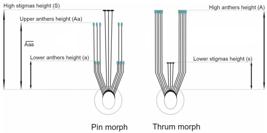
Schematic representation of anthers and stigma arrangement on pin and thrum flowers of three synchronopatric, distylous species of Erythroxylum (Erythroxylaceae) in a Caatinga Forest of NE Brazil. Pin flowers of E. citrifolium and E. pauferrense have two anther levels [(taller (Aa) and shorter (a)], and E. simonis has only one. A̅a̅a̅: average of Aa and a anthers.
To test the intra and interspecific RH we used the floral adaptative inaccuracy method (Armbruster et al., 2009, 2017; Li et al., 2018). This index estimates the reciprocity between the higher (pin stigmas and thrum anthers) and lower (thrum stigmas and pin anthers) floral organs of distylous species and considers the midpoint of the correspondent floral organ as the flower optimum (Armbruster et al., 2017). The optimum is described as the most reciprocal value (a perfect RH) and represents the highest chances of legitimate (intermorph) pollination (Armbruster et al., 2017). We used the mean and the variance of stigma and anthers’ heights to calculate the values of the adaptive inaccuracy of the higher and lower organs (higher: Equation1; lower: Equation 2, 3, and 4). Because pin flowers of E. citrifolium and E. pauferrense have two anther heights (hereafter referred to taller and shorter anthers, Figure 1), we performed three calculations for the lower organs in those flowers: one for each anther level (Equation 2 and Equation 3) and another using the mean of those two levels of anthers (a and Aa; Equation 4), as follows:
In which: A̅, A̅a̅, and a̅ represent, respectively, anther height of thrum flowers (all species), anther height of the taller and shorter anthers of pin flowers of E. citrifolium and E. pauferrense. A̅a̅a̅ is the mean height between A and a. S and s are, respectively, stigmas’ height of pin and thrum flowers and V is the variance (Matias et al., 2020).
The inaccuracy is calculated and presented as units squared (here we used mm; (Armbruster et al., 2017). An innacuracy of zero represents the flower optimum and values higher than that are interpreted as deviations from the optimum, and consequently a lower degree of RH (Armbruster et al., 2017).
We also calculated the standardized inaccuracy, which is a percentage that represents the extension to which the estimated inaccuracy deviates from zero, or the flower optimal (i.e., perfect RH). It is calculated by dividing the estimated inaccuracy by the average height of all organs squared (Armbruster et al., 2017).
Although the inaccuracy index and the standardized innacuracy were originally developed for the evaluation of intraspecific RH, we used those calculations to evaluate the interspecific RH of the studied Erythroxylum species. We aimed to check if anthers and stigma’ heights of the three Erythroxylum species studied here allow (and in which extension) pollen deposition and receipt in coincident areas of shared pollinators’ body and, consequently, interspecific pollination.
2.3. Floral visitors
We conducted direct observations of floral visitors in 10 focal plants of each species from 5:00 h to 18:00 h, on different days, in a total of 36 h per species, homogeneously distributed along the day and among plants. In each visit we recorded the time, the visitor species, the number of flowers visited, and floral visitor’s behavior (contact with the anthers and stigma, the floral resource collected). We classified floral visitors as effective pollinators (EP; contact anther and stigma in a frequency ≥ 10 visits.hour-1), occasional pollinators (OP; contact anther and stigma in a frequency < 10 visits.hour-1), or robbers (RO; explore floral resource but do not contact reproductive structures; Dafni et al., 2005). Floral visitors were collected, identified by specialists, and deposited at the Plant Ecology and Reproductive Laboratory at Federal University of Paraíba (UFPB).
To evaluate if floral visitors’ species have preferences for Erythroxylum species, we compare the number of visits of each visitor to Erythroxyllum species using a generalized linear model (GLM; glm function and lme4 package; Bates et al., 2015). We used as fixed factors pollinator, time of visit, and species of Erythroxylum visited, as response variables interaction between these factors and number of visits. We modeled the data with a negative binomial distribution. We performed the calculation using the software R (version 3.6.2; R Development Core Team, 2019).
2.4. Breeding system
We studied the breeding system of the three Erythroxylum species employing controlled cross and natural pollination (control), following the protocol adopted by Bawa and Beach (1983). We performed each one of the following treatments in 60 bagged, pre-anthesis buds, distributed in ten individuals/morph/species: spontaneous self-pollination (bagged control; SS), hand self-pollination (HS), and intermorph manual-cross pollination (IM). We emasculated all pre-anthesis buds used in the intermorph pollination experiment. All flowers were remained bagged during anthesis to avoid contact with floral visitors. We marked the other 50 flowers of ten individuals/morph/species and we monitored their natural fruit formation (natural pollination or control, hereafter referred to as NP). We recorded the number of ripe fruits for all treatments. Fruit formation lasted around 30 days.
To test for interspecific fruit set between the species studied, we conducted interspecific manual cross-pollination. Each interspecific test between two species included four treatments: a) thrum pollen of species 1 on pin stigma of species 2; b) pin pollen of species 1 on thrum stigma of species 2; c) thrum pollen of species 2 on pin stigma of species 1; d) pin pollen of species 2 on thrum stigma of species 1. Before being used in controlled crosses, we removed pin pollen grains of E. citrifolium and E. pauferrense from the two sets of anthers, from flowers of around five individuals, mixed them in a petri dish, and then deposited them onto receptor stigmas. All hand crosses were conducted approximately one hour after anthesis.
To compare fruit set among the treatments, we performed a GLM analysis with binomial distribution using the R Program (version 3.6.2; R Development Core Team, 2019).
3. Results
3.1. Flowering phenology, morph ratio, and floral biology
The flowering period of the three species lasts from two to three months (Figure 2). The species showed similar variation in the flowering period between years. In 2014 no species bloomed, in 2015 they only bloomed from Apr to May, and in 2016 from Feb to Apr (Figure 2).

Flowering period of three synchronopatric, distylous species of Erythroxylum (Erythroxylaceae) in a Caatinga Forest of NE Brazil. (A) 2015; (B) 2016.
Erythroxylum citrifolium had similar proportion of morphs or isoplethy (thrum: 30; pin: 35; χ2 =0.38; p = 0.53), whereas E. pauferrense (thrum:183; pin: 129; χ2 = 9.3; p = 0.0022) and E. simonis (thrum: 195; pin: 152; χ2 = 5.3; p = 0.0209) had more thrum than pin individuals (anisoplethy).
The species have similar floral attributes. Flowers have five sepals that connate at the base, and a pentamerous, white, actinomorphic corolla of similar size (Table 1), and nectar as floral resource. All species are hermaphrodite, with ten stamens distributed in two arrangements: one set of five stamens is opposite to the sepals and another set of five stamens is opposite to the petals. Stamens of thrum flowers of all species and pin flowers of E. simonis are at the same level within the flower. Pin flowers of E. citrifolium and E. pauferrense have two heights of stamens, resulting in two anthers’ levels (hereafter referred to as taller and shorter anthers; Figure 1). The gynoecium includes a superior ovary and three styles (fused in E. pauferrense and free in the other two species) with capitate stigmas. In E. pauferrense and E. simonis, the stigmas of pin flowers are positioned in a downwards direction, touching the dehiscent anthers during the bud phase. Pollen-ovule ratio ranged between 2,800 (thrum flowers of E. pauferrense) to 8,600 (pin flowers of E. citrifolium, Table 1).
Means (variance in parentheses) of floral parts (mm) and pollen/ovule ratio (P:O) of three synchronopatric, distylous species of Erythroxylum (Erythroxylaceae) in a Caatinga Forest of NE Brazil.
All species showed diurnal anthesis that started between 6:00am to 09:00am. Stigmatic receptivity occurred approximately one hour after the beginning of the anthesis. The flowers of all species remained receptive throughout the day. On the second day, the petals become beige and felt down.
The species did not exhibit intraspecific reciprocal hercogamy, except for the low organs of E. citrifolium (i.e., thrum stigma and pin anthers; Table 2, Figure 3). The lowest values of intraspecific inaccuracy (which indicate the highest chances of intraspecific pollen flow) were found in the shorter anthers of pin flowers and low stigmas of thrum flowers of E. citrifolium and E. pauferrense, which were remarkably close to the optimal (Table 3). Regarding interspecific inaccuracy, the lowest values (which indicate the highest chances of interspecific pollen flow) were found between the shorter anthers of pin flowers of E citrifolium and the low stigmas of thrum flowers of E. pauferrense (i.e., pollen flow from E. citrifolium pin anther to E. pauferrense thrum stigma). It is interesting to note that this inaccuracy value was similar to that described above for the highest intraspecific inaccuracy value of E citrifolium (Figure 3).
Comparisons (using generalized linear model analysis, GLM) of heights between sexual organs, morphs, and between three synchronopatric, distylous species of Erythroxylum (Erythroxylaceae) in a Caatinga Forest of NE Brazil.

Intra and interspecific comparisons between anthers’ and stigmas’ heights of distylous species of Erythroxylum (Erythroxylaceae) in a Caatinga Forest of NE Brazil. In interspecific comparisons, only the organs that did not show significant differences are shown. ***Significant differences.
Intra and interspecific estimates of inaccuracy and standardized inaccuracy (in parenthesis, given in %) of three synchronopatric, distylous species of Erythroxylum (Erythroxylaceae) in a Caatinga Forest of NE Brazil.
3.2. Floral visitors
We observed the bee Apis mellifera L., Tetragona sp., and Trigona spinipes Fabr randomly visiting both floral morphs of the three species, from which they collected nectar and pollen. We recorded a significantly higher number of visits between 9:00h and 12:00h (Table 4, Figures 4 and 5). The bees visited all open flowers of an inflorescence. We considered all visitors as effective pollinators since they carried pollen all over their bodies. Tetragona sp. and Trigona spinipes had the highest visiting rates in both morphs of all plant species in the entire flowering period (Figures 4 and 5). There was a significant difference in the number of visits between Erythroxylum species: E. simonis was the most visited species (503 visits), being followed by E. pauferrense (468) and E. citrifolium (321; Table 4; Figure 5). However, we recorded no significant differences in the frequency of each pollinator visit between the three plant species.
Comparisons (using generalized linear model analysis, GLM) of the visitors' frequency of the three synchronopatric, distylous species of Erythroxylum (Erythroxylaceae) in a Caatinga Forest of NE Brazil.

Pollinators’ percentage of visits to three synchronopatric, distylous species of Erythroxylum (Erythroxylaceae) in a Caatinga Forest of NE Brazil.

Pollinators’ frequency of visits to three synchronopatric, distylous species of Erythroxylum (Erythroxylaceae) in a Caatinga Forest of NE Brazil.
3.3. Breeding system
Erythroxylum simonis formed fruits in all treatments, E. pauferrense formed fruits in all treatments except after hand self-pollination (HS, or bagged control) in the pin morph, and E. citrifolium only formed fruits after natural pollination (NP) and intermorph pollination (IM) (Table 5, Figure 6). The fruit set after natural pollination (NP) and intermoph pollination (IM) was higher than that after HS and SS for all species and morphs, except for thrum individuals of E. simonis, whose fruit set after intermoph pollination (IM) was similar to hand self-pollination (HS) and spontaneous self-pollination (SS) (Table 5, Figure 6). Interspecific crosses set fruits only after manual cross-pollination between E. pauferrense and E. simonis (Table 5).
Percentage of fruit set after intra- and interspecific pollination experiments on three synchronopatric, distylous species of Erythroxylum (Erythroxylaceae) in a Caatinga Forest of NE Brazil.

Comparisons of mean fruit set (using generalized linear model analysis, GLM) resulted from pollination experiments on three synchronopatric, distylous species of Erythroxylum (Erythroxylaceae) in a Caatinga Forest of NE Brazil. Ec: E. citrifolium; Ep: E. pauferrense; Es: E. simomis; NF: natural fruit set; TxP: thrum pollen on pin stigma; PxT: pin pollen on thrum stigma; PxP: pin manual self-pollination; TxT: thrum manual self-pollination; TS: thrum spontaneous self-pollination; PS: pin spontaneous self-pollination.
4. Discussion
The flowering period of the three studied species seems overlapped completely, and their responses to climate variations suggest a similar phenological pattern across these species. Despite this overlap, interspecific pollination was largely ineffective, as no fruit set occurred from interspecific crosses, underscoring the critical role of floral morphology and hercogamy in reproductive isolation. Only E. citrifolium exhibited typical distyly with strong reciprocal hercogamy (RH), while the other species displayed atypical patterns. Additionally, self-compatibility in E. pauferrense and E. simonis appears to be associated with deficiencies in effective distyly and insufficient pollination services. Despite high visitation rates, particularly for E. citrifolium, fruit set did not significantly increase, highlighting the complex interactions between floral morphology, pollinator behavior, and reproductive success.
The variation in the flowering period among the three consecutive years probably is partially a result of a strong drought that occurred in 2014. The similarity of variations in flowering phenology between species suggests that they respond in a similar way to climate variations. Flowering overlap of Erythroxyllum distylous species of the same section of the species studied here (Plowman and Hensold, 2004) with similar flowers and shared pollinators was already observed in the Cerrado (tropical savannah of Brazil), Barros, 1998). Some studies report the effect of co-flowering on the attraction of a higher number of floral visitors in other plant families, such as in Primula (Gurung et al., 2018) and Psychotria (Mesquita-Neto et al., 2018). The flowering phenology constitutes a critical factor for co-flowering, incompatible species that share pollinators, because it may influence plant reproductive success (Ghazoul, 2006; Yang et al., 2007; Grab et al., 2017). Strong similarities may lead to competition when pollinators are limited (in which species may reduce their fitness) or facilitation (in which reproduction is enhanced because of a higher attraction of pollinators; Moeller, 2004; Ghazoul, 2006; Mitchell et al., 2009; Yang et al., 2013).
Stamens of different sizes observed in pin flowers of E. citrifolium and E. pauferrense have already been recorded in other species of Erythroxylum by Amaral Jr. (1980) in both morphs of the E. coca and E. novogranatense (Ganders, 1979). The species exhibited different patterns related to the distylous syndrome, i.e., the presence of RH, isoplethy, and/or heteromorphic incompatibility system (Ganders, 1979; Pailler and Thompson, 1997; Sá et al., 2016). It is generally accepted that if the species lack one of those characteristics, it should be classified as atypically distylous (Hamilton, 1990). Our results indicate that only E. citrifolium is typical distylous since it exhibited those three characteristics when considering the shorter anthers in the pin morph (taller anthers of pin morph did not exhibit reciprocity with thrum stigma). Typical distyly constitutes a primitive character in the genus Erythroxylum (Payens, 1958; Robson, 1963), but atypical conditions were already reported (Barros, 1998). Matias et al. (2020), for example, also observed variations from the distylous pattern in Erithroxylum species of the Cerrado: in a general matter, a 1:1 morph ratio was observed in self-incompatible species. Conversely, populations of self-compatible species, such as E. campestre, showed an excess of pin or thrum individuals or were thrum-monomorphic. Thrum flowers of E. havanense had low pollen viability, being considered as a gynodioecious species.
In general, the values of adaptive inaccuracy observed here were much higher when compared to other species of Erythroxylum (10 and 43%, Matias et al., 2020) and in other heterostylous groups (e.g., Armbruster et al., 2017; Jacquemyn et al., 2018), indicating the absence of reciprocity. The only exception was the shorter anthers of pin flowers and low stigmas of thrum flowers of E. citrifolium, which showed the lowest inaccuracy values (i.e., the highest degree of RH). Curiously, it was the only species whose fruit set of thrum flowers were two times that observed in pin flowers, which may indicate a higher efficiency in pollen transfer between low-level organs when compared to the high-level ones. Also, this efficiency may explain the higher fruit set of thrum morph (56%) when compared to the pin morph (24%). Matias et al. (2020) also recorded the association between low inaccuracy values and high fruit set after natural pollination in E. campestre, E. deciduum, E. suberosum, E. tortuosum in the Cerrado of central Brazil. Erythroxylum deciduum and E. suberosum are included in the same section of the species studied here (Plowman and Hensold, 2004). The association between low inaccuracy values and high fruit set after natural pollination was also observed in Pulmonaria (Boraginaceae, Jacquemyn et al., 2018). The greater reciprocity of the lower organs was also reported in Primulaceae (Armbruster et al., 2017; Jacquemyn et al., 2018; Li et al., 2018).
The high P:O ratio observed in all species indicates facultatively xenogamy, i.e., they are usually self-compatible but xenogamic crosses through morphological and/or physiological adaptation occur, with self-pollination restricted to the absence or in addition to pollination (Cruden, 1977; Barros, 1998). The high P:O was favored by the presence of a single ovule and a high number of pollen grains (Cruden, 1977; Barros, 1998).
The self-compatibility observed in E. pauferrense and E. simonis was also reported in other Erythroxylum species (Ganders, 1979; Barros, 1998; Pailler and Thompson, 1997; Silva et al., 2007) and in some distylous groups of Boraginaceae and Rubiaceae (Faria et al., 2012; Ferrero et al., 2017). Self-compatibility in distylous taxa indicates a failure in distyly functioning (Matias et al., 2020), and maybe associated both with the lack of reciprocal hercogamy and inefficient or insufficient pollination services (Armbruster et al., 2009). Since there were no differences in the number of visits among plant species, is possible that the pollinators' behavior combined with HR is exerting selective pressure influencing the evolution of atypical distyly in those species (Arroyo et al., 2002; Barrett and Hodgins, 2006). Pollinators are considered important agents for the maintenance of polymorphic species because they promote the flow of disassortative pollen (Armbruster et al., 2006; Armbruster et al., 2009). The higher visitation rates observed in E. citrifolium, for example, did not result in higher fruit set after natural pollination when compared to the other two species, reinforcing the idea that floral morphology, breeding system, and pollinators play an integrative influence on fruit set. On the other hand, the high number of visits within a single inflorescence by pollinators may impact differently the three species, since E. citrifolium is self-incompatible and a high degree of RH between pin anthers and thrum stigmas, and the other two are self-compatible and RH is almost absent. Therefore, further studies are needed to evaluate the pollen transfer rate by pollinators in those species.
It is interesting to note that, even E. pauferrense and E simonis being capable of self-pollinating during the bud phase, fruit set after spontaneous self-pollination was relatively low when compared to natural and intermorph pollinations. Thus, apparently, this self-pollen deposition does not cause stigma clogging, allowing pollen grains deposited by pollinators to germinate.
The lower value of interspecific inaccuracy observed for the shorter anthers of pin flowers of E. citrifolium with the thrum stigmas of E. pauferrense is similar to the values of the intraspecific inaccuracy of E. citrifolium, indicating that the chances of this interspecific pollination (i.e., from E. citrifolium anthers to E. pauferrense stigma) are similar to intraspecific (for E. citrifolium) pollination. Considering that E. citrifolium and E. pauferrense grow closely intermixed, overlap their flowering periods, and share pollinators, interspecific pollination may occur (Thomson, 1982; Chittka et al., 1997; Seifan et al., 2014). However, interspecific pollinations set no fruits. On the other hand, although manual interspecific pollinations among E. pauferrense and E. simonis set fruits, the high inaccuracy values indicate low chances of natural interspecific pollination. Moreover, it is not possible to state if the resulting hybrid seeds germinate, grow, and reproduce satisfactorily. It is important to note that, if the hybrids grow, their flower morphometrics may be different from the non-hybrid individuals. Therefore, it is also not possible to state if our data on floral morphometrics of E. pauferrense and E. simonis was collected from hybrids or not. These issues can be elucidated by studies including production of plants and genetics.
5. Conclusions
A low level of both intra and interspecific RH was revealed for all species, except for the low level organs of E. citrifolium. The high levels of reciprocal herkogamy observed in E. citrifolium were associated with a high fruit set, similarly to what was observed in other distylous species. The floral morphometric analysis also showed that the chances of intraspecific pollination are higher when compared to interspecific ones, except for the pollination between pin flowers of E. citrifolium and thrum flowers of E. pauferrense. However, the manual interspecific pollination between these two species did not form fruits, conversely to what was observed between E. pauferrense and E. simonis, whose all interspecific intermorph pollinations set fruits. The atypical distyly observed in E. pauferrense and E simonis indicates a collapse in the distylous system and may be related to a relaxation in the interspecific incompatibility mechanism. More field, experimental and molecular studies are needed to understand the reproductive relationships between the species studied, as well as whether these relationships influence the local population dynamics of these species.
Acknowledgements
We thank the Programa de Pós-Graduação em Biodiversidade of the Universidade Federal Rural de Pernambuco and Universiade Federal da Paraíba for institutional support. This work was supported by the Coordination of Superior Level Staff Improvement (CAPES; Finance code 001).
References
- ANDRADE-LIMA, D., 1982. Present day forest refuges in Northeastern Brazil. In: G.T. PRANCE, ed. Biological diversification in the tropics New York: Columbia University Press, pp. 245-254.
-
ARCEO-GÓMEZ, G. and ASHMAN, T.-L., 2014. Co-flowering community context influences female fitness and alters the adaptive value of flower longevity in Mimulus guttatus American Naturalist, vol. 183, no. 2, pp. E50-63. http://doi.org/10.1086/674358 PMid:24464206.
» http://doi.org/10.1086/674358 -
ARMBRUSTER, W.S., BOLSTAD, G.H., HANSEN, T.F., KELLER, B., CONTI, E. and PÉLABON, C., 2017. The measure and mismeasure of reciprocity in heterostylous flowers. The New Phytologist, vol. 215, no. 2, pp. 906-917. http://doi.org/10.1111/nph.14604 PMid:28556899.
» http://doi.org/10.1111/nph.14604 -
ARMBRUSTER, W.S., LEE, J. and BALDWIN, B.G., 2009. Macroevolutionary patterns of defense and pollination in Dalechampia vines: adaptation, exaptation, and evolutionary novelty. Proceedings of the National Academy of Sciences of the United States of America, vol. 106, no. 43, pp. 18085-18090. http://doi.org/10.1073/pnas.0907051106 PMid:19841278.
» http://doi.org/10.1073/pnas.0907051106 -
ARMBRUSTER, W.S., PÉREZ-BARRALES, R., ARROYO, J., EDWARDS, M.E. and VARGAS, P., 2006. Threedimensional reciprocity of floral morphs in wild flax (Linum suffruticosum): a new twist on heterostyly. The New Phytologist, vol. 171, no. 3, pp. 581-590. http://doi.org/10.1111/j.1469-8137.2006.01749.x PMid:16866960.
» http://doi.org/10.1111/j.1469-8137.2006.01749.x -
ARROYO, J., BARRETT, S.C.H., HIDALGO, R. and COLE, W.W., 2002. Evolutionary maintenance of stigma-height dimorphism in Narcissus papyraceus (Amaryllidaceae). American Journal of Botany, vol. 89, no. 8, pp. 1242-1249. http://doi.org/10.3732/ajb.89.8.1242 PMid:21665725.
» http://doi.org/10.3732/ajb.89.8.1242 - AVILA-SAKAR, G. and DOMÍNGUEZ, C.A., 2000. Parental effects and gender specialization in a tropical heterostylous shrub. Evolution; International Journal of Organic Evolution, vol. 54, no. 3, pp. 866-877. http://doi.org/10.1111/j.0014-3820.2000.tb00087.x. PMid:10937260.
-
BAACK, E., MELO, M.C., RIESEBERG, L.H. and ORTIZ‐BARRIENTOS, D., 2015. The origins of reproductive isolation in plants. The New Phytologist, vol. 207, no. 4, pp. 968-984. http://doi.org/10.1111/nph.13424 PMid:25944305.
» http://doi.org/10.1111/nph.13424 - BARBOSA, M.R.V., AGRA, M.F., SAMPAIO, E.V.S.B., CUNHA, J.P. and ANDRADE, L.A., 2004. Diversidade Florística na Mata do Pau-ferro, Areia, Paraíba. In: K.C. PÔRTO, J.J.P CABRAL and M. TABARELLI, eds. Brejos de Altitude em Pernambuco e Paraíba: história natural, ecologia e conservação. Brasília: Ministério do Meio Ambiente, pp. 111-122.
-
BARRETT, S.C.H. and HODGINS, K.A., 2006. Floral design and the evolution of asymmetrical mating systems. In: L.D. HARDER and S.C.H. BARRETT, eds. Ecology and evolution of flowers. Oxford: Oxford University Press, pp. 239–259. http://doi.org/10.1093/oso/9780198570851.003.0013
» http://doi.org/10.1093/oso/9780198570851.003.0013 -
BARRETT, S.C.H. and SHORE, J.S., 2008. New Insights on Heterostyly: comparative biology, ecology, and genetics. In: V.E. FRANKLIN-TONG, ed. Self-incompatibility in flowering plants Berlin: Springer, pp. 3-32. http://doi.org/10.1007/978-3-540-68486-2_1
» http://doi.org/10.1007/978-3-540-68486-2_1 -
BARRETT, S.C.H., 2002. The evolution of plant sexual diversity. Nature Reviews. Genetics, vol. 3, no. 4, pp. 274-284. http://doi.org/10.1038/nrg776 PMid:11967552.
» http://doi.org/10.1038/nrg776 -
BARROS, M.G., 1998. Sistemas reprodutivos e polinização em espécies simpátricas de Erythroxylum P. Br. (Erythroxylaceae) do Brasil. Revista Brasileira de Botanica. Brazilian Journal of Botany, vol. 21, no. 2, pp. 159-166. http://doi.org/10.1590/S0100-84041998000200008
» http://doi.org/10.1590/S0100-84041998000200008 -
BATES, D., MÄCHLER, M., BOLKER, B. and WALKER, S., 2015. Fitting linear mixed-effects models using lme4. Journal of Statistical Software, vol. 67, no. 1, pp. 1-48. http://doi.org/10.18637/jss.v067.i01
» http://doi.org/10.18637/jss.v067.i01 -
BAWA, K.S. and BEACH, J.H., 1983. Self-incompatibility systems in the Rubiaceae of a tropical lowland wet forest. American Journal of Botany, vol. 70, no. 9, pp. 1281-1288. http://doi.org/10.1002/j.1537-2197.1983.tb07917.x
» http://doi.org/10.1002/j.1537-2197.1983.tb07917.x -
BAWA, K.S. and OPLER, P.A., 1975. Dioecism in tropical forest trees. Evolution; International Journal of Organic Evolution, vol. 29, no. 1, pp. 167-179. http://doi.org/10.2307/2407150 PMid:28563295.
» http://doi.org/10.2307/2407150 -
BENCKE, C.S.C. and MORELLATO, L.P.C., 2002. Comparação de dois métodos de avaliação da fenologia de plantas, sua interpretação e representação. Revista Brasileira de Botanica. Brazilian Journal of Botany, vol. 25, no. 3, pp. 269-275. http://doi.org/10.1590/S0100-84042002000300003
» http://doi.org/10.1590/S0100-84042002000300003 -
BRADSHAW JUNIOR, H.D., WILBERT, J.R.S.M., OTTO, K.G. and SCHEMSKE, D.W., 1995. Genetic mapping of floral traits associated with reproductive isolation in monkeyflowers (Mimulus). Nature, vol. 376, no. 6543, pp. 762-765. http://doi.org/10.1038/376762a0
» http://doi.org/10.1038/376762a0 -
CASTRO, C.C., OLIVEIRA, P.E.A.M. and ALVES, M.C., 2004. Breeding system and floral morphometry of distylous Psychotria L. species in the Atlantic rain forest, SE Brazil. Plant Biology, vol. 6, no. 6, pp. 755-760. http://doi.org/10.1055/s-2004-830349 PMid:15570482.
» http://doi.org/10.1055/s-2004-830349 -
CHITTKA, L., GUMBERT, A. and KUNZE, J., 1997. Foraging dynamics of bumblebees: correlates of movements within and between plant species. Behavioral Ecology, vol. 8, no. 3, pp. 239-249. http://doi.org/10.1093/beheco/8.3.239
» http://doi.org/10.1093/beheco/8.3.239 -
CRUDEN, R.W., 1977. Pollen-ovule ratios: a conservative indicator of breeding systems in flowering plants. Evolution; International Journal of Organic Evolution, vol. 31, no. 1, pp. 32-46. http://doi.org/10.2307/2407542 PMid:28567723.
» http://doi.org/10.2307/2407542 - DAFNI, A., KEVAN, P.G. and HUSBAND, B.C., 2005. Practical pollination biology Cambridge: Enviroquest, 590 p.
-
DOMÍNGUEZ, C.A., ÁVILA-SAKAR, G., VÁZQUEZ-SANTANA, S. and MÁRQUEZ-GUZMÁN, J., 1997. Morph-biased male sterility in the tropical distylous shrub Erythroxylum havanense (Erythroxylaceae). American Journal of Botany, vol. 84, no. 5, pp. 626-632. http://doi.org/10.2307/2445899 PMid:21708615.
» http://doi.org/10.2307/2445899 -
FARIA, R.R., FERRERO, V., NAVARRO, L. and ARAUJO, A.C., 2012. Flexible mating system in distylous populations of Psychotria carthagenensis Jacq. (Rubiaceae) in Brazilian Cerrado. Plant Systematics and Evolution, vol. 298, no. 3, pp. 619-627. http://doi.org/10.1007/s00606-011-0571-7
» http://doi.org/10.1007/s00606-011-0571-7 -
FERRERO, V., BARRETT, S.C.H., ROJAS, D., ARROYO, J. and NAVARRO, L., 2017. Associations between sex-organ deployment and morph bias in related heterostylous taxa with different stylar polymorphisms. American Journal of Botany, vol. 104, no. 1, pp. 50-61. http://doi.org/10.3732/ajb.1600345 PMid:28039130.
» http://doi.org/10.3732/ajb.1600345 -
GANDERS, F.R., 1979. The biology of heterostyly. New Zealand Journal of Botany, vol. 17, no. 4, pp. 607-635. http://doi.org/10.1080/0028825X.1979.10432574
» http://doi.org/10.1080/0028825X.1979.10432574 -
GHAZOUL, J., 2006. Floral diversity and the facilitation of pollination. Journal of Ecology, vol. 94, no. 2, pp. 295-304. http://doi.org/10.1111/j.1365-2745.2006.01098.x
» http://doi.org/10.1111/j.1365-2745.2006.01098.x -
GRAB, H., BLITZER, E.J., DANFORTH, B., LOEB, G. and POVEDA, K., 2017. Temporally dependent pollinator competition and facilitation with mass flowering crops affect yield in co-blooming crops. Scientific Reports, vol. 7, no. 1, pp. 45296. http://doi.org/10.1038/srep45296 PMid:28345653.
» http://doi.org/10.1038/srep45296 -
GREINER, S., RAUWOLF, U., MEURER, J. and HERRMANN, R.G., 2011. The role of plastids in plant speciation. Molecular Ecology, vol. 20, no. 4, pp. 671-691. http://doi.org/10.1111/j.1365-294X.2010.04984.x PMid:21214654.
» http://doi.org/10.1111/j.1365-294X.2010.04984.x -
GURUNG, P.D., RATNAM, J. and RAMAKRISHNAN, U., 2018. Facilitative interactions among co-flowering Primula species mediated by pollinator sharing. Plant Ecology, vol. 219, no. 10, pp. 1159-1168. http://doi.org/10.1007/s11258-018-0868-5
» http://doi.org/10.1007/s11258-018-0868-5 - HAMILTON, C.W., 1990. Variation on a distylous theme in Mesoamerican Psychotria subgenus Psychotria (Rubiaceae). Memoirs of the New York Botanical Garden, vol. 55, pp. 62-75.
-
HOPKINS, R., 2013. Reinforcement in plants. The New Phytologist, vol. 197, no. 4, pp. 1095-1103. http://doi.org/10.1111/nph.12119 PMid:23495388.
» http://doi.org/10.1111/nph.12119 -
JACQUEMYN, H., GIELEN, M. and BRYS, R., 2018. Is sexual organ reciprocity related to legitimate pollen deposition in distylous Pulmonaria (Boraginaceae)? Oikos, vol. 127, no. 8, pp. 1216-1224. http://doi.org/10.1111/oik.05122
» http://doi.org/10.1111/oik.05122 -
JOHNSON, N.A., 2010. Hybrid incompatibility genes: remnants of a genomic battlefield? Trends in Genetics, vol. 26, no. 7, pp. 317-325. http://doi.org/10.1016/j.tig.2010.04.005 PMid:20621759.
» http://doi.org/10.1016/j.tig.2010.04.005 - JUDD, W.S., CAMPEBELL, C.S., KELLONG, E.A., STEVENS, P.F. and DONOGHUE, M.J., 2009. Sistemática vegetal: um enfoque filogenético. Porto Alegre: Artmed, 632 p.
-
LENTH, R.V., 2016. Least-squares means: the R Package lsmeans. Journal of Statistical Software, vol. 69, no. 1, pp. 1-33. https://doi.org/10.18637/jss.v069.i01
» https://doi.org/10.18637/jss.v069.i01 -
LEVIN, D.A., 1971. The origin of reproductive isolating mechanisms in flowering plants. Taxon, vol. 20, no. 1, pp. 91-113. http://doi.org/10.2307/1218538
» http://doi.org/10.2307/1218538 -
LI, H.-D., REN, Z.-X., ZHOU, W., BERNHARDT, P., ZHAO, Y.-H., WU, Z.K., LI, D.-Z. and WANG, H., 2018. Comparative intra- and inter-specific sexual organ reciprocity in four distylous Primula species in the Himalaya-Hengduan Mountains. Plant Biology, vol. 20, no. 4, pp. 643-653. https://doi.org/10.1111/plb.12834
» https://doi.org/10.1111/plb.12834 -
MARTIN, N.H. and WILLIS, J.H., 2007. Ecological divergence associated with mating system causes nearly complete reproductive isolation between sympatric Mimulus species. Evolution; International Journal of Organic Evolution, vol. 61, no. 1, pp. 68-82. http://doi.org/10.1111/j.1558-5646.2007.00006.x PMid:17300428.
» http://doi.org/10.1111/j.1558-5646.2007.00006.x -
MATIAS, R., PÉREZ-BARRALES, R. and CONSOLARO, H., 2020. Patterns of variation in distylous traits and reproductive consequences in Erythroxylum species and populations. American Journal of Botany, vol. 107, no. 6, pp. 910-922. http://doi.org/10.1002/ajb2.1478 PMid:32462680.
» http://doi.org/10.1002/ajb2.1478 -
MESQUITA-NETO, J.N., BORGES, J.P., SÁ, T.F., DE OLIVEIRA TEIXEIRA, T.P., FERREIRA, I.N., FURTADO, M.T., CONSOLARO, H. and FRANCESCHINELLI, E.V., 2018. Pollen flow and pollinator sharing among synchronopatric species of Psychotria (Rubiaceae). Plant Systematics and Evolution, vol. 304, no. 8, pp. 943-953. http://doi.org/10.1007/s00606-018-1527-y
» http://doi.org/10.1007/s00606-018-1527-y -
MITCHELL, R.J., FLANAGAN, R.J., BROWN, B.J., WASER, N.M. and KARRON, J.D., 2009. New frontiers in competition for pollination. Annals of Botany, vol. 103, no. 9, pp. 1403-1413. http://doi.org/10.1093/aob/mcp062 PMid:19304814.
» http://doi.org/10.1093/aob/mcp062 -
MOELLER, D.A., 2004. Facilitative interactions among plants via shared pollinators. Ecology, vol. 85, no. 12, pp. 3289-3301. http://doi.org/10.1890/03-0810
» http://doi.org/10.1890/03-0810 - MUCHHALA, N., JOHNSEN, S. and SMITH, S.D., 2014. Competition for hummingbird pollination shapes flower color variation in Andean solanaceae. Evolution, vol. 68, no. 8, pp. 2275-2286. http://doi.org/10.1111/evo.12441. PMid:24766107.
-
MYERS, N., MITTERMEIER, R.A., MITTERMEIER, C.G., DA FONSECA, G.A.B. and KENT, J., 2000. Biodiversity hotspots for conservation priorities. Nature, vol. 403, no. 6772, pp. 853-858. http://doi.org/10.1038/35002501 PMid:10706275.
» http://doi.org/10.1038/35002501 -
PAILLER, T. and THOMPSON, J.D., 1997. Distyly and variation in heteromorphic incompatibility in Gaertnera vaginata (Rubiaceae) endemic to La Réunion Island. American Journal of Botany, vol. 84, no. 3, pp. 315-327. http://doi.org/10.2307/2446005 PMid:21708585.
» http://doi.org/10.2307/2446005 - PAYENS, J.P.D.W., 1958. Erythroxylaceae. Flora Malesiana, vol. 5, pp. 543-552.
-
PLOWMAN, T. and HENSOLD, N., 2004. Names, types and distribution of neotropical species of Erythroxylum (Erythroxylaceae). Brittonia, vol. 56, no. 1, pp. 1-53. http://doi.org/10.1663/0007-196X(2004)056[0001:NTADON]2.0.CO;2
» http://doi.org/10.1663/0007-196X(2004)056[0001:NTADON]2.0.CO;2 -
R DEVELOPMENT CORE TEAM, 2019 [viewed 22 June 2024]. R: a language and environment for statistical computing. Version 3.6.2 [software]. Vienna: R Foundation for Statistical Computing. Available from: http://www.R-project.org
» http://www.R-project.org -
RICHARDS, J.H. and KOPTUR, S., 1993. Floral variation and distyly in Guettarda scabra (Rubiaceae). American Journal of Botany, vol. 80, no. 1, pp. 31-40. http://doi.org/10.1002/j.1537-2197.1993.tb13764.x
» http://doi.org/10.1002/j.1537-2197.1993.tb13764.x - ROBSON, N.K.B., 1963. Linaceae. Flora Zambesiaca, vol. 2, pp. 91-99.
-
SA, T., FURTADO, M.T., FERRERO, V., PEREZ-BARRALES, R., RODRIGUES, E.B., SANTOS, I.G. and CONSOLARO, H., 2016. Floral biology, reciprocal herkogamy and breeding system in four Psychotria species (Rubiaceae) in Brazil. Botanical Journal of the Linnean Society, vol. 182, no. 3, pp. 689-707. http://doi.org/10.1111/boj.12476
» http://doi.org/10.1111/boj.12476 -
SALZMANN, C.C., BROWN, A. and SCHIESTL, F.P., 2006. Floral scent emission and pollination syndromes: evolutionary changes from food to sexual deception. International Journal of Plant Sciences, vol. 6, no. 167, pp. 1197-1204. http://doi.org/10.1086/508022
» http://doi.org/10.1086/508022 -
SCHEMSKE, D.W., 1981. Floral convergence and pollinator sharing in two bee-pollinated tropical herbs. Ecology, vol. 62, no. 4, pp. 946-954. http://doi.org/10.2307/1936993
» http://doi.org/10.2307/1936993 -
SCOPECE, G., LEXER, C., WIDMER, A. and COZZOLINO, S., 2010. Polymorphism of postmating reproductive isolation within plant species. Taxon, vol. 59, no. 5, pp. 1367-1374. http://doi.org/10.1002/tax.595004
» http://doi.org/10.1002/tax.595004 -
SEIFAN, M., HOCH, E.-M., HANOTEAUX, S. and TIELBÖRGER, K., 2014. The outcome of shared pollination services is affected by the density and spatial pattern of an attractive neighbor. Journal of Ecology, vol. 102, no. 4, pp. 953-962. http://doi.org/10.1111/1365-2745.12256
» http://doi.org/10.1111/1365-2745.12256 - SILVA, F.J.T., SCHWADE, M.R.M. and WEBBER, A.C., 2007. Fenologia, biologia floral e polinização de Erythroxylum cf macrophyllum (Erythroxylaceae), na Amazônia Central. Revista Brasileira de Biociências, vol. 5, suppl. 1, pp. 186-188.
-
STONE, G.N., WILLMER, P.G. and ROWE, J.A., 1998. Partitioning of pollinators during flowering in an African Acacia community. Ecology, vol. 79, no. 8, pp. 2808-2827. http://doi.org/10.1890/0012-9658(1998)079[2808:POPDFI]2.0.CO;2
» http://doi.org/10.1890/0012-9658(1998)079[2808:POPDFI]2.0.CO;2 -
THOMSON, J.D., 1982. Patterns of visitation by animal pollinators. Oikos, vol. 39, no. 2, pp. 241-250. http://doi.org/10.2307/3544491
» http://doi.org/10.2307/3544491 - VELOSO, H.P., RANGEL-FILHO, A.L.R. and LIMA, J.C.A., 1991. Classificação da vegetação brasileira, adaptada a um sistema universal Rio de Janeiro: IBGE.
-
WEBB, C.J. and LLOYD, D.G., 1986. The avoidance of interference between the presentation of pollen and stigmas in angiosperms II Herkogamy. New Zealand Journal of Botany, vol. 24, no. 1, pp. 163-178. http://doi.org/10.1080/0028825X.1986.10409726
» http://doi.org/10.1080/0028825X.1986.10409726 -
WENDT, T., CANELA, B.F., FARIA, A.P.G. and RIOS, R.I., 2001. Reproductive biology and natural hybridization between two endemic species of Pitcairnia (Bromeliaceae). American Journal of Botany, vol. 88, no. 10, pp. 1760-1767. http://doi.org/10.2307/3558350 PMid:21669607.
» http://doi.org/10.2307/3558350 -
WENDT, T., COSER, T.S., MATALLANA, G. and GUILHERME, F.A.G., 2008. An apparent lack of prezygotic reproductive isolation among 42 sympatric species of Bromeliaceae in southeastern Brazil. Plant Systematics and Evolution, vol. 275, no. 1-2, pp. 31-41. http://doi.org/10.1007/s00606-008-0054-7
» http://doi.org/10.1007/s00606-008-0054-7 -
WU, C.I., 2001. The genic view of the process of speciation. Journal of Evolutionary Biology, vol. 14, no. 6, pp. 851-865. http://doi.org/10.1046/j.1420-9101.2001.00335.x
» http://doi.org/10.1046/j.1420-9101.2001.00335.x -
YANG, C.F., GITURU, R.W. and GUO, Y.H., 2007. Reproductive isolation of two sympatric louseworts, Pedicularis rhinanthoides and Pedicularis longiflora (Orobanchaceae): how does the same pollinator type avoid interspecific pollen transfer? Biological Journal of the Linnean Society, vol. 90, no. 1, pp. 37-48. http://doi.org/10.1111/j.1095-8312.2007.00709.x
» http://doi.org/10.1111/j.1095-8312.2007.00709.x -
YANG, C.F., WANG, Q.F. and GUO, Y.H., 2013. Pollination in a patchily distributed lousewort is facilitated by presence of a co-flowering plant due to enhancement of quantity and quality of pollinator visits. Annals of Botany, vol. 112, no. 9, pp. 1751-1758. http://doi.org/10.1093/aob/mct228 PMid:24131615.
» http://doi.org/10.1093/aob/mct228


