
 Spatial and spatiotemporal analysis of leprosy occurrence in a hyperendemic state in northeastern Brazil: an ecological study
Abstract
Leprosy, caused by Mycobacterium leprae, remains a public health challenge in Brazil, characterized by persistent transmission, physical disabilities, and a strong association with social inequalities. This study aimed to describe the sociodemographic and clinical profile of cases, analyze temporal trends, and identify spatial and spatiotemporal patterns from 2001 to 2024. Spatial distribution was analyzed using maps of crude rates and rates smoothed by the Local Empirical Bayesian Estimator. Temporal trends were assessed across four periods (2001-2024). Spatial dependence and clustering were identified using global and local Moran’s indices, with a 5% significance level. This is an ecological study with time-series and spatial analyses, including 91,138 new cases reported in the Notifiable Diseases Information System and demographic data from the Brazilian Institute of Geography and Statistics. A predominance was observed among males (56.9%), young adults aged 15-29 years (24.8%), individuals of mixed race ethnicity (58.4%), and those with low educational attainment (51.5%), with a higher frequency of multibacillary (65.8%) and borderline (42.7%) forms. Spatial analysis revealed persistent hyperendemic areas in the northern, northeastern, and eastern regions of the state, as well as active transmission foci among individuals under 15 years of age. Spatiotemporal scan analysis identified high-risk clusters in the central region (2006-2015; RR = 2.24) and in the São Luís metropolitan area (2010-2019; RR = 1.77). In conclusion, leprosy maintains a high burden in Maranhão, requiring strengthened primary health care, expanded active case finding, and the integration of spatial analyses into surveillance, alongside intersectoral policies aimed at reducing social inequalities.
Keywords:
neglected diseases; spatial analysis; public health
Resumo
A hanseníase, causada pelo Mycobacterium leprae, segue como desafio de saúde pública no Brasil, marcada por transmissão persistente, incapacidades físicas e forte associação com desigualdades sociais. Este estudo teve como objetivo descrever o perfil sociodemográfico e clínico dos casos, analisar tendências temporais e identificar padrões espaciais e espaço-temporais no período de 2001 e 2024. A distribuição espacial foi analisada por mapas de taxas brutas e suavizadas pelo estimador bayesiano empírico local. As tendências temporais foram avaliadas em quatro períodos (2001-2024). A dependência espacial e os aglomerados foram identificados pelos índices de Moran global e local, com significância de 5%. Trata-se de estudo ecológico de séries temporais e análise espacial, que incluiu 91.138 casos novos registrados no Sistema de Informação de Agravos de Notificação e dados demográficos do Instituto Brasileiro de Geografia e Estatística. Observou-se predomínio em homens (56,9%), adultos jovens de 15 a 29 anos (24,8%), pardos (58,4%) e indivíduos com baixa escolaridade (51,5%), com maior frequência da forma multibacilar (65,8%) e dimorfa (42,7%). A análise espacial evidenciou áreas hiperendêmicas persistentes no norte, nordeste e leste do estado, além de focos de transmissão em menores de 15 anos. A varredura espaço-temporal identificou clusters de alto risco na região central (2006-2015; RR = 2,24) e na metrópole de São Luís (2010-2019; RR = 1,77). Conclui-se que a hanseníase mantém elevada carga no Maranhão, exigindo fortalecimento da atenção primária, ampliação da busca ativa e integração de análises espaciais à vigilância, em articulação com políticas intersetoriais para reduzir desigualdades sociais.
Palavras-chave:
doenças negligenciadas; análise espacial; saúde pública
1. Introduction
Leprosy is a chronic infectious disease characterized by high transmissibility and low pathogenicity among exposed individuals. Its etiological agent is Mycobacterium leprae, an intracellular acid-fast bacillus with unique biological behavior, marked by its ability to infect macrophages and, especially, Schwann cells, which surround peripheral nerves. This neurotropism makes leprosy a distinctive infectious disease of the peripheral nervous system and skin (Froes Junior et al., 2022; Cabral et al., 2022; Chavarro-Portillo et al., 2023).
The major public health concern related to leprosy lies in its high potential to cause physical disabilities. This occurs because M. leprae can invade peripheral nerves, leading to progressive sensory loss, motor impairment, and deformities when diagnosis and treatment are delayed (Calderone et al., 2024; Chen et al., 2024). Transmission occurs predominantly through the upper respiratory tract via prolonged and close contact with untreated individuals or those who have recently initiated therapy, while cutaneous transmission is considered rare and limited to specific circumstances, such as the presence of open skin lesions (WHO, 2025; Brasil, 2023). Although exposure to the bacillus is relatively common in endemic areas, approximately 95% of exposed individuals are naturally resistant, and only about 5% develop the disease, depending on genetic, immunological, and environmental factors (Sousa et al., 2017; Cabral et al., 2022).
In Brazil, leprosy remains an endemic disease and a significant public health problem. In 2023, 22,773 new cases were reported nationwide, showing a progressive increase compared to 2022 (19,635 cases) and 2021 (18,318 cases), according to official epidemiological data (Brasil, 2025). This scenario is consistent with recent global and national analyses identifying Brazil as one of the countries with the highest leprosy burden worldwide (Araújo et al., 2024; Jha et al., 2024).
The occurrence of leprosy is strongly associated with social inequalities, being more prevalent in contexts marked by poverty, precarious housing conditions, low educational attainment, limited access to basic sanitation, and restricted access to healthcare services. Consequently, its spatial distribution is highly heterogeneous, disproportionately affecting socially vulnerable populations, particularly in the North and Northeast regions of Brazil, with Maranhão standing out as a high-burden state (Venâncio et al., 2023; Ribeiro et al., 2022; Mackert et al., 2025).
Early diagnosis is essential to prevent irreversible sequelae, such as physical disabilities, which are associated with stigma, social exclusion, financial losses, and psychological distress (Jesus et al., 2023; Souza et al., 2024b). In this context, the training of primary healthcare professionals plays a central role and is one of the strategic pillars of the Brazilian National Plan for Leprosy Elimination (Brasil, 2023; Macêdo et al., 2024). However, disease control still faces major challenges, including the long incubation period of the bacillus, limited population awareness of early symptoms, operational difficulties within health services, and the persistence of social stigma historically linked to leprosy (Eidt, 2004; Santos et al., 2008; Santacroce et al., 2021).
Therefore, urgent public health measures aimed at strengthening surveillance, early diagnosis, and prevention are required, particularly in socially unequal settings. Knowledge of the true occurrence and detection trends of leprosy within a given territory is essential to guide effective public policies for disease control. From this perspective, spatial and spatiotemporal analyses constitute essential tools for identifying priority areas, detecting transmission clusters, and monitoring the dynamics of the disease over time, thereby enabling more efficient resource allocation, targeted interventions, and the strengthening of surveillance strategies. In this context, this study aimed to describe the sociodemographic and clinical profile of cases, analyze temporal trends, and identify spatial and spatiotemporal patterns from 2001 to 2024.
2. Material and Methods
2.1. Study type
This epidemiological study used an ecological design and integrated temporal and spatial analyses of leprosy from January 2001 to December 2024.
2.2. Study area
Maranhão is the 12th most populous state in Brazil, with an estimated population of 7,010,960 inhabitants in 2024, and the second largest state in the Northeast region in terms of territorial extension, covering approximately 331,983 km2, with a population density of about 20.5 inhabitants per km2. A total of 193 municipalities in Maranhão are small-sized (fewer than 50,000 inhabitants), and approximately 37% of the population lives in rural areas.
In the national ranking of Gross Domestic Product (GDP), Maranhão ranked 17th in 2021, accounting for approximately 1.9% of Brazil’s GDP, and was the sixth largest economy in the Northeast region. Despite economic growth recorded in recent years, social indicators remain challenging: the Human Development Index (HDI) was 0.676 in 2021, placing the state among those with the lowest levels of development in the country.
The state is administratively divided into 19 health regions: São Luís, Chapadinha, Itapecuru, Rosário, Timon, Pinheiro, Viana, Açailândia, Imperatriz, Barra do Corda, Presidente Dutra, São João dos Patos, Bacabal, Codó, Pedreiras, Santa Inês, Zé Doca, Balsas, and Caxias.
Maranhão is a state in the northeast of Brazil, between parallels 1°01' and 10°21' south and meridians 41°48' and 48°50' west. It has a territorial area of 329,651.496 km2, 6,775,152 inhabitants, and a population density of 20.55 inhabitants/km2, with the largest concentration in the northern mesoregion (2,840,284 inhabitants) in 2022. Also, this state borders to the west by the state of Pará, east by Piauí, and south and southeast by Tocantins. Maranhão has significant social inequalities, with a general social vulnerability index of 0.359 and a human development index of 0.676 in 2021 (IPEA, 2023).
2.3. Data source
Leprosy cases in the state of Maranhão were obtained from the Notifiable Diseases Information System of the Brazilian Ministry of Health (SINAN), available through the website of the Department of Informatics of the Unified Health System (DATASUS). This is a secondary, publicly accessible database that compiles records derived from compulsory disease notification forms completed by healthcare professionals within health services. As secondary data collected for epidemiological surveillance purposes, no direct contact with individuals was required. All cases reported in SINAN during the study period were included.
Population data were obtained from the Brazilian Institute of Geography and Statistics (IBGE) based on data from the 2010 and 2022 population censuses of the state and population estimates for intercensal years (2001-2009, 2011-2021, and 2023-2024). Cartographic base files in shapefile format were obtained using the Geographic Projection System of Latitude/Longitude, with the SIRGAS 2000 geodetic reference system, as provided by IBGE.
2.4. Data analysis
Sociodemographic and clinical-epidemiological variables were analyzed to characterize the profile of new leprosy cases, including sex (male or female), age group (0-14, 15-29, 30-39, 40-49, 50-59, 60-69, and ≥70 years), ethnicity (white, black, asian, mixed race, indigenous, or unknown/missing), educational level (illiterate, primary education, secondary education, higher education, or unknown/missing), clinical form (indeterminate, tuberculoid, borderline, lepromatous, or unknown/missing), operational classification (paucibacillary, multibacillary, or unknown/missing), mode of detection (referral, spontaneous demand, community screening, contact examination, others, or unknown/missing), and degree of physical disability (grade 0, grade I, grade II, not evaluated, or unknown/missing).
The magnitude of leprosy was assessed using indicators recommended by the Brazilian Ministry of Health (Brasil, 2025). The overall detection rate of new leprosy cases was calculated as the ratio between the number of new cases reported in each year and location and the respective resident population in the same period and area, multiplied by 100,000 inhabitants. The detection rate of new cases among individuals under 15 years of age was obtained by dividing the number of new cases diagnosed in individuals aged 0-14 years, residing in the reference location and period, by the total population in the same age group and location, with subsequent multiplication by 100,000 inhabitants. The detection rate of new leprosy cases with grade 2 physical disability at the time of diagnosis was calculated as the ratio between the number of new cases classified with grade 2 physical disability, residing in the reference location and diagnosed in the reference year, and the resident population in the same location and period, multiplied by 100,000 inhabitants.
In an initial stage, a descriptive analysis was performed to characterize the sociodemographic and clinical profile of leprosy cases at the time of diagnosis, considering both the absolute frequency of cases and their respective relative percentages. This analysis was conducted using Microsoft Excel 2021 for Windows, which allows data analysis and visualization.
To characterize the spatial distribution of leprosy, thematic maps were produced representing crude municipal detection rates, as well as smoothed maps using the Local Empirical Bayesian Estimator (LEBE), in order to reduce random fluctuations and provide more stable estimates. This approach minimizes distortions caused by random variation in the number of cases, yielding more reliable rate estimates. Epidemiological indicators were then classified according to the following endemicity strata. For the overall detection rate of new leprosy cases, the categories were defined as low (<2.00 per 100,000 inhabitants), medium (2.00-9.99 per 100,000 inhabitants), high (10.00-19.99 per 100,000 inhabitants), very high (20.00-39.99 per 100,000 inhabitants), and hyperendemic (≥40.00 per 100,000 inhabitants). For the detection rate of new leprosy cases in individuals under 15 years of age, endemicity levels were classified as low (<0.50 per 100,000 inhabitants), medium (0.50-2.49 per 100,000 inhabitants), high (2.50-4.99 per 100,000 inhabitants), very high (5.00-9.99 per 100,000 inhabitants), and hyperendemic (≥10.00 per 100,000 inhabitants).
In the analytical stage, the Global Moran’s Index (I) was applied to assess the presence of spatial dependence among municipalities and to identify geographic distribution patterns. This index ranges from -1 to +1 and allows interpretation of spatial structure: values close to zero indicate the absence of a defined spatial pattern, positive values indicate clustering of areas with similar behavior, and negative values indicate a tendency toward spatial dispersion. Statistically significant positive spatial autocorrelation (p < 0.05) indicates the presence of local high-risk clusters, suggesting non-random concentration of the disease in specific territories.
To identify specific spatial clustering patterns, Local Indicators of Spatial Association (LISA) were used. This method classifies spatial units into high-high clusters, representing hotspots where municipalities with high rates are surrounded by neighbors with similarly high values; low-low clusters, known as coldspots, where areas with low incidence cluster together; high-low clusters, referring to municipalities with high values surrounded by neighbors with low magnitude; and low-high clusters, representing areas with low occurrence located within higher-risk neighboring contexts. The analysis was performed using 9.999 Monte Carlo permutations and a significance level of p < 0.05. Thematic maps were organized into four successive temporal periods: 2001-2006, 2007-2012, 2013-2018, and 2019-2024 (Moran, 1948; Anselin, 1995; Carvalho et al., 2004) Spatial analyses were conducted using GeoDa software, version 1.22, and QGIS version 3.22.13.
2.5. Ethical aspects
This study used aggregated secondary data with no identification of individual patients; therefore, approval by a Research Ethics Committee was not required. The study was conducted in accordance with ethical standards established by the Brazilian Ministry of Health, as defined in Resolutions No. 466/2012, 510/2016, and 580/2018.
3. Results
In Maranhão, leprosy predominantly affected males (56.97%), with the highest occurrence among young adults aged 15-29 years (24.85%). Most cases were reported among individuals of mixed race ethnicity (58.40%) and with low educational attainment, with 51.54% having completed primary education and 17.73% being illiterate. The most frequent clinical form was borderline leprosy (42.75%), followed by the tuberculoid (17.39%) and indeterminate (15.52%) forms. Regarding physical disability at diagnosis, 20.66% of cases presented grade I disability and 5.94% presented grade II disability. According to operational classification, the multibacillary form predominated (65.82%) (Table 1).
Demographic and clinical characteristics analyzed according to gender (male and female) of leprosy cases in Maranhão, Brazil, 2001-2024.
The spatial distribution of the overall leprosy detection rate in Maranhão revealed a heterogeneous pattern of high endemicity. During the period from 2001 to 2006, a large extent of hyperendemic areas was observed in the northern and eastern parts of the state. Between 2007 and 2018, there was an expansion of the high disease burden into central regions, with intense endemicity persisting across much of the territory. From 2019 to 2024, a slight reduction in hyperendemic areas was observed; however, areas of very high risk persisted, particularly in the eastern and northern regions of Maranhão (Figures 1 and 2).

Spatial distribution of the detection coefficient (A) and smoothed (B) detection coefficients for leprosy cases in Maranhão, Brazil, 2001-2024.

Spatial autocorrelation of the gross (A) and smoothed (B) overall detection coefficient for leprosy in Maranhão, Brazil, 2001-2024.
The spatial distribution of the leprosy detection rate among individuals under 15 years of age showed the persistence of a hyperendemic pattern throughout the entire study period, despite regional fluctuations. Between 2001 and 2006, very high detection rates were observed in the northern and eastern parts of the state, with expansion into central areas between 2007 and 2012. During the period from 2013 to 2018, a slight reduction was observed in the central-southern region; however, hyperendemic clusters persisted in the northern and northeastern areas. From 2019 to 2024, active transmission foci among individuals under 15 years of age remained, particularly in the eastern and western regions of Maranhão (Figures 3 and 4).
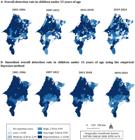
Spatial distribution of the detection rate in children under 15 years of age (A) crude and (B) smoothed for leprosy cases in Maranhão, Brazil, 2001-2024.

Spatial autocorrelation of the detection rate in children under 15 years of age (A) raw and (B) smoothed for leprosy in Maranhão, Brazil, 2001-2024.
The spatiotemporal analysis identified two statistically significant high-risk clusters for leprosy in Maranhão, indicating a non-random spatial distribution of the disease. The primary cluster, encompassing 107 municipalities in the central region between 2006 and 2015, showed a relative risk of 2.24 (p < 0.001), indicating a more than twofold higher risk compared with areas outside the cluster and suggesting sustained transmission over a decade. The secondary cluster, located in the São Luís metropolitan region between 2010 and 2019, presented a relative risk of 1.77 (p < 0.001), revealing the persistence of transmission foci in an urban context. Taken together, these findings point to distinct epidemiological patterns in the state, characterized by widespread risk concentration in inland areas and continued transmission in metropolitan centers, reinforcing the need for territorially targeted leprosy control strategies (Figure 5).

The primary cluster was detected from 2012 to 2021, including 65 municipalities located mainly in the south and center of Maranhão (RR = 1.87; p < 0.005), with a coefficient of mortality of 3.5 deaths per 100,000 inhabitants. One secondary cluster was identified in the eastern area from 2001 to 2009, comprising six municipalities and a coefficient of mortality of 3.6 deaths per 100,000 inhabitants (RR = 1.82; p < 0.005). Another secondary cluster was in the north from 2008 to 2017, covering ten municipalities with a coefficient of mortality of 17.9 deaths per 100,000 inhabitants (RR = 1.86; p < 0.005) (Table 1).
4. Discussion
Maranhão remains one of the areas with the highest leprosy burden in Brazil, characterized by high detection rates and the persistence of hyperendemic spatial patterns. The continued occurrence of high detection rates among individuals under 15 years of age reinforces the existence of ongoing active transmission (Vieira et al., 2018; Sczmanski et al., 2025). Detection in children, in addition to reflecting recent exposure to M. leprae, represents an important epidemiological marker of failures in contact tracing and surveillance activities (Barbosa et al., 2025). In this context, Maranhão has previously been identified as a priority area for the intensification of leprosy control actions due to the high burden observed among children and adolescents (Freitas et al., 2025).
The identification of critical areas where late diagnosis and physical deformities are concentrated allows for more targeted and effective interventions (Lima et al., 2025). This spatially oriented approach has been widely applied to other infectious diseases, such as dengue, tuberculosis, and leishmaniasis, demonstrating its usefulness in identifying transmission clusters and guiding surveillance priorities (Souza et al., 2024a, 2025; Nina et al., 2023).
From a clinical perspective, a predominance of the borderline form was observed, followed by the tuberculoid and indeterminate forms. A higher frequency of multibacillary cases was also identified, suggesting a greater potential for disease transmission within the population. This profile is consistent with findings reported in other hyperendemic areas and is commonly associated with delayed diagnosis, which contributes to increased community transmissibility and a higher risk of physical deformities (Araújo et al., 2024; Sczmanski et al., 2025). Physical deformities have significant social consequences, perpetuating stigma and social exclusion among affected individuals (Sales et al., 2025).
Although the proportion of cases presenting with grade II physical disability has shown a declining trend, it remains high, indicating persistent delays in diagnosis and highlighting one of the main challenges to achieving global leprosy elimination targets (Pina et al., 2025).
The high proportion of cases diagnosed with established physical disabilities reflects shortcomings in early case detection and clinical follow-up. Beyond their epidemiological impact, physical disabilities carry important psychosocial implications, reinforcing stigma and social marginalization (van Wijk et al., 2021).
Strengthening Primary Health Care (SPHC) is essential to expand early diagnosis and improve contact tracing (Martinez et al., 2025). However, substantial structural weaknesses remain, including high turnover of health professionals, limited training of healthcare teams, and underutilization of active surveillance tools (Paz et al., 2022; Barbosa et al., 2025). Beyond addressing the structural limitations of PHC, it is also important to emphasize health promotion and leprosy prevention strategies that can be developed by health services in articulation with broader public policies (Silva et al., 2023).
These strategies include community-based health education, school-based actions aimed at early recognition of signs and symptoms, systematic evaluation and follow-up of household contacts, expansion of active case-finding in priority territories, and initiatives to reduce stigma and discrimination (Barbosa et al., 2025). When integrated with intersectoral policies focused on improving living conditions, reducing social vulnerability, and strengthening local surveillance networks, these actions may contribute to interrupting transmission, promoting earlier diagnosis, and reducing the burden of physical disabilities, especially in hyperendemic settings such as Maranhão.
This study has limitations inherent to secondary data analyses, which are subject to underreporting and incomplete notification forms (Matos et al., 2025). To mitigate these effects, joinpoint regression was applied to identify temporal trends, the local empirical Bayesian method was used to smooth rates, and Kulldorff’s spatial scan statistics were employed to detect primary and secondary clusters.
The identification of spatial and spatiotemporal clusters of leprosy in Maranhão highlights the persistence of high-risk areas and ongoing transmission. These findings indicate that municipalities within these clusters should be prioritized for intensified active case finding and contact tracing. The co-occurrence of these patterns with a high frequency of multibacillary cases and physical disabilities suggests delays in diagnosis and limitations in primary health care performance. Moreover, the spatial concentration of cases points to the role of social determinants in sustaining endemic transmission, underscoring the need for intersectoral strategies and strengthened epidemiological surveillance to support more targeted and effective interventions.
Despite declining trends observed in certain periods, epidemiological indicators in Maranhão, particularly high detection rates among individuals under 15 years of age and the predominance of multibacillary cases, indicate that achieving the elimination targets proposed by the World Health Organization remains a major challenge. In this context, beyond strengthening health services, the development and implementation of sustainable public policies addressing social determinants of health are required, taking into account local and regional specificities to support the elimination of leprosy as a public health problem (Paz et al., 2026). Priority should be given to intensifying health actions targeting individuals under 15 years of age, as cases in this group reflect recent transmission and failures to interrupt the chain of infection.
5. Conclusions
Leprosy remains an important public health challenge in Maranhão, predominantly affecting men, young adults with low educational attainment, and presenting a high proportion of multibacillary forms, particularly the borderline form. Spatial analysis revealed the persistence of hyperendemic clusters, especially in the northern, northeastern, and eastern regions of the state, as well as the identification of high-risk spatiotemporal clusters in the central region, highlighting the focal and resilient nature of transmission. In addition, the spatiotemporal cluster findings reinforce that leprosy in Maranhão is not homogeneously distributed but remains concentrated in specific territories over time, indicating persistent transmission and possible structural gaps in surveillance and control actions. The presence of a large and long-lasting primary cluster in the central region, together with a secondary cluster in a metropolitan area, highlights the coexistence of different epidemiological dynamics, involving both rural and inland settings as well as urban contexts. These patterns suggest the need for differentiated and territorially targeted strategies, including intensified active case finding, systematic contact tracing, and strengthening of Primary Health Care in priority areas, in order to interrupt the transmission chain and reduce the occurrence of physical disabilities associated with delayed diagnosis.
Acknowledgements
The first author acknowledges the Coordenação de Aperfeiçoamento de Pessoal de Nível Superior (CAPES - Process 88887.995248/2024-00), and the Fundação de Amparo à Pesquisa e ao Desenvolvimento Científico e Tecnológico do Maranhão (FAPEMA - BD-02117/23) for granting scholarships to the authors.
Data Availability Statement
The data used in this study are publicly available and were obtained from the Brazilian Ministry of Health through the Notifiable Diseases Information System (SINAN), available via the DATASUS platform (http://datasus.saude.gov.br), and from the Brazilian Institute of Geography and Statistics (IBGE). The processed datasets and the statistical codes used in the analyses are available from the corresponding author upon reasonable request.
References
-
ANSELIN, L., 1995. Local indicators of spatial association-LISA. Geographical Analysis, vol. 27, no. 2, pp. 93-115. https://doi.org/10.1111/j.1538-4632.1995.tb00338.x
» https://doi.org/10.1111/j.1538-4632.1995.tb00338.x -
ARAÚJO, V.E.M., VELOSO, G.A., KERR, L.R.F.S., PESCARINI, J.M., CARDOSO, L.D.M., NAGHAVI, M. and MALTA, D.C., 2024. Leprosy in Brazil: an analysis of the Global Burden of Disease estimates between 1990 and 2019. Public Health, vol. 236, pp. 307-314. https://doi.org/10.1016/j.puhe.2024.07.035 PMid:39288716.
» https://doi.org/10.1016/j.puhe.2024.07.035 -
BARBOSA, C.C., BEZERRA, G.S.N., XAVIER, A.T., OLIVEIRA, A.L.S., MEDEIROS, M.S., BONFIM, C.V.D., MEDEIROS, Z.M. and SOUZA, W.V., 2025. Analysis of the spatial distribution of new cases of leprosy in the State of Pernambuco, Northeast Brazil. Tropical Medicine and Infectious Disease, vol. 10, no. 12, pp. 1-18. https://doi.org/10.3390/tropicalmed10120327 PMid:41441566.
» https://doi.org/10.3390/tropicalmed10120327 -
BRASIL. Ministério da Saúde, 2023 [viewed 13 April 2025]. Protocolo clínico e diretrizes terapêuticas da hanseníase [online]. Brasília. Available from: https://www.gov.br/saude/pt-br/assuntos/saude-de-a-a-z/h/hanseniase/publicacoes/2023-pcdt-hanseniase.pdf
» https://www.gov.br/saude/pt-br/assuntos/saude-de-a-a-z/h/hanseniase/publicacoes/2023-pcdt-hanseniase.pdf -
BRASIL. Ministério da Saúde, 2025 [viewed 20 April 2025]. Boletim epidemiológico de hanseníase [online]. Brasília. Available from: https://www.gov.br/saude/pt-br/centrais-de-conteudo/publicacoes/boletins/epidemiologicos/especiais/2025/boletim-epidemiologico-de-hanseniase-numero-especial-jan-2025.pdf
» https://www.gov.br/saude/pt-br/centrais-de-conteudo/publicacoes/boletins/epidemiologicos/especiais/2025/boletim-epidemiologico-de-hanseniase-numero-especial-jan-2025.pdf -
CABRAL, N., FIGUEIREDO, V., GANDINI, M., SOUZA, C.F., MEDEIROS, R.A., LERY, L.M.S. and PEREIRA, G.M.B., 2022. Modulation of the response to Mycobacterium leprae and pathogenesis of leprosy. Frontiers in Microbiology, vol. 13, pp. 918009. https://doi.org/10.3389/fmicb.2022.918009 PMid:35722339.
» https://doi.org/10.3389/fmicb.2022.918009 -
CALDERONE, A., ALOISI, M.C., CASELLA, C., FIANNACCA, S., COSENZA, B., QUARTARONE, A. and CALABRÒ, R.S., 2024. The neurological impact of leprosy: manifestations and treatment approaches. Neurology International, vol. 16, no. 6, pp. 1492-1508. https://doi.org/10.3390/neurolint16060111 PMid:39585070.
» https://doi.org/10.3390/neurolint16060111 -
CARVALHO, M.S., CÂMARA, G., CRUZ, O.G. and CORREA, V., 2004 [viewed 25 April 2025]. Análise de dados de áreas. In: S. DRUCK, M.S. CARVALHO, G. CÂMARA and A.V.M. MONTEIRO, eds. Análise espacial de dados geográficos [online]. Planaltina: Embrapa, cap. 5. Available from: http://www.dpi.inpe.br/gilberto/livro/analise/cap5-areas.pdf
» http://www.dpi.inpe.br/gilberto/livro/analise/cap5-areas.pdf -
CHAVARRO-PORTILLO, B., SOTO, C.Y. and GUERRERO, M.I., 2023. Mycobacterium leprae’s infective capacity is associated with activation of genes involved in PGL-I biosynthesis in a Schwann cells infection model. International Journal of Molecular Sciences, vol. 24, no. 10, pp. 8727. https://doi.org/10.3390/ijms24108727 PMid:37240073.
» https://doi.org/10.3390/ijms24108727 -
CHEN, X., DI, L., QIAN, M., SHEN, D., FENG, X. and ZHANG, X., 2024. Neurological features of Hansen disease: a retrospective, multicenter cohort study. Scientific Reports, vol. 14, no. 1, pp. 10374. https://doi.org/10.1038/s41598-024-60457-0 PMid:38710787.
» https://doi.org/10.1038/s41598-024-60457-0 -
EIDT, L.M., 2004. Breve história da hanseníase: sua expansão do mundo para as Américas, o Brasil e o Rio Grande do Sul e sua trajetória na saúde pública brasileira. Saúde e Sociedade, vol. 13, no. 2, pp. 76-88. https://doi.org/10.1590/S0104-12902004000200008
» https://doi.org/10.1590/S0104-12902004000200008 -
FREITAS, L.R.S.D., FREITAS, J.A.O.D., PENNA, G.O. and DUARTE, E.C., 2025. Evaluating machine learning models for predicting late leprosy diagnosis by physical disability grade in Brazil (2018-2022). Tropical Medicine and Infectious Disease, vol. 10, no. 5, pp. 2-13. https://doi.org/10.3390/tropicalmed10050131 PMid:40423361.
» https://doi.org/10.3390/tropicalmed10050131 -
FROES JUNIOR, L.A.R., SOTTO, M.N. and TRINDADE, M.A.B., 2022. Leprosy: clinical and immunopathological characteristics. Anais Brasileiros de Dermatologia, vol. 97, no. 3, pp. 338-347. https://doi.org/10.1016/j.abd.2021.08.006 PMid:35379512.
» https://doi.org/10.1016/j.abd.2021.08.006 -
INSTITUTO DE PESQUISA ECONÔMICA APLICADA – IPEA, 2023 [viewed 9 September 2025]. Atlas de Desenvolvimento Humano [online]. Available from: http://ivs.ipea.gov.br/index.php/pt/
» http://ivs.ipea.gov.br/index.php/pt/ -
JESUS, I.L.R.D., MONTAGNER, M.I., MONTAGNER, M.Â., ALVES, S.M.C. and DELDUQUE, M.C., 2023. Leprosy and vulnerability: a scoping review. Ciência & Saúde Coletiva, vol. 28, pp. 143-154. https://doi.org/10.1590/1413-81232023281.09722022
» https://doi.org/10.1590/1413-81232023281.09722022 -
JHA, R.P., DHAMNETIYA, D., BHATTACHARYYA, K. and MEHRA, A., 2024. Secular trends in leprosy burden: comparative insights from India and Brazil in the last three decades using the Global Burden of Disease study data. Leprosy Review, vol. 95, no. 4, e2024067. https://doi.org/10.47276/lr.95.4.2024067
» https://doi.org/10.47276/lr.95.4.2024067 -
LIMA, L.V.D., PAVINATI, G., SILVA, R.G.T.D., QUEIROZ, I.G., OLIVEIRA, G.L.A.D., DURÃES, S.M.B., LÓPEZ, M.A.A., ALVES, K.B.A., BERALDI-MAGALHÃES, F. and MAGNABOSCO, G.T., 2025. Estágio de eliminação da hanseníase em Alagoas, 2001-2022: estudo ecológico. Epidemiologia e Serviços de Saúde: Revista do Sistema Unico de Saúde do Brasil, vol. 34, pp. 1-15. https://doi.org/10.1590/s2237-96222024v34e20240255.en
» https://doi.org/10.1590/s2237-96222024v34e20240255.en -
MACÊDO, M.S., BARBOSA, N.S., ALMEIDA, P.D., MELO, J.O., CARDOSO, J.A. and ARAÚJO, T.M.E., 2024. Primary health care professionals’ practice in the face of leprosy: a scoping review. Revista Brasileira de Enfermagem, vol. 77, no. 2, e20230207. https://doi.org/10.1590/0034-7167-2023-0207
» https://doi.org/10.1590/0034-7167-2023-0207 -
MACKERT, C.C.O., LÁZARO, F.P., OLANDOWSKI, M., D’ESPINDULA, H.R.S., SANTOS, A.M., SARTORI, P.V.U. and MIRA, M.T., 2025. Insights into leprosy epidemiology from an isolated population located in the Brazilian Amazon. Scientific Reports, vol. 15, no. 1, pp. 6103. https://doi.org/10.1038/s41598-025-90399-0 PMid:39971783.
» https://doi.org/10.1038/s41598-025-90399-0 -
MARTINEZ, A.B.R., SANTOS, J.M., COSTA, H.B., PALÁCIO, M.A.V., CORREIA, M.L.D.C. and TAKENAMI, I., 2025. Trends and clinical profile of leprosy cases in children and adolescents under 15 years old in inland Bahia, Brazil.Rev. Contexto & Saúde, vol. 25, no. 50, pp. 1-11. https://doi.org/10.21527/2176-7114.2025.50.15390
» https://doi.org/10.21527/2176-7114.2025.50.15390 -
MATOS, T.S., SOUZA, C.D.F., FERNANDES, T.R.M.O., SANTOS, M.B., BRITO, R.J.V.C., MATOS, D.U.S., CARMO, R.F. and SILVA, T.F.A., 2025. Time trend and identification of risk areas for physical disability due to leprosy in Brazil: an ecological study, 2001-2022. BMC Infectious Diseases, vol. 25, no. 1, pp. 1-11. https://doi.org/10.1186/s12879-025-10586-2 PMid:40050792.
» https://doi.org/10.1186/s12879-025-10586-2 -
MORAN, P.A.P., 1948. The interpretation of statistical maps. Journal of the Royal Statistical Society. Series B, Statistical Methodology, vol. 10, no. 2, pp. 243-251. https://doi.org/10.1111/j.2517-6161.1948.tb00012.x
» https://doi.org/10.1111/j.2517-6161.1948.tb00012.x -
NINA, L.N.S., CALDAS, A.D.J.M., SOEIRO, V.M.S., FERREIRA, T.F., SILVA, T.C. and RABELO, P.P.C., 2023. Spatial-temporal distribution of visceral leishmaniasis in Brazil from 2007 to 2020. Revista Panamericana de Salud Pública = Pan American Journal of Public Health, vol. 47, pp. 1-10. https://doi.org/10.26633/RPSP.2023.160 PMid:38024446.
» https://doi.org/10.26633/RPSP.2023.160 -
PAZ, W.S., SOUZA, M.D.R., TAVARES, D.D.S., JESUS, A.R., SANTOS, A.D., CARMO, R.F., SOUZA, C.D.F. and BEZERRA-SANTOS, M., 2022. Impact of the COVID-19 pandemic on the diagnosis of leprosy in Brazil: an ecological and population-based study. Lancet Regional Health. Americas, vol. 9, pp. 1-10. https://doi.org/10.1016/j.lana.2021.100181 PMid:35072147.
» https://doi.org/10.1016/j.lana.2021.100181 -
PAZ, W.S., REIS, E.S., SANTOS, M.B. and XIMENES, R.A.A., 2026. Temporal trends and identification of risk areas related to the burden of leprosy in Brazil: an ecological study from 2001 to 2021. Clinical and Experimental Dermatology, vol. 51, no. 5, pp. 853-861. https://doi.org/10.1093/ced/llaf508
» https://doi.org/10.1093/ced/llaf508 -
PINA, W.L.D.S.M., MELO, L.F.D.A., ROCHA, H.N.D., MOURA, J.D., LUZ, L.L., SILVA, L.S., CARVALHO, S.C.C. and SANTOS, G.M.C., 2025. Determinants of delayed leprosy diagnosis in an endemic area of northeast Brazil: a cross-sectional study. Revista da Sociedade Brasileira de Medicina Tropical, vol. 58, pp. 1-9. https://doi.org/10.1590/0037-8682-0230-2025 PMid:41417342.
» https://doi.org/10.1590/0037-8682-0230-2025 -
RIBEIRO, D.M., LIMA, B.V.M., MARCOS, E.A.C., SANTOS, M.D., OLIVEIRA, D.V., ARAÚJO, M.D. and SILVA, C.D., 2022. Epidemiological overview of leprosy, neglected tropical disease that plagues northeast Brazil. Research, Society and Development, vol. 11, no. 1, e23111124884. https://doi.org/10.33448/rsd-v11i1.24884
» https://doi.org/10.33448/rsd-v11i1.24884 -
SALES, J.K.D., SILVA, K.N., MARTINS, A.K.L., LOPES, M.D.S.V., TAVARES, C.M. and CAVALCANTE, E.G.R., 2025. Educational technologies to promote self-care in people affected by leprosy: a systematic review. Aquichan, vol. 25, no. 1, pp. 1-20. https://doi.org/10.5294/aqui.2025.25.1.3
» https://doi.org/10.5294/aqui.2025.25.1.3 -
SANTACROCE, L., DEL PRETE, R., CHARITOS, I.A. and BOTTALICO, L., 2021. Mycobacterium leprae: a historical study on the origins of leprosy and its social stigma. Le Infezioni in Medicina, vol. 29, no. 4, pp. 623-632. https://doi.org/10.53854/liim-2904-18 PMid:35146374.
» https://doi.org/10.53854/liim-2904-18 -
SANTOS, L.A.C., FARIA, L. and MENEZES, R.F., 2008. Contrapontos da história da hanseníase no Brasil: cenários de estigma e confinamento. Revista Brasileira de Estudos de População, vol. 25, no. 1, pp. 167-190. https://doi.org/10.1590/S0102-30982008000100010
» https://doi.org/10.1590/S0102-30982008000100010 -
SCZMANSKI, A.S., PAZIN, L., SAKAE, T.M. and MAZON, J., 2025. Analysis of the clinical and epidemiological profile of leprosy in Brazil and Major Regions. Anais Brasileiros de Dermatologia, vol. 100, no. 4, pp. 1-8. https://doi.org/10.1016/j.abd.2025.501127 PMid:40554354.
» https://doi.org/10.1016/j.abd.2025.501127 -
SILVA, J.C., OLIVEIRA, R.A., SANTOS, L.F.S., PASCOAL, L.M., SANTOS, F.S., COSTA, A.C.P.J., DIAS, I.C.C.M., ROLIM, I.L.T.P., FONTOURA, I.G., GORDON, A.S.A., LOBATO, J.S.M., SANTOS, F.A.A.S., BEZERRA, J.M., FONTOURA, V.M., RAMOS, A.C.V., SANTOS, L.H. and SANTOS-NETO, M., 2023. Factors associated with multibacillary leprosy in a region of northeastern Brazil. Journal of Infection in Developing Countries, vol. 17, no. 6, pp. 846-853. https://doi.org/10.3855/jidc.17284 PMid:37406066.
» https://doi.org/10.3855/jidc.17284 -
SOUSA, J.R., SOTTO, M.N. and SIMÕES-QUARESMA, J.A., 2017. Leprosy as a complex infection: breakdown of the Th1 and Th2 immune paradigm in the immunopathogenesis of the disease. Frontiers in Immunology, vol. 8, pp. 1635. https://doi.org/10.3389/fimmu.2017.01635 PMid:29234318.
» https://doi.org/10.3389/fimmu.2017.01635 -
SOUZA, F.E.A., SILVA, A.C., CASTRO, P.A.S.V., GOMES, H.C.A. and BEZERRA, J.M.T., 2024a. Epidemiological profile and spatial analysis of probable cases of dengue registered from 2010 to 2021 in the state of Maranhão. Revista de Patologia Tropical, vol. 53, no. 2, pp. 73-89. https://doi.org/10.5216/rpt.v53i2.76833
» https://doi.org/10.5216/rpt.v53i2.76833 -
SOUZA, G.C., OLIVEIRA, P.S., ARAUJO, P.N., SANTOS, F.L., SILVA, J.P., SANTOS, K.D.S. and FORTUNA, C.M., 2024b. Experiences of social stigma of people living with Hansen’s disease in Brazil: silencing, secrets and exclusion. International Health, vol. 16, no. 16, suppl. 1, pp. i60-i67. https://doi.org/10.1093/inthealth/ihae005 PMid:38547345.
» https://doi.org/10.1093/inthealth/ihae005 - SOUZA, N.K.M., MACHADO, L.D.S., ALVES, D.F., SILVA FILHO, L.A.D. and SILVA, V.M.D., 2025. Persistência temporal e espacial de casos de tuberculose nos municípios brasileiros entre 2001 e 2022. Ciência & Saúde Coletiva, vol. 30, no. 7, e15972023. https://doi.org/10.1590/1413-81232025307.15972023.
-
VAN WIJK, R., VAN SELM, L., BARBOSA, M.C., VAN BRAKEL, W.H., WALTZ, M. and PUCHNER, K.P., 2021. Psychosocial burden of neglected tropical diseases in eastern Colombia: an explorative qualitative study in persons affected by leprosy, cutaneous leishmaniasis and Chagas disease. Global Mental Health, vol. 8, e21. https://doi.org/10.1017/gmh.2021.18 PMid:34249368.
» https://doi.org/10.1017/gmh.2021.18 -
VENÂNCIO, C.D.L., ANDRADE, S.M.D. and ROSA, L.M., 2023. Epidemiological analysis of leprosy in the state of Maranhão, Brazil. Diversitas Journal, vol. 8, no. 4, pp. 3065-3075. https://doi.org/10.48017/dj.v8i4.2716
» https://doi.org/10.48017/dj.v8i4.2716 -
VIEIRA, M.C.A., NERY, J.S., PAIXÃO, E.S., FREITAS DE ANDRADE, K.V., OLIVEIRA PENNA, G. and TEIXEIRA, M.G., 2018. Leprosy in children under 15 years of age in Brazil: a systematic review of the literature. PLoS Neglected Tropical Diseases, vol. 12, no. 10, pp. 1-13. https://doi.org/10.1371/journal.pntd.0006788 PMid:30278054.
» https://doi.org/10.1371/journal.pntd.0006788 -
WORLD HEALTH ORGANIZATION – WHO, 2025 [viewed 20 April 2025]. Leprosy (Hansen disease) [online] Geneva. Available from: https://www.who.int/data/gho/data/themes/topics/leprosyhansensdisease
» https://www.who.int/data/gho/data/themes/topics/leprosyhansensdisease
Edited by
-
Editor:
Takako Matsumura Tundisi


