 Development of tuberous roots and yield of cassava in response to potassium topdressing rates in Northwestern Paraná, Brazil
Abstract
Potassium fertilization is essential for cassava cultivation, especially in sandy soils with low nutrient availability. This study aimed to evaluate the growth, development, and yield of cassava in response to increasing rates of potassium chloride (60% K2O), as well as to assess the feasibility of applying higher rates. The experiment was carried out in a randomized block design with four replications and five treatments: T1 – no potassium fertilization; T2 – 200 kg ha−1 of KCl applied 45 days after planting; T3 – 200 kg ha−1 of KCl at 45 days plus 200 kg ha−1 at 90 days after planting; T4 – 267 kg ha−1 of KCl at 45 days; and T5 – 267 kg ha−1 of KCl at 45 days plus 267 kg ha−1 at 90 days after planting. Five plants were harvested per plot to determine the number and mass (kg) of tuberous roots, allowing estimation of the total number of roots per hectare and yield (kg ha−1). From each harvested plant, one root was randomly selected for measuring length (cm) and diameter (cm). Starch content (g kg−1) was determined using the hydrostatic balance method. No significant differences among treatments were observed for root length, diameter, or starch content. However, treatments with 200 kg ha−1 of KCl (T2 and T3) showed higher root numbers per hectare and yield compared with the others. The management with doubled potassium rates was not economically feasible, since the productivity gain did not offset the increased fertilizer cost.
Keywords:
Manihot esculenta; potassium fertilization; topdressing
Resumo
A adubação potássica é essencial para o cultivo da mandioca, especialmente em solos arenosos com baixa disponibilidade de nutrientes. Este estudo teve como objetivo avaliar o crescimento, o desenvolvimento e a produtividade da mandioca em resposta a doses crescentes de cloreto de potássio (60% de K2O), bem como verificar a viabilidade da aplicação de doses mais elevadas. O experimento foi conduzido em delineamento em blocos ao acaso, com quatro repetições e cinco tratamentos: T1 – sem adubação potássica; T2 – 200 kg ha−1 de KCl aplicados 45 dias após o plantio; T3 – 200 kg ha−1 de KCl aos 45 dias mais 200 kg ha−1 aos 90 dias após o plantio; T4 – 267 kg ha−1 de KCl aos 45 dias; e T5 – 267 kg ha−1 de KCl aos 45 dias mais 267 kg ha−1 aos 90 dias após o plantio. Cinco plantas foram colhidas por parcela para determinar o número e a massa (kg) de raízes tuberosas, permitindo estimar o número total de raízes por hectare e a produtividade (kg ha−1). De cada planta colhida, uma raiz foi selecionada aleatoriamente para medição do comprimento (cm) e do diâmetro (cm). O teor de amido (g kg−1) foi determinado pelo método da balança hidrostática. Não foram observadas diferenças significativas entre os tratamentos para comprimento de raiz, diâmetro ou teor de amido. No entanto, os tratamentos com 200 kg ha−1 de KCl (T2 e T3) apresentaram maior número de raízes por hectare e maior produtividade em comparação com os demais. O manejo com doses dobradas de potássio não se mostrou economicamente viável, pois o ganho de produtividade não compensou o aumento no custo do fertilizante.
Palavras chave:
Manihot esculenta; adubação potássica; cobertura
1. Introduction
Cassava is a rustic crop well adapted to environments with edaphoclimatic variability due to its broad genetic diversity. However, commercial cassava cultivation in Brazil has not yet reached the same technological level as major crops such as soybean and maize, resulting in relatively low yields compared with the world’s leading producers (Nunes et al., 2020). Studies involving cassava-associated systems highlight the importance of biological and environmental interactions affecting crop performance (Ramírez-Camejo et al., 2022).
In Northwestern Paraná, cassava is the main alternative for the renewal of degraded pastures, often cultivated under lease agreements and encouraged by the large number of starch processing industries established in the region. The crop represents an important agricultural option because of its strong adaptability to sandy soils and local edaphoclimatic conditions (Fidalski, 1999). Cassava performs better in sandy or medium-textured soils, which favor root development, yield, and ease of harvest (Fialho and Vieira, 2011).
Although cassava is tolerant to low soil fertility, adequate fertilization is necessary since the crop exports considerable amounts of nutrients through roots, stems used for propagation, and even aerial parts employed for animal feeding (Thomas et al., 2016). Among the exported nutrients, potassium is the most required element, being absorbed and removed in the greatest quantities (Gazola, 2017). Studies on nutrient dynamics in cropping systems reinforce the importance of proper nutrient supply for plant development (Costa et al., 2023).
In the plant, potassium occurs as a monovalent cation (K+) and plays a key role in osmotic regulation, besides being essential for the activation of several enzymes involved in respiration and photosynthesis (Taiz and Zeiger, 2013). In cassava, potassium deficiency leads to reduced growth and vigor, shortened internodes, and smaller petioles and leaves. Under severe deficiency, reddish spots, yellowing, and necrosis appear on the edges of lower leaves, which prematurely age and fall. The upper branches may show necrosis and fine streaks on petioles (Otsubo and Lorenzi, 2002).
In addition to high nutrient export, potassium losses through erosion and leaching are not fully compensated by fertilization, which compromises crop productivity (Malavolta, 2006). Soil texture strongly influences potassium retention capacity, with clayey soils retaining more of the nutrient (Wu et al., 2011). In contrast, sandy soils exhibit greater potassium loss, especially in the presence of calcium, which competes for cation exchange sites due to its bivalent nature (Ca2+) and higher ionic strength. Large-scale studies on nutrient cycling also demonstrate the relevance of nutrient losses and balances in tropical environments (Martinelli et al., 2012).
For yields above 40 t ha−1, potassium fertilization is recommended at 121 to 160 kg ha−1 of K2O for soils with low potassium levels (0.06-0.12 cmolc dm−3) (Pavinato et at., 2017). In an experiment using potassium chloride at rates of 0, 20, 40, and 60 kg ha−1 of K2O, divided into up to three applications, observed no significant differences in root yield (Rós, 2013). A linear increase in cassava yield with increasing K2O rates, averaging a yield gain of 167 kg ha−1 per kilogram of K2O applied, with a maximum yield of 62.9 t ha−1 at 240 kg ha−1 of K2O (Uchôa et al., 2014). Positive effects were also observed on the harvest index, starch content, and flour yield, which showed quadratic responses to potassium rates.
Several potassium fertilizers can be used for cassava; however, potassium chloride (KCl) is the most common worldwide due to its high K2O concentration (60%) and low cost per nutrient unit (Ernani et al., 2007). Nevertheless, its high salt index can negatively affect germination and early plant growth.
Therefore, this study aimed to evaluate the management of potassium fertilization rates applied as topdressing on cassava growth and yield in sandy soil conditions in Northwestern Paraná, Brazil.
2. Material and Methods
The experiment was carried out in a commercial field located at 23°43’42.55”S and 53°21’40.77”W, at an elevation of 394 m, in the municipality of Umuarama, Paraná State, Southern Brazil. According to the Köppen climate classification, the regional climate is Cfa – humid subtropical mesothermic, characterized by hot summers and mild winters with rare frosts, an annual mean temperature of 22.1 °C, and average rainfall between 1,400 mm and 1,600 mm (Umuarama, 2020).
According to the Municipal Basic Sanitation Plan, Umuarama is entirely situated on the Caiuá Sandstone Formation, where sandy soils predominate, with sand content equal to or greater than 75%. The soil of the experimental area was classified as a Typic Dystrophic Red Latosol (Oxisol), according to the Brazilian Soil Classification System (EMBRAPA, 2025).
The farmer applied 1,240 kg ha−1 of dolomitic limestone in October 2021. In March 2022, pearl millet (Pennisetum glaucum) was planted as a cover crop and later harvested for silage. In July of the same year, soil preparation was carried out with a leveling harrow followed by subsoiling. Before setting up the experiment, soil samples were collected from the 0-20 cm layer for chemical and particle-size analyses (Table 1).
The particle-size analysis indicated that the experimental soil had a sandy texture. Based on the chemical analysis, the base saturation (V%) was higher than the level recommended for cassava, which is 50% (Pavinato et al., 2017). This elevated V% was mainly due to the high levels of calcium (Ca2+) and magnesium (Mg2+) in the cation exchange capacity (CEC).
The pH value indicated a condition of moderate acidity suitable for cassava. That cassava tolerates soil acidity better than crops such as soybean and maize, maintaining relatively high productivity even under low pH and aluminum presence. This tolerance is likely a result of long-term domestication and selection of genotypes adapted to acidic soils.
However, the soil analysis revealed a base imbalance (Ca, Mg, and K) due to the low potassium content (0.12 cmolc dm−3), corresponding to only 1.20% of the CEC. Potassium equilibrium in the CEC should range from 0.22 to 0.45 cmolc dm−3, as determined by the Mehlich-1 extraction method. The high levels of Ca2+ and Mg2+, both with greater ionic strength and affinity for exchange sites than K+, likely reduced potassium retention in the soil. Therefore, the prior application of 1,240 kg ha−1 of dolomitic limestone may have been unnecessary.
The experiment was arranged in a randomized block design (RBD) with five treatments and four replications. Each experimental plot consisted of four planting rows, each 4 m long and spaced 0.90 m apart (14.4 m2 per plot; 288 m2 total experimental area), with 0.5 m between plants, totaling 32 plants per plot and an estimated plant population of 22,222 plants ha−1.
Planting was carried out on August 12, 2022, using the IPR B36 cultivar. A basal application of 140 kg ha−1 of monoammonium phosphate (MAP) was performed. Potassium rates were established according to the Fertilization and Liming Manual for the State of Paraná, considering the recommended range of 121-160 kg ha−1 of K2O. Potassium chloride (KCl – 60% K2O) was used as the potassium source and applied as topdressing.
The treatments consisted of a control without potassium fertilization, 200 kg ha−1 of KCl applied 45 days after planting, 200 kg ha−1 of KCl applied at 45 days plus another 200 kg ha−1 at 90 days, 267 kg ha−1 of KCl applied 45 days after planting, and 267 kg ha−1 of KCl applied at 45 days plus another 267 kg ha−1 at 90 days after planting. Applications were carried out on September 25, 2022 (45 days) and November 9, 2022 (90 days).
The decision to apply the same rates at two different times, effectively doubling the recommendation rather than splitting the application, was made to evaluate cassava’s response to high K2O rates, considering the sandy texture and low cation retention capacity of the soil.
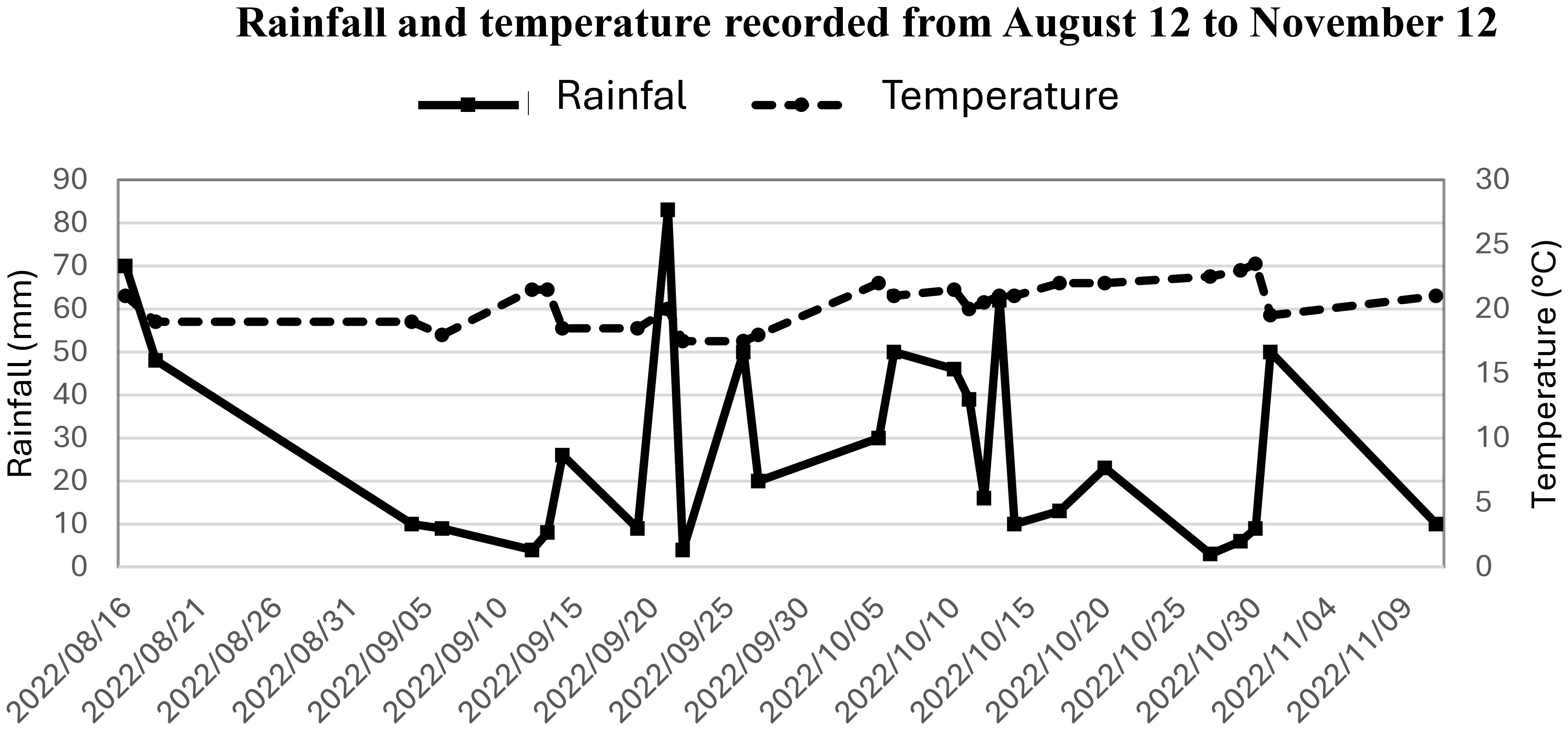
During the first three months after planting, the accumulated rainfall reached 716.4 mm, a condition that greatly affects potassium solubility and leaching (Figure 1). Because KCl contains highly soluble salts, it rapidly releases K+ into the soil solution, increasing leaching potential, particularly in sandy soils with low CEC (Raij, 2011). The potassium mobility in the soil profile is enhanced by its high water solubility, underscoring the importance of proper fertilization management (Araujo et al., 2016).
During the experiment, weed control was performed through three manual hoeings carried out until row canopy closure. Two insecticide applications were conducted to control the cassava hornworm (Erinnyis ello), using the commercial product Kaiso 250 CS (Lambda-cyhalothrin – 250 g L−1).
The harvest took place on July 6, 2023, approximately 11 months after planting. For the evaluations, the two central rows of each plot were considered as the useful area, excluding the border rows and 0.5 m at both ends of each plot.
The evaluated variables included: number of tuberous roots (NR), root length (RL, cm), root diameter (RD, cm), starch content (SC, g kg−1), and total root mass (TRM, kg), the latter being used to estimate yield (t ha−1).
For each plot, five plants were randomly harvested, and data for NR and TRM were collected. From each plant, one root was randomly selected to measure RL and RD. For starch content (SC), roots from each plot were sampled to form 5-kg composite samples, analyzed using the hydrostatic balance method.
This method is widely employed in starch-processing industries to determine the dry matter content of cassava roots through specific gravity (Pola et al., 2020). Although not the most precise technique, the simplicity and practicality of the hydrostatic balance method make it a common choice in cassava processing plants (Carvalho et al., 2007).
After weighing the 5-kg sample, the roots were placed in a metal basket suspended by three rods attached to the balance base. The basket was then immersed in a water drum, and the measured submerged weight was directly proportional to the starch (dry matter) content of the sample, as the water displacement correlates with root density.
The data obtained were subjected to analysis of variance (ANOVA), and treatment means were compared using the LSD test (Least Significant Difference) at the 5% probability level, with statistical analyses performed using the Sisvar software (Ferreira, 2011).
3. Results
As shown in the analysis of variance summary (Table 2), potassium rates and application times did not significantly affect, at the 5% probability level by the LSD test, the variables tuber length, tuber diameter, and starch content.
Mean tuber length (cm), mean tuber diameter (cm), and starch content (g kg−1) of cassava roots as a function of potassium fertilization management.
For the variables NR (number of roots) and MTR (mean total roots), which were converted into total number of roots per hectare and yield, respectively, treatments T2 and T3, consisting of the minimum rate (121 kg ha−1 of K2O) applied once and twice, showed significant effects (Table 3).
Total number of roots per hectare and yield (t ha−1) of cassava roots as a function of potassium fertilization management.
The mean yield of all treatments exceeded the average yield in Paraná in 2022, which was approximately 23 t ha−1.
When the relationship between investment and productivity was considered, it was observed that although T3 showed a 5.92% increase in yield compared to T2, the practice of splitting the rate at 90 days after planting was not economically viable, due to the doubling of cost.
The cost of potassium chloride at the time of application was R$ 1,092.00 ha−1 for T2 and R$ 2,184.00 ha−1 for T3.
Furthermore, Table 3 shows that treatments T4 and T5, with the maximum rate, resulted in no statistical difference in yield compared to the treatment without potassium fertilization (T1).
4. Discussion
The results obtained in this study are consistent with performed potassium fertilization in the planting row using KCl and found that plant density, number of roots per plant, root length, root diameter, and starch content were not affected by potassium management (Paganini et al., 2013).
Also found no significant differences in root length and diameter when applying 40 kg ha−1 of K2O at 180 days after planting (Costa et al., 2020).
The application of 0, 30, 60, and 90 kg ha−1 of K2O as topdressing, 45 days after planting, produced no significant differences among treatments (Paganini et al., 2012). In contrast reported a quadratic increase in starch content in response to K2O rates (0, 30, 60, 120, and 240 kg ha−1) applied at planting and as topdressing at 30 and 60 days after planting (Uchôa et al., 2014).
With respect to root diameter, a linear increase as a function of potassium rates, using potassium chloride at 30 and 60 kg ha−1 of K2O incorporated into the planting furrow, and 120 kg ha−1 of K2O split (60 kg at planting and 60 kg as topdressing) (Paz, 2019).
A decreasing linear effect for rates of 45, 90, and 180 kg ha−1 of K2O combined with four splitting schemes (Gazola, 2017). The author noted that split applications of potassium between planting and 90 days after planting promoted greater root diameter compared to single applications.
The present results are also similar to those reported a 35% increase in the number of roots with the highest rate (240 kg ha−1 of K2O) (Sousa, 2014). Likewise, observed an increase in the number of tuberous roots up to a rate of 52 kg ha−1 of K2O (Gonçalves, 2018).
No increase in total root yield with topdressing rates up to 60 kg ha−1 of K2O, attributing this to the high initial soil K content (3.1 mmolc dm3) (Rós, 2013).
Number of tuberous roots in cassava is defined mainly during the first 120 days after planting (Lorenzi, 2003), when intense carbohydrate accumulation occurs (Alves, 2006).
Yield increases in two consecutive years, with a quadratic response up to approximately 110 kg ha−1 of K2O in the first year and a linear response to split applications between planting and 45 days after planting in the second year (Gazola, 2017).
Applying KCl in topdressing at 0, 30, 60, and 90 kg ha−1 of K2O, found no significant yield increase in cassava (Silva et al., 2013).
The lack of significant differences between the maximum-rate and unfertilized treatments (T4, T5, and T1) may be related to the high salinity of potassium chloride, can reduce the osmotic potential near the rhizosphere, impairing root development and nutrient and water uptake (Paz, 2019).
Although potassium fertilization may increase cassava yield, literature findings remain contradictory. Stated that cassava shows low response to potassium fertilization, as it is a crop adapted to low-fertility soils (Howeler, 2002) Cassava response tends to be low in the first cropping cycles but increases in subsequent ones (Souza and Fialho, 2003).
Nonetheless, even if immediate responses are limited, potassium fertilization is essential to prevent soil K depletion (Mattos and Bezerra, 2003).
Reinforced this view by reporting significant reductions in soil K levels after cassava harvests in Northwestern Paraná, even when no yield increases were observed, due to cassava’s high K extraction capacity (Fidalski, 1999).
Finally, further studies involving different potassium rates and application methods are required to establish more accurate and sustainable management strategies for cassava fertilization.
5. Conclusions
The length and diameter of the tuberous roots, as well as the starch content, were not affected by potassium topdressing.
Potassium fertilization at a rate of 121 kg ha−1 of K2O applied as a topdressing increased the total number of roots per hectare and crop yield. However, the same rate applied twice, at 45 and 90 days after planting, was not economically viable, as the cost-to-yield ratio indicated that the single application (at 45 DAP) was more profitable.
Acknowledgements
This study was financed in part by the Coordenação de Aperfeiçoamento de Pessoal de Nível Superior (CAPES, Finance Code 001) and the Conselho Nacional de Desenvolvimento Científico e Tecnológico (CNPq) - Processo Nº 302923/2022-5 - Bolsa de produtividade em pesquisa - Chamada CNPq Nº 09/2022.
Data Availability Statement
The research data is available upon prior request via email to the corresponding author.
References
-
ALVES, A.A.C., 2006 [viewed 10 November 2023]. Fisiologia da mandioca. In: L.S. SOUZA, A.R.N. FARIAS, P.L.P. MATTOS and W.M.G. FUKUDA, eds. Aspectos socioeconômicos e agronômicos da mandioca [online]. Cruz das Almas: Embrapa Mandioca e Fruticultura Tropical, pp. 138-169. Available from: https://www.infoteca.cnptia.embrapa.br/infoteca/bitstream/doc/1152564/1/Fisiologia-da-mandioca.pdf
» https://www.infoteca.cnptia.embrapa.br/infoteca/bitstream/doc/1152564/1/Fisiologia-da-mandioca.pdf -
ARAÚJO, Y.R., SOUZA, C.A., ARAÚJO-NETO, J.R., RIBEIRO-FILHO, J.C. and LIMA, J.W.C., 2016 [viewed 10 November 2023]. Nutrient loss and erosion cost in small watersheds of the Brazilian semiarid region. Revista Geonorte [online], vol. 7, pp. 206-219. Available from: https://www.periodicos.ufam.edu.br/index.php/revista-geonorte/article/view/2768/2461
» https://www.periodicos.ufam.edu.br/index.php/revista-geonorte/article/view/2768/2461 -
CARVALHO, P.R.N., MEZZETTE, T.F., VALLE, T.L., CARVALHO, C.L.R. and FELTRAN, J.C., 2007 [viewed 10 November 2023]. Evaluation of the accuracy, precision and robustness of the hydrostatic balance method for determining dry matter in cassava (Manihot esculenta Crantz). Revista Raízes e Amidos Tropicais [online], vol. 3, pp. 1-4. Available from: https://revistas.fca.unesp.br/index.php/rat/article/view/1313/636
» https://revistas.fca.unesp.br/index.php/rat/article/view/1313/636 -
COSTA, K.S.Q., SILVA, J.A. and OLIVEIRA, F.A., 2023. Growth and production of cowpea beans under potassium fertilization. Brazilian Journal of Biology, vol. 83, e273777. https://doi.org/10.1590/1519-6984.273777 PMid:37970900.
» https://doi.org/10.1590/1519-6984.273777 -
COSTA, R.M., GONZAGA, K.S., BOTELHO, I.G.S.O., BARRETO, S.S.C., CARTAXO, P.H., SANTOS, J.P.O. and MIELEZRSKI, F., 2020. Cassava yield in response to spacing and potassium topdressing in the Paraíba uplands. Revista Desafios, vol. 7, pp. 46-53. https://doi.org/10.20873/uftv7-8776
» https://doi.org/10.20873/uftv7-8776 -
EMPRESA BRASILEIRA DE PESQUISA AGROPECUÁRIA – EMBRAPA, 2025 [viewed 10 November 2023]. Sistema Brasileiro de Classificação de Solos [online]. 6. ed. Brasília. Available from: https://www.infoteca.cnptia.embrapa.br/infoteca/bitstream/doc/1176834/1/Sistema-Brasileiro-de-Classificacao-de-Solos-2025.pdf
» https://www.infoteca.cnptia.embrapa.br/infoteca/bitstream/doc/1176834/1/Sistema-Brasileiro-de-Classificacao-de-Solos-2025.pdf - ERNANI, P.R., ALMEIDA, J.A. and SANTOS, F.C., 2007. Potassium. In: R.F. NOVAIS, V.H.V. ALVAREZ, N.F. BARROS, R.L.F. FONTES, R.B. CANTARUTTI and J.C.L. NEVES, eds. Soil fertility Viçosa: Sociedade Brasileira de Ciência do Solo, 1017 p.
-
FERREIRA, D.F., 2011. Sisvar: a computer statistical analysis system. Ciência e Agrotecnologia, vol. 35, no. 6, pp. 1039-1042. https://doi.org/10.1590/S1413-70542011000600001
» https://doi.org/10.1590/S1413-70542011000600001 -
FIALHO, J.F. and VIEIRA, E.A., 2011 [viewed 10 November 2023]. Cassava in the Cerrado: technical guidelines [online]. Planaltina: Embrapa Cerrados, 208 p. Available from: https://www.infoteca.cnptia.embrapa.br/bitstream/doc/981357/1/fialho02.pdf
» https://www.infoteca.cnptia.embrapa.br/bitstream/doc/981357/1/fialho02.pdf -
FIDALSKI, J., 1999. Cassava response to NPK and liming in sandy soils of Northwest Paraná, Brazil. Pesquisa Agropecuária Brasileira, vol. 34, pp. 1353-1359. https://doi.org/10.1590/S0100-204X1999000800005
» https://doi.org/10.1590/S0100-204X1999000800005 - GAZOLA, B., 2017. Produtividade e cozimento da mandioca cultivar IAC 576-70 em resposta à adubação potássica em solo arenoso. Botucatu: Universidade Estadual Paulista, 93 p. Dissertação de Mestrado em Agronomia.
- GONÇALVES, Y.S., 2018. Fontes e doses de potássio na produtividade e qualidade da mandioca de mesa. Campos dos Goytacazes: Universidade Estadual do Norte Fluminense Darcy Ribeiro, 46 p. Dissertação de Mestrado em Produção Vegetal.
- HOWELER, R.H., 2002. Cassava mineral nutrition and fertilization. In: R.J. HILLOCKS, J.M. THRESH and A. BELLOTTI, eds. Cassava: biology, production and utilization. Wallingford: CABI Publishing, pp. 115-147.
- LORENZI, J.O., 2003.Cassava. Campinas: CATI, 110 p. Technical Bulletin, no. 245.
- MALAVOLTA, E., 2006.Manual of mineral nutrition of plants São Paulo: Agronômica Ceres, 631 p.
-
MARTINELLI, L.A., NAYLOR, R., VITOUSEK, P.M. and MOUTINHO, P., 2012. Nitrogen mass balance in the Brazilian Amazon: an update. Brazilian Journal of Biology, vol. 72, no. 3, suppl., pp. 683-690. https://doi.org/10.1590/S1519-69842012000400007 PMid:23011298.
» https://doi.org/10.1590/S1519-69842012000400007 -
MATTOS, P.L.P. and BEZERRA, V.S., 2003 [viewed 12 November 2023]. Cassava cultivation for the State of Amapá [online]. Embrapa Cassava and Fruit Production Systems, no. 2. Available from:http://sistemasdeproducao.cnptia.embrapa.br/FontesHTML/Mandioca/mandioca_amapa/adubacao.htm
» http://sistemasdeproducao.cnptia.embrapa.br/FontesHTML/Mandioca/mandioca_amapa/adubacao.htm - NUNES, E.C., MARCHESI, D.R. and BACK, A.J., 2020. Soil fertility management for cassava: technical bases and manual of the AdubaMANÍ-SC program. Florianópolis: Epagri, 40 p.
-
OTSUBO, A.A. and LORENZI, J.O., 2002 [viewed 10 November 2023]. Cassava cultivation in the South-Central region of Brazil [online]. Dourados: Embrapa, 116 p. Available from: https://www.infoteca.cnptia.embrapa.br/infoteca/bitstream/doc/247449/1/SP20046.pdf
» https://www.infoteca.cnptia.embrapa.br/infoteca/bitstream/doc/247449/1/SP20046.pdf - PAGANINI, T.P., DANIEL, V.C., JESUS, M.H., MIRON, G.A., MACIEL, D.M., SOUZA, J.E., SILVA, A.S. and POLETTO, N., 2012. Leaf development, root yield and starch content of cassava cultivated with lime, organic and potassium fertilization. Revista Técnico-Científica do IFSC, vol. 3, pp. 357-363.
-
PAGANINI, T.P., SOUZA, J.E., ZACCARON, J.B., DUART, A.M., DUART, V.M. and POLETTO, N., 2013 [viewed 10 November 2023]. Efeito da adubação potássica nas variáveis de planta da cultura da mandioca cultivada no extremo sul catarinense. In:Anais do 2º Simpósio de Integração Científica e Tecnológica do Sul Catarinense [online], 2013, Araranguá, SC. Florianópolis: IFSC, vol. 1, p. 697. Available from: https://periodicos.ifsc.edu.br/index.php/rtc/article/view/1220/709
» https://periodicos.ifsc.edu.br/index.php/rtc/article/view/1220/709 - PAVINATO, P.S., PAULETTI, V., MOTTA, A.C.V. and MOREIRA, A. 2017. Manual of liming and fertilization for the state of Paraná. Curitiba: SBCS/NEPAR, 482 p.
-
PAZ, R.B.O., 2019 [viewed 10 November 2023]. Potassium fertilization and agronomic performance of table cassava cultivars in a Cerrado environment. Jatai: Universidade Federal de Goiás, 40 p. Dissertação de Mestrado em Agronomia. Available from: https://files.cercomp.ufg.br/weby/up/217/o/Dissertacao_-_Rogerio.pdf
» https://files.cercomp.ufg.br/weby/up/217/o/Dissertacao_-_Rogerio.pdf -
POLA, A.C., NUNES, E.C. and MORETO, A.L., 2020 [viewed 10 November 2023]. Dry matter in cassava roots determined by hydrostatic balance and oven drying methods. Agropecuária Catarinense [online], vol. 33, pp. 56-60. Available from: https://publicacoes.epagri.sc.gov.br/rac/article/view/533/707
» https://publicacoes.epagri.sc.gov.br/rac/article/view/533/707 - RAIJ, B.V., 2011.Soil fertility and nutrient management. Piracicaba: International Plant Nutrition Institute, 420 p.
- RAMÍREZ-CAMEJO, L.A., LÓPEZ, M. and GUEVARA, R., 2022. Diversity of culturable endophytic fungi vary through time in cassava (Manihot esculenta). Brazilian Journal of Biology, vol. 82, e263675.
- RÓS, A.B., 2013. Cassava root yield as a function of potassium doses. Revista Raízes e Amidos Tropicais, vol. 9, pp. 25-32.
- SILVA, A.S., RICKEN-NETO, J., DUARTE, V.M. and GARBUIO, F.J., 2013. Soil chemical attributes and cassava yield as affected by liming, organic and potassium fertilization. In:Anais do 2º Simpósio de Integração Científica e Tecnológica do Sul Catarinense [online], 2013, Araranguá, SC. Florianópolis: IFSC, vol. 1, pp. 86-92.
-
SOUSA, A.A., 2014 [viewed 10 November 2023]. Produtividade e qualidade de raízes de mandioca, CV. Aciolina, sob diferentes doses de potássio e épocas de avaliação na savana de Roraima [online]. Boa Vista: Universidade Federal de Roraima, 72 p. Dissertação de Mestrado em Agronomia. Available from: http://repositorio.ufrr.br:8080/jspui/handle/prefix/532
» http://repositorio.ufrr.br:8080/jspui/handle/prefix/532 -
SOUZA, L.S. and FIALHO, J.F., 2003 [viewed 10 November 2023]. Cultivo da mandioca para a região do Cerrado [online]. Embrapa Mandioca e Fruticultura. Available from: https://sistemasdeproducao.cnptia.embrapa.br/FontesHTML/Mandioca/mandioca_cerrados/sementes.htm
» https://sistemasdeproducao.cnptia.embrapa.br/FontesHTML/Mandioca/mandioca_cerrados/sementes.htm - TAIZ, L. and ZEIGER, E., 2013.Plant physiology. 5th ed. Porto Alegre: Artmed, 954 p.
- THOMAS, P.C., ALMEIDA-JUNIOR, J.J., SMILJANIC, K.B.A., MATOS, F.S.A., KUS, G.M. and SILVA, H.D., 2016. Nutritional requirements of cassava (Manihot esculenta Crantz). In:Anais da 11ª Semana Universitária, 10º Encontro de Iniciação Científica, 3ª Feira de Ciência, Tecnologia e Inovação, 2016, Mineiros, GO. Mineiros: Centro Universitário de Mineiros.
- UCHÔA, S.C.P., SOUZA, A.A., ALVES, J.M.A., SILVA, D.O., MONTENEGRO, R.A. and CARVALHO, L.B., 2014. Potassium fertilization on cassava root yield and quality. In:XX Latin American Congress of Soil Science and the XVI Peruvian Congress of Soil Science, 2014, Cusco, Peru. Rome: FAO, 6 p.
- UMUARAMA. Prefeitura Municipal, 2020.Basic Sanitation Plan of Umuarama, Paraná. 1st ed. Umuarama, 102 p.
-
WU, L.F., SHIZATO, M.C. and ANDRADE, S., 2011 [viewed 10 November 2023]. Estudo experimental de lixiviação de potássio em solos. In:Anais do XIII Congresso Brasileiro de Geoquímica [online], 2011, Gramado, RS. São Paulo: USP. Available from: https://repositorio.usp.br/directbitstream/cb7d697a-edb0-4547-ae73-637ae40eed66/2243387.pdf
» https://repositorio.usp.br/directbitstream/cb7d697a-edb0-4547-ae73-637ae40eed66/2243387.pdf
Edited by
-
Editor:
Takako Matsumura Tundisi