 Impact of highways on biodiversity: records of wild mammal roadkill on Highway ES-060, Guarapari, Espírito Santo, Brazil
Abstract
Wildlife-vehicle collisions represent one of the main causes of wild mammal mortality in Brazil, particularly in regions with high biodiversity and expanding road networks. This study analyzed wild mammal roadkill records along Highway ES-060, in the municipality of Guarapari, Espírito Santo, Brazil, between 2010 and 2022, aiming to characterize the species affected and describe the spatial and temporal distribution of recorded roadkill events. A total of 166 individuals belonging to 17 species were documented from opportunistic records compiled by the Zoology Laboratory of the Instituto Federal do Espírito Santo (IFES), without standardized sampling effort. Callithrix geoffroyi, Cerdocyon thous, and Didelphis aurita together accounted for approximately 61% of all records. Spatial analysis identified kilometer 50 as the main roadkill hotspot based on the frequency of recorded occurrences, while additional concentrations were observed between kilometers 36–42 and 61–63. Variations in the annual number of records were observed throughout the study period and should be interpreted considering the opportunistic nature of the dataset. These findings provide baseline information for identifying priority areas for mitigation measures and support wildlife conservation and road management strategies in the Atlantic Forest of southeastern Brazil.
Keywords:
environmental mitigation; forest fragmentation; road ecology; zoology
Resumo
Colisões entre vida selvagem e veículos representam uma das principais causas de mortalidade de mamíferos selvagens no Brasil, especialmente em regiões de alta biodiversidade e redes viárias em expansão. Este estudo analisou registros de animais atropelados por mamíferos selvagens ao longo da Rodovia ES-060, no município de Guarapari, Espírito Santo, Brasil, entre 2010 e 2022, com o objetivo de caracterizar as espécies afetadas e descrever a distribuição espacial e temporal dos eventos de atropelamento registrados. Um total de 166 indivíduos pertencentes a 17 espécies foi documentado a partir de registros oportunistas compilados pelo Laboratório de Zoologia do Instituto Federal do Espírito Santo (IFES), sem esforço padronizado de amostragem. Callithrix geoffroyi, Cerdocyon thous e Didelphis aurita juntos representaram aproximadamente 61% de todos os registros. A análise espacial identificou o quilômetro 50 como o principal ponto crítico de atropelamentos com base na frequência das ocorrências registradas, enquanto concentrações adicionais foram observadas entre os quilômetros 36–42 e 61–63. Variações no número anual de registros foram observadas ao longo do período do estudo e devem ser interpretadas considerando a natureza oportunista do conjunto de dados. Esses achados fornecem informações básicas para identificar áreas prioritárias para medidas de mitigação e apoiam estratégias de conservação da vida selvagem e manejo rodoviário na Mata Atlântica do sudeste do Brasil.
Palavras-chave:
mitigação ambiental; fragmentação florestal; ecologia de estradas; zoologia
1. Introduction
Wildlife roadkill has become a significant concern in Brazil in the context of species conservation and the maintenance of ecological network integrity (Pinto et al., 2022a). It is estimated that approximately 475 million animals are killed on Brazilian highways each year (Ribeiro et al., 2022). This scenario has become increasingly concerning, considering that Brazil harbors one of the greatest biodiversities on the planet (Waichert and Borges-Filho, 2024; Viana, 2024) and has experienced a continuous expansion of its road network, which frequently overlaps natural areas or areas adjacent to protected areas, such as conservation units, representing one of the leading causes of wildlife mortality in the country (Almeida and Santos, 2020; Sansolo, 2020).
The ES-060 Highway, also known as Rodovia do Sol, crosses one of the ecologically most important regions of the state of Espírito Santo, connecting the coastal municipalities of Guarapari, Anchieta, and Piúma. Its route runs alongside restinga vegetation, Atlantic Forest fragments, and coastal ecosystems, which harbor a high diversity of plant and wildlife species (Weichert et al., 2024; Alves et al., 2024). Among these areas, the Parque Estadual Paulo César Vinha, a strictly protected conservation unit located in the municipality of Guarapari, stands out for protecting restinga ecosystems, coastal lagoons, and shrubland formations that are characteristic of the Espírito Santo coastline.
Despite the ecological importance of these areas, most Brazilian highways rely solely on vertical signage (VS) as a mitigation measure to warn drivers about wildlife crossings. However, studies have shown that such measures are insufficient to significantly reduce wildlife roadkill (Ribeiro et al., 2022).
Factors such as habitat fragmentation, increased vehicular traffic, and the lack of adequate wildlife crossings contribute to the intensification of this problem (Mota et al., 2023; Lima and Monteiro, 2025) particularly in regions of high biological richness, such as the state of Espírito Santo (Srbek-Araujo et al., 2015).
Studies based on opportunistic records have frequently been used as an initial tool for understanding wildlife roadkill patterns, although they present limitations associated with the lack of standardized sampling effort (Jackson et al., 2026). Nevertheless, such surveys are important because they provide preliminary information to guide more structured future studies, as well as the development of mitigation measures.
In this context, the present study aimed to analyze records of wild mammal roadkill along the ES-060 Highway (Rodovia do Sol), in the municipality of Guarapari, Espírito Santo, Brazil, from 2010 to 2022. Specifically, the study sought to identify the most frequently recorded species and describe the temporal variation in the number of roadkill records. The findings may provide a basis for future studies and support the planning of mitigation strategies aimed at conserving the region's wildlife.
2. Materials and Methods
2.1. Study area
The data used in this study consisted of wild mammal roadkill records collected along the ES-060 Highway, known as Rodovia do Sol, in the municipality of Guarapari, Espírito Santo State, Brazil. Animal carcasses were collected in the vicinity of the Parque Estadual Paulo César Vinha (Figure 1). Data analysis and all subsequent methodological procedures were conducted at the Zoology Laboratory of the Instituto Federal do Espírito Santo – Campus de Alegre.

Location of the Paulo César Vinha State Park and the ES-060 Highway in the municipality of Guarapari, Espírito Santo, Brazil. Source: Elaborated by the authors based on data from IBGE (2023), IEMA (2024), and field records.
The Parque Estadual Paulo César Vinha is a protected area classified as a strictly protected conservation unit under State Law No. 9,462/2010, covering an area of 1,500 ha between the parallels 20°31'40" S and 20°38'15" S and the meridians 40°22'15" W and 40°26'20" W (Figure 1). The conservation unit was established in 1990 by Decree No. 2,993-N with the primary objective of preserving a coastal restinga plain covered by vegetation composed of a mosaic of plant formations shaped by complex ecological processes, constituting one of the most dynamic transition zones between terrestrial and marine environments. Therefore, the park protects an important remnant of a coastal ecosystem characterized by strong ecological interactions between vegetation, wildlife, and the surrounding environment.
2.2. Carcass collection
The records were obtained opportunistically through notifications submitted to the Zoology Laboratory of the IFES – Campus de Alegre by different collaborators throughout the study period, including professionals from environmental consulting companies and members affiliated with the laboratory. Whenever possible, road-killed animals were collected for taxonomic identification.
No standardized monitoring protocol, fixed sampling frequency, constant number of observers, or control of the distance traveled along the highway was employed. Therefore, the records reflect the availability of notifications received throughout the study period.
The Institution strictly adhered to the ethical guidelines required for conducting the study, following the Internal Regulations of the Animal Ethics Committee (Comissão de Ética no Uso de Animais – CEUA) of the Instituto Federal do Espírito Santo, which exempts studies involving road-killed animal carcasses from prior ethical approval and the submission of research approval documentation.
2.3. Species classification
The species were identified to the lowest possible taxonomic level using taxonomic keys. When necessary, species identification was complemented using specialized literature.
Individuals that could not be identified due to advanced decomposition or other factors that prevented taxonomic classification were excluded from the study.
2.4. Data analysis
The data obtained were organized and tabulated in spreadsheets and subsequently analyzed using Excel (Microsoft Office 365®), which was also used to produce the graphs presented in the Results section. It should be noted that no inferential statistical tests were performed, as the dataset was obtained opportunistically without standardized sampling effort (i.e., distance traveled, monitoring frequency, or number of observers).
Therefore, the data do not allow direct comparisons among years or robust inferences regarding temporal trends in wildlife roadkill. Accordingly, the results presented should be interpreted as a descriptive account of the records available throughout the study period and may reflect variations in recording effort rather than actual changes in roadkill rates.
For the spatial description of roadkill records, the frequency of occurrences was calculated for each kilometer along Highway ES-060. The road section with the highest number of recorded occurrences was considered the principal roadkill concentration area (hotspot) for descriptive purposes. This section was subsequently delimited and represented cartographically using QGIS (version 3.44). Because no inferential spatial hotspot analysis was performed, the identified hotspot represents the section with the highest observed frequency of records in the available dataset
3. Results and Discussion
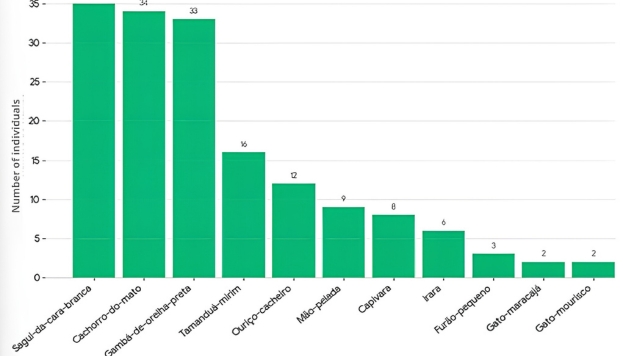
Between 2010 and 2022, a total of 166 wild mammal roadkill records were documented along the ES-060 Highway in the municipality of Guarapari and received by the laboratory responsible for this study. These records comprised 17 different species (Table 1), distributed throughout the municipality of Guarapari. Among the recorded species, ten stood out due to their high frequency of occurrence (Figure 2).

Main wild mammal species recorded as roadkill along the Rodovia do Sol (2010–2022). Source: Elaborated by the authors based on study data.
The ten most frequently recorded species accounted for nearly 90% of all records analyzed, with generalist and widely distributed species11 predominating, such as the white-faced marmoset (Callithrix geoffroyi), the crab-eating fox (Cerdocyon thous), and the black-eared opossum (Didelphis aurita). These species exhibit high mobility and frequently use roadside habitats for movement or foraging, making them particularly susceptible to the barrier effect (Hody et al., 2019; Santos Neta et al., 2023).
The results of the present study are consistent with previous reports in the literature (Dutra-Vieira et al., 2024), demonstrating that these species continue to rank among the most frequently recorded roadkill species in Brazil (Srbek-Araujo et al., 2015; Marques et al., 2023). This pattern is likely associated with the ecological characteristics of generalist species, which are typically more tolerant of anthropized environments and frequently exploit disturbed habitats and roadside resources. In particular, Cerdocyon thous, an opportunistic omnivore, is known to forage along roadsides and may be attracted to food resources, increasing its exposure to vehicle collisions (Hody et al., 2019; Dutra-Vieira et al., 2024). Together, these ecological characteristics help explain the predominance of generalist species among roadkill records and highlight wildlife-vehicle collisions as an important conservation issue.
The number of reported records varied throughout the study period, with a higher number of notifications starting in 2019, particularly in 2020 and 2021. As the dataset was compiled opportunistically, without a standardized sampling effort, these differences should not be interpreted as evidence of temporal changes in mortality due to vehicle collisions and may instead reflect variations in reporting effort. The highest number of records was observed in 2020 (45 road-killed individuals), followed by 2021 (37) and 2022 (20) (Figure 3). During the first years of the study period (2010–2012), the number of records ranged from 6 to 20 per year, which may reflect variations in recording effort over time.

Records of wildlife roadkill along the Rodovia do Sol during the period from 2010 to 2022. Source: Elaborated by the authors based on study data.
Most of the animals were found in the metropolitan region of the state, in the vicinity of the Parque Estadual Paulo César Vinha, located in the municipality of Guarapari, Espírito Santo. The high number of records in this area is likely associated with the intense daily traffic along the ES-060 Highway, one of the state's main highways, highlighting the influence of habitat fragmentation and road network expansion on terrestrial wildlife.
The spatial distribution of the records along the ES-060 Highway revealed that wildlife roadkill did not occur uniformly but was concentrated in specific sections of the highway (Figure 4).

Frequency of wild mammal roadkill records per kilometer along the ES-060 Highway, Guarapari, Espírito Santo, between 2010 and 2022. Source: Elaborated by the authors based on study data.
The highest frequencies of wildlife roadkill were recorded primarily at kilometer 50, which presented the greatest number of occurrences. Secondary concentrations were also observed between kilometers 36 and 42 and between kilometers 61 and 63. These segments can be considered wildlife roadkill hotspots, indicating a higher probability of interactions between wildlife and vehicle traffic and, consequently, a higher priority for mitigation and monitoring efforts.
The majority of the records were concentrated in highway sections located within landscape transition zones, particularly near forest remnants and the urban perimeter. The main wildlife roadkill hotspot was located in close proximity to the urban area of the municipality of Guarapari (Figure 5).

Location of the main hotspot for wild mammal roadkill recorded along Highway ES-060, corresponding to mile 50, in the municipality of Guarapari, Espírito Santo, Brazil. Source: Elaborated by the authors based on roadkill records and cartographic data from IBGE.
This pattern is not unique and is supported by several studies that have identified areas adjacent to protected areas as critical zones for wildlife roadkill (Curvo et al., 2020; Souza et al., 2022). In these transition zones between natural environments and highways, the high abundance of animals and habitat fragmentation increase the risk of wildlife-vehicle collisions. These rates have been shown to be even higher in areas surrounding protected areas in the northern Pantanal region of Brazil (Pinto et al., 2022b; Campos and Silva, 2023).
The identification of these hotspots has direct applications in the planning of mitigation measures. Currently, this critical section of the highway includes underground wildlife crossings, which were implemented in 2020 during the expansion of the southern section of the highway (Espírito Santo, 2024), as well as warning signs indicating wildlife crossings. Mota et al. (2023) described effective mitigation methodologies tailored to specific species, corresponding to the measures currently implemented along the ES-060 Highway. Although wildlife underpasses and warning signs have been recommended in the literature as mitigation measures, their effectiveness along Highway ES-060 was not evaluated in the present study. Therefore, no conclusions can be drawn regarding their contribution to reducing wildlife-vehicle collisions. Although these structures are widely recommended in the literature as mitigation measures, their effectiveness was not evaluated in the present study. Therefore, specific monitoring studies are needed to determine whether these structures are contributing to the reduction of wildlife roadkill and to the maintenance of local wildlife connectivity.
4. Conclusion
The results of this study demonstrate that the ES-060 Highway represents a significant source of impact on the wild mammal fauna of the municipality of Guarapari, affecting primarily generalist and widely distributed species, but also species of greater conservation concern. The analysis of the roadkill records made it possible to characterize the composition of the most frequently affected species and to identify the spatial distribution of roadkill occurrences along the highway, revealing the presence of wildlife roadkill hotspots associated mainly with sections located in areas of greater connectivity with native vegetation remnants and coastal ecosystems. The identification of these critical areas provides valuable information for planning and prioritizing mitigation strategies, guiding the implementation and improvement of measures such as wildlife crossings, directional fencing, targeted signage, and permanent monitoring programs along the sections at greatest risk. Consequently, the information generated by this study contributes to the development of more effective wildlife conservation actions, reconciling road safety with the maintenance of ecological connectivity in a region of high importance for the biodiversity of the Atlantic Forest. The present dataset did not include information on traffic volume, vehicle speed, surrounding land cover, distance to forest remnants, proximity to water bodies or seasonal variation. These variables may influence the spatial distribution of wildlife-vehicle collisions and should be incorporated into future standardized monitoring programs.
Data Availability Statement
Research data are available upon reasonable request from the corresponding author.
Referências
- ALMEIDA, A.C. and SANTOS, F.A., 2020. Corredores ecológicos e passagens de fauna: estratégias de manutenção da biodiversidade no Parque Estadual do Juquery-SP a partir da Biogeografia da conservação. Boletim Paulista de Geografia, vol. 1, no. 103, pp. 123-147.
-
ALVES, K.P., VALADARES, R.T., SILVA, L.T.P., PERALTA, D.F. and DUTRA, V.F., 2024. Bryophytes in the Área de Proteção Ambiental Mestre Álvaro (APAMA), Serra, Espírito Santo, Brazil. Rodriguésia, vol. 75, pp. e00792023. https://doi.org/10.1590/2175-7860202475092
» https://doi.org/10.1590/2175-7860202475092 -
CAMPOS, A. and SILVA, A.G.C., 2023. Análise da fauna silvestre atropelada e da efetividade das estruturas de proteção da fauna na BR-487 ao lado da reserva biológica das Perobas, no Sul do Brasil. Biodiversidade Brasileira, vol. 13, no. 1, pp. 1-17. https://doi.org/10.37002/biobrasil.v13i1.2059
» https://doi.org/10.37002/biobrasil.v13i1.2059 -
CURVO, L.R.V., ALENCAR, S.B.A., KREUTZ, F.I., BARBOSA, G.C.R., COSTA, C.S. and FERREIRA, M.W., 2020. Atropelamento de fauna silvestre em uma Reserva da Biosfera no Brasil: ameaças à conservação do Pantanal Norte do Brasil. Revista Ibero-Americana de Ciências Ambientais, vol. 12, no. 1, pp. 114-125. https://doi.org/10.6008/CBPC2179-6858.2021.001.0010
» https://doi.org/10.6008/CBPC2179-6858.2021.001.0010 - ESPÍRITO SANTO. Departamento de Edificações e de Rodovias do Estado do Espírito Santo – DER-ES, 2024. Relatório ambiental simplificado Vitória: DER-ES.
-
DUTRA-VIEIRA, F.M., SILVA, M.S., VIEIRA, G.S., CARVALHO, A.S. and SCHIMMING, B.C., 2024. Diet of crab-eating fox (Cerdocyon thous) in two conservation units of the Amazon rainforest, Brazil. Brazilian Journal of Biology = Revista Brasileira de Biologia, vol. 84, pp. e252093. https://doi.org/10.1590/1519-6984.252093 PMid:34932633.
» https://doi.org/10.1590/1519-6984.252093 -
HODY, A.W., MORENO, R., MEYER, N.F.V., PACIFICI, K. and KAYS, R., 2019. Canid collision: expanding populations of coyotes (Canis latrans) and crab-eating foxes (Cerdocyon thous) meet up in Panama. Journal of Mammalogy, vol. 100, no. 6, pp. 1819-1830. https://doi.org/10.1093/jmammal/gyz158
» https://doi.org/10.1093/jmammal/gyz158 - INSTITUTO BRASILEIRO DE GEOGRAFIA E ESTATÍSTICA – IBGE, 2023. Base Cartográfica Contínua do Brasil Rio de Janeiro: IBGE.
- INSTITUTO ESTADUAL DE MEIO AMBIENTE E RECURSOS HÍDRICOS – IEMA, 2024. GEOIEMA: Base cartográfica das Unidades de Conservação do Estado do Espírito Santo Vitória: IEMA.
-
JACKSON, S., BURROWS, A.J., JOHNSON, G., MCCLUSKEY, E.M. and LANGEN, T.A., 2026. Predicting road encounter hotspots for infrequently detected species using opportunistic data: a case study with blanding’s turtle (Emydoidea blandingii). Ecology and Evolution, vol. 16, no. 3, pp. e73265. https://doi.org/10.1002/ece3.73265 PMid:42016979.
» https://doi.org/10.1002/ece3.73265 - LIMA, J.C.S. and MONTEIRO, M.B.F., 2025. Análise da fauna silvestre de vertebrados atropelada em rodovias no sudoeste do estado de São Paulo. Acta Biologica Brasiliensia, vol. 8, no. 2, pp. 178-196.
- MARQUES, A.P., LOURENÇO NETO, L.L., DO CARMO, M.E.R. and LOPES, S.C., 2023. Levantamento dos impactos ambientais causados pela construção e uso de rodovias. REMUNOM, vol. 4, no. 1, pp. 1-18.
-
MOTA, T.G., TELINO JUNIOR, W.R., BAGER, A., TENÓRIO, J.C.S. and NEVES, R.M.L., 2023. Definição de hotspots e estratégias de mitigação para atropelamento de animais vertebrados silvestres. Revista Ibero-Americana de Ciências Ambientais, vol. 13, no. 8, pp. 202-214. https://doi.org/10.6008/CBPC2179-6858.2022.008.0016
» https://doi.org/10.6008/CBPC2179-6858.2022.008.0016 -
PINTO, F.A.S., CIRINO, D.W., CERQUEIRA, R.C., ROSA, C. and FREITAS, S.R., 2022a. How many mammals are killed on Brazilian roads? Assessing impacts and conservation implications. Diversity, vol. 14, no. 10, pp. 835. https://doi.org/10.3390/d14100835
» https://doi.org/10.3390/d14100835 -
PINTO, F.A.S., BAGER, A., CERQUEIRA, R.C., MILAGRES, A.P., MORAIS, B.C., SILVA, P.B.A., CASTRO, E., MEDICI, E.P., DESBIEZ, A.L.J., TORTATO, F.R. and CONCONE, H.V.B., 2022b. Diagnóstico do atropelamento de mamíferos silvestres em estradas na bacia do Alto Paraguai. Boletim do Museu Paraense Emílio Goeldi. Ciências Naturais, vol. 16, no. 3, pp. 441-458. https://doi.org/10.46357/bcnaturais.v16i3.812
» https://doi.org/10.46357/bcnaturais.v16i3.812 -
RIBEIRO, T.R.S., LARANJA, R.E.P. and BARBIERI, C.B., 2022. Dinâmica das rodovias: o papel do tráfego nos índices de atropelamentos de fauna. Sociedade & Natureza, vol. 34, no. 1, pp. e63884. https://doi.org/10.14393/SN-v34-2022-63884
» https://doi.org/10.14393/SN-v34-2022-63884 -
SANTOS NETA, C.D.S., ABRA, F.D., SANTOS, L.B., COSTA, E.P.L., DINIZ, M.F. and MORATO, R.G., 2023. Identificação de áreas críticas de atropelamento de fauna na região do parque nacional da Serra da Capivara, Piauí. Biodiversidade Brasileira, vol. 13, no. 4, pp. 1-18. https://doi.org/10.37002/biodiversidadebrasileira.v13i4.2412
» https://doi.org/10.37002/biodiversidadebrasileira.v13i4.2412 -
SANSOLO, D.G., 2020. Unidade de conservação, rodovia e território: uma análise da relação entre BR-319 e a Reserva de Desenvolvimento Sustentável Igapó-Açu, Amazonas, Brasil. Sociedade & Natureza, vol. 32, pp. 210-224. https://doi.org/10.14393/SN-v32-2020-46996
» https://doi.org/10.14393/SN-v32-2020-46996 -
SRBEK-ARAUJO, A.C., MENDES, S.L. and CHIARELLO, A.G., 2015. Jaguar roadkill in Atlantic Forest area preserves the connectivity between protected areas in southeastern Brazil. Brazilian Journal of Biology = Revista Brasileira de Biologia, vol. 75, no. 3, pp. 581-586. https://doi.org/10.1590/1519-6984.17613
» https://doi.org/10.1590/1519-6984.17613 - SOUZA, L.A.C., DE ARAÚJO SOUSA, E.S., FIGUEIRA, S.V., REIS, A.D.B.G., DA SILVA, B.P.A., ALVES, F.M., PARANAIBA, W.C.R., SANTOS, T.P., PONTES, S.R.L. and SILVA, G.F.O., 2022. Levantamento de fauna atropelada na GO 050, trecho Trindade-Campestre de Goiás. Vita et Sanitas, vol. 16, no. 1, pp. 120-132.
- VIANA, J.P., 2024. Gastos do governo federal na proteção da biodiversidade e das paisagens (2001-2022): as despesas tímidas do país que abriga a maior biodiversidade do planeta Brasília: Instituto de Pesquisa Econômica Aplicada.
- WAICHERT, R.H. and BORGES-FILHO, O.F., 2024. A fauna da baía de Vitória–ES: uma análise qualitativas dos levantamentos realizados entre os anos de 2000 e 2020. Revista Ciência & Saúde em Foco, vol. 1, no. 1, pp. 19-49.
-
WEICHERT, R.F., MAZZINGHY, A.C.C., COSTA, B.A., NUNES, B.V., LOPES, L.F., GARCIA, L.S., REIS, M., PARREIRAS, V., REINA, L. and MELO, J., 2024. Cerrado em destaque: o papel vital do Cerrado na biodiversidade do planeta. In: J.O.F. MELO, C. DAMIANI, R.L.B. ARAUJO and R.F.P. LUCENA, eds. Árvores, Plantas e Frutos do Cerrado: aplicações e possibilidades São Paulo: Editora Científica Digital, pp. 32-67. https://doi.org/10.37885/240315956
» https://doi.org/10.37885/240315956
*
e-mail: dudasalmelo@gmail.comEditor: