
 Enrichment of glutinous rice bread using Asparagus officinalis
Abstract
Developing gluten-free food products is an important direction in the creation of functional and health-oriented foods. The aim of this study was to evaluate the sensory properties, chemical composition (protein, fat, carbohydrates, amino acid profile, antioxidant activity), and energy value of bread produced from white, brown, and black glutinous rice with the addition of asparagus powder. A comparative analysis was performed using control samples and samples fortified with Asparagus officinalis at 3%, 5%, 10%, 15%, and 20% (15 formulations). Based on sensory evaluation, nine formulations (control, 3%, and 5%) were selected for detailed analysis. Black rice bread showed the highest baseline protein content; however, fortification at 3-5% reduced protein by 6.64-10.14%. The highest fat content (1.20 ± 0.006 g) was observed in white rice with 5% supplementation, while other samples ranged from 0.27 to 0.48 g. Carbohydrates increased in white (+32.32%) and black (+5.11%) rice breads at 3%, but decreased in brown rice (−12.07%). Antioxidant activity in-creased significantly in white rice with 5% supplementation (+21.95%). The highest energy value was recorded for white rice with 3% addition (212.71 kcal). Samples with 5% asparagus increased the content of key amino acids, particularly arginine, proline, serine, and alanine.
Keywords:
functional foods; antioxidant activity; nutritional value; fortified bread; capillary electrophoresis
Resumo
O desenvolvimento de produtos alimentícios sem glúten é uma importante direção na criação de alimentos funcionais e voltados para a saúde. O objetivo deste estudo foi avaliar as propriedades sensoriais, a composição química (proteínas, gorduras, carboidratos, perfil de aminoácidos, atividade antioxidante) e o valor energético de pães produzidos com arroz glutinoso branco, integral e preto, com adição de farinha de aspargo. Uma análise comparativa foi realizada utilizando amostras-controle e amostras enriquecidas com Asparagus officinalis em concentrações de 3%, 5%, 10%, 15% e 20% (15 formulações). Com base na avaliação sensorial, nove formulações (controle, 3% e 5%) foram selecionadas para análise detalhada. O pão de arroz preto apresentou o maior teor de proteína; no entanto, o enriquecimento em concentrações de 3% a 5% reduziu o teor de proteína em 6,64%-10,14%. O maior teor de lipídios (1,20 ± 0,006 g) foi observado no pão de arroz branco com 5% de suplementação, enquanto as demais amostras variaram de 0,27 a 0,48 g. O teor de carboidratos aumentou nos pães de arroz branco (+32,32%) e preto (+5,11%) com 3% de adição de aspargos, mas diminuiu no arroz integral (−12,07%). A atividade antioxidante aumentou significativamente no arroz branco com 5% de suplementação (+21,95%). O maior valor energético foi registrado para o arroz branco com 3% de adição (212,71 kcal). As amostras com 5% de aspargos aumentaram o teor de aminoácidos essenciais, principalmente arginina, prolina, serina e alanina.
Palavras-chave:
alimentos funcionais; atividade antioxidante; valor nutricional; pão fortificado; eletroforese capilar
1. Introduction
The development of gluten-free bakery products as functional foods is becoming increasingly important. The use of rice in bread production has recently become one of the most promising approaches in the development of gluten-free functional food technologies. The importance and relevance of this trend are driven by the increasing prevalence of gluten-related disorders and allergies, as well as by growing consumer interest in a healthy lifestyle and products with improved physiological benefits (Culetu et al., 2021; Shevkani and Singh, 2014; Siminiuc and Turcanu, 2023). However, conventionally produced gluten-free products are often characterized by low nutritional value (Man et al., 2014; Rondanelli et al., 2019; Sattaka, 2016). They are typically deficient in dietary fiber and protein, B vitamins, and essential minerals (Bao et al., 2004; Bardella et al., 2000; Falguera et al., 2012; Juliano, 1998; Omary et al., 2012), and their sensory properties, including taste and texture, are often unsatisfactory. Therefore, the search for new raw materials and enrichment ingredients capable of overcoming these limitations remains highly relevant (Demirkesen et al., 2010; Laddha et al., 2021; Nguyin, 2001; Šmídová and Rysová, 2022; Utarova et al., 2024).
Glutinous rice represents a promising basis for the production of gluten-free functional bakery products (Gujral et al., 2012; King et al., 2020; Królak et al., 2017; Sedej et al., 2011; Wang et al., 2022). Waxy (glutinous) rice has a fundamentally different starch structure compared with traditional rice types (Heberle et al., 2022; Locke et al., 2019; Olsen and Purugganan, 2002). Its starch consists almost entirely of amylopectin and contains minimal amounts of amylose, which explains its high water-binding capacity, viscosity, and ability to form a stable structured system (Paz et al., 2021). These properties enable glutinous rice to compensate for the lack of a gluten framework and facilitate the formation of a soft, uniform, and elastic crumb without the addition of gluten-containing ingredients (Rai et al., 2014). Bakery products made from glutinous rice are characterized by a soft and sticky texture (Park et al., 2012). In addition, its starch grains are small, which pro-motes efficient gelatinization and high hydration capacity of the dough (Melini et al., 2019). Another important advantage of glutinous rice is its hypoallergenic properties (Bordiga et al., 2014; Yawadio and Morita, 2007). Therefore, glutinous rice is considered an important potential ingredient for the development of specialized bakery products applicable for functional, dietary, and therapeutic nutrition (Adom and Liu, 2002; Gularte et al., 2012; Sakač et al., 2011). Different types of glutinous rice exhibit significant biochemical differences (King et al., 2020). Polished white rice contains low levels of fiber and loses some of its biologically active substances (Glover and Martin, 2012; Kushwaha, 2016; Luo et al., 2021). In contrast, brown rice retains its germ and bran layers and is rich in dietary fiber, vitamins, and minerals, while also exhibiting a lower glycemic index. Black glutinous rice contains higher levels of anthocyanins, flavonoids, and more than 23 other compounds with pronounced antioxidant activity (Kim et al., 2010). Such compounds are capable of neutralizing free radicals and reducing oxidative stress in the body cells, which plays an important preventive role in nutrition-related diseases (Kim et al., 2010; Zhang et al., 2006a). In addition, black rice generally contains higher levels of fiber, protein, and minerals compared with white and brown types (Hou et al., 2013). However, black rice has a distinctive taste and higher cost, which may limit its widespread use (Bolea et al., 2016; Burešová et al., 2023). Furthermore, glutinous rice is a rich source of essential microelements, including iron, copper, zinc, and selenium, which are also involved in antioxidant defense and enzymatic systems in the human body (Zhang et al., 2006b. Thus, the use of glutinous rice not only contributes to the formation of the desired structure in gluten-free bread but also enhances its biological and nutritional value, transforming it from a predominantly carbohydrate-based product into a functional one (Alvarez-Jubete et al., 2009; Karakaya et al., 2016; Rini et al., 2019). Therefore, differences in functional properties and nutritional composition among rice types represent an important factor in the creation of a functional bakery product.
Despite the obvious technological advantages, bakery products made from rice flour, including glutinous rice flour, are characterized by accelerated staling and increased crumbliness, which are associated with the structural characteristics of the starch matrix and the absence of a protein network (Kohli et al., 2022). Therefore, the incorporation of plant-based ingredients as modifying agents represents a relevant approach to improve the rheological properties of dough, enhance water-holding capacity, and enrich the product with functional components (Pegiou et al., 2019). Asparagus (Asparagus officinalis) is such a promising plant mate-rial rich in vitamins, dietary fiber, and phenolic antioxidants, which allows for a targeted increase in the nutritional and functional value of the product, and with optimally selected dosages, without significant deterioration in the structural, mechanical, and organoleptic characteristics (Goñi et al., 2024). Asparagus officinalis is a valuable food plant containing a wide range of biologically compounds (Nguyen et al., 2024). It is rich in vitamins (folic acid, vitamin C, vitamins A, E, K and group B) and minerals (potassium, magnesium, iron, etc.) (Priss et al., 2024). It also contains polyphenolic compounds including quercetin, rutin, and hydroxycinnamic ac-ids derivatives with pronounced antioxidant activity (Priss et al., 2025). These compounds are capable of inhibiting lipid peroxidation, thereby contributing to increased shelf life of food products and protecting cellular structures from oxidative images (Yu and Fan, 2021). In addition, asparagus is rich in dietary fiber and oligosaccharides, particularly fructans and inulin-type com-pounds with well-documented prebiotic properties. These components selectively stimulate the growth of beneficial intestinal microbiota, contribute to metabolic regulation, im-prove digestion, and enhance overall physiological resilience (Kapoor et al., 2019). From a technological perspective, asparagus component exhibits high water-holding capacity, which is especially important for functional products. Oligosaccharides and dietary fiber can bind and retain significant amounts of water, thereby slowing starch retrogradation, the primary cause of bread staling (Osokina et al., 2017). As a result, the shelf life is extended and the organoleptic characteristics are improved (Papoutsis, 2023). Due to its high nutritional and biological value, asparagus was selected as a modifying component for glutinous rice bread (Priss and Bulhakov, 2024). The incorporation of asparagus powder can increase the amount of biologically active compounds. However, optimization of its concentration is necessary to avoid adverse effects on the structure and organoleptic properties of the final product (Guo et al., 2020).
The combination of glutinous rice and asparagus is of considerable scientific and practical interest due to their potential synergistic effect. The unique amylopectin-rich starch of glutinous rice provides the viscoelastic structural base, while asparagus contributes biologically active compounds, prebiotic components, antioxidants, and structure-stabilizing substances. This combination may enhance the nutritional profile, technological performance, and shelf life of the final product.
Therefore, the investigation of bakery products based on glutinous rice with the addition of asparagus as a plant component represents a relevant and scientifically justified direction in food technology.
This approach enables the production of bread with improved structural and mechanical properties, enhanced nutritional and biological value, and pronounced antioxidant and prebiotic potential
Such products may contribute to expanding the range of functional foods based on plant-derived ingredients that support health and help prevent nutrition-related diseases. The aim of study is to comprehensively evaluate the effect of different concentrations of Asparagus officinalis powder on the sensory, functional, and physicochemical properties of bread produced from three types of glutinous rice (white, brown, and black), and to deter-mine the optimal levels of additives.
2. Materials and Methods
The study utilized locally grown glutinous rice (white Chapsari, brown, and black) cultivated in the Maktaaral district of the Turkestan region, Kazakhstan. Glutinous rice is characterized by a high amylopectin content, which imparts a unique sticky texture, mild sweetness, and increased grain integrity (average grain length ~7 mm). Brown rice retains the bran layer, which is rich in dietary fiber and B vitamins, and is gluten-free. Black rice contains anthocyanins responsible for its dark pigmentation and antioxidant activity; it is characterized by a low glycemic index, a nutty flavour, and a purple coloration upon cooking (Figure 1).

Appearance of regular and glutinous rice grains: (a) Amylose rice (regular rice); (b) White glutinous rice; (c) Brown glutinous rice; (d) Black glutinous rice.
2.1. Preparation of glutinous rice flour
The rice grains were previously processed into flour. The milling was carried out using a Retsch GRINDOMIX GM 200 knife mill. This mill was used to grind and homogenize the rice grains. The mill consists of two sharp hard knives, which are driven by a 1000 W motor. The milling capacity of the sample is 700 grams. The milling was carried out for 3 minutes by varying the speed of rotation from 2500 to 8000 rpm
2.2. Preparation of bread product samples
For the preparation of glutinous rice bread test samples, the following recipes were developed: pure rice-based, with the addition of Asparagus officinalis in varying proportions (0%, 3%, 5%, 10%, 15%, 20%). Asparagus officinalis itself was used in powder form. A steamer was chosen as the preparation method. The sample steaming time was 30 minutes.
2.3. Sensory evaluation of food products
Sensory (organoleptic) evaluation of the bread samples was performed using a 9-point hedonic scale ranging from 1 to 9 (1 = dislike extremely, 5 = neither like nor dislike, and 9 = like extremely). A panel of ten semi-trained participants took part in the sensory evaluation by tasting the prepared samples. The participants were informed about the aims, procedures, and methodology of the study and provided their consent to participate. The bread samples were evaluated according to the following sensory attributes: appearance (external and crumb structure), texture (consistency), color, taste, and aroma. The evaluation results were expressed as the average score for each characteristic, calculated based on the panelists’ assessments (State Committee of the USSR for Standards, 1987).
2.4. Protein content analysis
The protein content of the bread samples was determined using the Kjeldahl method (Kjeldahl, 1883), which is based on the determination of total nitrogen after high-temperature mineralization of the sample. In this method, organic material is digested with concentrated sulfuric acid in the presence of a catalyst and sulfate salts at temperatures exceeding 400 °C. Under these conditions, organic nitrogen is converted into ammonium sulfate, while organic matter is decomposed into carbon dioxide and water. After digestion, the solution was alkalized with a concentrated alkali solution to release ammonia. The liberated ammonia was distilled with steam and absorbed in a boric or sulfuric acid solution. The amount of ammonia was then determined by acid-base titration using sodium hydroxide solution with a mixed indicator (methyl red and bromocresol green) or a Tashiro indicator. Based on the titration results, the mass fraction of total nitrogen in the sample was calculated. The protein content was subsequently determined by converting the nitrogen content using a protein conversion factor. For rice samples, a factor of 6.0 was applied based on the average nitrogen content of rice proteins, while 6.25 was used as the universal protein conversion factor (Latimer, 2016).
2.5. Total fat analysis
Lipid quantification was performed using the officially sanctioned Soxhlet technique. However, this conventional approach is constrained by its extended extraction period (16-24 h) and elevated temperature requirements. Automated Soxhlet extraction addresses these issues by offering enhanced efficiency through shorter run times, diminished solvent needs, and the capability for concurrent extraction of several specimens. The crude fat content of food has been determined by methodologies that involve extraction with organic solvents, drying of the extract, and gravimetric determination of fat. The method is based on the extraction of lipids from a pre-dried and homogenized sample using a non-polar organic solvent, followed by solvent removal and gravimetric quantification of the extracted fat. Samples were ground to a homogeneous mass and dried at 50-60 °C to an air-dry state. Analytical portions (3-5 g) were extracted with diethyl ether or petroleum ether in a Soxhlet apparatus until complete lipid removal. After extraction, the solvent was evaporated, and the residue was dried at 100-105 °C to constant mass. The fat content was calculated as the ratio of the extracted fat mass to the sample mass and expressed as a percentage. Results were reported as the mean of at least two parallel determinations (Shin and Park, 2015).
2.6. Method of carbohydrate content analysis
The content of reducing carbohydrates in the test samples was determined using the Bertrand permanganate method based on the reducing properties of sugars. Reducing sugars were oxidized with Fehling's solution, prepared by mixing equal volumes of cop-per sulfate solution (Fehling's No. 1) and an alkaline solution of potassium sodium tartrate (Fehling's No. 2). Upon heating, copper (II) ions were reduced to cuprous oxide. The resulting cuprous oxide was dissolved in an acidic medium using ferric ammonium alum or ferrous sulfate solution, resulting in the reduction of iron (III) to iron (II). The amount of iron (II) was determined by titration with potassium permanganate. The amount of reduced copper was calculated from the volume of permanganate solution, after which, using Bertrand calibration tables, the content of reducing sugars in the sample was deter-mined (Wildman and Hansen, 1940).
2.7. Determination of the energy value of food products
The nutritional and energy values of the bread samples were determined by calculation based on the chemical composition of the product. Nutritional value is characterized by energy value, digestibility, and the content of essential nutrients, including proteins, fats, carbohydrates. Energy value was calculated based on the content of essential nutrients in the product per 100 g. Specific energy coefficients were used for the calculation: proteins - 4.0 kcal/g; fats - 9.0 kcal/g; carbohydrates - 3.75 kcal/g. Energy value was calculated by multiplying the mass fraction of each component by the corresponding energy coefficient and then summing the resulting values. Energy value was expressed in kilo-calories (kcal) per 100 g of product. The resulting value characterizes the total amount of energy released during digestion of the product. The calculation method is based on experimentally obtained data on protein, fat, and carbohydrate content and allows for the determination of the theoretical energy value of a product. The accuracy of the method depends on the reliability of the initial chemical composition data and does not account for potential nutrient losses during heat treatment (Ingrao et al., 2018).
2.8. Determination of acidity of food products
The pH of the bread was measured using a pH meter (HACH, France). The bread crumb was mixed with distilled water to obtain a suspension using a 1:1 ratio of bread crumb to distilled water. The mixture was then measured with a suitable electrode. The pH measurements were performed in triplicate) (Tsanasidou et al., 2021).
The titratable acidity (TTA) of the bread was measured by titration with a sodium hydroxide (NaOH) solution. The bread crumb sample was mixed with water, filtered, and titrated with a pH indicator. The acidity was titrated with a 0.1 M NaOH solution (Silva et al., 2021).
2.9. Method for determination of amino acid composition in products
The mass fraction of amino acids in the samples was determined using a Kapel-105M capillary electrophoresis system (Lumex, Russia). The method is based on the acid hydrolysis of samples to liberate amino acids, their derivatization into phenylthiocarbamyl (PTC) derivatives, followed by the separation and quantification of these derivatives by capillary electrophoresis.
A 100 mg portion of ground bread was placed into a hydrolysis vial, and 10 mL of hydrochloric acid solution (diluted 1:1 with distilled water) was added. The vial was sealed tightly and stirred. Hydrolysis was then carried out in a drying oven at 110°C for 14-16 hours, as described by Kubczak et al. (2022). After hydrolysis, the vials were cooled to room temperature, and the contents were filtered. Subsequently, PTC derivatives were prepared according to the following procedure: 50 µL of the cooled hydrolysate was transferred into 10-15 mL glass beakers, and the solution was evaporated to dryness under a stream of warm air. To each beaker containing the dry residue, 0.15 mL of sodium carbonate solution (0.1 mol/L) and 0.3 mL of phenylisothiocyanate solution in isopropyl alcohol were added. The mixture was stirred thoroughly until the precipitate dissolved, covered with a lid, and left for 35 min at room temperature. The solutions were then evaporated to dryness again under a stream of warm air. The dry residues were dissolved in 0.5 mL of distilled water and used for analysis. The prepared solutions were transferred to Eppendorf tubes and centrifuged for 5 min at 5000 rpm.
Detection was carried out in the UV region of the spectrum at a wavelength of 254 nm. Data processing was performed using Elforan software. The analysis conditions were as follows: buffer: β-cyclodextrin (Fluka, Germany); phenylisothiocyanate (Sigma-Aldrich, USA) was used for the preparation of phenylthiocarbamyl derivatives; capillary column: Ltotal = 65/75 cm, ID = 50 µm; voltage: +25 kV; temperature: +30°C; detection wavelength: 254 nm. Calibration was performed using an amino acid standard mixture, LAA-21 (Sigma-Aldrich, USA) (Kubczak et al., 2022).
2.10. Determination of antioxidant content in food products
The total antioxidant content in the samples was determined using a Tsvet-Yauza-01-AA analyzer (Khimavtomatika, Moscow, Russia) based on the amperometric detection method, as described previously (Murzahmetova et al., 2015; Yashin et al., 2010). The analysis was performed using the mean value obtained from a series of five consecutive measurements. Commercially available antioxidants were used as reference standards: Quercetin hydrate (≥95%, Cat. No. 337951, Sigma-Aldrich, USA) and Gallic acid (≥97%, Cat. No. G7384, Sigma-Aldrich, USA) (Murzahmetova et al., 2015; Yashin et al., 2010).
2.11. Statistical analysis
All experiments were replicated at least three times, and the data were expressed as “mean ± standard deviation”. Two-way analysis of variance (ANOVA) was used to identify differences between samples, with p < 0.05 considered statistically significant (CRAN, 2026; Childs et al., 2026; GraphPad Software, 2026a, b).
3. Results
3.1. Sensory evaluation of rice bakery products
The organoleptic properties of the bread were assessed on a nine-point scale, taking into account appearance, structure, elasticity, aroma, freshness, and taste (9 = excellent; 1 = unsatisfactory). Control samples of bread made from white, brown, and black rice without the addition of Asparagus officinalis received high scores on all parameters, indicating the high quality of the original product (Figure 2).

Sensory characteristics of bakery products: (a) Bakery products made from white rice; (b) Bakery products made from brown rice; (c) Bakery products made from black rice.
Two-way analysis of variance (ANOVA) was performed to evaluate the effect of asparagus concentration and respondents on sensory attributes of rice bread. The results demonstrated a statistically significant effect of sample formulation on appearance, consistency, color, scent, and taste (p < 0.05) (Table 1).
With the addition of 3-5% asparagus powder, sensory characteristics remained high. In the white, brown, and black rice samples, taste, aroma, structure, and elasticity did not change significantly, and average scores were at least 4.5 points. This concentration did not adversely affect the consumer properties of the product. Increasing the Asparagus officinalis content to 10% or more resulted in a deterioration in organoleptic properties. The most pronounced decrease in quality was observed in bread made from white rice, where taste and aroma scores dropped to 2.0-3.0 points. Brown and black rice samples also showed a decrease in scores to 2.5-3.0 at concentrations of 10-15%, accompanied by the appearance of off-flavour and bitter notes. Overall, the deterioration in sensory perception at high doses is due to the excessive content of asparagus plant components, which affect the product's flavour and aroma. The optimal concentration of Asparagus officinalis powder in rice bread recipes is 3-5%, ensuring the preservation of organoleptic characteristics while simultaneously enriching the product with biologically active substances. Using the additive at concentrations above 5% reduces the bread's consumer appeal and is inadvisable.
Thus, based on the results of the sensory evaluation, rice bread samples with 3% and 5% asparagus additives were selected for further analysis.
3.2. Determination of protein content in rice bread samples
Protein content was determined in bread samples produced from three types of glutinous rice with the incorporation of asparagus powder at 3% and 5% levels. The analysis aimed to evaluate the effects of addition 3% and 5% asparagus to the protein content of the final bread product. Nine recipe formulations of bread were developed, including three control samples and six samples containing 3% and 5% Asparagus officinalis prepared from white, brown, and black glutinous rice. In the control white rice-bread samples, the protein content was 4.91 ± 0.04 g and the addition of 3% and 5% A. officinalis to the bread samples resulted in a decrease in protein to 4.04 ± 0.05 g and 3.72 ± 0.03 g, respectively, representing a 17.7% and 24.3% reduction compared to the control (Figure 3).
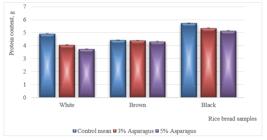
The obtained data demonstrate a pronounced diluting effect of asparagus, characterized by a relatively low protein content. In brown rice bread samples, the protein content in the control group was 4.42 ± 0.03 g, while with the addition of 3% and 5% asparagus, it decreased to 4.39 ± 0.02 g and 4.31 ± 0.05 g, respectively (Figure 3). This de-crease did not exceed 2.5%, demonstrating the relative stability of brown rice compounds.
The highest initial protein content was found in black rice samples (5.72 ± 0.04 g) and the protein content decreased to 5.34 ± 0.05 g and 5.14 ± 0.04 g in black rice bread samples with the addition of 3% and 5% asparagus, respectively (Figure 3), corresponding to a decrease of 6.6% and 10.1%. Despite the decrease of protein, black rice retained the highest protein content among the all studied bread samples.
Overall, the addition of Asparagus officinalis to all recipe variations resulted in a de-crease in overall protein content, most pronounced in the white rice samples. This effect is due to the partial replacement of the rice base with a plant component, the characteristic amino acid profile, and the lower protein concentration. Brown and black rice exhibit greater resistance to changes in protein composition when fortified with asparagus, making them more promising for the development of bakery products with increased nutritional value.
3.3. Fat content assessment in rice bread samples
Fat content analysis of the bread samples showed significant differences depending on the rice type and the level of A. officinalis added. The control white rice bread sample had a fat content of 0.48 ± 0.004 g, and the addition of 3% A. officinalis reduced the fat con-tent to 0.33 ± 0.002 g, while the addition of 5% resulted in a significant increase to 1.20 ± 0.006 g, which was the highest value among all samples (Figure 4).

In the control brown rice bread sample, the fat content was 0.33 ± 0.001 g. With the addition of 3% A. officinalis, a slight increase in fat content to 0.35 ± 0.001 g was observed, whereas a further increase in asparagus level to 5% led to a decrease in fat content to 0.29 ± 0.002 g (Figure 4).
The fat content in the control sample of black rice bread was 0.45 ± 0.003 g. The addi-tion of 3% A. officinalis resulted in a moderate decrease to 0.40 ± 0.003 g, with a further de-crease to 0.27 ± 0.002 g at the 5% addition level.
These results indicate that the effect of A. officinalis addition on fat content depends on both the rice type and the addition level.
3.4. Determination of carbohydrate content in rice bread samples
The results of the study demonstrate significant variability in carbohydrate content depending on the type of glutinous rice used and the concentration of Asparagus officinalis in the sample formulation. The control white rice sample had a carbohydrate content of 39.01 ± 0.47 g. When 3% asparagus powder was added to white rice bread, this value in-creased significantly to 51.62 ± 0.55 g (Figure 5).

Carbohydrate content in bread made from three rice types with 3% and 5% Asparagus officinalis.
This increase may be attributed to the high content of easily digestible sugars (glucose, fructose, and sucrose) in young shoots of Asparagus officinalis. Furthermore, the addition of the plant component increased the proportion of extractable reducing sugars, which was reflected in the results of the permanganometric analysis. When the concentration of the additive in the bread increased to 5%, the carbohydrate content decreased to 42.60 ± 0.51 g (Figure 5). This effect is likely due to dilution of the rice matrix, as well as the possible binding of sugars by the cell walls of the plant powder, which may reduce their availability for oxidation.
The control brown rice sample contained 38.37 ± 0.35 g of carbohydrates. The addition of 3% Asparagus officinalis to bread reduced this value to 33.74 ± 0.33 g (Figure 5), which may be explained by the presence of significant amounts of dietary fiber and phenolic compounds in the brown rice husks that can adsorb water-soluble sugars. When the additive proportion was increased to 5%, the carbohydrate content rose to 37.80 ± 0.45 g (Figure 5), approaching the control level. This indicates partial compensation for the ad-sorption effect due to the contribution of carbohydrates present in asparagus itself.
The control black rice sample had a carbohydrate content of 37.97 ± 0.42 g. The addition of 3% asparagus powder increased this value to 39.91 ± 0.45 g, whereas at a con-centration of 5%, a decrease to 38.42 ± 0.31 g was observed (Figure 5). Such fluctuations may be associated with the high content of anthocyanins and phenolic compounds in the black rice husk, which may participate in secondary oxidation-reduction reactions with potassium permanganate, partially affecting the results of the quantitative determination of reducing sugars.
Thus, the highest carbohydrate content was recorded in the white rice bread with the addition of 3% Asparagus officinalis (51.62 ± 0.55 g), making this formulation promising for the development of functional foods with increased energy value. The obtained data indicate that the effect of Asparagus officinalis on the carbohydrate content of bread is deter-mined not only by the additive concentration but also by the type of rice base used. This may be related to differences in the grain cellular structure, husk composition, dietary fiber content, and the presence of bioactive compounds. The permanganometric method is reliable for determining reducing sugars; however, when analyzing pigmented samples, particularly black rice, potential interference from phenolic compounds and anthocyanins should be considered. Overall, enrichment of glutinous rice bread with Asparagus officinalis powder makes it possible to modulate the carbohydrate content of the product, thereby creating opportunities for the targeted development of its energy and functional value depending on the intended application of the final product.
3.5. Determination of the energy value of bread samples made from three types of rice
This study assessed the energy value of bread products made from white, brown, and black glutinous rice in both control samples and samples fortified with Asparagus officinalis powder at concentrations of 3% and 5%. The results showed that the addition of 3% asparagus powder to white rice bread significantly increased the energy value of the product to 212.71 kcal, representing a 24.9% increase compared with the control value (170.25 kcal) (Table 2).
Increasing the asparagus powder content to 5% reduced this value to 185.43 kcal, remaining 8.9% higher than the control value (Table 2). This change may be due to the low content of easily digestible compounds and proteins in white rice, as well as the potentiating effect of the plant component at moderate dosages. At higher supplement levels, the rice base is partially replaced by lower-calorie plant matter, resulting in a reduction in the overall energy density of the product.
Introducing Asparagus officinalis to brown rice bread changed the product’s energy value. When 3% asparagus was added to brown bread, its caloric content decreased to 147.23 kcal (- 10.5%), while the calorie content of bread with 5% of asparagus was to de-creased slightly to 161.60 kcal (- 1.8%) compared to the control brown rice bread without asparagus (164.54 kcal). This effect may be related to the high proportion of dietary fiber in brown rice and the relatively low-calorie content of asparagus. As a result, the energy-dense base is "diluted" by a component with a lower energy content, resulting in a reduction in the overall calorie content of the product.
Black rice samples exhibit less pronounced changes in energy value. Adding 3% asparagus resulted in a slight increase in energy value to 174.62 kcal (+3.1%), while in the sample with 5% asparagus, it decreased to 167.06 kcal (-1.3%). This stability may indicate a balanced composition of the formula's components, as well as the stabilizing effect of biologically active substances characteristic of black rice, particularly anthocyanins and polyphenols, which can indirectly influence nutrient metabolism and composition.
Data analysis shows that fortifying white rice with 3% Asparagus officinalis is the most effective in increasing the energy value of the product. In the case of brown rice, the addition of asparagus, on the other hand, allows for a reduction in calorie content, which can be used in the development of low-calorie products. Black rice exhibits little fluctua-tion in energy value during fortification, indicating its stability and balanced nutritional profile.
Therefore, the choice of rice type and the percentage of plant additive content should be based on the specific purpose of the product being developed: increasing caloric content, maintaining energy balance, or reducing energy density for dietary and preventative nutrition.
3.6. Determination of rice bread samples acidity
Determination of the pH and total titratable acidity (TTA) of bread samples prepared from different types of rice flour with the addition of Asparagus officinalis powder revealed that the pH values of the samples ranged from 5.15 to 5.65 (Table 3).
The most acidic (pH 5.15) was the control sample of bread made from white flour, and the highest pH value was found in the control sample of bread made from brown flour, which showed a neutral pH (pH 5.65). The effect of asparagus addition on the pH of bread products was inconsistent. In white rice samples with asparagus, the pH increased to 5.41 at 3% addition, while increasing the addition to 5% resulted in a slight decrease in pH to 5.32. In the brown rice bread, the pH decreased to 5.33 at 3% addition and increased to 5.53 at 5%. The acidity of black rice bread with 3% asparagus added increased to 5.57, while in the 5% sample it decreased slightly to 5.22. Total titratable acidity (TTA) values varied over a wider range, from 1.10% to 3.70%. The highest acidity was found in the control black rice sample (3.70%), while the lowest was found in the fortified white and brown rice samples with 3% asparagus added (1.10%). The addition of asparagus powder resulted in a decrease in TTA in most cases. For example, in white rice bread, TTA de-creased to 1.10% with 3% asparagus, while with 5% asparagus, it increased to 3.00%. The dynamics in brown rice bread were similar: a decrease to 1.10% with 3% asparagus and an in-crease to 3.00% with 5%. A dose-dependent decrease in the acidity of black rice bread was observed: from 3.70% (control) to 3.20% (3%) and 1.30% (5%). Thus, both black rice flour and the concentration of Asparagus officinalis additive have a significant and ambiguous effect on the acidity of bread, which must be taken into account when developing recipes.
3.7. Determination of antioxidants content in rice bread samples
The initial level of antioxidant activity varied significantly depending on the rice type. In the water-soluble fraction, the highest values were observed for black rice, the lowest for white rice, and brown rice was intermediate. These differences are due to the high content of phenolic compounds and anthocyanins in the pigmented husk of black rice, as well as the presence of phenolic acids in the bran of brown rice (Figure 6).

Antioxidants content in rice bread samples. (a) Water-soluble antioxidants; (b) Fat-soluble antioxidants.
The addition of Asparagus officinalis resulted in an increase in water-soluble antioxidant activity in all samples studied. The most pronounced effect was observed in white rice bread, where antioxidant content increased from 0.41 g/g in the control to 0.50 g/g with a 5% supplement. In brown rice samples, the antioxidant content increased from 0.38 to 0.43 g/g, while in black rice it remained at a consistently high level (0.50-0.54 g/g). These results indicate a pronounced enriching effect of asparagus, associated with its high content of flavonoids and ascorbic acid.
Fat-soluble antioxidant activity in all samples was significantly lower than that of the water-soluble fraction. The highest values were recorded in black rice (0.091 g/g), which is due to the presence of tocopherols and other lipophilic compounds in the grain husk. In white rice, the addition of 5% asparagus increased the antioxidant activity from 0.049 to 0.063 g/g, corresponding to an increase of approximately 29%. In brown and black rice samples, the changes were less pronounced and, in some cases, were accompanied by a slight decrease in the antioxidant activity, likely due to matrix effects and the redistribution of lipophilic components.
Overall, fortification with Asparagus officinalis powder had a more pronounced effect on water-soluble antioxidant activity than on fat-soluble antioxidant activity. The main contribution of the supplement was associated with an increase in the content of polyphenols and vitamin C, while the contribution to the levels of tocopherols and carotenoids was limited.
Black rice had the highest initial antioxidant potential and maintained its leading position after fortification. White rice, initially low in antioxidants, demonstrated the greatest relative increase in antioxidant activity, indicating the high effectiveness of asparagus in enhancing its functional value. Brown rice exhibited intermediate properties. The obtained data confirm that the addition of Asparagus officinalis contributes to a comprehensive increase in the antioxidant activity of rice bread, mainly due to the enhancement of the hydrophilic fraction, and substantiate the feasibility of using this additive in the development of functional bakery products.
3.8. Evaluation of amino acid composition
An analysis of the amino acid profile of three rice types (white, brown, and black) using capillary electrophoresis revealed different effects of asparagus powder addition (3% and 5%) on their composition (Table 4).
The control black rice sample had the highest initial concentration of key amino ac-ids, particularly for arginine (45 mg/L), threonine (44 mg/L), and proline (43 mg/L). The effect of asparagus addition varied depending on the rice variety and yielded the following results. Adding 5% asparagus to white rice samples significantly increased the con-tent of proline (to 72.0 mg/L), arginine (to 40 mg/L), and alanine (to 22 mg/L), but caused a sharp decrease in lysine (to 12 mg/L) and tyrosine (to 13 mg/L). A clear negative trend was observed in brown rice samples. With the addition of 3% and 5% asparagus, the concentration of most amino acids decreased, but the 5% sample showed an increase in glycine concentration to 10.0 mg/L. Black rice bread samples enriched with 5% asparagus had elevated proline levels (up to 56 mg/L). Thus, the addition of 5% asparagus powder has an enriching effect on the amino acid composition of white and, especially, black rice (proline, arginine, glycine, and alanine). For brown rice, the addition of asparagus is inappropriate, as it leads to a decrease in amino acid content. The optimal raw material for developing a fortified product is a composition based on white and black glutinous rice with the addition of 5% Asparagus officinalis powder, providing the best balance of nutritional value and organoleptic properties.
The growing demand for functional and nutritionally enriched bakery products has prompted researchers to explore alternative raw materials and processing aids, ranging from by-product recycling to the use of novel hydrocolloids and enzymes. As noted by Priss et al. (2025), recycling food industry by-products such as asparagus waste into protein- and mineral-rich powder represents a viable strategy for improving the nutritional profile of bread while addressing sustainability concerns. However, the incorporation of such non-traditional ingredients often poses significant technological challenges. For example, the use of pigmented rice flour, despite its well-documented high phenolic con-tent and antioxidant capacity, has been shown to degrade dough rheology and bread volume due to dilution of the gluten network and interactions of fiber and polyphenols with starch (Evangelista and Schönlechner, 2025). Similar structural impairments are observed in gluten-free formulations, where the lack of a protein network results in poor gas retention and crumb hardness (Rybicka et al., 2019). To mitigate these effects, researchers have used various strategies. Stork et al. demonstrated that the addition of protein isolates (casein, albumin) in combination with transglutaminase could promote protein cross-linking, thereby improving the specific volume and texture of rice bread, although the result was highly dose-dependent (Storck et al., 2013). Furthermore, texture modifiers such as konjac glucomannan (KGM) have been shown to be effective; Li et al. (2024) reported that the strong water-binding capacity of KGM reduced starch swelling and gelatinization, which could increase product firmness, as well as enhance stickiness and water-holding capacity in products such as rice porridge, provided the optimal concentration (1.0%) was used.
The results of our study expand upon existing knowledge. Analysis of the nutritional energy value and amino acid composition of the developed product confirms that the chosen fortification approach achieves a nutritional value comparable to that of specialized protein isolates (Storck et al., 2013), but with a purer ingredient composition. The high antioxidant activity due to the added bioactive compounds is consistent with the findings of the re-view by Evangelista and Schonlechner (2025) on the potential of pigmented/fortified raw materials. However, in line with the observations of Priss et al. (2025) and Li et al. (2024), increasing the con-tent of functional ingredients inevitably impacts sensory properties. In our study, samples containing 3-5% asparagus powder showed good results. Adding the additive at higher concentrations negatively impacts organoleptic properties.
This interplay between technological functionality and sensory perception highlights the urgent need for a holistic approach to optimization, where the benefits of nutrient fortification are carefully balanced with consumer expectations regarding taste and texture, which ultimately determines the commercial viability of such functional bakery products.
4. Discussion
The type of glutinous rice is a key determinant of the nutritional, functional, and technological properties of gluten-free bread. White glutinous rice, characterized by a high amylopectin content, ensures favourable textural characteristics and a neutral sensory profile; however, it is comparatively lower in dietary fiber and bioactive compounds. Brown glutinous rice contributes higher mineral and fiber content but tends to produce a denser crumb structure. Black glutinous rice shows the highest antioxidant potential due to its elevated anthocyanin concentration, highlighting its suitability for functional food applications.
Enrichment with Asparagus officinalis powder (3-5%) enhances dietary fiber, inulin, and vitamin content, while significantly improving antioxidant activity. The most pronounced functional improvements were observed in white rice-based formulations, indicating its high responsiveness to targeted nutritional fortification. Nevertheless, increasing the concentration to 5% may intensify herbal flavour notes and alter product color, which should be considered in relation to consumer acceptance.
Although black glutinous rice demonstrates superior intrinsic functional properties, its distinctive taste, dark pigmentation, and relatively higher cost may restrict its application in mass-market products. From a practical and economic perspective, formulations based on white glutinous rice enriched with 3-5% asparagus powder appear to provide the most balanced combination of technological performance, sensory acceptability, and improved nutritional value.
Future research should be focused on glycemic response evaluation, bioavailability of phenolic compounds, and long-term stability of antioxidant properties during storage.
5. Conclusion
This study showed that enrichment of glutinous rice bread with Asparagus officinalis powder is a promising approach for developing gluten-free functional bakery products with improved nutritional and antioxidant properties. The most acceptable formulations were those containing 3-5% asparagus powder, as these levels preserved the sensory quality of bread while increasing its functional value. Higher concentrations negatively affected taste, aroma, and overall consumer acceptability. Among the rice types, black glutinous rice had the strongest initial nutritional and antioxidant profile, while white glutinous rice responded most noticeably to asparagus fortification, especially in terms of antioxidant activity and energy value.
Overall, the optimal formulation depends on the intended product purpose. White glutinous rice bread with 3-5% asparagus powder may be recommended for a balanced functional product with good sensory characteristics, while black glutinous rice bread with 5% asparagus is more suitable for products aimed at higher antioxidant and amino acid value. Brown rice formulations showed more limited benefits from asparagus addition, particularly in amino acid composition, but may still be useful for lower-calorie dietary products. Further research should evaluate storage stability, glycemic response, bioavailability of phenolic compounds, and consumer acceptance in a larger target group.
Acknowledgements
This research was funded by the Science Committee of the Ministry of Science and Higher Education of the Republic of Kazakhstan Program BR28712539 “Molecular-genetic patterns in the development of economically valuable traits and biological characteristics of major agricultural crops”. Project 02 “Study of molecular-genetic bases for increasing yield and grain quality improvement of domestic rice breeding”.
Data Availability Statement
Data is available upon request from the author.
References
-
ADOM, K.K. and LIU, R.H., 2002. Antioxidant activity of grains. Journal of Agricultural and Food Chemistry, vol. 50, no. 21, pp. 6182-6187. https://doi.org/10.1021/jf0205099 PMid:12358499.
» https://doi.org/10.1021/jf0205099 -
ALVAREZ-JUBETE, L., ARENDT, E.K. and GALLAGHER, E., 2009. Nutritive value and chemical composition of pseudocereals as gluten-free ingredients. International Journal of Food Sciences and Nutrition, vol. 6, no. 4, pp. 240-257. https://doi.org/10.1080/09637480902950597
» https://doi.org/10.1080/09637480902950597 -
BAO, J., CORKE, H. and SUN, M., 2004. Genetic diversity in the physicochemical properties of waxy rice (Oryza sativa L.) starch. Journal of the Science of Food and Agriculture, vol. 84, no. 11, pp. 1299-1306. https://doi.org/10.1002/jsfa.1750
» https://doi.org/10.1002/jsfa.1750 -
BARDELLA, M.T., FREDELLA, C., PRAMPOLINI, L., MOLTENI, N., GIUNTA, A.M. and BIANCHI, P.A., 2000. Body composition and dietary intakes in adult celiac disease patients consuming a strict gluten-free diet. The American Journal of Clinical Nutrition, vol. 72, no. 4, pp. 937-939. https://doi.org/10.1093/ajcn/72.4.937 PMid:11010934.
» https://doi.org/10.1093/ajcn/72.4.937 -
BOLEA, C., TURTURICA, M., STANCIUC, N. and VIZIREANU, C., 2016. Thermal degradation kinetics of bioactive compounds from black rice flour (Oryza sativa L.) extracts. Journal of Cereal Science, vol. 71, pp. 160-166. https://doi.org/10.1016/j.jcs.2016.08.010
» https://doi.org/10.1016/j.jcs.2016.08.010 -
BORDIGA, M., GOMEZ-ALONSO, S., LOCATELLI, M., TRAVAGLIA, F., COÏSSON, J.D., HERMOSIN-GUTIERREZ, I. and ARLORIO, M., 2014. Phenolics characterization and antioxidant activity of six different pigmented Oryza sativa L. cultivars grown in Piedmont (Italy). Food Research International, vol. 65, pp. 282-290. https://doi.org/10.1016/j.foodres.2014.03.007
» https://doi.org/10.1016/j.foodres.2014.03.007 -
BUREŠOVÁ, I., ČERVENKA, L., ŠEBESTÍKOVÁ, R., AUGUSTOVÁ, M. and JAROŠOVÁ, A., 2023. Applicability of flours from pigmented and glutinous rice in gluten-free bread baking. Foods, vol. 12, no. 6, pp. 1324. https://doi.org/10.3390/foods12061324 PMid:36981251.
» https://doi.org/10.3390/foods12061324 -
CHILDS, D.Z., HINDLE, B.J., and WARREN, P.H., 2026 [viewed 24 February 2026]. ANOVA for randomised block designs (RCBD) [online]. Available from: https://dzchilds.github.io/stats-for-bio/anova-for-randomised-block-designs.html
» https://dzchilds.github.io/stats-for-bio/anova-for-randomised-block-designs.html -
CRAN, 2026 [viewed 24 February 2026]. cld: Understanding and Interpreting Compact Letter Displays [online]. Available from: https://cran.r-project.org/web/packages/cld/vignettes/cld-interpretation-guide.html
» https://cran.r-project.org/web/packages/cld/vignettes/cld-interpretation-guide.html -
CULETU, A., SUSMAN, I.E., DUTA, D.E. and BELC, N., 2021. Nutritional and functional properties of gluten-free flours. Applied Sciences (Basel, Switzerland), vol. 11, no. 14, pp. 6283. https://doi.org/10.3390/app11146283
» https://doi.org/10.3390/app11146283 -
DEMIRKESEN, I., MERT, B., SUMNU, G. and SAHIN, S., 2010. Rheological properties of gluten-free bread formulations. Journal of Food Engineering, vol. 96, no. 2, pp. 295-303. https://doi.org/10.1016/j.jfoodeng.2009.08.004
» https://doi.org/10.1016/j.jfoodeng.2009.08.004 -
EVANGELISTA, G.C. and SCHÖNLECHNER, R., 2025. Potential of pigmented rice in bread, bakery products, and snacks: a narrative review of current technological and nutritional developments. Applied Sciences (Basel, Switzerland), vol. 15, no. 12, pp. 6698. https://doi.org/10.3390/app15126698
» https://doi.org/10.3390/app15126698 -
FALGUERA, V., ALIGUER, N. and FALGUERA, M., 2012. An integrated approach to current trends in food consumption: moving toward functional and organic products? Food Control, vol. 26, no. 2, pp. 274-281. https://doi.org/10.1016/j.foodcont.2012.01.051
» https://doi.org/10.1016/j.foodcont.2012.01.051 -
GLOVER, B.J. and MARTIN, C., 2012. Anthocyanins. Current Biology : CB, vol. 22, no. 5, pp. 147-150. https://doi.org/10.1016/j.cub.2012.01.021 PMid:22401890.
» https://doi.org/10.1016/j.cub.2012.01.021 -
GOÑI, I., GARCÍA-ALONSO, A., ALBA, C., RODRÍGUEZ, J.M., SÁNCHEZ-MATA, M.C., GUILLÉN-BEJARANO, R. and REDONDO-CUENCA, A., 2024. Composition and functional properties of the edible spear and by-products from Asparagus officinalis L. and their potential prebiotic effect. Foods, vol. 13, no. 8, pp. 1154. https://doi.org/10.3390/foods13081154 PMid:38672827.
» https://doi.org/10.3390/foods13081154 -
GRAPHPAD SOFTWARE, 2026a [viewed 24 February 2026]. Fisher's Least Significant Difference (LSD) test — FAQ [online]. Available from: https://www.graphpad.com/support/faq/fishers-least-significant-difference-lsd-test/
» https://www.graphpad.com/support/faq/fishers-least-significant-difference-lsd-test/ -
GRAPHPAD SOFTWARE, 2026b [viewed 24 February 2026]. Fisher's LSD test in Prism (guide) [online]. Available from: https://www.graphpad.com/guides/prism/latest/statistics/stat_fishers_lsd.htm
» https://www.graphpad.com/guides/prism/latest/statistics/stat_fishers_lsd.htm -
GUJRAL, N., FREEMAN, J.H. and THOMSON, A., 2012. Celiac disease: prevalence, diagnosis, pathogenesis and treatment. World Journal of Gastroenterology, vol. 18, no. 42, pp. 6036-6059. https://doi.org/10.3748/wjg.v18.i42.6036 PMid:23155333.
» https://doi.org/10.3748/wjg.v18.i42.6036 -
GULARTE, M.A., DE LA HERA, E., GÓMEZ, M. and ROSELL, C.M., 2012. Effect of different fibers on the enrichment of gluten-free layer cake. Lebensmittel-Wissenschaft + Technologie, vol. 48, no. 2, pp. 209-214. https://doi.org/10.1016/j.lwt.2012.03.015
» https://doi.org/10.1016/j.lwt.2012.03.015 -
GUO, Q., WANG, N., LIU, H., LI, Z., LU, L. and WANG, C., 2020. The bioactive compounds and biological functions of Asparagus officinalis L.: a review. Journal of Functional Foods, vol. 65, pp. 103727. https://doi.org/10.1016/j.jff.2019.103727
» https://doi.org/10.1016/j.jff.2019.103727 -
HEBERLE, T., ÁVILA, B.P., NASCIMENTO, L.Á.D. and GULARTE, M.A., 2022. Consumer perception of breads made with germinated rice flour and its nutritional and technological properties. Applied Food Research, vol. 2, no. 2, pp. 100142. https://doi.org/10.1016/j.afres.2022.100142
» https://doi.org/10.1016/j.afres.2022.100142 -
HOU, Z., QIN, P., ZHANG, Y., CUI, S. and REN, G., 2013. Identification of anthocyanins isolated from black rice (Oryza sativa L.) and their degradation kinetics. Food Research International, vol. 50, no. 2, pp. 691-697. https://doi.org/10.1016/j.foodres.2011.07.037
» https://doi.org/10.1016/j.foodres.2011.07.037 -
INGRAO, C., LICCIARDELLO, F., PECORINO, B., MURATORE, G., ZERBO, A. and MESSINEO, A., 2018. Energy and environmental assessment of a traditional durum-wheat bread. Journal of Cleaner Production, vol. 171, pp. 1494-1509. https://doi.org/10.1016/j.jclepro.2017.09.283
» https://doi.org/10.1016/j.jclepro.2017.09.283 - JULIANO, B.O., 1998. Varietal impact on rice quality. Cereal Foods World, vol. 43, no. 4, pp. 207-222.
- KAPOOR, M., MAWAL, P. and CHAND GUPTA, R., 2019. Antioxidant potential, total phenolic and flavonoid content of roots of seven Asparagus species from North-West India. International Journal of Pharmaceutical Sciences and Research, vol. 10, no. 8, pp. 1000-1006.
-
KARAKAYA, S., SIMSEK, S., TOLGA EKER, A., PINEDA-VADILLO, C., DUPONT, D., PEREZ, B., VIADEL, B., SANZ-BUENHOMBRE, M., GUADARRAMA RODRIGUEZ, A., KERTÉSZ, Z., HEGYI, A., BORDONIG, A. and NEHIR EL, S., 2016. Stability and bioaccessibility of anthocyanins in bakery products enriched with anthocyanins. Food & Function, vol. 7, no. 8, pp. 3488-3496. https://doi.org/10.1039/C6FO00567E PMid:27415853.
» https://doi.org/10.1039/C6FO00567E -
KIM, C., KIKUCHI, S., KIM, Y.K., PARK, S.H., YOON, U., LEE, G.S., CHOI, J.W., KIM, Y.H. and PARK, S.C., 2010. Computational identification of seed specific transcription factors involved in anthocyanin production in black rice. Biochip Journal, vol. 4, no. 3, pp. 247-255. https://doi.org/10.1007/s13206-010-4313-7
» https://doi.org/10.1007/s13206-010-4313-7 -
KING, J.A., JEONG, J., UNDERWOOD, F.E., QUAN, J., PANACCIONE, N., WINDSOR, J.W., COWARD, S., DEBRUYN, J., RONKSLEY, P.E., SHAHEEN, A., QUAN, H., GODLEY, J., VELDHUYZEN VAN ZANTEN, S., LEBWOHL, B., NG, S.C., LUDVIGSSON, J.F. and KAPLAN, G.G., 2020. Incidence of celiac disease is increasing over time: a systematic review and meta-analysis. The American Journal of Gastroenterology, vol. 115, no. 4, pp. 507-525. https://doi.org/10.14309/ajg.0000000000000523 PMid:32022718.
» https://doi.org/10.14309/ajg.0000000000000523 -
KJELDAHL, J., 1883. Neue Methode zur Bestimmung des Stickstoffs in organischen Körpern [New method for the determination of nitrogen in organic substances]. Fresenius’ Zeitschrift für Analytische Chemie, vol. 22, no. 1, pp. 366-383. https://doi.org/10.1007/BF01338151
» https://doi.org/10.1007/BF01338151 -
KOHLI, D., CHAMPAWAT, P.S. and MUDGAL, V.D., 2022. Asparagus (Asparagus racemosus L.) roots: nutritional profile, medicinal profile, preservation, and value addition. Journal of the Science of Food and Agriculture, vol. 103, no. 5, pp. 2239-2250. https://doi.org/10.1002/jsfa.12358
» https://doi.org/10.1002/jsfa.12358 -
KRÓLAK, M., JEŻEWSKA-ZYCHOWICZ, M., SAJDAKOWSKA, M. and GĘBSKI, J., 2017. Does perception of dietary fiber mediate the impact of nutrition knowledge on eating fiber-rich bread? Nutrients, vol. 9, no. 11, pp. 1255. https://doi.org/10.3390/nu9111255 PMid:29144429.
» https://doi.org/10.3390/nu9111255 -
KUBCZAK, M., KHASSENOVA, A.B., SKALSKI, B., MICHLEWSKA, S., WIELANEK, M., SKŁODOWSKA, M., ARALBAYEVA, A.N., NABIYEVA, Z.S., MURZAKHMETOVA, M.K., ZAMARAEVA, M., BRYSZEWSKA, M. and IONOV, M., 2022. Hippophae rhamnoides L. leaf and twig extracts as rich sources of nutrients and bioactive compounds with antioxidant activity. Scientific Reports, vol. 12, no. 1, pp. 1095. https://doi.org/10.1038/s41598-022-05104-2 PMid:35058528.
» https://doi.org/10.1038/s41598-022-05104-2 -
KUSHWAHA, U.K.S., 2016. Black rice: research, history and development Cham: Springer. Black rice, pp. 21-47.. https://doi.org/10.1007/978-3-319-30153-2_2
» https://doi.org/10.1007/978-3-319-30153-2_2 -
LADDHA, A., DESHPANDE, P., MORE, S. and HEDAOO, R., 2021. Formulation, overall acceptability, nutritive value assessment of gluten-free, vegan bread and comparison with contemporary gluten-free bread. Journal of Pharmaceutical Research International, vol. 33, no. 35A, pp. 186-196. https://doi.org/10.9734/jpri/2021/v33i35A31888
» https://doi.org/10.9734/jpri/2021/v33i35A31888 - LATIMER, G.W., 2016. Official methods of analysis of AOAC International. Gaithersburg: AOAC International.
-
LI, S., ZHANG, W., ZHANG, M., GUAN, L. and YE, G., 2024. Improvement in taste quality of rice porridge using konjac glucomannan. Foods, vol. 13, no. 19, pp. 3146. https://doi.org/10.3390/foods13193146 PMid:39410181.
» https://doi.org/10.3390/foods13193146 -
LOCKE, J.E.C., GONZÁLEZ, L.C., LOUBES, M.A. and TOLABA, M.P., 2019. Optimization of rice bread formulation by mixture design and relationship of bread quality to flour and dough attributes. Lebensmittel-Wissenschaft + Technologie, vol. 113, pp. 108299. https://doi.org/10.1016/j.lwt.2019.108299
» https://doi.org/10.1016/j.lwt.2019.108299 -
LUO, S., YAN, X., FU, Y., PANG, M., CHEN, R., LIU, Y., CHEN, J. and LIU, C., 2021. The quality of gluten-free bread made of brown rice flour prepared by low temperature impact mill. Food Chemistry, vol. 348, pp. 129032. https://doi.org/10.1016/j.foodchem.2021.129032 PMid:33508598.
» https://doi.org/10.1016/j.foodchem.2021.129032 - MAN, S., PĂUCEAN, A., MUSTE, S. and POP, A., 2014. Studies on the formulation and quality characteristics of gluten free muffins. Journal of Agroalimentary Processes and Technologies, vol. 20, no. 2, pp. 122-127.
-
MELINI, V., PANFILI, G., FRATIANNI, A. and ACQUISTUCCI, R., 2019. Bioactive compounds in rice on Italian market: pigmented varieties as a source of carotenoids, total phenolic compounds and anthocyanins, before and after cooking. Food Chemistry, vol. 277, pp. 119-127. https://doi.org/10.1016/j.foodchem.2018.10.053 PMid:30502126.
» https://doi.org/10.1016/j.foodchem.2018.10.053 - MURZAHMETOVA, M.K., TAYEVA, A.M., BAIMAGANBETOVA, G.B., NABIYEVA, Z.S., KIZATOVA, M.Z., KULAZHANOV, K.S. and AND VITAVSKAYA, A.V., 2015. Antioxidant activity of breads. Research Journal of Pharmaceutical, Biological and Chemical Sciences, vol. 6, no. 3, pp. 1020-1025.
-
NGUYEN, G.T.N., TRAN, K.V., VO, T.T.X. and NGUYEN, T.D., 2024. The nutrient, color and antioxidant capacity of asparagus (Asparagus officinalis L.) root tea after blanching. Acta Scientiarum Polonorum. Technologia Alimentaria, vol. 23, no. 2, pp. 213-223. https://doi.org/10.17306/J.AFS.001176
» https://doi.org/10.17306/J.AFS.001176 - NGUYIN, X.H., 2001. Glutinous-rice-eating tradition in Vietnam and elsewhere Bangkok: White Lotus Press, 258 p.
-
OLSEN, K.M. and PURUGGANAN, M.D., 2002. Molecular evidence on the origin and evolution of glutinous rice. Genetics, vol. 162, no. 2, pp. 941-950. https://doi.org/10.1093/genetics/162.2.941 PMid:12399401.
» https://doi.org/10.1093/genetics/162.2.941 -
OMARY, M.B., FONG, C., ROTHSCHILD, J. and FINNEY, P., 2012. Effects of germination on the nutritional profile of gluten-free cereals and pseudocereals: a review. Cereal Chemistry, vol. 89, no. 1, pp. 1-14. https://doi.org/10.1094/CCHEM-01-11-0008
» https://doi.org/10.1094/CCHEM-01-11-0008 -
OSOKINA, N., KOSTETSKA, K., GERASYMCHUK, H., VOZIIAN, V., TELEZHENKO, L., PRISS, O., ZHUKOVA, V., VERKHOLANTSEVA, V., PALYANICHKA, N. and STEPANENKO, D., 2017. Substantiation of the use of spice plants for enrichment of wheat bread. Eastern-European Journal of Enterprise Technologies, vol. 4, no. 11, pp. 16-22. https://doi.org/10.15587/1729-4061.2017.108900
» https://doi.org/10.15587/1729-4061.2017.108900 -
PAPOUTSIS, K., 2023. Sustainable postharvest treatments for prolonging asparagus (Asparagus officinalis L.) shelf life by minimizing the development of physiological disorders. ACS Food Science & Technology, vol. 3, no. 10, pp. 1617-1631. https://doi.org/10.1021/acsfoodscitech.3c00319
» https://doi.org/10.1021/acsfoodscitech.3c00319 -
PARK, S.J., HA, K.-Y. and SHIN, M., 2012. Properties and qualities of rice flours and gluten-free cupcakes made with higher-yield rice varieties in Korea. Food Science and Biotechnology, vol. 21, no. 2, pp. 365-372. https://doi.org/10.1007/s10068-012-0048-7
» https://doi.org/10.1007/s10068-012-0048-7 -
PAZ, G.M., KING, J.M. and PRINYAWIWATKUL, W., 2021. High protein rice flour in the development of gluten-free bread. Journal of Culinary Science & Technology, vol. 19, no. 4, pp. 315-330. https://doi.org/10.1080/15428052.2020.1768994
» https://doi.org/10.1080/15428052.2020.1768994 -
PEGIOU, E., MUMM, R., ACHARYA, P., DE VOS, R.C.H. and HALL, R.D., 2019. Green and white Asparagus (Asparagus officinalis): a source of developmental, chemical and urinary intrigue. Metabolites, vol. 10, no. 1, pp. 17. https://doi.org/10.3390/metabo10010017 PMid:31881716.
» https://doi.org/10.3390/metabo10010017 -
PRISS, O. and BULHAKOV, P., 2024. Storage waste of asparagus as a valuable source of phenolic compounds. Scientific Bulletin of the Tavria State Agrotechnological University, vol. 14, no. 2, pp. 1-10. https://doi.org/10.32782/2220-8674-2024-24-2-15
» https://doi.org/10.32782/2220-8674-2024-24-2-15 -
PRISS, O., HUTSOL, T., GLOWACKI, S., BULHAKOV, P., BAKHLUKOVA, K., OSOKINA, N., NUREK, T., HORETSKA, I. and MYKHAILOVA, L., 2024. Effect of Asparagus chitosan-rutin coating on losses and waste reduction during storage. Agricultural Engineering, vol. 28, no. 1, pp. 99-118. https://doi.org/10.2478/agriceng-2024-0008
» https://doi.org/10.2478/agriceng-2024-0008 -
PRISS, O., KOSTETSKA, K. and BULHAKOV, P., 2025. Use of asparagus waste to fortify bakery products. In: O. PRISS, ed. Innovative approaches in food processing and sustainability. Tallinn: Scientific Route OÜ, pp. 239-257. https://doi.org/10.21303/978-9908-9706-2-2.ch12
» https://doi.org/10.21303/978-9908-9706-2-2.ch12 -
RAI, S., KAUR, A. and SINGH, B., 2014. Quality characteristics of gluten free cookies prepared from different flour combinations. Journal of Food Science and Technology, vol. 51, no. 4, pp. 785-789. https://doi.org/10.1007/s13197-011-0547-1 PMid:24741176.
» https://doi.org/10.1007/s13197-011-0547-1 -
RINI, R.Y., ANGGRAINI, T. and CHANIA, N.E., 2019. The effects of various way of processing black glutinous rice (Oryza sativa L. Processing var Glutinosa) on digestibility and energy value of the products. IOP Conference Series. Earth and Environmental Science, vol. 327, no. 1, pp. 012013. https://doi.org/10.1088/1755-1315/327/1/012013
» https://doi.org/10.1088/1755-1315/327/1/012013 -
RONDANELLI, M., FALIVA, M.A., GASPARRI, C., PERONI, G., NASO, M., PICCIOTTO, G., RIVA, A., NICHETTI, M., INFANTINO, V., ALALWAN, T.A. and PERNA, S., 2019. Micronutrients dietary supplementation advices for celiac patients on long-term gluten-free diet with good compliance: a review. Medicina (Kaunas, Lithuania), vol. 55, no. 7, pp. 337. https://doi.org/10.3390/medicina55070337 PMid:31277328.
» https://doi.org/10.3390/medicina55070337 -
RYBICKA, I., DOBA, K. and BIŃCZAK, O., 2019. Improving the sensory and nutritional value of gluten-free bread. International Journal of Food Science & Technology, vol. 54, no. 9, pp. 2661-2667. https://doi.org/10.1111/ijfs.14190
» https://doi.org/10.1111/ijfs.14190 -
SAKAČ, M., TORBICA, A., SEDEJ, I. and HADNAĐEV, M., 2011. Influence of breadmaking on antioxidant capacity of gluten free breads based on rice and buckwheat flours. Food Research International, vol. 44, no. 9, pp. 2806-2813. https://doi.org/10.1016/j.foodres.2011.06.026
» https://doi.org/10.1016/j.foodres.2011.06.026 - SATTAKA, P., 2016. Geographical distribution of glutinous rice in the Greater Mekong Sub-region. Journal of Mekong Societies, vol. 12, no. 3, pp. 27-48.
-
SEDEJ, I., SAKAČ, M., MANDIĆ, A., MIŠAN, A., PESTORIĆ, M., ŠIMURINA, O. and ČANADANOVIĆ-BRUNET, J., 2011. Quality assessment of gluten-free crackers based on buckwheat flour. Lebensmittel-Wissenschaft + Technologie, vol. 44, no. 3, pp. 694-699. https://doi.org/10.1016/j.lwt.2010.11.010
» https://doi.org/10.1016/j.lwt.2010.11.010 -
SHEVKANI, K. and SINGH, N., 2014. Influence of kidney bean, field pea and amaranth protein isolates on the characteristics of starch-based gluten-free muffins. International Journal of Food Science & Technology, vol. 49, no. 10, pp. 2237-2244. https://doi.org/10.1111/ijfs.12537
» https://doi.org/10.1111/ijfs.12537 -
SHIN, J.M. and PARK, S.K., 2015. Comparison of fat determination methods depending on fat definition in bakery products. Lebensmittel-Wissenschaft + Technologie, vol. 63, no. 2, pp. 972-977. https://doi.org/10.1016/j.lwt.2015.04.011
» https://doi.org/10.1016/j.lwt.2015.04.011 -
SILVA, J.D.R., ROSA, G.C., DE ANDRADE NEVES, N., LEORO, M.G.V. and SCHMIELE, M., 2021. Production of sourdough and gluten-free bread with brown rice and carioca and cowpea beans flours: biochemical, nutritional and structural characteristics. Research. Social Development, vol. 10, no. 16, pp. e303101623992. https://doi.org/10.33448/rsd-v10i16.23992
» https://doi.org/10.33448/rsd-v10i16.23992 -
SIMINIUC, R. and TURCANU, D., 2023. Technological approaches applied in the design of gluten-free bakery products. Czech Journal of Food Sciences, vol. 41, no. 3, pp. 155-172. https://doi.org/10.17221/180/2022-CJFS
» https://doi.org/10.17221/180/2022-CJFS -
ŠMÍDOVÁ, Z. and RYSOVÁ, J., 2022. Gluten-free bread and bakery products technology. Foods, vol. 11, no. 3, pp. 480. https://doi.org/10.3390/foods11030480 PMid:35159630.
» https://doi.org/10.3390/foods11030480 - STATE COMMITTEE OF THE USSR FOR STANDARDS, 1987. Interstate Standard - GOST 27558-87 - Flour and bran: Methods for determination of color, odor, taste, and crunch Moscow: Standartinform.
-
STORCK, C.R., DA ROSA ZAVAREZE, E., GULARTE, M.A., ELIAS, M.C., ROSELL, C.M. and DIAS, A.R.G., 2013. Protein enrichment and its effects on gluten-free bread characteristics. Lebensmittel-Wissenschaft + Technologie, vol. 53, no. 1, pp. 346-354. https://doi.org/10.1016/j.lwt.2013.02.005
» https://doi.org/10.1016/j.lwt.2013.02.005 -
TSANASIDOU, C., KOSMA, I., BADEKA, A. and KONTOMINAS, M., 2021. Quality parameters of wheat bread with the addition of untreated cheese whey. Molecules (Basel, Switzerland), vol. 26, no. 24, pp. 7518. https://doi.org/10.3390/molecules26247518 PMid:34946599.
» https://doi.org/10.3390/molecules26247518 -
UTAROVA, N., KAKIMOV, M., GAJDZIK, B., WOLNIAK, R., NURTAYEVA, A., YERALIYEVA, S. and BEMBENEK, M., 2024. Development of gluten-free bread production technology with enhanced nutritional value in the context of Kazakhstan. Foods, vol. 13, no. 2, pp. 271. https://doi.org/10.3390/foods13020271 PMid:38254572.
» https://doi.org/10.3390/foods13020271 -
WANG, Y., SUN, K., ZHENG, K., ZHU, W., DING, W., LYV, Q., CHEN, L., WANG, G., ZHUANG, K. and CHEN, X., 2022. Pasting properties of various waxy rice flours: effect of a-amylase activity, protein, and amylopectin. Journal of Food Quality, vol. 2022, pp. 1636819. https://doi.org/10.1155/2022/1636819
» https://doi.org/10.1155/2022/1636819 -
WILDMAN, S.G. and HANSEN, E.D., 1940. A semi-micro method for the determination of reducing sugars. Plant Physiology, vol. 15, no. 4, pp. 719-725. https://doi.org/10.1104/pp.15.4.719 PMid:16653668.
» https://doi.org/10.1104/pp.15.4.719 -
YASHIN, Y.I., NEMZER, B.V., RYZHNEV, V.Y., YASHIN, A.Y., CHERNOUSOVA, N.I. and FEDINA, P.A., 2010. Creation of a databank for content of antioxidants in food products by an amperometric method. Molecules (Basel, Switzerland), vol. 15, no. 10, pp. 7450-7466. https://doi.org/10.3390/molecules15107450 PMid:20966884.
» https://doi.org/10.3390/molecules15107450 -
YAWADIO, R. and MORITA, N., 2007. Color enhancing effect of carboxylic acids on anthocyanins. Food Chemistry, vol. 105, no. 1, pp. 421-427. https://doi.org/10.1016/j.foodchem.2006.12.066
» https://doi.org/10.1016/j.foodchem.2006.12.066 -
YU, Q. and FAN, L., 2021. Improving the bioactive ingredients and functions of asparagus from efficient to emerging processing technologies: a review. Food Chemistry, vol. 358, pp. 129903. https://doi.org/10.1016/j.foodchem.2021.129903 PMid:33933971.
» https://doi.org/10.1016/j.foodchem.2021.129903 -
ZHANG, M.W., GUO, B.J., ZHANG, R.F., CHI, J.W., WEI, Z.C., XU, Z.H., ZHANG, Y. and TANG, X.J., 2006a. Separation, purification and identification of antioxidant compositions in black rice. Agricultural Sciences in China, vol. 5, no. 6, pp. 431-440. https://doi.org/10.1016/S1671-2927(06)60073-4
» https://doi.org/10.1016/S1671-2927(06)60073-4 - ZHANG, M.W., ZHANG, R.F., GUO, B.J., CHI, J.W., WEI, Z.C., XU, Z.H. and ZHANG, Y., 2006b. Hypolipidemic and antioxidative effects of black rice pericarp extracts accompanied by its components analysis. Zhongguo Nong Ye Ke Xue, vol. 39, pp. 2368-2373.
Edited by
-
Editor:
Takako Matsumura Tundis


