
 Commercialization of the bioinvasive mussel Perna viridis (Linnaeus, 1758), in the municipality of Niterói, Rio de Janeiro, Brazil
ABSTRACT
Ballast water is used by ships to ensure their operational safety and stability. However, the use of seawater as ballast can cause the dispersal of exotic marine species. Native species from other regions can be transported, causing serious socio-environmental and economic consequences, due to interaction with local species. The present study aimed to record the occurrence of bivalve mussel Perna viridis, produced, collected and sold in the city of Niterói, Rio de Janeiro, Brazil. This mollusc originating in Asia is now abundant in Guanabara Bay, in Rio de Janeiro. Furthermore, the disastrous consequences of the introduction of this invasive species for the native species of the region, the Perna perna mussel, were noted. Observation of the spread of P. viridis mussels at the site occurred from January to August 2022, with monthly visits to three communities in Niterói that sell mussels, as follows: Jurujuba (cultivation area), Boa Viagem and Centro (extractivism), coastal regions of the Guanabara Bay. It was concluded that this occurrence was demonstrated in the cultivation, extractivism, and irregular commercialization of this species introduced in Guanabara Bay without the knowledge of the competent bodies in Brazil.
Keywords
Ballast water; Bioinvasion; Asian green mussel;
Perna perna
RESUMO
A água de lastro é utilizada pelos navios para garantir sua segurança operacional e estabilidade, porém, quando se utiliza a água do mar como lastro, pode ocorrer a dispersão de espécies marinhas exóticas. As espécies nativas de outras regiões podem ser carreadas e ocasionar sérias consequências, tanto socioambientais quanto econômicas, por causa da interação com as espécies locais. Objetivou-se com o presente trabalho registrar a ocorrência do bivalve Perna viridis, na produção, extração e comercialização no município de Niterói, Rio de Janeiro, Brasil. Esse molusco, originário da Ásia, é atualmente encontrado em abundância na Baía de Guanabara, no Rio de Janeiro. Além disso, verificaram-se as consequências desastrosas da introdução dessa espécie invasora para a nativa da região, o Perna perna. A observação da propagação do mexilhão P. viridis no local ocorreu de janeiro a agosto de 2022, com visitas mensais a três comunidades de Niterói que comercializam mexilhões: Jurujuba (área de cultivo), Boa Viagem e Centro (extrativismo) – regiões litorâneas da Baía de Guanabara. Concluiu-se que essa ocorrência foi evidenciada no cultivo, extrativismo e comercialização irregular dessa espécie introduzida na Baía de Guanabara sem o conhecimento dos órgãos competentes no Brasil.
Palavras-chave
Àgua de lastro; Bioinvasão; Mexilhão verde asiático;
Perna perna
INTRODUCTION
The insertion and invasion of non-native bivalve mollusks are widely reported not only in freshwater but also in the marine environment, resulting from human activities, which have substantial impacts on ecosystems worldwide (Bax et al., 2002; Katsanevakis et al., 2023). Therefore, when seawater is used as ballast, exotic marine species may disperse.
Maritime transport transfers around 10 billion tons of ballast water each year around the world. Ballast water is essential for the safety and efficiency of modern shipping operations, providing stability and balance to unladen ships (Carmo, 2006).
The International Maritime Organization, responsible for the management and control of maritime shipping around the world, recommends the exchange of ballast water in the ocean to reduce epidemiological and environmental risks of de-ballasting. Consequently, ballast water and sediments can lead to colonization of other environments by aquatic organisms, generating previously non-existent environmental impacts (IMO, 2004).
According to Guimarães (2020), ballast water caused a cholera outbreak in Paranaguá, Paraná, Brazil, in 1999. There were no regulations at that time requiring any treatment of the water, which was simply collected and discharged upon arrival at the destination port, near the beaches.
The bivalve mollusk Perna viridis (Linnaeus, 1758), an exotic species, was pointed out as a high-risk invader worldwide (Dias et al., 2018). It is a species native to the Indo-Pacific region, distributed mainly along the Indian coast and the Southeast Asian coast (Smith & Doe, 2020).
The mussel of the Perna perna species (Linnaeus, 1758), of the same genus as species P. viridis (Rizzini-Ansari et al., 2016), can be found on the rocky shores of the Brazilian coast. It is particularly abundant from the state of Espírito Santo to the state of Santa Catarina, in Brazil (Pierri et al., 2016). Several studies pointed to the hypothesis that the species was introduced during the transatlantic slave trade between Africa and Brazil in the 15th and 19th centuries, and it is currently a naturalized species on the Brazilian coast (Silva et al., 2018).
This hypothesis is based on the analysis of the malacofauna from archaeological sites. However, in recent years, another hypothesis has been put forward to elucidate the status of P. perna in Brazil, as exotic or native, based on surveys in archaeological sites, molecular techniques and Carbon-14 dating of mollusk shells. Radiocarbon dating indicated that samples of P. perna from the Rio do Meio archaeological site, in Jurerê, Florianópolis, Santa Catarina, Brazil, are aged 720 ± 30 and 780 ± 30 years. The calculation of the divergence time indicated that the separation of Brazilian and African populations occurred approximately 200 thousand years ago (Silva & Santos, 2022). The results confirm the presence of the species in the Brazilian territory long before the discovery of Brazil by the Portuguese in the year 1500, indicating that P. perna is in fact a native species (Silva et al., 2018).
Similarities in the environmental requirements of both species are known to have been introduced and occuring in some regions (Micklem et al., 2016). Perna viridis has higher thermal and salinity tolerance limits than P. perna (Rajagopal et al., 2006). These facts constitute an aggravating factor, as P. perna is an important economic resource and a key species in several rocky shores in other regions of Brazil (Silva et al., 2018).
The mussels (P. perna) are then cooked in cans (recycled 10-L oil cans), using a gas cylinder. Then they are taken to a hard to clean table, and immediately after cooling, they are removed from their shells and packed in 1-kg plastic packaging (Dechelette & Maiatardelli, 2015).
Therefore, the authenticity of fish products is a challenge in the production chain. In order to increase mussel consumption, there is a growing need to raise consumer awareness about health and nutrition. Strict measures need to be adopted to guarantee the authenticity of food and protect the health of consumers (Pereira, 2020).
The present study aimed to record the occurrence of bivalve P. viridis, its production, extraction and commercialization in the municipality of Niterói, Rio de Janeiro, Brazil, within the sales space intended for native mussels.
METHODS
Green mussels (P. viridis) were collected randomly (10 animals at each collection) once a month, over a period of eight months (from January to August 2022) in the communities of Jurujuba (22°55’52’’S and 43°06’38’’W), Boa Viagem (22°54’36’’S and 43°07’47’’W), and Centro (22°53’29’’S and 43°07’35’’W), in the municipality of Niterói (Fig. 1), where traditional communities of shellfish collectors carry out commercial cultivation and extraction of mussels P. perna (Linnaeus, 1758).
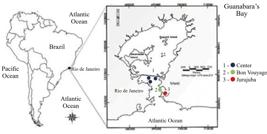
Map showing the South Atlantic and Guanabara Bay using markers of the regions of collection of Perna viridis in the three communities of Niterói, Rio de Janeiro, Brazil: 1) Centro, 2) Boa Viagem, and 3) Jurujuba.
The samples were transported to the Fish and Aquatic Health Laboratory of Faculdade de Veterinária, Universidade Federal Fluminense, Niterói, Rio de Janeiro, Brazil, for identification in the laboratory and occurrence in the communities.
Statistical analysis
Data on length, height, width, and total weight of the valves were expressed in Table 1 as means of the total values and the respective standard deviations.
Sizes of Perna viridis shells found in the three communities (Jurujuba, Boa Viagem, and Center) of Niterói, Rio de Janeiro, Brazil.
RESULTS
The presence of the exotic species P. viridis was observed (Fig. 2) during visits to the three communities (Jurujuba, Boa Viagem and Centro) responsible for the production and extraction of the P. perna mussel.

Presence of Perna viridis in the three communities (Jurujuba, Boa Viagem, and Centro) of Niterói, Rio de Janeiro, Brazil.
According to De Messano et al. (2019), the Brazilian mussel species has morphological features visible under a stereoscopic microscope, with smooth elongated shells, a curved shape, and extended posterior adductor scars, smooth mantle edges, visible concentric growth rings, the beak curved down, and a pair of hinge teeth on the left valve that interlock with a single hinge tooth on the right valve in a curved shape.
As observed under the stereoscopic microscope, the exotic P. viridis species does not have short tentacle-like papillae in the inner fold of the mantle as P. perna (Fig. 3).

Perna viridis individuals collected in the three communities (Jurujuba, Boa Viagem, and Centro) of Niterói, Rio de Janeiro, Brazil.
In one of the collections, 12 individuals were analyzed, presenting an average (Table 1) of 85.82 mm ± 11.38 in length, 41.16 mm ± 4.58 in height, 28.36 mm ± 4.23 in width, and 50.31 g ± 18.10 in weight.
In the municipality of Niterói, the production chain for P. perna mussels is organized around the processing of this species, in an irregular manner, by mussel producers and collectors, for selling the product to the final consumer. The mussels are processed (pre-cooking) outdoors (Fig. 4), in improvised containers, such as paint cans and/or pans, heated on small fires or on a 13-L cooking gas stove.

Methods and containers used to cook Perna Perna mussels in the three communities (Jurujuba, Boa Viagem, and Centro) of Niterói, Rio de Janeiro, Brazil.
After cooking and cooling, the cooked mussels are shelled on a countertop or rustic table and kept in plastic packaging (Fig. 5). Mussels of P. viridis species are found on natural shores or embankment rocks in Guanabara Bay and/or on ropes (“long lines”) at the Jurujuba marine farm and are then sold together with P. perna mussels.

Process of cooling and removing cooked mussels from shells on a bench or table, in which they are packed in plastic packaging, in Jurujuba, Niterói, Rio de Janeiro, Brazil.
After shelling, it is difficult to distinguish which of the already packed species is native and which is exotic. Also, as the consumer market assumes that they are buying P. perna mussels, they do not realize that a mixture of two species is being sold. It is necessary to identify the mussels after cooking and shelling, characterizing them by their morphological differences.
Therefore, an intense irregular commercialization of the referred introduced species is already taking place, without the knowledge of the competent bodies in Brazil. It was found that, after cooking, the color of P. viridis mussels becomes less intense (in the edible part), and the outer mantle fold takes on a light color, while in P. perna mussels there is a more intense color (in the edible part) and the outer fold takes on a characteristic dark color (Fig. 6).

Perna perna and Perna viridis after cooking. (a) Perna perna after cooking, with a more intense coloration (edible part) and a dark-colored outer fold (arrows). (b) Perna viridis after cooking, with a less intense coloration (edible part) and a light-colored outer fold (mantle) (arrows).
DISCUSSION
Invasive alien species, once introduced into other environments, adapt, reproduce, and proliferate in places where they did not previously inhabit. They have rapid maturation, high reproductive capacity, and a tendency to persist in the area after colonizing these new environments (Latini et al., 2016).
In Brazil, there is currently a platform with the national database of invasive alien species, which was developed in 2004 through a partnership between the Hórus Institute and the Universidad Nacional del Sur in Bahía Blanca, Argentina, with a record of the total of 468 invasive species (Instituto Hórus, 2020).
Perna viridis and P. Perna can be found on several rocky shores (Rizzini-Ansari et al., 2016) and at the Jurujuba marine farm, in Guanabara Bay. Perna viridis is considered a superior competitive species, with higher thermal and salinity tolerance limits than P. perna species (Rajagopal et al., 2006). Therefore, regular monitoring and research are recommended to distinguish one specimen from another (Ojaveer et al., 2014).
The mussel extraction and production activity in the municipality of Niterói faces organizational issues due to the absence of a warehouse (processing) where products are stored and then sold in the state of Rio de Janeiro. Thus, the activity poses a risk to consumers, as it does not comply with food safety standards and regulations (Antunes & Mesquita, 2018).
Inspection services, whether municipal, state or federal, do not cover the cultivation area, but rather the commercial establishment. As a result, producers illegally transport their products to other consumer markets. The lack of inspection poses risks to public health, such as microbiological contaminants, harmful microalgae producing toxins, phycotoxin contaminants, inorganic contaminants, polycyclic aromatic hydrocarbons, and the lack of infrastructure for proper processing (Brasil, 2023).
This clandestine operation makes it impossible to sell the product with a marketing strategy. Hence, demand remains low in the coastal region (Assumpção, 1999).
Furthermore, as the price of Chilean mussel Mytilus chilensis (Hupé, 1854) is equal to the price of the national product, it is advantageous to purchase the imported product, as it has higher quality, characterized by an internationally recognized health certification, standard container size, individually frozen meat, appropriate packaging, and regular supply (Cordeiro, 2005).
Thus, in many countries, food control has become difficult because of the fragmented legislation, jurisdictions, and deficiencies in surveillance, monitoring and inspection. Therefore, the Food and Agriculture Organization of the United Nations and the World Health Organization (2003) are committed to promoting national food control systems based on scientific principles and guidelines, covering all sectors of the food chain, to protect collective health, prevent fraud, deception and food adulteration, in order to facilitate trade.
CONCLUSION
The cause of the abundance of Asian mussels in the municipality of Niterói may be the bioinvasion of this species, facilitated by the use of seawater as ballast in ships accessing the region. Additionally, competition may occur between the Asian green mussel (P. viridis) and the South Atlantic brown mussel (P. perna), due to overlapping ecological niches.
Both species compete for similar resources, such as space for attachment on rocky substrates and artificial structures, as well as planktonic food in the water column.
The larger size of P. viridis compared to P. perna may give the invasive species a competitive advantage by occupying more space and outcompeting the native species. This directly prevents the native species from establishing itself, demonstrating interference in resource access and compromising its survival.
In some situations, the invasive species may be also more tolerant of variations in temperature and salinity, allowing it to expand into areas where the native species might not thrive as well, creating an ecological advantage.
The commercialization of this invasive bivalve mollusk may pose health risks to consumers, including contamination by toxins, pathogens, and heavy metals. Additionally, it may be considered economic fraud when there is a lack of transparency about the species being sold or when native species of higher value are replaced by invasive species.
To avoid these problems, rigorous oversight is essential, with clear labeling, efficient sanitary inspection, and education for consumers and producers about the risks and characteristics of invasive species.
Therefore, mussel farming planning must include the mapping and registration of suitable areas, minimizing conflicts over the use of public areas, providing continuous training through effective health education, and encouraging producers and harvesters (traditional communities) to better structure their processing units with municipal, state, or federal inspection services. This is necessary to ensure depuration, heat treatment, and the commercialization of a safe product that will not harm consumers, the product’s image, or the state of Rio de Janeiro itself.
ACKNOWLEDGMENTS
We thank Rio de Janeiro State Fisheries Institute Foundation, Mussel Project RJ, Free Association of Mariculturists of Jurujuba, Associated Workers of the Sea of Boa Viagem, Friends of São Pedro Fishermen’s Association, the Applied Project Development Program, Niterói City Hall, Euclides da Cunha Foundation, and Universidade Federal Fluminense.
-
FUNDING
Coordenação de Aperfeiçoamento de Pessoal de Nível SuperiorFinance code 0001.
DATA AVAILABILITY STATEMENT
All data sets were generated or analyzed in the current study.
REFERENCES
-
Antunes, R. M., & Mesquita, E. F. M. (2018). Exploração extrativa do mexilhão Perna perna (Mollusca: Bivalvia) no estado do Rio de Janeiro e suas questões socioculturais, educacionais, governamentais, ambientais e de saúde coletiva: uma revisão de literatura. Revista Vértices, 20(3), 304-316. https://doi.org/10.19180/1809-2667.v20n32018p304-316
» https://doi.org/10.19180/1809-2667.v20n32018p304-316 - Assumpção, A. (1999). Estudo da viabilidade de criação de cooperativa dos produtores de mexilhões do litoral norte paulista ESALQ, Departamento de Economia, Administração e Sociologia. (Relatório CES, 629).
- Bax, N., Hayes, K., Marshall, A., Parry, D., & Thresher, R. (2002). Man-made marinas as sheltered islands for alien marine organisms: Establishment and eradication of an alien invasive marine species. In C. R. Veitch & M. N. Clout (Eds.), Turning the tide: The eradication of invasive species (pp. 26-39). IUCN SSC Invasive Species Specialist Group.
-
Brasil (2023). Secretaria de Defesa Agropecuária. Ministério da Agricultura e Pecuária. Portaria SDA/MAPA nº 884, de 6 de setembro de 2023 Aprova o Programa Nacional de Moluscos Bivalves Seguros - MoluBiS. Retrieved from https://www.in.gov.br/en/web/dou/-/portaria-sda/mapa-n-884-de-6-de-setembro-de-2023-510078795
» https://www.in.gov.br/en/web/dou/-/portaria-sda/mapa-n-884-de-6-de-setembro-de-2023-510078795 - Carmo, M. C. (2006). Água de lastro Ministério da Defesa, Exército Brasileiro, Secretaria de Ciência e Tecnologia, Instituto Militar de Engenharia.
-
Cordeiro, D. (2005). Qualidade do mexilhão Perna perna submetido ao processo combinado de cocção, congelamento e armazenamento (Dissertação de Mestrado, Escola Superior de Agricultura Luiz de Queiroz). https://doi.org/10.11606/D.11.2005.tde-27102005-150046
» https://doi.org/10.11606/D.11.2005.tde-27102005-150046 - Dechelette, I. A. S., & Maiatardelli, G. C. (2015). Entre grandes empreendimentos: Trajetórias em perspectiva de pescadores artesanais catadores de mexilhão na Baía de Guanabara. REA ABANNE
-
De Messano, L. V. R., Messano, J. E. A., Campos, H. F., Coutinho, S. H. C., & Coutinho, R. (2019). Primeiro relato do mexilhão verde asiático Perna viridis (Linnaeus, 1758) no Rio de Janeiro, Brasil: Um novo registro para o sul do Oceano Atlântico. BioInvasions Records, 8(3), 653-660. https://doi.org/10.3391/bir.2019.8.3.22
» https://doi.org/10.3391/bir.2019.8.3.22 -
Dias, P. J., Gilg, M. R., Lukehurst, S. S., Kennington, W. J., Huhn, M., Madduppa, H. H., McKirdy, S. J., & McDonald, J. I. (2018). Genetic diversity of a hitchhiker and prized food source in the Anthropocene: The Asian green mussel Perna viridis (Mollusca, Mytilidae). Biological Invasions, 20, 1749-1770. https://doi.org/10.1007/s10530-018-1659-6
» https://doi.org/10.1007/s10530-018-1659-6 -
Food and Agriculture Organization & World Health Organization (2003). Garantía de la inocuidad y calidad de los alimentos: Directrices para el fortalecimiento de los sistemas nacionales de control de los alimentos FAO. Retrieved from http://www.fao.org/3/a-y8705s.pdf
» http://www.fao.org/3/a-y8705s.pdf -
Guimarães, S. (2020). Como os navios podem levar ou trazer contaminações dentro dos cascos? Conexão Planeta Retrieved from https://conexaoplaneta.com.br/blog/como-osnavios-podem-levar-ou-trazer-contaminacoes-dentro-doscascos/
» https://conexaoplaneta.com.br/blog/como-osnavios-podem-levar-ou-trazer-contaminacoes-dentro-doscascos/ -
Instituto Hórus (2020). Base de dados sobre espécies exóticas invasoras em I3NBrasil Instituto Hórus. Retrieved from http://bd.institutohorus.org.br
» http://bd.institutohorus.org.br -
International Maritime Organization (IMO). (2004). International Convention for the Control and Management of Ships’ Ballast Water and Sediments (BWM Convention). IMO. Retrieved from https://www.imo.org
» https://www.imo.org -
Katsanevakis, S., Tempera, F., Cardeccia, A., & Zenetos, A. (2023). Marine invasive alien species in Europe: 9 years after the IAS Regulation. Frontiers in Marine Science, 10, 1271755. https://doi.org/10.3389/fmars.2023.1271755
» https://doi.org/10.3389/fmars.2023.1271755 - Latini, A. O., Resende, D. C., & Lima, J. E. F. W. (2016). Espécies exóticas invasoras de águas continentais no Brasil Ministério do Meio Ambiente.
-
Micklem, J. M., Griffiths, C. L., Ntuli, N., & Mwale, M. (2016). The invasive Asian green mussel Perna viridis in South Africa: Not all that is green is viridis. African Journal of Marine Science, 38(2), 207-215. https://doi.org/10.2989/1814232X.2016.1180323
» https://doi.org/10.2989/1814232X.2016.1180323 -
Ojaveer, H., Galil, B. S., Minchin, D., Olenin, S., Amorim, A., Canning-Clode, J., & Lehtiniemi, M. (2014). Ten recommendations for advancing the assessment and management of non-indigenous species in marine ecosystems. Marine Policy, 44, 160-165. https://doi.org/10.1016/j.marpol.2013.08.019
» https://doi.org/10.1016/j.marpol.2013.08.019 -
Pereira, V. L. (2020). Verificação da autenticidade da identificação de espécies de pescados comercializados com diferentes formas de processos em supermercados e mercados de Maceió por meio da técnica de DNA barcoding (Dissertação de Mestrado, Universidade Federal de Alagoas). http://www.repositorio.ufal.br/jspui/handle/riufal/7755
» http://www.repositorio.ufal.br/jspui/handle/riufal/7755 -
Pierri, B. S., Fossari, T. D., & Magalhães, A. R. M. (2016). O mexilhão Perna perna no Brasil: Nativo ou exótico? Arquivos Brasileiros de Medicina Veterinária e Zootecnia, 68(2), 404-414. https://doi.org/10.1590/1678-4162-8534
» https://doi.org/10.1590/1678-4162-8534 -
Rajagopal, S., Venugopalan, V. P., Van Der Velde, G., & Jenner, H. A. (2006). Greening of the coasts: A review of the Perna viridis success story. Aquatic Ecology, 40, 273-297. https://doi.org/10.1007/s10452-006-9032-8
» https://doi.org/10.1007/s10452-006-9032-8 -
Rizzini-Ansari, N., Fernandez, M. A., Brito, J. L., Vidal, L. G., De Andrade, C. E. S., & Malm, O. (2016). Assessing mercury contamination in a tropical coastal system using the mussel Perna perna and the sea anemone Bunodosoma caissarum Environmental Monitoring and Assessment, 188, 679. https://doi.org/10.1007/s10661-016-5683-7
» https://doi.org/10.1007/s10661-016-5683-7 -
Silva, E. P., Moreno, I., Amaral, F. J. H., Ferreira, R. P., & Alves, H. G. (2018). Evidências zooarqueológicas de que o mexilhão marrom (Perna perna) é um bioinvasor do litoral brasileiro. The Holocene, 28(11), 1771-1780. https://doi.org/10.1177/0959683618788670
» https://doi.org/10.1177/0959683618788670 - Silva, J. A., & Santos, M. F. (2022). Archaeological insights into the status of Perna perna in Brazil: Native or exotic? Marine Biodiversity Journal, 34(2), 45-60.
- Smith, J., & Doe, A. (2020). Distribution of marine species in the Indo-Pacific region. Journal of Marine Biology, 45(3), 123-135.
Edited by
-
Section editor:
Erika Fabiane Furlan https://orcid.org/0000-0001-8583-0764


