
 A new pre-slaughter stunning method promotes quality of tambaqui (Colossoma macropomum) fillets compared to conventional methods
ABSTRACT
The study aimed to evaluate the influence of pre-slaughter stunning methods on the quality of tambaqui (Colossoma macropomum) fillets, namely ice asphyxiation (AG); asphyxia in air (AA); electronarcosis (EE); and hypothermia followed by bleeding (HS). The quality was evaluated using the pH of the meat; the rigor mortis index; and meat texture, blood glucose and colorimetry. For each treatment, 12 animals were used, and six animals from each treatment were kept intact for pH and rigor mortis analysis during the times of 0, 1, 1.5, 2.5, 4.5, 6.5, 24, 36, 48, 72, 96, 120, 160 and 360 hours after slaughter. The pH values were kept in compliance with the legislation, below 7. As for the rigor mortis index, the group killed by electronarcosis took one hour longer to show full rigor. For texture attributes, no differences were found between treatments. Therefore, the tambaqui fillets submitted to EE and HS tended to lower red coloration. EE, in addition to draining more blood, promotes the integrity of the cut, providing more succulence and tenderness to the fillet.
Keywords
Animal welfare; Electronarcosis; Fish farming; Meat quality;
Rigor mortis
RESUMO
O estudo teve como objetivo avaliar a influência de métodos de insensibilização pré-abate na qualidade de filés de tambaqui (Colossoma macropomum), sendo eles asfixia em gelo (AG), asfixia em ar (AA), eletronarcose (EE) e hipotermia seguida de sangria (HS). A qualidade da carne foi avaliada empregando-se o pH; índice de rigor mortis; e textura e colorimetria. O bem-estar foi avaliado com base nos teores da glicose sanguínea. Para cada tratamento, utilizaram-se 12 animais, e seis animais de cada tratamento foram mantidos inteiros para a análise de pH e rigor mortis por 0, 1, 1,5, 2,5, 4,5, 6,5, 24, 36, 48, 72, 96, 120, 168 e 360 horas após o abate. Os valores de pH mantiveram-se em conformidade com a legislação, abaixo de 7. Quanto ao índice de rigor mortis, o grupo abatido por EE demorou uma hora a mais para apresentar rigor pleno. Para os atributos de textura, não foram constatadas diferenças entre os tratamentos. Portanto, os filés de tambaqui submetidos a EE e HS tenderam a menor coloração vermelha. EE, além de drenar mais sangue, promove a integridade do corte, proporcionando maior suculência e maciez ao filé.
Palavras-chave
Bem-estar animal; Eletronarcose; Piscicultura; Qualidade da carne;
Rigor mortis
INTRODUCTION
It is known that the humane treatment of production animals, from birth to slaughter, provides benefits, such as lower rate of injuries, stress, and mortality for these animals. Consequently, higher quality meat is obtained with a gain in the attributed value (Cavali et al., 2022; Cavali et al., 2023). Officially, animal welfare had its principles addressed in 1965 in the United Kingdom, by the Brambell Committee, a multidisciplinary technical commission appointed by the British government that defined animal welfare based on respect for the five freedoms: animals must be free from hunger and thirst; free from discomfort; free from pain, disease and injury; free to express the natural behaviors of the species; and free from fear and stress (Concollato et al., 2016; Cavali et al., 2024).
Stress can be related to several factors, such as feeding, crowding, parasitism, handling, capture and slaughter. Slaughter, once considered an operation of low scientific and technological level, became a cause for concern when there was an understanding that the management of the animal from the rural property until death influences the meat quality (Silva et al., 2022). In this context, it is possible to mention Ordinance No. 365 of July 16, 2021 (Brasil 2021). which approved the Technical Regulation for Pre-slaughter Management and Humane Slaughter, and the stunning methods authorized by the Ministério da Agricultura, Pecuária e Abastecimento. This legislation refers to the slaughter of butchery and fish animals. However, in Art. No. 4, item VIII, in its definition of fish, the ordinance refers only to “amphibians and reptiles slaughtered in establishments under official veterinary inspection” (Brasil, 2021), thus not including fish.
Fish farming, as well as other areas of animal production, seeks to use systems that aim to produce the most at the lowest cost. The quest to maximize production may be responsible for exposing the crop to high levels of stress. In view of this, the other important segment is to farmed fish with animal welfare. Because fish do not have a neocortex, some laypeople deny the possibility that these animals feel pain. Scadeng et al. (2020) point to the fact that the brain structures that transmit pain in other vertebrates are also present in fish, which suggests that these animals are sentient, that is, they are aware of sensations, including feeling pain. Based on this understanding, when studying the methods of stunning and slaughtering fish, one must consider that they feel pain, hunger, comfort, discomfort, etc. In view of this, the concern for the well-being of the fish at all stages of production is justified (Hashimoto et al., 2024; Vargas et al., 2013).
In overview presented, care in carrying out adequate desensitization before causing the death of fish is necessary. Many fish slaughter techniques are employed without involving the stunning process, in small-scale fish processing units. The conditions under which pre-slaughter and fish slaughter operations are carried out, in general, are precarious in Brazil (Poli et al., 2005). Compromising the quality of the final product may be related to unpreparedness in handling production, infrastructure problems, lack of storage capacity, and inadequate transport to slaughterhouses (Concollato et al., 2016). These factors can lead to high waste and low yields. At the time of slaughter, as with other fish, in round fish, the biochemical reactions caused by stress can cause the depletion of muscle glycogen, resulting in an inadequate pH value in the muscle, that is, acidification does not occur, and rigor mortis quickly sets (Oliveira Filho et al., 2016). As there is no specific legislation for the time of fish slaughter, the choice of method is made based on the species of fish to be slaughtered, ease of application and low cost. However, the pre-slaughter stunning method should contribute to the quality of the final product and its shelf life.
Given these assumptions, the aim of this study was to evaluate different slaughter techniques, namely: asphyxiation on ice, asphyxiation in air, electronarcosis, and hypothermia followed by bleeding on tambaqui (Colossoma macropomum) fillets quality and animal welfare.
MATERIAL AND METHODS
Bioethical considerations and fish collect
This study was submitted to the Ethics Committee for the use of Animals of the Universidade Federal de Rondônia (UNIR), in Rolim de Moura, RO, Brazil, and all activities carried out had the approval of its execution by protocol No. 0015/2021. A total of 48 tambaquis was used for carrying out the current study came from commercial fish farms in Urupá municipality, RO, Brazil, and were transported to the de Bromotology Laboratory of UNIR.
To carry out the experimental procedures, the tambaqui were fished with a trawl and taken to the slaughtering site in polyethylene boxes with water. The tambaquis were cultivated for 14 months, weighing 2.25 ± 0.25 kg, fed with commercial feed containing 32–28% of crude protein with granulometry of 2 to 2.5 mm for the initial phase of transition—juvenile.
Pre-slaughter stunning methods
No chemical agent was applied for euthanasia, only the conventional methods of stunning and slaughter of the fishing industry, in addition to the innovative method of electronarcosis followed by bleeding. The pre-slaughter stunning method was ice asphyxiation (AG), i.e., the fish were removed from the box with water and placed in a thermal box in the ice/fish/ice arrangement, until death occurred due to lack of oxygen, as described by Freire and Gonçalves (2013), Robb and Roth (2003), and Viegas et al. (2012). Fish slaughtered by asphyxiation in air (AA), after being removed from the transport box, were deposited in an empty container, in which they remained until death. Hypothermia, the methodology described by Ashley (2007), was adopted, that is, a process in which the fish is submerged in a polyethylene box containing a solution of ice and water (1:1) at the temperature of around 1°C, until death. Then, these animals were subjected to the bleeding process (HS) by cutting the branchial arches.
After observing complete desensitization (movement absence and balance loss) (Oliveira Filho et al., 2016), the animals were immediately sacrificed by cutting the branchial arches for bleeding. After slaughter, the tambaqui were weighed on a portable digital scale, measured using a millimeter ichthyometer, and each animal was identified with numerical labels identified as:
-
Treatment 1: ice asphyxiation (AG);
-
Treatment 2: air asphyxiation (AA);
-
Treatment 3: electronarcosis (EM);
-
Treatment 4: hypothermia followed by bleeding (HS).
Regarding the new method of EE, a container with approximately 200 L of water and 500 grams of sodium chloride (NaCl) was used to enhance electrical conduction. The fish were immersed in this solution and subjected to an electrical discharge previously established in preliminary tests: 220 V, 3.5 A, frequency of 1,200 Hz, and exposure time of 20 seconds. After observing complete desensitization, characterized by the absence of movement and loss of balance, the animals were immediately slaughtered by cutting the gill arches for the bleeding process (Cavali et al., 2024). After slaughter, tambaqui specimens were weighed on a portable digital scale, measured using a millimeter ichthyometer, and identified with numerical labels corresponding to the following treatments: treatment 1 (IA), treatment 2 (AA), treatment 3 (EE), and treatment 4 (HB) (Cavali et al., 2024).
A total of 12 tambaqui fillets per treatment was sent for sample processing. The tambaqui fillets were stored in plastic bags with Ziplock closure, receiving the same identification as the animal of origin. After obtaining the first data, still in the vicinity of the fish farm visited, all samples were sent on ice to the Laboratory of Physical-Chemical and Microbiological Analysis of UNIR, where they were stored in a freezer, at 0°C, throughout the experiment.
Obtaining data
The pH measurements started at time 0 (immediately after slaughter), being repeated at 1 and 1.5 hours at the place of slaughter, in the Laboratory of Physical-Chemical and Microbiological Analysis at UNIR, then the analyses followed, being carried out with 2.5, 4.5, 6.5 hours. After these times, the pH analyses started to be carried out at 24, 36, 48, 72, 96, 120, 168 and 360 hours. Measurements were taken on the right side below the dorsal fin, with the aid of a portable pulsation pedometer (Sensoglass SP1400). At each measurement, a new perforation was performed to insert the probe in a different location, at the minimum distance of 1 centimeter from one to the other, in order to avoid false data due to possible contamination of the site.
The determination of the rigor mortis index (Eq. 1) started on the property, at time 0 (immediately after the slaughter), and followed the same schedules established for the pH, with the purpose of monitoring the muscular behavior of the animals. This measurement was performed according to the methodology developed by Bito et al. (1983).
Where: RI: rigor mortis index; Do: value that separates the base of the tail fin from the reference point (time 0); D: distance separating the base of the tail fin from the reference point in the selected time intervals.
The fish were deposited on a table, and the length of the animal’s body (head-to-tail distance) was measured using an ichthyometer. The value of the total length was divided by 2 to obtain the half location of the animal’s body, which was marked with a pin. Then, the animal was placed with the upper half of the body on the table, so that from the middle to the end (towards the tail) there was no contact with the surface of the table. The measurement of the length of the slope that formed with the surface was measured with the aid of a square and ruler.
For texture analysis, fillets on the right side were used (six samples for each treatment). The methodology to determine the texture profile was performed according to Bourne (2002). The compression strength (KgF�mm-2), hardness (N) and adhesiveness (mm2) attributes were evaluated in a TAXT.plus texturometer, using the Exponent Stable Micro Systems software (Stable Micro System LTD, Vienna Court, United Kingdom). The samples were positioned horizontally on a platform, using a cylindrical probe with a flat end, ½ inch in diameter. Concerning the conditions of the instrumental texture tests, the pre-test speed was 2 mm�s-1, post-test 10 mm�s-1, distance of 4 mm, with measurement of strength in compression (Almeida et al., 2020). Measurements started 24 hours after slaughter and were repeated at 36, 48, 72, 96, 120, and 168 hours after slaughter, totaling a period of seven days.
For blood glucose analysis, blood samples were collected from slaughters in which the gills were cut (EE and HS) at the time of bleeding. In animals slaughtered by asphyxiation methods (AG and AA), blood collection occurred as soon as death by pulsation of the vein located in the tail fin was verified, using a 5-mL disposable syringe. An Accu-Chek Active glucose meter kit was used, with the value expressed in mg�dL-1.
Instrumental colorimetry was measured using a portable colorimeter (Minolta CR-10, Minolta Camera Co., Osaka, Japan), previously calibrated with a black and white standard before each analysis, operating a D65 light source, an observation angle of 10° and 30-mm measure cell opening. The color was expressed using the color standards of the Commission Internationale de L’Eclairage (CIELAB) system: L* (brightness, which evaluates a range 0, which is considered black, to 100, which means white), a* (red-green color intensity), and b* (yellow-blue color intensity) (Hunter & Harold, 1975).
Statistical analysis
The pH, rigor mortis index and glucose data were submitted to a completely randomized design, using the Shapiro-Wilk’s normality test. Analysis of variance (ANOVA) and means were compared by Tukey’s test (α = 0.05), using the SAS Statistical Program, at the significance level of 5% probability.
Regarding the texture profile, the averages of the three repetitions of each fillet at the sampling moment were performed. The results were preliminarily submitted to ANOVA. Then, in case of normality and significance, the Tukey’s test was applied (α = 0.05). To assist the interpretation of the compression strength results, dispersion analysis was applied.
RESULTS AND DISCUSSION
After death, the fish begins to undergo a series of changes, as the result of a complex biochemical modification in the muscle. In anaerobic conditions, the formation of lactic acid occurs, causing a drop in muscle pH (Silva et al., 2022). In this present study, muscle pH values were following RIISPOA (Brasil, 2017), performing below 7 throughout the experiment for all slaughter methods.
When comparing the average pH between treatments, no statistical differences were found (p > 0.05) at 0, 1.5, 24, 36, 72, and 120 h, contrary to what happened at the other times (Table 1). Oliveira Filho et al. (2015) did not find differences in pH values of Nile tilapia when compared to slaughter by CO2 stunning and hypothermia in a study for 408 h.
Averages and standard deviations in muscle pH of tambaqui (Colossoma macropomum) submitted to pre-slaughter stunning methods by ice asphyxia (AG), air asphyxiation (AA), electronarcosis (EE), and hypothermia followed by bleeding (HS), at different sampling times*.
A sharp drop in values of the AG groups, up to 1.5 h after slaughter, and EE, up to 1h, can be observed in the pH averages. For animals subjected to AA and HS methods, there was a slight drop in pH up to 1 hour after slaughter (Fig. 1). According to Pardi et al. (2006), the drop in muscle pH is not uniform between different muscles of the same animal, between individuals of the same breed and between those of different breeds and species.

Graphic representation of the muscle pH variation in tambaqui (Colossoma macropomum) submitted to pre-slaughter stunning methods by ice asphyxia (AG), air asphyxiation (AA), electronarcosis (EE), and hypothermia followed by bleeding (HS), at different sampling times.
In no group did the pH reach values lower than 6.0, in agreement with Mendes et al. (2017), who ensures that the muscle pH of fish after death will hardly be below 6, even in full rigor mortis, unlike the meat of mammals. However, Almeida et al. (2020) found pH values of 5.89 in tilapia fillets, which were “disaggregated” (gapping effect), a typical defect of meat from animals that suffered intense stress before slaughter.
There is a tendency for the muscle to present, over time, pH values lower than those at time 0 h for all slaughter methods, except for AA and HS at 48 hours (Fig. 1). Rucinque et al. (2023) worked with tilapias slaughtered by electric shock, gas mixture, and hypothermia, and kept them cool after slaughter for a period of 624 hours. The pH results were like those found in the current study, with a reduction in the final values in relation to the initial ones for the three methods. Vargas et al. (2013) reported the occurrence of muscle acidification in matrinxãs (Brycon cephalus) up to 56 hours after slaughter with thermal shock; 24.5 hours for electronarcosis; and 26.5 hours for CO2. Although contrary to what was observed in the current study, from those times onwards there was a gradual increase in pH values for the animals in the electronarcosis and CO2 groups, and stability for the thermal shock. Also, Lessi et al. (2004), working with matrinxã, found an increase in pH after the sixth day. The increase in pH levels in these studies may have occurred due to the synthesis of volatile nitrogenous bases, such as trimethylamine and ammonia, resulting from the microbial degradation process involving aerobic and facultative anaerobic bacteria (Silva et al., 2022). Trimethylamine oxide is a natural component of fish muscle, and in the postmortem period it is reduced to trimethylamine, and ammonia, in turn, results from the degradation of amino acids in muscle proteins. Both compounds interfere with the odor of stored fish.
Some authors have questioned the use of pH as a parameter for analyzing the fish quality. For Özogul and Özogul (2004), the pH values vary according to the species and capture methods used and should not be used as the only freshness index method, although it is known that the variation of this parameter during storage may indicate the occurrence of any alteration (biochemical or microbiological). Ocaño-Higuera et al. (2011) reported that, in work with tambaquis, the pH did not prove to be a good index to assess quality, since no difference was observed in the values in animals that underwent harvesting; 4 h transport; 24 and 48 h recovery and slaughtered by asphyxiation with CO2 and hypothermia.
After slaughter, another significant change in the muscle is the event of rigor mortis, characterized by extreme and irreversible contraction of the muscle due to the depletion of energy sources, when the pH reaches a minimum value. The longer the muscle remains in the pre-rigor stage, when there is still muscle flexibility, the longer its shelf life should be. This is because after the period of stiffness, due to the drop in pH, there is activation of proteolytic systems, thus occurring relaxation and recovery of muscle elasticity. From then on, the autolysis process takes shape, followed by the action of microbial proteases (Amlacher, 1961; Tavares & Gonçalves, 2011).
The rigor mortis index showed differences between the slaughter methods at the other times, except at 1:30 a.m., 12 p.m., and 4 p.m. (p < 0.05). Bagni et al. (2006) asserted that stress before death causes early onset of rigor mortis. Paying attention to the figure, it can be seen that AG and AA entered full rigor mortis at 1.5 hour after slaughter. however, the AG group in particular showed a propensity to enter full rigor mortis before the others, and at time 0 to 80% of their samples were already in this condition, and 2.5 hours after slaughter, 83% of them had already entered rigor resolution, with signs of muscle relaxation.
It is also observed that the animals slaughtered by the EE method showed 100% of accuracy index in all samples 2.5 hours after slaughter and remained in it until 36 hours. Animals slaughtered by HS at time 0 showed absolute rigor mortis in 53% of the samples, and the remaining animals in the group were close to entering rigor from 1 h after slaughter. In general, the results for EE point to a greater preservation of muscle glycogen. Perhaps because of this the group took longer to enter rigor mortis (Table 2; Fig. 2).
Averages in rigor mortis inde,x (IR%) of tambaqui (Colossoma macropomum) submitted to pre-slaughter stunning methods by ice asphyxia (AG), air asphyxiation (AA), electronarcosis (EE) and hypothermia followed by bleeding (HS), at different sampling times*.
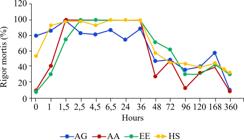
Graphic representation of the rigor mortis index variation in tambaqui (Colossoma macropomum) submitted to pre-slaughter stunning methods by ice asphyxia (AG), air asphyxiation (AA), electronarcosis (EE), and hypothermia followed by bleeding (HS), at different sampling times.
Contrary to what was observed here, Digre et al. (2011), in a study with Atlantic cod (Gadus morhua), found that electronarcosis accelerated the process of entry into rigor mortis when treated with anesthetic. Likewise, Morzel et al. (2002) with turbot (Psetta maxima), noted that the EE group entered rigor mortis before the groups slaughtered by cranial percussion and heat shock. There was a rapid reduction in the rigor index for AG, AA, and HS from 36 hours after slaughter, and for EE this reduction from the same time was smoother than in the others (Fig. 2). For Almeida et al. (2006), the later it occurs and the longer the duration of rigor mortis is, the smaller the changes in the characteristics of the meat and the longer the shelf life of this product are, an establishment desired by the industries.
Castro et al. (2017) listed some causes associated with the speed of the pH drop, the onset and duration of rigor mortis: handling before slaughter; stress; resistance or susceptibility of the animal itself to stress; and postmortem temperature. Mello et al. (2016) also mentioned factors such as the size of the fish, the level of fat in the body or even the species. Finally, Mendes et al. (2015) follow this line of thought, arguing that the entry and exit of rigor mortis seems to depend on the intensity and duration of pre-slaughter stress.
Postmortem events cause changes in meat texture, which is one of the main quality attributes of this product. In post-rigor, these changes occur due to autolytic reactions, which at first contribute to the tenderization of the meat after the period of cadaveric rigidity, but advanced autolysis causes destruction of connective tissue during storage, causing softening (Rucinque et al., 2023).
In the current study, the results for texture, namely, compression strength, and adhesiveness were compared between groups to check whether the slaughtering method would interfere with these properties during storage. However, there was no difference between the general averages of the treatments for the three texture variables (p > 0.05) (Table 3). The compression strength analysis, using a texturometer, measures the tenderness of the meat. The higher the shear force, the lower the softness (Antiwi-Boasiako & Acheampong, 2016). The compression strength values were compared between the samples of each group individually, and in all treatments, there was a difference (p < 0.05) between the values over time.
Instrumental texture profile in tambaqui (Colossoma macropomum) fillets under refrigeration for up to 168 hours, submitted to pre-slaughter stunning methods by ice asphyxia (AG), air asphyxiation (AA), electronarcosis (EE), and hypothermia followed by bleeding (HS)*.
It was verified that the animals of AA and EE in 36 h were still in total rigor mortis. At this time, a peak was observed in the values of compression strength in these two groups, with a tendency towards a reduction in this parameter (with an increase in tenderness) in the following hours, with a more pronounced drop in AA. The AG group went into full rigor mortis before the first texture reading, making comparison difficult. On the other hand, HS, despite still being rigorous at 36 h, showed greater tenderness (p < 0.05) at this time than at the next sampling point, 48 h, tending to decrease in the later times.
In the AG and AA treatments, there was no significant difference in tenderness at the sampling points 24 and 168 h, and despite the variations in measurements over time, tenderness did not increase, indicating the non-occurrence of autolysis, or microbial degradation. For EE, there was a difference (p < 0.05) between 24 and 168 h for compression strength, indicating that, at the end, the meat was more tender. Incidentally, the graph shows a tendency for EE to have lower values compared to the AG and HS groups. Unlike the others, HS showed a higher value (p < 0.05) than the 24-h value at the end, which may indicate that there was no loss of texture (Table 3).
Considered as a negative force necessary to overcome the food’s attraction to another material or surface, the adhesiveness parameter in the study did not shown a significant difference between treatments (Zhao et al., 2018). However, it can be observed that there is a trend towards an increase in the applied force for all groups over the course of the experimental days. Ocaño-Higuera et al. (2011), in work with slaughter of tambaquis by asphyxiation with CO2 and hypothermia stored on ice, recorded a significant difference for texture, measured with the force parameter, between the slaughters used. Bahuaud et al. (2010) state that stressful and time-consuming slaughter methods resulted in a smoother (softened) muscle texture and a shorter shelf life in a study carried out with salmonids. Tilapias slaughtered with carbon dioxide and stored on ice for 17 days showed differences in texture results between the days of analysis, for the same slaughter group, according to Oliveira Filho et al. (2015).
In the case of stress, the elevation of blood glucose is a typical response in fish under this condition (Affonso et al., 2009). Glycemia increases in the presence of some stressor to meet the greater energy demand, characteristic of unfavorable situations. Fish, when subjected to stressful factors, tend to spend their energy reserves in an attempt at osmoregulation, escape or breathing, thus triggering the glycogen present in the liver, causing an increase in blood glucose values. In this study, the glucose values of each group did not differ significantly from each other (p < 0.05) (Table 4). Compared to conventional methods, the pre-slaughter stunning process using EE causes less stress to the fish, as Cavali et al. (2024) found in the slaughter of pirarucu (Arapaima gigas) in Rondônia state, Brazil. Even in cases with a highly balanced and standardized diet, very well carried out stunning can make all the difference in the quality of fish (Hashimoto et al., 2024).
Blood glucose (mg•dL-1) averages in tambaqui (Colossoma macropomum) submitted to pre-slaughter stunning methods, ice asphyxia (AG), air asphyxiation (AA), electronarcosis (EE), and hypothermia followed by bleeding (HS)*.
According to Brandão et al. (2022), the mean glucose values in non-stressed tambaquis are 28.67 ± 10.23 mg�dL-1, with a range of variation from 13 to 45 mg�dL-1. In this study, the averages of the glucose results for all treatments indicate that the animals were stressed. This result may be related not only to the method of slaughter, but also to the management since harvesting. Staurnes et al. (1994) reports that the moment of capture of the fish may be responsible for generating intense stress to the animals. Chasing animals with nets, putting them in direct contact with the net (abrasion) and with other fish, exposing the animals to air, and forced swimming comprise a sequence of isolated and successive stressor stimuli that generate a cumulative stress response (Zuanazzi et al., 2019), which can be reflected in glucose values.
Regarding an instrumental colorimetry, the parameters of luminosity (L*), chromaticity (a*) (red-green component), and chromaticity (b*) (yellow-blue component) were studied. The EE and HS treatments expressed the highest average of L* (86.84 and 85.43, respectively), although the AA and EE treatments expressed the highest average of a* (4.55), while the EE and HS treatments expressed the highest average of b* (-14.94 and -12.48, respectively) in relation to the other treatments. Furthermore, there was an interaction effect between slaughter methods and tambaqui fillets (p < 0.001) (Table 5). That is, in the tambaqui submitted to EE and HS, the fillets tended to show a lower red color. In view of this, it was found that these methods exposed less water and showed the destruction of blood cells, allowing better luminosity and preservation of the fillets. It was confirmed that in EE method the blood was better drained, which promotes the fillet integrity.
Instrumental colorimetry in tambaqui (Colossoma macropomum) fillets at 360 hours under refrigeration for up to 360 hours of storage, submitted to different pre-slaughter stunning methods#.
CONCLUSIONS
Electronarcosis was an excellent pre-slaughter stunning method for tambaqui (C. macropomum). The fish subjected to this method did not suffer stress during slaughter. Furthermore, during the 15 days of refrigerated storage, the fish fillets subjected to EE presented better preservation, juiciness and tenderness.
ACKNOWLEDGMENTS
Jucilene B. Cavali and Jerônimo V. Dantas Filho are grateful to FUNDAPE/UNIR for the DTI scholarship.
-
FUNDING
Programa de Desenvolvimento da Cadeia Produtiva da Aquicultura 2023–2026 - FUNDAPE/UNIR.Grant No: 167879/2022-7
DATA AVAILABILITY STATEMENT
The data will be available upon request.
REFERENCES
- Affonso, E., Barros, F. P., Brasil, E. M., Tavares-Dias, M., & Onoi, E. A. (2009). Indicadores fisiológicos de estresse em peixes expostos ao peróxido de hidrogênio (H2O2). In M. Tavares-Dias (Ed.), Manejo e sanidade de peixes em cultivo (Vol. 20, No. 1, pp. 346-360). Embrapa Amapá.
-
Almeida, N. M., Batista, G. M., Kodaira, M., & Lessi, E. (2006). Alterações pós-mortem em tambaqui (Colossoma macropomum) conservados em gelo. Ciência Rural, 36(4), 1288-1293. https://doi.org/10.1590/S0103-84782006000400038
» https://doi.org/10.1590/S0103-84782006000400038 -
Almeida, R. L. J., Santos, N. C., Pereira, P. S., Silva, V. M. A., Ribeiro, V. H. A., Silva, L. N., Santiago, Â. M., Luiz, M. R., Moreira, F. I. N., & Lima, S. E. R. (2020). Texture profile and water activity of cookies made with red rice during storage. Research, Society and Development, 9(1), 1-15. https://doi.org/10.33448/rsd-v9i1.1830
» https://doi.org/10.33448/rsd-v9i1.1830 - Amlacher, E. (1961). Rigor mortis in fish. In G. Borgstrom (Ed.), New York (pp. 385-409). Academic Press.
-
Antiwi-Boasiako, C., & Acheampong, B. B. (2016). Strength properties and calorific values of sawdust-briquettes as wood-residue energy generation source from tropical hardwoods of different densities. Biomass and Bioenergy, 85, 144-152. https://doi.org/10.1016/j.biombioe.2015.12.006
» https://doi.org/10.1016/j.biombioe.2015.12.006 -
Ashley, P. J. (2007). Fish welfare: Current issues in aquaculture. Applied Animal Behaviour Science, 104(3-4), 199-235. https://doi.org/10.1016/j.applanim.2006.09.001
» https://doi.org/10.1016/j.applanim.2006.09.001 -
Bagni, M., Civitareale, C., Priori, A., Ballerini, A., Finoia, M., Brambill, A., & Marino, G. (2006). Pre-slaughter crowding stress and killing procedures affecting quality and welfare in sea bass (Dicentrarchus labrax) and sea bream (Sparus aurata). Aquaculture, 263(1-4), 52-60. https://doi.org/10.1016/j.aquaculture.2006.07.049
» https://doi.org/10.1016/j.aquaculture.2006.07.049 -
Bahuaud, D. T., Morkore, T. K., Ostbye, E., Veiseth-Kent, M. S., & Thomassen, R. O. (2010). Muscle structure responses and lysosomal cathepsins B and L in farmed Atlantic salmon (Salmo salar L.) pre- and post-rigor fillets exposed to short and long-term crowding stress. Food Chemistry, 118(3), 602-615. https://doi.org/10.1016/j.foodchem.2009.05.028
» https://doi.org/10.1016/j.foodchem.2009.05.028 - Bito, M., Yamada, K., Mikumo, Y., & Amano, K. (1983). Studies on rigor mortis of fish - I. Difference in the mode of rigor mortis among some varieties of fish. By modified cutting methods. Bulletin Tokai Regional Fisheries Research Laboratory, 109, 89-96.
- Bourne, M. C. (2002). Food texture and viscosity: Concept and measurement (Vol. 10, No. 2, pp. 416-426). Academic Press.
-
Brandão, F. R., Duncan, W. P., Farias, C. F. S., Souza, D. C. M., Oliveira, M. I. B., Rocha, M. J. S., Monteiro, P. C., Majolo, C., Chaves, F. C. M., O’Sullivan, F. L. A., & Chagas, E. C. (2022). Essential oils of Lippia sidoides and Mentha piperita as reducers of stress during the transport of Colossoma macropomum. Aquaculture, 560, 738515. https://doi.org/10.1016/j.aquaculture.2022.738515
» https://doi.org/10.1016/j.aquaculture.2022.738515 -
Brasil (2017). Decreto nº 9.013, de 29 de março de 2017. Regulamenta a inspeção industrial e sanitária de produtos de origem animal. Diário Oficial da União Retrieved from: https://www.in.gov.br/materia/-/asset_publisher/Kujrw0TZC2Mb/content/id/20134711
» https://www.in.gov.br/materia/-/asset_publisher/Kujrw0TZC2Mb/content/id/20134711 -
Brasil (2021). Ministério da Agricultura, Pecuária e Abastecimento. Portaria nº 365, de 16 de julho de 2021. Aprova o Regulamento Técnico de Manejo Pré-abate e Abate Humanitário e os métodos de insensibilização autorizados. Diário Oficial da União, seção 1. Retrieved from https://www.in.gov.br/en/web/dou/-/portaria-n-365-de-16-de-julho-de-2021-333081465
» https://www.in.gov.br/en/web/dou/-/portaria-n-365-de-16-de-julho-de-2021-333081465 -
Castro, P. L., Lewandowski, V., Souza, M. L. R., Coradini, M. F., Alexandre, A. A. da C., Sary, C., & Ribeiro, R. P. (2017). Effect of different periods of pre-slaughter stress on the quality of the Nile tilapia meat. Food Science and Technology, 37(1), 52-58. https://doi.org/10.1590/1678-457X.05616
» https://doi.org/10.1590/1678-457X.05616 -
Cavali, J. B., Baldi, S. C. V., Rocha, A. S. C. M., Silva, E. E., Nunes, C. T., Soares, E. C., Schons, S. V., Zanella, R., Pontuschka, R. B., & Dantas Filho, J. V. (2024). Pre-slaughter stunning methods influence the meat quality of Arapaima gigas fillets. Animals, 14(8), 1155. https://doi.org/10.3390/ani14081155
» https://doi.org/10.3390/ani14081155 -
Cavali, J. B., Dantas Filho, J. V., Nunes, C. T., Ferreira, E., Pontuschka, R. B., Zanella, R., & Souza, M. L. R. (2023). Fatty acid profile, omegas, and lipid quality in commercial cuts of pirarucu (Arapaima gigas Schinz, 1822) cultivated in excavated tanks. Acta Scientiarum. Animal Sciences, 45(1), e61186. https://doi.org/10.4025/actascianimsci.v45i1.61186
» https://doi.org/10.4025/actascianimsci.v45i1.61186 -
Cavali, J. B., Marmentini, R. P., Dantas Filho, J. V., Pontuschka, R. B., & Schons, S. de V. (2022). Fatty acid profile, omegas, and lipid quality in commercial cuts of tambaqui (Colossoma macropomum Cuvier, 1818) cultivated in ponds. Boletim do Instituto de Pesca, 48, e700. https://doi.org/10.20950/1678-2305/bip.2022.48.e700
» https://doi.org/10.20950/1678-2305/bip.2022.48.e700 -
Concollato, A., Olsen, R. E., Vargas, S. C., Bonelli, A., Cullere, M., & Parisi, G. (2016). Effects of stunning/slaughtering methods in rainbow trout (Oncorhynchus mykiss) from death until rigor mortis resolution. Aquaculture, 464, 74-79. https://doi.org/10.1016/j.aquaculture.2016.06.009
» https://doi.org/10.1016/j.aquaculture.2016.06.009 -
Digre, H., Erikson, U., Skaret, J., Lea, P., Gallart-Jornet, L., & Misimi, E. (2011). Biochemical, physical and sensory quality of ice-stored Atlantic cod (Gadus morhua) as affected by pre-slaughter stress, percussion stunning and AQUI-S™ anaesthesia. European Food Research and Technology, 233, 447-456. https://doi.org/10.1007/s00217-011-1531-8
» https://doi.org/10.1007/s00217-011-1531-8 -
Freire, C. E. C., & Gonçalves, A. A. (2013). Diferentes métodos de abate do pescado produzido em aquicultura, qualidade da carne e bem-estar do animal. Holos, 6(3), 33-41. https://doi.org/10.15628/holos.2013.992
» https://doi.org/10.15628/holos.2013.992 -
Hashimoto, A. J., Rocha, A. S. C. M., Hurtado, F. B., Viana, G. A., Medeiros, I. D. de, Porto, M. O., Dantas Filho, J. V., & Cavali, J. (2024). Biochemical and hematological characterization of pirarucu (Arapaima gigas Schinz, 1822) juveniles fed with different nutritional feeding systems. Acta Scientiarum. Animal Sciences, 46(1), e66797. https://doi.org/10.4025/actascianimsci.v46i1.66797
» https://doi.org/10.4025/actascianimsci.v46i1.66797 - Hunter, R. S., & Harold, R. W. (1975). The measurement of appearance John Wiley & Sons.
-
Lessi, E., Batista, G. M., Kodaira, M., & Falcão, P. T. (2004). Post-mortem biochemical alterations of matrinxã Brycon cephalus (Gunther, 1869) from fish farms, kept on ice. Science and Food Technology, 24(4), 573-581. https://doi.org/10.1590/S0101-20612004000400016
» https://doi.org/10.1590/S0101-20612004000400016 -
Mello, F., Daruzi, F., Godoy, L. C., Lothhammer, N., Guerreiro, L. R., & Streit Junior, D. P. (2016). Morphological and morphometric analysis of skeletal muscle between male and female young adult Colossoma macropomum (Characiformes: Serrasalmidae). Neotropical Ichthyology, 14(2), e150149. https://doi.org/10.1590/1982-0224-20150149
» https://doi.org/10.1590/1982-0224-20150149 -
Mendes, J. M., Dairiki, J. K., Inoue, L. A. K. A., & Jesus, R. S. (2017). Advantages of recovery from pre-slaughter stress in tambaqui Colossoma macropomum (Cuvier 1816) agroindustry in the Amazon. Food Science and Technology, 37(3), 383-388. https://doi.org/10.1590/1678-457X.14316
» https://doi.org/10.1590/1678-457X.14316 -
Mendes, J. M., Inoue, L. A., & Jesus, R. S. (2015). Influence of transport stress and slaughter method on rigor mortis of tambaqui (Colossoma macropomum). Brazilian Journal of Food Technology, 18(2), 162-169. https://doi.org/10.1590/1981-6723.1115
» https://doi.org/10.1590/1981-6723.1115 -
Morzel, M., Sohier, D., & Van de Vis, H. (2002). Evaluation of slaughtering methods for turbot with respect to animal welfare and flesh quality. Journal of the Science of Food and Agriculture, 83(1), 19-28. https://doi.org/10.1002/jsfa.1253
» https://doi.org/10.1002/jsfa.1253 -
Ocaño-Higuera, V. M., Maeda-Martínez, A. N., Marquez-Ríos, E., Canizales-Rodríguez, D. F., Castillo-Yáñez, F. J., Ruíz-Bustos, E., Graciano-Verdugo, A. Z., & Plascencia-Jatomea, M. (2011). Freshness assessment of ray fish stored in ice by biochemical, chemical and physical methods. Food Chemistry, 125(1), 49-54. https://doi.org/10.1016/j.foodchem.2010.08.034
» https://doi.org/10.1016/j.foodchem.2010.08.034 -
Oliveira Filho, P. R. C., Girao, J. M., Guimarães, J. L., Natori, M. M., Vargas, S. C., & Viegas, E. M. M. (2016). Impact of electrical stunning on fish behavior and meat quality of pacu (Piaractus mesopotamicus). Acta Scientiarum. Technology, 38(1), 81-88. https://doi.org/10.4025/actascitechnol.v38i1.27103
» https://doi.org/10.4025/actascitechnol.v38i1.27103 -
Oliveira Filho, P. R. C., Oliveira, C. A. F., Sobral, P. J. A., Balieiro, J. C. C., Natori, M. M., & Viegas, E. M. M. (2015). How stunning methods affect the quality of Nile tilapia meat. CyTA - Journal of Food, 13(1), 56-62. https://doi.org/10.1080/19476337.2014.911211
» https://doi.org/10.1080/19476337.2014.911211 -
Özogul, Y., & Özogul, F. (2004). Effects of slaughtering methods on sensory, chemical and microbiological quality of rainbow trout (Onchorynchus mykiss) stored in ice and MAP. European Food Research and Technology, 219(6), 211-228. https://doi.org/10.1007/s00217-004-0951-0
» https://doi.org/10.1007/s00217-004-0951-0 - Pardi, M. C., Santos, I. F., Souza, E. R., & Pardi, H. S. (2006). Conversão do músculo em carne. In M. C. Pardi, I. F. Santos, E. R. Souza, & H. S. Pardi (Eds.), Ciência, Higiene e Tecnologia da Carne (Vol. 2, No. 2, pp. 626-636). Editora da UFG.
-
Poli, B. M., Parisi, G., Scappini, F., & Zampacavallo, G. (2005). Fish welfare and quality as affected by pre-slaughter and slaughter management. Aquaculture International, 13, 29-49. https://doi.org/10.1007/s10499-004-9035-1
» https://doi.org/10.1007/s10499-004-9035-1 -
Robb, D. H., & Roth, B. (2003). Brain activity of Atlantic salmon (Salmo salar) following electrical stunning using various field strengths and pulse durations. Aquaculture, 216(1-4), 363-369. https://doi.org/10.1016/S0044-8486(02)00494-5
» https://doi.org/10.1016/S0044-8486(02)00494-5 -
Rucinque, D. S., Pulecio-Santos, S. L., & Viegas, E. E. M. (2023). Impact of pre-slaughter methods on the overall quality of Nile tilapia (Oreochromis niloticus). Journal of Aquatic Food Product Technology, 32(4), 447-461. https://doi.org/10.1080/10498850.2023.2229334
» https://doi.org/10.1080/10498850.2023.2229334 -
Scadeng, M., McKenzie, C. H. E. W., Bartsch, H., Dubowitz, D. J., Stec, D., & Leger, J. (2020). Morphology of the Amazonian teleost genus Arapaima using advanced 3D imaging. Frontiers in Physiology, 11, 260. https://doi.org/10.3389/fphys.2020.00260
» https://doi.org/10.3389/fphys.2020.00260 -
Silva, S. M., Ramírez, J. R. B., Silva, S. M., Dantas Filho, J. V., Marmentini, R. P., Schons, S. de V., & Cavali, J. (2022). Quality assessment of Amazonian fish from fish farming stored on ice. Acta Veterinaria Brasilica, 16(2), 134-140. https://doi.org/10.21708/avb.2022.16.2.10492
» https://doi.org/10.21708/avb.2022.16.2.10492 -
Staurnes, M., Sigholt, T., Pedersen, H. P., & Rustad, T. (1994). Physiological effects of simulated high-density transport of Atlantic cod (Gadus morhua). Aquaculture, 119(4), 381-391. https://doi.org/10.1016/0044-8486(94)90302-6
» https://doi.org/10.1016/0044-8486(94)90302-6 - Tavares, M., & Gonçalves, A. A. (2011). Aspectos físico-químicos do pescado. In A. A. Gonçalves (Ed.), Tecnologia do pescado: ciência, tecnologia, inovação e legislação (Vol. 1, pp. 61-84). Atheneu.
- Vargas, S. C., Oliveira Filho, P. R. C., Natori, M. M., Lima, C. G., & Viegas, E. M. M. (2013). Evaluation of different stunning methods on aspects of animal welfare and meat quality of matrinxã (Brycon cephalus). Italian Journal of Food Science, 25(3), 255-263.
-
Viegas, E. M. M., Pimenta, F. A., Previero, T. C., Gonçalves, L. U., Durães, J. P., Ribeiro, M. A. R., & Oliveira Filho, P. R. C. (2012). Métodos de abate e qualidade da carne de peixe. Archivos de Zootecnia, 61(237), 41-50. https://doi.org/10.21071/az.v61i237.2957
» https://doi.org/10.21071/az.v61i237.2957 -
Zhao, Y. M., Alba, M., Sun, D. W., & Tiwari, B. (2018). Principles and recent applications of novel non-thermal processing technologies for the fish industry—a review. Critical Reviews in Food Science and Nutrition, 59(5), 728-742. https://doi.org/10.1080/10408398.2018.1495613
» https://doi.org/10.1080/10408398.2018.1495613 -
Zuanazzi, J. S. G., Lara, J. A. F., Goes, E. S. dos R., Almeida, F. L. A. de, Oliveira, C. A. L., & Ribeiro, R. P. (2019). Anoxia stress and effect on flesh quality and gene expression of tilapia. Food Science and Technology, 39(1), 195-202. https://doi.org/10.1590/fst.00518
» https://doi.org/10.1590/fst.00518
Edited by
-
Section editor:
Fabiana Garcia https://orcid.org/0000-0002-2475-745X


