
 Ichthyoplankton distribution in a fragmented river stretch in a semi-arid Brazilian watershed
The Jequitinhonha River in Brazil is located in a region with a large proportion of endemic freshwater fish species. Currently, it is fragmented in its middle stretch by the Irapé Hydroelectric Power Plant. Few studies have been done on the dynamics of fish eggs and larvae in this region. Thus, the objectives of this study were to present a panoramic view of the spatial and temporal distribution of the eggs and larval assemblage in the Upper-Middle stretch of Jequitinhonha River Basin, and to relate them to the existing environmental characteristics. Sampling was conducted every three days between October 2014 and March 2015 at two stretches located upstream and two downstream of the dam. A total of 2,916 eggs and 2,709 larvae were collected. The highest density of eggs and larvae was collected in the environments located downstream of the dam, but the fragmentation of the Jequitinhonha River by the dam did not influence the distribution of larval assemblages either upstream or downstream of the reservoir. The environments downstream of the dam, especially the Araçuaí tributary, appeared to significantly contribute to the reproductive success of fish species in the region.
Accessory route; Dam; Eggs and larvae; Jequitinhonha River; Reproduction
 Thumbnail
 Thumbnail
 Thumbnail
 UPJ: upstream Jequitinhonha; UPI: upstream Itacambiruçu; DNJ: downstream Jequitinhonha; DNA: downstream Araçuaí.
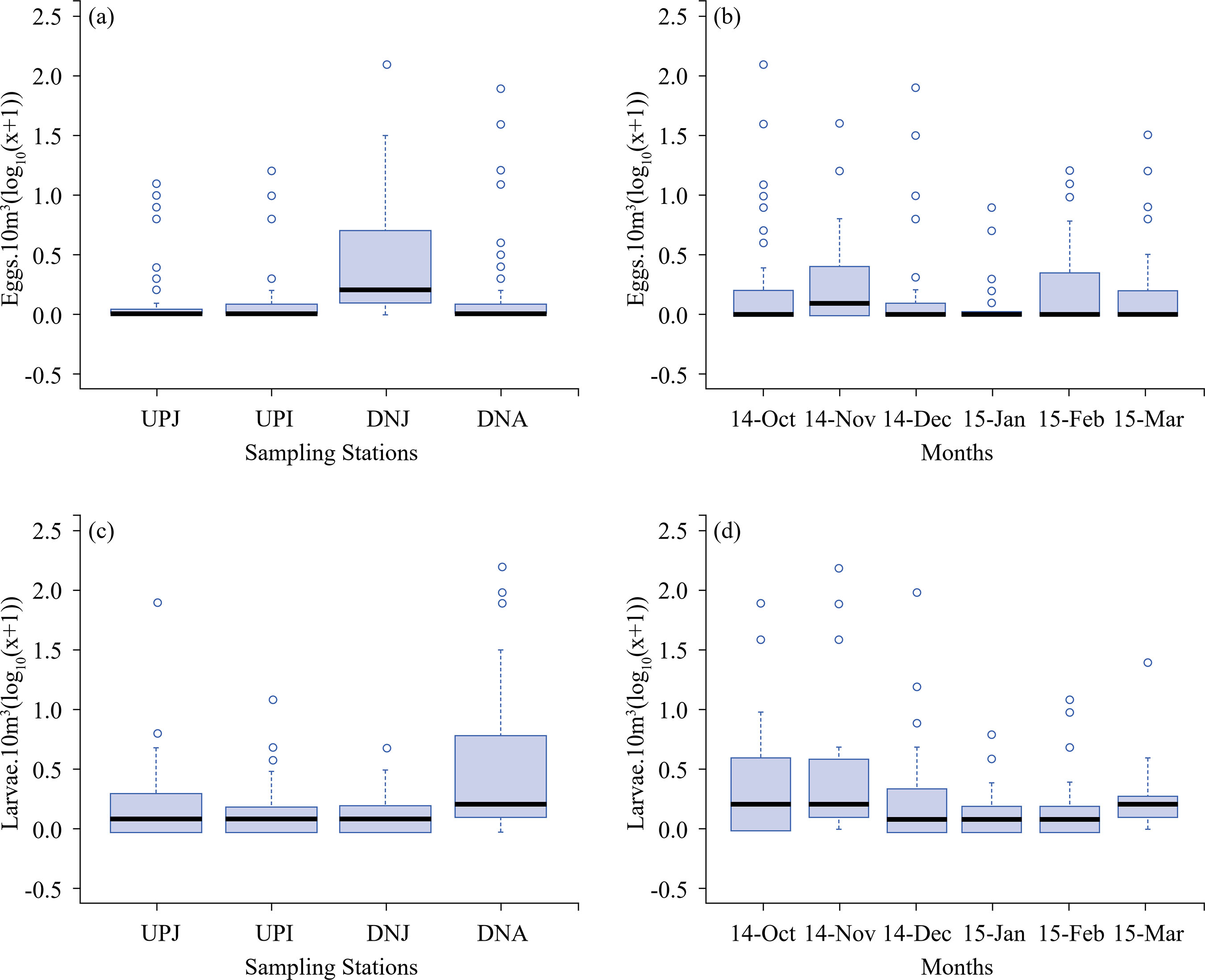
 UPJ: upstream Jequitinhonha; UPI: upstream Itacambiruçu; DNJ: downstream Jequitinhonha; and DNA: downstream Araçuaí.