 Decision-making on mechanical ventilation in palliative care: perceptions and challenges
Abstract
Decision-making in palliative care is complex, particularly when choosing invasive measures over comfort-focused approaches. This study conducted an integrative review using the Scopus and Web of Science databases with the keywords: “decision making” and “physician or doctor or medical” and “palliative care.” Quantitative and qualitative studies from the last five years addressing invasive procedures in palliative patients were included. Of the 19 articles identified, five were analyzed. Decision-making often reflects a technical perspective focused on preserving life. However, experience and training in palliative care foster decisions centered on patients’ and families’ values, ensuring respect for their wishes, promoting comfort, and reducing suffering. The limited literature on this topic highlights the need for further discussion and encourage patient-centered approaches.
Keywords:
Decision making; Physician; Palliative care
Resumo
A tomada de decisão em cuidados paliativos é desafiadora, especialmente ao se optar por medidas invasivas em detrimento do conforto. Este estudo realizou uma revisão integrativa nas bases Scopus e Web of Science, utilizando os descritores “decision making” e “physician or doctor or medical” e “palliative care”. Foram incluídos estudos quantitativos e qualitativos dos últimos cinco anos sobre decisões relacionadas a procedimentos invasivos em pacientes paliativos, dos quais, após a triagem, foram analisados cinco. Observou-se predomínio de decisões baseadas em uma visão tecnicista voltada para a manutenção da vida. Contudo, experiência e treinamento em cuidados paliativos influenciam escolhas mais centradas nos valores do paciente e da família, respeitando sua vontade, promovendo conforto e reduzindo o sofrimento. A literatura sobre o tema ainda é escassa, destacando a importância de ampliar a discussão e incentivar abordagens focadas no bem-estar do paciente.
Palavras-chave:
Tomada de decisão; Médico; Cuidados paliativos
Resumen
La toma de decisiones en cuidados paliativos es compleja, especialmente al optar por medidas invasivas en lugar de enfoques centrados en el confort. Este estudio realizó una revisión integradora en las bases Scopus y Web of Science utilizando los descriptores: “decision making” and “physician or doctor or medical” and “palliative care”. Se incluyeron estudios cuantitativos y cualitativos de los últimos cinco años que abordaran procedimientos invasivos en pacientes paliativos; de los cuales se analizaron cinco tras la selección. Las decisiones suelen basarse en una perspectiva técnica enfocada en preservar la vida. Sin embargo, la experiencia y la formación en cuidados paliativos favorecen decisiones centradas en los valores del paciente y la familia, que respeten sus deseos, promuevan el confort y reduzcan el sufrimiento. La escasa literatura sobre el tema subraya la necesidad de ampliar el debate e impulsar enfoques centrados en el bienestar del paciente.
Palabras clave:
Toma de decisiones; Médico; Cuidados paliativos
The 20th century saw significant evolution of medical technologies, providing numerous scientific advances, such as early and accurate diagnoses and therapeutic interventions that modified the epidemiological profiles by reducing mortality and increasing life expectancy in relation to several diseases 1. Scientific advance even reached medicine beyond the curative aspect, with the concept of medicine focused on comfort care arising still in the 20th century.
Since the early days of the profession, medical practice has been centered on technical care, which prioritizes an approach focused on intensive care. However, this model has limitations in the context of chronic diseases and progressive and incurable pathologies when the preservation of life, in biological terms, ceases to be the main focus of patient care. In this context, palliative care gained prominence as an approach focused on relieving suffering and promoting quality of life. By prioritizing patient well-being, this practice seeks to minimize unnecessary interventions and respect patient and family values, considering bioethical and emotional issues 2.
In Brazil, the integration of palliative care into the health care system has been gradual, but constant, especially in the care of patients with chronic or advanced diseases. The publication of the National Palliative Care Policy (PNCP) in 2024 is a significant milestone in this process. This policy is geared toward promoting the training of health care professionals and ensuring universal access to palliative care, aiming to improve the quality of life of patients and their families in the context of risk diseases. In addition, the PNCP seeks to raise awareness on the importance of palliative care throughout society 3.
Medical care, especially in end-of-life and chronic disease management contexts, should be guided by a balanced approach that considers patient autonomy about the health care plan. The importance of prior dialogue between the patient and the health care team was demonstrated in the study of Boivin and collaborators 4, who observed that, when priorities are defined between professionals and patients, clinical decision-making in managing chronic diseases tend to be guided by principles such as self-care support. On the other hand, when these priorities are established unilaterally by professionals, there is a predominance of technical aspects, with less consideration of patient values and needs.
Care planning for patients under palliative care should explore the role of the family in clinical decision-making, promoting dialogue on preferences, values and goals of care, in order to reach decisions built on mutual agreement. As observed in the study of Holdsworth and collaborators 5, the quality of care in the caregiver experience was perceived by the prioritization of patient autonomy, guarantee of person-centered care, transparency in clinical decision-making and timely and efficient information sharing and care provision.
The use of invasive life support therapies, such as mechanical ventilation, is a challenge in patients under palliative care. Decision-making requires significant medical judgement in view of the set of circumstances involved in the diagnosis, the stage of the disease and the prognosis, consistently with consideration of ethical principles and patient and family values and judgments 6.
This literature review seeks to analyze the perception of health care teams, patients and families regarding decision-making about mechanical ventilation in persons eligible for palliative care.
Method
This is an integrative review using an electronic search of publications in the Scopus and Web of Science databases, using the following descriptors: “decision making,” “physician or doctor or medical,” “palliative care,” and “mechanical ventilation or intubation.”
The following inclusion criteria were used: complete articles available in full, qualitative and quantitative studies, in Portuguese, English and Spanish, published in the last five years and evaluating the decision-making about intensive care to the detriment of comfort measures in palliative care patients. Exclusion criteria were the following: review articles, editorials and book chapters.
Results
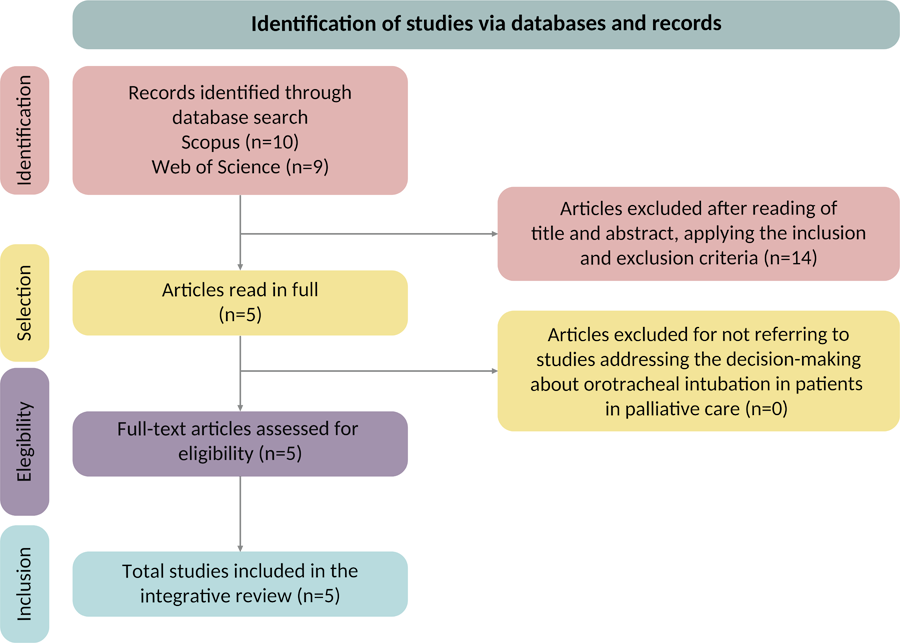
The adopted search methodology retrieved 19 articles distributed in Scopus and Web of Science. After applying the inclusion and exclusion criteria through the evaluation of titles and abstracts, five studies met the eligibility method for full reading; of these, all were selected to support this work.
Chart 1 provides information on the articles selected for research, describing data regarding authorship, year of publication, title, production method and main findings in each text analyzed.
Among the articles in the study, one was published in 2021 7, three in 2022 8-10 and one in 2024 11. All selected articles were produced outside Brazil, written in English. They were published in the following journals: BMC Palliative Care 8, International Journal of Environmental Research and Public Health 9, Journal of Palliative Care 7,10 and Academic Emergency Medicine 11.
As for study methods, one article was an experience report 7; as for the others, two were cohort studies, one being retrospective 8 and the other study was multicenter and prospective 10. In addition to these, there was a sequential-explanatory, mixed-method study, with application of semi-structured interviews 11. One work is the result of a cross-sectional study, adopting a mixed approach, with quantitative and qualitative methods 9. Qualitative and quantitative design was observed in two studies, using interviews 11 or questionnaires 9.
Discussion
After analyzing the five articles identified in the results, the discussion can be divided into the following topics: 1) Technical view and perspective of the medical team; 2) Mechanical ventilation and intensive care; 3) Perspectives and rights of the patient; and 4) Family expectations.
Technical view and perspective of the medical team
Since the early days, medicine has been based on a strong biological view of the disease process, so physicians are conditioned to a need for cure and intervention on diseases at all costs 9,10. From this perspective, palliative care is still seen with prejudice, such that so-called dying patients are generally not classified as a priority for health care professionals 8,9. Kim and collaborators 8 reiterated these facts, demonstrating that the percentage of intensive care in the emergency room was higher than that of end-of-life care, especially in those without previous consultations with palliative care teams.
Palliative care is still strongly restricted only to cancer patients, to the detriment of those with other chronic pathologies. As demonstrated by Kim and collaborators 8, cancer patients were significantly less likely to receive invasive interventions, while those without a cancer diagnosis had less access to comfort care, such as opioid analgesia.
As found in the studies, many hospitalized patients, despite needing palliative care, did not receive it, even when the professionals in charge considered this approach essential 9. Erel and collaborators 9 foster a discussion about the role of health care providers, noting the preference for aggressive treatments, influenced by a medical culture oriented toward healing and insufficient training in palliative care.
The concepts of life maintenance and palliative care are still conflicting for many health care professionals, reflecting the limited understanding and insufficient knowledge in the proper management of palliative care patients. Physicians report little self-confidence and low competence in the management of these individuals, in addition to the difficulty in dealing with issues related to the feelings of powerlessness and failure when a patient dies 9. Thus, they avoid taking care of these people and, when they do, they recommend all available and possible procedures in an attempt to maintain life, regardless of subsequent costs 8,9.
Moreover, in the context of the conversation with family members about the clinical situation and the need for invasive measures, it was observed that the approach was different depending on the medical specialty that provided care. According to the analysis of Ouchi and collaborators 11, emergency medicine professionals were more likely to ask questions based on procedures, such as the need for intubation, mechanical ventilation or resuscitation. While palliative care physicians were more likely to ask about values, such as “What would the patient say is most important if they had little time?,” and to give recommendations more often.
Mechanical ventilation and intensive care
The decision of the medical team on the introduction of mechanical ventilation and intensive care in palliative care patients is complex. Professionals, in general, are forced to weigh between the value of life and quality of life of the patient, adjusting the therapeutic approach according to the clinical context 9. In addition, it is essential to consider the will of the patient and the will of their family, which may sometimes be inconsistent.
In the context of an acute scenario, the decisions made are usually those that recommend intensive care and mechanical ventilation. In these situations, numerous variables are considered: the level of knowledge of the health care team about the preferences of the patient or of the family; the recommendation of the life-saving approach as standard treatment in most services; or whether the team is before a serious patient who needs a rapid intervention 9-11. In this context, Ouchi and collaborators 11 showed that shared decision-making reduced hospital death and aggressive medical care rates and increased referrals to palliative care.
The specialty of the medical professional was shown to be a factor that influences decision-making about intensive care. The study of Erel and collaborators 9 observed that clinical teams adopted a more palliative approach than surgical teams. Regarding emergency care professionals, they advocated a conduct based on procedures, justifying that the clinical urgency often precludes questions based on values 11. In contrast, the palliative care team advocated a value-based approach, trying to understand the level of knowledge about the disease and the preferences of the patient and their family 11.
The physician’s level of experience was shown to be important in palliative care decision-making. Teams with more experienced professionals, characterized by the term senior, advocated a more palliative approach than the junior team 9. The choice of the junior team for more intensive care was associated with a concern about possible criticism from the upper echelon, in addition to little experience regarding the long-term course of the disease, prognosis and suffering of the patient.
The study of Correia and collaborators 10 with frail ICU patients showed that the decision to perform invasive procedures in critically ill individuals was based, in most cases, on therapeutic failure to the detriment of the patient’s general health situation. The authors note that frail patients were more frequently submitted to mechanical ventilation and intensive care than non-frail patients, also with higher mortality. In addition, the percentage of palliative care provide to frail patients was only 15%.
A ratification of this mentioned point is provided by Erel and collaborators 9, who showed that, in the context of an advanced disease, despite approximately 90% agreeing with palliative approaches, the acceptance of this approach was 73%, and most opted for invasive approaches, such as mechanical ventilation 9. In this sense, it is important to note that the choice for intensive care is not unifactorial, since, given the complexity of the subject and the disease process, there must be consideration of the patient’s decision, the opinion of family members, the stress of the conduct, the organizational support, and possible legal proceedings 8.
As for the patients’ comorbidities, Kim and collaborators 8 showed that patients with advanced cancer received more comfort care, especially those who had advance directives or had previously talked with the palliative care team. In the opposite context, it was observed that patients without cancer received fewer palliative care consultations and underwent fewer comfort care interventions. Despite the still prevailing notion that palliative care is mainly geared toward cancer patients, it was found that those who talked to the palliative care team and had advance directives or prior care planning had lower intensive care and mechanical ventilation rates and higher comfort care rates 8.
Despite the evident advances in palliative care, the classic premise of saving lives in acute care settings, combined with the lack of palliative care training of health teams, may explain the persistent increase in the use of intensive care and mechanical ventilation and the low rate of adoption of palliative approaches 7-9,11.
Patient perspectives and rights
In the face of the need for palliative care and the possibility of invasive interventions and intensive care, it is necessary to share the decision-making with the patient and their families seeking to protect human dignity 8. According to Ouchi and collaborators 11, early conversations related to values and priorities in end-of-life care can lead to shared and well-informed choices, aiming at improving the quality of life and safeguarding the values of the person under care. This conversation is intended to ensure that patient autonomy is recognized and reflected.
Advance directives are a means to ensure that patient autonomy is respected, even when they are not in conditions to make decisions on their own. Kim and collaborators 8 observed that patients without advance directives or legal forms received more critical care compared to those who had such documents. Additionally, patients who had early conversations about care before and/or after emergency room visits received more comfort care and significantly fewer acute interventions compared to those who did not have visits 8. Thus, it is noted that such documents can be effective in maintaining patient autonomy in relation to health care, including invasive procedures.
According to Erel and collaborators 9, in a study with patients with advanced dementia, it was observed that the adoption of advanced directives and previous conversations with the patient and their families can prevent unnecessary referrals to hospitals and contribute to the effectiveness of palliative care in this group when affected by acute diseases with risk of death.
The study of Correia and collaborators 10 observed that patients were often submitted to invasive procedures, despite do-not-resuscitate orders and limitations to therapeutic efforts. This suggests that decisions related to end-of-life care were more associated with the failure of therapeutic measures than with the general health condition or goals established for care.
Family expectations
The disease and the disease experience are unique processes that involve—in addition to the patient—the family. Along the way, family members deal with a complex combination of feelings, ideas and expectations about the disease, the patient and the health care team. In this context, the palliative care team is essential and should be available early to all participants in the disease process 7.
In addition to the health care team, the comfort care measures of the palliative care approach need to be discussed with the patient and their family, as palliative care teams are responsible for collaborating in patient management, decision-making, and family-directed support 7. This conversation is very important and needs to occur early, since later decisions result in less comfort care and a higher percentage of more aggressive care 8-10.
In the context of a patient under palliative care, especially in the final stage of life, dialogue with the family is even more essential. Dealing with the idea of the imminent loss of the loved one tends to generate a sentimental reaction, which causes family members to often not accept the patient’s prior decision. Kim and collaborators 8 demonstrated that rates of family determination remained higher than rates of self-determination. Thus, there are increased chances of the patient being submitted to mechanical ventilation and intensive care, leading, in fact, to an extension of life, but at the expense of greater suffering.
Thus, it is evident that the perceptions about and acceptance of palliative care have been improved in recent decades; however, its implementation remains limited in some specific sectors, such as emergency rooms. The underutilization of palliative care and the lack of communication with patients and family members are concerning. In addition, it is observed that the end-of-life decision-making policy needs to be redesigned to systematically include care objectives 9,10.
Final considerations
Medical decision-making in palliative care patients is a complex process that involves numerous variables, especially on performing invasive procedures such as mechanical ventilation, as it requires significant medical judgement considering the set of circumstances involved in diagnosis, stage of the disease and prognosis, consistently with the consideration of ethical principles and patient and family values. In this regard, it is noted that professional specialty and experience are very influential variables in this process, such that palliative care specialists tend to adopt more conservative positions when compared to emergency care professionals.
On the other hand, it is observed that the disease stage and prior determination of patient will also influence the choice of the professional, since patients in more advanced conditions or with prior care planning had lower rates of intensive procedures. In addition, strengthening the bond between the professional and the patient and their family—by establishing a clear and honest dialogue, respecting the expressed will—arises as a significant tool to assist in decision-making.
Finally, there is evident need for further studies on medical decision-making about intensive care, given the scarce academic literature on this issue.
References
-
1 Barros BFM, Pasklan ANP, Rodrigues NF, Barros JB, Motta VBR, Lima SF. Percepções e conhecimentos médicos sobre limitação de suporte de vida. Rev. bioét. (Impr.) [Internet]. 2023 [acesso 25 mar 2025];31(1):1-12. DOI: 10.1590/1983-803420233387pt
» https://doi.org/10.1590/1983-803420233387pt -
2 Molina Filho ET, Olivero AA, Gurgel SJT, Gil NM, Sanches RCN, Sanches MA et al. Cuidados paliativos em terapia intensiva: revisão integrativa. Rev. bioét. (Impr.) [Internet]. 2023 [acesso 25 mar 2025];31(2):1-12. DOI: 10.1590/1983-803420233418pt
» https://doi.org/10.1590/1983-803420233418pt -
3 Brasil. Ministério da Saúde. Portaria GM/MS nº 3.681, de 7 de maio de 2024. Institui a Política Nacional de Cuidados Paliativos - PNCP no âmbito do Sistema Único de Saúde - SUS, por meio da alteração da Portaria de Consolidação GM/MS nº 2, de 28 de setembro de 2017. Diário Oficial da União [Internet]. Brasília, 7 maio 2024 [acesso 25 mar 2025]. Disponível: https://bit.ly/46GurUy
» https://bit.ly/46GurUy -
4 Boivin A, Lehoux P, Lacombe R, Burgers J, Grol R. Involving patients in setting priorities for healthcare improvement: a cluster randomized trial. Implement Sci [Internet]. 2014 [acesso 25 mar 2025];9:24. DOI: 10.1186/1748-5908-9-24
» https://doi.org/10.1186/1748-5908-9-24 -
5 Holdsworth LM, Giannitrapani K, Gamboa RC, O'Hanlon C, Singh N, Walling A et al. Role matters in understanding 'quality' in palliative care: a qualitative analysis of patient, caregiver and practitioner perspectives. BMJ Open [Internet]. 2024 [acesso 25 mar 2025];14(1):e076768. DOI: 10.1136/bmjopen-2023-076768
» https://doi.org/10.1136/bmjopen-2023-076768 -
6 Anjos SG, Marques JM, Santiago LC, Marta CB, Machado DA, Silva RCL et al. Cuidados paliativos em terapia intensiva: revisão integrativa. Rev Educ Meio Amb Saude [Internet]. 2023 [acesso 25 mar 2025];13:2. Disponível: https://tinyurl.com/bdf5ayw6
» https://tinyurl.com/bdf5ayw6 -
7 Rao A, Kelemen A. Lessons learned from caring for patients with covid-19 at the end of life. J Palliat Med [Internet]. 2021 [acesso 25 mar 2025];24(3):468-71. DOI: 10.1089/jpm.2020.0251
» https://doi.org/10.1089/jpm.2020.0251 -
8 Kim JS, Lee SY, Lee MS, Yoo SH, Shin J, Choi W et al. Aggressiveness of care in the last days of life in the emergency department of a tertiary hospital in Korea. BMC Palliat Care [Internet]. 2022 [acesso 25 mar 2025];21(1):105. DOI: 10.1186/s12904-022-00988-3
» https://doi.org/10.1186/s12904-022-00988-3 -
9 Erel M, Marcus EL, Heyman SN, DeKeyser Ganz F. Do perceptions about palliative care affect emergency decisions of health personnel for patients with advanced dementia? Int J Environ Res Public Health [Internet]. 2022 [acesso 25 mar 2025];19(16):10236. DOI: 10.3390/ijerph191610236
» https://doi.org/10.3390/ijerph191610236 -
10 Correia I, Simas A, Chaves S, Paixão AI, Catarino A, Gonçalves-Pereira J. The Palliative Multicenter Study in Intensive Care (PalMuSIC). Results from a multicenter study addressing frailty and palliative care interventions in intensive care units in Portugal. J Palliat Care [Internet]. 2022 [acesso 25 mar 2025];37(4):552-61. DOI: 10.1177/08258597211020964
» https://doi.org/10.1177/08258597211020964 -
11 Ouchi K, Prachanukool T, Aaronson EL, Lakin JR, Higuchi M, Liu SW et al. The differences in code status conversation approaches reported by emergency medicine and palliative care clinicians: a mixed-method study. Acad Emerg Med [Internet]. 2024 [acesso 25 mar 2025];31(1):18-27. DOI: 10.1111/acem.14818
» https://doi.org/10.1111/acem.14818
-
Data availability:
All data used or generated in this study are described and presented in full in the body of the article.
Edited by
-
Editor in charge:
Dilza Teresinha Ambrós Ribeiro
All data used or generated in this study are described and presented in full in the body of the article.