
 Prevalence of periodontal diseases and correlations with risk factors among a sample of Yemeni people: cross-sectional study
ABSTRACT
Objective In Yemen, several studies have investigated the prevalence of periodontal diseases; however, most were geographically restricted or assessed fewer clinical parameters and risk factors. Therefore, the objective of this study was to evaluate the prevalence and severity of periodontal diseases among the Yemeni population and their relationship to various risk factors.
Material and Methods A total of 405 Yemeni adults attending the polyclinics of Civilization, Mahweet, and Aden Universities, as well as private clinics, from March 2024 to August 2024, were included in this study. Data were collected using a questionnaire that covered sociodemographic information, oral hygiene practices, and harmful habits, along with a clinical examination. All data were subsequently entered for statistical analysis.
Results The results showed that the prevalence of biofilm-induced gingivitis was 51.6%, while periodontitis was more prevalent, affecting 79.3% of the population. Both gingivitis and periodontitis were more common in males and in participants aged ≥35 years. Regular daily tooth brushing, especially twice daily, was significantly associated with lower rates of gingivitis and periodontitis (p < 0.001). In contrast, gingivitis and periodontitis were more frequent among khat chewers, particularly those who chewed daily for more than 20 years. Similarly, smokers, especially those who smoked for over 20 years, showed a significantly higher prevalence of gingivitis and periodontitis (p < 0.001).
Conclusion Periodontitis is more prevalent than biofilm-induced gingivitis among the Yemeni population. Both conditions are more common in males and in individuals aged ≥35 years. Lack of tooth brushing, long-term daily khat chewing, and long-term smoking (>20 years) were identified as the most strongly associated risk factors.
KEYWORDS:
Khat; Periodontal diseases; Prevalence; Risk factors; Yemen
RESUMO
Objetivo No Iêmen, vários estudos investigaram a prevalência de doenças periodontais; no entanto, a maioria era geograficamente restrita ou avaliava menos parâmetros clínicos e fatores de risco. Portanto, o objetivo deste estudo foi avaliar a prevalência e a gravidade das doenças periodontais entre a população iemenita e sua relação com vários fatores de risco.
Material e Métodos Um total de 405 adultos iemenitas atendidos nas policlínicas das Universidades Civilization, Mahweet e Aden, bem como em clínicas privadas, de março de 2024 a agosto de 2024, foram incluídos neste estudo. Os dados foram coletados por meio de um questionário que abrangia informações sociodemográficas, práticas de higiene bucal e hábitos prejudiciais, juntamente com um exame clínico. Todos os dados foram posteriormente inseridos para análise estatística
Resultados Os resultados mostraram que a prevalência de gengivite induzida por biofilme foi de 51,6%, enquanto a periodontite foi mais prevalente, afetando 79,3% da população. Tanto a gengivite quanto a periodontite foram mais comuns em homens e em participantes com idade ≥35 anos. A escovação diária regular dos dentes, especialmente duas vezes ao dia, foi significativamente associada a taxas mais baixas de gengivite e periodontite (p < 0,001). Em contrapartida, a gengivite e a periodontite foram mais frequentes entre os consumidores de khat, particularmente aqueles que o consumiam diariamente há mais de 20 anos. Da mesma forma, os fumantes, especialmente aqueles que fumavam há mais de 20 anos, apresentaram uma prevalência significativamente maior de gengivite e periodontite (p < 0,001).
Conclusão A periodontite é mais prevalente do que a gengivite induzida por biofilme entre a população iemenita. Ambas as condições são mais comuns em homens e em indivíduos com idade ≥35 anos. A falta de escovagem dos dentes, a mastigação diária prolongada de khat e o tabagismo prolongado (>20 anos) foram identificados como os fatores de risco mais fortemente associados.
PALAVRAS-CHAVE:
Khat; Doenças periodontais; Prevalência; Fatores de risco; Iêmen
INTRODUCTION
Chronic diseases have been steadily increasing worldwide, affecting all regions and socioeconomic groups without exception. Among these, periodontal disease contributes significantly to this growing global health burden and shares many common risk factors with other chronic conditions [1]. Despite this, oral and periodontal health often receive limited attention.
The American Academy of Periodontology describes periodontal diseases as “a serious infection that if left untreated, can lead to tooth loss.” [2]. These diseases involve inflammation and/or infection that progressively damages the supporting structures of the teeth, including the gingiva, cementum, periodontal ligaments, and alveolar bone [2].
Although the primary cause of periodontal disease is bacterial dental biofilm, multiple factors can influence its onset and progression [3]. Smoking is a major risk factor, while other well-established contributors include diabetes, khat consumption, male sex, poor oral hygiene practices, low educational level, improper brushing techniques, iatrogenic factors, genetic predisposition, and aging [4,5].
Several studies have demonstrated that tobacco use significantly impacts the oral ecosystem, affecting periodontal blood supply, altering immune and inflammatory responses, and impairing the healing capacity of periodontal tissues [6,7]. The prevalence of periodontal diseases varies globally, largely due to differences in the distribution and intensity of these risk factors [8]. For example, cigarette smoking is more prevalent in lower-income populations [9]. Additionally, some risk factors are unique to specific geographical areas, such as betel quid chewing and smokeless tobacco use in South Asia [10]. Recognizing country-specific risk factors is therefore essential for designing effective educational campaigns, planning interventions, and guiding public health policies [11] .
Yemen, a low-income developing country located in the southwest of the Arabian Peninsula has unique local factors influencing periodontal health. One such factor is khat (Catha edulis), an evergreen shrub whose leaves are chewed by millions in Yemen and East Africa for their stimulant effects. Khat chewing is widespread in Yemen, particularly among men [12]. Several studies among Yemeni adults have reported a positive correlation between the frequency and duration of khat chewing and the severity of periodontal disease [4,13,14]. Studies looking for risk factors of periodontitis in Yemen have nearly exclusively concentrated on the possible role of khat (also spelled qat) chewing [15]. The results from these studies have been debatable, so far; some have recorded harmful effects on the periodontium [4,16,17] , while others reported no or even protective effects [18-21] .
In a related context, a recent cross-sectional study among Yemeni adults found that females had a higher overall prevalence of gingival recession (GR) and periodontitis, whereas males exhibited a greater number of teeth affected by GR and furcation involvement (FI) [22]. The risk of developing periodontitis increases with age, typically resulting in tooth loss after 35 years of age. This age-related increase in prevalence is generally attributed to the cumulative progression of the disease rather than increased biological susceptibility [23,24].
The diagnosis and monitoring of periodontal conditions rely heavily on clinical measures. Key clinical parameters assessed by periodontal probing include probing pocket depth (PPD)—the distance from the base of the sulcus or pocket to the gingival margin; gingival recession (GR)—the distance from the cementoenamel junction (CEJ) to the gingival margin; and clinical attachment level (CAL)—the distance from the base of the sulcus or pocket to the CEJ [25]. A prevalence study, commonly referred to as a cross-sectional study, is the simplest form of observational research and is particularly effective for assessing chronic rather than acute conditions [26].
Several studies have investigated the prevalence of periodontal diseases in different populations. In Yemen, however, existing studies have often been geographically limited to specific governorates or have assessed only a few clinical parameters and risk factors. Therefore, the aim of the present study is to determine the prevalence and severity of periodontal diseases among the Yemeni population and to examine their association with selected risk factors.
MATERIAL AND METHODS
This study is a cross-sectional investigation involving Yemeni adults who were randomly recruited from patients seeking dental treatment between March 2024 and August 2024. Participants were recruited from the outpatient dental clinics at the Department of Dentistry, Civilization University (Sana’a), the Faculty of Dentistry, Aden University, as well as public and private clinics in the cities of Sana’a, Aden, and Mukalla. A total of 405 adult dental patients were included in the study. Inclusion criteria included individuals aged ≥15 years and having ≥20 teeth. Exclusion criteria included fully edentulous patients, complete denture wearers, and patients with acute oral diseases or those who had received antimicrobial therapy within one month prior to the study [25] .
Ethical approval was obtained from the Research and Ethics Committee, Faculty of Dentistry, Thamar University (Ref#: 2024008). Informed consent was obtained from each participant after explaining the study objectives. Written or verbal consent was accepted prior to participation. Aims of the study were explained to all participants and they were called for giving their written or verbal consent to participate.
Data Collection: Data were collected through a questionnaire and a clinical examination, as follows:
Questionnaire: which included an important information as the following:
-
a- Sociodemographic data: Age, sex and occupation.
-
b- Oral hygiene practices: Tooth brushing, interdental aids, frequency and types.
-
c- Harmful habits e.g. khat chewing (Frequency, duration and time), smoking (duration and cigarettes number).
Clinical examination
All fully erupted permanent teeth, excluding third molars, were examined. Clinical parameters were assessed as follows: Dental plaque was calculated by PLI on a 0-3 scale [26,27]. Gingival inflammation was calculated by GI, also on a 0-3 scale [26,27]. The degree of bleeding is measured by PBI on a scale of 0-4 [28]. The presence or absence of supra- and/or subgingival calculus (CI) was determined also [29].
The parameters were determined using a mm periodontal probe with grading (1,2,3,5,7,8,9,10) (University of Michigan O probe with Williams markings, Hu-Friedy Inc., Chicago, IL, USA). The university of Michigan O probe with Williams markings probe tip is inserted between the lateral wall of the gingival sulcus or periodontal pocket and tooth surface and walked around the tooth to determine the subgingival calculus, pocket depth, and bleeding response. The examined sites per tooth were mesial, mid-line and distal on both facial and lingual or palatal/lingual surfaces. The dentition was divided into six sextants. The third molars were excluded except where they were in place of missed or non-functional second molars. Six index teeth, that is, 16, 11, 26, 36, 31, 46 were examined [25].
All measurements were performed using a millimeter-calibrated periodontal probe (University of Michigan O probe with Williams markings; Hu-Friedy Inc., Chicago, IL, USA). The probe tip was gently inserted between the lateral wall of the gingival sulcus or periodontal pocket and the tooth surface and moved circumferentially to assess subgingival calculus, pocket depth, and bleeding response.
Each tooth was examined at mesial, midline, and distal sites on both facial and lingual (or palatal) surfaces. The dentition was divided into six sextants. Third molars were excluded except when replacing missing or non-functional second molars. Six index teeth (16, 11, 26, 36, 31, 46) were examined [27].
PD was measured to the nearest millimeter at the mid-facial aspect of each tooth and was defined as the distance from the free gingival margin to the base of the gingival sulcus [30], GR was measured in millimeters from the cementoenamel junction (CEJ) to the gingival margin at six sites per tooth: mesiobuccal, midbuccal, distobuccal, mesiolingual, midlingual, and distolingual. The measured recession was then classified according to Miller’s classification (Classes I–IV) [31]. If the CEJ was covered by calculus or lost due to carious lesions, its location was estimated based on adjacent teeth. FI was also assessed and recorded as either present or absent. Tooth mobility was evaluated according to Miller’s classification (1950), as the tooth is firmly held between two instruments to move back and forth and mobility is scored on a scale of 0-3 where 0: No detectable movement beyond physiologic mobility, 1: Slight mobility greater than normal, 2: Mobility up to 1 mm in the buccolingual direction and 3: Mobility >1 mm in the buccolingual direction, often combined with vertical displacement [32].
Statistical analysis
Microsoft Excel 2016, coded, and analyzed using SPSS (v25; IBM Corp.). Results were expressed as frequencies and percentages for categorical variables and as means ± standard deviations for continuous variables. The chi-square test was used for 2×2 categorical comparisons, and Spearman correlation was applied to assess associations between categorical variables. A p-value <0.05 was considered statistically significant.
RESULTS
A total of 405 patients were included in this study, with a mean age of 34.3 ± 12.1 years (range: 16–80 years). More than half of the participants (53.1%) were aged ≥35 years. The distribution by sex was approximately equal, with 49.6% males and 50.4% females. Among them, 32.2% were students, 58.3% were khat chewers, and 40.7% had been chewing khat for more than 20 years. Regarding smoking habits, 56.5% were smokers, while cigarette smoking was the most common type among smokers (38.9%). Concerning oral hygiene practices, 76.3% of participants reported brushing their teeth, with 68.9% brushing daily. Further details on the sociodemographic and behavioral characteristics of the study sample are presented in Table I.
The results presented in Table II show that the overall prevalence of biofilm-induced gingivitis was 51.6%, with the mild form being the most common, accounting for 67% of gingivitis cases. Periodontitis was more prevalent in the Yemeni population, affecting 79.3% of participants. Among periodontitis cases, Stage I and Stage II were the most frequent, observed in 35.5% and 31.8% of patients, respectively.
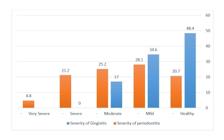
The results in Table III and Graph 1 indicate that the mean PLI of the sample was 1.7, reflecting moderate oral hygiene, while the mean GI was 1.1, indicating that most patients had moderate gingivitis. The mean CI was 1.1, and the mean PPD was 4.1 mm. The correlation between PLI and GI is presented in Table IV. It shows that most participants aged <35 years had a PLI score of 2, while those aged ≥35 years had a PLI score of 3. Similarly, females generally had a PLI score of 2, whereas males had a PLI score of 3. Participants with farmer or worker occupations also exhibited the highest PLI scores. Regarding GI, the worst gingival conditions were observed among participants aged ≥35 years, males, and those who were farmers, workers, or unemployed. The correlation analysis of khat chewing, smoking, and tooth brushing revealed the following: Khat chewers, smokers, and non-brushers had the highest PLI scores. Smoking alone showed a slightly lower impact on GI compared to khat chewing and poor oral hygiene.
Correlation between PLI and GI, FI with age, gender, occupation, khat chewing, smoking and tooth brushing
The possible correlations between periodontal health status and various risk factors including age, gender, occupation, oral hygiene measures (tooth brushing), smoking, and khat chewing were assessed. As shown in Table V and Graph 2.
Correlation between biofilm-induced gingivitis and periodontitis with age, gender and occupation

- Showing the correlation between biofilm-induced gingivitis and periodontitis with age, gender and occupation.
Gender: Both gingivitis and periodontitis were more prevalent in males than in females, with 28.6% of males and 23% of females having gingivitis, and 45.4% of males versus 33.6% of females having periodontitis. This difference was statistically significant.
Age: Gingivitis and periodontitis were more prevalent in participants aged <35 years, as demonstrated in Table V.
Occupation: While students and housewives constituted the largest number of cases in absolute count, workers and unemployed participants had the highest prevalence as a percentage of their respective groups.
As shown in Table VI, the analysis of tooth brushing measures as risk factors for gingivitis and periodontitis demonstrated that regular tooth brushing was significantly associated with lower prevalence of both conditions (p < 0.001). Conversely, infrequent brushing including not brushing daily or brushing only once per day was significantly associated with higher prevalence of gingivitis and periodontitis (p < 0.001). Similarly, the analysis of interdental aid use as a potential protective factor revealed that participants who used interdental cleaning aids had lower rates of gingivitis and periodontitis; however, this difference was not statistically significant (p > 0.3). Further details are provided in Table VI.
Correlation between biofilm-induced gingivitis and periodontitis with oral hygiene measures
The correlation between khat chewing and gingivitis and periodontitis showed a statistically significant difference between khat chewers and non-chewers, with higher prevalence of both conditions among khat chewers. Participants who chewed khat daily, for more than 20 years, and for 6–10 hours per day exhibited markedly higher rates of gingivitis and periodontitis compared to those with less frequent use, shorter duration, or fewer hours of chewing, with P < 0.001. Similarly, the analysis of smoking habits demonstrated that smokers had significantly higher prevalence of both gingivitis and periodontitis compared to non-smokers (p < 0.001). Furthermore, participants who had been smoking for more than 20 years exhibited worse periodontal status than those with shorter smoking durations, with p < 0.001. Further details are provided in Table VII.
Correlation between biofilm-induced gingivitis and periodontitis with khat chewing frequency, duration, smoking duration and type
The analysis of periodontal parameters including PPD, GR, FI, and tooth mobilityshowed that participants aged ≥35 years and males exhibited higher values and stronger associations with all these parameters. Regarding occupation, farmers, workers, and unemployed participants demonstrated the highest correlation with PPD, GR, FI, and tooth mobility compared to other occupational groups. More details are presented in Table VIII.
DISCUSSION
Periodontal diseases encompass two primary conditions: gingivitis, which is confined to the gingival tissues and is reversible with adequate oral hygiene, and periodontitis, which involves progressive destruction of the periodontal ligament and alveolar bone, leading to clinical attachment loss [1]. This cross-sectional study assessed the prevalence and severity of periodontal diseases in a Yemeni population and explored their association with demographic, behavioral, and oral hygiene risk factors.
The present cross-sectional study assessed the prevalence of periodontal diseases and their association with several risk factors in a Yemeni population. Biofilm-induced gingivitis was observed in 51.6% of participants, predominantly in its mild form (67%), while periodontitis was more widespread, affecting 79.3% of the sample. These rates are lower than those reported by Bansal et al. in India (96.3%), likely due to differences in socioeconomic status, cultural practices, and oral hygiene behaviors [25]. Analysis of PLI and GI revealed a clear association between poor oral hygiene and age ≥35, male gender, and occupations such as farming and manual labor, consistent with findings by Amran et al. [33]. This supports the observation that males, who often have less attention to oral care and higher plaque and calculus deposition, experience worse periodontal conditions than females [34]. Although behavioral differences largely explain this disparity, hormonal and biological factors may also contribute [35], though the gender effect remains partly controversial [36,37]. Age showed a significant influence, with older adults presenting more gingivitis, periodontitis, and clinical attachment loss, which aligns with the cumulative effect of untreated periodontal inflammation rather than age-related susceptibility [38,39].
Oral hygiene practices demonstrated a strong protective effect, as regular tooth brushing was significantly associated with lower prevalence of both gingivitis and periodontitis (p < 0.001), whereas infrequent or once-daily brushing correlated with higher disease rates, consistent with Amran et al. [33]. Khat chewing emerged as a major local risk factor. This study found significantly higher prevalence of gingivitis and periodontitis among khat chewers, especially those chewing daily for over 20 years, corroborating findings by Al-Hajj et al. [22,40] . While some studies suggested that khat might have a mechanical or anti-plaque effect, with deeper pockets on non-chewing sides [16,19,41] , the overall evidence, including our results, supports its detrimental periodontal impact, likely due to chronic mechanical trauma and facilitation of plaque retention [42]. Smoking was also strongly associated with periodontal disease (p < 0.001), with longer duration and higher consumption leading to worse outcomes, consistent with previous Yemeni and international studies [22,33].
Further evaluation of clinical parameters, including PPD, GR, and FI, confirmed that older age and male gender correlated with more advanced periodontal destruction. GR and FI were more prevalent in khat chewers, consistent with prior researches linking repetitive chewing trauma to recession and furcation defects [13,22,43,44]. Males also exhibited more severe GR, although Al-Hajj et al. [22] noted that females had more GR sites, possibly reflecting a difference between number of sites versus depth and severity (Miller class III–IV). These findings align with Hill and Gibson, who reported higher PPD on chewing sides in long-term Yemeni khat chewers [20].
CONCLUSIONS
Within the limitations of this study, it can be concluded that periodontitis is more prevalent than biofilm-induced gingivitis in the Yemeni population. Both conditions were found to be more common among males, individuals aged 35 years or older, and those working as farmers or manual laborers. Poor oral hygiene, particularly irregular tooth brushing, along with long-term khat chewing especially daily chewing for > 20 years and 6–10 hours per day emerged as significant risk factors for the development of both gingivitis and periodontitis. Cigarette smoking, particularly for durations > 20 years, showed a strong association with the presence and severity of periodontal disease. Furthermore, older age, male gender, and occupations such as farming, manual labor, or unemployment were correlated with worse periodontal parameters, including PPD, GR, and FI.
LIMITATIONS
This study has several limitations that should be acknowledged. Although it was conducted across multiple centers, the majority of participants were recruited from Sanaa which may limit generalizability. This reflects the demographic reality and healthcare referral patterns in Yemen, where Sanaa serves as the primary hub for advanced dental services, attracting patients from surrounding regions. Nevertheless, this distribution may limit the full representativeness of all Yemeni regions.
Another limitation is that risk factors such as khat chewing, smoking, and oral hygiene practices were not analyzed independently, making it challenging to determine the isolated impact of each factor. This is because most participants were exposed to multiple risk factors simultaneously, complicating the assessment of each one’s distinct effect. Because our primary objective was to identify significant associations and explore patterns within the dataset, the associations between risk factors and outcomes were assessed primarily using bivariate analyses (chi-square and correlation tests), and multivariate analyses were not initially performed. This may limit the ability to fully control for potential confounding factors. Future studies are recommended to include multivariate approaches with broader and more balanced sampling to enhance the generalizability and robustness of findings. Further recommendation states that public health efforts should focus on improving oral hygiene awareness, addressing culturally specific risk factors such as khat chewing, and promoting smoking cessation.
Acknowledgements
We are very grateful to Dr. Hisham Hwaiti, whose contribution was significant and distinctive in the statistical work of the research.
Data availability
The data that support the findings of this study are available on request from the corresponding author.
-
How to cite:
Alhajj WA, AlHaj NJ, Basmail FS, Saleh RA. Prevalence of periodontal diseases and correlations with risk factors among a sample of Yemeni people: cross-sectional study. Braz. Dent. Sci. 2026;29:e4747. https://doi.org/10.4322/bds.2026.e4747
-
Funding
This research did not receive any specific grant from funding agencies in the public, commercial, or not-for-profit sectors.
-
Regulatory Statement
The study was approved from Ethical committee at Thamar University (Faculty of Dentistry) (Ref#: 2024008) and written informed consents were obtained from patient to participate and publish.
REFERENCES
-
1 Nazir M, Al-Ansari A, Al-Khalifa K, Alhareky M, Gaffar B, Almas K. Global prevalence of periodontal disease and lack of its surveillance. ScientificWorldJournal. 2020;2020(1):2146160. https://doi.org/10.1155/2020/2146160 PMid:32549797.
» https://doi.org/10.1155/2020/2146160 -
2 Armitage GC. Development of a classification system for periodontal diseases and conditions. Ann Periodontol. 1999;4(1):1-6. https://doi.org/10.1902/annals.1999.4.1.1 PMid:10863370.
» https://doi.org/10.1902/annals.1999.4.1.1 -
3 Pastagia J, Nicoara P, Robertson PB. The effect of patient-centered plaque control and periodontal maintenance therapy on adverse outcomes of periodontitis. J Evid Based Dent Pract. 2006;6(1):25-32. https://doi.org/10.1016/j.jebdp.2005.12.009 PMid:17138393.
» https://doi.org/10.1016/j.jebdp.2005.12.009 -
4 Ali AA. Qat habit in Yemen society: a causative factor for oral periodontal diseases. Int J Environ Res Public Health. 2007;4(3):243-7. https://doi.org/10.3390/ijerph2007030008 PMid:17911664.
» https://doi.org/10.3390/ijerph2007030008 -
5 Borgnakke WS. Modifiable risk factors for periodontitis and diabetes. Curr Oral Health Rep. 2016;3(3):254-69. https://doi.org/10.1007/s40496-016-0099-6
» https://doi.org/10.1007/s40496-016-0099-6 -
6 Johnson GK, Guthmiller JM. The impact of cigarette smoking on periodontal disease and treatment. Periodontol 2000. 2007;44(1):178-94. https://doi.org/10.1111/j.1600-0757.2007.00212.x PMid:17474933.
» https://doi.org/10.1111/j.1600-0757.2007.00212.x -
7 Palmer RM, Wilson RF, Hasan AS, Scott DA. Mechanisms of action of environmental factors–tobacco smoking. J Clin Periodontol. 2005;32(Suppl 6):180-95. https://doi.org/10.1111/j.1600-051X.2005.00786.x PMid:16128837.
» https://doi.org/10.1111/j.1600-051X.2005.00786.x -
8 Dye BA. The global burden of oral disease: research and public health significance. J Dent Res. 2017;96(4):361-3. https://doi.org/10.1177/0022034517693567 PMid:28318392.
» https://doi.org/10.1177/0022034517693567 -
9 Frencken JE, Sharma P, Stenhouse L, Green D, Laverty D, Dietrich T. Global epidemiology of dental caries and severe periodontitis–a comprehensive review. J Clin Periodontol. 2017;44(Suppl 18):S94-105. https://doi.org/10.1111/jcpe.12677 PMid:28266116.
» https://doi.org/10.1111/jcpe.12677 -
10 Wellapuli N, Ekanayake L. Risk factors for chronic periodontitis in Sri Lankan adults: a population based case–control study. BMC Res Notes. 2017;10(1):460. https://doi.org/10.1186/s13104-017-2778-3 PMid:28882173.
» https://doi.org/10.1186/s13104-017-2778-3 -
11 Kassebaum NJ, Bernabé E, Dahiya M, Bhandari B, Murray CJ, Marcenes W. Global burden of severe periodontitis in 1990-2010: a systematic review and meta-regression. J Dent Res. 2014;93(11):1045-53. https://doi.org/10.1177/0022034514552491 PMid:25261053.
» https://doi.org/10.1177/0022034514552491 -
12 Wedegaertner F, al-Warith H, Hillemacher T, te Wildt B, Schneider U, Bleich S, et al. Motives for khat use and abstinence in Yemen-a gender perspective. BMC Public Health. 2010;10:735. https://doi.org/10.1186/1471-2458-10-735 PMid:21110889.
» https://doi.org/10.1186/1471-2458-10-735 - 13 Amran AG, Alhajj MN. Assessment of gingival health status among a group of preclinical and clinical dental students at Thamar University, Yemen. IOSR-JDMS. 2016;15(2):69-75.
-
14 Kalakonda B, Al-Maweri SA, Al-Shamiri HM, Ijaz A, Gamal S, Dhaifullah E. Is Khat (Catha edulis) chewing a risk factor for periodontal diseases? A systematic review. J Clin Exp Dent. 2017;9(10):e1264-70. https://doi.org/10.4317/jced.54163 PMid:29167719.
» https://doi.org/10.4317/jced.54163 -
15 Al‐Hebshi NN, Skaug N. Khat (Catha edulis): an updated review. Addict Biol. 2005;10(4):299-307. https://doi.org/10.1080/13556210500353020 PMid:16318950.
» https://doi.org/10.1080/13556210500353020 - 16 Al-Kholani AI. Influence of khat chewing on periodontal tissues and oral hygiene status among Yemenis. Dent Res J (Isfahan). 2010;7(1):1-6. PMid:21448439.
-
17 Mengel R, Eigenbrodt M, Schünemann T, Florès-de-Jacoby L. Periodontal status of a subject sample of Yemen. J Clin Periodontol. 1996;23(5):437-43. https://doi.org/10.1111/j.1600-051X.1996.tb00571.x PMid:8783048.
» https://doi.org/10.1111/j.1600-051X.1996.tb00571.x -
18 Dhaifullah E, Al-Maweri SA, Al-Motareb F, Halboub E, Elkhatat E, Baroudi K, et al. Periodontal health condition and associated factors among university students, Yemen. J Clin Diagn Res. 2015;9(12):ZC30-3. https://doi.org/10.7860/JCDR/2015/16435.6964 PMid:26813290.
» https://doi.org/10.7860/JCDR/2015/16435.6964 - 19 Al-hebshi NN, Al-Ak’hali M. Experimental gingivitis in male khat (Catha edulis) chewers. J Int Acad Periodontol. 2010;12(2):56-62. PMid:20465033.
-
20 Hill CM, Gibson A. The oral and dental effects of q’at chewing. Oral Surg Oral Med Oral Pathol. 1987;63(4):433-6. https://doi.org/10.1016/0030-4220(87)90255-6 PMid:3472143.
» https://doi.org/10.1016/0030-4220(87)90255-6 - 21 Jorgensen E, Kaimenyi J. The status of periodontal health and oral hygiene of Miraa (catha edulis) chewers. East Afr Med J. 1990;67(8):585-90. PMid:1979771.
-
22 Al-Hajj W, Hwaiti H, Shamala A, Al-Azazi H, Alwesabi M. Association of Khat chewing, smoking, age and sex with periodontal status among Yemeni adults. Braz Dent Sci. 2020;23(1):1-8. https://doi.org/10.14295/bds.2020.v23i1.1861
» https://doi.org/10.14295/bds.2020.v23i1.1861 -
23 Locker D, Slade GD, Murray H. Epidemiology of periodontal disease among older adults: a review. Periodontol 2000. 1998;16(1):16-33. https://doi.org/10.1111/j.1600-0757.1998.tb00113.x PMid:10337302.
» https://doi.org/10.1111/j.1600-0757.1998.tb00113.x -
24 Beck JD. Periodontal implications: older adults. Ann Periodontol. 1996;1(1):322-57. https://doi.org/10.1902/annals.1996.1.1.322 PMid:9118262.
» https://doi.org/10.1902/annals.1996.1.1.322 -
25 Bansal M, Mittal N, Singh TB. Assessment of the prevalence of periodontal diseases and treatment needs: a hospital-based study. J Indian Soc Periodontol. 2015;19(2):211-5. https://doi.org/10.4103/0972-124X.145810 PMid:26015675.
» https://doi.org/10.4103/0972-124X.145810 -
26 Löe H, Silness J. Periodontal disease in pregnancy I. Prevalence and severity. Acta Odontol Scand. 1963;21(6):533-51. https://doi.org/10.3109/00016356309011240 PMid:14121956.
» https://doi.org/10.3109/00016356309011240 -
27 Silness J, Löe H. Periodontal disease in pregnancy II. Correlation between oral hygiene and periodontal condition. Acta Odontol Scand. 1964;22(1):121-35. https://doi.org/10.3109/00016356408993968 PMid:14158464.
» https://doi.org/10.3109/00016356408993968 - 28 Mühlemann HR. Psychological and chemical mediators of gingival health. Rev Odontostomatol (Paris). 1977;6(5):352-7. PMid:272008.
- 29 Ainamo J, Bay I. Problems and proposals for recording gingivitis and plaque. Int Dent J. 1975;25(4):229-35. PMid:1058834.
-
30 Kim Y-S, Park JS, Jang YH, Son JH, Kim WK, Lee YK, et al. Accuracy of periodontal probe visibility in the assessment of gingival thickness. J Periodontal Implant Sci. 2021;51(1):30-9. https://doi.org/10.5051/jpis.2003880194 PMid:33634613.
» https://doi.org/10.5051/jpis.2003880194 - 31 Miller PD Jr. A classification of marginal tissue recession. Int J Periodont Restor Dent. 1985;5(2):8-13. PMid:3858267.
- 32 Purkait S, Bandyopadhyaya P, Mallick B, Das I. Classification of tooth mobility: concept Revisited. Int J Rec Adv Multidiscip Res. 2016;3:1510-22.
-
33 Amran A, Alhajj M, Ari̇ffi̇n Z, Johari̇ Y, Al-Soswa A, Abdulghani̇ E, et al. Risk factors associated with periodontal diseases among yemeni adult patients. Cumhur Dent J. 2022;25(1):71-8. https://doi.org/10.7126/cumudj.981660
» https://doi.org/10.7126/cumudj.981660 -
34 Abdellatif HM, Burt BA. An epidemiological investigation into the relative importance of age and oral hygiene status as determinants of periodontitis. J Dent Res. 1987;66(1):13-8. https://doi.org/10.1177/00220345870660010201 PMid:3497960.
» https://doi.org/10.1177/00220345870660010201 -
35 Genco RJ, Borgnakke WS. Risk factors for periodontal disease. Periodontol 2000. 2013;62(1):59-94. https://doi.org/10.1111/j.1600-0757.2012.00457.x PMid:23574464.
» https://doi.org/10.1111/j.1600-0757.2012.00457.x -
36 Bain JL, Lester SR, Henry WD, Bishop CM, Turnage AA, Naftel JP, et al. Comparative gender differences in local and systemic concentrations of pro‐inflammatory cytokines in rats with experimental periodontitis. J Periodontal Res. 2009;44(1):133-40. https://doi.org/10.1111/j.1600-0765.2008.01110.x PMid:19515023.
» https://doi.org/10.1111/j.1600-0765.2008.01110.x -
37 Sánchez GA, Acquier AB, De Couto A, Busch L, Mendez CF. Association between Aggregatibacter actinomycetemcomitans and Porphyromonas gingivalis in subgingival plaque and clinical parameters, in Argentine patients with aggressive periodontitis. Microb Pathog. 2015;82:31-6. https://doi.org/10.1016/j.micpath.2015.03.016 PMid:25812474.
» https://doi.org/10.1016/j.micpath.2015.03.016 -
38 Papapason PN. Risk assessments in the diagnosis and treatment of periodontal diseases. J Dent Educ. 1998;62(10):822-39. https://doi.org/10.1002/j.0022-0337.1998.62.10.tb03250.x PMid:9847886.
» https://doi.org/10.1002/j.0022-0337.1998.62.10.tb03250.x - 39 Agarwal V, Khatri M, Singh G, Gupta G, Marya CM, Kumar V. Prevalence of periodontal diseases in India. Health Care (Don Mills). 2010;44(3)
- 40 Al-Sharabi AK. Conditions of oral mucosa due to takhzeen al-qat. Yemeni J Med Sci. 2011;5(1):1-6.
-
41 Yarom N, Epstein J, Levi H, Porat D, Kaufman E, Gorsky M. Oral manifestations of habitual khat chewing: a case-control study. Oral Surg Oral Med Oral Pathol Oral Radiol Endod. 2010;109(6):e60-6. https://doi.org/10.1016/j.tripleo.2010.02.022 PMid:20451834.
» https://doi.org/10.1016/j.tripleo.2010.02.022 -
42 Al‐Akhali MS, Al‐Moraissi EA. Khat chewing habit produces a significant adverse effect on periodontal, oral health: a systematic review and meta‐analysis. J Periodontal Res. 2017;52(6):937-45. https://doi.org/10.1111/jre.12468 PMid:28626895.
» https://doi.org/10.1111/jre.12468 -
43 Al-Sharabi AK, Shuga-Aldin H, Ghandour I, Al-Hebshi NN. Qat chewing as an independent risk factor for periodontitis: a cross‐sectional study. Int J Dent. 2013;2013(1):317640. https://doi.org/10.1155/2013/317640 PMid:23509461.
» https://doi.org/10.1155/2013/317640 - 44 Amran AG, Alhajj MN, Madfa AA. Social characteristics and oral self-care practices associated with periodontal health status among a sample of Yemeni dental students. IOSR J Dent Med Sci. 2015;14:28-35.
Edited by
-
Editor:
Maria Aparecida Neves Jardini.


