 Antibiofilm activity of three-dimensional bacterial nanocellulose scaffolds containing antimicrobial agents
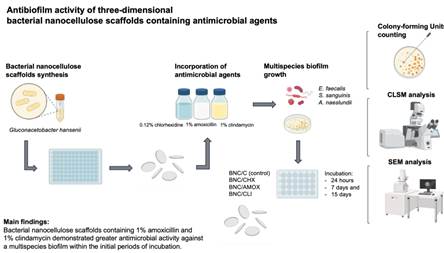
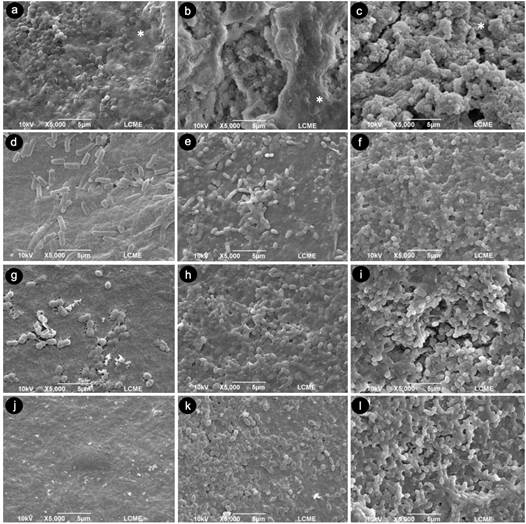
Studies have focused on the use of alternative scaffolds for Regenerative Endodontic Procedures (REPs) because current materials still pose significant technical limitations. The purpose of this in vitro study was to evaluate the antibiofilm activity of three-dimensional bacterial nanocellulose (BNC) scaffolds incorporated with 0.12% chlorhexidine digluconate (BNC/CHX), 1% amoxicillin (BNC/AMOX), and 1% clindamycin (BNC/CLI). BNC scaffolds without an antimicrobial agent composed the control group (BNC/C). BNC scaffolds were immersed in a multispecies culture of E. faecalis, A. naeslundii, and S. sanguinis, which served as a substrate for biofilm growth. After 24 hours, 7, and 15 days, the mean value of colony-forming units (CFUs) was determined. Multispecies biofilm formation on the BNC scaffolds was assessed under Scanning Electron Microscopy (SEM) and Confocal Laser Scanning Microscopy (CLSM). For the biofilm cell viability test, the mean value of CFU/mL for each sample was determined, and the data were normalized by taking the base-10 logarithm (log10) of each CFU/mL value. Data were analyzed by Two-way ANOVA, followed by Bonferroni’s post-hoc multiple comparisons (α=5%). In the 24h period, BNC/AMOX demonstrated significantly lower CFUs mean values than BNC/CHX, BNC/CLI, and BNC/C (p<0.05). CFUs mean values increased throughout the experimental periods, with no significant difference compared to the other groups (p>0.05). SEM and CLSM analysis revealed, in the initial periods, a lower number of microorganisms in the experimental groups compared to the control group. BNC scaffolds containing 1% amoxicillin and 1% clindamycin demonstrated greater antimicrobial activity against a multispecies biofilm within the initial periods of incubation
Key Words:
Bacterial Nanocellulose; Multispecies Biofilm; Regenerative Endodontics
 Thumbnail
 Thumbnail
 Thumbnail