 Women in Brazilian Politics: An Investigation into Adaptation to a Masculinized Culture, Intragroup Comparison, and the Perpetuation of Gender Hierarchy
ABSTRACT
Objective: investigate the extent to which women working in the Brazilian political field adhere to the characteristics of the queen bee phenomenon (QBP), specifically analyzing the traits of adherence to a masculinized culture, intragroup comparison, and the maintenance of gender hierarchy.
Methods: this is a qualitative study; 40 semi-structured interviews were conducted with women active in the political context.
Results: the analysis, using Gioia’s method, confirms the first hypothesis, indicating that women adopt masculinized behaviors influenced by the political context and the pressure exerted by stereotypes. However, the second and third hypotheses were refuted, demonstrating that women do not make comparisons of high commitment and professional sacrifices within groups, and the interviewees do not legitimize gender hierarchy, as they recognize discrimination and defend affirmative action policies.
Conclusions: thus, although the political environment is predominantly male and competitive, the results question the occurrence of the QBP. The findings highlight the importance of raising awareness about gender bias as an inhibiting factor of the phenomenon. Furthermore, the study cautiously conducts a comparative analysis between the Brazilian reality and that of other Latin American countries.
Keywords:
women; politics; queen bee phenomenon; gender issues; culture
INTRODUCTION
In Brazil, women represent approximately 53% of the electorate. However, when it comes to occupying political spaces, this scenario is largely reversed. Parliament is traditionally dominated by men, with women occupying only 18% of the seats (Siqueira, 2022). According to the Inter-Parliamentary Union (IPU-ONU, 2023)1, Brazil is the country with the greatest gender inequality in politics in South America and ranks 129th globally in the percentage of women in parliament.
This persistent underrepresentation of women in politics reflects broader challenges faced by women in male-dominated environments. One framework that helps explain some of these dynamics is the queen bee phenomenon (QBP), which suggests that traditionally male-dominated organizational environments characterized by intense competition are conducive to the emergence of competitive behaviors among women (Derks et al., 2016). The QBP points out that some women who experience gender discrimination and threats to their social identity, when assuming leadership positions, hinder or limit the opportunities of female colleagues who are in subordinate positions and at the beginning of their careers (Faniko et al., 2021).
According to the literature, queen bee women exhibit behaviors such as adapting to a masculinized culture by reproducing masculine traits, perceiving greater commitment, and making more professional sacrifices than their female colleagues who are at the beginning of their careers (Faniko et al., 2021). Another behavior is to legitimize and perpetuate the status quo of the gender hierarchy by denying discrimination, defending the existence of a meritocracy even in the face of gender bias, and opposing gender affirmative action (Derks et al., 2016).
This study builds on critiques in the QBP literature, which highlight that although predominantly male organizational structures tend to intensify conflicts among women, women themselves are often blamed and perceived as more problematic than men for collaborating with each other (Sheppard & Aquino, 2017). In this context, considering that the Brazilian political environment is historically masculine, competitive, and embedded in a patriarchal culture, making it fertile ground for the emergence of QBP, we propose to investigate the extent to which women working in the Brazilian political field adhere to the traits of the QBP, specifically analyzing adherence to a masculinized culture, intragroup comparison, and the maintenance of the gender hierarchy.
To this end, this research seeks to contribute to the discussion of the psychosocial mechanisms underlying this phenomenon by examining whether and how women engage in three behaviors identified in the QBP literature: (1) male identification, that is, whether women operating in the political context adopt more masculine traits in their behavior, interpersonal relations, and self-expression; (2) intragroup comparison, in which they evaluate their career trajectories against those of other women, perceiving themselves as more ambitious and committed than their colleagues who do not occupy equivalent positions; and (3) legitimation of the status quo, characterized by the denial of gender inequality and opposition to gender-affirmative policies.
Our analytical categories are based on existing literature. The first proposition (P1) assumed that, given individual experiences of discrimination and the traditionally masculine nature of the political context, women tend to adopt strategies of self-masculinization as a means of ensuring their inclusion, permanence, and advancement in the political environment. In the second proposition (P2), it is presumed that women who already hold political positions tend to perceive their levels of commitment and sacrifice as higher than those of their female colleagues who have not yet reached such positions. Finally, in the third proposition (P3), it is assumed that women engaged in political activities may adopt individual strategies that implicitly reinforce gender hierarchy, grounded in the belief that personal effort and competence are the primary determinants of success within the political arena.
The results revealed that, although the women interviewed identify with masculine traits, thus confirming P1, theoretical reflections and empirical data suggest that the political arena and interactions with male colleagues exert a strong influence on women’s behaviors and modes of action in this field. The results also indicate that the interviewees do not perceive their levels of commitment and sacrifice as superior to those of their peers, thus refuting P2. Furthermore, women do not legitimize gender hierarchy; on the contrary, they recognize the existence of discrimination and demonstrate active engagement in the defense and implementation of affirmative action policies, contradicting P3. In this sense, the results question the manifestation of the QBP and identify alternative behaviors adopted by women in the political context that foster female participation and advancement.
Furthermore, the study broadens the debate on gender in the political arena by going beyond the analysis of formal barriers to access to electoral positions and resources in the Brazilian political landscape, also contributing alternative theoretical approaches to understanding the phenomenon. In this sense, it is evident that structural elements of the work context, such as gender-based violence, threats to social identity, the relevance of women’s presence in confronting gender oppression, and the effectiveness of quota policies, constitute factors that challenge the manifestation of QBP. The originality of this research also stands out, filling a theoretical gap by analyzing QBP in a context deeply marked by patriarchy, machismo, and sexism, considering that research on the phenomenon in the Global South, especially in the political arena, remains scarce (see Grangeiro et al., 2024).
THEORETICAL BACKGROUND
Evolution of studies on QBP and analysis of underlying behaviors
QBP was introduced to the literature by Staines, Tavris, and Jayaratne in 1974, in an article published in the journal Psychology Today (Grangeiro et al., 2024). The authors used the metaphor of the ‘queen bee’ to describe how these women adopted behaviors that hindered and threatened the advancement of other women by making negative evaluations of their attempts to achieve success. Thirty years later, Ellemers et al. (2004), when investigating the underrepresentation of women in university teaching staff in the Netherlands and Italy, found evidence of the QBP also in academia.
This study served as the basis for various studies on the phenomenon (Abalkhail, 2020; Faniko et al., 2021; Grangeiro et al., 2022; Grangeiro & Gomes, 2023); exploratory analyses to identify the determining factors for the emergence of the phenomenon (Derks et al., 2016; Mavin & Williams, 2013); critiques of the metaphor (Sheppard & Aquino, 2017; Webber & Giuffre, 2019); and analyses of the underlying behaviors, such as male identification, comparison with the group, and legitimization of the status quo (Derks et al., 2016), which will be presented below.
Adherence to male stereotypes
Among the studies that describe the traits underlying the phenomenon, the first behavior highlights identification with masculine characteristics, often adopted as a survival strategy in environments that are hostile to feminine identity. Faced with leadership expectations and the belief that men possess traits more suited to management positions, some women adopt masculine traits as a strategy to be accepted and reach leadership positions at higher levels (Derks et al., 2016).
Diehl et al. (2020) point out that the older generation of female executives, leaders of religious organizations, doctors, and lawyers tend to present themselves in a more masculine way and report more stereotyped perceptions compared to the younger generation. In the technology sector, women emphasize the importance of becoming ‘invisible,’ i.e., ‘becoming one of the men,’ avoiding highlighting feminine characteristics (Harvey & Tremblay, 2020).
Strategic adherence to masculine norms not only facilitates the permanence and advancement of women in male-dominated environments, but can also influence how they perceive and evaluate other women, giving rise to intragender comparisons marked by distance and differentiation from other women.
Intragender comparison (women vs. women)
In addition to dressing, speaking, and relating in a typically masculine way to subordinates, queen bee women also compare their career paths with those of their female colleagues, rating themselves as more ambitious and committed than their female colleagues and as having career paths more aligned with those of their male colleagues (Faniko et al., 2016; Şengül et al., 2019). They are particularly critical of the career commitment, assertiveness, and leadership skills of other women (Ellemers et al., 2004). Goff et al. (2024) identified gendered perspectives in several Canadian academic surgical programs, in which interviewees evaluated female students in subordinate positions more critically than male students.
Queen bee women also believe that they have made difficult choices in their career paths and expect their younger colleagues to make similar sacrifices (Faniko et al., 2021). Thus, this adherence to masculine traits and characteristics (the more favored group) is a strategy commonly adopted by women in order to remain and progress in traditionally masculine work environments.
Thus, intragender comparisons based on alignment with masculine norms go beyond interpersonal assessments and can influence the legitimization of gender hierarchies, promoting stances of denial of discrimination and upholding the status quo in male-dominated contexts.
Legitimizing the status quo
Some women leaders have ignored the existence of gender inequality even in contexts with strong barriers to female participation (Derks et al., 2016; Faniko et al., 2021). In this sense, queen bee women end up legitimizing gender inequality by denying discrimination and being reluctant to support quotas or policies to combat inequality. They defend selection processes as legitimate, even in the face of evidence of gender bias (Derks et al., 2016; Derks, Ellemers et al., 2011; Faniko et al., 2021).
In a study on police officers in senior positions, Derks, Van Laar et al. (2011) found that some women demonstrate individual mobility behaviors, denying the existence of gender discrimination. In this process of denial, these women rely on the belief that the meritocratic system is neutral, which directly influences their opposition to gender-affirmative policies (Derks, Ellemers et al., 2011). In the academic context, female professors in male-dominated areas were more likely to deny discrimination and show less support for quotas compared to professors in mixed or predominantly female areas (Gomes et al., 2022).
Criticism of the phenomenon
The literature shows that QBP emerges as a reaction to experiences of gender discrimination and threats to social identity experienced by women in predominantly male environments (e.g., Derks et al., 2016; Ellemers et al., 2004). When members of a disadvantaged group (women) perceive that the typical characteristics of their group are devalued, two strategies can be adopted: (1) at the collective level, with actions aimed at reinforcing the demands of the group as a whole; or (2) at the individual level, emphasizing personal results by adopting characteristics associated with the (male) advantaged group. This second strategy favors the emergence of the QBP phenomenon (Derks et al., 2016).
However, Mavin and Williams (2013) argue that the metaphor of the queen bee is not sufficiently problematized in studies, as many studies ignore the complexity of women’s experiences of ascension in traditionally male spaces and the violence they constantly experience. This conceptual criticism is reinforced by the argument that some studies use the metaphor to highlight conflict in female relationships, but fail to propose explanations for the emergence of this behavior and fail to question how gender roles are involved in these contexts. In addition, these authors also point out that the term can be sexist and harm the image of women who reach high hierarchical levels in organizations, reinforcing the negative connotation associated with women in leadership positions. The critique also warns that the mere use of this term can contribute to the perpetuation of a stereotypical image of female leaders, portrayed as overly ambitious and more masculine than men themselves.
Sheppard and Aquino (2017) argue that the QBP can carry a stigma associated with women in leadership positions, suggesting that they exhibit inappropriate or deviant behavior. The authors also highlight that much of the research on the topic neglects the dynamics of male-male conflicts, naturalizing male conflicts while pathologizing those between women. While disputes between men are often interpreted as trivial or expected, summarized by the expression ‘boys being boys,’ similar behaviors between women tend to be perceived as dysfunctional, more serious, or socially problematic.
Although the most recent studies do not attribute responsibility for the emergence of the QBP phenomenon to women themselves, but rather highlight the influence of the predominantly male organizational context as a determining factor for this phenomenon, criticism persists (Grangeiro et al., 2022). Thus, given the pejorative connotation associated with the term ‘queen bee,’ there is a need to investigate the psychological, cultural, and organizational mechanisms that generate this phenomenon (Faniko et al., 2021; Sheppard & Aquino, 2017). Studies on QBP should analyze how social, cultural, and organizational factors influence and shape individual and collective behavior. These factors not only condition the way women act in traditionally masculine environments, but also interfere in power dynamics, interpersonal interactions, and the way relationships are (co)created.
METHOD
This is a qualitative study. The data collection strategy used semi-structured interviews. The political scenario was chosen because it is a mostly male and competitive field, where women face barriers during the electoral process and when holding office (Gomes et al., 2024).
This study demonstrates construct validity by coherently investigating the phenomenon it proposes to analyze. Among the criteria observed and presented below, the following stand out: a description of the circumstances surrounding access to interviewees and the phenomenon under investigation; an explanation of the structure of the data collection process; and a clear presentation of the respondent selection criteria, as well as the construction of the data collection instruments.
Regarding internal validity, the study’s theoretical framework is consistently explained, in addition to the use of a set of analytical categories based on behaviors previously identified in the literature. Also noteworthy is the systematic description of the data coding and analysis process, which contributes to the research’s methodological robustness.
Interview script
The interview script was designed based on theoretical studies on gender and the QBP (Derks et al., 2016; Grangeiro et al., 2022; Grangeiro & Esnard, 2021). The script was divided into two parts: the first block is made up of questions relating to personal information, professional trajectories, and motivations for working in the political field, with questions such as: “Could you comment on your professional background/education and how you began working in politics? What were the motivations that led you to enter politics? What changes have occurred in your life since entering politics?”
The second part aims to understand how the relationship between women in politics is characterized, with questions about the behavior of their colleagues and themselves, such as: “What characteristics and behaviors do you believe are necessary for a woman to thrive in politics? How do you evaluate (in a general context) female participation in politics? How would you describe your relationship with other women in politics? What do you believe is necessary for a woman to achieve success in politics? What measures do you believe are necessary to increase female participation in politics? How do you evaluate affirmative action policies for women in politics?”
Data collection
Data collection was conducted remotely using videoconferencing platforms such as Google Meet. The choice of this collection method was motivated by the ease of reaching interviewees in different locations, resulting in greater geographical coverage of the people investigated. The women involved were reached via emails obtained from institutional websites and social media platforms such as WhatsApp and Instagram.
Due to the initial difficulty in obtaining feedback from women willing to take part in the study, the snowball sampling technique was adopted, which is based on the indication of other potential interviewees by the respondents themselves (Leighton et al., 2021). In total, 390 women holding public office in the legislative and executive branches in the Northeast and Southeast were contacted. Of these, 77 responded, of whom 14 immediately refused and 23 did not attend the interview, resulting in a final sample of 40 women.
Data collection was terminated for two reasons: (1) participation of at least two women from each state in the regions studied; and (2) theoretical saturation, since the last interviews did not provide new insights into the phenomenon studied. Regarding the second point, it is worth noting that the themes related to support for affirmative action policies and experiences of gender discrimination did not present any new elements after the twenty-first interview. The themes related to greater sacrifices, greater commitment and effort compared to male colleagues, and the need to adopt masculine behaviors highlighted the need for more interviews to achieve theoretical depth, in which saturation was identified from the thirty-seventh interview onward. However, in order to meet the first criterion, three more interviews were conducted.
About the interviewees
The interviewees were women over the age of 18, between 23 and 76 years old, with an average age of 42, who work in the political field in the executive and legislative spheres. Eighteen of the women are from the Northeast region (coded as NO), composed of nine states and the second-largest region in the country in terms of population, and 22 are from the Southeast region (coded as SU), composed of four states and representing the most populated region in Brazil.
Table 1 presents the sociodemographic characteristics of the interviewees, including state of origin, age, marital status, education level, race/ethnicity, and number of children. It is worth noting that information such as party affiliation and political views of the interviewees was not included in the table to ensure their anonymity. This methodological decision is justified by the fact that cross-referencing variables such as state and age with these categories could allow for individual identification of the women who were interviewed.
Data analysis
The interviews were thoroughly transcribed (224 pages of material, with 12-point font and single spacing) and then categorized using the ATLAS.ti tool. The material collected was analyzed using Gioia’s method, which allows for a combination of inductive, qualitative, and interpretative techniques, enabling new theoretical insights, better explanations, or creative hypotheses about the specific phenomenon (Magnani & Gioia, 2023). In the first stage, data coding began from the notes organized during the fieldwork, with an emphasis on fidelity to the words of the informants (Gioia et al., 2013).
For example, statements such as “For me, politics was above all else, more than family. So, for my younger children, I was very absent...” (SU.12) and “So, I have a son, but we ended up not giving him the education he should have... we ended up outsourcing. For political reasons, I ended up harming him; I couldn’t balance that” (SU.08) were categorized as ‘sacrifices of distancing from children.’ A second example is that passages such as “... when I was a candidate, I had to change class semesters” (NO.01) and “... I prioritized building my political project over my university qualifications” were categorized as ‘sacrifices of distancing from studies.’ It is worth noting that approximately 68 codes and 743 speech excerpts were identified. The code names were defined as keywords that represent the participants’ speeches.
Next, a more abstract phase of data exploration began, corresponding to the second-order analysis of the statements, a stage dedicated to creating thematic categories. The objective of this phase was to group the first-order codes into interpretative themes and identify possible convergences and divergences between the constructed themes and the existing literature, evaluating the concepts and theories most relevant to understanding the data and achieving the research objective (Gioia et al., 2013). For example, the first-order codes related to personal sacrifices for professional success (i.e., codes previously cited as ‘sacrifices of distancing from children,’ ‘sacrifices of distancing from studies,’ and other codes) gave rise to the theme ‘perceptions of greater sacrifices.’ However, unlike what the literature on the QBP suggests, the interviewees’ reports do not show comparison with female colleagues, but rather with male colleagues, who have privileges and make fewer sacrifices. This finding confronted the existing literature and paved the way for the development of a new theme.
During this phase of defining themes (second-order codes), a second author read the interviews and identified the presence of the themes defined by the first author. The authors assessed coding agreement among researchers, calculating the percentage of agreement to ensure the external validity of the results. Agreement percentages ranged from 80% to 100%, considered significant for all thematic occurrences, as shown in Table 2. Discrepancies between researchers’ coding were subsequently resolved through discussion until a consensus was reached to advance to the next stage.
Finally, the second-order codes (themes) obtained from the interviews were cross-referenced with the relevant literature, which allowed for the analysis and construction of aggregate dimensions. In accordance with the recommendations of Gioia et al. (2013), at this stage the researchers assessed whether the emerging themes indicated the presence of theoretical concepts that could be useful in describing or explaining the phenomena studied. This resulted in the creation of a systemic representation of the process of analyzing the raw data until the aggregated dimensions were obtained, as shown in Figure 1.

PRESENTATION OF RESULTS
Adapting to a masculinized culture
Masculine traits
Although the interviewees mention some traits considered feminine (e.g., resilience, patience, and collectivity), the traits considered masculine are predominant in the interviewees’ statements (e.g., courageous, resolute, strong, objective). Interviewee NO.05 emphasizes that women need to be “persistent, tough, daring, intelligent... Studious, they have to be. Men don’t need that. But women have to.” They point out that they must adopt a more rigid posture and, in certain situations, behave more aggressively in order to be respected: “In front of an assembly, setting up a table and the men come up to me, trying to embarrass me. I have to bang my fist on the table and be firm” (NO.01).
However, the women explain that the need to adopt more masculine traits is primarily due to the historical absence of female identity in politics and the absence of other female colleagues: “It’s not difficult for me to be in places where I’m the only woman, right? ... The leadership is often made up of men. ... Sometimes, even if you’re a woman, you need to incorporate some more masculine elements, right? To be able to assert yourself” (NO.16).
Furthermore, the interviewees also point out that they encounter daily incongruence in gender roles, as they are forced to display masculine traits to survive in a political space that devalues women’s identities. At the same time, they are forced to embrace their femininity due to the demands of social gender standards and stereotypes. SU.06 says that “a man who changes the tone of his speech is treated completely differently from a woman who has to raise her tone to be heard. So, she’s labeled as hysterical, crazy, and other pejorative things. But not the men. They’re considered men being men.”
Although they recognize some feminine characteristics, women indicate a predominance of traits socially associated with masculinity, perceived as necessary to gain legitimacy in a male-dominated political environment. These results confirm P1, but reflect a persistent gender role incongruence.
Intergroup comparison (women vs. men)
Commitment to career
Women point to the need for a high level of commitment to their careers and to make greater efforts to gain credibility and be recognized in the political arena by their fellow parliamentarians and voters. “We always need to be more competent, ... show more service, ... be more willing” (NO.06). “Women have to work twice as hard to achieve the same legitimacy and affirmation as men” (NO.16).
The interviewees reported that demonstrating high commitment and ambition toward a political career is a requirement to maintain a prominent position in the political arena. NO.02 says that she sees “many men in the political context who don’t do half of what some women do. But they are not questioned, because they are men.” Furthermore, the interviewees acknowledged that any attempt to reduce their level of commitment could result in an even greater disadvantage for them, reinforcing the perception that female political success depends on continuous and disproportionate effort compared to their male counterparts.
Perceptions of greater sacrifices
In addition to their greater commitment and dedication to their careers, the interviewees also say they have made substantially greater sacrifices than their male counterparts in order to prioritize their professional careers. These sacrifices are reported in various circumstances, such as delays in completing courses: “There were some very difficult and important decisions. The very fact that I am conquering my undergraduate degree only today reflects this. I prioritized the construction of the political project to the detriment of my personal qualification at university.” Distance from the job market and the chosen profession is also mentioned: “A life of dedication ... I’m no longer an engineer, I’m a councilor. We’re taking it very seriously here” (SU.11).
Relationships with children, partners, family, and friends are also damaged in favor of a political career. Due to the high level of commitment and demands, the long hours of work at weekends and the double and/or triple shifts end up affecting their relationships and intimacy. NO.15 confirms: “I end up sacrificing, as many women do. They do sacrifice personal, family relationships, as my relationship with my son, with my mother.” Interviewee NO.15 emphasizes that this distancing is not a choice, but a necessity to guarantee recognition for her work: “It’s not a choice! If I don’t do this, the mandate won’t have the visibility, we won’t have political support from the party, which we should have, as they make it easier for men. So, there’s no balance! Women end up really overburdened” (NO.15).
Women perceive the need for high levels of commitment and ambition to achieve credibility and legitimacy in the political arena, demonstrating disproportionate effort compared to men. Furthermore, they describe the need to make greater personal and professional sacrifices compared to their male colleagues, thus refuting P2.
Interrupting the status quo
Experiences of discrimination and gender violence
The women interviewed said they had experienced gender discrimination in various contexts and described the environment as hostile and violent for women: “a hostile, toxic space, ... women are often afraid, they don’t want to occupy this space because they know it’s going to be a space where they won’t be respected, right?” (SU.09). NO.13 sees violence as a political project aimed at alienating women: “The environment is so hostile, so low-level, that women with great potential no longer want to continue in politics. I see it as a project, political gender violence is aimed at getting fewer and fewer women to take part.” Beyond the environment, experiences of discrimination arise from different sources. The interviewees reported negative experiences in their relationships with voters, who questioned their abilities, verbally attacked them through insults, and even threatened their physical safety. SU.14 recounted the incident when voters from the opposing party who were at a protest surrounded her car: “I didn’t go past the protest, I went straight to my car. The people saw that it was me, a lot of men ran out ... they surrounded my car on all sides.” She adds: “They called me a slut, they called me a thief, a lot of things, ... they hit my car. It was quite shocking!”
Disqualification and disrespect are also mentioned in relationships with male parliamentary colleagues. Interviewees NO.13, SU.04, and SU.03 recounted situations in which colleagues took violent and disrespectful stances: “I went to this meeting, but there were six male councilors and I was shouted at three times by this councilor with his finger in my face and telling me to leave” (NO.13). The attitude of disqualification is portrayed by SU.03: “Several times it has happened to me that I was contradicting a councilor, and he printed out the law and took it to me in front of the Chamber, in front of all my colleagues, for me to read as if I didn’t know what I was talking about.”
Situations of invisibility, silencing, and disregard for their speeches are also reported. “When it’s time to speak in plenary, we have to start by telling people to sit down, like a teacher. Sit down, listen, look, I’m talking. It takes time away from my speech, I’m not going to speak until there’s silence” (SU.18). The difficulty of having their ideas accepted is also addressed: “It’s those classic situations that happen: I say something... Nobody [speaks up]. Then the councilor next to me gets up and says the same thing as me, in the same words” (SU.14).
Another veiled form of violence cited by the women interviewed is the restriction and isolation of their political projects: “My bills, they’re all thoroughly examined by all the councilors, which doesn’t happen with the bills of the male councilors, who often don’t even know what they’re voting on. Mine always have a longer process, always,” says SU.14. Alongside symbolic and veiled violence, the interlocutors reported situations of harassment, sexualization, and threats from colleagues: “I had posted a photo in a bikini. I arrived in plenary the other day and a councilor thought it would be nice to say that he saw my photo and zoomed in on my private parts” (NO.04). “The councilor said he was going armed into the Chamber, that I should be careful; he said it into the microphone” (SU.20).
Support for quotas and necessary changes
In agreement, the interviewees support affirmative action policies: “We need quotas so that we can start to undo the great inequality, right? To make it less difficult for us to enter politics. We need to go further on, we still need more incentives” (SU.10). One interviewee said that at one point in her life she was against quotas, but today she recognizes the need for them:
I think they’re essential! Before I entered politics, I was never very much in favor of quotas. But when I joined, I realized that I was living in a bubble, and I closed myself off in that bubble where, thank God, we didn’t encounter many problems. But when you start to get out of your bubble and get to know the world, you realize that prejudice is very big, sexism is very big, racism is very big and that, if we don’t institute these quotas, it will be very difficult for people to face those places. So, I totally changed my mind. Nowadays, I’m in favor of all quotas (NO.07).
Although the interviewees are in favor of affirmative action policies, they recognize that the measures are flawed and far from achieving the expected results, as SU.14 and SU.09 report: “We have the quota for the election, right? But we don’t have an elected quota, which doesn’t reflect our size, and then there’s a lack of oversight. There are parties that don’t meet the funding quota for women” (SU.14). The absence of other policies and actions that help and coordinate women’s participation is also highlighted: “Just to fulfill a quota, without experience with the public, without experience with what it means to do politics, without security, which I think is a fundamental point to be addressed with women in politics.” SU.21 mentions: “It’s not enough just to have quotas, it’s not enough just to have these rules, ... it’s about teaching women how they can run these campaigns, how they can manage these resources” (SU.21).
Faced with this context, the interviewees suggest some changes in monitoring and punishment for parties that do not respect quota policies: “We really need to strengthen the company’s affirmative actions, strengthen the mechanisms, including monitoring” (NO.04). “I’m a supporter of reserving seats for women in legislative spaces. I think this is fundamental for the democracy that I believe we need to build” (SU.01). “We need to build other possibilities, including extending what the law says today. It needs to reach 50%, above all, guaranteeing a public budget, otherwise we see a lot of propaganda and little implementation” (NO.15).
The results expose widespread experiences of gender discrimination and political violence. Such practices are perceived as deliberate mechanisms to discourage women in the political field. Furthermore, they expressed support for affirmative action policies, recognizing them as necessary to reduce structural inequalities, thus refuting P3.
DISCUSSION OF RESULTS
Discussion of aggregated dimensions
Based on the theoretical corpus of the QBP, women who work in predominantly male environments tend to assimilate characteristics associated with male behavior. This is because their skills and ambitions are often underestimated, while masculine traits are considered more suitable for positions of power (Derks et al., 2016). In the political context, female candidates emphasize masculine traits because they believe they are more beneficial to their campaigns and/or because of the need for acceptance (Fernandes & Lourenço, 2023).
Although 18 interviewees cite the importance of some stereotypically feminine behaviors (e.g., resilience, patience, collectivity), 26 women recognize that the context is unfavorable to their identities and that feminine behaviors are less acceptable, forcing them to adopt masculine traits throughout the campaign and the mandate. Studies show that employees prefer male managers in male-dominated contexts more than in female-dominated contexts (Offringa & Groeneveld, 2024). Thus, this adherence can be understood as a way of surviving the environment in which they find themselves, with the aim of being respected among their fellow parliamentarians, and not as typical QBP behavior. These data corroborate studies on the phenomenon in the technological environment of startups (Grangeiro & Gomes, 2023), in academia (Faniko et al., 2021; Grangeiro et al., 2022), and in business (Duarte & Gallon, 2022). This highlights that gender and QBP challenges are present in both private and public institutions.
This pressure to adopt more masculine characteristics places women in an incongruity of gender roles: they are encouraged to demonstrate masculinity (e.g., assertive and competent), but at the same time they are criticized when they do not express the expected femininity (e.g., friendly and welcoming) (Abalkhail, 2020; Somogyi, 2019). Blackman and Jackson (2021) found evidence of bias against female candidates among voters and found that voters are more likely to prefer male candidates who emphasize security issues over women’s rights. The interviewees point out that when women adopt behaviors that are considered feminine in masculine environments, they are seen as unsuitable to occupy these spaces. However, when they do not express these feminine behaviors, they are also judged negatively (Bauer, 2020).
This incongruity reinforces the stigma that women are not skilled enough to occupy traditionally male positions and that female relationships are more conflictual (Sheppard & Aquino, 2017). Furthermore, the incongruity reveals that predominantly male spaces, such as Brazilian politics, are environments historically conceived and structured by men and for men. Consequently, institutional norms, interaction patterns, and informal power dynamics tend to privilege masculine patterns of behavior and leadership, marginalizing women and other gender minorities.
A second problem with this reproduction of male traits is that by adopting a more reactive and incisive stance, behaviors that are seen as normal and appropriate when displayed by male colleagues, women are often stereotyped as ‘crazy,’ ‘harsh,’ ‘unbalanced,’ or ‘hysterical.’ In this way, women are constantly misjudged, as they experience situations in which they can be accused of being too aggressive or too emotional (Harvey & Tremblay, 2020).
Thus, to survive in a masculinized environment, women are symbolically penalized for behaviors that are naturalized and valued when expressed by men. This mechanism reinforces the logic of delegitimization and hinders female presence in politics, reinforcing the cycle of invisibility, in which women are simultaneously pressured to adapt and punished for not meeting normative gender expectations.
The third consequence is that conforming to male behavior ratifies existing gender barriers, hinders the development of measures to combat inequality, facilitates distancing and the emergence of feelings of loneliness among women, and reduces the chances of them sharing their doubts, anxieties, and weaknesses (Duarte & Gallon, 2022). In this context, it is not enough just to promote some women to management positions and then hope that the number of women will increase; it is necessary to ensure identity security and institute practices that reduce the threat and violence that women experience when expressing feminine behavior (Faniko et al., 2021).
This reproduction of male behavior shifts the focus of inequalities from the institutional level to the individual level, reinforcing the idea that success depends on personal effort and not on structural changes. Thus, conformity causes women, even involuntarily, to contribute to the stability of the very system that excludes them, weakening the construction of collective gender agendas, limiting solidarity among women, and compromising the transformative potential of their presence in politics.
In addition to the similarity in the way they dress, speak, and relate to subordinates in a typically masculine way, QBP women also describe their commitment as higher than that of their colleagues, being more similar to male colleagues (Derks et al., 2016; Ellemers et al., 2004; Faniko et al., 2021; Şengül et al., 2019). Based on the results, 24 of the interviewees demonstrated greater commitment to their careers, and 30 women indicated a need to make substantial sacrifices to achieve credibility and recognition. However, unlike the literature, these comparisons are not directed at their female counterparts, but at their male colleagues and the privileges offered to them in political circles.
Women in the political context face a system of masculine values and identities that make it difficult for them to enter institutional spaces. Although they adopt masculine characteristics and show greater commitment as survival strategies, this is due to the influence that the political field and the relationships built in this environment have on their behavior and identity. This adaptation is aggravated by the pressure of stereotypes and gender segregation, which affect women in both social and organizational spaces (Van Veelen et al., 2019).
This comparative movement suggests that women are aware of gender inequality, in which excessive effort and sacrifices are not naturalized and/or seen as individual failures or female limitations, but are recognized as institutional problems that require questioning and structural transformations. However, it is important to recognize that this comparison can generate even greater identity tensions between men and women, considering that this perception of discrepancy between sacrifice/commitment and recognition can amplify feelings of injustice and distancing from the public sphere.
The literature on QBP also shows that women have reached positions of command in the workplace by relying on the belief in the neutrality of the meritocratic system and positioning themselves against gender affirmative action policies, even in the face of clear signs of gender bias (Derks et al., 2016; Faniko et al., 2021). Franceschet et al. (2016) point out that some women in the political context distance themselves from feminism, deny gender inequality, and reject allegations of sexism. However, the interviewees in this study do not legitimize the status quo, do not deny experiences of discrimination, and are not reluctant to support affirmative policies.
All 40 participants acknowledge that they are in a violent environment, and all of them say that they have experienced or witnessed situations of discrimination and gender violence. They explain hostile and disrespectful situations, both implicit (e.g., interruptions, invalidations of their speeches, disapproval of projects) and explicit (e.g., insults, jokes, threats, harassment), by male voters and fellow male parliamentarians. They recognize this violence as intentional, aimed at making politics an uncomfortable place for women to work. The experiences of discrimination reported by the interviewees corroborate the existing literature (Fernandes & Lourenço, 2023; Gomes et al., 2024).
Quotas are the most widely used mechanism to reduce gender inequality in politics (Buckley & Mariani, 2023). However, several studies point out that these measures in the Brazilian context are not correctly adopted and highlight several flaws (Araújo & Rodrigues, 2023; Ramos & Silva, 2020; Scheidweiler et al., 2023). Among the respondents, 37 indicated the perceived ineffectiveness of national affirmative action policies. The data show that legislation alone does not transform the reality marked by gender violence, highlighting the importance of occupying these spaces as a means of promoting concrete changes. Thus, the inclusion of these women should not be seen merely as a question of quantitative ‘representativeness,’ but as a strategic necessity for the implementation of practical actions that contribute to altering the existing dynamics of gender violence.
Faced with this difficulty in achieving gender equality through current policies, the women interviewed suggest changes in the processes of oversight, punishment, and party structures. Similar to Gomes et al. (2024), as an alternative to increase the inclusion of women in politics, the interviewees also suggest reserving vacancies for women in the seats of legislative and executive houses, rather than on party candidate lists.
It should be recognized that the construction of political identity and social characteristics (e.g., women who are part of social movements, collective struggles, have a high level of education, are mostly feminists, and are financially independent) directly reflects the defense of affirmative action policies, as it strengthens the sense of belonging and individual engagement in collective struggles (Girerd & Bonnot, 2020).
Furthermore, the inclusion of women in politics ranges from the right to participate in electoral processes (voting and eligibility), to achieving representation in various spheres, as well as promoting structural changes in society and the political space. Thus, it is not enough just to ‘be a woman’; it is essential to be a woman who is aware of the gender oppression that permeates Brazilian society and the political space, so as to act in a transformative way and promote changes in this context. Figure 2 presents a summary of the theoretical contribution of this study.

Theoretical model of individual experiences and non-adherence to Queen Bee behavior in Brazilian politics.
The theoretical model presented illustrates the results found in this study. The Brazilian political environment, characterized by a masculine tradition, competitiveness, hostility, and gender-based violence, tends to favor behaviors that adhere to masculine stereotypes and legitimize the status quo. However, the individual experiences of the interviewees in this study indicate a movement of resistance to this pattern. The women interviewed did not negatively compare the sacrifices made by other women, nor did they evaluate them as less committed; on the contrary, they recognized the environment as violent and hostile to women and defended the relevance of affirmative action policies. Thus, the model demonstrates that, even in a structurally adverse context, there is room for non-adherence to queen bee behavior, driven by critical awareness and engagement with gender equality issues.
Finally, the results corroborate national and international research carried out on the phenomenon in the technological context (Grangeiro & Gomes, 2023), in the public context (Arvate et al., 2018), in the business environment (Amornkitvikai & Pholphirul, 2024), and in the academic context (Grangeiro et al., 2022) by not identifying the behaviors underlying QBP, but contrast with the findings in the business sector (Duarte & Gallon, 2022). These divergences among the findings highlight the need for more studies on the phenomenon and on possible organizational and individual variables for its emergence.
Transferability and reflections for the Global South
Regarding the presence of women in parliaments, Brazil, along with Paraguay, occupies a position far behind other Latin American countries that lead in female representativeness, such as Mexico, Peru, and Argentina (IPU-ONU, 2023). Although many countries in the Global South have adopted electoral reforms and policies introducing gender quotas, it is evident that those implementing strict parity mechanisms have succeeded in increasing female representation in parliaments, as in the cases of Mexico (50%), Bolivia (46.2%), and Argentina (44.8%). In contrast, countries where such reforms present shortcomings or weak enforcement, such as Brazil (17.7%) and Paraguay (18.8%), face slower inclusion processes that depend on the efforts of social movements and women’s networks operating outside formal political-party structures. Table 3 presents some comparative axes among Latin American countries.
Observing the comparative axes and the dynamics of the aggregated dimensions from the previous section in the context of the Global South, it is evident that, in most Latin American countries, as in Brazil, patriarchal structures, colonial legacies, and deep social inequalities continue to shape women’s access to power and legitimacy. Although there have been advances in female political representation, such progress alone does not guarantee symbolic transformations or the effective dismantling of gender barriers.
Even in contexts of greater gender balance in party politics, such as Bolivia (46.2%), the literature indicates that increased female representation does not eliminate dynamics of discrimination and symbolic violence (Sanín, 2022). Although the authors did not identify specific studies on the QBP in the political context of other countries, the data suggest interpretations according to which the mere numerical presence of women does not necessarily translate into the effective transformation of the political field. Thus, despite gender-parity parliaments, women may remain exposed to pressures to adopt masculine behaviors, not only as an expression of the QBP but also as a strategy for survival and legitimation in spaces dominated by masculinized values and practices.
Mexico is also a good example of how even significant female political-party representation does not improve this scenario in the absence of other affirmative actions. Mexico has one of the highest rates of women in parliament (50.0%), comparable to Scandinavian countries, yet there is still a long way to go toward a more egalitarian society for women. Women’s presence in politics tends to be conditioned by the assimilation of hegemonically masculine behavioral patterns, often at the cost of erasing alternative and more plural forms of leadership (Lombard et al., 2021).
In comparative terms, certain results can be generalized across Latin American countries, particularly the finding that women who adopt masculinized traits do so in response to contextual pressures rather than identity rejection, given the persistence of patriarchal political structures, colonial legacies, and gendered social inequalities, ills that all Latin American countries have experienced and continue to face.
Furthermore, even in contexts with greater gender balance in parliamentary seats, women may still perceive the need to make greater sacrifices and demonstrate stronger commitments to achieve effective results in the political field, due to the historical and structural forms of violence that continue to shape their trajectories and experiences of power in these countries.
On the other hand, there are aspects that cannot be generalized. Brazil presents a particularity that amplifies barriers to political equity: the low institutional density of gender policies makes the Brazilian scenario unique within the Global South. Unlike countries that have constitutionalized gender parity, Brazil remains limited to a model of formal quotas with little practical effectiveness (Ramos & Silva, 2020), which restricts the institutional impact of female representation and reinforces dependence on individual trajectories. Thus, the findings on gender-based violence and discrimination, as well as the evidence indicating the need for changes in quota policies, are specific to women operating within the national political context.
Alternative theoretical pathways to QBP
Studies on social identity threats that support the QBP assert that women in traditionally masculine environments may adopt individual strategies to distance themselves from their own group and adhere to traits valued by the socially dominant group. However, the results that emerged in this study indicate that threats to female identity do not lead to its rupture, but rather to the strengthening of collective identity. This finding suggests that gender identity can be constructed and influenced contextually; that is, shared experiences of discrimination and exclusion can reinforce women’s sense of belonging. Furthermore, the data suggest that the emergence of the QBP should be explored through factors other than those already highlighted in the literature, such as individual factors (need for self-affirmation, stigma reduction, and competitive behaviors).
Women working in politics can adopt, as an adaptive strategy, an identity performance shaped by the institutional context, transitioning between styles that are sometimes more ‘masculine’ and sometimes more ‘feminine,’ depending on situational demands, without this representing a distancing from their group. By adopting behavioral traits considered masculine, these women seek to penetrate the symbolic power of the political field and dialogue with its dominant logic. Bauer and Santia (2022) point out that women strategically balance masculine and feminine stereotypes in ways that value their qualities and win elections. Thus, the data from this study propose an in-depth reflection on masculinization as a possible sign not of distancing themselves, but of silent resistance, a form of strategic insertion and permanence in these spaces. It is equally pertinent to investigate to what extent such performance can, however, reproduce a standardized social expectation about what ‘a woman should be’ in the exercise of power.
In the political context, male status is directly reflected in the political and structural capital that privileges men through easier access to networks of influence, funding, media time, party support, and other resources (e.g., Lowndes, 2020; Smrek, 2022). Therefore, the data from this research suggest that women perceive the need for greater commitment and greater sacrifices as a way of structurally compensating for the absence of this capital. Specifically, in a scenario in which the collective is one of the main determinants of achieving positions, women demonstrate greater involvement in collective actions that favor the construction of a shared social identity. However, it is important to analyze in future studies to what extent this behavior of valuing and recognizing the group stems from genuine conviction or whether it may reflect a pattern of social desirability, as society and the electorate expect more collaborative and supportive attitudes from elected women.
By highlighting experiences of discrimination and supporting quota policies, women reaffirm the importance of these instruments as mechanisms for institutional rebalancing aimed at promoting female inclusion in the political arena (Fernández & Valiente, 2021). Recognizing that the problem lies not only in the numerical absence of women, but also in the very structure of legitimization of political power, becomes essential. This requires political institutions to cease being seen as neutral arenas and begin to be understood as spaces intersected by power relations and diverse identities, in which both those in office and those who decide who will occupy these positions recognize the multiplicity of identity actors present.
Furthermore, research indicates that establishing the organizational changes necessary for women to assume leadership positions requires creating accessible and visible career paths, providing networking support, activating mentoring opportunities, and addressing unconscious biases (O’Brien et al., 2023). This demonstrates that debates must shift the focus from women’s individual responsibilities, commonly interpreted as competitive, to the structural level of organizational and cultural practices. In the political context, this analytical shift is especially relevant because women’s behavior and relationships cannot be summarized in isolation, but rather as products of institutional, symbolic, and cultural structures that continue to reproduce gender hierarchies and inequalities.
Thus, while studies on the QBP portray women as defensive and individualistic, the results of this study suggest that such behaviors may reflect strategic and collective alternatives for action in the political arena. The data show that political identity in these spaces contributes to the recognition of gender challenges and, consequently, can aid in the persistence and formulation of policies aimed at promoting greater women’s participation (Refki & Faerman, 2024). Thus, instead of perpetuating the gender hierarchy, these women reconfigure themselves, sometimes performatively (i.e., through adherence to the most accepted behavior), to slowly transform threats to identity into actions that value female solidarity and guarantee political legitimacy for women.
FINAL CONSIDERATIONS
Our findings challenge the presence of QBP in a male-dominated, competitive, and often hostile work environment. Although the first proposition was confirmed, and the women interviewed demonstrate adherence to more masculine behaviors, this pattern can be explained by the political field and the relationships that strongly influence individuals’ behaviors. The results show the pressure that stereotypes and gender segregation exert on women’s behavior. Contrary to the literature and in contradiction to the second proposition, the interviewees do not compare their high levels of commitment with those of female colleagues who are at the beginning of their careers or occupy different positions. They compare themselves to their male colleagues who, having privileges and benefiting from gender hegemony, do not need to make extra efforts to gain legitimacy in their positions.
The third proposition is also refuted, as the interviewees do not legitimize the gender hierarchy, since they recognize discrimination and act strongly to enforce affirmative policies. They confirm that the environment is hostile and violent for women: voters and fellow parliamentarians disqualify, disrespect, silence, harass, threaten, and create obstacles for women in the political arena. All the women interviewed support and highlight the importance of affirmative gender policies (quotas in particular). They recognize the flaws in and need for changes to these policies, as they are still inefficient. The interviewees show that although affirmative action and policies are indispensable, they are insufficient, since in practice they are often not properly respected or implemented. Thus, it can be concluded that in the political context, the precursor factors of QBP trigger masculine traits in women, although they do not promote the set of attitudes that characterize QBP.
By listening to the interviewees’ narratives, it was possible to go beyond simply verifying the presence or absence of behaviors associated with the QBP in the political landscape. Reports emerged of women engaged and attentive to gender issues, with clarity about the historical and social mechanisms that sustain their disadvantage. This gender awareness acts as a protective factor that helps explain why the queen bee phenomenon was not identified in the political context. This recognition fosters closer relationships between women and reduces intra-group comparisons, as well as delegitimizing perceptions based on individual deficits or supposed failures of other women. Furthermore, it contributes to strengthening ties with women’s collectives and to challenging the norms and practices that sustain gender inequality in the political field.
This study also conducts a comparative analysis of how the conclusions drawn from the Brazilian reality are broadened or limited in relation to the realities of other Latin American countries, specifically observing how political competition among women, quotas, and other affirmative action policies are reflected in women’s participation in politics and the QBP. This comparison makes it possible to understand that the existence or non-existence of this phenomenon can be influenced by the design and effectiveness of affirmative action policies, by the structural and institutional reforms adopted in political spaces, and by the organizational and ideological contexts of political parties themselves, which can mitigate or reinforce dynamics of competition and gender hierarchy.
While previous research suggests that environments dominated by masculine norms favor the QBP, our results reveal a different scenario: awareness of gender bias strengthens the ability to identify structural barriers, challenge male privilege, identify gender-based violence, and support affirmative action measures such as quotas. In this sense, even though women adopt masculine traits, the data show that they are aware of gender bias and tend to resist the legitimization of the gender hierarchy that characterizes the QBP. Such evidence broadens the theoretical understanding of the phenomenon in the still underexplored political context, suggesting the need to incorporate other variables less discussed in the literature, such as identification with feminist agendas and critical recognition of inequalities, which can act as barriers to the reproduction of queen bee attitudes.
The main theoretical implication of this study is for the literature on the QBP, as it reinforces that this behavior is not something that comes naturally to women, whose actions are influenced by factors beyond their workplace experiences. Although the literature states that violence and experiences of gender discrimination are enough for women to promote individual gains to the detriment of collective gains, it was observed in this study that the precursor factors of the phenomenon (e.g., experiencing discrimination and threats to social identity in traditionally male environments) do not promote the existence of typical QBP behavior in the researched context, and it is necessary to advance the discussion on how other variables favor the emergence of the phenomenon.
In terms of practical application, the data presented can be used to build public policies, define strategies, and strengthen women’s collectives, as well as raise awareness among individuals, activists, political collectives, social groups, and political parties about critical issues that are often neglected in decision-making discussions. Thus, the study offers concrete support for the construction of strategies that go beyond individualization, prioritizing structural changes for the collective, strengthening affirmative gender policies, creating spaces for political education, and fostering relationships of mutual support among women.
This research highlights the need for more in-depth studies on how individual, social, and cultural factors specific to countries in the Global South, such as Brazil, influence and mitigate competitive behaviors among women and the emergence of QBP in predominantly male professional contexts, impacting relations among women in the workplace. It also reinforces the need for further discussion on the subject, such as: (1) how other factors may be determinants of the emergence of the phenomenon; (2) examining other identity and behavioral variables; (3) how cultural, social, organizational, family, and professional contexts may act as inhibitors of the phenomenon; and (4) the existence of the phenomenon in the national political context according to the spheres of the legislative, executive, and judiciary, at municipal, state, and national government levels, in relation to party political positions (right, center, and left).
We also emphasize the need for future research on the QBP to be conducted from other theoretical perspectives. In the political field, we particularly suggest studies that integrate perspectives and authors from the field of public administration, allowing for the establishment of interfaces between gender dynamics and the functioning of political and public institutions.
This study encourages reflection on administrative practices and presents evidence that points to the need for changes and the formulation of public policies capable of guaranteeing female legitimacy in the political sphere. The pressure for women to adopt masculinized behaviors highlights the urgent need for educational and institutional programs aimed at deconstructing leadership stereotypes associated with men. The recognition of institutional hostility and violence reveals the importance of implementing formal administrative protocols for reporting, accommodating, and protecting against all types of violence and threats directed at women. The flaws observed in quota systems require a critical evaluation of current public policies and their effective results. Furthermore, it is essential that the training of public administrators, party leaders, and politicians include discussions on gender, intersectionality, social identity, and the impacts of male hegemony, with the aim of making the political environment fairer, more inclusive, and more welcoming.
REFERENCES
-
Abalkhail, J. M. (2020). Women managing women: Hierarchical relationships and career impact. Career Development International, 25(4), 389-413. https://doi.org/10.1108/CDI-01-2019-0020
» https://doi.org/10.1108/CDI-01-2019-0020 -
Amornkitvikai, Y., & Pholphirul, P. (2024). Measuring the Queen Bee Phenomenon in technically efficient firms: Implications from Southeast Asian manufacturers. Gender, Technology and Development, 28(2), 223-244. https://doi.org/10.1080/09718524.2024.2316424
» https://doi.org/10.1080/09718524.2024.2316424 -
Araújo, C. M. O. & Rodrigues, T. C. M. (2023). Judicialização da competição política e gênero: Ação afirmativa nos Fundos Partidário e Eleitoral no Brasil. Revista Brasileira de Ciência Política, 40, 1-31, e260812. https://doi.org/10.1590/0103-3352.2023.40.260812
» https://doi.org/10.1590/0103-3352.2023.40.260812 -
Arvate, P. R., Galilea, G. W., & Todescat, I. (2018). The queen bee: A myth? The effect of top-level female leadership on subordinate females. The Leadership Quarterly, 29(5), 533-548. https://doi.org/10.1016/j.leaqua.2018.03.002
» https://doi.org/10.1016/j.leaqua.2018.03.002 -
Bauer, N. M. (2020). Shifting standards: How voters evaluate the qualifications of female and male candidates. The Journal of Politics, 82(1), 1-12. https://doi.org/10.1086/705817
» https://doi.org/10.1086/705817 -
Bauer, N. M., & Santia, M. (2022). Going feminine: Identifying how and when female candidates emphasize feminine and masculine traits on the campaign trail. Political Research Quarterly, 75(3), 691-705. https://doi.org/10.1177/10659129211020257
» https://doi.org/10.1177/10659129211020257 -
Blackman, A. D., & Jackson, M. (2021). Gender stereotypes, political leadership, and voting behavior in Tunisia. Political Behavior, 43(3), 1037-1066. https://doi.org/10.1007/s11109-019-09582-5
» https://doi.org/10.1007/s11109-019-09582-5 -
Buckley, F., & Mariani, M. (2023). Money matters: The impact of gender quotas on campaign spending for women candidates. International Political Science Review, 44(1), 59-76. https://doi.org/10.1177/01925121211041028
» https://doi.org/10.1177/01925121211041028 -
Derks, B., Ellemers, N., Van Laar, C., & Groot, K. (2011). Do sexist organizational cultures create the Queen Bee?. British Journal of Social Psychology, 50(3), 519-535. https://doi.org/10.1348/014466610X525280
» https://doi.org/10.1348/014466610X525280 -
Derks, B., Van Laar, C., Ellemers, N., & De Groot, K. (2011). Gender-bias primes elicit queen-bee responses among senior policewomen. Psychological Science, 22(10), 1243-1249. https://doi.org/10.1177/0956797611417258
» https://doi.org/10.1177/0956797611417258 -
Derks, B., Van Laar, C., & Ellemers, N. (2016). The queen bee phenomenon: Why women leaders distance themselves from junior women. The Leadership Quarterly, 27, 456- 469. https://doi.org/10.1016/j.leaqua.2015.12.007
» https://doi.org/10.1016/j.leaqua.2015.12.007 -
Diaz, G., Oliveros, V., Weitz-Shapiro, R., & Winters, M. S. (2025). Ignoring women’s performance: A survey experiment on policy implementation in Argentina. British Journal of Political Science, 55, e54. https://doi.org/10.1017/S0007123424000668
» https://doi.org/10.1017/S0007123424000668 -
Diehl, A. B., Stephenson, A. L., Dzubinski, L. M., & Wang, D. C. (2020). Measuring the invisible: Development and multi-industry validation of the Gender Bias Scale for Women Leaders. Human Resource Development Quarterly, 31(3), 249-280. https://doi.org/10.1002/hrdq.21389
» https://doi.org/10.1002/hrdq.21389 -
Domínguez, E., & Pacheco, M. (2018). Beyond parity in figures: The challenges in reality of municipal women councillors in Bolivia. Iberoamericana-Nordic Journal of Latin American and Caribbean Studies, 47(1). https://doi.org/10.16993/iberoamericana.412
» https://doi.org/10.16993/iberoamericana.412 -
Duarte, E. R., & Gallon, S. (2022). ‘No, I do not suffer from it’: the analysis of the manipulation of the subjectivity of the executive woman in the rise of the career. Brazilian Business Review, 19, 78-95. https://doi.org/10.15728/bbr.2022.19.1.5
» https://doi.org/10.15728/bbr.2022.19.1.5 -
Ellemers, N., Van den Heuvel, H., De Gilder, D., Maass, A., & Bonvini, A. (2004). The underrepresentation of women in science: Differential commitment or the queen bee syndrome?. British Journal of Social Psychology, 43(3), 315-338. https://doi.org/10.1348/0144666042037999
» https://doi.org/10.1348/0144666042037999 -
Faniko, K., Ellemers, N., & Derks, B. (2016). Queen Bees and Alpha Males: Are successful women more competitive than successful men?. European Journal of Social Psychology, 46(7), 903-913. https://doi.org/10.1002/ejsp.2198
» https://doi.org/10.1002/ejsp.2198 -
Faniko, K., Ellemers, N., & Derks, B. (2021). The Queen Bee phenomenon in Academia 15 years after: Does it still exist, and if so, why?. British Journal of Social Psychology, 60(2), 383-399. https://doi.org/10.1111/bjso.12408
» https://doi.org/10.1111/bjso.12408 -
Fernandes, C., & Lourenço, M. L. (2023). A Woman’s Place is… in Politics: Reflections about Micro and Macroaggressions of Identities. Revista de Administração Contemporânea, 27(5), e220252. https://doi.org/10.1590/1982-7849rac2023220252.por
» https://doi.org/10.1590/1982-7849rac2023220252.por -
Fernández, J. J., & Valiente, C. (2021). Gender quotas and public demand for increasing women’s representation in politics: An analysis of 28 European countries. European Political Science Review, 13(3), 351-370. https://doi.org/10.1017/S1755773921000126
» https://doi.org/10.1017/S1755773921000126 -
Franceschet, S., Piscopo, J. M., & Thomas, G. (2016). Supermadres, maternal legacies and women’s political participation in contemporary Latin America. Journal of Latin American Studies, 48(1), 1-32. https://doi.org/10.1017/S0022216X15000814
» https://doi.org/10.1017/S0022216X15000814 -
Gioia, D. A., Corley, K. G., & Hamilton, A. L. (2013). Seeking qualitative rigor in inductive research: Notes on the Gioia methodology. Organizational research methods, 16(1), 15-31. https://doi.org/10.1177/1094428112452151
» https://doi.org/10.1177/1094428112452151 -
Girerd, L., & Bonnot, V. (2020). Neoliberalism: An ideological barrier to feminist identification and collective action. Social Justice Research, 33, 81-109. https://doi.org/10.1007/s11211-020-00347-8
» https://doi.org/10.1007/s11211-020-00347-8 -
Goff, L., Greene, H., Munn, A., Furey, A., & Smith, N. (2024). The queen bee phenomenon in Canadian surgical subspecialties: An evaluation of gender biases in the resident training environment. Plos one, 19(3), e0297893. https://doi.org/10.1371/journal.pone.0297893
» https://doi.org/10.1371/journal.pone.0297893 -
Gomes, M. B. Neto, Grangeiro, R. R., & Esnard, C. (2022). Mulheres na academia: Um estudo sobre o fenômeno queen bee. RAM. Revista de Administração Mackenzie, 23(2), eRAMG220211. https://doi.org/10.1590/1678-6971/eRAMG220211.pt
» https://doi.org/10.1590/1678-6971/eRAMG220211.pt -
Gomes, M. B. Neto, Santos, C. M. M., Carvalho Neto, A., & Grangeiro, R. R. (2024). The multiple gender barriers faced by women in politics. Revista de Administração Pública, 58, e2024-0124. https://doi.org/10.1590/0034-761220240124x
» https://doi.org/10.1590/0034-761220240124x -
Graf, P. (2020). The normalization of conservative gender politics in Chile and the role of civil society. Frontiers in Sociology, 5, 17. https://doi.org/10.3389/fsoc.2020.00017
» https://doi.org/10.3389/fsoc.2020.00017 -
Grangeiro, R. D. R., & Esnard, C. (2021). O fenômeno abelha-rainha: Quais as particularidades na universidade?. Cadernos de Pesquisa, 51. https://doi.org/10.1590/198053147516
» https://doi.org/10.1590/198053147516 -
Grangeiro, R., & Gomes, M., Neto. (2023). Women startups founders: An examination through the prism of the Queen Bee Phenomenon. Review of Business Management, 25(3). https://doi.org/10.7819/rbgn.v25i3.4235
» https://doi.org/10.7819/rbgn.v25i3.4235 -
Grangeiro, R. R., Gomes, M. B. Neto, Silva, L. E. N., & Esnard, C. (2024). The triggers and consequences of the Queen Bee phenomenon: A systematic literature review and integrative framework. Scandinavian Journal of Psychology, 65(1), 86-97. https://doi.org/10.1111/sjop.12957
» https://doi.org/10.1111/sjop.12957 -
Grangeiro, R. D. R., Rezende, A. T., Gomes Neto, M. B., Carneiro, J. S., & Esnard, C. (2022). Queen Bee phenomenon scale: Psychometric evidence in the Brazilian context. Brazilian Administration Review, 19(1), e210070. https://doi.org/10.1590/1807-7692bar2022210070
» https://doi.org/10.1590/1807-7692bar2022210070 -
Harvey, V., & Tremblay, D. G. (2020). Women in the IT sector: Queen bee and gender judo strategies. Employee Responsibilities and Rights Journal, 32(4), 197-214. https://doi.org/10.1007/s10672-020-09353-z
» https://doi.org/10.1007/s10672-020-09353-z -
Inter-Parliamentary Union. (2023). Women in politics: 2023. https://www.ipu.org/resources/publications/infographics/2023-03/women-in-politics-2023
» https://www.ipu.org/resources/publications/infographics/2023-03/women-in-politics-2023 -
Leighton, K., Kardong-Edgren, S., Schneidereith, T., & Foisy-Doll, C. (2021). Using social media and snowball sampling as an alternative recruitment strategy for research. Clinical Simulation in Nursing, 55, 37-42. https://doi.org/10.1016/j.ecns.2021.03.006
» https://doi.org/10.1016/j.ecns.2021.03.006 -
Lombard, E. J., Azpeitia, J., & Cheryan, S. (2021). Built on uneven ground: How masculine defaults disadvantage women in political leadership. Psychological Inquiry, 32(2), 107-116. https://doi.org/10.1080/1047840X.2021.1930776
» https://doi.org/10.1080/1047840X.2021.1930776 -
Lowndes, V. (2020). How are political institutions gendered?. Political Studies, 68(3), 543-564. https://doi.org/10.1177/0032321719867667
» https://doi.org/10.1177/0032321719867667 -
Magnani, G., & Gioia, D. (2023). Using the Gioia Methodology in international business and entrepreneurship research. International business review, 32(2), 102097. https://doi.org/10.1016/j.ibusrev.2022.102097
» https://doi.org/10.1016/j.ibusrev.2022.102097 - Mavin, S., & Williams, J. (2013). Women’s impact on women’s careers in management: Queen bees, female misogyny, negative intra-relations and solidarity behaviours. In Handbook of research on promoting women’s careers (178-195). Edward Elgar Publishing.
-
O’Brien, W., Hanlon, C., & Apostolopoulos, V. (2023). Women as leaders in male-dominated sectors: A bifocal analysis of gendered organizational practices. Gender, Work & Organization, 30(6), 1867-1884. https://doi.org/10.1111/gwao.13019
» https://doi.org/10.1111/gwao.13019 -
Offringa, S., & Groeneveld, S. (2024). Are leadership preferences gendered? A conjoint analysis of employee preferences for manager characteristics in male-and female-dominated public sub-sectors in the Netherlands. Review of Public Personnel Administration, 44(4), 740-767. https://doi.org/10.1177/0734371X231182970
» https://doi.org/10.1177/0734371X231182970 -
Piscopo, J. M. (2015). States as gender equality activists: The evolution of quota laws in Latin America. Latin American politics and society, 57(3), 27-49. https://doi.org/10.1111/j.1548-2456.2015.00278.x
» https://doi.org/10.1111/j.1548-2456.2015.00278.x -
Piscopo, J. M. (2016). When informality advantages women: Quota networks, electoral rules and candidate selection in Mexico. Government and Opposition, 51(3), 487-512. https://doi.org/10.1080/14616742.2023.2240335
» https://doi.org/10.1080/14616742.2023.2240335 -
Piscopo, J. M., & Vázquez Correa, L. (2024). From 30 percent to gender parity in everything: The steady route to raising women’s political representation in Mexico. International Feminist Journal of Politics, 26(1), 54-80. https://doi.org/10.1017/gov.2016.11
» https://doi.org/10.1017/gov.2016.11 -
Refki, D., & Faerman, S. (2024). The making of female politicians: Why political identity matters. International Political Science Review, 45(4), 506-520. https://doi.org/10.1177/01925121231170575
» https://doi.org/10.1177/01925121231170575 -
Ramos, L. O., & Silva, V. A. (2020). The gender gap in Brazilian politics and the role of the electoral court. Politics & Gender, 16(2), 409-437. https://doi.org/10.1017/S1743923X18000879
» https://doi.org/10.1017/S1743923X18000879 -
Sanín, J. R. (2022). Violence against women in politics as an unintended consequence of democratization. International Feminist Journal of Politics, 24(1), 16-39. https://doi.org/10.1080/14616742.2021.2014343
» https://doi.org/10.1080/14616742.2021.2014343 -
Şengül, H., Çınar, F., & Bulut, A. (2019). The perception of queen bee phenomenon in nurses; Qualitative study in health sector. J Clin Pract, 22(7), 906-912. https://doi.org/10.4103/njcp.njcp_308_18
» https://doi.org/10.4103/njcp.njcp_308_18 -
Scheidweiler, G., Oliveira, A. C. S., & Sousa, J. K. L. L. (2023). Congresswomen and substantive representation in Brazil. Revista Estudos Feministas, 31(1), e79898. https://doi.org/10.1590/1806-9584-2023v31n179898-en
» https://doi.org/10.1590/1806-9584-2023v31n179898-en -
Sheppard, L. D., & Aquino, K. (2017). Sisters at arms: A theory of female same-sex conflict and its problematization in organizations. Journal of Management, 43(3), 691-715. https://doi.org/10.1177/0149206314539348
» https://doi.org/10.1177/0149206314539348 -
Siqueira, C. (2022). Bancada feminina aumenta 18,2% e tem duas representantes trans. Câmara dos deputados. https://www.camara.leg.br/noticias/911406-bancada-feminina-aumenta-182-e-tem-duas-representantes-trans/
» https://www.camara.leg.br/noticias/911406-bancada-feminina-aumenta-182-e-tem-duas-representantes-trans/ -
Smrek, M. (2022). When is access to political capital gendered? Lessons from the Czech parliament. Parliamentary Affairs, 75(1), 76-93. https://doi.org/10.1093/pa/gsaa051
» https://doi.org/10.1093/pa/gsaa051 -
Somogyi, M. V. (2019). The figure of the mother in the cases of the Latin American Presidents Michelle Bachelet (Chile), Cristina Fernández (Argentina) and Dilma Rousseff (Brazil). Revista de Estudios Sociales, (69), 67-78. https://doi.org/10.7440/res69.2019.06
» https://doi.org/10.7440/res69.2019.06 -
Van Veelen, R., Derks, B., & Endedijk, M. D. (2019). Double trouble: How being outnumbered and negatively stereotyped threatens career outcomes of women in STEM. Frontiers in Psychology, 10, 150. https://doi.org/10.3389/fpsyg.2019.00150
» https://doi.org/10.3389/fpsyg.2019.00150 -
Webber, G. R., & Giuffre, P. (2019). Women’s relationships with women at work: Barriers to solidarity. Sociology Compass, 13(6), 1-13, e12698. https://doi.org/10.1111/soc4.12698
» https://doi.org/10.1111/soc4.12698
-
How to cite:
Gomes, M. B., Neto., Mota-Santos, C. M., Carvalho, A. M., Neto., & Grangeiro, R. R. (2026). Women in Brazilian politics: An investigation into adaptation to a masculinized culture, intragroup comparison, and the perpetuation of gender hierarchy. BAR-Brazilian Administration Review, 23(2), e250033. DOI: https://doi.org/10.1590/1807-7692bar2026250033
-
Funding:
The author stated that there is no funding for the research.
-
Peer Review Report:
The disclosure of the Peer Review Report was not authorized by its reviewers.
-
Data Availability:
The collected data contain sensitive information and are therefore not publicly available. BAR - Brazilian Administration Review encourages data sharing but, in compliance with ethical principles, it does not demand the disclosure of any means of identifying research subjects.
-
Plagiarism Check:
BAR maintains the practice of submitting all documents received to the plagiarism check, using specific tools, e.g.: iThenticate.
-
Peer review:
is responsible for acknowledging an article’s potential contribution to the frontiers of scholarly knowledge on business or public administration. The authors are the ultimate responsible for the consistency of the theoretical references, the accurate report of empirical data, the personal perspectives, and the use of copyrighted material. This content was evaluated using the double-blind peer review process. The disclosure of the reviewers’ information on the first page is made only after concluding the evaluation process, and with the voluntary consent of the respective reviewers.
-
JEL Code:
J7
-
1
The data, published in March 2023 by the IPU-ONU Women in Politics Map, reflect the situation in 186 countries, resulting from elections or appointments held since January 1, 2023. The IPU is the global organization of national parliaments, and the map was presented during the 67th Session of the Commission on the Status of Women. https://www.ipu.org/resources/publications/infographics/2023-03/women-in-politics-2023
Edited by
-
Editor-in-Chief:
Ricardo Limongi https://orcid.org/0000-0003-3231-7515(Universidade Federal de Goiás, Brazil)
The collected data contain sensitive information and are therefore not publicly available. BAR - Brazilian Administration Review encourages data sharing but, in compliance with ethical principles, it does not demand the disclosure of any means of identifying research subjects.

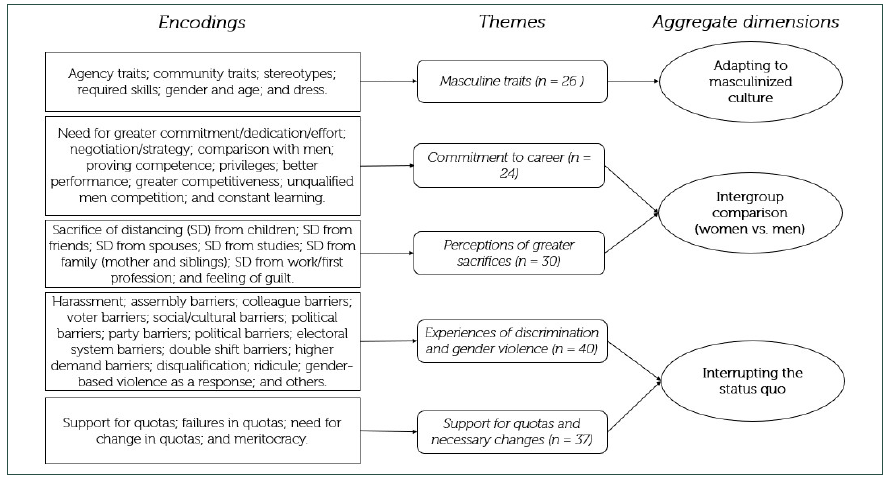 Source: Developed by the authors.
 Source: Developed by the authors.