
 Dissemination of Skin Fashion Among Fortnite Players: An Analysis from the Trickle Phenomenon Perspective
ABSTRACT
Objective: this study aimed to analyze how reference groups influence the diffusion and adoption of skin fashion among Fortnite players from the perspective of the Trickle phenomenon.
Methods: the research employed a netnographic approach. Data were collected through forty-five online interviews and non-participant observations conducted on social media platforms.
Results: the findings revealed factors beyond economic capital that contribute to social distinction, including exclusivity, dedication, loyalty to the game, online visibility, nostalgia, skill, and specialized knowledge. These factors are associated with the Trickle-Down phenomenon, differing from traditional notions of socioeconomic class-based stratification while also signaling the emergence of new elite groups, such as professional players (Pro Players), tryhards, and content creators (YouTubers and streamers). The study also showed that individuals with lower status can influence those with higher prestige, characterizing a Trickle-Up process. Furthermore, evidence of Trickle-Across diffusion was identified in the dissemination of skins.
Conclusions: this research demonstrates how specific reference groups within the gaming context shape the diffusion of skins, extending beyond economic capital and broadening the applicability of the Trickle phenomenon to virtual environments. The findings also provide valuable insights for marketing and game companies seeking to improve their promotional strategies and customer retention efforts.
Keywords:
fashion; trickle; skins
INTRODUCTION
The consumption of digital goods, such as skins, has become an increasingly common practice (Mohr et al., 2022). As avatars function as extensions of the self, skins serve as a means of signaling socially observable identity (Silva, 2025; Silva et al., 2024), enabling processes of comparison, imitation, and differentiation among players. The consumption of these skins is also influenced by social groups that shape consumption practices both within virtual environments and beyond them (Albarello et al., 2021; Carter et al., 2020; King & De La Hera, 2020; Sanderson et al., 2020; Silva, 2025).
These phenomena occur within environments commonly referred to as the metaverse - that is, virtual spaces inhabited by avatars and controlled by individuals in the physical world. Consequently, companies across a wide range of industries have increasingly explored commercial opportunities in these environments, including fashion brands (Joy et al., 2022). A prominent example is Fortnite, where companies such as Balenciaga, Havaianas, DC Comics, Coca-Cola, Nike, and others offer virtual clothing and accessories (skins) through in-game stores.
Developed by Epic Games, Fortnite can be understood as a metaverse environment because it enables social interaction, avatar-based self-representation, ownership of virtual goods, and digital commerce (Joy et al., 2022). The game features several gameplay modes, the most popular being Battle Royale. In this mode, one hundred avatars are placed in a digital environment where the objective is to survive by employing a variety of strategies (King & De La Hera, 2020).
In Fortnite, skins constitute the avatar's appearance and were not designed to enhance players' performance (King & De La Hera, 2020). Nevertheless, 68% of users spend money on in-game purchases in Fortnite (Li et al., 2020). This scenario raises questions about how social distinction and hierarchy are structured in an environment where the functional performance of clothing is not the primary determinant of its value.
Previous literature highlights the need to better understand how individuals behave - both in terms of consumption and social interaction - within metaverse environments (Joy et al., 2022; Silva et al., 2024; Silva, 2025). Among the motivations for purchasing skins, functionality has been identified as an important factor, since certain skins - particularly those with smaller silhouettes and more subdued colors - may facilitate camouflage during gameplay (Pereira et al., 2024). Other motivations are associated with the influence of reference groups, including parents, online friends, offline friends (Albarello et al., 2021), and streamers and YouTubers (Carter et al., 2020; King & De La Hera, 2020; Sanderson et al., 2020).
Reference groups are individuals who influence the choices of others (Kemper, 2011), including clothing choices through status-power relationships. The study of reference groups contributes to understanding social distinction across social strata through processes of symbolic competition (Bourdieu, 2010). Comparative processes among reference groups shape the adoption and diffusion of fashion, a dynamic explained by Trickle theory, encompassing the Trickle-Down, Trickle-Up, and Trickle-Across models (Field, 1970; King, 1973; Robinson, 1973; Simmel, 2020; Veblen, 2018).
Previous research has shown that the Trickle phenomenon explains fashion consumption behavior in the physical world (Atik & Fırat, 2013; Mohr et al., 2022), including dimensions that extend beyond economic capital by emphasizing lifestyle-related factors (Eckhardt & Bardhi, 2020; McCracken, 2000). Likewise, the literature on skin consumption demonstrates that these digital goods express users' identities and are influenced by social groups (Carter et al., 2020; King & De La Hera, 2020; Sanderson et al., 2020). However, it remains unclear how the diffusion and adoption of skins occur through interactions among reference groups or how status-power dynamics are structured within these virtual environments.
Accordingly, this study aimed to analyze how reference groups influence the diffusion and adoption of skin fashion among Fortnite players from the perspective of the Trickle phenomenon. It builds on the contemporary view that such groups are not necessarily structured around economic capital but rather around other forms of capital associated with lifestyle.
By investigating who these influential actors are and how status-power dynamics are established, this study seeks to make theoretical contributions by extending fashion diffusion theories to virtual environments. It also provides strategic insights for marketing and game companies seeking to improve their promotional strategies and customer retention efforts. In digital environments, the logic of the Trickle phenomenon is reconfigured by forms of capital that transcend economic resources.
The remainder of this article is organized as follows. The next section presents the theoretical background, followed by the methodological procedures, the results, and, finally, the concluding remarks.
THEORETICAL BACKGROUND
The theoretical background integrates Bourdieu's field theory (social structure and distinction), Trickle theory, and the dynamics of digital platforms (algorithmic mediation and social influence), conceptualizing skins as symbolic goods involved in the construction of identity and social status.
Symbolic Consumption on Digital Platforms
In digital contexts, skins can be understood as symbolic goods that perform multiple functions. Beyond their aesthetic appeal, they signal identity, group belonging, and social distinction (Li et al., 2020; King & De La Hera, 2020).
Skins enable individuals to differentiate themselves within gaming communities. Their symbolic value is often constructed through mechanisms of scarcity, such as limited-edition items and time-restricted availability, which intensify consumer desire (Pereira et al., 2024). Moreover, skins communicate players' trajectories over time. For example, items acquired during previous seasons or exclusive in-game events (Sharma, 2024) become symbols of experience, commitment, and superiority. Consequently, skin consumption encompasses temporal, social, and symbolic dimensions.
Some players also attribute strategic advantages to particular skins based on their visual characteristics. For instance, skins with smaller silhouettes or more subdued colors may facilitate camouflage during gameplay, reinforcing their association with cultural capital and gaming skill (Pereira et al., 2024; Sharma, 2024). Thus, skins function both as markers of symbolic distinction and as instruments of performance.
In online platform-mediated environments, these processes are intensified through real-time social interaction. Many of these environments - including Fortnite - can be understood as metaverse spaces in which the avatar represents an extension of the self (Carter et al., 2020; King & De La Hera, 2020; Sanderson et al., 2020). Within this context, skins operate as symbolic goods that simultaneously express identity, distinction, and social recognition (Sharma, 2024; Silva, 2025; Silva et al., 2024).
Classical consumer research has long recognized the symbolic role of goods, emphasizing their function in the construction of cultural meanings (McCracken, 2000). However, the emergence of digital platforms has introduced new dynamics to this phenomenon, particularly those associated with algorithmic mediation (Airoldi & Rokka, 2022), the attention economy (Faucher, 2014), and the growing centrality of digital intermediaries (Nielsen & Ganter, 2018).
Within these environments, visibility becomes a contested resource that is transformed into forms of prestige and social recognition. Accordingly, the attention economy (Davenport & Beck, 2001) provides an important analytical lens for understanding contemporary consumption dynamics, as algorithmically mediated attention increasingly determines which practices, styles, and digital goods gain visibility and, consequently, legitimacy within online communities.
Furthermore, digital influencers and content creators have emerged as new cultural intermediaries (Eckhardt & Bardhi, 2020; Nielsen & Ganter, 2018), acting as curators, legitimizers, and disseminators of cultural meanings. These actors perform functions similar to those described by McCracken (2000), but within a platform-based logic in which algorithms and engagement metrics shape their capacity to influence audiences.
Structure and Distinction: The Field as an Analytical Lens
To enhance the understanding of how symbolic consumption is organized in digital environments, this study draws on Bourdieu's field theory. A field is understood as a social space in which agents and institutions compete for positions, resources, and recognition. Within this space, different forms of capital - economic, social, cultural, and symbolic - are accumulated, structuring hierarchies and power dynamics (Bourdieu, 2010, 2025).
In the context of Fortnite, the game can be understood as a relational field in which players interact, compete, and construct meanings that circulate both within the platform and beyond it, including social media and offline settings (King & De La Hera, 2020; Silva, 2025). Within this field, the forms of capital that enable social distinction assume context-specific manifestations. Economic capital is reflected in the ability to purchase paid virtual items (Li et al., 2020); cultural capital is associated with gaming skill and mastery (Pereira et al., 2024); social capital emerges from players' networks of interaction (Carter et al., 2020; Sanderson et al., 2020); and symbolic capital corresponds to the social recognition granted by the gaming community.
The interplay among these forms of capital enables individuals to attain prestige within the field. For example, acquiring rare skins (economic capital) may be converted into social recognition (symbolic capital), while high levels of gameplay skill (cultural capital) can generate visibility and reputation, thereby strengthening social capital. Accordingly, the consumption of digital goods can be understood as a mechanism through which social distinction, community legitimation, and hierarchical positioning are produced and maintained.
It is important to distinguish several concepts that are frequently used in the existing literature - including status, prestige, visibility, and skill (Joy et al., 2022; King & De La Hera, 2020; Pereira et al., 2024) - as they refer to different dimensions. Status refers to an individual's social standing within a community; prestige denotes the symbolic value attributed to that individual; visibility concerns the degree of public exposure and audience reach; and skill refers to a player's competence and performance in achieving the objectives of the game.
Diffusion and Symbolic Circulation: Revisiting Trickle Theory
Social influence shapes fashion adoption and diffusion through comparative processes based on reference groups (Simmel, 2020). Certain individuals influence the choices and behaviors of others through real or perceived status-power relationships (Kemper, 2011). Within this framework, fashion adoption and diffusion may occur through either hierarchical or horizontal structures. Accordingly, Trickle theory comprises three complementary mechanisms: Trickle-Down, Trickle-Up, and Trickle-Across.
The Trickle-Down model assumes a hierarchical flow in which lower-status groups adopt the practices and styles of higher-status groups through processes of emulation. Such dynamics may also communicate signals of wealth and social position to observers (Simmel, 2020; Um et al., 2024; Veblen, 2018). A traditional example is found in fashion weeks, where access is generally restricted to the media and individuals occupying prestigious social positions.
In contrast, the Trickle-Up model (Field, 1970) describes the reverse movement, whereby cultural elements originate among lower-status groups and are subsequently appropriated by more prestigious ones. In this process, an opinion leader identifies a trend emerging among lower-status groups and introduces it to higher-status audiences, thereby accelerating its diffusion within those groups. Examples include the popularization of activewear, inspired by streetwear and gym culture (Mohr et al., 2022), as well as trends initiated by micro-influencers that are later adopted by audiences with greater social prestige.
The Trickle-Across model (King, 1973; Robinson, 1973), in turn, proposes that fashion diffuses horizontally and simultaneously across different social groups. In contemporary society, this process has been reinforced by the internet, mass communication, promotional strategies, and greater consumer accessibility. The fast-fashion industry illustrates this mechanism, as designers rapidly translate luxury runway trends into products aimed at broader consumer markets (Mohr et al., 2022).
Despite its widespread use, Trickle theory has been criticized for oversimplifying social dynamics and placing excessive emphasis on social class structures (Eckhardt & Bardhi, 2020; Lipovetsky, 2009). Contemporary studies argue that the diffusion of symbolic goods occurs through more complex networks mediated by multiple factors, including lifestyle, media, and digital culture (Eckhardt & Bardhi, 2020; McCracken, 2000; Wills et al., 2024).
These critiques and recent theoretical developments do not invalidate the core assumptions of Trickle theory. Rather, they suggest that its mechanisms should be reinterpreted to account for contemporary forms of consumption (Atik & Fırat, 2013; Bonneau & Aroles, 2021; Mohr et al., 2022). Nevertheless, research on Trickle theory has yet to adequately examine consumption behaviors shaped by the internet, social media, and avatar fashion within metaverse environments (Wills et al., 2024).
It is important to emphasize that Trickle theory is conceived here as a mechanism of symbolic circulation operating within a field rather than as a theory explaining social structure itself. While Bourdieu (2010, 2025) provides the conceptual framework for understanding how positions and hierarchies are structured, Trickle theory explains how fashion circulates among different groups within that field, thereby accounting for its adoption and diffusion.
Finally, it is important to distinguish between the concepts of diffusion and adoption in the context of fashion. Diffusion refers to the process through which symbolic elements circulate across social groups, whereas adoption occurs at the individual level, when a person decides to incorporate a particular style or symbolic good into their own consumption practices (Lipovetsky, 2009; Reilly, 2021).
METHODOLOGY
This study forms part of a broader research project and adopted a qualitative approach, operationalized through netnography (Kozinets, 2014), combined with online interviews and non-participant observation. This methodological choice is justified by the nature of the phenomenon under investigation - consumption practices in digital environments - which requires an in-depth understanding of online interactions, meanings, and sociocultural dynamics. The netnographic study was conducted with a moderate level of researcher immersion, involving longitudinal observation between August 2023 and July 2024.
Throughout the study, the researcher assumed the role of a non-participant observer, refraining from intervening in group dynamics in order to preserve the naturalness of participants' interactions. Ethical procedures included the anonymization of participants and respect for the public nature of the online settings observed.
The research design was organized into sequential stages (Figure 1). This strategy enabled data collection from multiple sources, thereby supporting methodological triangulation.

Netnography was conducted in five sequential stages: (1) definition of the empirical field and selection of digital materials, with Fortnite chosen due to its contemporary relevance and popularity among young adults (Albarello et al., 2021; King & De La Hera, 2020); (2) initial data collection through non-participant observation to gain familiarity with the characteristics and dynamics of the selected field, as recommended by Kozinets (2014); (3) in-depth data collection, involving online interviews with YouTubers, streamers, and Fortnite players; (4) organization and preparation of the empirical material, including field notes and interview transcripts; and (5) data analysis, conducted using content analysis (Bardin, 2016).
The selection of digital settings was based on their relevance and popularity among Fortnite players, focusing on active Portuguese-language communities. Non-participant observations were conducted on Facebook, WhatsApp, and YouTube, as these platforms are widely used by the game's community. YouTuber and streamer channels were identified through keyword searches on YouTube, and those selected met two criteria: recent activity and substantial audience engagement, defined as at least one million subscribers. Non-participant observation was conducted across thirteen YouTube channels, involving the examination of published content, videos, and user comments. In addition, seven Facebook and WhatsApp groups were identified through keyword searches on Facebook. Interactions within these communities were systematically observed and documented through field notes.
All participants in the online interviews were over eighteen years of age. YouTubers and streamers were invited to participate via email and Instagram, and interviews were conducted with all those who agreed to participate (Table 1). Fortnite players were recruited from Facebook groups dedicated to the game through voluntary and random participation (Table 2). This recruitment strategy introduces a self-selection bias, with a predominance of participants who were more actively engaged in the Fortnite community. This limitation is acknowledged and considered in the interpretation of the findings.
Table 2 presents the demographic and profile characteristics of the Fortnite players interviewed during the data collection phase.
The interviews were conducted using a semi-structured interview guide developed from the literature on symbolic consumption, reference groups, and Trickle dynamics. The instrument was organized into three sections: (1) participant profile; (2) consumption practices in Fortnite; and (3) processes of socialization and imitation, allowing the exploration of both descriptive and interpretive dimensions of the phenomenon. All participants provided informed consent prior to participation, and the study was approved by the institution’s Research Ethics Committee (REC) (Protocol No. 72879323.0.0000.0104).
With regard to data saturation, thematic recurrence among Fortnite players became evident after the twenty-fourth interview (USER24). However, saturation was not achieved within the subgroup of YouTubers and streamers (Table 1) due to the difficulty of gaining access to these participants. Given this limitation, the study does not seek to generalize findings concerning this subgroup. Instead, their accounts are used to complement and enrich the interpretation of the findings rather than serving as the primary basis for inference.
The empirical material - including field notes and interview transcripts - was analyzed using content analysis (Bardin, 2016), supported by the Atlas.ti software. The analytical process comprised the stages of pre-analysis, open coding, category development, and interpretation, the results of which are presented in Tables 3, 4, and 5.
Initially, the theoretical categories associated with Trickle dynamics (Trickle-Down, Trickle-Up, and Trickle-Across) were used as a guiding framework for the analysis, as previous studies suggest that these mechanisms remain applicable in contemporary consumption contexts (Atik & Fırat, 2013; Bonneau & Aroles, 2021; Mohr et al., 2022). However, the analysis adopted a reflexive and inductive stance, allowing additional units of analysis - particularly reference groups - to emerge from the empirical data. Previous studies have identified parents, online friends, offline friends, and YouTubers/streamers as the principal reference groups influencing Fortnite players (Carter et al., 2020; King & De La Hera, 2020; Sanderson et al., 2020). Nevertheless, the present study identified additional groups, such as Pro Players and Tryhards, highlighting the exploratory nature of these emergent categories.
The triangulation of non-participant observations and online interviews enhanced the analytical rigor of the study by enabling the complementary use of multiple data sources. Non-participant observations primarily contributed to understanding the dynamics of the game and familiarizing the researcher with participants' language and patterns of interaction. However, the majority of the empirical evidence underpinning the findings was derived from the online interviews. Additionally, social class data based on the Brazilian Economic Classification Criterion (ABEP, 2022) were used as contextual information, allowing traditional socioeconomic classifications to be contrasted with alternative forms of social distinction operating within digital environments.
RESULTS
Data collection involved Fortnite players who predominantly belonged to the middle socioeconomic class (Table 2). This profile is associated with the technological requirements for accessing the game, including relatively expensive devices and reliable internet connectivity, which create higher barriers to entry than games that are readily accessible via smartphones. Consistent with this finding, none of the participants reported playing Fortnite on a smartphone.
Trickle down
With respect to Trickle-Down dynamics, the adoption of skins associated with celebrities and characters admired by the gaming community (e.g., Travis Scott, Lady Gaga, John Wick, and Solid Snake) reflects players' desire to emulate the aesthetics and behaviors of these figures (Pereira et al., 2024). The prestige associated with celebrities motivates consumers to adopt fashion elements that are consistent with prevailing sociocultural contexts (Lipovetsky, 2009), thereby expressing identification with and loyalty to these symbolic figures (Kemper, 2011).
The public display of skin collections, purchase decisions, and skin reviews by YouTubers and streamers establishes consumption patterns and fashion trends that are subsequently imitated by the broader community. This finding emerged from both social media observations and interview accounts provided by players. For example, the use of the Default¹ skin by a particular streamer motivated many community members to imitate this choice, attributing new symbolic meaning to an otherwise ordinary cosmetic item. Notably, this streamer was also recognized as a Tryhard², reinforcing the role of high-status content creators in legitimizing consumption practices. These findings suggest that digital influencers act as influential cultural intermediaries within gaming communities (Nielsen & Ganter, 2018).
Within the Fortnite ecosystem, YouTubers and streamers serve as agents of aesthetic validation through activities such as contests to select the ‘best skin.’ Evidence of this practice emerged primarily from non-participant observations conducted on social media platforms. These findings indicate the coexistence of Trickle-Up and Trickle-Down dynamics, as skins submitted by players are selected and endorsed by YouTubers and streamers, and the resulting content is subsequently shared online. This process increases the desirability of these items and encourages their widespread adoption, as recognition by influential figures may evoke admiration and social envy among community members (Um et al., 2024; Veblen, 2018).
The organization of coordinated community campaigns encouraging viewers to use the same skin throughout a game season provides further evidence of imitation processes shaped by the influence of YouTubers and streamers, fostering a sense of group belonging (Simmel, 2020). This phenomenon was observed during the analysis of YouTube videos conducted in the initial phase of data collection.
Within the Fortnite ecosystem, YouTubers and streamers serve as agents of aesthetic validation through activities such as contests to select the ‘best skin.’ Evidence of this practice emerged primarily from non-participant observations conducted on social media platforms. These findings indicate the coexistence of Trickle-Up and Trickle-Down dynamics, as skins submitted by players are selected and endorsed by these influential content creators, whose content is subsequently disseminated online. This process increases the desirability of these items and encourages their widespread adoption, as recognition by influential figures may evoke admiration and social envy among community members (Um et al., 2024; Veblen, 2018).
The influence of YouTubers and streamers also extends to behavioral practices, such as demonstrating strategies for deceiving ‘simps’ (gados³) into sending skins as gifts. These practices are used to generate content for their channels and are subsequently imitated by members of the gaming community. This represents an opportunistic practice mediated by social interactions. Thus, influential Fortnite content creators stand out not only because of their visibility but also because of their specialized knowledge of the game, even when that expertise is associated with controversial practices.
Trickle-Down dynamics were also observed among lower-status community members (novice players), who imitate the skins used by Tryhards. In this case, imitation is driven by admiration and social envy and can be understood as a strategy for symbolic social advancement, even though these players do not actually attain Tryhard status. Unlike the original formulation of Trickle theory, this process is not associated with socioeconomic class or wealth, but rather with the value attributed to skill and dedication, representing an adaptation of the theory to the context of skin consumption. Tryhards invest considerable time and effort in improving their performance and may eventually become Pro Players⁴. Their symbolic relevance is further reinforced through appearances on YouTubers' and streamers' channels, increasing both their visibility and the diffusion of their consumption practices throughout the gaming community (Airoldi & Rokka, 2022).
Pro Players play a central role in Trickle-Down dynamics, emerging as the most influential reference group within the Fortnite community. Players closely observe and imitate their skin choices because of their online visibility, exceptional skill, and dedication to the game. In practice, adopting skins associated with Pro Players may also serve a strategic function by intimidating opponents, particularly those with lower levels of skill.
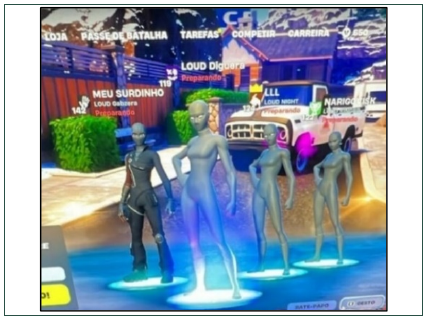
Playing as a team while using coordinated skins or identical cosmetic items is a common practice among Pro Players (see Figure 2 - Polarity skin), reinforcing the pursuit of optimal in-game performance. This practice is subsequently imitated by members of the broader gaming community during matches with friends. The symbolic relevance of Pro Players is further reinforced when the items they use are featured on YouTubers' and streamers' channels, increasing both the visibility of their consumption practices and players' perceived proximity to these influential figures (Davenport & Beck, 2001; Faucher, 2014).

Pro Players also influence the consumption practices of Tryhards who aspire to become professional players. From an aesthetic perspective, the items associated with Pro Players are perceived as facilitating skill development and in-game performance; symbolically, they represent dedication and commitment to the game. This process is further intensified by the appeal of Pro Players' online visibility and status, as this social position enables them to pursue full-time careers as online content creators and professional gamers, often supported by sponsorships and brand partnerships.
Further evidence of Trickle-Down dynamics emerged from the distinction between two subgroups within the online Fortnite community: novice and veteran players. The use of older and rarer skins constitutes a valued consumption practice among veteran players. Previous research has shown that rarity is highly valued by players (Pereira et al., 2024), as it symbolizes exclusivity, dedication, and long-term commitment to the game. Conversely, novice players often seek to avoid revealing their inexperience by refraining from using free, newly released, or Default skins. Instead, they adopt skins associated with veteran players as a means of signaling positive symbolic attributes. This practice is facilitated through resale transactions conducted on social media platforms, particularly within WhatsApp and Facebook groups, where such exchanges were frequently observed during fieldwork.
Finally, some players were found to collect fashion items, a practice that generates envy among friends who consume skins less frequently (Veblen, 2018) while simultaneously conferring social prestige through the accumulation of possessions. In this context, imitation functions as an attempt to achieve social parity, surpass others, or secure a sense of belonging within the gaming community.
Table 3 summarizes the findings related to Trickle-Down dynamics and presents the excerpts from the online interviews that most clearly illustrate this phenomenon, as this data source provided the richest empirical evidence supporting the analysis.
Therefore, only one form of social distinction was found to be directly associated with the volume of possessions - namely, players who collect skins and invest substantial financial resources to maintain this consumption pattern. However, several other factors were found to evoke social envy and, consequently, the desire for imitation, including exclusivity, dedication, loyalty to the game, online visibility, nostalgia, skill, and specialized knowledge.
The following subsection examines Trickle-Up dynamics.
Trickle Up
Members of the gaming community frequently recommend fashion items to YouTubers and streamers during gameplay sessions, as these content creators often play alongside their followers. This interaction reflects Trickle-Up dynamics (Field, 1970), whereby the preferences of players with relatively low social status gain visibility and become legitimized once adopted by influential figures (Airoldi & Rokka, 2022).
This process is further reinforced through the ongoing interaction between followers and YouTubers and streamers, particularly through the sharing of skin preferences and community challenges designed to identify the ‘best skin.’ Given the extensive range of customization options available in Fortnite, these recommendations illustrate Trickle-Up dynamics operating alongside Trickle-Down processes, highlighting the gaming community's active role in the co-creation of fashion trends.
Furthermore, Pro Players and Tryhards often abandon particular skins once they become widely adopted by the broader community. A notable example is the Default skin, which has been strategically adopted by Tryhards and Pro Players as a means of differentiating themselves from players who imitate their consumption practices. Although the Default skin was initially associated with low-status players, its adoption by influential community members transformed its symbolic meaning, making it a marker of high status, particularly in terms of skill and prestige.
This constant reconfiguration of symbolic value reflects processes of inconspicuous consumption (subtle status signaling) and the flexibility with which players adopt new identities (Eckhardt & Bardhi, 2020).
This constant reconfiguration of symbolic value reflects processes of inconspicuous consumption (subtle status signaling) and the flexibility with which players adopt new identities (Eckhardt & Bardhi, 2020).
Finally, some players belonging to the traditional middle social class deliberately adopt consumption practices typically associated with lower-income players, such as using free skins, the Default skin, or skins received as gifts. This behavior is particularly common among players who engage less intensively with the game, spend less time playing, and use these items as a way of resisting the status-oriented consumption logic associated with rare or paid skins. Some players who adopt this stance even reject the use of rare skins as a means of distancing themselves from prevailing trends (Li et al., 2020; Simmel, 2020; Reilly, 2021). These findings challenge the traditional expectation that greater purchasing power necessarily increases the tendency toward conspicuous displays of possessions (Veblen, 2018).
Table 4 summarizes the findings related to Trickle-Up dynamics.
Evidence of Trickle-Across dynamics was also identified in relation to the consumption of fashion items in Fortnite. The findings are presented below.
Trickle Across
The consumption of skins associated with fashion brands diffuses across player groups regardless of their social characteristics, illustrating the democratization of these consumption practices (Lipovetsky, 2009). This diffusion is facilitated by various consumption strategies, including gifting, the cost savings associated with digital goods compared with physical fashion products, and the purchase of skins from third parties through social media marketplaces at lower prices.
Another finding consistent with Trickle-Across dynamics (King, 1973; Robinson, 1973) concerns the widespread adoption of female skins regardless of players’ gender. This trend is primarily driven by their association with superior in-game performance, as these skins are frequently used by Tryhards and Pro Players. As the use of female skins became increasingly popular, Epic Games responded by expanding the development of this type of cosmetic item. An important exception, however, concerns players who seek anonymity or wish to avoid negative social interactions. For example, some women choose male skins, whereas some men avoid female skins because of traditional gender stereotypes.
Another finding of this study indicates that YouTubers and streamers influence one another's skin consumption practices as they seek inspiration for creating content to share on social media. In contrast, the same pattern was not observed among Pro Players, for whom only limited evidence of peer influence was identified. Among the interview participants, only one respondent (INTER4) had previously been a Pro Player.
Furthermore, there are instances in which the appearance of an opponent influences other players' skin consumption decisions based solely on aesthetic appeal, rather than on status considerations. In these cases, adoption is driven by how visually attractive a skin is, depending on individual perceptions (Daimiel et al., 2022). Observing opponents' skins also enables players to evaluate the item's cost-benefit ratio by considering its price as well as the possible presence of bugs (software errors or glitches).
Fashion trends also spread horizontally among friends through the display of their skin choices, collections, online reviews, and recommendations. In this context, friends refer to players connected through Fortnite's friendship system who maintain regular social interaction. These exchanges stimulate consumption practices, shape individual aesthetic preferences in the absence of a clearly defined hierarchy, and strengthen players' sense of belonging, consistent with the logic of the attention economy (Davenport & Beck, 2001; Faucher, 2014).
This finding is further supported by the common practice of groups of friends playing together while using coordinated skins, which functions both as an in-game strategy and as a mechanism for Trickle-Across diffusion (King, 1973; Robinson, 1973). In addition, competition among friends regarding the ownership of rare or legendary skins (Pereira et al., 2024) encourages peer consumption. Being excluded from a reference group creates a need to restore one's sense of belonging, thereby motivating consumption practices aimed at social reintegration (Kemper, 2011).
During the initial phase of data collection, frequent displays of players' own skin choices - as well as those of their friendship groups - were observed across social media platforms, together with reviews and recommendations of fashion items. These practices contribute to the diffusion of trends and the popularization of particular skins, including female skins and those perceived as offering the best cost-benefit ratio, such as cosmetic items believed to enhance in-game performance while representing good financial value. The sharing of this type of content facilitates the horizontal diffusion of fashion trends regardless of social hierarchy (Mohr et al., 2022).
A finding consistent with this pattern is the resale of skins and player accounts through social media platforms, which expands access to consumption by reducing financial barriers and enabling players to acquire rare items that are no longer available in the game. Another mechanism through which fashion trends spread across player groups is the gifting of skins to friends or even strangers. These peer-to-peer exchanges reinforce players' active participation in the circulation of fashion trends, allowing them to diffuse more democratically across the community (Mohr et al., 2022).
Similarly to female skins, male skins are adopted regardless of the player's gender. This pattern may reflect a broader trend across digital platforms. For example, Aris et al. (2023) found that contemporary fashion consumption increasingly blurs traditional gender boundaries. In this context, the adoption of skins illustrates consumers' willingness to assume new identities in order to satisfy their symbolic and expressive needs (Eckhardt & Bardhi, 2020; Silva, 2025; Silva et al., 2024).
Another finding consistent with Trickle-Across dynamics concerns the diffusion of high-priced skins across players regardless of their income level. At first glance, the consumption of expensive cosmetic items appears to reflect traditional notions of upper social class and conspicuous consumption (Veblen, 2018). However, the findings of this study suggest that such an interpretation is not sufficient, as players employ a variety of strategies that broaden access to these items, including receiving skins as gifts, substituting digital purchases for physical consumption, obtaining financial support from family members, and purchasing skins or accounts from third parties through social media marketplaces at lower prices.
Likewise, free or low-cost skins are adopted by a wide range of players, including those with relatively high purchasing power, particularly individuals who are less engaged with the game or who embrace anti-fashion practices by deliberately avoiding popular items (Li et al., 2020; Simmel, 2020). The Default skin exemplifies this phenomenon, as it carries multiple symbolic meanings depending on the social context - from novice players to Pro Players and Tryhards. The interpretation of these symbolic meanings depends on the circumstances in which the skin is used, including players’ behavior, their social interactions, and the communities to which they belong.
Table 5. Summarizes the findings related to Trickle-Across dynamics and presents illustrative excerpts from the online interviews.
Figure 3 presents a conceptual framework summarizing the reference groups and the Trickle-Down (green), Trickle-Up (red), and Trickle-Across (blue) dynamics identified in this study. The framework should be interpreted in conjunction with Tables 3, 4, and 5, which provide the empirical evidence synthesized in the figure. It also highlights the key factors underlying these diffusion processes, as derived from the findings presented in the three tables.

For example, the figure illustrates how Epic Games' development of female skins has contributed to the diffusion of these cosmetic items throughout the gaming community regardless of players' gender, exemplifying Trickle-Across dynamics. Another example concerns low-symbolic-status items, such as the Default skin, which was originally associated with novice players but was subsequently adopted by Pro Players and Tryhards as a strategy of symbolic differentiation, illustrating Trickle-Up dynamics.
In Figure 3, the online gaming community is represented as comprising players with diverse characteristics. This is illustrated through the use of gray connectors, which denote the ‘detailed composition of the online gaming community’, as indicated in the figure legend.
FINAL CONSIDERATIONS
This study investigated how reference groups influence the diffusion and adoption of skin fashion among Fortnite players from the perspective of the Trickle phenomenon. Extending classical theories of fashion diffusion, the findings suggest a reconfiguration of the concept of status, which is no longer determined exclusively by economic capital but is instead constructed through hybrid forms of symbolic capital, including exclusivity, dedication, loyalty to the game, online visibility, nostalgia, skill, and specialized knowledge.
More specifically, these factors can be understood as distinct forms of capital that enable social distinction in digital environments. These include scarcity capital (exclusivity), performative capital (skill and dedication), visibility capital (online prominence), temporal capital (loyalty to the game and accumulated experience), and affective capital (nostalgia). Together, these forms of capital highlight the multidimensional nature of the symbolic resources through which players construct belonging and social distinction via fashion within the investigated digital environment.
Accordingly, the findings indicate that symbolic scarcity - that is, the value attributed to rare, legacy, or prestigious in-game items - can outweigh players' monetary scarcity. The results also show that interactions within online communities continuously reshape the symbolic status of cosmetic items, while digital distinction is primarily constructed through the combination of in-game performance, players' trajectories, and their visibility within the gaming community.
The study's primary theoretical contribution lies in demonstrating that the diffusion and adoption of digital fashion are not organized predominantly around traditional economic hierarchies. Instead, these processes are driven by forms of visibility and social validation mediated by the gaming community. In doing so, the study extends contemporary discussions of Trickle theory by showing how mechanisms of social distinction and imitation are reconfigured in digital environments, where multiple reference groups - notably YouTubers and streamers, Pro Players, and Tryhards - interact with algorithmic dynamics that amplify particular cultural repertoires.
From a managerial perspective, the findings offer practical implications for the digital goods industry. Companies may develop monetization strategies based on historical rarity and controlled scarcity, segment skin collections according to the status archetypes valued by different player communities, and recognize influencers as key legitimizers of symbolic repertoires. Furthermore, the importance attributed to nostalgia and identity suggests opportunities for developing collections with strong symbolic and media appeal, while the existence of secondary marketplaces may provide valuable insights into unmet consumer demand.
This study also has several limitations. First, it is context-specific, focusing on Brazilian players and Portuguese-speaking digital environments, which limits the transferability of the findings to other cultural settings. Second, participants were recruited through voluntary participation, introducing the possibility of self-selection bias toward more highly engaged community members. In addition, theoretical saturation was not achieved among Pro Players or YouTubers and streamers, limiting the depth of the findings regarding these groups. Finally, the qualitative design and the focus on a single game constrain the broader applicability of the results to other digital gaming contexts.
Future research could examine how processes of social distinction operate across different games and digital platforms, as well as explore the conversion of digital capital into economic capital. Additional studies may also investigate the role of algorithms and platform architectures in legitimizing virtual goods, while comparing the symbolic dynamics surrounding purely cosmetic items with those associated with functional in-game advantages. Finally, research focusing on different player profiles - such as Pro Players, novice players, and collectors - may further advance understanding of consumption dynamics in digital gaming environments.
REFERENCES
-
Airoldi, M., & Rokka, J. (2022). Algorithmic consumer culture. Consumption Markets & Culture, 25(5), 411-428. https://doi.org/10.1080/10253866.2022.2084726
» https://doi.org/10.1080/10253866.2022.2084726 -
Albarello, F., Novoa, A., Castro Sanches, M., Velasco, A., Hueyo, M. V. N., Narbais, F. (2021). The social dynamics of multiplayer online videogames in Argentinian and Chilean family contexts: The case of Fortnite. Global Studies of Childhood, 11(4), 302-317. https://doi.org/10.1177%2F20436106211015997
» https://doi.org/10.1177%2F20436106211015997 -
Aris, S., Akhavan, M., & Sabbar, S. (2023).Motivações para Consumir Itens Virtuais Específicos do Avatar na Plataforma Zepeto Gaming. Cadernos de Educação Tecnologia e Sociedade, 16(4), 1248-1258. https://doi.org/10.14571/brajets.v16.n4.1248-1258
» https://doi.org/10.14571/brajets.v16.n4.1248-1258 -
Associação Brasileira de Empresas de Pesquisa. (2022). Brazilian Economic Classification Criterion ABEP. https://www.abep.org/criterio-brasil
» https://www.abep.org/criterio-brasil -
Atik, D., & Fırat, A. F. (2013). Fashion creation and diffusion: The institution of marketing. Journal of Marketing Management, 29(7-8), 836-860. https://doi.org/10.1080/0267257X.2012.729073
» https://doi.org/10.1080/0267257X.2012.729073 - Bardin, L. (2016). Analyse de contenu Presses Universitaires France.
-
Bonneau, C., & Aroles, J. (2021) ‘Digital nomads: A new form of leisure class?’, in Experiencing the New World of Work (pp. 157-177). https://doi.org/10.1017/9781108865814.011
» https://doi.org/10.1017/9781108865814.011 - Bourdieu, P. (2010). Distinction: A Social Critique of the Judgement of Taste Routledge.
- Bourdieu, P. (2025). Microcosmos: Teoria dos campos Editora da Universidade de São Paulo.
-
Carter, M., Moore, K., Mavoa, J., Gaspard, L., & Horst, H. (2020). Children’s perspectives and attitudes towards Fortnite ‘addiction’. Media International Australia, 176(1), 138-151. https://doi.org/10.1177/1329878X20921568
» https://doi.org/10.1177/1329878X20921568 -
Daimiel, G. B., Estrella, E. C. M., & Ormaechea, S. L. (2022). Análisis del uso del advergaming y metaverso en España y México. Revista Latina de Comunicación Social, (80), 155-178. https://doi.org/10.4185/RLCS-2022-1802
» https://doi.org/10.4185/RLCS-2022-1802 - Davenport, T. H., & Beck, J. C. (2001). A economia da atenção: Compreendendo o novo diferencial de valor dos negócios Campus.
-
Eckhardt, G. M., & Bardhi, F. (2020). New dynamics of social status and distinction. Marketing Theory, 20(1), 85-102. https://journals.sagepub.com/doi/10.1177/1470593119856650
» https://journals.sagepub.com/doi/10.1177/1470593119856650 -
Faucher, K. X. (2014). Veblen 2.0: Neoliberal games of social capital and the attention economy as conspicuous consumption. tripleC: Communication, Capitalism & Critique. Open Access Journal for a Global Sustainable Information Society, 12(1), 40-56. https://doi.org/10.31269/triplec.v12i1.530
» https://doi.org/10.31269/triplec.v12i1.530 -
Field, G. A. (1970). The status float phenomenon The upward diffusion of innovation. Business Horizons, 13(4), 45-52. https://doi.org/10.1016/0007-6813(70)90157-6
» https://doi.org/10.1016/0007-6813(70)90157-6 -
Joy, A., Zhu, Y, Peña, C., & Brouard, M. (2022). Digital future of luxury brands: Metaverse, digital fashion, and non-fungible tokens. Strategic Change, 31(3), 337-343. https://doi.org/10.1002/jsc.2502
» https://doi.org/10.1002/jsc.2502 - Kemper, T. D. (2011). Status, power and ritual interaction: A relational reading of Durkheim, Goffman and Collins Ashgate Publishing, Ltd..
-
King, C. W. (1973). A rebuttal to the ‘trickle down’ theory. In G. Wills, D. Midgley, M. Christopher, & R. Hayhurst (Eds.), Fashion marketing: An anthology of viewpoints and perspectives 1st ed. Routledge. https://www.taylorfrancis.com/chapters/edit/10.4324/9781003424208-13/rebuttal-trickle-theory-charles-king
» https://www.taylorfrancis.com/chapters/edit/10.4324/9781003424208-13/rebuttal-trickle-theory-charles-king -
King, R., & De La Hera, T. (2020). Fortnite streamers as influencers: A study on gamers’ perceptions. The Computer Games Journal, 9(4), 349-368. https://doi.org/10.1007/s40869-020-00112-6
» https://doi.org/10.1007/s40869-020-00112-6 - Kozinets, R. V. (2014). Netnography: Doing ethnographic research online Sage Publications.
-
Li, L., Freeman, G., & Wohn, D. Y. (2020). Power in Skin: The interplay of self-presentation, tactical play, and spending in fortnite. In Proceedings of the Annual Symposium on Computer-Human Interaction in Play (pp. 71-80). https://doi.org/10.1145/3410404.3414262
» https://doi.org/10.1145/3410404.3414262 - Lipovetsky, G. (2009). The Empire of Fashion: Dressing Modern Democracy Princeton University Press.
- McCracken, G. D. (2000). Culture and consumption: New approaches to the symbolic character of consumer goods and activities (Vol. 1). Indiana University Press.
-
Mohr, I., Fuxman, L., & Mahmoud, A. B. (2022), “A triple-Trickle theory for sustainable fashion adoption: The rise of a luxury trend”, Journal of Fashion Marketing and Management, 26(4), 640-660. https://doi.org/10.1108/JFMM-03-2021-0060
» https://doi.org/10.1108/JFMM-03-2021-0060 -
Nielsen, R. K., & Ganter, S. A. (2018). Dealing with digital intermediaries: A case study of the relations between publishers and platforms. New Media & Society, 20(4), 1600-1617. https://doi.org/10.1177/1461444817701318
» https://doi.org/10.1177/1461444817701318 -
Pereira, T. C. C., Pepece, O. M. C., Silva, L., & Senra, K. (2024). Moda e jogos eletrônicos imersivos: Um estudo sobre o consumo de skins Projética, 15(2). 1-39. https://doi.org/10.5433/2236-2207.2024.v15.n2.50005
» https://doi.org/10.5433/2236-2207.2024.v15.n2.50005 - Reilly, A. (2021). Introducing fashion theory: From androgyny to zeitgeist Bloomsbury Publishing.
-
Robinson, D. E. (1973). Fashion theory and product design. In G. Wills, D. Midgley, M. Christopher, & R. Hayhurst (Eds.), Fashion marketing: An anthology of viewpoints and perspectives Routledge. https://www.taylorfrancis.com/chapters/edit/10.4324/9781003424208-28/fashion-theory-product-design-dwight-robinson
» https://www.taylorfrancis.com/chapters/edit/10.4324/9781003424208-28/fashion-theory-product-design-dwight-robinson -
Sanderson, J., Browning, B., & DeHay, H. (2020). “It’s the universal language:” Investigating Student-athletes’ use of and motivations for playing fortnite. Journal of Issues in Intercollegiate Athletics, 13(1), 22-44. https://scholarcommons.sc.edu/jiia/vol13/iss1/2/
» https://scholarcommons.sc.edu/jiia/vol13/iss1/2/ -
Sharma, S. (2024). Global trends in virtual luxury: Examining avatar identification, virtual materialism, and status consumption in online gaming. Journal of Global Marketing, 37(4), 282-303. https://doi.org/10.1080/08911762.2024.2375709
» https://doi.org/10.1080/08911762.2024.2375709 -
Silva, J. P. N., Assis, F. A. A., Pedrosa, G., Grutzmann, A., & Rezende, D. C. de. (2024). The experiences of self-extension, archetypes, and motivations in MMORPG online games: An analysis of Brazilian World of Warcraft context. BAR-Brazilian Administration Review, 21(Suppl.), e240110. https://doi.org/10.1590/1807-7692bar2024240110
» https://doi.org/10.1590/1807-7692bar2024240110 - Silva, L. B. A. R. (2025). From pixels to identity: How fashion consumption in metaverse environments constitutes children’s fashion identity [Tese de doutorado]. Universidade Estadual de Maringá, Brasil.
- Simmel, G. (2020). Fashion. In Barnard, M. (2020). Fashion theory: A reader Routledge.
-
Um, H., Ko, E., Minjung, C. (2024). Does luxury fashion shape consumers’ perception differently in the real world versus the metaverse? A comparative study on wearer evaluation. Journal of Business Research, 160, 112-124. https://doi.org/10.1080/10447318.2024.2407688
» https://doi.org/10.1080/10447318.2024.2407688 - Veblen, T. (2018). The theory of the leisure class: An economic study of institutions. Actual Editora.
- Wills, G., Midgley, D., Christopher, M., & Hayhurst, R. (Eds.). (2024). Fashion marketing: An anthology of viewpoints and perspectives Routledge Revivals.
How to cite:
Funding:
Peer Review Report:
Data Availability:
Plagiarism Check:
Peer review:
JEL Code:
1
2
3
4
APPENDIX A - INTERVIEW SCRIPT WITH USERS
Part 1: RESPONDENT CHARACTERIZATIONQuestions
1. How old are you?
2. Where do you live?
3. What is your educational background?
4. What kind of work do you do?
Part 2: UNDERSTANDING CONSUMPTION IN FORTNITEQuestions
5. How much time do you spend playing Fortnite?
6. What is your current career level in Fortnite?
7. When did you start playing Fortnite?
8. How frequently do you purchase skins? How much do you spend?
9. How many skins do you own?
10. What motivates you to purchase skins?
11. Are you satisfied with the skins you own, or would you like to purchase more? Please explain.
12. Which skin best represents you?
• Ask the participant to display the indicated skin.
Part 3: SOCIALIZATION AND IMITATIONQuestions
13. Do you play/have you played Fortnite Creative Mode?
14. If you could create an ideal world within Fortnite, what would it be like?
15. How many friends do you have on Fortnite?
16. Do you maintain friendships with people you met through Fortnite?
17. How do you keep up with Fortnite-related updates and trends?
• Social media, YouTube, Twitch?
18. Do you participate in or engage in discussions within Fortnite groups and communities? Which ones?
19. How do you identify a powerful user in Fortnite? What does this power mean?
20. Has anyone influenced you to purchase skins? Please explain.
21. Can you identify characteristics from the real world in other Fortnite users?
• Social class, gender, age, nationality, popularity?
APPENDIX B - INTERVIEW SCRIPT WITH YOUTUBERS/STREAMERS
Part 1: RESPONDENT CHARACTERIZATIONQuestions
1. How old are you?
2. Where do you live?
3. What is your educational background?
4. What kind of work do you do? (other than content creation)
Part 2: UNDERSTANDING CONSUMPTION IN FORTNITEQuestions
5. How much time do you spend playing Fortnite?
6. What is your current career level in Fortnite?
7. How frequently do you purchase skins? How much do you spend?
8. How many skins do you own?
9. What motivates you to purchase skins?
10. Which skin best represents you?
• Ask the participant to display the indicated skin.
Part 3: SOCIALIZATION AND IMITATIONQuestions
11. How do you interact with your followers?
12. If you could create an ideal world within Fortnite, what would it be like?
13. How do you identify a powerful user in Fortnite? What does this power mean?
14. Has anyone influenced you to purchase skins? Please explain.
15. Can you identify characteristics from the real world in other Fortnite users?
• Social class, gender, age, nationality, popularity?

 Source: Elaborated by the authors.
 Source: Elaborated by the authors. * The author of the Facebook group post included the following caption: ‘My squad is on point - everyone looks like Pro Players.’
 Source: Elaborated by the authors based on the research data (2025).