
 Markets Gone Hybrid: Institutional Complexity and Work Toward Market Hybridization
ABSTRACT
Objective: the goal of this article is to theorize how institutional complexity and work can lead to the hybridization of markets.
Methods: we draw upon a critical and reflexive analysis of institutional complexity and work, as well as the literature on the sociology of markets, to deductively develop a theory of market hybridization.
Results: we theorize that hybrid markets arise when institutional work to define the formal and informal rules and norms underlying economic and social transactions (regulation), the infrastructure and resource allocation (allocation), the actors allowed to participate in market exchanges, the roles performed by them (classification), and the perceived value of goods and services available in the marketplace (evaluation) are shaped by non-economic or commercial logics, that is, by increased institutional complexity.
Conclusions: by identifying the socio-symbolic mechanisms that organizations and social actors use to promote market hybridization, we contribute to the much-needed in-depth understanding of how environmental, social, and cultural logic can lead to market hybridization through the market’s four comprising elements: regulation, allocation, classification, and evaluation.
Keywords:
hybrid markets; sociology of markets; institutional complexity; institutional work; market hybridization
“In our society, and most other modern societies, markets in which people exchange goods for money play a very important role. But markets do not operate in a social vacuum; they are part of a wider framework of social institutions. And they operate with many externalities: that is to say, many consequences of the actions taken in market economies are not fully incorporated in market prices.”
Herbert A. Simon, Reason in Human Affairs, 1983.
INTRODUCTION
The society we used to live in until the turn of the millennium, in which different institutions such as the state, markets, families, and religion had well-defined roles and functions operating under their own specific logics (Friedland & Alford, 1991; Thornton et al., 2012), have been shifting toward a reality in which institutional boundaries, roles, and functions are becoming increasingly intertwined. Through the study of such institutions, defined as sets of “regulative, normative, and cultural-cognitive elements that, together with associated activities and resources, provide stability and meaning to social life” (Scott, 2013, p. 56), different streams of ‘institutionalism’1 have focused on understanding how these institutions determine the way society establishes and maintains social order and how organizations within the society would be structured and operate in order to be deemed as legitimate and survive. In particular, organizational institutionalism “shifted away from institutional homogeneity to the prevalence and co-existence of multiple institutional logics and institutional pluralism” (Ocasio & Gai, 2020, p. 264).
In this regard, the mutual influence of this multiplicity of institutional pressures in organizations, markets, and institutions has been labeled as institutional complexity (Greenwood et al., 2011; Micelotta et al., 2017). However, even though institutional complexity has developed to become a prominent literature within organizational institutionalism, Hampel et al.’s (2017) show that institutional complexity research still presents concerning blind spots. For example, the authors argue that (a) current literature “tend[s] to ignore how actors purposefully and skillfully affect the meaning and status of major institutions”; (b) institutional complexity “prioritized field- and organization-specific institutions rather than institutions that cut across fields”; (c) we know little “about the work needed to marshal support from actors in different fields, who may have vastly different goals and occupy very different roles” (pp. 572-575), that is, the focus is narrowed in homogenous sets of actors; and (d) we also have limited knowledge about the work of actors when negotiating formal and informal institutional standards.
To address these gaps, our article extrapolates organizational-level analyses to understand how institutional complexity can influence one of the central institutions of modern society (Beckert, 2009; Friedland & Alford, 1991; Thornton et al., 2012): markets. Markets, which are defined as broader social constructions of formal and informal rules of patterned exchange between buyers, sellers, consumers, governments, and workers (Aspers, 2022; Fligstein & Calder, 2015), are considered stable and perennial institutions. And as such, they have been the dominant institutional order regulating economic exchanges. As Ocasio and Gai (2020) show, the “market order includes financial and business institutions, which encompasses not only individual firms, but also supra-organizations like the various stock exchanges as well as not-for-profit organizations” (p. 267). However, we argue that the ongoing transition of society toward the increased concern with environmental and social issues has pressured markets to embed such logics into economic transactions (Buchanan et al., 2023). Such movements led to the emergence of the phenomenon of hybrid markets, which are yet to be explained by extant literature.
We thus propose to tackle these shortcomings by analyzing how institutional complexity influence markets as an institution. To do so, first, we rely on the economic sociology and sociology of markets literature (Fligstein & Calder, 2015; Lie, 1997; White, 1981) to understand what are the key elements of markets and how market transactions are regulated. In this regard, we propose that markets are institutional arenas of negotiated interests, where the rules of exchange and the norms underlying social and economic transactions (regulation), the resource allocation and market infrastructure, as well as the roles played by market actors (classification) and how they are evaluated by the audience, are socially constructed (Fligstein & Dauter, 2007; Fligstein & McAdam, 2012).
Furthermore, as McKague et al. (2015) suggest, “scholars who take seriously the concept of embeddedness view markets as inherently hybridized” (p. 1087). However, we argue that research in both institutional theory and economic sociology has neglected the phenomenon of hybridization (that is, the embeddedness of markets in multiple and complex institutional settings) in a market-level analysis. Institutional analysts have been limiting their scope to the organizational-level analysis of complexity, specifically with regard to hybrid organizations (Battilana et al., 2017; Smith & Besharov, 2019). Despite recent efforts to research hybridization at higher levels of analysis, such as field and logic level (Fan & Zietsma, 2017; York et al., 2016), markets are yet to be considered a locus of analysis of hybridization under institutional lenses. It is also worthy of note that economic sociology and sociology of markets have yet to give more than just scant attention to hybrid markets (Beckert, 2009).
Thus, we ask: how institutional complexity and work can lead to the hybridization of existing contemporary markets or the emergence of hybrid markets? To answer this question, we theorize on what are the sources of institutional pressure (endogenous or exogenous) (Zietsma & Lawrence, 2010) to hybridize the four core elements of markets (regulation, allocation, classification, and evaluation) and what are the outcomes of such pressure (hybrid market creation, change, and disruption). Finally, we delve into institutional work literature (Lawrence et al., 2011; Lawrence et al., 2013) to explain how both market insiders and outsiders use social-symbolic objects (Hampel et al., 2017; Lawrence & Phillips, 2019) to enact hybridizing work.
We contribute to the organizational theory and sociology of market literatures. In the former, we add to the contemporary discussions on institutional complexity and institutional work, while in the latter we contribute by contrasting to a dominant static view of markets. We provide in-depth understanding of the conflicts, changes, and evolution that can occur during ongoing market dynamics, considering not only the economic realm on market transactions, but environmental, social, and cultural aspects that can lead to market hybridization in the four comprising elements of markets: regulation, resource and infrastructure allocation, classification, and evaluation.
This article is structured as follows. First, we discuss how the concept of markets has evolved historically in the sociology of markets literature and propose an alternative definition that allows us to understand the process of market hybridization. Second, we discuss the institutional context of markets, explaining how institutional complexity and institutional work can help explain market dynamics. Third, we propose a shift in the analysis of hybridization processes from an organizational level to the market level. Fourth, we disentangle the process of market hybridization, explaining why, when, and how markets hybridize. Finally, we conclude by presenting our article’s contributions, limitations, and possible research opportunities on hybrid markets and market hybridization.
THE DEFINING ELEMENTS OF MARKETS
Defining the boundaries of the concept of markets, that is the raison d’être of sociology of markets, is essential for understanding its nature as a central societal institution. Historically, the delimitation of markets considered only its role structures, especially concerning competition, suppliers, and buyers (White, 1981). As the field evolved, sociologists started to consider markets as broader social constructions of formal and informal rules of patterned exchange between buyers, sellers, consumers, governments, and workers (Aspers, 2022; Fligstein & Calder, 2015). Furthermore, scholars noticed that markets require certain resource and institutional infrastructure ‘allocation’ where the exchange takes place under the norms, rules, and shared beliefs that are socially negotiated (Hinings et al., 2017; Lee et al., 2018; Nascimento & Sacomano Neto, 2024).
Moreover, Beckert (2009) defines markets as arenas of social interaction comprising social structures and institutional orders, in which actors face three central coordination problems as sources of uncertainty: the value, the cooperation, and the competition problem. The value problem arises from the audience’s constitution of preferences, that is, it informs how the demand side of markets perceives the value of service or product offerings. Through this ‘evaluation’ process, thus, given institutionalized standards are adopted for ascribing value to market offerings (Aspers, 2018; Fligstein, 2001). As Aspers (2018) suggests, in the absence of objective standards or rankings, audiences assume the role of assessment of what is ‘good’ and ‘bad,’ and the evaluated (market actors) ‘fight out’ for reducing uncertainty and being perceived as valuable by the audience. These contests stem from a mutual adjustment instead of a consequence of intentional actions.
The second central coordination problem is cooperation. As suggested by M. Weber (1978), markets must be considered a form of social action, and as such, firms engaging in market exchanges deal with the difficulty “to establish their exchange partners’ intentions to abide by their agreements” (Przepiorka & Aksoy, 2021, p. 1576). Thus, the extent of cooperation between buyers, suppliers, and competitors, as well as the social risk of defection and the forms of sanctioning opportunistic behaviors, have been central to understanding how markets are socially organized (Beckert, 2009).
The third coordination problem is competition. In this regard, competition problems are inherent to the market constitution, as for without competition and exchange, markets cannot exist (M. Weber, 1978). Furthermore, organizations compete in the marketplace not only in terms of price (Bååth, 2023) but for advantageous status positions (Podolny, 1993), for access to scarce resource and information (Burt, 1992), and for authority, power, and control (Wolfmayr, 2024). A central element of the competition problem is accurately defining who the competition is. To sort this problem out, firms rely on ‘classification’ processes that enable them “to identify a set of rivals, providing an important social structural element that stabilizes markets” (Lounsbury & Rao, 2004, p. 970).
Finally, considering that “without government monetary systems, legal frameworks for incorporation, and laws governing exchange, the world would have not markets as such” (Dobbin & Dowd, 1997, p. 524), we argue that there is a need to consider a fourth central coordination problem, that is, the ‘regulation’ problem. Over the last two centuries, the escalation of economic and social regulations over industrial activities, as well as later waves of neoliberalism (Amengual & Bartley, 2022; Schneiberg & Bartley, 2008), has become a matter of concern for organizational scholars. Thus, the paradox regarding the extent to which an economic activity should or should not be regulated has never reached a consensual status, especially considering contemporary trends toward the globalization and transnationalism (see Nascimento & Sacomano Neto, 2024, for an example on the regulation of credit rating agencies in international financial markets).
Neoliberalist economists defended a self-regulated laissez-faire market, and as a consequence, we witnessed an ‘unqualified deregulation,’ in which “[e]conomists had joined consumer advocates to delegitimate economic regulation in the United States, and then joined with international organizations to spread the gospel of markets, privatization, liberalization, and shock therapy” (Schneiberg & Bartley, 2008, p. 36). Moreover, as advised in the early years of the 20th century, purely free markets are an abomination to market ethics (cf. M. Weber, 1978), and research have shown that such underregulation led to critical consequences, as manifested in the subprime mortgage crisis in the U.S. financial markets in 2008 (Mizruchi, 2010). On the other end of the spectrum, overregulation was also found to be harmful and could be seen as an impediment to competitiveness, efficiency, and growth (Schneiberg & Bartley, 2008). For example, U.S. Food and Drug Administration (FDA) overregulation over the biopharmaceutical industry have negatively affected early responses to the global COVID-19 pandemic (Fuleihan, 2022).
Considering the coordination mechanisms discussed above, we formally define markets as institutional arenas of negotiated interests, in which actors might socially define the rules and norms underlying the economic and social transactions (‘regulation’), the infrastructure and resource ‘allocation’ necessary for the functioning of the market, the roles played by each actor in the market (‘classification’), and the perception of value (‘evaluation’) of the goods and services that are going to be produced and traded in the marketplace.
THE INSTITUTIONAL CONTEXT OF MARKETS: COMPLEXITY AND WORK
Adopting institutional theory for analyzing markets was central to the transition from an economy-centric approach toward the development of the sociology of markets as a field. The first movement that led to such a transition was the understanding that markets, “while often not considered part of the cultural sphere, are directly shaped by culture and social structure” (Thornton et al., 2012, p. 11). The second element was the increased influence of organizational institutionalism in the sociology of markets (Nedzhvetskaya & Fligstein, 2020). In this regard, markets are intertwined with distinct “groupings of interrelated institutions, characterized as institutional orders” (p. 267). Consequently, market organizations are embedded within these distinct institutional orders, and as Nedzhvetskaya and Fligstein (2020) argue, they must compete under a set of shared understandings influenced by neighboring institutional orders.
This multiplexity of the embeddedness of markets in institutional orders other than the market logic leads to what organizational institutionalists call institutional complexity, which is defined as the condition in which organizations “confront incompatible prescriptions from multiple institutional logics” (Greenwood et al., 2011, p. 318), that is, markets inherent underlying “set[s] of material practices and symbolic constructions - which constitutes its organizing principles” (Friedland & Alford, 1991, p. 248). As a consequence, markets are influenced by compatible or conflicting constellations of logics (Stevenson et al., 2024) such as the ones emanating from social and environmental institutional orders (Buchanan et al., 2023).
More importantly, we contend that “the subjective experience of logic contradictions by organizations ... may support or hinder different kinds of institutional change” (Micelotta et al., 2017, p. 1895), and thus, contrary to the idea of markets as stable and perennial social institutions (Nedzhvetskaya & Fligstein, 2020), we argue that markets as “social structures should be viewed more as vortexes in the flow of social life than as buildings of stone” (Padgett & Powell, 2012, p. 28). Thus, we posit that although presenting stable and durable features, which are the glue that holds markets together, an institutional account of markets shall take into consideration the conflicts, changes, and evolution occurred during ongoing market dynamics and the multiple institutional influences that shape market relations (Ahrne et al., 2015; McKague et al., 2015).
Thus, to explain how institutions (such as the market) can change, organizational institutionalists developed the concept of institutional work (Lawrence & Suddaby, 2006), which is the process through which “agentic actors can navigate and shape the institutional order of an organizational field in addition to the institutional order governing actors” (Goodrick et al., 2020, p. 737). As an institution, a market is subject to the efforts of invested actors to promote institutional change by means of its creation, maintenance, and disruption (Lawrence et al., 2011; Lawrence et al., 2013). For example, Kaplan (2024) shows how business-led initiatives worked to crowd out a state-based logic of regulated environmental protection through an institutional creation work project that promoted a market-based logic solution via corporate social responsibility and private governance. This study illustrates how market actors engaged in institutional work to embed a conflicting logic (environmental) into the market to protect themselves from another institutional order (the state).
Concerning the classic question from the sociology of markets, “where do markets come from”? (Fourcade, 2007; White, 1981), and taking the assumption that markets are socially constructed institutional arenas of negotiated interests (Fligstein, 2001), we contend that markets are built through participants’ institutional work projects, be it for market creation (K. Weber et al., 2008), for market change (Hsu & Grodal, 2015), or for market disruption intended to replace it with a new market (Lowrey & Erzikova, 2014). In the contemporary society, however, endeavoring such efforts requires from social actors a certain knowledge that logics other than the economic-oriented one may influence action in markets (Kaplan, 2024), and that “different institutional complexes and principles of justification may clash in consequential ways even if individuals are not aware of the conflict” (Granovetter, 2017, p. 186). In this regard, a market “draws strongly on the struggles between economic and social logics in society; markets are as much political arenas as they are economic realms” (Beckert, 2009, p. 259). Thus, we assert that markets may only function if their participants create an agreement toward markets’ material and institutional infrastructures (Hinings et al., 2017) through achieving some sort of shared understandings or settlements regarding the multiple, coexisting, and conflicting logics governing their actions (Buchanan et al., 2023; York et al., 2016). Such settlements require mutual concessions in constant negotiations held in the market arena, that is, through negotiation work (Helfen & Sydow, 2013; Lok & De Rond, 2013).
ANALYZING THE JUNGLES, NOT THE TREES: FROM HYBRID ORGANIZATIONS TO HYBRID MARKETS
Current conversations regarding the phenomenon of hybridization have been taking organizations as the locus of discussion - social enterprises, in particular (Battilana et al., 2017; Greenwood et al., 2014). Social enterprises are companies whose main purpose is pursuing a social mission while maintaining some sort of commercial activity to gather the financial support necessary for its operation (Battilana et al., 2015; Battilana et al., 2022). As Smith and Besharov (2019) show, social and business missions are intertwined and inseparable, functioning as guardrails in which organizations bump every time they face strategic tensions and experiment new sets of practices, preventing possible deviations from their hybrid condition toward a single mission (i.e., mission drifts). However, considering the assumption that the hybridization is also inherent to contemporary markets, we advocate for the shift of the locus of analysis from social enterprises to markets in organizational studies. In this regard, we explore the conceptual foundations from the sociology of markets and institutional theory to understand what hybridization is and why markets are the possible locus of hybridization.
First, we assume Battilana and colleagues’ conceptualization of hybridization “as the mixing of core organizational elements that would conventionally not go together” (Battilana et al., 2017, p. 138). The authors expanded their explanation asserting that hybrid organizations present a set of identities, forms, and rationales that “violates institutionalized rules about what is appropriate and compatible.” Why, then, hybrid organizational forms have been gathering so much attention from organizational scholars? Research has been showing that hybrid organizations are more likely to find novel and innovative ways of solving social problems in critical fields for society (Calderini et al., 2023). Thus, hybrid organizations are said to have the ability to permeate multiple worlds by combining multiple organizational forms for attaining multiple goals and missions by means of their business operations (Battilana et al., 2015).
However, hybridization cannot be seen as a riskless effort. When investigating the impact of organizational hybridizing in the audience’s perception of firms (startups) from the carbon nanotubes industry that combine science and technology logics, Wry et al. (2014) show that organizations with a technology logic identity hybridizing toward a science one were more likely to loss venture capital attractiveness. Additionally, the opposite was true for startups hybridizing in the direction science-to-technology. This result is relevant for going beyond the traditional social-economic dichotomy and shows that moves toward specific directions may be harmful to organizations.
Moreover, we posit that the hybridization phenomenon may be translated to markets, given that the ubiquitous movement toward markets comprising multiple institutional logics such as commercial, social, and environmental logics (Buchanan et al., 2023) cannot go unnoticed. However, if research on hybrid organizations focus on shifts in organizational identity and cognitive framing through changes in structure, personnel, and narratives (Smith & Besharov, 2019; Wry et al., 2014), we argue research on hybrid markets must focus on understanding how the permeability of logics other than the economic one may lead to differentiation in terms of formal and informal rules exchange between market actors (Fligstein & Calder, 2015), in the resource allocation and material infrastructure of the marketplace (Logue, 2014; McKague et al., 2015), in the institutionalized standards of evaluation of goods and services (Aspers, 2018; Fligstein, 2001), and in the shift in the roles and status position of actors (Podolny, 1993; White, 1981) in the market.
The common point is that hybridization in both forums (organizations and markets) may lead the audience to wonder “what’s going on here” (Wry et al., 2014, p. 1313), putting their attention to logics other than a purely instrumental one (typical of traditional market exchange). Furthermore, as have been discussed in organization studies, the source of hybridity is usually the conflict/combination between a market or commercial logic and another logic connected to social issues (Buchanan et al., 2023). Another argument we make is that market hybridization can be socially constructed by means of institutional work projects of certain market actors, specifically when considering those from actors to create or expand market boundaries and practices (Zietsma & Lawrence, 2010) to accommodate distinct and conflicting interests of market participants. Such dynamic account of hybrid markets is a response to “[m]uch research [that] has depicted the elements of a hybrid as fixed, akin to two [or more] solid objects such as stones or bricks whose rigidity creates friction and resistance when they collide” (Smith & Besharov, 2019, p. 29). This dynamic may be clearly observed when markets involve actors from different sectors of formal society, such as social, private, and public sectors (Mair & Rathert, 2021).
In this scenario, located at the intersection of interests of states, organizations, and citizens, the problem of markets goes beyond profit. For example, the creation of the dairy market in Bangladesh was led by a civil society organization (CARE NGO) and delivered both social and economic benefit, helping the state to alleviate poverty in the region and firms to increase their rents through scaling up their production (McKague et al., 2015). York et al.’s (2016) work about the wind energy field in Colorado shows that logic hybridization at field level takes place when actors are engaged in an effort to accommodate incompatible goals (economizing vs. ecologizing) and means to achieve them under shared governance arrangements. Finally, another example was the creation of the U.S. green building supply industry as moral markets, where nascent hybrid firms championing market, pro-environmental, and social welfare logics in these markers were capable to outperform established incumbent firms due to their dual-purpose nature (Vedula et al., 2022).
DISENTANGLING THE PROCESS OF MARKETS’ HYBRIDIZATION
Hybrid markets are those in which the definition of formal and informal rules and norms underlying economic and social transactions (regulation), the infrastructure and resource allocation, the actors allowed to perform market exchanges and the roles performed by them (classification), as well as the perception of value of the goods and services available in the marketplace (evaluation), are defined by logics other than a solely economic/commercial one, even if they seem to be incompatible at a glance. Table 1 presents a comparison of the regulation, allocation, classification, and evaluation in traditional and in hybrid market settings.
This process is socially constructed in the institutional arena of negotiated interests through negotiation work between market actors. This work is often “unreflexive and unintended, but just as often in ways that reflect people’s institutional awareness, their desires to affect institutional arrangements, and the skills and resources they marshal to achieve those desires” (Hampel et al., 2017, p. 559). The result of this settlement process is the achievement of a shared understanding of how the market is going to be governed (Buchanan et al., 2023; Fan & Zietsma, 2017), considering not only economic, but also social, environmental, and public outcomes (among others).
Yet, considering Hampel et al.’s (2017) concerns regarding “a much less developed appreciation of when, why and how networks of heterogeneous actors work together to shape institutions” (p. 583), we propose a framework for analyzing the work performed by the actors in terms of the process of market creation, maintenance, disruption, and change (Lawrence et al., 2011; Lawrence et al., 2013), as well as the symbolic, material, and relational means adopted by them in these processes (Cartel et al., 2019; Hampel et al., 2017) that helps understanding the whys, the whens, and the hows of market hybridization.
On the why(s) of market hybridization
Most of institutional complexity in market contexts emanates from the fact that the contemporary world is fast-paced and ever-changing. As Stark (2009) argues, institutionalists and economic sociologists “during the 1980s developed concepts of classificatory rules, scripts, and cultural taken-for-granteds to explain how organizations gain legitimacy to operate in stabilized institutional environments, today organizations in rapidly changing environments face the problem that their taken-for-granteds can soon be out-of-date” (p. 16). New logics constantly arise and gain prominence in society (Hinings et al., 2017) - especially social and environmental ones -, and as Meyer and Bromley (2013)note, “in becoming legitimated and responsible actors, they [market actors] incorporate, and are interpenetrated with, all sorts of inconsistent rationalized elements of society” (p. 383). However, we claim that market as a central institution of society is not fated to fade away, because “the best-known form by which uncertainty is reduced is [still] perhaps the market” (Aspers, 2018, p. 138). Why, then, do they hybridize?
For starting answering this question, we echo York et al. (2016) to state that when a market hybridizes, it does not simply become an aggregate of elements originating from multiple logics, “but instead integrates the goals associated with previously incompatible logics through specific material forms, practices, and arrangements that instantiate these goals” (p. 580). This helps us understanding that market hybridization is not the same as exorcising the economic goals of organizations nor supplanting the market logic in favor of other hybridizing logic. In fact, it is accommodating the ecological, community, social, religious, cultural, and other logics, in the economic transactions held in the marketplace, seeking the mutual benefit of business, environment, and society (Gümüşay et al., 2024; Hoffman et al., 2012). Thus, hybridization is similar to what Selznick (2008) considered “a basic antinomy in moral experience: it is both other-regarding and self-regarding” (p. 36), since, in the same extent that organizations, customers, and governments gather economic value for themselves, they also provide value creation in other societal spheres that would not be possible by isolated actors alone (Bacq & Aguilera, 2022; Rockmann & Northcraft, 2018).
For the profiteers (Ahrne et al., 2015), hybrid markets may provide opportunities for making even more profit at the same time they gather legitimation and become highly praised by the audience (Dalpiaz et al., 2016; Vedula et al., 2022). And how is it possible? Research show that Certified B Corporations, which are dual-purpose companies leading market hybridization processes through the combination of profits with social and environmental responsibility, were able to successfully challenge incumbent firms that follow the predominant and shareholder-oriented market logic and perform transformative changes in the public companies’ space (Kim & Schifeling, 2022). Moreover, Nardi et al. (2022) find that companies embedding social and environmental aspects in the relationships with stakeholders (e.g., communities, customers, employees, and investors) during the implementation of unique corporate social responsibility strategies are more likely to be positively differentiated from competition, and, thus, increase their market value.
In addition, McKague et al. (2015) state that embedding the creation of the dairy market with a social logic led not only to new market opportunities for the whole value chain but also to the improvement of the social outcomes for the community. Beyond providing actors with tools for gathering economic value, the creation of the hybrid market in the Bengali dairy industry led to poverty alleviation of a fragile population (mainly women), increasing the net income per household by 69%. Thus, a possible answer to the question of why markets hybridize is that hybrid markets may provide a balance between both worlds: they provide market actors with opportunities for increasing their economic outcomes and give value back to the social context the market is embedded in, be it reducing environmental hazards (York et al., 2016), alleviating poverty conditions (McKague et al., 2015), providing cultural experiences (Becker et al., 2017; Dalpiaz et al., 2016), or even strengthening community relations (Abrams et al., 2015; Kurland & McCaffrey, 2016).
On the when(s) of market hybridization
Traditional markets are typically unitary and uncontested institutions. Market logic is dominant, the institutional infrastructure is coherent and established (Hinings et al., 2017), and changes such as market entry and exit, market positioning (Greve, 1996; Haveman, 1993), and new products and services releases (Conti et al., 2013) naturally take place in terms of competitive realms. However, markets may occasionally become contested when multiple logics permeate market traditions. Thus, when do markets hybridize? The answer to this question depends on the stage of development of a market during the process of change toward hybridization. As McKague et al. (2015) argue, “the stage of a market’s development shapes the relative priority that should be attached to social and economic aspects, with social structuring predominating in earlier phases and durable economic exchange revealing itself in latter phases of market growth” (p. 1087). Thus, the process of hybridization for established markets is not expected to be equal to the hybridization of emergent/nascent markets or to maturing and contested markets.
In established markets, the institutional work performed by actors that can lead to market hybridization can be divided into two distinct categories: the source of the efforts for change, which can be endogenous or exogenous to the existing market (Zietsma & Lawrence, 2010); and the kind of effort chosen by market actors to perform the institutional change (York et al., 2016). Endogenous changes take place when market participants see change as beneficial for them and work in order to guarantee the establishment of a new market order that allows them to explore strategic opportunities provided by the hybridization (Dalpiaz et al., 2016; Hsu & Grodal, 2015). In the supply side, this is in line with Davis’s (2005) argument that “[o]nce a practice proves profitable, whole fields can change their shape through the entry of newcomers and the restructuring of incumbents” (p. 488). For example, In Brazil, the market of cosmetics was hybridized when two manufacturers, O Boticário, in Curitiba, and Natura, in São Paulo, introduced a logic of environmental protection and green consumption in the market for beauty products in the 1990s (Jones, 2017).
Mature markets can also hybridize endogenously when the demand side pressures firms to change their offerings. For example, Debenedetti et al. (2021) show how endogenous pressures toward environmentalism shaped the hybridization of the French automotive market. The authors find that the market’s dominant players Renault, Peugeot, and Citröen had to conform to the environmental logic due to pressures stemming from internal actors such as car customers willing to drive greener vehicles and employees willing to work for companies considered green citizens (Debenedetti et al., 2021). Endogenous pressures toward the hybridization of automotive markets can also be evidenced by the growing demand for electric vehicles (Dutta & Vasudeva, 2024), which was led by the commercial success of companies like Tesla.
Another possible source of endogenous market hybridization in established contexts is innovation. Firms can pursue the legitimation of new logics for achieving first-mover advantages over their peers. In this sense, when innovations are successfully legitimized, markets can hybridize because incumbent firms are likely going to follow the innovators to regain competitive advantage (Fligstein, 2013), reproducing both the dominant economic logic inherent to markets and the new logics inserted through innovation (be it environmental, social, aesthetic, or cultural). For example, in the early 1990s, after perceiving that lead was hazardous for human health and the environment, Hewlett-Packard developed “solders that are an amalgam of tin, silver, and copper, and even developed chemical agents to tackle the problems of oxidization and tarnishing during the soldering process” (Nidumolu et al., 2009, p. 59). The firm championed the hybridization toward an environmental logic to the electronics market, which ignited a series of regulations such as the European Union’s Restriction of Hazardous Substances Directive in 2006 (Nidumolu et al., 2009).
On the other hand, exogenous market hybridization takes place when change is a consequence of institutional work from actors inhabiting outside the market. Outside actors include but are not limited to professional associations (Greenwood et al., 2002; Scott, 2008), state and government (Dobbin & Dowd, 1997; Guillén & Capron, 2016), civil society organizations (McKague et al., 2015; York et al., 2016), advocacy groups (Maguire et al., 2004), boards and external committees (Fan & Zietsma, 2017), and transnational organizations (Ansari et al., 2013). Outsiders’ work can lead to hybridization of markets when they successfully challenge powerful incumbent actors. For example, York et al. (2016) show that the energy market changed in the direction of hybridization when a group of actors from outside the market, pro-environmental social movement organizations, started to advocate in favor of the establishment of policies for the development of the wind energy industry as a viable alternative for reducing environmental hazards that were caused by traditional energy sources (coal, oil, and gas, for instance). Powerful actors in the market, the leading service provider and the regulatory agency that was advocating for the maintenance of an economizing logic, witnessed the dilution of their power concentration and centralization with the increase in the number of stakeholders, adhering to the new hybrid logic that started to prevail in Colorado’s energy market.
In emerging or nascent markets, institutional creation work is more likely to take place, resulting in market hybridization out of the get-go. This kind of hybridization is more common when there is a lack of supporting institutional infrastructure (Mair & Rathert, 2021). As an illustration, we can see that an innovation in the financial market has led to the emergence of impact investing markets as hybrid markets, since they involve “investing in companies, organizations and funds with the intention of generating measurable social and environmental impacts as well as financial returns” (Hinings et al., 2017, p. 182). The creation work for legitimizing impact investing markets have been employed by the Australian government for supporting social innovations that, despite being economically sustainable, also provide social and environmental value (Logue, 2014). In another example, Casasnovas and Ferraro (2022) show how the emergence of social and impact investing hybrid markets in the U.K. (which combine both commercial and social logics) was a result of institutional work projects of interested stakeholders that engaged in a task force for developing the social investing market infrastructure.
On the how(s) of market hybridization
To understand when and why markets hybridize, we argue that one must analyze the outcomes of institutional work (Hampel et al., 2017) of actors that purposefully modify market institutions toward hybrid forms, especially through endogenous and exogenous work (Zietsma & Lawrence, 2010) for institutional creation, maintenance, disruption, and change (Lawrence et al., 2011; Lawrence et al., 2013). It is relevant to recall Hinings et al.’s (2017) rationale that market changes toward hybridization are not an automatic process that takes place when logics other than economic/commercial one arise, but they “are attached to particular groups of actors, and come with their own relational channels, bases for legitimacy, and power and governance structures, and are materialized in various elements of institutional infrastructure” (p. 185). Thus, to explain how markets hybridize, we rely on Hampel et al.’s (2017) and Lawrence and Phillips’s (2019) classification of the means adopted by market actors (that is, social-symbolic work through symbolic, material, and relational means) to work toward market hybridization in four core elements of markets: regulation, allocation, classification, and evaluation.
As Hampel et al. (2017) suggest, symbolic work is the one “that uses symbols, including signs, identities and language, to influence institutions”; material work “draws on the physical elements of the institutional environment, such as objects or places, to influence institutions”; and relational work “is concerned with building interactions to advance institutional ends” (p. 570). However, it is noteworthy that symbolic, material, and relational works are strictly interrelated. Because these three kinds of work are part of the institutional infrastructure of markets (Hinings et al., 2017), when actors engage in one of them (e.g., symbolic) that leads to market hybridizing, this shift in the configurations of logic in the market affects its remaining relational and material elements.
Regulation is the first element of our conceptualization of markets that can be changed through institutional work for hybridization. Regulation is the definition of formal and informal rules that govern economic and social transactions in the marketplace and sanctions to prevent defiant behaviors (Beckert, 2009; Fligstein & Calder, 2015; Phillips et al., 2013). As York et al. (2016) show in the case of the ballot for approving the Amendment 37, renewable energy regulation in Colorado led to market hybridization because the SMOs involved in the institutional work adopted persuasive symbolic work strategies, such as narratives and discourses, to convince the legislators and civil society that Colorado needed “cleaner air and cheaper energy” (p. 595), that is, a combination of both economizing and ecologizing logics.
Concerning material work on changing regulation aspects in hybrid markets, Purtik and Arenas (2019) show how actors use material objects (product innovation/new technology development) to change regulation and foster the hybridization of markets toward an environmental logic (green innovation) in Western European and the U.K. mobility and energy industries. The authors’ findings suggest that innovating actors willing to work for the legitimation of hybrid markets needed to provide users with the knowledge and skills necessary to use new green technologies and to support their adoption after proving that green products would be as functional as traditional ones. Pilot studies and field trials provided the material experience demanded to implement a pro-environmental logic in traditional markets (Purtik & Arenas, 2019).
Regarding relational work, Abrams et al. (2015) find that the community-based organization responsible for the creation of the hybrid market for sustainable harvesting in the rural northern California developed and accessed relationships they built with the staff of the federal regulatory agency, congressional staff, and groups of interest in order to work toward an institutional change that could bring social and economic development for the community. This hybrid market involved the community in the supply of value-added wood products produced by the local workforce from small-diameter timber as well as a wide range of services of stewardship and forest conservation activities, such as wildfire risk management and river basin restorations.
The second element of our understanding of market hybridization is market infrastructure and resource allocation (see Lee et al., 2018; Struben et al., 2020). Allocation of resources is key for market creation and change since it involves most rational decision-making. However, as Simon notes, “[w]e have no automatic formulas, no numbers to compute, that will tell us just how much emphasis we should put on improving the environment and just how much on meeting our energy needs” (Simon, 1983, p. 84) nor how much we should compromise economic goals and “make concessions to partially conform to the demands of proponents of incompatible logics” (York et al., 2016, p. 582). Furthermore, research suggests that an adequate market infrastructure can provide firms with confidence and certainty about the stability of market transactions (Lee et al., 2018), conferring them the foundations for resource allocation in the collective action needed for the development of the hybrid market infrastructure as a whole.
A successful symbolic, material, and relational institutional work for market hybridization can be found in McKague et al.’s (2015) study about the creation of market infrastructure and resource allocation in the Bengali dairy market. The NGO advocating for formalizing the market built a narrative conciliating economizing and socializing logics, putting their efforts in shifting local farmers’ mindset that saw cattle “as ‘savings’ or ‘insurance’ rather than income-producing assets and thus invested only as much as required to keep the cattle alive” (McKague et al., 2015, p. 1068). Moreover, after creating a relational network between farmers, they started to bring the value chain actors, such as milk collectors and distributors, feeding, veterinary medicine stores, and even large multinational pharmaceutical industries (e.g., Novartis and Pfizer) to the meetings for engaging them with local farmers.
The third element of the definition of hybrid markets that may change due to institutional work is classification. Classification in hybridizing markets is understood as “the renegotiation of existing institutional arrangements to define who can access and participate in markets and under which conditions” (Mair et al., 2012, p. 833). In other words, classifying market actors takes into account the roles to be performed by each market actor (White, 1981) and their relative position in the marketplace (Podolny, 1993). Furthermore, hybrid markets are expected to emerge through the expansion of the market boundaries (Zietsma & Lawrence, 2010). In this regard, actors who are not expected to be involved in market transactions (i.e., outsiders) or who play peripheral roles in the market can become important players by championing the integration of new practices and institutional logics into the market.
The symbolic work of changing the roles and status positions of actors is carried out, for example, in the case of the hybridization of the fashion market (Dolbec & Fischer, 2015). The hybridization of the market toward an ‘affordability’ logic results from the emergence of new categories of actors (engaged online consumers and emergent categories of professionals, such as fashion bloggers and street photographers) that challenged traditional actors from both prevailing logics (market logics of the mass production and art logic of the haute couture) by sharing and curating in the social media visually appealing and economically accessible ‘looks’ for ordinary customers. Material and relational work is also a source of change toward hybridization in markets’ classification. Dalpiaz et al.’s (2016) findings suggest that Alessi used their products designed by renewed artists as material work through physical means (objects) to embed the household market with a cultural (art and aesthetics) logic. They did so “by selecting elements from the logic of cultural production and combining them in varying configurations with the logic of industrial manufacturing to reconceptualize what it produced (product categorization), how (value attributes), why (goals), and for whom (referent audiences)” (Dalpiaz et al., 2016, p. 368). Alessi also put their efforts into relational work. In this regard, they engaged actors attached to the art logic such as museums and art critics for playing the role of carriers of the art logic to the household market, creating a new category of product in this sector (applied art).
The last element for exploring how hybrid markets emerge is evaluation. Thus, we believe that shifts in the institutionalized standards of evaluation of goods and services available in the marketplace and in the audience’s perception of value (Aspers, 2018; Fligstein, 2001) are necessary for a market to hybridize. In this regard, value plays a key role in the hybridization of markets because “[t]he more the value of products becomes detached from the fulfillment of purely functional needs, the more they depend upon symbolic assignments of value that must be constructed by market actors” (Beckert, 2009, p. 256). In Simon’s (1983) terms, hybrid markets are a way to overcome “economic myopia” because “preferences are evaluated rather than merely accepted as given” (p. 86). This is relevant for organizations because nowadays (more than ever before) “[p]references are examined for irrationalities and distortions; business activity is assessed for its integrity and effects on other spheres, as when the public interest in a nurturing environment is neglected.” Table 2 shows in detail how each kind of institutional work can be used to hybridize the four core elements of markets.
In the wine market, for example, the evaluation of organizations and their goods and services is highly attached to cultural and aesthetic logics (Becker et al., 2017). Voronov et al. (2013) express the complexity involved in the evaluation of hybrid market actors by suggesting that “there was no unique alignment between particular logics and specific audience groups, but rather the aesthetic and market logics, and their underlying scripts, were salient in the communication with each of audience groups, albeit to varying degrees” (p. 1590). The efforts invested by market actors from Ontario to infuse aesthetic logics in the market and changing audience’s perception of the value of the wine produced locally is challenging since the authors show the extent in which wine market is dominated by wineries from traditional terroirs, such as the French Burgundy and Bordeaux.
They show that market actors engage in institutional work adopting distinct (but complementary) scripts attached to specific logics in the hybrid market. For example, wineries engage in symbolic work to show the audience their adherence to an aesthetic logic. To do so, they “enter competitions, attempt to place their wines on prestigious restaurants’ wine lists, bring the wines to the attention of other wine producers, all in an attempt to earn artistic acclaim” (Voronov et al., 2013, p. 1582). However, they also engage in symbolic work to reinforce market logic when they communicate to the audience that buying their wines does not confer only aesthetic value, but also a fair economic value. Ontario wineries also engage in material work through the enacting of a farmer script to improve the evaluation of wineries from the terroir. Voronov et al. (2013) relate that wineries promote events to provide hands-in-the-dirt experiences to their audience, in which customers, critics, and even elite restauranteurs are able to work in the field collecting grapes along with the wineries’ workers.
Concerning relational work, Voronov et al.’s (2013)findings suggest that wineries form partnerships with other market actors to reinforce both aesthetic and market logics. For example, wineries develop relationships with wine critics, as such actors are considered gatekeepers in the industry; they are considered the “ultimate guardians of the aesthetic logic in the wine industry and, arguably, possess more power than any other group of actors in legitimizing (or not) a winery’s efforts,” at the same time that they “are not opponents of, and are not unconcerned with, market logic” (Voronov et al., 2013, p. 1587).
In sum, our model (Figure 1) shows that the process of market hybridization takes place. Contrary to traditional markets (a) that are influenced solely by market-based logics coming from the market institutional order, hybrid markets (b) are influenced by plural institutional orders (conflicting or not). We propose that hybridization can take place either via changes in the institutional order (growing institutional complexity) or via institutional change work of interested actors (e.g., communities, government, customers, or competitors) to infuse market’s regulation, allocation of resources and infrastructure, classification, and evaluation with multiple institutional logics. In the former, market hybridization occurs due to changes in the configuration of the institutional orders (institutional logic constellation) and their logics that influence the functioning of markets. In the latter, endogenous (from market actors) and exogenous pressures (from outsiders) stemming from institutional work via symbolic (s), material (m), and relational (r) work embed the market with logics other than market-based ones.

Process model of institutional complexity and institutional work toward market hybridization.
CONCLUSION
The purpose of our article was to understand how institutional complexity and institutional work can lead to the hybridization of existing markets or to the emergence of hybrid markets. Our theorization shows that although sociology of markets and institutional theory literature can provide the tools to analyze the emergence of hybrid markets, it still lacks the systematization of this knowledge in an integrative analytical framework of market hybridization. In this article, we address the former by proposing a formal framework for analyzing both existing and emergent hybrid markets. However, we recognize that further research is required to provide a deeper understanding of the nuances inherent to distinct empirical settings in which markets are embedded. Still, we posit that the institutional work of market actors or from outsiders to introduce new logics to market transactions can become a source of change toward institutional complexity and market hybridization.
Additionally, we add to extant literature by shifting the attention from the usual locus of analysis of research on hybridization from hybrid organizations (Battilana et al., 2017; Smith & Besharov, 2019) to hybrid markets. Thus, we argue that while research in hybrid organizations focus on organizational identity and cognitive framing (Smith & Besharov, 2019; Wry et al., 2014), studying market hybridization requires investigating how logics other than market-based ones can lead to changes in the four core elements of markets: regulation, that is, formal and informal norms and rules of exchange, allocation of resources and market infrastructure, classification of actors as pertaining to the marketplace and in the roles played by them, and the evaluation of market actors by their peers and by the audience.
Furthermore, we started from the call for the understanding of why, when, and how actors work towards shaping institutions (Hampel et al., 2017), focusing specifically on the phenomenon of market hybridization. We argue that hybridization of markets can provide actors with opportunities to increase their market value, achieve legitimacy, and even improve their evaluation by the audience. Furthermore, market actors can gather access to resources available for those supporting hybridizing efforts. Citizens and civil society, for example, benefit with the improvement of their quality of life, be it through poverty alleviation (social logic) or reduction of environmental hazards (environmental logic). We also posit that states and governments benefit from hybridization because private actors can fulfill institutional voids (Mair et al., 2012), relocating exogenous pressures from the state to the market. Thus, hybrid markets can help achieve a balance between both worlds, because the adherence of market actors to seemingly incompatible logics can even reinforce their economic outcomes, and in consequence, the market logic (Nardi et al., 2022).
We also suggest that explaining when markets hybridize depends on two main factors. The first is the market’s stage of development (McKague et al., 2015). We show that in established contexts, actors are more likely to engage in change and disruption work to embed the market with conflicting/competing logics, while a nascent/emergent one may demand a creation work effort from actors championing the emergence of a hybrid market (Vedula et al., 2022). The second factor is the source of efforts to change market conditions. In this regard, market hybridization may take place by means of endogenous or exogenous efforts (Zietsma & Lawrence, 2010). Endogenous efforts are performed by insiders, such as changes led by the supply (through innovation, for instance) or demand side of the market. Exogenous market hybridization takes place when change is a result of institutional work projects carried out by market outsiders, such as civil society organizations, advocacy groups, state, and government.
Finally, our article shows how markets hybridize. We base our arguments on the classification of means adopted by actors to change markets toward hybridizing (Hampel et al., 2017; Lawrence & Phillips, 2019). In this regard, we claim that hybridization of markets takes place through the symbolic, material, and relational work for changing market formal and informal regulation, allocation of resources and market infrastructure, as well as the classification of actors allowed to be part of market exchanges, and the evaluation of market actors by the audience. Thus, market actors use language, discourse, and narratives as symbolic work; devices, technology, and practical experiences as material work; and training, engagement of outsiders, and partnerships as relational work.
As for our article’s ‘limitations,’ we recognize that our framework is not comprehensive and that some factors may not have been covered here. For example, one may argue that market hybridization is not different from extant research on market niche, specialization, differentiation, or segmentation. However, we claim that hybridization goes further since the magnitude of change and the outcomes (benefits) generated from hybrid markets are beyond profit generation (see Hoffman et al., 2012). Indeed, endogenous efforts from market actors for creating niches in markets may lead to hybridization of the whole market (Cartel et al., 2019; Purtik & Arenas, 2019). Moreover, we suggest ‘future research’ to consider oppositional efforts to market hybridization, since in mature markets, opposition tends to be greater and to ignite institutional maintenance work from incumbents and other powerful actors. For example, in the fashion market, Dolbec and Fischer (2015) portray the efforts of actors from traditional haute couture (i.e., Dolce & Gabbana) to delegitimate the carriers of the emerging affordability logic in the market. We also urge researchers to investigate further how market actors can respond to hybridization of markets. Adoption of distinct scripts when interacting with different audiences (Debenedetti et al., 2021), decoupling (Meyer & Bromley, 2013), and creative compliance (Thiemann & Lepoutre, 2017) to regulation can be fruitful avenues to be explored in this regard. Finally, we encourage management scholars to build upon our framework to show the market hybridization process unfolds using primary empirical data.
Acknowledgments:
We would like to thank the many scholars who provided us with insightful feedback on previous versions of this manuscript: Charlene Zietsma, Charles Kirschbaum, Diego Coraiola, Desirée Pacheco, Erica Salvaj, Mauricio Reinert, and Patrick Haack. We also would like to acknowledge the valuable insights from the participants of the “More voices, better theories: Strengthening research and collaboration among Latin American scholars” OMT division-sponsored PDW in Buenos Aires, Argentina, and acknowledge the contribution of our manuscript editors and reviewers.
REFERENCES
-
Abrams, J., Davis, E. J., & Moseley, C. (2015). Community-based organizations and institutional work in the remote rural west. Review of Policy Research, 32(6), 675-698. https://doi.org/10.1111/ropr.12148
» https://doi.org/10.1111/ropr.12148 -
Ahrne, G., Aspers, P., & Brunsson, N. (2015). The organization of markets. Organization Studies, 36(1), 7-27. https://doi.org/10.1177/0170840614544557
» https://doi.org/10.1177/0170840614544557 -
Amengual, M., & Bartley, T. (2022). Global markets, corporate assurances, and the legitimacy of state intervention: Perceptions of distant labor and environmental problems. American Sociological Review, 87(3), 383-414. https://doi.org/10.1177/00031224221092340
» https://doi.org/10.1177/00031224221092340 -
Ansari, S., Wijen, F., & Gray, B. (2013). Constructing a climate change logic: An institutional perspective on the “tragedy of the commons”. Organization Science, 24(4), 1014-1040. https://doi.org/10.1287/orsc.1120.0799
» https://doi.org/10.1287/orsc.1120.0799 -
Aspers, P. (2018). Forms of uncertainty reduction: Decision, valuation, and contest. Theory and Society, 47(2), 133-149. https://doi.org/10.1007/s11186-018-9311-0
» https://doi.org/10.1007/s11186-018-9311-0 -
Aspers, P. (2022). What is unique about labor markets? In U. Mense-Petermann, T. Welskopp, & A. Zaharieva (Eds.), In search of the global labor market (Studies in Critical Social Sciences) (vol. 219, pp. 106-118). Brill. https://doi.org/10.1163/9789004514539_009
» https://doi.org/10.1163/9789004514539_009 -
Bååth, J. (2023). Towards a unified theory of market prices: Turning to pricing in practice. Socio-Economic Review, 21(1), 5-23. https://doi.org/10.1093/ser/mwac010
» https://doi.org/10.1093/ser/mwac010 -
Bacq, S., & Aguilera, R. V. (2022). Stakeholder governance for responsible innovation: A theory of value creation, appropriation, and distribution. Journal of Management Studies, 59(1), 29-60. https://doi.org/10.1111/joms.12746
» https://doi.org/10.1111/joms.12746 - Battilana, J., Besharov, M. L., & Mitzinneck, B. (2017). On hybrids and hybrid organizing: A review and roadmap for future research. In R. Greenwood, C. Oliver, T. B. Lawrence, & R. E. Meyer (Eds.), The SAGE Handbook of Organizational Institutionalism (pp. 128-162). Sage.
-
Battilana, J., Obloj, T., Pache, A.-C., & Sengul, M. (2022). Beyond shareholder value maximization: Accounting for financial/social trade-offs in dual-purpose companies. Academy of Management Review, 47(2), 237-258. https://doi.org/10.5465/amr.2019.0386
» https://doi.org/10.5465/amr.2019.0386 -
Battilana, J., Sengul, M., Pache, A.-C., & Model, J. (2015). Harnessing productive tensions in hybrid organizations: The case of work integration social enterprises. Academy of Management Journal, 58(6), 1658-1685. https://doi.org/10.5465/amj.2013.0903
» https://doi.org/10.5465/amj.2013.0903 -
Beckert, J. (2009). The social order of markets. Theory and Society, 38(3), 245-269. https://doi.org/10.1007/s11186-008-9082-0
» https://doi.org/10.1007/s11186-008-9082-0 -
Beckert, J., Rössel, J., & Schenk, P. (2017). Wine as a cultural product: Symbolic capital and price formation in the wine field. Sociological Perspectives, 60(1), 206-222. https://doi.org/10.1177/0731121416629994
» https://doi.org/10.1177/0731121416629994 -
Buchanan, S., Zietsma, C., & Matten, D. (2023). Settlement constellations and the dynamics of fields formed around social and environmental issues. Organization Science, 34(2), 700-721. https://doi.org/10.1287/orsc.2022.1593
» https://doi.org/10.1287/orsc.2022.1593 - Burt, R. S. (1992). Structural holes: The social structure of competition. In R. G. Eccles & N. Nohria (Eds.), Network and organizations: Structure, form and action (pp. 57-93). Harvard Business School Press.
-
Calderini, M., Fia, M., & Gerli, F. (2023). Organizing for transformative innovation policies: The role of social enterprises. Theoretical insights and evidence from Italy. Research Policy, 52(7), 104818. https://doi.org/10.1016/j.respol.2023.104818
» https://doi.org/10.1016/j.respol.2023.104818 -
Cartel, M., Boxenbaum, E., & Aggeri, F. (2019). Just for fun! How experimental spaces stimulate innovation in institutionalized fields. Organization Studies, 40(1), 65-92. https://doi.org/10.1177/0170840617736937
» https://doi.org/10.1177/0170840617736937 -
Casasnovas, G., & Ferraro, F. (2022). Speciation in nascent markets: Collective learning through cultural and material scaffolding. Organization Studies, 43(6), 829-860. https://doi.org/10.1177/01708406211031733
» https://doi.org/10.1177/01708406211031733 -
Conti, R., Gambardella, A., & Novelli, E. (2013). Research on markets for inventions and implications for R&D allocation strategies. Academy of Management Annals, 7(1), 717-774. https://doi.org/10.1080/19416520.2013.787709
» https://doi.org/10.1080/19416520.2013.787709 -
Dalpiaz, E., Rindova, V., & Ravasi, D. (2016). Combining logics to transform organizational agency: Blending industry and art at Alessi. Administrative Science Quarterly, 61(3), 347-392. https://doi.org/10.1177/0001839216636103
» https://doi.org/10.1177/0001839216636103 - Davis, G. F. (2005). Firms and environments. In N. J. Smelser & R. Swedberg (Eds.), The Handbook of Economic Sociology (pp. 478-502). Princeton University Press.
-
Debenedetti, A., Philippe, D., Chaney, D., & Humphreys, A. (2021). Maintaining legitimacy in contested mature markets through discursive strategies: The case of corporate environmentalism in the French automotive industry. Industrial Marketing Management, 92, 332-343. https://doi.org/10.1016/j.indmarman.2020.02.009
» https://doi.org/10.1016/j.indmarman.2020.02.009 -
Dobbin, F., & Dowd, T. J. (1997). How policy shapes competition: Early railroad foundings in Massachusetts. Administrative Science Quarterly, 42(3), 501-529. https://doi.org/10.2307/2393736
» https://doi.org/10.2307/2393736 -
Dolbec, P.-Y., & Fischer, E. (2015). Refashioning a field? Connected consumers and institutional dynamics in markets. Journal of Consumer Research, 41(6), 1447-1468. https://doi.org/10.1086/680671
» https://doi.org/10.1086/680671 -
Dutta, S., & Vasudeva, G. (2024). How demand shocks “jumpstart” technological ecosystems and commercialization: evidence from the global electric vehicle industry. Strategy Science, In press. https://doi.org/10.1287/stsc.2022.0075
» https://doi.org/10.1287/stsc.2022.0075 -
Fan, G. H., & Zietsma, C. (2017). Constructing a shared governance logic: The role of emotions in enabling dually embedded agency. Academy of Management Journal, 60(6), 2321-2351. https://doi.org/10.5465/amj.2015.0402
» https://doi.org/10.5465/amj.2015.0402 - Fligstein, N. (2001). The architecture of markets: An economic sociology of Twenty-first-century capitalist societies. Princeton University Press.
-
Fligstein, N. (2013). Understanding stability and change in fields. Research in Organizational Behavior, 33, 39-51. https://doi.org/10.1016/j.riob.2013.10.005
» https://doi.org/10.1016/j.riob.2013.10.005 - Fligstein, N., & Calder, R. (2015). Architecture of markets. In R. Scott & S. Kosslyn (Eds.), Emerging Trends in the Social and Behavioral Sciences (pp. 1-14). John-Wiley & Sons.
-
Fligstein, N., & Dauter, L. (2007). The sociology of markets. Annual Review of Sociology, 33, 105-128. https://doi.org/10.1146/annurev.soc.33.040406.131736
» https://doi.org/10.1146/annurev.soc.33.040406.131736 - Fligstein, N., & McAdam, D. (2012). A theory of fields. Oxford University Press.
-
Fourcade, M. (2007). Theories of markets and theories of society. American Behavioral Scientist, 50(8), 1015-1034. https://doi.org/10.1177/0002764207299351
» https://doi.org/10.1177/0002764207299351 - Friedland, R., & Alford, R. R. (1991). Bringing society back in: Symbols, practices and institutional contradictions. In W. W. Powell & P. J. DiMaggio (Eds.), The new institutionalism in organizational analysis (pp. 232-263). The University of Chicago Press.
-
Fuleihan, C. (2022). Shattering the mirage: The FDA’s early COVID-19 pandemic response demonstrates a need for reform to restore agency credibility. American Journal of Law & Medicine, 48(4), 307-342. https://doi.org/10.1017/amj.2023.1
» https://doi.org/10.1017/amj.2023.1 -
Goodrick, E., Jarvis, L. C., & Reay, T. (2020). Preserving a professional institution: Emotion in discursive institutional work. Journal of Management Studies, 57(4), 735-774. https://doi.org/10.1111/joms.12535
» https://doi.org/10.1111/joms.12535 - Granovetter, M. (2017). Society and Economy: Framework and principles. The Belknap Press.
-
Greenwood, R., Hinings, C. R., & Whetten, D. (2014). Rethinking institutions and organizations. Journal of Management Studies, 51(7), 1206-1220. https://doi.org/10.1111/joms.12070
» https://doi.org/10.1111/joms.12070 -
Greenwood, R., Raynard, M., Kodeih, F., Micelotta, E. R., & Lounsbury, M. (2011). Institutional complexity and organizational responses. Academy of Management Annals, 5(1), 317-371. https://doi.org/10.1080/19416520.2011.590299
» https://doi.org/10.1080/19416520.2011.590299 -
Greenwood, R., Suddaby, R., & Hinings, C. R. (2002). Theorizing change: The role of professional associations in the transformation of institutionalized fields. Academy of Management Journal, 45(1), 58-80. https://doi.org/10.5465/3069285
» https://doi.org/10.5465/3069285 -
Greve, H. R. (1996). Patterns of competition: The diffusion of a market position in radio broadcasting. Administrative Science Quarterly, 41(1), 29-60. https://doi.org/10.2307/2393985
» https://doi.org/10.2307/2393985 -
Guillén, M. F., & Capron, L. (2016). State capacity, minority shareholder protections, and stock market development. Administrative Science Quarterly, 61(1), 125-160. https://doi.org/10.1177/0001839215601459
» https://doi.org/10.1177/0001839215601459 -
Gümüşay, A. A., Meyer, R. E., & Höllerer, M. A. (2024). Committed actors, institutional complexity, and pathways to compromise: The Emergence of islamic banking in Germany. Journal of Management Studies, In press. https://doi.org/10.1111/joms.13061
» https://doi.org/10.1111/joms.13061 - Hampel, C. E., Lawrence, T. B., & Tracey, P. (2017). Institutional work: Taking stock and making it matter. In R. Greenwood, C. Oliver, T. Lawrence, & R. E. Meyer (Eds.), The SAGE Handbook of Organizational Institutionalism (2nd ed., pp. 558-590). Sage.
-
Haveman, H. A. (1993). Follow the leader: Mimetic isomorphism and entry into new markets. Administrative Science Quarterly, 38(4), 593-627. https://doi.org/10.2307/2393338
» https://doi.org/10.2307/2393338 -
Helfen, M., & Sydow, J. (2013). Negotiating as institutional work: The case of labour standards and international framework agreements. Organization Studies, 34(8), 1073-1098. https://doi.org/10.1177/0170840613492072
» https://doi.org/10.1177/0170840613492072 - Hinings, C. R., Logue, D., & Zietsma, C. (2017). Fields, institutional infrastructure, and governance. In R. Greenwood, C. Oliver, T. Lawrence, & R. E. Meyer (Eds.), The SAGE Handbook of Organizational Institutionalism (2nd ed., pp. 163-189). Sage.
- Hoffman, A. J., Badiane, K. K., & Haigh, N. (2012). Hybrid organizations as agents of positive social change: Bridging the for-profit and non-profit divide. In K. Golden-Biddle & J. E. Dutton (Eds.), Using a positive lens to explore social change and organizations: Building a theoretical and research foundation (pp. 131-153). Routledge.
-
Hsu, G., & Grodal, S. (2015). Category taken-for-grantedness as a strategic opportunity: The case of light cigarettes, 1964 to 1993. American Sociological Review, 80(1), 28-62. https://doi.org/10.1177/0003122414565391
» https://doi.org/10.1177/0003122414565391 - Jones, G. (2017). Profits and sustainability: A history of green entrepreneurship. Oxford University Press.
-
Kaplan, R. (2024). “Rather than follow change, business must lead this transformation”: Global business’s institutional project to privatize global environmental governance, 1990-2010. Organization Studies, 45(1), 161-188. https://doi.org/10.1177/01708406231151498
» https://doi.org/10.1177/01708406231151498 -
Kim, S., & Schifeling, T. (2022). Good corp, bad corp, and the rise of B Corps: How market incumbents’ diverse responses reinvigorate challengers. Administrative Science Quarterly, 67(3), 674-720. https://doi.org/10.1177/00018392221091734
» https://doi.org/10.1177/00018392221091734 -
Kurland, N. B., & McCaffrey, S. J. (2016). Social movement organization leaders and the creation of markets for “local” goods. Business and Society, 55(7), 1017-1058. https://doi.org/10.1177/0007650314549439
» https://doi.org/10.1177/0007650314549439 -
Lawrence, T. B., Leca, B., & Zilber, T. B. (2013). Institutional work: Current research, new directions and overlooked issues. Organization Studies, 34(8), 1023-1033. https://doi.org/10.1177/0170840613495305
» https://doi.org/10.1177/0170840613495305 - Lawrence, T. B., & Phillips, N. (2019). Constructing organizational life: How social-symbolic work shapes selves, organizations, and institutions. Oxford University Press.
- Lawrence, T. B., & Suddaby, R. (2006). Institutions and institutional work. In S. R. Clegg, C. Hardy, T. B. Lawrence, & W. R. Nord (Eds.), Handbook of organization studies (pp. 215-254). Sage.
-
Lawrence, T. B., Suddaby, R., & Leca, B. (2011). Institutional work: Refocusing institutional studies of organization. Journal of Management Inquiry, 20(1), 52-58. https://doi.org/10.1177/1056492610387222
» https://doi.org/10.1177/1056492610387222 -
Lee, B. H., Struben, J., & Bingham, C. B. (2018). Collective action and market formation: An integrative framework. Strategic Management Journal, 39(1), 242-266. https://doi.org/10.1002/smj.2694
» https://doi.org/10.1002/smj.2694 -
Lie, J. (1997). Sociology of markets. Annual Review of Sociology, 23, 341-360. https://doi.org/10.1146/annurev.soc.23.1.341
» https://doi.org/10.1146/annurev.soc.23.1.341 -
Logue, D. (2014). The ‘stuff’ of markets: An institutional analysis of impact investing. Academy of Management Proceedings, 2014(1), 10480. https://doi.org/10.5465/ambpp.2014.10480abstract
» https://doi.org/10.5465/ambpp.2014.10480abstract -
Lok, J., & De Rond, M. (2013). On the plasticity of institutions: Containing and restoring practice breakdowns at the Cambridge University Boat Club. Academy of Management Journal, 56(1), 185-207. https://doi.org/10.5465/amj.2010.0688
» https://doi.org/10.5465/amj.2010.0688 -
Lounsbury, M., & Rao, H. (2004). Sources of durability and change in market classifications: A study of the reconstitution of product categories in the American Mutual Fund Industry, 1944-1985. Social Forces, 82(3), 969-999. https://doi.org/10.1353/sof.2004.0046
» https://doi.org/10.1353/sof.2004.0046 -
Lowrey, W., & Erzikova, E. (2014). Shifting institutional orders and responses to technological disruption among local journalists in Russia and the U.S. International Communication Gazette, 76(7), 552-574. https://doi.org/10.1177/1748048514538930
» https://doi.org/10.1177/1748048514538930 -
Maguire, S., Hardy, C., & Lawrence, T. B. (2004). Institutional entrepreneurship in emerging fields: HIV/AIDS treatment advocacy in Canada. Academy of Management Journal, 47(5), 657-679. https://doi.org/10.5465/20159610
» https://doi.org/10.5465/20159610 -
Mair, J., Martí, I., & Ventresca, M. J. (2012). Building inclusive markets in rural Bangladesh: How intermediaries work institutional voids. Academy of Management Journal, 55(4), 819-850. https://doi.org/10.5465/amj.2010.0627
» https://doi.org/10.5465/amj.2010.0627 -
Mair, J., & Rathert, N. (2021). Alternative organizing with social purpose: Revisiting institutional analysis of market-based activity. Socio-Economic Review, 19(2), 817-836. https://doi.org/10.1093/ser/mwz031
» https://doi.org/10.1093/ser/mwz031 -
McKague, K., Zietsma, C., & Oliver, C. (2015). Building the social structure of a market. Organization Studies, 36(8), 1063-1093. https://doi.org/10.1177/0170840615580011
» https://doi.org/10.1177/0170840615580011 -
Meyer, J. W., & Bromley, P. (2013). The worldwide expansion of “organization”. Sociological Theory, 31(4), 366-389. https://doi.org/10.1177/0735275113513264
» https://doi.org/10.1177/0735275113513264 -
Micelotta, E., Lounsbury, M., & Greenwood, R. (2017). Pathways of institutional change: An integrative review and research agenda. Journal of Management, 43(6), 1885-1910. https://doi.org/10.1177/0149206317699522
» https://doi.org/10.1177/0149206317699522 -
Mizruchi, M. S. (2010). The American corporate elite and the historical roots of the financial crisis of 2008. In M. Lounsbury & P. M. Hirsch (Eds.), Markets on Trial: The Economic Sociology of the U.S. Financial Crisis (Vol. 30B, pp. 103-139). Emerald. https://doi.org/10.1108/S0733-558X(2010)000030B008
» https://doi.org/10.1108/S0733-558X(2010)000030B008 -
Nardi, L., Zenger, T., Lazzarini, S., & Cabral, S. (2022). Doing well by doing good, uniquely: Materiality and the market value of unique CSR strategies. Strategy Science, 7(1), 10-26. https://doi.org/10.1287/stsc.2021.0145
» https://doi.org/10.1287/stsc.2021.0145 -
Nascimento, R. R., & Sacomano Neto, M. (2024). Credit rating agencies and the state: An inter-field regulated relationship. Theory and Society, In press, 1-34. https://doi.org/10.1007/s11186-024-09556-5
» https://doi.org/10.1007/s11186-024-09556-5 -
Nedzhvetskaya, N., & Fligstein, N. (2020). The evolving role of organizational theory within economic sociology. Sociology Compass, 14(3), e12747. https://doi.org/10.1111/soc4.12747
» https://doi.org/10.1111/soc4.12747 - Nidumolu, R., Prahalad, C. K., & Rangaswami, M. R. (2009). Why sustainability is now the key driver of innovation. Harvard Business Review, 87(9), 56-64.
-
Ocasio, W., & Gai, S. L. (2020). Institutions: Everywhere but not everything. Journal of Management Inquiry, 29(3), 262-271. https://doi.org/10.1177/1056492619899331
» https://doi.org/10.1177/1056492619899331 - Padgett, J. F., & Powell, W. W. (2012). The emergence of organizations and markets. Princeton University Press.
-
Phillips, D. J., Turco, C. J., & Zuckerman, E. W. (2013). Betrayal as market barrier: Identity-based limits to diversification among high-status corporate law firms. American Journal of Sociology, 118(4), 1023-1054. https://doi.org/10.1086/668412
» https://doi.org/10.1086/668412 -
Podolny, J. M. (1993). A status-based model of market competition. American Journal of Sociology, 98(4), 829-872. https://doi.org/10.1086/230091
» https://doi.org/10.1086/230091 -
Przepiorka, W., & Aksoy, O. (2021). Does herding undermine the trust enhancing effect of reputation? An empirical investigation with online-auction data. Social Forces, 99(4), 1575-1600. https://doi.org/10.1093/sf/soaa057
» https://doi.org/10.1093/sf/soaa057 -
Purtik, H., & Arenas, D. (2019). Embedding social innovation: Shaping societal norms and behaviors throughout the innovation process. Business and Society, 58(5), 963-1002. https://doi.org/10.1177/0007650317726523
» https://doi.org/10.1177/0007650317726523 -
Rockmann, K. W., & Northcraft, G. B. (2018). The dilemma portfolio: A strategy to advance the study of social dilemmas in organizations. Academy of Management Annals, 12(2), 494-509. https://doi.org/10.5465/annals.2016.0133
» https://doi.org/10.5465/annals.2016.0133 -
Schneiberg, M., & Bartley, T. (2008). Organizations, regulation, and economic behavior: Regulatory dynamics and forms from the nineteenth to twenty-first century. Annual Review of Law and Social Science, 4, 31-61. https://doi.org/10.1146/annurev.lawsocsci.4.110707.172338
» https://doi.org/10.1146/annurev.lawsocsci.4.110707.172338 -
Scott, W. R. (2008). Lords of the dance: Professionals as institutional agents. Organization Studies, 29(2), 219-238. https://doi.org/10.1177/0170840607088151
» https://doi.org/10.1177/0170840607088151 - Scott, W. R. (2013). Institutions and organizations: Ideas, interests, and identities (4th ed.). Sage.
- Selznick, P. (2008). A humanist science: Values and ideals in social inquiry. Stanford University Press.
- Simon, H. A. (1983). Reason in Human Affairs. Stanford University Press.
-
Smith, W. K., & Besharov, M. L. (2019). Bowing before dual gods: How structured flexibility sustains organizational hybridity. Administrative Science Quarterly, 64(1), 1-44. https://doi.org/10.1177/0001839217750826
» https://doi.org/10.1177/0001839217750826 - Stark, D. (2009). The sense of dissonance: Accounts of worth in economic life. Princeton University Press.
-
Stevenson, L., Honingh, M., & Brandsen, T. (2024). Putting centrality central in the study of institutional complexity: On the relative and relational aspects of the centrality of institutional logics. Organization Theory, 5(2), 26317877241257209. https://doi.org/10.1177/26317877241257209
» https://doi.org/10.1177/26317877241257209 -
Struben, J., Lee, B. H., & Bingham, C. B. (2020). Collective action problems and resource allocation during market formation. Strategy Science, 5(3), 245-270. https://doi.org/10.1287/stsc.2020.0105
» https://doi.org/10.1287/stsc.2020.0105 -
Thiemann, M., & Lepoutre, J. (2017). Stitched on the edge: Rule evasion, embedded regulators, and the evolution of markets. American Journal of Sociology, 122(6), 1775-1821. https://doi.org/10.1086/691348
» https://doi.org/10.1086/691348 -
Thornton, P. H., Ocasio, W., & Lounsbury, M. (2012). The institutional logics perspective: A new approach to culture, structure and process. Oxford University Press. https://doi.org/10.1093/acprof:oso/9780199601936.001.0001
» https://doi.org/10.1093/acprof:oso/9780199601936.001.0001 -
Vedula, S., York, J. G., Conger, M., & Embry, E. (2022). Green to gone? Regional institutional logics and firm survival in moral markets. Organization Science, 33(6), 2274-2299. https://doi.org/10.1287/orsc.2021.1533
» https://doi.org/10.1287/orsc.2021.1533 -
Voronov, M., DeClercq, D., & Hinings, C. R. (2013). Institutional complexity and logic engagement: An investigation of Ontario fine wine. Human Relations, 66(12), 1563-1596. https://doi.org/10.1177/0018726713481634
» https://doi.org/10.1177/0018726713481634 -
Weber, K., Heinze, K. L., & DeSoucey, M. (2008). Forage for thought: Mobilizing codes in the movement for grass-fed meat and dairy products. Administrative Science Quarterly, 53(3), 529-567. https://doi.org/10.2189/asqu.53.3.529
» https://doi.org/10.2189/asqu.53.3.529 - Weber, M. (1978). Economy and Society: An outline of interpretive sociology (Vol. 1). University of California Press.
-
White, H. C. (1981). Where do markets come from? American Journal of Sociology, 87(3), 517-547. https://doi.org/10.1086/227495
» https://doi.org/10.1086/227495 -
Wolfmayr, G. (2024). Competitization: The proliferation of competition as a multidimensional process. Journal of Cultural Economy, 17(1), 121-137. https://doi.org/10.1080/17530350.2023.2261475
» https://doi.org/10.1080/17530350.2023.2261475 -
Wry, T., Lounsbury, M., & Jennings, P. D. (2014). Hybrid vigor: Securing venture capital by spanning categories in nanotechnology. Academy of Management Journal, 57(5), 1309-1333. https://doi.org/10.5465/amj.2011.0588
» https://doi.org/10.5465/amj.2011.0588 -
York, J. G., Hargrave, T. J., & Pacheco, D. F. (2016). Converging winds: Logic hybridization in the Colorado wind energy field. Academy of Management Journal, 59(2), 579-610. https://doi.org/10.5465/amj.2013.0657
» https://doi.org/10.5465/amj.2013.0657 -
Zietsma, C., & Lawrence, T. B. (2010). Institutional work in the transformation of an organizational field: The interplay of boundary work and practice work. Administrative Science Quarterly, 55(2), 189-221. https://doi.org/10.2189/asqu.2010.55.2.189
» https://doi.org/10.2189/asqu.2010.55.2.189
NOTE
-
1
As Ocasio and Gai (2020) show, institutional theory, or Institutionalism as a field, has co-evolved in different disciplinary traditions, such as the new institutional economics, rational choice institutionalism, historical institutionalism, sociological institutionalism - as old and new institutional theory, and organizational institutionalism. In this article, however, even though we recognize the influence of the old and new institutional theory, we develop our arguments exclusively upon organizational institutionalism.
-
Funding:
This study was financed in part by the Coordination for the Improvement of Higher Education Personnel (Coordenação de Aperfeiçoamento de Pessoal de Nível Superior [CAPES], Brazil] - Finance Code 001.
-
Data Availability:
BAR - Brazilian Administration Review encourages data sharing but, in compliance with ethical principles, it does not demand the disclosure of any means of identifying research subjects.
-
Plagiarism Check:
BAR maintains the practice of submitting all documents received to the plagiarism check, using specific tools, e.g.: iThenticate.
-
Peer review:
is responsible for acknowledging an article’s potential contribution to the frontiers of scholarly knowledge on business or public administration. The authors are the ultimate responsible for the consistency of the theoretical references, the accurate report of empirical data, the personal perspectives, and the use of copyrighted material. This content was evaluated using the double-blind peer review process. The disclosure of the reviewers’ information on the first page is made only after concluding the evaluation process, and with the voluntary consent of the respective reviewers.
-
JEL Code:
L19; Z13
Edited by
BAR - Brazilian Administration Review encourages data sharing but, in compliance with ethical principles, it does not demand the disclosure of any means of identifying research subjects.

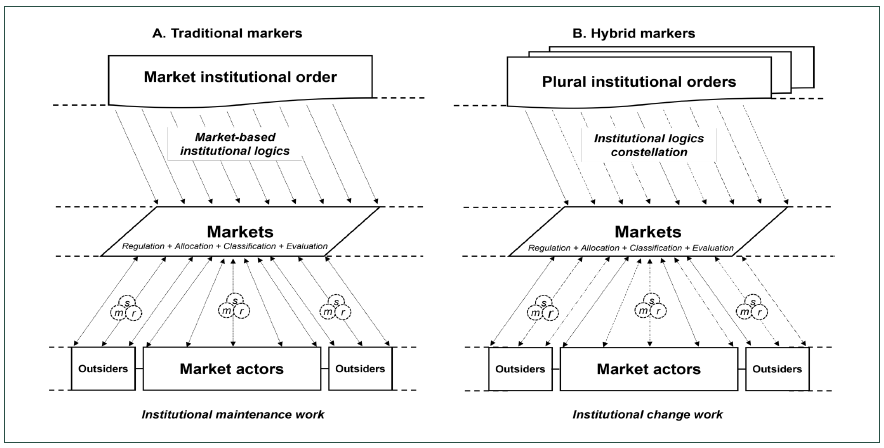 Source: Developed by the authors.