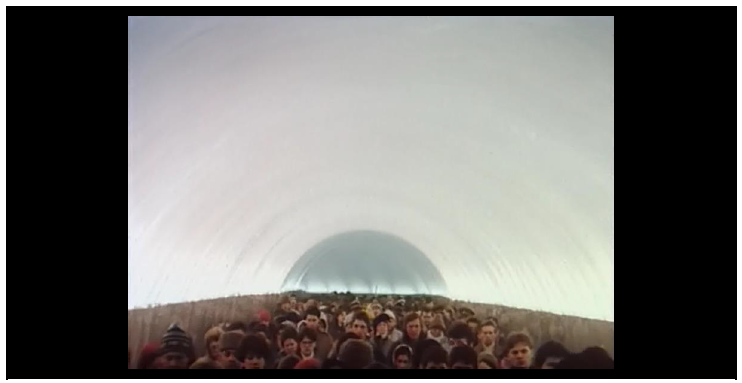
 The Conceptual Mise-en-Scène in The Asthenic Syndrome: Dialogues between Cinema, Art and Poetry in Kira Muratova
ABSTRACT
This article explores underlying concepts of the aesthetics of the film Asthenic Syndrome (1989), directed by Kira Muratova. The methodology adopted involves a comparative analysis of the elements of the mise-en-scène with examples from the visual arts, more specifically, installations, performances and paintings from the unofficial conceptual art produced in the Soviet Union between 1960-1980, based on theoretical perspectives on conceptual art and situating them in the USSR context. To enrich this comparison, this analysis uses concepts of cinematographic language and relates them to the dynamics of poetic cinema and the time-image, which helps to classify this film’s images and aesthetic choices more precisely, highlighting the connections among different artistic media.
KEYWORDS:
Kira Muratova; Soviet Cinema; Conceptual Art; Poetic Cinema; Film Analysis
RESUMO
Este artigo visa explorar conceitos que subjazem à estética do filme Síndrome astênica (1989), dirigido por Kira Muratova. A metodologia envolve a análise comparativa dos elementos da mise-en-scène com exemplos das artes plásticas, mais especificamente, com instalações, performances e pinturas da arte conceitual, não oficial, produzida na União Soviética entre 1960-1980, tomando-se aqui os apontamentos teóricos sobre a arte conceitual e situando-os no contexto da URSS. Para enriquecer essa comparação, a análise mobiliza conceitos da linguagem cinematográfica, relacionando-os especialmente às dinâmicas do cinema poético e da imagem-tempo, contribuindo para classificar mais precisamente as imagens e as escolhas estéticas, destacando as conexões entre os diferentes meios artísticos.
PALAVRAS-CHAVE:
Kira Muratova; Cinema soviético; Arte conceitual; Cinema poético; Análise fílmica
Introduction
The film Asthenic Syndrome was released in 1989 in a particular historical and political context: the Soviet Union’s growing social and cultural tensions before its dissolution in 1991. Kira Muratova,1 the film’s director, developed her career amid this scenario, facing a tense relationship with the cultural institutions of the Soviet state. For decades, the film’s director dealt with censorship and the constant rejection of her projects, reflecting the complexity of the relationship between power and authorial artistic creation in the USSR. Winner of the Silver Bear at the Berlin Film Festival in 1990, the film takes a critical stance toward the power structures and ideological convictions inherent in the USSR context. However, the film’s relevance goes beyond the immediate Soviet context, addressing an experimental language that allows for a broader reflection on social and cultural control, revealing a skepticism towards the possibility of human advancement in the face of these aspects. The experiments with cinematographic language in this film connect Muratova’s cinema to other artistic practices that develop in tension with established models, mainly because of the way the film uses the cinematographic medium to subvert aesthetic, social and ideological conventions, which extends the film’s relevance to a wider context.
Concerning style, in Asthenic Syndrome one can observe how the reforms of the USSR’s policy2 review period directly impacted the boldness level of the director’s aesthetic and technical choices. The film presents a fragmented narrative, abandoning rational narrative linearity and using a language that moves away from transparency, which is typical of both Soviet realism and the parameters of classical cinema. Instead, meaning construction happens mainly through the mise-en-scène, which occupies the center of the film’s conceptual articulation.

This emphasis on mise-en-scène not only fragments the narrative, but also transforms it into a series of visual and poetic moments that function almost like cinematic “installations” where each scene can be analyzed in isolation as a conceptual gesture by the director. Therefore, the starting point of this analysis lies in the connection between the ideas manifested by the cinematographic language, especially the mise-en-scène of the film and the ideas of the artistic practices of movements such as Moscow Conceptualism and Sots Art, which emerged in the Soviet Union between the 1960s and 1980s, expanding the notion of the artistic medium and positioning themselves critically about the parameters of the Soviet institutes. The mise-en-scène, a central element of cinematographic language, refers to a technique of organizing all the visual and sound elements within a scene. This is a fundamental means of constructing meaning in cinema, since each visual choice provokes sensations and creates atmospheres, which, in a more classical sense, enhances the film’s narrative, or, in a more experimental sense, creates the ambiences and sensory impressions needed to deepen the film’s meaning effects. Dialogues between the visual arts and mise-en-scène have been widely explored in film analysis, especially regarding the composition of framing, intertextuality and visual references. However, establishing a connection between conceptual art and the aesthetics of the film Asthenic Syndrome requires a more creative interpretative effort, as this relationship does not occur at the iconographic or more obvious visual level, but at the level of ideas. In this film, Kira Muratova moves away from the conventions that regard style as subordinate to narrative, turning each scene into an autonomous visual installation in which the arrangement of elements provokes a conceptual reflection, dominant in this work’s meaning production. This distinction animates a methodological challenge in the face of a need to connect something that is not material - ideas - with their material manifestations in the film. This takes place mainly through the mise-en-scène in dialogue with formal elements from the plastic arts and the conceptual arts, while also considering other specificities of cinematographic language, such as framing, shot length and editing, which have become consolidated, essential elements of cinema as a medium.
Furthermore, a pertinent question arises about the suitability of Western conceptual art theory, such as Rosalind Krauss’s, to the Soviet context. Conceptual art, as proposed by the capitalist block, was largely a critical response to institutions and the art market, where the value of a work is determined by capitalist dynamics. However, this art production and circulation model differs substantially from the Soviet context, in which art was subordinated to state control. This difference between the production modes and the artistic movements sheds light on a gap in the analysis calling for adaptations when comparing unofficial conceptual art and the Asthenic Syndrome’s aesthetics, without disregarding the specificity of their contexts. This problem suggests the need to re-evaluate the theoretical tools to analyze artistic forms created in such diverse contexts. In this reflection, it is essential to recover the principles for conceptual art described by Rosalind Krauss, but with enough flexibility to adapt or transform them by basing this approach on a deeper investigation into the interactions between the social-political context, artistic production modes, and cinematic aesthetics. This allows a more accurate understanding of the cultural and historical specificities that shape artistic creation, especially in institutional control contexts. For this reason, the first part of this article entitled The Aesthetic-Logic of the State contextualizes the relationship between art and power, briefly reviewing the mechanisms involved in the production and circulation of Soviet art. As we will see further in this text, Moscow Conceptualism, like Sots Art, used ironic strategies and deconstruction to criticize Soviet ideology, which can also be identified in Asthenic Syndrome. However, these movements from the 1960s-1980s did so by their means: while Moscow Conceptualism expanded the artistic medium with performances and temporary installations, Sots Art worked with the manipulation of objects and icons from propaganda and official art. In Muratova’s film, subversion takes place within the cinematographic language, fragmenting the narrative and incorporating the objects, propaganda icons, and official art into its mise-en-scène, thus aligning with unofficial art practices. To expand the film’s image analysis and highlight its cinematographic techniques, it will be necessary to resort to consolidated cinema theories, such as Maya Deren’s considerations on poetic cinema, as well as the classifications of image regimes formulated by Gilles Deleuze, and Jacques Aumont’s formulations on mise-en-scène and film analysis. With their different and complementary perspectives, each theorist offers relevant tools for understanding how Asthenic Syndrome creates a conceptual space where each scene functions as a cinematic installation - a poetic gesture that challenges narrative logic and expands the film’s meaning.
1 Aesthetic-Logic of the State
Coincidentally, Kira Muratova was born two months before the First Congress of Soviet Writers (1934), during which the main artistic guideline of the Soviet state was established: socialist realism. This guideline acted for several decades, influencing all the artistic production in the USSR and was modulated by the following ideological and political criteria, which requires a brief historical review to situate the concerns and artistic ideas discussed here and justify the adaptations of Western theoretical principles.
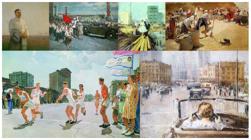
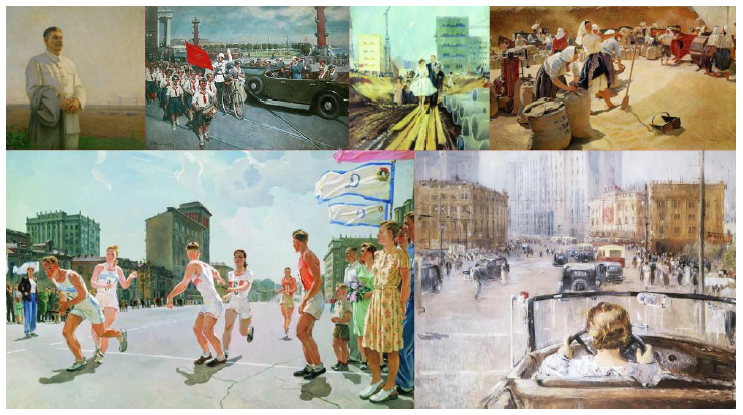
The USSR economy, which was based on the planned model as opposed to the capitalist market model, directly influenced aesthetic matters regarding cultural and artistic production, including cinema. In this context, government institutions exercised control over film production and dissemination, with the Goskino (State Cinematography Committee) as the main authority responsible for supervising what could be produced, distributed and exhibited to ensure that cinema and other arts served the party’s interests. That model demanded art to be accessible to people regarding communication, reflect socialist values, and project a positive vision of reality. Although the ideal was to portray the “labor hero” and the construction of a communist future, this approach increasingly fell in dissonance with social reality, resulting in didactic artistic forms that were disconnected from the real conditions of the population. As reported by several Soviet filmmakers, the requirements imposed on film productions were extremely restrictive and selective. Not only did the state interfere in the thematic content of films, but also regulated the cinematographic techniques that could be used. Styles that deviated from the realist form or in some way destabilized the discourse were often censored (Willinger, 2013). Cinematic language and aesthetics were supervised by the production studios regulated by Goskino to ensure ideological-aesthetic conformity and promote a moderate representation of Soviet reality. Similar demands were also placed on writers and critics in the literary field, who were driven to approach themes by adopting aligned perspectives. These guidelines sought to ensure that cultural production, both in film and literature, reinforced the values and objectives of the state’s political agenda:
Literary reviews are guided by: 1. the ideology of identification between the good and the beautiful - an action that expresses high social ideals not only arouses moral satisfaction, but also aesthetic delight; and 2. the ideology of the relationship between truth and honesty: the writer is honest when their work expresses the national truth, without hurting the party line (Röhl; Schwarz, 2006, p. 18).4
Therefore, aesthetics was not treated as a simple formal attribute of art, but as a strategic power tool, constituting an “aesthetic-logical synthesis” that directly linked artistic style to the state’s reasoning. Destabilizing this aesthetic meant, in a way, questioning power itself. The end of the Stalinist period in 1953 marked an important turning point for Soviet cinema and art. With the death of Josef Stalin and the subsequent revelation of his crimes, the so-called thaw began, an era of relative cultural openness under Nikita Khrushchev. In this context, heroic themes and slogan-laden dialogues gave way to more complex and humanized narratives. Films produced during this phase began to depict imperfect characters with more sensitivity and psychological depth and portray reality more honestly. In this period, cinema shifted from socialist realism to psychological dramatization with transparent language, as well as enabling the emergence of new aesthetics, which also coincided with the emergence of modern cinema on a global scale (Powell-Jones, 2015). Filmmakers from different movements in the modern world cinema, from the French Nouvelle Vague to Marginal Cinema, proposed aesthetics that broke away from the dominant models of their time. Despite these characteristics considered as common to modern cinema, the filmmaking production during the thaw was marked less by the filmmakers’ belonging to broader movements and more by the search for a very individual stylistic truth, which is revealed in the uniqueness and variation of the directors’ language, a trait perhaps provoked by the weariness of globalizing manifestos.
Toward the end of the thaw, censorship focused on aesthetics and language increased. Projects and films with authorial approaches, such as those by Kira Muratova, who released her first films at the Odessa Studio, ran up against the censorship barrier: while the film Brief Encounters (1967) still had a limited run, her next feature Long Goodbye (1971) was shelved shortly after its production. For the next eighteen years until the production of Asthenic Syndrome, Kira Muratova lived in an environment that required an acrobatic mentality to get her projects approved. In one of her interviews, she commented on the unfilmed project Watch Dreams Carefully:
(...) For three years I tried to gain approval by the ideological command. But I spent those years in some kind of eclipse. It had been clear for some time that the film wouldn’t be made, but I still imagined that if I did this or that, it would... be approved. It was the same with Princess Mary, based on Lermontov, and a few other scripts (Muratova 1997, translated by Iurii Kokin).5
These problems faced by Kira Muratova and other Soviet filmmakers persisted until the Fifth Congress of Filmmakers of the USSR was held in 1986, after which the Conflict Commission was created to resolve disputes between filmmakers and the authorities, as well as to re-evaluate the criteria that had previously limited creative freedom, such as those relating to language and style, which restored more than 250 films over the four years the Commission was in operation (Kosinova, 2020, p. 113). In this context, Kira Muratova’s archived films were released and Asthenic Syndrome was approved for filming.
2 Connections and Ruptures in Critical Intentions
Around the 1960s, an artistic movement emerged parallel to the official one, known as unofficial (or underground) art, in which a growing number of artists began to deviate from state guidelines. Excluded from the institutions and without access to state support, they developed their practices in alternative spaces, often in private circles and clandestine exhibitions, where formal experimentation and political criticism were possible, breaking with the limitations imposed by the institute, and establishing dialogues among artistic media. In the Western bloc, similar processes were identified by Rosalind Krauss (1999) in the 1960s and 1970s art, not just as a new trend, but as a profound change in artistic thinking and positioning. During this period, the focus became criticism of the status of art itself and the notion that each artistic form had a specific and autonomous medium. For conceptual artists, the value of the work was no longer placed in the physical object, but in the ideas represented. Thus, the autonomy of the medium was questioned, opening space for hybrid and multidisciplinary practices which involved various supports and media:
By abandoning this claim to artistic autonomy and voluntarily taking on various forms and locations - the mass-printed/distributed book, for example, or the public billboard - conceptual art found itself guaranteeing a greater purity for Art, so that, by flowing through channels of commodity distribution, it would not only adopt the form it needed, but, by a kind of homeopathic defense, escape the effects of the market itself (Krauss, 1999, p. 11).
For Krauss, criticism of the status of art develops in tension with the institutional and commercial system. In the 1960s and 1970s, conceptual artists began to question not only the traditional means of artistic production, but also the role of art institutions such as museums, galleries and the art market. However, this movement to deconstruct artistic convictions developed differently in the USSR, where art was heavily regulated and institutionalized by state control, in contrast to the market economy context analyzed by Krauss. In the case of Moscow Conceptual Art and Sots Art, this deconstruction took place through irony, satire, and a critical reflection on ideological control and “universal truths” promoted by official art. Unlike the West, where criticism of art institutionalization was linked to the market and commercial cultural institutions, these movements in the Soviet Union emerged in a context of ideological saturation and state surveillance. Their practices aimed not only to subvert socialist realism or propaganda posters, but also question the role of art as a control tool, as seen in the practice of APT- ART [АПТ-АРТ],6 private exhibitions in apartments, in which artists sought ways to create alternative spaces for creation and exhibition, away from surveillance networks (Bishop, 2022, pp. 431-435). Unlike Rosalind Krauss’ critique of institutionalization in the West, Moscow Conceptualism and Sots Art exposed a direct relationship between art, power and state ideological control, while building a collective and communal art form marked by trust among members. These practices highlight the complex interaction between art and politics in the Soviet Union, where artistic production became a form of resistance to censorship and state control.

These movements ironically appropriate the icons, fonts, symbols and sound elements of the official aesthetic, transforming them into other objects with a critical bias. Through this appropriation and the very process of creation in duos, groups, and collectives, authorship in these movements is not only fragmented, but also reinvents itself as a debate field on the role of the author within such a system. Returning to the Western world, as observed by Rosalind Krauss in her study of conceptual art, the notion of authorship is increasingly becoming a reflection on the structure, language and signification system in which a work is inserted. In the Soviet context, authorship was further problematized by the fact that many unofficial artists had to hide their identities or work under pseudonyms to escape state control, so the dilution of authorship in this context is not only a matter of necessity, but also a stance in which artistic creation denies individual ideological centralization and proposes new understandings of authorship.
The problem of authorship is also significantly manifested in cinema, although under different dynamics from those of the visual arts. With its highly bureaucratized technological and organizational infrastructure, cinema was controlled by the state, creating constant tension between filmmakers with authorial approaches and the official agenda imposed by production and distribution bodies. This conflict is particularly evident in the case of Kira Muratova, whose creative autonomy was restricted. A striking example is the episode that occurred with her film Between Gray Stones (1983), which was reedited without her permission by the studio where she worked as a director, a reality that many of her colleagues faced in an attempt to preserve their artistic vision.
It was a different act. Then someone came to the team and said: “You know, they don’t like it when the director does not include their surname in the credits; I don’t know why, but they don’t like it.” And I sent them a telegram and they replied: “All right, which name should I replace his with?” So I answered angrily: “Well, I don’t know, Ivanov, Petrov, Sidorov...” They say, okay, Sidorov. (...) Why did they remake it then? They spent extra money, did all the restructuring, removed various parts and then put the rest on the shelf... (Muratova, 2004, translated by Iurii Kokin).7
Muratova’s gesture of removing her name from the film’s credits not only expresses her frustration at state censorship, but also reflects a rupture in the authorship concept, highlighting the conflict between the director’s artistic choices and the institutional control over her work. This kind of experience affected Muratova deeply, both emotionally and artistically, leading her to reflect on the role of the organs of power in Soviet cinema as happened in Asthenic Syndrome, a film in which she problematizes issues such as originality, genre specificity and artistic autonomy, presenting a blunt critique of the role that institutions play in defining what is considered art.
In this context, the concept of apparatus can be useful for understanding how state control shaped both the production and reception of films, restricting filmmakers’ creative freedom. The theory of the cinematographic apparatus, which marked film studies in the 1970s, with the studies of Jean-Louis Baudry (1970) at its center, argues that cinema is ideological per se insofar as its technologies, including cameras and editing, are ideological, and insofar as these technologies are used to create the illusion of reality in the viewer, contributing to the affirmation of the dominant ideology in films through a certain representation of reality. A formalist cinema then emerges as a reaction to this, focused on revealing the cinematographic device itself in an attempt to denaturalize representation and undo the commitment to the illusion of reality, which Ismail Xavier (2005) defines based on the binomial transparency versus opacity. Krauss’ criticism of the autonomy of the medium in the conceptual arts directly reflects this reality: film production was regulated by norms and systems of power that determined the value and function of the work, transforming cinema into an institutional product. Although Muratova does not align herself directly with conceptual art practices, she conceptually explores a more critical, self-reflexive approach common to these practices, questioning the limits of representation and the role of institutes.
Now, the rich satisfactions of reflecting on the specificity of cinema at that time derived from the added condition of the medium, which led to a slightly later generation of theorists to define its support with the idea of “apparatus” - the medium or support of cinema being neither the celluloid tape of the images, nor the camera that filmed them, nor the projector that brings them to life in motion, nor the beam of light that transmits them to the screen, nor the screen itself, but all these elements together, including the position of the audience, caught between the source of the light behind them and the image projected before their eyes (Krauss, 1999, p. 25).
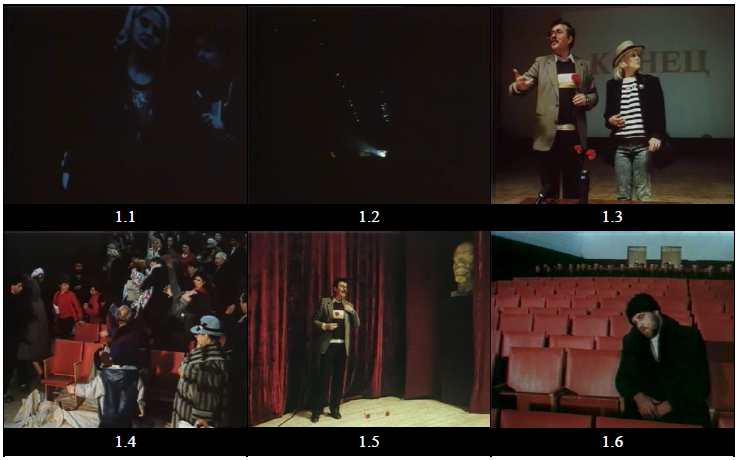
In Asthenic Syndrome, the apparatus is exposed in the mise-en-scène, in a particular scene of the film, a moment of transition between two parts of the narrative - from the more conventional first segment to the second, where the narrative structure begins to dissolve. Here, Muratova reveals the cinematographic apparatus itself: the film image goes dark, and then we see a shot showing the projector (1.2). The lights come on and the stage reveals the screening curator introducing the actress from the film by giving a formal speech about the importance of the event and the work being shown. (1.3) He mentions the names of real directors who flirt with experimental aesthetics, such as Aleksei German and Alexandr Sokurov, and a name that resonates with Muratova’s. But the noise in the room makes it difficult to understand: while the curator is speaking, his speech is constantly interrupted by the noises of the audience, who are trying to leave the room in a hurry, discussing trivial everyday issues. (1.4) The curator’s speeches and the noises from the stage overlap on top of this noise, creating a sense of disorganization and dissonance.
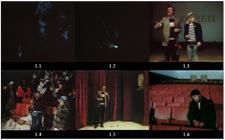
The last two shots of the scene intensify this idea through images and symbols, just as Sots Art did: a bust of Lenin next to the curator, who emphasizes the importance of watching “serious cinema” (1.5), and another shot (1.6) showing a man sleeping in the almost empty room, with red chairs and military personnel in the background, remaining there only because they did not hear the command to leave. This scene uses tools similar to conceptual art’s, ironizing the institutions that seek to impose a narrative of value and artistic seriousness, while the public seems indifferent and disconnected. The construction of this scene, especially in the final shot with the military in the background, slows down the logical rhythm and deepens the idea vertically, creating a temporal experience that expands the possibilities of interpretation. As in conceptual art, the scene criticizes the institutional imposition of official art, just as Sots Art satirizes the ideological component. The bust of Lenin next to the curator reinforces the idea of the state’s “aesthetic-logical synthesis,” suggesting that the value of art - in this case, cinema - is often determined by state policies. The scene also introduces a suspension: the action doesn’t move forward, making time express itself directly and thus provoking a critical reflection constructed by the combination of image and sound.
3 Aesthetic and Sensory Intensities
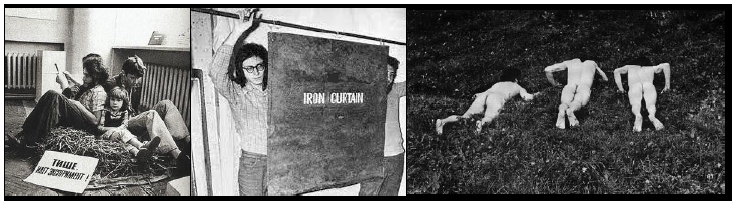
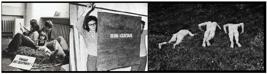
When looking more closely at the mise-en-scène in Kira Muratova’s film, it is possible to observe the use of techniques that break with narrative linearity: non-linear editing, the repetition of gestures and phrases, the expressive use of the body, and decentralized framing allow the image to go beyond its literal meaning and expand. These strategies break with narrative logic, forcing the viewer to engage with the scenes in a kind of observation state, rather than seeking a rational linearity given a priori. This is reflected, for example, in the sequences of shots without logical progression, suggesting the failure of reasoning, and at certain moments connecting to the experimental practices of unofficial art, such as the performances of the Gnezdo group. The Gnezdo group [Nest group] was a 1970s collective that held performances in spaces apart from the official circuits.
The scene in the film showing naked people as artists and models in an apartment resembles the artistic manifestations of the Gnezdo group and other artistic collectives that developed on the fringes of institutions. In the scene, Muratova similarly incorporates the bodies into the mise-en-scène: in an alternative space, among members who know each other, and far from the official circuit’s places and surveillance.
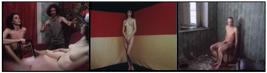
The artistic presentation in the alternative space, just like the Gnezdo group’s practices, suggests Muratova’s position, which reflects the search for freedom by deviating from logic using poetic techniques such as vertical deepening as proposed by Maya Deren. For Deren, a poem “creates visible or auditory forms for something invisible, which is the feeling, or the emotion, or the metaphysical content of the movement” (Deren, 1953, no page), in a movement that does not advance linearly, that is, obeying narrative logic, but deepens in a vertical line to investigate an emotion or idea by making use of the expressive resources of cinematographic language, especially concerning editing. As she explains:
(...) the relationship between the images in dreams, in montage, and poetry--is ... they are related because they are held together by either an emotion or a meaning they have in common, rather than by the logical action. In other words, it isn’t that one action leads to another action (this is what I would call a “horizontal” development), but they are brought to a center, gathered up, and collected by the fact that they all refer to a common emotion, although the incidents themselves may be quite disparate. Whereas, in what is called a “horizontal” development, the logic is a logic of actions. In a “vertical” development, it is a logic of a central emotion or idea which attracts to itself even disparate images which contain that central core they have in common. This, to me, is the structure of poetry... (Deren, 1953, n.p).
By aligning itself with this verticality of poetic cinema, Asthenic Syndrome removes the viewer from the logic of classic cinema and Soviet realism, in which the editing serves the progression of the story, and leads them into a sensory experience, again creating a suspension in which the scene does not aim to explain the theme it deals with. Instead, we are only offered an experience reinforced by expressive editing. The connections between Maya Deren’s theory and the mise-en-scène and editing of certain scenes in Asthenic Syndrome, such as the sequence of naked bodies in the apartment, point to a break with what, according to the philosopher Gilles Deleuze’s formulation (1989),8 is the quality of the movement-image: the sustaining of action under a narrative logic. Rather than leading to a logical progression, these images by Muratova directly insert the viewer into the domain of the time-image, focusing on the sensory experience generated by the off-center framing and the absence of continuity or logical concatenation between shots. Deleuze identifies a rupture with the regime of the moving image occurred in post-war cinema, present in films to sustain narrative action: when there is a rupture with the logic of the actions, this provokes direct sensory contact with the images, making them “pure optical and sound situations,” which opens up a field of interpretative possibilities:
But precisely what brings this cinema of action into question after the war is the very break-up of the sensory-motor schema: the rise of situations to which one can no longer react, of environments with which there are now only chance relations, of empty or disconnected anyspace-whatevers replacing qualified extended space. It is here that situations no longer extend into action or reaction in accordance with the requirements of the movement-image. These are pure optical and sound situations… (Deleuze, 1989, p. 288).
In the specific case of the scene analyzed here, Muratova arranges a scene immersed in a somber tone, which reflects a spatial organization - a kind of geometric imbalance that mirrors the apathy of the characters and the devastation of the setting. In this sense, Muratova uses cinematographic techniques to construct a space that allows for a more critical gaze, where the logic of narrative illusion has been corrupted, but which at the same time provides us with sensations of a world falling apart, in the Derenian sense. In her interviews, the director reveals how her films “grow” and “accumulate” during the making process, resulting in layers of meaning. Muratova mentions that the more time she spends on her projects, the more they deepen and become complex, as these layers create a density. As she states:
If the projects were done more quickly, much more quickly, then my films would be different. But in the working process, they “grow,” they “accumulate”... I watch someone else’s movie once - and it satisfies me. But mine... I have worked on them for so long that I manage to deepen, strengthen, improve them a thousandfold, sometimes “adding several layers” to make them more interesting to me (Muratova 1997, translated by Iurii Kokin).9
The layers of deepening ideas and emotions in Kira Muratova’s work reveal her specific approach to cinema, in which language breaks with transparency because it is constructed through vertical deepening. As a critic of the established and regulated model, Muratova subverts the concept of cinema as a transparent medium, bringing her film closer to the parameters of poetry. She uses repetition of lines and shots as rhymes, voice displacement, editing that deconstructs linearity by juxtaposing shots with no direct relationship to the narrative. Just as Maya Deren draws attention to the juxtaposition of disparate images in favour of the sensory experience, in Asthenic Syndrome, each scene exemplifies this discontinuous juxtaposition of shots, as the narrative stops conventionally organizing the sequences. In the film, the story of the teacher with asthenic syndrome deviates from the personal drama to become a symbol of society’s generalized apathy. The plot does not unfold into concrete actions, but into fragmented images that reflect exhaustion, placing this plot into a much more symbolic and conceptual scope than a narrative one. The intensity of the ideas in each sequence, often associated with nonsense and the disjunction between sound and image, reinforces the criticism of power structures, highlighting alienation and the collapse of a supposedly logical and coherent system. These same techniques are repeated, contributing to delineate what could be called a style. However, the disjunction occurs even there, because this supposed style does not apply to the entire film. Otherwise, it is formed by very individualized and different sessions, which ultimately build tension on the traditional understanding of style in cinema based on regularity, coherence and constancy of means, which pushes the viewer to think beyond this theme.
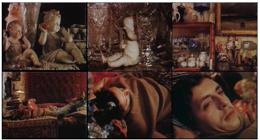
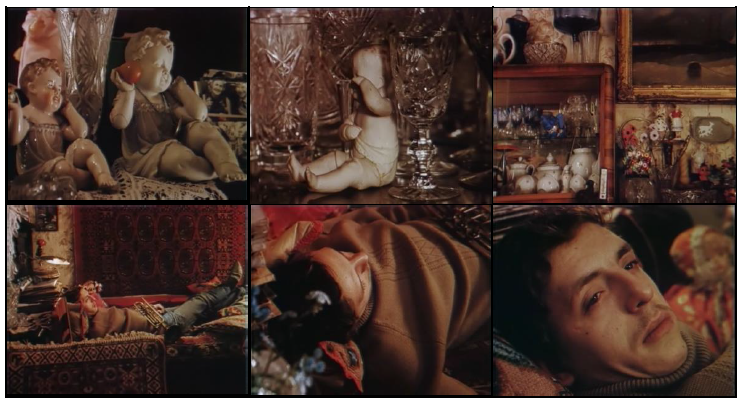
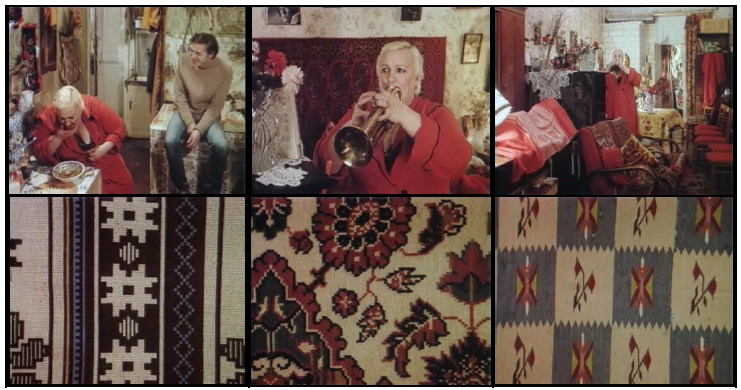
Another scene begins with a similar technique: a montage of disparate images consisting of a sequence of detail shots, and close-ups of decorative objects and the character’s face. It is important to understand that, in this case, the juxtaposition of images of these decorative elements does not follow the logic of the montage proposed by Serguei Eisenstein which seeks to create a shock effect and generate a clear ideological discourse from the confrontation between shots. On the contrary, Muratova’s images do not serve to articulate an explicit message. They have a different function, as they act more as interruptions to the action, establishing a regime of opacity and forcing the viewer to reflect on their own visual experience. In this sense, these images act as moments of pause that break the narrative fluidity, opening space for perceptual and emotional intensity. This approach is more in line with Gilles Deleuze’s idea of the affect-image, which, in his classification, corresponds to the foreground and the close-up, acting as an abstract and intense force concentrated on the face, body or object (Deleuze, 1989).10
Often, conceptual artists have also incorporated everyday objects into their work to challenge and expand the concept of the medium, shifting art from a space of aesthetic contemplation to a field of reflection on its own institutional and functional limits. Asthenic Syndrome does not fit directly into this movement, but shares similar concerns with it. Muratova restructures the mise-en-scène by treating everyday objects as ready-mades, and displaces them from their usual context to create new meanings. An example of this is a procedure also used by conceptual art of the 1960s and 1970s, which displaced banal objects into artistic contexts to provoke reflections on the limits of art, using these elements to intensify the viewer’s critical experience of social and political norms. The trumpet on which the mother (Irina Pavlovna, a teacher) plays Frank Sinatra’s song Strangers in the Night (1966) at the end of the scene reinforces the effect of “imbalance” with the out-of-tune diegetic sound that emerges over the montage and resonates with the initial detail shots of the scene, suggesting a formal circularity and intensifying the experience.

These last geometric detail shots are part of a sequence of drawings on carpets, and the change of music from diegetic to non-diegetic transforms the scene into a kind of music video, which changes the viewer’s perception and adds an extra layer of meaning. Returning to Maya Deren’s theory which highlights the vertical deepening of ideas and emotions in poetic cinema, this is where Muratova comes close to Deren’s principles again in that her film provokes moments of emotional and perceptual intensity beyond representation. Her choice for apparently trivial detail shots, such as the carpet designs, gives new meaning to everyday aesthetics and highlights the alienation inherent in life under the political and social context in which the film was produced. The characters’ acting in this scene is also built on intensities and the edge of the absurd. Towards the end of the scene, the mother, with an accent, starts eccentrically repeating words and her son also adopts the accent:
- Selfish, selfish, ...
- selfish, selfish, ...
- Go eat!
- I don’t want to.
- Go eat, I’m telling you!
- I don’t want to.
- Who did I cook for?
- I don’t want to eat.
The repetition of words in the interaction between mother and son is a powerful technique that intensifies the tension in the scene and explores the power dynamic, which resonates with the pressure of the social and political context of the time. The word “selfish,” repeated insistently, not only emphasizes the meaning of the word, but also reveals resistance in a refusal to meet expectations, creating a cadence of banalities that highlights the difficulty of communication between the characters. This turns the dialog into a field of tensions, where repetition becomes a dispute for individual affirmation, echoing the complexities of social conformity in the lives of the individuals in that context.
Final Considerations
Throughout this article, different intersections and historical, theoretical concepts have been mobilized to enable a comprehensive reflection on Kira Muratova’s film Asthenic Syndrome. The conceptual art of the 1960s-1970s, characterized by its focus on ideas and concepts expressed in its works, broke with traditional convictions about the medium, challenged expectations about what art “should be,” and ironized the institutions that defined what was considered art. Promoting a dialogue between these conceptual art questions and Muratova’s cinema helped problematize the tension between the Soviet institutes and the search for authorial authenticity in the director’s cinema, which situated this tension within a broader aesthetic-political context. By bringing Muratova’s formal paths in this film closer to Maya Deren’s theory of poetic cinema and aspects of Gilles Deleuze’s concept of image-time, it was possible to broaden the reflection on the film based on the ruptures with the regime of transparency and the director’s option for a cinema that emphasized expressive resources.
Although Asthenic Syndrome uses cinema as a defined medium, Muratova constructs a critique of cinematographic conventions through an aesthetic that not only affirms her unique authorship, but also reflects her position to the historical conjuncture of that period. In a context of conformity where art was often used as propaganda, her aesthetic approach highlights the tensions between politics and art in the Soviet world. The fragmentation and juxtaposition of disparate shots not only defy visual and narrative logic, but also suggest disintegration, probably reflecting the alienation and silencing of dissident voices in Soviet society.
Muratova aligns herself with conceptual art by critically and ironically questioning cinema and challenging the conventions of the medium, just as the 60s and 70s artists did when they subverted expectations about the essence of art and its institutional dependence. Likewise, when she indirectly inserts her name into the narrative, she is ironic about her position within the system, acknowledging her participation and exposing the tensions between artistic creation and institutional control. In this way, Asthenic Syndrome is not only a simple authorial statement but a metalinguistic and political critique of the authenticity of the film itself, by deconstructing cinematographic conventions and reflecting on the tensions between art, power and society.
References
- AUMONT, Jacques; MARIE, Michel. A análise do filme. Tradução de Marcelo Felix. Rio de Janeiro: Texto e Grafia, 2010.
- BAUDRY, Jean-Louis. Cinema: efeitos ideológicos produzidos pelo aparelho de base. Tradução de Vinícius Dantas. In: XAVIER, Ismail (Org.). A experiência do cinema: antologia. Rio de Janeiro: Graal, 2000. [1970].
-
BISHOP, Claire. Zonas de indistinguibilidade: “Grupo de Ações Coletivas” e Arte Participativa. Tradução: Jefferson Miranda. Arte & ensaios. Rio de Janeiro, PPGAV-UFRJ, v. 28 n. 44, pp. 430-447, jul.-dez. 2022. ISSN-2448-3338. DOI: https://doi.org/10.37235/ae.n44.21 Disponível em: https://revistas.ufrj.br/index.php/ae/article/view/56436/30872 Acesso em: 13 mar. 2025.
» https://doi.org/10.37235/ae.n44.21» https://revistas.ufrj.br/index.php/ae/article/view/56436/30872 -
DEREN, Maya. Poetry and the Film: A Symposium. Transcripted by Willard Maas. Film Culture, n. 29, 1963, pp. 55-63. Disponível em: https://www.ubu.com/papers/poetry_film_symposium.html Acesso em 12 mar. 2025.
» https://www.ubu.com/papers/poetry_film_symposium.html - DELEUZE, Gilles. Cinema 2: Imagem-Tempo. São Paulo: Editora 34, 2018.
- MURATOVA, Kira. Entrevista concedida a Jane Nox-Voina e Vladimir Voina. Iskusstvo Kino, novembro de 1997. Tradução para o português de Iurii Kokin (inédita).
-
MURATOVA, Kira. Entrevista concedida a Anton Dolin. Arthouse.ru, 2004. Disponível em: https://shorturl.at/VEQJi Acesso em: 26 out. 2024.
» https://shorturl.at/VEQJi - KRAUSS, Rosalind. A Voyage on the North Sea: Art in the Age of the Post-Medium Condition. New York: Thames & Hudson, 1999.
-
KOSINOVA, Marina. Relações Internacionais do Cinema Soviético nos Anos do Degelo. Modern Research of Social Problems, v.6, n.50, 2015. Disponível em: https://shorturl.at/gFK24 Acesso em: 15 mar. 2024.
» https://shorturl.at/gFK24 -
KOSINOVA, Marina. Pervye shagi reformirovaniya organizatsionno-ekonomicheskoy sistemy otechestvennoy kinematografii v epokhu perestroiki [Os primeiros passos na reforma do sistema organizacional e econômico da cinematografia nacional durante a era da perestroika]. Service Plus Scientific Journal, 2020, v. 14, n. 3, pp. 110-118. DOI: 10.24411/2413-693 X-2020-1031. Acesso em: 15 mar. 2024.
» https://doi.org/10.24411/2413-693 X-2020-1031 -
POWELL-JONES, Lindsay. Deleuze and Tarkovsky: the Time-Image and Post-War Soviet Cinema History. Dissertation submitted towards the award of Doctor of Philosophy. Chapter: Socialist Realism and the Crisis of the Action-Image. Cardiff University, Cardiff, Reino Unido, 2015. Disponível em: https://orca.cardiff.ac.uk/id/eprint/93276/1/2016powell-joneslphd.pdf.pdf Acesso em: 20 ago. 2024.
» https://orca.cardiff.ac.uk/id/eprint/93276/1/2016powell-joneslphd.pdf.pdf -
RASKATOVA, Elena. “Ideologicheskie Fil'try” i Pozdnee Sovetskoe Kino. Labirint: Zhurnal Sotsi’l'no-Gumanitarnykh Issledovaniy [“Filtros Ideológicos” e o Cinema Soviético Tardio]. Labirinto: Revista de Pesquisa Social e Humanitária. Ivanovo, n. 6, pp. 81-90, 2016. Disponível em: https://bit.ly/499Tnm4 Acesso em: 13 fev. 2024.
» https://bit.ly/499Tnm4 - RÖHL, Ruth Cerqueira de Oliveira e SCHWARZ, Bernhard J. A literatura da República Democrática Alemã. São Paulo: Perspectiva, 2006.
-
RYAZANTSEVA, Natalya. “Korotkoe Dykhanie, Ili Dolgie Provody” [Respiração curta ou longa despedida]. Iskusstvo Kino, Arquivo, n. 12, dez/2004. Disponível em: https://old.kinoart.ru/archive/2004/12/n12-article5 Acesso em: 4 nov. 2024.
» https://old.kinoart.ru/archive/2004/12/n12-article5 - SÍNDROME ASTÊNICA (Astenicheskiy Sindrom). Direção de Kira Muratova. URSS, Estúdio de Odessa, 1989. DVD. (153 minutos), colorido.
- WILLINGER, Isa. Kira Muratova: Kino und Subversion. Köln: Herbert von Halem Verlag, 2018.
- XAVIER, Ismail. O discurso cinematográfico: a opacidade e a transparência. Rio de Janeiro: Paz e Terra, 1984.
-
Research Data and Other Materials Availability
The contents underlying the research text are included in the manuscript.
-
Reviews
Due to the commitment assumed by Bakhtiniana. Revista de Estudos do Discurso [Bakhtiniana. Journal of Discourse Analysis] to Open Science, this journal Only publishes reviews that have been authorized by all involved.
-
1
Kira Muratova was a Ukrainian filmmaker who marked the history of Soviet and post-Soviet cinema with her authentic style that contrasted with the official models of the Soviet era. She was born in Moldova in 1934. She directed 21 films during her career, many of which were critically acclaimed. She studied cinema in Moscow and released her first solo film in 1967, produced in the Odessa studio (Ukraine). His films are characterised by fragmentation, expressive stylisation and the use of non-professional actors. His career was marked by numerous confrontations and censorship by the regulatory institutes for film production in the USSR. After the Soviet period, Muratova received critical acclaim and several awards for her work, including the Silver Bear Grand Jury Prize at the Berlinale in 1990 for her film “Asthenic Syndrome,” and is now considered one of the most important filmmakers in the former Soviet Union. She died in 2018 at the age of 83.
-
2
Perestroika and Glasnost reforms, implemented in the late 1980s by Mikhail Gorbachev’s government. These reforms promoted greater freedom of expression and a review of the regime’s cultural policies, enabling the formation of conflict commissions that reviewed and released previously censored films. In this environment, films such as Muratova’s, with their experimental language and criticism of power, found an opening to be produced and shown.
-
3
The images present in this article fall under Article 46, item VIII, of Law 9610/98, and do not constitute copyright infringement, as they are reproductions of small excerpts of pre-existing works (film stills) or, even when it comes to full reproduction, in the case of reproductions of works of visual arts, the reproductions themselves are not the main objective and do not harm the normal exploitation of the reproduced work nor cause prejudice to the legitimate interests of the authors, being included here only for the illustrative purpose of ideas developed in the article. Thus, based on this understanding of Article 46, item VIII, of Law 9610/98, the authors are fully responsible for the reproduction rights of the images in the Bakhtiniana journal, and will answer for any claims that may eventually arise regarding their use.
-
4
As resenhas literárias se orientam: 1. pela ideologia da identificação entre o bom e o belo - a ação que expressa ideais sociais elevados não só desperta uma satisfação moral, mas também um deleite estético; e 2. pela ideologia da relação entre verdade e honestidade: o escritor é honesto quando sua obra expressa a verdade nacional, sem ferir a linha do partido.
-
5
“Tri goda pytalas’ yevo probit’ cherez ideologicheskoye nachal’stvo. Tri goda provela v kakom-to zatmenii. Uzh davno stalo yasno, chto film ne budet snimat’sya, a ya yeshche sebe voobrazhala, chto vot esli ya sdelaю to-to ili to-to, to on... ‘proydet’. Tak zhe bylo i s ‘Knyazhnoy Meri’ po Lermontovu i yeshche s neskol’kimi stsenariyami.”
-
6
АПТ-АРТ (flat art) refers to an unofficial art practice in the USSR during the 1970s and 1980s, in which exhibitions and performances took place in flats.
-
7
“— Eto byl akt drugoy. Togda kto-to prishël v gruppu i skazal: “Znayesh, oni ochen’ ne lyubyat, kogda rezhisser ubirayet svoyu familiyu iz titrov; pochemu — ne znayu, no ne lyubyat.” I ya shlyu telegrammu, a oni otvechayut: “Khorosho, na kakuyu zamenit’?” Ya togda v zlost’i govoryu: “Nu ne znayu, Ivanov, Petrov, Sidorov...” Oni govoryat — khorosho, Sidorov. <...> Zachem togda rezali? Lishnie dengi tradili, perезапisi vsyakie delali, vybrosali i etot kusochek, i tot, a potom ostavshyesya polozhili na polku...”.
-
8
DELEUZE, Gilles. Cinema 2. The Time-Image. Translated by Hugh Tomlinson and Roberta Galeta. Menneapolis: Minnesota Press, 1989.
-
9
“Esli by fil'my delalis’ bystree, gorazdo bystree, to moi kartiny byli by drugimi. No v protsesse raboty oni “obrastayut,” “naslaivayutsya”... Chuzhoy fil'm ya smotryu odin raz - i on menya udovletvaryaet. A svoy... Ya delayu ego tak dolgo, chto tysyachu raz uspevayu ego obogatit’, usilit’, uluchshit’, “nasloit’,” chtoby on byl mne bolee interesen.”
-
10
See footnote 9.
Edited by
Review I
About the reviewerSCIMAGO INSTITUTIONS RANKINGSReview I
The article carries out an excellent analysis of the film, mobilizing very clear concepts for this procedure. It focuses on formal aspects of the film, which is a great merit. There is no further explanation to the reader of the filmmaker’s origins and background (it only mentions the year of her birth), or even a synopsis of the feature analyzed. I imagine that for reasons of character limits the author chose not to write such information, but these are details that would enrich the article for a reader who doesn’t know the work or the director. Another point: in some parts of the article he uses the expression “Soviet institutes.” I don’t know if the correct term would be “Soviet institutions,” given the meaning of the sentences. Adapt the article to the new citation rules, according to ABNT NBR 10520:2023. REQUIRED REVISIONS [Revised]
- peer review recommendation: revision
Review II
About the reviewerSCIMAGO INSTITUTIONS RANKINGSReview II
The article entitled “The conceptual mise-en-scène in Asthenic Syndrome: dialogues between cinema, art and poetry in Kira Muratova” adequately reflects the content presented, being clear and objective. The title accurately summarizes the subject of the research. The work has a well-defined objective, which is maintained consistently throughout its development. The authors identify the film as a fragmented work, which adopts different narrative parameters from Soviet realism and classical cinema, placing the mise-en-scène as the central element of the audiovisual. This structural choice also serves as a starting point for establishing poetic relationships with the shots and visual movements, which, according to the authors, “function almost like cinematographic ‘installations,’ where each scene can be analyzed in isolation, like a conceptual gesture by the director.” The argumentative structure is logical and well-articulated, allowing the reader to follow the proposed reflection. Despite dealing with complex themes, relating political and social context with sophisticated and dense theories, the authors have developed an appropriate progression using didactics in academic writing to ensure a clear and cohesive exposition of the themes addressed. The language used in the article is clear, objective and in line with academic standards. The text is grammatically correct and has textual cohesion, without impairing comprehension. In addition, the writing maintains an appropriate tone, avoiding ambiguity and ensuring conceptual precision. The authors demonstrate mastery of the bibliography by dialoguing with relevant filmmakers and theorists, such as Maya Deren and Gilles Deleuze. The theoretical basis is consistent and the references adequately support the analysis presented. In addition, the text contains an original and relevant approach, contributing to the advancement of knowledge in the area by articulating theoretical concepts with an in-depth analysis of the object of study. In view of the above, the article meets the requirements for publication. Its approval is recommended, as it has an appropriate title, a well-defined objective, a solid theoretical foundation, an original contribution to the field of study and appropriate academic language.
- peer review recommendation: accept
Review III
About the reviewerSCIMAGO INSTITUTIONS RANKINGSReview III
This is an excellent piece of work that explores the relationship between the work of filmmaker Kira Murátova in the Soviet context and, more broadly, in dialog with the artistic and cultural trends of that period. However, the analysis does not present any link between Muratova’s work and the theoretical heritage of Mikhail Bakhtin and the Circle. In this sense, I recommend Eugénie Zvonkine’s book - Kira Mouratova. Un cinéma de la dissonance (2012) which, among other issues, explores precisely this relationship.
- peer review recommendation: accept
The contents underlying the research text are included in the manuscript.