 Fragments of One Health? A Review Reveals the Lack of Integration among Human, Animal, and Environmental Health.
Abstract
The concept of “One Health” (OH) has evolved throughout modern human history, undergoing multiple reinterpretations and refinements. Its most recent definition, established in 2021, reinforces a collaborative and interdisciplinary approach aimed at improving human, animal, and environmental health. The objective of this study is to conduct a systematic scientometric review to examine the evolution of OH’s conceptual dimensions and global research trends. The review followed three steps: (1) retrieval of all articles containing the term OH from PubMed, Web of Science, and Scopus since their earliest records; (2) screening and integration of datasets following the PRISMA protocol and using the bibliometrix package in R; and (3) classification of studies into three thematic axes: ecology, zoonoses, and human health; analyzed by publication year and country of origin. Results revealed the United States as the leading contributor, with studies often addressing multiple thematic areas and a notable surge in publications following the COVID-19 pandemic. Although contributions from developing countries are gradually increasing, research on OH remains concentrated in developed nations, still largely focused on multidisciplinary rather than fully interdisciplinary approaches. Nonetheless, a slow but steady shift toward integrative perspectives is observed, expanding the scope of studies and fostering dialogue across disciplines. These findings underscore the ongoing diversification of the OH framework and its progressive alignment with global challenges that demand cooperative, cross-sectoral scientific efforts. These insights may guide future policies and research strategies toward more equitable and integrative implementations of the OH approach.
Keywords:
Interdisciplinary; Covid-19; Ecology; Zoonoses; Review; Multidisciplinary.
HIGHLIGHTS
• The USA and China have more articles on One Health theme
• There has been an increase in One Health studies after Covid-19
• Antimicrobial resistance is the second most used term in articles
• Today we have more multi-theme articles than in the pre-pandemic period

INTRODUCTION
Health can be understood as an indicator of the quality of life of organisms, ecosystems, and consequently, the biosphere, being influenced by a bioethical perspective aligned with the concept of “One Health” (OH) [1-2]. The term goes beyond the mere absence of disease or illness, as defined by the World Health Organization, also encompassing the physical, mental, and social well-being of human beings [3-4]. Moreover, the concept of health can be extended to environmental integrity, in which fauna, flora, and the environment itself remain in balance, performing their essential functions for collective life [5-6]. In recent years, however, achieving socio-environmental well-being has become increasingly difficult, almost intangible, due to various anthropogenic activities [7]. Among them stand out the production and use of pesticides and other synthetic compounds, the lack of basic sanitation, the rise of antimicrobial resistance, and the overexploitation of natural resources, which result in environmental degradation and the consequent decline in human health [8-10]. Given the growing compromise of ecosystem health, and therefore also of human health, the concept of OH-introduced in the early years of the 21st century and still under conceptual debate-has gained renewed relevance [11], especially evident after the COVID-19 outbreak [5,7,12-13]. This concept has established itself as a central reference for guiding studies, projects, and programs aimed at promoting global health.
The concept of OH can be considered recent, especially when compared to the practice it represents. This is due to the fact that, even before its theoretical formulation, there were already initiatives aimed at promoting and strengthening public health, including in developing countries in Latin America and Africa. These programs, although not using the term OH, had been applying its principles in practice for more than three decades [14], as exemplified by Brazil’s National Immunization Program, created in 1973 [15]. Furthermore, knowledge can be elevated to understand that the theory and approach of OH had already been practiced for centuries, even before its official designation (Figure 1), with Hippocrates (460 B.C.-377 B.C.), who established a relationship between human health and the environment [16], and even earlier with indigenous groups and their traditional teachings, which measured the essential values and resources for life alongside an ecosystemic approach to health, where human and animal health were incorporated through the lens of the influence they receive from the environment in which they live [8,17]. Therefore, the known nomenclature was officially used for the first time approximately during the emergence of zoonotic outbreaks, such as severe acute respiratory syndrome (SARS) in early 2003 [18,19], and currently has its most recent definition provided by the One Health High Level Expert Panel (OHHLEP), formed in May 2021, instituting a collaborative and interdisciplinary approach at local, regional, and global levels with the aim of improving the health of humans, animals, plants, and the environment [6,13,14].

In this context, the OH approach began to receive international support through an initiative called “One World, One Health,” based on the Twelve Manhattan Principles, proposed during the Wildlife Conservation Society meeting in 2004. This proposal introduced an ecological perspective to public health discussions, establishing explicit connections between human, animal, and environmental health. Subsequently, the concept was formalized by the Tripartite Alliance, composed of the World Health Organization [25], the World Organization for Animal Health [26], and the Food and Agriculture Organization, and more recently expanded with the inclusion of the United Nations Environment Programme [6,21,27]. The alliance recognizes the OH approach as the most suitable method for the prevention and control of emerging and endemic zoonotic diseases, highlighting the interdependence between human, animal, and ecosystem health [9,17,20]. Despite the growing recognition and application of the concept across different disciplinary areas, the predominant focus still appears to be on zoonotic diseases and antimicrobial resistance, reflecting a continuity of the precursor term “One Medicine” [11,21,28], which contributes to a scenario where public health interventions in general continue to be predominantly conceived and managed in isolated sectors, with limited communication and collaboration [29].
The global history and recent events have influenced the current scenario of increasing focus on academic work aimed at zoonotic diseases [28,30], as well as antimicrobial resistance [16,31-33]. Zoonotic diseases are associated with one of the greatest challenges to global health, especially in the face of the growing threat of emerging and re-emerging zoonoses, such as H1N1, Ebola, Zika, and SARS-CoV-2 [10,34]. Other agents, such as parasites [35,36] and harmful algal blooms (HABs) [37], also represent significant threats to global health. This scenario is exacerbated by multiple factors, including the intensification of international trade and travel, climate change, the rapid evolution of pathogens, population growth, and the expansion of intensive livestock farming [7,16,38,39]. These conditions increase the spread of infectious agents, disproportionately affecting low-income and developing countries, such as those in Latin America, the African continent, and South Asia, which face structural and economic limitations, as well as difficulties in intersectoral coordination [23,40-44].
In this scenario, governments and institutions promote programs and initiatives in Africa [23,35,45], such as the African Center for Disease Control and Prevention (CDC) [13], the National Institute for One Health (NIOH) proposed in Nagpur, India [21], and in South America, the plan of the National Health Surveillance Agency (Anvisa) aimed at addressing antimicrobial resistance [46]. Other relevant actions include the creation of specific legislation, such as Law No. 14,792/2024, which establishes the National One Health Day in Brazil (November 3) [47]-a date originally proposed by the One Health Commission (www.onehealthcommission.org) in 2016. Added to this are more than a hundred OH initiatives in the eastern Africa region alone [23], demonstrating the growing expansion and consolidation of the concept, especially in vulnerable regions, broadening its applicability beyond the transatlantic axis.
Therefore, there has been a focus and concentration of studies directed toward certain areas, which has contributed to the lack of integration among them. As a consequence, the search for a truly interdisciplinary approach emerged, a perspective that goes beyond simple multidisciplinarity and is inherent to the concept originally proposed. The term “EcoHealth” recognizes the inseparable links between ecosystems and the health of all organisms, from microorganisms and parasites to trees, in which the benefits of a balanced environment extend to the health of the entire biota, whether animal or plant [29,48]. In turn, the concept of “Planetary Health” is aimed at a vision that emphasizes human health and its connections with politics, economy, and the social environment, while integrating with the natural environment in which it exists [20,49]. Due to the variety of understandings relevant to what the term truly means, one of the models that can facilitate the understanding of current needs and provide a more realistic representation of global health interconnections is the one represented as an “umbrella” [18,50], developed by “One Health Sweden” and the “One Health Initiative” (Figure 2). In this way, a distinct number of scientific areas are encompassed by the concept of “One Health,” ranging from human medicine and health economics to biology, environmental chemistry, and toxicology [11,28,51], potentially extending to areas of ecology and conservation [52,53], reinforcing the idea of a broad and comprehensive science where multiple fields of study can contribute.

Scope of the term “One Health” according to the “Umbrella” model (Available at: www.onehealthinitiative.com).
In the context of a globalized consumption scenario, there is a significant increase in the production of waste, effluents, and emerging contaminants (such as antibiotics, microplastics, and agricultural products), in addition to the destruction and fragmentation of habitats. This set of factors contributes to an uncertain future for the biosphere, also marked by the expansion of infectious agents and, consequently, diseases [8,28,54]. In this context, synergy among transdisciplinary teams from the human, animal, and environmental sectors become essential, as does collaboration among different actors and institutions, both public and private. Despite political, legal, ethical, and financial barriers and complexities, as well as persistent conceptual disagreements, such interactions are fundamental for the practical implementation of public policies aimed at well-being, global health, and the resolution of complex problems related to the OH concept [6,9,22]. These actions also represent a response to the challenges of the 21st century and align with the United Nations 2030 Agenda Sustainable Development Goals [55]. Indeed, a symbolic interpretation of the word “HEALTH” can be understood as the acronym “Humans, Ecosystems and Animals Living Together Harmoniously” [8], highlighting the importance of interconnections among areas of study and recognizing that all forms of life are essential and interdependent - including plant health, which maintains fundamental links with the environment [56].
Therefore, the main objective of the present work is to conduct a systematic scientometric review in order to compare the dimensions of the OH concept. Among the specific objectives, the following stand out: 1) To evaluate, through a “word cloud,” which major areas the studies emphasize; 2) To describe the geographic and temporal patterns to ascertain whether there is a discrepancy in scientific production between global regions regarding OH studies; 3) To quantitatively compare studies conducted before and after the pandemic related to the topic. Based on this, the following predictive hypotheses related to the study objectives are formulated: 1) Scientific production related to the OH topic has increased significantly since 2019, reflecting the global impact of the pandemic and the strengthening of discussions on integrated health; 2) Studies on “One Health” are predominantly concentrated in developed countries, due to the historical higher investment in research and scientific infrastructure; 3) There is still a greater number of studies focused on zoonoses, as this has been a long-standing issue and gained additional prominence after the COVID-19 pandemic; 4) A reduced portion of studies addresses the OH concept in its entirety, that is, considering the human, animal, and environmental dimensions in an integrated manner.
MATERIAL AND METHODS
This systematic and scientometric review was conducted in three stages (Figure 3). In the first stage, data were collected through searches for scientific articles related to the OH topic. We considered studies that linked OH with any ecological level or system, human health or zoonoses, ecotoxicology, and environmental contamination. Searches were conducted on the Web of Science (Thomson Reuters), Scopus (Elsevier), and PubMed (National Library of Medicine) platforms. For the search, the following keyword with Boolean operators was used in September 2025: (“*One Health”). We considered articles published in English, Spanish, and Portuguese. Abstracts published at scientific events, short research notes, book chapters, dissertations, and these were not considered.

Stages of the systematic review applied in this study: (A) Three stages of the review. (B) PRISMA Protocol Diagram [57].
In the second stage, the articles resulting from the search were screened, applying the PRISMA guidelines for systematic reviews [57]. For this purpose, the data were converted into a format compatible with the R package bibliometrix [58], allowing the unification of records from different databases. Then, the data were integrated, and duplicates were removed, resulting in a unified dataset. After consolidation, the data were simplified, retaining only the most relevant columns for analysis (DOI, year of publication, title, journal, document type, keywords, and number of citations).
In the third stage, a scientometric analysis was performed using the articles that passed the filter applied in the second stage. The articles were grouped according to the country of origin using bibliometrix (Table 1), producing a world map of academic production in the OH field. Article production by year was also evaluated, from the first appearance of the term “One Health” in a study up to 2025, to assess the evolution of academic production and compare the preand post-COVID-19 (SARS-CoV-2) periods. Subsequently, using bibliometrix functions, including keyword summarization and scientific production indicators, it was possible to identify the most relevant terms and thematic axes in the studies, thus creating a “Word Cloud.”
A clustering of a subsample composed of 150 publications was also conducted, selected from the total number of analyzed articles, organized into three thematic axes: ecology, zoonoses, and human health (Table 2). This was done due to the large number of publications found in the search and the impossibility of detailed reading of all publications. Studies addressing more than one of these axes were classified as multi-thematic. The identification of the main axis followed the central logic of each publication. Thus, studies focused exclusively on diseases not associated with animals, or related only to human health (such as cardiovascular diseases, occupational well-being, and maternal health during the preand postpartum periods) were classified under the human health axis. On the other hand, studies on diseases with a direct link between humans and animals, such as Zika, rabies, Ebola, and COVID-19, were classified under the zoonoses axis. Finally, the ecology axis included studies related to ecotoxicology, environmental health, and phytotoxicity, especially those addressing environmental interferences on animal and human health, bioaccumulation processes, and related topics.
Number of articles read, divided by central themes, according to the subsampling of 150 randomly selected articles.
The 150 articles were divided by publication periods. Thirty articles were randomly selected in each of the following periods: 1950-1980; 1990; 2000-2009; 2010-2019; 2020-2025. This was done considering the occurrence of the OH term in titles, abstracts, or keywords. When the term was not present in these sections, the article was included in the analysis whenever the OH term appeared in the body of the text, regardless of its conceptual emphasis. The purpose of this stage was to analyze, in a broader way and from this subsample, the evolution of publication focus across the main thematic axes over the decades, identifying possible transitions toward more interdisciplinary and integrated approaches across different areas of knowledge, in accordance with the contemporary OH principle.
RESULTS
Evaluation of the Complete Bibliography
In the Scopus database, 15,452 articles were found; in the Web of Science, 15,831 articles; and in PubMed, 3,868 works. After merging and removing 13,435 duplicates, a total of 21,716 articles was obtained. A new screening was then conducted to further refine the article filtering using the DOI identification number. At this stage, 2,332 duplicate records were excluded, resulting in a total of 19,384 articles. Regarding the use of the OH term in annual scientific production, it was observed that the first studies appeared in 1953. The production of articles with this term showed continuous growth from 2013, with a sharper increase from 2019, coinciding with the COVID-19 pandemic period (Figure 4).

Annual scientific production of articles related to the term One Health up to the period of the bibliographic review (1953-September/2025).
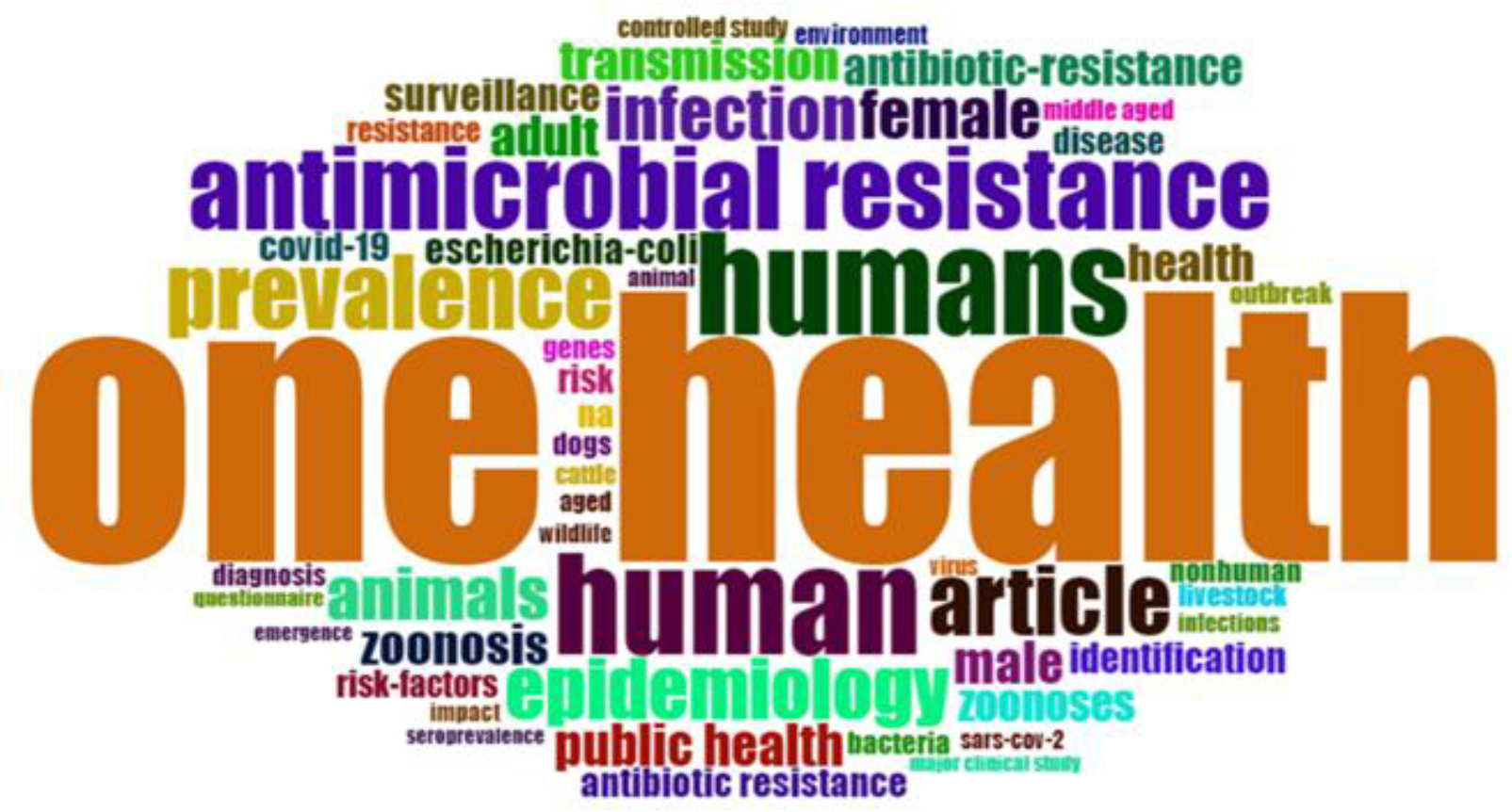
The countries that published the most articles using the term “One Health” were the United States, followed by China, the United Kingdom, Italy, and in fifth place, Brazil (Figure 5A and 5B). As represented in the word cloud (Figure 6), the term “One Health” was mainly accompanied by words such as antimicrobial resistance, humans, epidemiology, and prevalence.

(A) Number of publications from the ten countries with the most articles up to the date of this study (September/2025). (B) Map representing the global distribution of scientific production associated with the term One Health. The color gradient ranges from dark blue, indicating countries with the highest number of publications, to progressively lighter shades, corresponding to lower levels of production. Countries shown in gray have no records of scientific publications related to the topic.

Word cloud illustrating the most recurrent keywords in the articles analyzed in the review. The size of each term represents the frequency of its use.
Evaluation of the bibliography focusing on “One Health” in the title by period
Between 1950 and 1989, the 30 selected articles were linked to the human health thematic axis. In the period from 1990 to 1999, it was also observed that all 30 evaluated publications were related to this axis. Between 2000 and 2009, changes occurred: 6 articles focused on zoonoses, 20 on human health, 1 on ecology, and 3 were multi-thematic. From 2010 to 2019, 18 articles were on zoonoses, 3 on human health, 6 on ecology, and 3 were multi-thematic. Finally, between 2020 and 2025, 4 articles were related to human health, 2 to ecology, and 24 were classified as multi-thematic. Among the 150 analyzed articles, a distribution across the three main thematic axes was evident, along with a significant and growing number of multidisciplinary studies that encompass the integration of these different areas of knowledge over time (Figure 7).

Distribution of the number of articles presenting the term One Health in the title-or, if absent, in the abstract, keywords, or body of the text (in that order)-across the different periods analyzed. The colors represent the central themes and highlight articles that address more than one thematic axis.
DISCUSSION
The concept of OH has undergone several discussions and redefinitions over time, in accordance with the guidelines proposed by OHHLEP [6,14]. The extensive review conducted in this study showed that conceptual divergences still persist among different disciplines and areas of knowledge. Despite the absence of a definitive consensus, after a period of lower production, a significant increase in the number of studies related to the topic was observed, especially from 2019, the year the COVID-19 pandemic began in Asia [59], which reignited interest in the OH approach. Thus, we generated evidence supporting one of the hypotheses of this study. This growth in academic production was not limited to studies directly linked to the pandemic and its consequences but also extended to emerging global topics, such as climate change, antimicrobial resistance [38], and microplastic pollution [54]. Such expansion reflects a broader understanding that human, animal, and environmental health are inseparable, reinforcing the need for integrated public policies [9].
In this context, ecology has gained greater relevance within the OH approach [53], receiving increasing attention in studies that incorporate a more systemic view of the relationships between environment and health. An example of this is the study by Bonilla-Aldana and coauthors [39], which revisited the OH concept in the context of COVID-19 from an ecological perspective. In previous decades, this ecological dimension had less prominence, as the predominant focus was on zoonotic diseases and human health [19], without broadly considering the influence of the environment on these axes.
Our results also support the hypothesis that developed countries continue to be the main contributors to scientific production associated with the OH concept. However, a progressive increase in contributions from countries on other continents, such as China and Brazil, as well as several nations in Africa and South America, is observed [2,13,38]. This increase may be related to persistent challenges in these contexts, such as limitations in public health policies, vulnerability to endemic and emerging zoonoses, and historical deficiencies in sanitary infrastructure [44,60]. Nevertheless, there is a growing effort by these countries to improve the quality of life of their populations, which has driven interest and scientific production focused on the OH approach [21,23,36].
As expected, a higher number of studies related to zoonoses was observed, especially in older publications. However, the growth of scientific production in the post-pandemic period is noteworthy, with an emphasis on multi-thematic and multidisciplinary studies. This increase is largely associated with the impact of COVID-19, which stimulated research not only on vaccination [61] but also on environmental effects resulting from the intensive use of drugs and personal protective equipment, such as disposable masks. Domingo-Echaburu and coauthors [62], for example, reported environmental quality concerns by identifying potential pharmaceutical contamination in Vitoria-Gasteiz, Spain, during the pandemic. Similarly, Sendra and coauthors [63] used the improper disposal of surgical masks as a starting point to assess the ecotoxicological effects of these residues on Danio rerio (Hamilton, 1822) embryos, a model organism widely used due to its high genomic similarity with humans. In this way, it is evident that although the increase in academic productivity has focused on a central theme, such as COVID-19, studies have begun to encompass new dimensions of the OH concept, especially environmental health, one of the fundamental pillars of this approach. However, it is important to highlight that the expansion of approaches often integrates only two thematic axes, and few studies can be classified as truly interdisciplinary, capable of fully encompassing the contemporary OH concept.
Even though there is an observed increase in the decentralization of thematic axes and an expansion toward more diverse studies over the decades, many works still focus on and demonstrate greater relevance when related solely to human health, either directly or indirectly. When evaluating the “word cloud,” we observed that the main words found in studies are those linked to humans, such as “epidemiology,” “humans” [64], and “antimicrobial resistance.” These references align with the “Anthropocene” [65], a period in which humans are the primary agents shaping environmental dynamics and transformations on a global scale. Just as humans modify the environment in which they live, these changes ultimately impact the health of the species itself. The increased consumption of antibiotics, for example, results in the release of these compounds into water bodies through sewage systems, contributing to the degradation of water resources and exerting selective pressure on microorganisms, such as bacteria and fungi, which then develop greater antimicrobial resistance [32,33,66]. Although the centrality of humans in research associated with the OH concept is still evident, the results indicate significant advances compared to previous decades, with a gradual expansion of focus toward the ecological and environmental dimensions of health.
However, a temporal shift in publication patterns is evident. Articles published between the 1950s and 1990s were mostly focused on issues related to human health. During this period, notable works addressed public policies and community health systems [67], as well as discussions on expanding traditional medical check-ups to incorporate environmental and domestic factors, such as the physical structure of homes [68]. Studies on preand post-pregnancy care [69,70], population surveys and the use of questionnaires [71,72], as well as research on cardiovascular and pediatric diseases [73,74], were also common. It is important to note that during this period, the term OH was used in reference to districts or regions with health systems, without relation to the current concept. The production was mainly concentrated in the United States and the United Kingdom.
In the period from 2000 to 2009, articles with OH in the title demonstrated a conceptual transition. In this review, we highlight this transition. Until 2004, studies predominantly focused on human health, especially on the assessment and improvement of hospital care systems. In 2005, the article “All is One: Healthy Communities and a Sustainable Future” [75] introduced a broader approach, considering the interactions between human, animal, and environmental health. From 2007 onwards, there was a significant increase in studies directed toward zoonoses and animal disease control, culminating in more integrative discussions highlighted by the “Executive Summary of the AVMA One Health Initiative Task Force Report” [76] and “One World - One Health” [77]. This decade, therefore, marked a transition: from an incipient application of the concept to a broader and more systemic perspective.
Between 2010 and 2019, there was a significant growth in publications and reviews related to human health, with an emphasis on diseases such as tuberculosis, influenza, and other viral infections [78]. Gradually, the focus shifted toward zoonoses, maintaining the predominance of human health but expanding the thematic scope. Bacterial zoonoses were the most studied [79,80], accompanied by an increase in publications in journals in the fields of immunology, parasitology, microbiology, and veterinary medicine [81,82]. In the final years of the decade, there emerged a growing interest in approaches incorporating ecological dimensions [83], reflecting the conceptual maturation of OH. Geographically, the United States, Canada, Europe, and India stood out as the main hubs of scientific production.
Currently, the literature recognizes the importance of transdisciplinarity in the OH approach. However, most studies still adopt multidisciplinary perspectives, addressing the human, animal, and environmental axes in a fragmented manner. Few studies fully integrate these components into a truly transdisciplinary framework [84,85]. Furthermore, there is a lack of studies that adequately consider the ecological dimension [86], which is often underrepresented in OH analyses. Several publications evaluate the application of the concept in public health policies [85-88], generally revealing a partial adoption of the paradigm proposed by OHHLEP, or focusing on specific events, such as emerging zoonoses and the COVID-19 pandemic [89,90]. There are also articles exploring the ethical dimensions of the concept [91,92], reflecting the growing thematic diversity and scientific maturation of the field. Although progress is gradual, the evidence indicates a progressive consolidation of OH as a field integrating disciplines, aimed at understanding and jointly addressing global challenges.
CONCLUSION
The advancement of the OH concept reflects an important evolution in understanding the interconnections between human, animal, and environmental health. However, there is still a long way to go for this integration to be fully consolidated. The scarcity of truly transdisciplinary studies highlights the need to strengthen collaborations across different areas of knowledge, promoting more integrated and systemic approaches. Thus, future research should prioritize this convergence, aiming not only to understand but also to propose joint solutions to emerging global challenges. Strengthening scientific production guided by interdisciplinarity and international cooperation is, therefore, essential for the effective advancement of the OH paradigm and the promotion of more equitable and sustainable global health.
-
Funding:
This study was supported by CNPq (National Council for Scientific and Technological Development, financial support number for A.A. Padial.: 308648/2021-8) and also was financed by the Coordination of Superior Level Staff Improvement- Brazil (CAPES) - Finance Code 001.
-
Institutional Review Board Statement:
Not applicable
-
Informed Consent Statement:
Not applicable
Acknowledgments:
The authors thank the Graduate Program in Ecology and Conservation (PPGECO) at the Federal University of Paraná (UFPR) for all the support, technical assistance, and encouragement in the production of this article.
-
Use of Generative Artificial Intelligence:
The authors declare that no generative artificial intelligence (AI) or AI-assisted technologies were used to generate or modify the scientific content of this manuscript, including the conception of the study, data collection, data analysis, interpretation of results, or creation of original text, figures, tables or graphical abstracts, apart from routine tools for spelling, grammar checking and reference management that do not create original scholarly content.
Data Availability Statement:
Research data are only available upon request for corresponding author.
REFERENCES
-
1 Stepke FL. Considerations on forms of health. The road to One Health. Iberoam J Med. 2023;5(2):54-6. doi:10.53986/ibjm.2023.0014
» https://doi.org/10.53986/ibjm.2023.0014 -
2 Alarcón Becerra JO, Bustamante Campaña AJ, Heredia Talledo ME, Yacarini Martínez A. [One Health and bioethics: challenges toward integration in health]. Apuntes Bioet. 2023;6(2):99-112. doi:10.35383/apuntes.v6i2.1000
» https://doi.org/10.35383/apuntes.v6i2.1000 -
3 World Health Organization (WHO). Constitution of the World Health Organization. 1946. Available from: https://www.who.int/about/governance/constitution
» https://www.who.int/about/governance/constitution -
4 World Health Organization. Division of Health Promotion, Education, and Communication. [Health promotion: glossary]. World Health Organization; 1998. Available from: https://iris.who.int/handle/10665/67246
» https://iris.who.int/handle/10665/67246 -
5 Morand S. One Health: an ecosystem-based ecology of health. Field Actions Sci Rep [Internet]. 2022 [cited 2025 Sep 23] ;(24):58-63. Available from: https://journals.openedition.org/factsreports/6940
» https://journals.openedition.org/factsreports/6940 - 6 Adisasmito WB, Almuhairi S, Behravesh CB, Bilivogui P, Bukachi SA, Casas N, et al. One Health: a new definition for a sustainable and healthy future. PLoS Pathog. 2022 Jun 1;18(6).
- 7 Rizzotto MLF, Costa AM, Dias AP, Corrêa Filho HR, Friedrich K, Augusto LG da S. [One Health - an ambiguous concept under debate]. Saude Debate. 2024 Oct;48(143).
- 8 Evans BR, Leighton FA. A history of One Health. Rev Sci Tech. 2014;33.
- 9 Couto RM, Brandespim DF. A review of the One Health concept and its application as a tool for policy-makers. Int J One Health. 2020; 6:83-9.
- 10 Nzietchueng S, Kitua A, Nyatanyi T, Rwego IB. Facilitating implementation of the One Health approach: a definition of a One Health intervention. One Health. 2023 Jun 1;16.
- 11 Lerner H, Berg C. The concept of health in One Health and some practical implications for research and education: what is One Health? Infect Ecol Epidemiol. 2015 Jan;5(1):25300.
- 12 Wakimoto MD, Menezes RC, Pereira SA, Nery T, Castro-Alves J, Penetra SLS, et al. COVID-19 and zoonoses in Brazil: environmental scan of One Health preparedness and response. One Health. 2022 Jun 1;14.
- 13 Evans BR, Leighton FA. One World, One Health: a growing need for an integrated global health approach. S Afr Fam Pract. 2023;65.
- 14 Pettan-Brewer C, Penn G, Biondo AW, Jaenisch T, Grützmacher K, Kahn LH. Who coined the term “One Health”? Cooperation amid the siloization. One Health. 2024;18.
- 15 Domingues CMAS, Maranhão AGK, Teixeira AM, Fantinato FFS, Domingues RAS. The Brazilian National Immunization Program: 46 years of achievements and challenges. Cad Saude Publica. 2020 Oct 1;36.
- 16 Ruiz J. A reflection on the concept of One Health. Rev Peru Med Exp Salud Publica. 2018 Oct 1;35(4):657-62.
- 17 Riley T, Anderson NE, Lovett R, Meredith A, Cumming B, Thandrayen J. One Health in Indigenous communities: a critical review of the evidence. Int J Environ Res Public Health. 2021;18.
- 18 Mackenzie JS, Jeggo M. The One Health approach: why is it so important? Trop Med Infect Dis. 2019;4.
- 19 Shaheen MNF. The concept of One Health applied to the problem of zoonotic diseases. Rev Med Virol. 2022;32.
- 20 Lerner H, Berg C. A comparison of three holistic approaches to health: One Health, EcoHealth, and Planetary Health. Front Vet Sci. 2017 Sep 29;4.
- 21 Yasobant S, Memon F, Kalpana P, Saxena D. One Medicine vs One Health: policy disconnect in India. CABI One Health. 2024 Jan 16.
- 22 Monath TP, Kahn LH, Kaplan B. Introduction: One Health perspective. ILAR J. 2010;51(3):193-8.
- 23 Fasina FO, Fasanmi OG, Makonnen YJ, Bebay C, Bett B, Roesel K. The One Health landscape in Sub-Saharan African countries. One Health. 2021 Dec 1;13.
- 24 Bhatia R. Addressing challenge of zoonotic diseases through One Health approach. Indian J Med Res. 2021; 153:249-52.
-
25 World Health Organization. Tripartite and UNEP support OHHLEP’s definition of “One Health”: joint Tripartite (FAO, OIE, WHO) and UNEP statement. 2021. Available from: https://www.who.int/news/item/01-12-2021-tripartite-and-unep-support-ohhlep-s-definition-of-one-health
» https://www.who.int/news/item/01-12-2021-tripartite-and-unep-support-ohhlep-s-definition-of-one-health -
26 World Organization for Animal Health. Tripartite and UNEP support OHHLEP’s definition of “One Health”. 2021. Available from: https://www.oie.int/en/tripartite-and-unep-support-ohhleps-definition-of-one-health/
» https://www.oie.int/en/tripartite-and-unep-support-ohhleps-definition-of-one-health/ -
27 United Nations Environment Programme. Joint Tripartite and UNEP statement on definition of “One Health”. 2021. Available from: https://www.unep.org/news-and-stories/statements/joint-tripartite-and-unep-statement-definition-one-health
» https://www.unep.org/news-and-stories/statements/joint-tripartite-and-unep-statement-definition-one-health - 28 Destoumieux-Garzón D, Mavingui P, Boetsch G, Boissier J, Darriet F, Duboz P, et al. The One Health concept: 10 years old and a long road ahead. Front Vet Sci. 2018;5.
- 29 Zinsstag J, Schelling E, Waltner-Toews D, Tanner M. From One Medicine to One Health and systemic approaches to health and well-being. Prev Vet Med. 2011 Sep 1;101(3-4):148-56.
- 30 Essack SY. Environment: the neglected component of the One Health triad. Lancet Planet Health. 2018;2:e238-9.
- 31 Hernando-Amado S, Coque TM, Baquero F, Martínez JL. Defining and combating antibiotic resistance from One Health and global health perspectives. Nat Microbiol. 2019; 4:1432-42.
- 32 Guardabassi L, Butaye P, Dockrell DH, Fitzgerald JR, Kuijper EJ. One Health: a multifaceted concept combining diverse approaches to prevent and control antimicrobial resistance. Clin Microbiol Infect. 2020; 26:1604-5.
- 33 Aslam B, Khurshid M, Arshad MI, Muzammil S, Rasool M, Yasmeen N, et al. Antibiotic resistance: One Health One World outlook. Front Cell Infect Microbiol. 2021;11.
- 34 Soares TF. [Environment and One Health: what can we expect?]. Rev Bras Meio Ambiente. 2020;8(4):74-80.
- 35 Maxamhud S, Reghaissia N, Laatamna AEK, Gentekaki E, Tsaousis AD. Epidemiology and transmission patterns of Cryptosporidium spp. and Giardia duodenalis within a One Health framework in rural areas from eastern Algeria. Parasitology. 2024.
- 36 Prakobwong S, Charoensuk L, Chaipibool S, Chedtabud K, Laothong U, Suwannatrai AT, et al. One Health integrated strategies for sustainable control of Opisthorchis viverrini infections in rural endemic areas of Thailand. Infect Dis Poverty. 2025 Dec 1;14(1).
- 37 Libisch B, Picot C, Ceballos-Garzon A, Moravkova M, Klimesová M, Telkes G, et al. Prototheca infections and ecology from a One Health perspective. Microorganisms. 2022;10.
- 38 Abbasi K, Ali P, Barbour V, Benfield T, Bibbins K, Hancocks S, et al. Time to treat the climate and nature crisis as one indivisible global health emergency. Afr J Lab Med. 2023;12.
- 39 Bonilla-Aldana DK, Dhama K, Rodriguez-Morales AJ. Revisiting the One Health approach in the context of COVID-19: a look into the ecology of this emerging disease. Adv Anim Vet Sci. 2020;8(3):234-7.
- 40 Hailat E, Amiri M, Debnath N, Rahman M, Nurul Islam M, Fatima Z, et al. Strengthening the One Health approach in the Eastern Mediterranean Region. Interact J Med Res. 2023 Mar 21;12: e41190.
- 41 Osman AY, Mohamed H, Mumin FI, Mahrous H, Saidouni A, Elmi SA, et al. Prioritization of zoonoses for multisectoral One Health collaboration in Somalia, 2023. One Health. 2023 Dec 1;17.
- 42 Pampa-Espinoza L, Espinoza-Venegas L, Moscoso MY. The need for multisectoral actions for dengue control in Peru: a One Health approach. An Fac Med. 2023;84.
- 43 Goryoka GW, Lokossou VK, Varela K, Oussayef N, Kofi B, Iwar V, et al. Prioritizing zoonotic diseases using a multisectoral One Health approach for the Economic Community of West African States (ECOWAS). One Health Outlook. 2021 Dec;3(1).
- 44 Zhang YF, Li SZ, Wang SW, Mu D, Chen X, Zhou S, et al. Zoonotic diseases in China: epidemiological trends, incidence forecasting, and comparative analysis between real-world surveillance data and Global Burden of Disease 2021 estimates. Infect Dis Poverty. 2025 Dec 1;14(1).
- 45 Musoke D, Ndejjo R, Atusingwize E, Halage AA. The role of environmental health in One Health: a Uganda perspective. One Health. 2016 Dec 1; 2:157-60.
-
46 Brazil. [PAN-Health Services: National Plan for the Prevention and Control of Antimicrobial Resistance in Health Services] [Internet]. Brasília (DF): Anvisa; 2023 [cited 2024 Sep 9]. Available from: https://www.gov.br/anvisa/pt-br/assuntos/servicosdesaude/prevencao-e-controle-de-infeccao-e-resistencia-microbiana/pnpciras-e-pan-servicos-de-saude/pan-servicos-de-saude-2023-2027-final-15-12-2023.pdf
» https://www.gov.br/anvisa/pt-br/assuntos/servicosdesaude/prevencao-e-controle-de-infeccao-e-resistencia-microbiana/pnpciras-e-pan-servicos-de-saude/pan-servicos-de-saude-2023-2027-final-15-12-2023.pdf -
47 Brazil. [Law No. 14,792, of January 5, 2024. Establishes the National One Health Day]. Diário Oficial da União [Internet]. Brasília (DF). 2024 Jan 8 [cited 2025 Sep 9]; Section I:4. Available from: https://www.planalto.gov.br/ccivil_03/_ato2023-2026/2024/lei/L14792.htm
» https://www.planalto.gov.br/ccivil_03/_ato2023-2026/2024/lei/L14792.htm - 48 Harrison S, Kivuti-Bitok L, Macmillan A, Priest P. EcoHealth and One Health: a theory-focused review in response to calls for convergence. Environ Int. 2019;132.
-
49 Horton R, Lo S. Planetary health: a new science for exceptional action. Lancet. 2015; 386:1921-2. doi:10.1016/S0140-6736(15)61038-8
» https://doi.org/10.1016/S0140-6736(15)61038-8 - 50 Gibbs EPJ. The evolution of One Health: a decade of progress and challenges for the future. Vet Rec. 2014 Jan 25;174(4):85-91.
-
51 Beasley V. One Toxicology, Ecosystem Health and One Health. Vet Ital [Internet]. 2009;45(1):97-110. Available from: http://www.izs.it/vet_italiana
» http://www.izs.it/vet_italiana - 52 Cleaveland S, Borner M, Gislason M. Ecology and conservation: contributions to One Health. Rev Sci Tech. 2014;33.
-
53 Gittleman JL. One Health needs ecology. Proc Natl Acad Sci U S A. 2024;121(50):e2413367121. doi: 10.1073/pnas.2413367121.
» https://doi.org/10.1073/pnas.2413367121. - 54 Kumari D, Arora S. Multi-dimensional view of microplastic toxicity: environmental and health impacts. Water Air Soil Pollut. 2025 Sep 1;236(9).
-
55 United Nations. Transforming our world: the 2030 Agenda for Sustainable Development. 2015. Available from: https://www.refworld.org/docid/57b6e3e44.html [cited 2025 Apr 9].
» https://www.refworld.org/docid/57b6e3e44.html - 56 Danielsen S, Schaffner U, Zinsstag J. Worlds apart: plant health and One Health and a path to convergence. CABI One Health. 2025 Apr 10.
-
57 Page MJ, McKenzie JE, Bossuyt PM, Boutron I, Hoffmann TC, Mulrow CD, et al. The PRISMA 2020 statement: an updated guideline for reporting systematic reviews. Int J Surg. 2021; 88:105906. doi:10.1016/j.ijsu.2021.105906
» https://doi.org/10.1016/j.ijsu.2021.105906 -
58 Aria M, Cuccurullo C. Bibliometrix: comprehensive science mapping analysis (version 5.1.1) [R package]. CRAN. 2025. Available from: https://CRAN.R-project.org/package=bibliometrix
» https://CRAN.R-project.org/package=bibliometrix -
59 Hao YJ, Wang YL, Wang MY, Zhou L, Shi JY, Cao JM, et al. The origins of the COVID-19 pandemic: a brief overview. Transbound Emerg Dis. 2022;69(6):3181-97. doi:10.1111/tbed.14732
» https://doi.org/10.1111/tbed.14732 -
60 Ghali-Mohammed I, Afolayan AS, Bakare AA, Adesola RO, Isola TO, Akpabio U, et al. Risk of zoonotic diseases among veterinary students in Nigeria: a multi-institutional national cross-sectional survey. Discov Public Health. 2025; 22:288. doi:10.1186/s12982-025-00687-3
» https://doi.org/10.1186/s12982-025-00687-3 -
61 Trilla A, Vilella A. [Vaccination against COVID-19: One world, one health]. Farm Hosp [Internet]. 2022 Feb;46(1):1-2. doi:10.7399/fh.13172
» https://doi.org/10.7399/fh.13172 -
62 Domingo-Echaburu S, Irazola M, Prieto A, Rocano B, Lopez de Torre-Querejazu A, Quintana A, et al. Drugs used during the COVID-19 first wave in Vitoria-Gasteiz (Spain) and their presence in the environment. Sci Total Environ. 2022 May 10; 820:153122. doi:10.1016/j.scitotenv.2022.153122
» https://doi.org/10.1016/j.scitotenv.2022.153122 -
63 Sendra M, Pereiro P, Yeste MP, Novoa B, Figueras A. Surgical face masks as a source of emergent pollutants in aquatic systems: analysis of their degradation product effects in Danio rerio through RNA-Seq. J Hazard Mater. 2022 Apr 15; 428:128186. doi:10.1016/j.jhazmat.2021.128186
» https://doi.org/10.1016/j.jhazmat.2021.128186 -
64 El Zowalaty ME, Järhult JD. From SARS to COVID-19: a previously unknown SARS-related coronavirus (SARS-CoV-2) of pandemic potential infecting humans-call for a One Health approach. One Health. 2020; 9:100124. doi:10.1016/j.onehlt.2020.100124
» https://doi.org/10.1016/j.onehlt.2020.100124 -
65 Dudgeon D. Multiple threats imperil freshwater biodiversity in the Anthropocene. Curr Biol. 2019;29(19):R960-7. doi:10.1016/j.cub.2019.08.002
» https://doi.org/10.1016/j.cub.2019.08.002 -
66 Sievert D, Kirby A, McDonald LC. The CDC response to antibiotic and antifungal resistance in the environment. Med (N Y). 2021 Apr;2(4):365-9. doi:10.1016/j.medj.2021.03.011
» https://doi.org/10.1016/j.medj.2021.03.011 -
67 Chamberlin RW, Radebaugh JF. Delivery of primary health care-union style. A critical review of the Robert F. Kennedy plan for the United Farm Workers of America. N Engl J Med. 1976;294(12):641-5. doi:10.1056/NEJM197603182941205
» https://doi.org/10.1056/NEJM197603182941205 -
68 Bruhn JG. The complete health checkup: fad, fiction, or fact. South Med J. 1979;72(7):865-8. doi:10.1097/00007611-197907000-00029
» https://doi.org/10.1097/00007611-197907000-00029 -
69 Glazener CM, Abdalla M, Stroud P, Naji S, Templeton A, Russell IT. Postnatal maternal morbidity: extent, causes, prevention and treatment. Br J Obstet Gynaecol. 1995;102(4):282-7. doi:10.1111/j.1471-0528.1995.tb09132.x
» https://doi.org/10.1111/j.1471-0528.1995.tb09132.x - 70 Maroto de Agustín A, Moreno Bueno MA, Rubio Moreno MM, Ortiz Valle C, Escobar Rabadán F. [Knowledge and use of contraceptive methods by the female population of a health area]. Rev Esp Salud Publica. 1998 Nov;72(6):547-70.
-
71 Webb C, Pontin D. Introducing primary nursing: nurses’ opinions. J Clin Nurs. 1996 Nov;5(6):351-8. doi:10.1111/j.1365-2702.1996.tb00267.x
» https://doi.org/10.1111/j.1365-2702.1996.tb00267.x -
72 Bennun I, Simpson D. Who uses community mental health centres? A study of one health district. J Community Appl Soc Psychol. 1992;2(3):209-15. doi:10.1002/casp.2450020305
» https://doi.org/10.1002/casp.2450020305 -
73 Abu-Harb M, Hey E, Wren C. Death in infancy from unrecognised congenital heart disease. Arch Dis Child. 1994 Jan;71(1):3-7. doi:10.1136/adc.71.1.3
» https://doi.org/10.1136/adc.71.1.3 -
74 Stayte M, Reeves B, Wortham C. Ocular and vision defects in preschool children. Br J Ophthalmol. 1993 Apr;77(4):228-32. doi:10.1136/bjo.77.4.228
» https://doi.org/10.1136/bjo.77.4.228 - 75 Kajner P. All is one: healthy communities and a sustainable future. Community Dev J. 2005 Oct;40(4):447-52.
- 76 King LJ, Anderson LR, Blackmore CG, Blackwell MJ, Lautner EA, Marcus LC, et al. Executive summary of the AVMA One Health initiative task force report. J Am Vet Med Assoc. 2008 Jul 15;233(2):259-61.
- 77 Karesh WB, Cook RA. One world-one health. Clin Med (Lond). 2009 Jun;9(3):259-60.
- 78 Craddock S. Precarious connections: making therapeutic production happen for malaria and tuberculosis. Soc Sci Med. 2015; 129:36-43.
- 79 Hewitt R, Willingham A. Status of schistosomiasis elimination in the Caribbean region. Trop Med Infect Dis. 2019 Jan 31;4(1):24.
- 80 Mittal M, Sharma V, Nehra K, Chakravarti S, Kundu K, Bansal VK, et al. Abortions in an organized dairy farm from North India reveal the possibility of breed susceptibility to bovine brucellosis. One Health. 2018 Jun 1; 5:1-5.
- 81 Capps B, Lederman Z. Responding to a public health objection to vaccinating the great apes. J Agric Environ Ethics. 2016 Sep 2;29(5):883-95.
- 82 Little SE. Future challenges for parasitology: vector control and One Health in the Americas. Vet Parasitol. 2013 Aug;195(3-4):249-55.
-
83 Zinsstag J, Crump L, Schelling E, Hattendorf J, Maidane YO, Ali KO, et al. Climate change and One Health. FEMS Microbiol Lett. 2018 Apr 4;365(11). doi:10.1093/femsle/fny085
» https://doi.org/10.1093/femsle/fny085 - 84 Tsaousis AD, Gentekaki E, Stensvold CR. Advancing research on Blastocystis through a One Health approach. Open Res Eur. 2024 Jul 12; 4:145.
- 85 Wakimoto MD, Menezes RC, Nery T, Nunes NC, Pereira SA, Veloso VG. One Health governance: recent advances in Brazil. One Health. 2025 Jun; 20:101089.
- 86 Desvars-Larrive A, Burger P, Khol JL, Posautz A, Schernhammer E, Kutalek R, et al. Launching Austria’s One Health network: paving the way for transdisciplinary collaborations. One Health Outlook. 2024 Oct 28;6(1):23.
- 87 Atusingwize E, Ndejjo R, Tumukunde G, Buregyeya E, Nsamba P, Tuhebwe D, et al. Application of One Health approach in training at Makerere University: experiences from the One Health Workforce Project in Uganda. One Health Outlook. 2020 Dec;2(1):23.
- 88 Wu C, Astbury CC, Lee KM, Gong Z, Chen S, Li A, et al. Public awareness of One Health in China. One Health. 2023 Dec 1; 17:100603.
- 89 Huang L, Zhang X, Xu A. Effectiveness of interventions as part of the One Health approach to control coronavirus disease 2019 and stratified case features in Anhui Province, China: a real-world population-based cohort study. One Health. 2021 Jun; 12:100224.
- 90 Tucker C, Fagre A, Wittemyer G, Webb T, Abworo EO, VandeWoude S, et al. Parallel pandemics illustrate the need for One Health solutions. Front Microbiol. 2021 Oct 8;12:718546.
- 91 Lindenmayer JM, Kaufman GE, Baker L, Coghlan S, Koontz FW, Nieuwland J, et al. One Health ethics: what then must we do? CABI One Health. 2022 Dec 19;cabionehealth.2022.0011.
- 92 Capps B. One Health ethics. Bioethics. 2022 May;36(4):348-55.
-
Editor-in-Chief:
Paulo Vitor Farago
-
Associate Editor:
Bruno Pedroso