 Control System with Fuzzy Inference for the Input Values Applied to Temperature Control of an Aerated Stirred Tank Bioreactor
HIGHLIGHTS
-
A temperature control system coded in C++ was implemented via Arduino.
-
Based on simple tests, operators were able to adjust the controller parameters.
-
Implemented controller acted successfully on the temperature variable.
-
High ethanol conversion rate and high final product concentration were obtained.
Abstract
In alcoholic fermentations, variables’ control has a direct influence on growth and productivity. In particular, temperature is fundamental for increasing ethanol production and essential to avoid its toxicity. However, these processes are non-linear and complex, in a way that PID controllers may perform unsatisfactorily. In these cases, an alternative is to use modern controllers such as those based on fuzzy logic. Thus, the objective of this study was to implement and test a control system with fuzzy inference for the input values, to act on the temperature variable of an aerated stirred tank bioreactor for the production of ethanol. The temperature controller coded in C++ was implemented via Arduino. By analyzing the sensors’ measured data and through logical interpretation, the controller provides guidance to change the power of an electric heating element, which promotes temperature change until it converges to the desired set point. Based on simple tests, operators were able to adjust the controller parameters and obtain excellent performance for the process, applying ±0.2 °C of the setpoint, which represented an oscillation of around 0.6%. As for alcoholic fermentation, a substrate-to-product conversion factor of 0.42 ± 0.02 gethanol.gsubstrate-1 was obtained, with a volumetric productivity of 5.275 gethanol.L-1.h-1 and a fermentation efficiency of 82.47%. From these results, it can be seen that this study showed a good ethanol conversion rate and the temperature control caused by the control system with fuzzy inference for the input values provided the right conditions to improve the fermentation process.
INTRODUCTION
Biofuel ethanol is produced by the fermentation of starch or other plant-based sugars. In Brazil, ethanol production started in the 1970s, following government interventions related to the global oil crisis. Brazil is now the world’s second largest producer of ethanol, after the United States of America, with high productivity related to abundant natural resources and very large areas of available arable land [1,2]. It has been estimated that bioethanol from yeast fermentation, which transforms sugars into ethanol, accounts for 80% of the global production of renewable fuels [3].
Industrial bioethanol production is based on use of the yeast Saccharomyces cerevisiae [4], a unicellular fungus that is ellipsoidal in shape, measuring around 5 μm in width and 6-8 μm in length, with a highly complex and rigid cell wall. This microorganism had its genome sequenced for the first time in 1996 [5,6], became a widely recognized eukaryotic system with great economic and scientific relevance [7–9]. The many advantages of this yeast include adaptability in fermentation processes (allowing high ethanol productivity), tolerance of low pH and high concentrations of sugar and ethanol, and resistance to inhibitors present in biomass hydrolysates [10–12].
Research concerning the cultivation of Saccharomyces cerevisiae has sought to determine the best operating ranges of process variables for achieving efficient cell growth. Careful control of these variables is essential for high levels of productivity, quality, and yield, among other factors [13,14]. Temperature is one of the most important variables affecting the growth and survival of microorganisms [15,16]. In industrial alcoholic fermentations employing Saccharomyces cerevisiae, precise temperature control is essential for maximizing ethanol production, since it directly influences the efficiency of the process and the yield and quality of the product. Notably, higher temperatures can increase both the risk of bacterial contamination and the sensitivity of yeast cells to ethanol toxicity [17,18]. To optimize productivity, it is necessary to control process variables within narrow ranges that are close to optimal operating conditions [19].
The PID (Proportional-Integral-Derivative) feedback control system is one of the types most widely used in industry, enabling the appropriate adjustment of parameters to obtain the best performance in both servo and regulatory problems. In PID control, the control output value is a linear combination of the error signal, its integral, and its derivative [7,20]. However, when the processes are not linear, or the plant is highly complex, as in cultivations using Saccharomyces cerevisiae, the performance of PID controllers may be unsatisfactory [21]. Consequently, despite Brazil having well-defined processes and being a major global producer, industrial fermentation processes still suffer from non-ideal regulation associated with temperature control. The climatic conditions of the country further increase the technical challenges associated with maintaining an appropriate temperature range during fermentation processes in distilleries. On hot days, especially in the summer months, the fermentation temperature can exceed 38 °C, necessitating the use of cooling equipment, which may have limitations and lead to increased energy costs in the attempt to maintain the temperature within the optimal operating range. In this situation, classical PID control algorithm cannot achieve an expected or desirable temperature control performance, resulting in greater product toxicity, lower ethanol production, and higher formation of secondary products such as glycerol and vinasse, consequently negatively impacting the sustainability of the industrial ethanol production process [17,18].
One solution is to use newer controllers, such as those based on computational intelligence. For example, automated control may be achieved using fuzzy logic, an extension of Boolean logic, introduced by Dr. Lofti Zadeh in the 1960s. This logic allows expression of the concept of partial truth, with determination of values between the limits of “completely true” and “completely false”. Essentially, linguistic control is based on specialist knowledge, translated into an automated strategy [22,23]. The use of a fuzzy controller allows adaptation of the gain of the controller, compensating the nonlinearities of the system.
The work by Cesmat and Mcandrew [24], illustrates the use of a PID controller to adjust the variables of a bioreactor, requiring determination of the proportional, integral, and derivative gains. The authors highlighted the need for effective tuning to perform specific adjustments of the PID parameters, which can be achieved by trial and error or by means of a process model. However, for some plants, the use of models to obtain this information can be complex, while trial and error can be dangerous and expensive. In the case of the PSO-PID system reported by Yerolla, P and Besta [19], a transfer function model was developed by linearization at the steady-state operating point, enabling optimization of the parameters of the PSO-PID controller. However, depending on the plant and process, obtaining the transfer function may be problematic. As reported by Puviyarasi and coauthors [21], unsatisfactory results are likely to be obtained when PID control is applied to nonlinear processes or highly complex plants. Lawrynczuk [25], proposed the use of neural networks in nonlinear model-based predictive control to improve bioreactor temperature management. However, this approach requires online quadratic programming for each sample. In contrast, fuzzy-logic controllers are simpler and can handle complex nonlinear connections with imprecise, incomplete, and noisy inputs. Fonseca and coauthors [26], employed fuzzy-PI and fuzzy-PID controllers to regulate the temperature of a fermenter. However, this type of controller requires the error and error variation values to be obtained by tuning, using the Ziegler-Nichols method, which may present challenges for some plants and processes. There is still a scarcity of studies concerning the use of fuzzy logic as an alternative way to optimize temperature regulation in bioreactors.
Besides, from the integration (with the bioprocess) point of view, development of more affordable and accessible equipment opens up new perspectives. In particular, one hardware that has shown the potential to create solutions across various fields is Arduino. Arduino microcontroller can be described as a device made up of two components: a board that is the hardware responsible for executing functions and its programmable part in descriptive code via a computer. These Arduino boards have the following advantages over other platforms, and consequently end up becoming the choice for a variety of uses: the price, these boards are relatively inexpensive compared to other platforms; in addition, these modules are available pre-assembled and if manual assembly is required, it is not highly complex. As for the programmable sector, any operating system can be used and the software used to program it is open source. In these microcontrollers it is possible to carry out all the fuzzy programming [27].
Therefore, the aim of the present investigation was to develop and test a control system taking advantage of fuzzy logic applied to the temperature variable of an aerated stirred-tank type bioreactor. The system was implemented in the Development and Automation of Bioprocesses II Laboratory (LaDABio II) of DEQ-UFSCar, with the production of ethanol by S. cerevisiae chosen as a case study to evaluate the performance of a control system with fuzzy inference for the input values. Arduino was used for the integration with the bioprocess. In this case, the microcontroller receives temperature readings from the bioreactor and a heating/cooling tank (thermal tank), and the control system, by carrying out integration, can adjust the control action to the dynamic changes in the bioprocess. This feature gives the controller the flexibility to adapt to changes inherent to different phases of biotechnological processes.
THEORY AND SOFTWARE
The SUPERSYS_HCDC system used in this research was developed at the Development and Automation of Bioprocesses Laboratory (LaDABio) of the Department of Chemical Engineering, at the Federal University of São Carlos. This computational system has been applied to different cultures, including those employing Saccharomyces cerevisiae, Pichia pastoris, Bacillus megaterium and Escherichia coli [28–30]. The temperature control prototype was added to SUPERSYS, with fuzzy logic coded using the ATmega328P microcontroller [31–33].
Fuzzy logic
Fuzzy logic is based on the theory of fuzzy sets. Different to classical logic, which always provides dichotomous values (0 or 1), fuzzy logic allows for approximate reasoning, where the degree of truth of a premise can vary from “0” to “1”, so it can be partially true or partially false [23,34,35]. Therefore, fuzzy logic considers that all things have degrees of relevance, enabling modeling of the sense of words, decision-making, or common sense of humans, interpreted as a process of composition of fuzzy (nebulous) relationships [34,35].
As reported by Zuffo [36], Guillaume and Charnomordic [37], one of the pioneering works concerning the application of fuzzy logic was that of Mamdani and Assilian [38]. Fuzzy has been used for process control of equipment such as washing machines, televisions, and cameras, among others. However, as noted by Zuffo [36], the idea of using fuzzy logic was initially rejected by mathematicians, engineers, and statisticians, who believed that probability theory was able to rigorously describe uncertainties, so traditional mathematics was able to solve problems involving such uncertainties. Nonetheless, problems involving nonlinear or highly complex systems, where traditional mathematics provides unsatisfactory results, may be solved using fuzzy logic, due to its interpretability, adaptability, and manipulation capabilities. Consequently, fuzzy logic has been increasingly applied in a variety of areas [39–42].
Typical fuzzy reasoning can be characterized as occurring in three main stages, namely fuzzification, inference, and defuzzification. The fuzzification step is responsible for associating a membership function to each input value (linguistic term), enabling determination of the degree of truth of the proposition, shown by a value that can vary between 0 and 1. Membership functions may be triangular, trapezoidal, Gaussian, or singleton. In the inference step, a process specialist develops fuzzy rules, in the form of linguistic sentences, which relate the input and output sets. In the defuzzification step, the result is transformed into crisp values, with the output set being inferred by interpretation of the rules to obtain a numerical value. Finally, the fuzzy control is tested to check its response in relation to the real process. If the response generated by the fuzzy controller is considered unsatisfactory, changes may be made in the number of rules, the types of membership functions, or other features [43–46].
MATERIAL AND METHODS
Bioreactor configuration
The cultures were performed using the experimental setup shown in Figure 1, consisting of a custom-built 2 L stirred-tank bioreactor (1) equipped with a Rushton-type impeller (2), operated at a stirring speed of 200 rpm and controlled with SUPERSYS_HCDC software (3). The temperature was measured using two thermometers (type DS18B20) (4), one located inside the bioreactor and the other in the thermal tank (5) that was coupled to an electric pump (6) (127 V, 60 Hz, 34 W, EMICOL) for circulation of water through the thermal jacket (7). The system also included a thermostatic water bath (8). The temperature was regulated by a control system with fuzzy inference for the input values implemented using an Arduino UNO microcontroller (9), which adjusted the power of an electric heating element (10) inside the thermal tank, as well as the opening/closing of a solenoid valve (11) to regulate the flow of cooling fluid from the thermostatic bath.

Schematic illustration of the bioreactor installation: bioreactor (1), impeller (2), SUPERSYS_HCDC (3), digital thermometers (4), thermal tank (5), electric pump (6), cooling jacket (7), thermostatic bath (8), microcontroller (9), electric heating element (10), cooling fluid valve (11).
The biological process temperature was regulated by the exchange of heat between the culture and the water circulating through the bioreactor jacket. The water in the thermal tank was heated by an electric resistance element, with power applied under fuzzy programming control using the microcontroller. The control system adjusted the temperature by means of its rules and real-time reading of the temperatures of the thermal tank and the bioreactor (the biological process). When the temperature was identified to be above the desired setpoint, cooling was activated by the Arduino microcontroller.
Implementation of control system using the Arduino microcontroller
The bioreactor temperature control system operated as follows: the data acquired by the temperature sensors were analyzed, with logical interpretation providing instructions for the actuator to adjust the power, resulting in the temperature changing until convergence to the defined process setpoint.
SUPERSYS_HCDC
The bioreactor control system with fuzzy inference for the input values was configured and supervised using the SUPERSYS_HCDC program, developed in LabVIEW (National Instruments), which defined the desired operating conditions, considering the parameters impeller rotation speed, process duration, air feed, and temperature. The S. cerevisiae cultures were performed as described previously [31,47,48], with stirring speed of 200 rpm, 12 h of cultivation, no aeration, and temperature of 35 °C.
Culture media
Commercial lyophilized yeast (Fleishmann®, Brazil) was used in this work. The solutions were prepared using distilled water, without sterilization.
The inoculum was prepared according to the procedure (protocol 1) described by Ramos and coauthors [48], based on cultivation in liquid medium (adapted from [49]), with an initial hydration step followed by activation. Hydration was performed for 1 h, at 30 °C and 250 rpm, with a 10 g.L-1 suspension of lyophilized yeast in distilled water. In the activation step, a medium composed of yeast extract, peptone, and glucose was added to give final concentrations of 20 g.L-1 of peptone, 10 g.L-1 of yeast extract, and 75 g.L-1 of glucose. The operating conditions for activation were the same as those for the hydration step.
Ethanol production using Saccharomyces cerevisiae cultures employed a minimal medium, adapted from Mesquita and coauthors [49]. Glucose (150 g.L-1) was employed as carbon source, besides the salts MgSO4.7H2O (8 g.L-1) and KH2PO4 (25 g.L-1), and urea (7.5 g.L-1).
Analytical methods
To determine the ethanol production of the study, 2 mL samples were collected (for each experimental point), and centrifuged (IEC MicroCL 21R, Thermo Electron Corp., Madison, WI, USA) for 10 min, at 10,000 rpm and 4 °C, in previously dried and weighed Eppendorf tubes (procedure performed twice to ensure that all solids were removed from the sample). The supernatants were filtered and stored in other Eppendorf tubes, for subsequent analysis by HPLC.
The concentrations of ethanol and glucose were determined using an HPLC system (Shimadzu, Kyoto, Japan) equipped with a Rezex™ column (Phenomenex, CA, USA), with 5 mM H2SO4 as the mobile phase. The column temperature was 50 °C and the eluent flow rate was 0.60 mL/min, with a run time of 30 min.
The glucose to ethanol conversion factor was determined using Equation (1) [50].
Where, Pfinal is the final ethanol concentration, Pinitial is the initial ethanol concentration, Sfinal is the final substrate (glucose) concentration, and Sinitial is the initial substrate concentration.
The substrate conversion (X) was calculated using Equation (2) [50].
The glucose to ethanol conversion efficiency (E), as the percentage ethanol yield (%), was obtained using Equation (3) [50].
Where, YP/S theoretical is the theoretical conversion factor for the fermentation of glucose to ethanol, calculated based on the Gay-Lussac equation. Based on theory, YP/S theoretical = 0.511 [51], while YP/S is the conversion factor obtained experimentally.
The volumetric ethanol productivity (QP) was determined using Equation (4) [4,50].
where, Pfinal is the maximum final ethanol concentration, Pinitial is the initial ethanol concentration tfinal is the fermentation end time, and tinitial is the fermentation start time.
The glucose to cells conversion factor (YX/S) was obtained using Equation (5) [50].
Where, Xfinal is the final biomass concentration, Xinitial is the initial biomass concentration, Sfinal is the final substrate (glucose) concentration, and Sinitial is the initial substrate concentration.
RESULTS AND DISCUSSION
The temperature control system with fuzzy inference for the input values was implemented using the programming logic pseudocode shown in Scheme 1, with five coded linguistic values of the bioreactor culture temperature, namely “Very Low”, “Low”, “Optimal”, “High”, and “Very High”, as shown in Figure 2A, and three linguistic values for the thermal tank temperature, namely “Low”, “Optimal”, and “High” (Figure 2B). The sensors provided the temperature values for the bioreactor culture and the thermal tank, which were transformed into fuzzy values, followed by classification into linguistic values that were then inferred and interpreted. These values were inserted in the equation for hot and cold power, followed by “defuzzification” to obtain a final numerical value for the control action, which in turn generated a power alteration that led to adjustment of the temperature. Important to notice that here, the mentioned “defuzzification” step of control signals is based on a weighted calculation, only considering membership degrees of each input value. In this sense, it is a control system with fuzzy inference for the input values.

Control system with fuzzy inference for the input values pseudocode, where S(i) are the tunable parameters of the heating controller and SC(i) are the tunable parameters of the cooling controller.
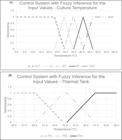
Membership functions for temperature control, with a setpoint of 35 °C: (A) Internal culture temperature; (B) Tank temperature (hot bath).
Some values for S(i), representing the tunable parameters of the heating controller, and SC(i), representing the tunable parameters of the cooling controller, were as follows: S1 = 10, S2 = 10, S3 = 5, S4 = 2, S5 = 2, SC1 = 5000, SC2 = 5000, SC3 = 4000, SC4 = 15000, and SC5 = 60000. Initially, the influence of the parameters S(i) and SC(i) on the response of the controlled variable was evaluated to identify which exhibited greater sensitivity in the specific case. Subsequently, these parameters were heuristically tuned to obtain their final values.
Therefore, it can be seen from the membership function graphs and the pseudocode that when the acquired temperature value is associated with the linguistic values “Very Low” or “Low” and “Low Tank Temperature”, this indicates that the process temperature is far from the established setpoint. In this case, the control action response is: “temperature below the desired value, so increase the power”, resulting in an increase of the heating power to raise the temperature. When the values “Optimal” and “Optimal Tank Temperature” are reached, this indicates that the system is at the desired setpoint, so the response from the control system is: “temperature at the setpoint, so maintain the power”. When the acquired temperature values start to oscillate between “Optimal” and “High”, and between “High Tank Temperature” and Optimal Tank Temperature”, the controller response is: “temperature starting to shift from the setpoint, so open the valve for cold water slightly to correct the temperature rise”. When the values correspond to the “High” or “Very High” and “High Tank Temperature” levels, the hot sector switches off completely and the controller response becomes: “fully activate the cold-water valve to lower the temperatures to “Optimal” and “Optimal Tank Temperature”, to maintain the system at the desired setpoint”. The program performs this operating loop to control the temperature variable during the entire process.
Before applying control system with fuzzy inference for the input values to the Saccharomyces cerevisiae cultivation, the behavior of the system was evaluated in a series of tests performed for different periods of time, with water at different temperatures. Oscillation of around 0.1 to 0.2 °C below the setpoint was observed, while before achieving the desired equilibrium of the temperature variable (setpoint ±0.2 °C), there were two small shoots, the first during heating (0.5 to 1 °C overshoot, above the setpoint) and the second during cooling (0.8 to 1 °C undershoot, below the setpoint). The shoots were related to the controller tuning and the external temperature conditions, such as the effect of the laboratory air conditioning, which was set at 20 °C. These results are shown in Figure 3A. The tests revealed that the two shoot peaks can be minimized if the initial culture and tank temperatures are similar, as shown in Figure 3B. Unfortunately, it was not always possible to select the initial system temperatures, since these were the perturbations that the controller needed to mitigate. Therefore, possible strategies were to i) retune the controller, ii) gradually alter the setpoint, avoiding any abrupt actions.

Tests with water, using different temperatures: (A) Oscillatory behavior of ±0.2 °C around the setpoint, after the two shoot peaks; (B) Similar initial culture and tank temperatures, minimizing the two shoot peaks.
The behavior of the control system with fuzzy inference for the input values developed here showed similarity to the findings of Fonseca and coauthors [26], who used a fuzzy PI and PID controller, and Yerolla, P and Besta [19], who used a PSO-PID (Particle Swarm Optimization-Proportional Integral Derivative) control system. The control described by Fonseca and coauthors [26], required fuzzy PI, PD, or PID controllers to obtain the parameter values by means of tuning (Ziegler-Nichols method). However, depending on the plant and process, it can be challenging to obtain these tuning variables. In the case of the PSO-PID system reported by Yerolla, P and Besta [19], a transfer function model was developed by linearization at the steady-state operating point, enabling optimization of the parameters of the PSO-PID controller. However, depending on the plant and process, obtaining the transfer function may be problematic. The control system developed here offers a simple alternative, since the code parameters can be adjusted by trial and error, with little prior knowledge of the plant. Furthermore, greater accuracy in the tuning of this controller may be achieved if performed by a process expert able to predict the necessary control action, according to the process condition. For example, a very cold temperature would necessitate more intense heating, while a temperature within 90% of the optimum would require a milder response from the controller. Intuitive knowledge of the process enables the operator to effectively adjust the parameters. In this work, the experts who developed the code, based on simple tests, were able to adjust the control parameters and obtain excellent performance for the process, applying ±0.2 °C of the setpoint, which represented an oscillation of around 0.6%.
It should be noted that temperature control of this bioreactor was previously performed with PID control, developed using the SUPERSYS software. The PID was usually tuned employing the closed-loop Ziegler-Nichols method, which was very slow and laborious, or the open-loop reaction curve method. Both methods provided approximate values of Kp, Ki, and Kd, which are parameters related to the dynamics of the process. The main difficulty was the highly complex nature of the process, which did not present linear behavior over time, so the values obtained for a given condition needed to be recalibrated for other conditions. In this sense, for non-linear processes, an adaptive control strategy could be an alternative, in which PID parameters are continuously adapted considering process variable values, as continuous changes in system dynamics can require periodic recalibration and adjustment to maintain optimal performance. Important to say, however, that adaptive PID is not the focus of this paper.
Figure 4 shows the responses of the control system with fuzzy inference for the input values and the previously tuned PID controller (non-adaptive), still testing with water. In these case, the PID presented oscillations both above the setpoint (heating sector) and below the setpoint (cooling sector), resulting in a temperature profile that resembles an on-off control in some extent, as reported elsewhere [52–54]. Important to say, PID was not badly tuned. On the contrary, the PID control whose result is shown in Figure 4 utilized an anti-reset windup mechanism implemented by means of a sub-VI in SUPERSYS. In this specific implementation, the integrator always resets when the error changes sign, and the integral value does not accumulate, preventing integral accumulation. However, despite this mechanism, the PID controller still exhibited oscillations (mainly due to the somewhat slow process of temperature change), which motivated the transition to control system with fuzzy inference for the input values. Table 1 shows the results of the performance tests, including the integral absolute error (IAE), the integral square error (ISE), the integral of time-weighted square error (ITSE), and the integral of time-weighted absolute error (ITAE), applied to the results for the control system and PID control (shown in Figure 4). It can be seen from Table 1 that in all the performance tests, the error values were lower for the control system, compared to the classical PID, demonstrating the superior performance of the control system with fuzzy inference for the input values.

Comparison of the Control system with fuzzy inference for the input values and PID control applied to the benchtop bioreactor.
Performance tests applied to the results obtained using the control system with fuzzy inference for the input values and the previously tuned PID controller: integral absolute error (IAE), integral square error (ISE), integral of time-weighted square error (ITSE), and integral of time-weighted absolute error (ITAE).
After the tests with water and comparison of the results with studies reported in the literature [19,26], two tests were performed using real cultivations of Saccharomyces cerevisiae for ethanol production. The temperature profiles of the process are shown in Figure 5.

(A) Control system with fuzzy inference for the input values applied to cultivations of Saccharomyces cerevisiae. (B) Image zoom.
Statistical analysis for the repeated runs indicated a low standard deviation of 0.03 oC (maximum value). In fact, the agreement between the curves is visible. Accordingly, ITAE for the runs were also very similar (12.91 and 13.30 °C.h2). Thus, the control system was able to maintain the temperature close to the setpoint value, with a small oscillation that was the same as in the tests with water.
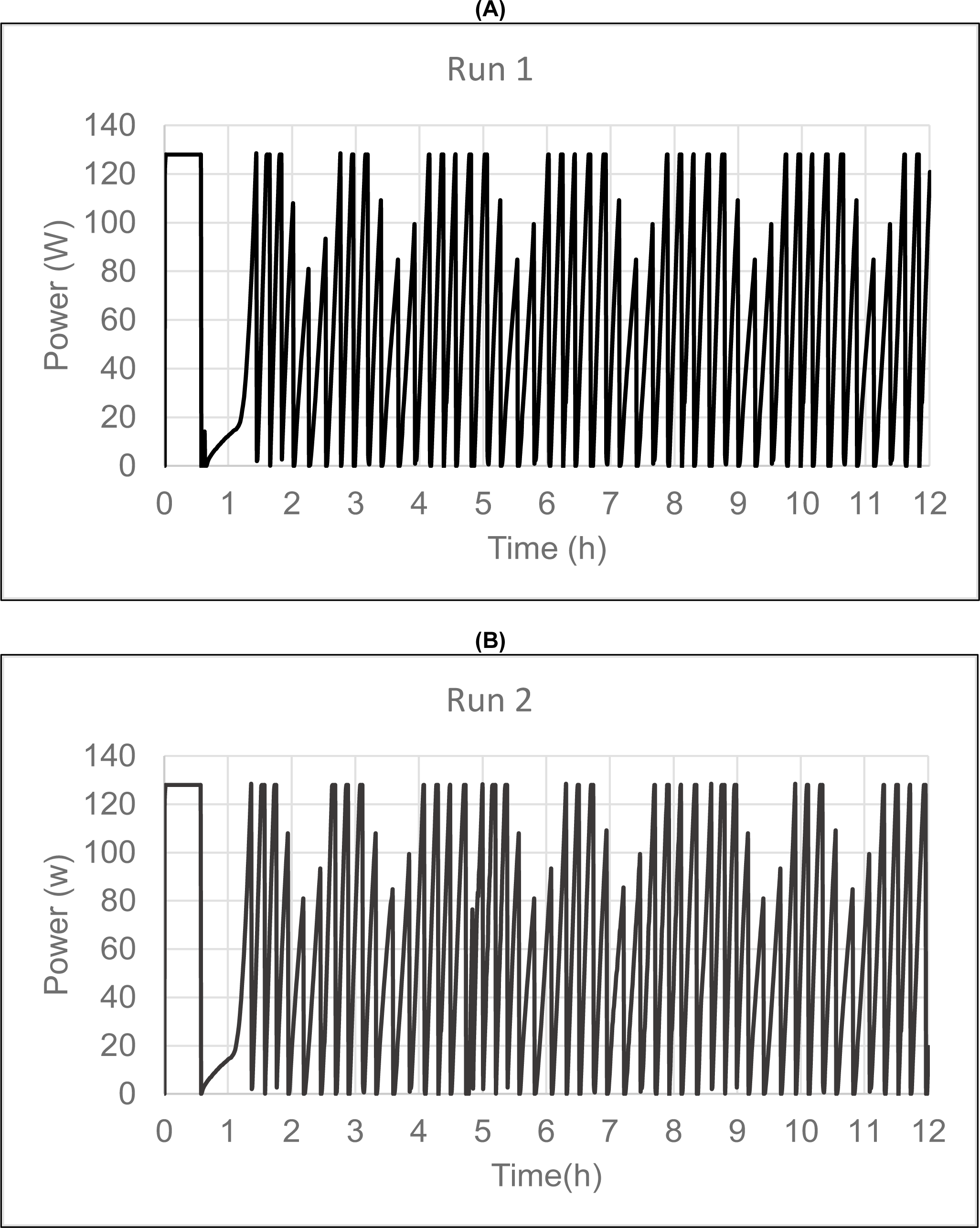
As an additional effort, analysis of the power of the electric heating element is presented in Figure 6.

It is important to say that the power profile showed reflects a viable performance from an energetic point of view. It would be undesirable, for example, if the behavior were to maintain operation close to maximum power throughout the test. However, as can be seen, this does not occur. On the contrary, there is an alternation between minimum and maximum power (average power of run 1, Figure 6A, equal to 58.30 W; average power of run 2, Figure 6B, equal to 59.49 W; Average power between the two runs and the respective standard deviation equal to 58.90 ± 0.84 W). From a broader perspective, we believe that it can be stated that scale-up would be favored and viable.
As reported here and in the literature [15,19], temperature control is a crucial factor in the alcoholic fermentation process involving the production of biomass and ethanol. According to Góes-Favoni and coauthors [55], the optimal temperature for production of biomass and ethanol is in the range from 25 to 36 °C. Outside this range, temperatures below 25 °C result in slow metabolism and growth activity of the yeast, with low product formation, while temperatures above 36 °C lead to increased toxicity of ethanol, the main product.
Figure 7 shows, the changes in the concentrations of glucose, ethanol, and biomass during run 2 (best result). The anaerobic conditions of the process favored ethanol production. In this 12-hour fermentation, the lag phase occurred up to 4 h, the log phase was between 4 and 10 h, and the stationary phase was from 10 to 12 h.

Results for cultivation of Saccharomyces cerevisiae in synthetic medium: (A) Glucose consumption, ethanol production, and microbial growth; (B) Substrate conversion to ethanol.
As shown in Figure 7B, after 9 h the yeast had consumed almost all the glucose in the medium and achieved a high level of ethanol production. According to the works by Ruchala and coauthors [57] and Semkiv and coauthors [58], the transformation of glucose by S. cerevisiae occurs according to the Embden-Meyerhof-Parnas (EMP) pathway, with anaerobic production of 2 mol of ethanol for each 1 mol of glucose consumed, providing a maximum concentration of around 7-11% (v/v). The ethanol yield accompanies the glucose consumption and may be up to 93%, with volumetric productivity in the range from 4.6 to 10 gethanol.L-1.h-1 [49,59]. Table 2 shows the results obtained in the fermentation.
Results for the fermentation using S. cerevisiae. The values were calculated for a 12-h fermentation without aeration or addition of other components.
As shown in Table 2 and Figure 7, the substrate-to-product conversion factor (YP/S) was 0.42 ± 0.02 gethanol.gsubstrate-1, with volumetric productivity (QP) of 5.275 gethanol.L-1.h-1 and fermentation efficiency (E) of 82.47%. These values showed that the yeast was able to develop satisfactorily under the process conditions, with consumption of almost all the glucose (99.36%).
Mesquita and coauthors [47], reproduced, in the laboratory, the experimental conditions of the “Brazilian Bioethanol Plant”, which is the fed-batch followed by batch cultivation used for ethanol production in most Brazilian sugarcane processing plants. The tank is first fed an initial inoculum of yeast at a very high concentration, followed by addition of molasses, usually at a constant flow rate, until reaching the final working volume. The process continues as a batch fermentation, until total consumption of fermentable sugars. The process is anaerobic, with no air input or inlet gas flow.
The results obtained here revealed superior productivity, compared to the work of Mesquita and coauthors [47]. This strongly indicated that the control system with fuzzy inference for the input values provided more efficient temperature regulation, compared to the PID controller, consequently increasing the final yield of the process. Temperature has direct effects on yeast growth, cell viability, and ethanol production. For the same substrate, the biomass yield and the ethanol yield coefficient vary, depending on the process temperature. It should be noted that Mesquita and coauthors [47] used the PID temperature control shown in Figure 4. As very properly stated by Yerolla, P and Besta [19], effective temperature regulation is essential for enhancing ethanol production, as it directly affects the yield, efficiency, and quality of the final product. Biological systems are extremely responsive to changes in temperature, highlighting the significance of precise temperature regulation to ensure the desired quality and productivity of the output [60]. The genetic modifications that allow yeast strains to adapt to high temperatures have led to an increased ability to withstand the restrictive circumstances commonly seen in commercial ethanol production. This highlights the importance of temperature in boosting ethanol production [61].
Table 3 provides a comparison of the results obtained here and those reported in other studies using the same synthetic medium and a wild yeast strain. The highest ethanol conversion rate and the highest final product concentration were obtained in the present work, despite not using advanced microaeration techniques or recombinant/adapted yeasts. Ethanol production could be further enhanced by the application of microaeration techniques, or even the inclusion of acidic compounds, as employed in other studies [62,63].
Therefore, the temperature regulation provided by the control system with fuzzy inference for the input values ensured appropriate conditions for optimizing the fermentation process and maximizing the yield of the desired product. The flexibility of the structure of this control system enables its use with any type of bioreactor, including the airlift design and others. In addition to the economic benefits associated with increased productivity, the system can reduce energy consumption, since the power profile reflects a viable performance from an energetic point of view, as well as reduce the final volume of vinasse, because the process achieves a higher final concentration of the desired product. Hence, the use of this control system can increase bioprocess sustainability.
CONCLUSION
A control system with fuzzy inference for the input values was implemented via arduino to control the temperature variable. First, a series of tests were carried out with water at different temperatures and for different lengths of time, to check the system's behavior. In the tests with water, for different temperatures, an oscillation of approximately ±0.2 °C below the setpoint was observed, which in this case represents approximately 0.6% oscillation. Before achieving the desired balance of the temperature variable, two small shoots were observed, the first during heating (0.5 to 1 °C above the setpoint) and the second during cooling (0.8 to 1 °C below the setpoint). The shoots observed depend on the controller's tuning and also on external temperature conditions, such as interference from laboratory air conditioning. In the tests on the real cultivation of Saccharomyces cerevisiae for ethanol production, the control system kept the temperature close to the setpoint value, with a small oscillation, the same observed in the tests with water. Obtaining an alcoholic fermentation with a substrate-to-product conversion factor of 0.42 ± 0.02 gethanol.gsubstrate-1, with a volumetric productivity of 5.275 gethanol.L-1.h-1 and a fermentation efficiency of 82.47%. Therefore, the temperature control brought about by the system provided the right conditions to improve the fermentation process. The implemented system guarantees lower energy consumption as well as reducing the final volume of vinasse. Consequently, the control system with fuzzy inference for the input values increases the degree of sustainability of the bioprocess in question.
Funding:
Institutional Review Board Statement:
Informed Consent Statement:
Data Availability Statement:
Research data are available in the body of the manuscript.
Acknowledgments:
The authors have no additional acknowledgments to declare.
Use of Generative Artificial Intelligence:
REFERENCES
-
1 Aguiar DRD, Taheripour F, Silva DAL. Ethanol fuel in Brazil: policies and carbon emission avoidance. Biofuels. 2024;16(3):248–58. Available from: https://doi.org/10.1080/17597269.2024.2405765
» https://doi.org/10.1080/17597269.2024.2405765 - 2 Soares AA, Zukowski JCJ. [Brazil as a big player in the global ethanol market]. Rev. Polit. Agric. 2021:57–71.
- 3 De Oliveira Lino FS, Garg S, Li SS, Misiakou MA, Kang K, Vale da Costa BL, et al. Strain dynamics of contaminating bacteria modulate the yield of ethanol biorefineries. Nat. Commun. 2024;15(1): 1–12.
-
4 Nascimento VM, Fonseca GG. Effects of the carbon source and the interaction between carbon sources on the physiology of the industrial Saccharomyces cerevisiae CAT-1. Prep. Biochem. Biotechnol. 2020;50(4):349–56. Available from: https://doi.org/10.1080/10826068.2019.1703192
» https://doi.org/10.1080/10826068.2019.1703192 -
5 Engel SR, Dietrich FS, Fisk DG, Binkley G, Balakrishnan R, Costanzo MC, et al. The Reference Genome Sequence of Saccharomyces cerevisiae?: Then and Now. G3: Genes Genomes Genet. 2014;4(3):389–98. Available from: https://academic.oup.com/g3journal/article/4/3/389/6025598
» https://academic.oup.com/g3journal/article/4/3/389/6025598 -
6 Galao RP, Scheller N, Alves-Rodrigues I, Breinig T, Meyerhans A, Díez J. Saccharomyces cerevisiae: a versatile eukaryotic system in virology. Microb. Cell Fact. 2007;6(1):32. Available from: https://microbialcellfactories.biomedcentral.com/articles/10.1186/1475-2859-6-32
» https://microbialcellfactories.biomedcentral.com/articles/10.1186/1475-2859-6-32 -
7 Boscaino V, Ditta V, Marsala G, Panzavecchia N, Tinè G, Cosentino V, et al. Grid-connected photovoltaic inverters: Grid codes, topologies and control techniques. Renew. Sustain. Energy Rev. 2024;189:113935. Available from: https://linkinghub.elsevier.com/retrieve/pii/S136403212300761X
» https://linkinghub.elsevier.com/retrieve/pii/S136403212300761X - 8 Chavez CM, Groenewald M, Hulfachor AB, Kpurubu G, Huerta R, Hittinger CT, et al. The cell morphological diversity of Saccharomycotina yeasts FEMS Yeast Res. 2024;24:1–9.
-
9 Utama GL, Dio C, Sulistiyo J, Yee Chye F, Lembong E, Cahyana Y, et al. Evaluating comparative β-glucan production aptitude of Saccharomyces cerevisiae, Aspergillus oryzae, Xanthomonas campestris, and Bacillus natto Saudi J. Biol. Sci. 2021;28(12):6765–73. Available from: https://doi.org/10.1016/j.sjbs.2021.07.051
» https://doi.org/10.1016/j.sjbs.2021.07.051 - 10 Topaloğlu A, Esen Ö, Turanlı-Yıldız B, Arslan M, Çakar ZP. From Saccharomyces cerevisiae to Ethanol: Unlocking the Power of Evolutionary Engineering in Metabolic Engineering Applications. J. Fungi. 2023;9(10):984.
-
11 Oliveira MRB, da Silva APM, Faria TM, Basso LC, Baptista AS. Protective Effect of Silica on Adaptation of Saccharomyces cerevisiae, Ethanol Red® for Very High Gravity Fermentation. Braz. Arch. Biol. Technol. 2023;66. Available from: https://doi.org/10.1590/1678-4324-2023210416
» https://doi.org/10.1590/1678-4324-2023210416 - 12 Xavier LM. [Analysis of the differential gene expression profile of laboratory and wild-type Saccharomyces cerevisiae strains under different stresses using bioinformatics tools]. [Master's dissertation]. Vitória, Espírito Santo: Federal University of Espírito Santo; 2015.
-
13 Karapatsia A, Penloglou G, Chatzidoukas C, Kiparissides C. Fed-batch Saccharomyces cerevisiae fermentation of hydrolysate sugars: A dynamic model-based approach for high yield ethanol production. Biomass Bioenerg. 2016;90:32–41. Available from: http://dx.doi.org/10.1016/j.biombioe.2016.03.021
» http://dx.doi.org/10.1016/j.biombioe.2016.03.021 - 14 Rebello FR. [Optimization and verification of microbiological methods used in the quality control of oral medications]. [Master’s dissertation]. Rio de Janeiro, Rio de Janeiro: Institute of Pharmaceutical Technology – FIOCRUZ; 2015.
-
15 Phong HX, Klanrit P, Dung NTP, Thanonkeo S, Yamada M, Thanonkeo P. High-temperature ethanol fermentation from pineapple waste hydrolysate and gene expression analysis of thermotolerant yeast Saccharomyces cerevisiae Sci. Rep. 2022;12(1):13965. Available from: https://doi.org/10.1038/s41598-022-18212-w
» https://doi.org/10.1038/s41598-022-18212-w -
16 Samtani H, Unni G, Khurana P. Microbial Mechanisms of Heat Sensing. Indian J. Microbiol. 2022;62(2):175–86. Available from: https://doi.org/10.1007/s12088-022-01009-w
» https://doi.org/10.1007/s12088-022-01009-w - 17 Almeida LP, Silva CR, Martins TB, Pereira RD, Esperança MN, Cruz AJG, et al. Heat transfer evaluation for conventional and extractive ethanol fermentations: Saving cooling water. J. Clean. Prod. 2021;304:127063.
- 18 Lima U de A. [Industrial biotechnology: Fermentation and enzymatic processes]. 2nd ed. Vol. 3. São Paulo: Blucher; 2019.
-
19 Yerolla R, P S, Besta CS. Advanced temperature control in ethanol fermentation using a PSO-PID controller with split-range control strategy. Prep. Biochem. Biotechnol. 2025;55(2):196–209. Available from: https://doi.org/10.1080/10826068.2024.2381761
» https://doi.org/10.1080/10826068.2024.2381761 -
20 Alagoz BB, Ates A, Yeroglu C, Senol B. An experimental investigation for error-cube PID control. Trans. Inst. Meas. Control. 2015;37(5):652–60. Available from: https://doi.org/10.1177/0142331214527476
» https://doi.org/10.1177/0142331214527476 - 21 Puviyarasi B, Murukesh C, Alagiri M. Design and implementation of gain scheduling decentralized PI/PID controller for the fluid catalytic cracking unit. Biomed. Signal Process. Control. 2022;77:103780.
-
22 Zadeh LA. Fuzzy sets. Inf. Control. 1965;8(3):338–53. Available from: https://doi.org/10.1016/S0019-9958(65)90241-X
» https://doi.org/10.1016/S0019-9958(65)90241-X - 23 Elnour M, Taha WIM. PID and fuzzy logic in temperature control system. In: Proceedings - 2013 International Conference on Computer, Electrical and Electronics Engineering: “Research Makes a Difference”, ICCEEE 2013. 2013. p. 172–7.
- 24 Cesmat J, Mcandrew J. The Significance of PID Tuning within Biopharmaceutical Processes. DISTEK. 2022;(223):1–8.
-
25 Ławryńczuk, M. Modelling and Nonlinear Predictive Control of a Yeast Fermentation Biochemical Reactor Using Neural Networks. Chem. Eng. J. 2008;145: 290–307, Available from: https://doi.org/10.1016/j.cej.2008.08.005
» https://doi.org/10.1016/j.cej.2008.08.005 -
26 Fonseca RR, Schmitz JE, Fileti AMF, da Silva FV. A fuzzy–split range control system applied to a fermentation process. Bioresour. Technol. 2013;142:475–82. Available from: http://dx.doi.org/10.1016/j.biortech.2013.05.083
» http://dx.doi.org/10.1016/j.biortech.2013.05.083 -
27 Tsebesebe NT, Mpofu K, Sivarasu S, Mthunzi-Kufa P. Arduino-Based Devices in Healthcare and Environmental Monitoring. Discov. Internet Things. 2025;5:46. Available from: https://doi.org/10.1007/s43926-025-00139-z
» https://doi.org/10.1007/s43926-025-00139-z - 28 Campani G, dos Santos MP, da Silva GG, Horta ACL, Badino AC, de Campos Giordano R, et al. Recombinant protein production by engineered Escherichia coli in a pressurized airlift bioreactor: A techno-economic analysis. Chem. Eng. Process. Process Intensif. 2016;103:63–9.
- 29 Horta ACL, da Silva AJ, Sargo CR, Cavalcanti-Montaño ID, Galeano-Suarez ID, Velez AM, et al. On-line monitoring of biomass concentration based on a capacitance sensor: assessing the methodology for different bacteria and yeast high cell density fed-batch cultures. Braz. J. Chem. Eng. 2015;32(4):821–9.
-
30 Horta ACL, da Silva AJ, Sargo CR, Gonçalves VM, Zangirolami TC, de Campos Giordano R. Robust artificial intelligence tool for automatic start-up of the supplementary medium feeding in recombinant E. coli cultivations. Bioprocess Biosyst. Eng. 201;34(7):891–901. Available from: http://link.springer.com/10.1007/s00449-011-0540-0
» http://link.springer.com/10.1007/s00449-011-0540-0 -
31 Akisue RA, Harth ML, Horta ACL, de Sousa Junior R. Optimized dissolved oxygen fuzzy control for recombinant Escherichia coli cultivations. Algorithms. 2021;14(11):1–22. Available from: https://www.mdpi.com/1999-4893/14/11/326
» https://www.mdpi.com/1999-4893/14/11/326 - 32 Akisue RA. [Implementation of a fuzzy system for dissolved oxygen control in Escherichia coli culture for recombinant protein expression]. [PhD thesis]. São Carlos, São Paulo: Federal University of São Carlos; 2022.
- 33 Horta ACL. [Automated system for monitoring and controlling high-density cell cultures of recombinant E. coli]. [PhD thesis]. São Carlos, São Paulo: Federal University of São Carlos; 2011.
- 34 Gomide FAC, Gudwin RR, Tanscheit R. [Fundamental concepts of fuzzy set theory, fuzzy logic, and applications]. Proc 6 th IFSA Congr. 1995;(July):1–38.
-
35 Baskar M, Jamuna V. Green Energy Generation Using FLC Based WECS With Lithium Ion Polymer Batteries. Braz. Arch. Biol. Technol. 2016;59(spe2):1–15. Available from: https://doi.org/10.1590/1678-4324-2016161013
» https://doi.org/10.1590/1678-4324-2016161013 - 36 Zuffo AC. [Multicriteria analysis for water resources planning: a fuzzy methodology for an environmental approach]. [PhD thesis]. Campinas, São Paulo: State University of Campinas; 2010.
-
37 Guillaume S, Charnomordic B. Fuzzy inference systems: An integrated modeling environment for collaboration between expert knowledge and data using FisPro. Expert Syst. Appl. 2012;39(10):8744–55. Available from: http://dx.doi.org/10.1016/j.eswa.2012.01.206
» http://dx.doi.org/10.1016/j.eswa.2012.01.206 -
38 Mamdani EH, Assilian S. An experiment in linguistic synthesis with a fuzzy logic controller. Int. J. Man-Mach. Stud. 1975;7(1):1–13. Available from: https://linkinghub.elsevier.com/retrieve/pii/S0020737375800022
» https://linkinghub.elsevier.com/retrieve/pii/S0020737375800022 -
39 Artur APS, Abreu BMPN, de Lima Oliveira LJP, Gontijo KSJ, Cardozo TTM, Laizo WS, et al. Use of Fuzzy Logic To Demonstrate Possibility of Health System Collapse Due To Coronavirus Pandemic. Braz. J. Dev. 2021;7(1):1455–66. Available from: https://www.brazilianjournals.com/index.php/BRJD/article/view/22679/18173
» https://www.brazilianjournals.com/index.php/BRJD/article/view/22679/18173 -
40 Muniraj M, Ramaswamy A. Optimization and Validation of Model Predictive Controller (MPC) Approach for Wind Turbine Energy System in Domestic Loads. Braz. Arch. Biol. Technol. 2023;66:1–8. Available from: https://doi.org/10.1590/1678-4324-2023210791
» https://doi.org/10.1590/1678-4324-2023210791 -
41 Ferreira CM, Akisue RA, de Sousa Júnior R. Mathematical Modeling and Computational Simulation Applied to the Study of Glycerol and/or Molasses Anaerobic Co-Digestion Processes. Processes. 2023;11(7):2121. Available from: https://www.mdpi.com/2227-9717/11/7/2121
» https://www.mdpi.com/2227-9717/11/7/2121 -
42 Oliveira DSBL, Colmati F, Gonzalez ER, de Sousa Junior R. Neurofuzzy modelling on the influence of Pt–Sn catalyst properties in direct ethanol fuel cells performance: Fuzzy inference system generation and cell power density optimization. Int. J. Hydrog. Energy. 2023;48(63):24481–91. Available from: https://doi.org/10.1016/j.ijhydene.2023.03.137
» https://doi.org/10.1016/j.ijhydene.2023.03.137 -
43 Borges AS, Montano IDC, Sousa Junior R, Suarez CAG. Automatic solids feeder using fuzzy control: A tool for fed batch bioprocesses. J. Process Control. 2020;93:28–42. Available from: https://doi.org/10.1016/j.jprocont.2020.07.006
» https://doi.org/10.1016/j.jprocont.2020.07.006 -
44 Silva Artur AP, Paterline Novais Abreu BM, De Lima Oliveira LJP, Nucci ER. Application of Fuzzy logic for the analysis of the pandemic (COVID-19), if there was no social isolation. Rev. Saúde (St. Maria, Online). 2020;46(2). Available from: https://doi.org/10.5902/2236583447080
» https://doi.org/10.5902/2236583447080 -
45 Da Silva LM, Gonçalves RM, Ferreira LM, Aristides da Silva EJ, Da Silva BQ. [State-of-art of fundamentals and ideas of fuzzy logic applied to science and technology]. Rev. Bras. Geomát. 2019;7(3):149. Available from: https://periodicos.utfpr.edu.br/rbgeo/article/view/9365
» https://periodicos.utfpr.edu.br/rbgeo/article/view/9365 -
46 Bressan GM, Azevedo BCF de, Souza RM de. A Fuzzy Approach for Diabetes Mellitus Type 2 Classification. Braz. Arch. Biol. Technol. 2020;63. Available from: https://doi.org/10.1590/1678-4324-2020180742
» https://doi.org/10.1590/1678-4324-2020180742 -
47 Mesquita TJB, Sargo CR, Fuzer JR, Paredes SAH, Giordano RDC, Horta ACL, et al. Metabolic fluxes-oriented control of bioreactors: A novel approach to tune micro-Aeration and substrate feeding in fermentations. Microb. Cell Fact. 2019;18(1):1–17. Available from: https://doi.org/10.1186/s12934-019-1198-6
» https://doi.org/10.1186/s12934-019-1198-6 - 48 Ramos MDN, de Souza JPM, Milessi TS, Zangirolami TC. Development of a Protocol for Commercial Baker Yeast Propagation Aiming Its Application in Bioprocesses. Advances Renew Clean Energy Technol. 2022;7.
-
49 Mesquita TJB, Sandri JP, De Campos Giordano R, Horta ACL, Zangirolami TC. A High-Throughput Approach for Modeling and Simulation of Homofermentative Microorganisms Applied to Ethanol Fermentation by S. cerevisiae Ind. Biotechnol. 2021;17(1):13–26. Available from: https://www.liebertpub.com/doi/10.1089/ind.2020.0034
» https://www.liebertpub.com/doi/10.1089/ind.2020.0034 - 50 Shuler ML, Kargi F. Bioprocess Engineering Basic Concepts. 2nd ed. Upper Saddle River, NJ: Prentice-Hall; 2002. 577 p.
-
51 Della-Bianca BE, Basso TO, Stambuk BU, Basso LC, Gombert AK. What do we know about the yeast strains from the Brazilian fuel ethanol industry? Appl. Microbiol. Biotechnol. 2013;97(3):979–91. Available from: http://link.springer.com/10.1007/s00253-012-4631-x
» http://link.springer.com/10.1007/s00253-012-4631-x -
52 Dulău M. Experiments on Temperature Control Using On-Off Algorithm Combined with PID Algorithm. Acta Marisiensis, Ser. Technol. 2019;16(1):5–9. Available from: https://www.sciendo.com/article/10.2478/amset-2019-0001
» https://www.sciendo.com/article/10.2478/amset-2019-0001 - 53 Pereira Silva FH. On/Off Control Versus PID Control: A Comparative Case Study On Condensers of Cooling Systems. In: Proceedings of The 4th International Conference on Advanced Research in Applied Science and Engineering. Brussels, Belgium: GLOBALKS; 2022. p. 13.
-
54 Ulpiani G, Borgognoni M, Romagnoli A, Di Perna C. Comparing the performance of on/off, PID and fuzzy controllers applied to the heating system of an energy-efficient building. Energy Build. 2016;116(2016):1–17. Available from: http://dx.doi.org/10.1016/j.enbuild.2015.12.027
» http://dx.doi.org/10.1016/j.enbuild.2015.12.027 - 55 Góes-Favoni SP de, Monteiro ACC, Dorta C, Crippa MG, Shigematsu E. [Ethanol production by alcoholic fermentation and its yield-determining factors]. Rev. Ibero-Am. Ciênc. Ambient. 2018;9(4):285–96.
- 56 Furlani JMS. [Influence of phenolic compounds in the fermentation of glucose to ethanol by Saccharomyces cerevisiae PE-2 and baker’s yeast Saccharomyces cerevisiae and identification of their bioconversion products]. [PhD thesis]. São Paulo, São Paulo: University of São Paulo; 2014.
-
57 Ruchala J, Kurylenko OO, Dmytruk KV, Sibirny AA. Construction of advanced producers of first- and second-generation ethanol in Saccharomyces cerevisiae and selected species of non-conventional yeasts (Scheffersomyces stipitis, Ogataea polymorpha). J. Ind. Microbiol. Biotechnol. 2020;47(1):109–32. Available from: https://doi.org/10.1007/s10295-019-02242-x
» https://doi.org/10.1007/s10295-019-02242-x -
58 Semkiv MV, Dmytruk KV, Abbas CA, Sibirny AA. Increased ethanol accumulation from glucose via reduction of ATP level in a recombinant strain of Saccharomyces cerevisiae over expressing alkaline phosphatase. BMC Biotechnol. 2014,14(1):42. Available from: https://bmcbiotechnol.biomedcentral.com/articles/10.1186/1472-6750-14-42
» https://bmcbiotechnol.biomedcentral.com/articles/10.1186/1472-6750-14-42 -
59 Amorim HV, Lopes ML, de Castro Oliveira JV, Buckeridge MS, Goldman GH. Scientific challenges of bioethanol production in Brazil. Appl. Microbiol. Biotechnol. 2011;91(5):1267–75. Available from: http://link.springer.com/10.1007/s00253-011-3437-6
» http://link.springer.com/10.1007/s00253-011-3437-6 -
60 Lisci S, Grosso M, Tronci S. Different Control Strategies for a Yeast Fermentation Bioreactor. IFAC-PapersOnLine. 2021; 54: 306–11, Available from: https://doi.org/10.1016/j.ifacol.2021.08.259
» https://doi.org/10.1016/j.ifacol.2021.08.259 -
61 Caspeta L, Nielsen J. Thermotolerant Yeast Strains Adapted by Laboratory Evolution Show Trade-Off at Ancestral Temperatures and Preadaptation to Other Stresses. MBio. 2015; 6. Available from: https://doi.org/10.1128/mbio.00431-15
» https://doi.org/10.1128/mbio.00431-15 -
62 Costa MAS, Cerri BC, Ceccato-Antonini SR. Ethanol addition enhances acid treatment to eliminate Lactobacillus fermentum from the fermentation process for fuel ethanol production. Lett. Appl. Microbiol. 2018;66(1):77–85. Available from: https://academic.oup.com/lambio/article/66/1/77/6699051
» https://academic.oup.com/lambio/article/66/1/77/6699051 -
63 Mesquita TJB, Campani G, Giordano RC, Zangirolami TC, Horta ACL. Machine learning applied for metabolic flux‐based control of micro‐aerated fermentations in bioreactors. Biotechnol. Bioeng. 2021;118(5):2076–91. Available from: https://doi.org/10.1002/bit.27721
» https://doi.org/10.1002/bit.27721 -
64 Colombi BL, Ortiz MA, Zanoni PRS, Magalhães WLE, Tavares LBB. [Effect of inhibiting compounds on the bioconversion of glucose to ethanol by the yeast Saccharomyces cerevisiae]. Engevista. 2017;19(2):339. Available from: https://doi.org/10.22409/engevista.v19i2.838
» https://doi.org/10.22409/engevista.v19i2.838


 *Legend: VLT - Very Low Temperature; LT - Low Temperature; ET - Excellent Temperature; HT - High Temperature; VHT - Very High Temperature; TTL - Tank Temperature Low; TTE - Tank Temperature Excellent; TTH - Tank Temperature High.