 Decolourization Kinetics of Congo Red Using Immobilized and Free Cells of Rhodococcus biphenylivorans
Abstract
In the present study, a cost-effective and eco-friendly approach is being explored to remove the harmful dye Congo red from synthetic wastewater, using an equatorial strain of Rhodococcus biphenylivorans. The immobilized cells’ Congo red-decolorizing activity in calcium alginate showed an increase of 217% compared to the free cells. By improving the alginate concentration to 4% (w/v), the bead diameter to 3 mm and using 50 beads, a 67% decrease in the time required for complete decolorization was accomplished. Both free and immobilized cells followed first-order kinetics for the elimination of Congo red, with immobilized cells displaying a decolorization rate 3.2 times greater than that of free cells, resulting in an 84% reduction in half-life. The immobilized cells displayed the capability to remove 0.10 g/L Congo red without any significant decline in their efficiency for up to twelve cycles, offering an economic advantage due to their reusability. Examining the decolorized products of Congo red showed no hindrance in the germination of Triticum aestivum and Vigna radiata, indicating the effective removal of all toxic components from the original dye via the biological method. Therefore, this strain has significant potential as a biological agent to eliminate wastewater contaminated with Congo red efficiently.
Keywords:
Congo red; decolorization; immobilization; kinetic study; Rhodococcus biphenylivorans
HIGHLIGHTS
Immobilized cells increased Congo red-decolorizing activity by 217%.
Immobilized cells removed Congo red efficiently for 12 cycles without decline.
Effective toxic component removal was revealed through a phytotoxicity study.
Rhodococcus discovery boosts local biodiversity for effective bioremediation.
INTRODUCTION
Congo red (C.I. No. 22120, Direct Red 28) is an azo dye that can dissolve in water (as the sodium salt of 3,3′-([1, -biphenyl]-4,4′-diyl) bis (4-aminonaphthalene-1-sulfonic acid)), but has greater solubility in organic solvents [1]. It is commonly used in a variety of applications such as dyeing textiles and paper products, as well as an acid-base indicator, a means of detecting bacteria and protein folding disorders, and a treatment for dermatological disorders, neurodegenerative diseases and Alzheimer's disease [2]. Congo red is also frequently used as an indicator dye in laboratory tests [2]. However, due to its mutagenic and mitotic properties, it has been identified as a potential carcinogen [3]. When released as wastewater, it can cause water discoloration and irritation or ruptures on sensitive skin, as well as permanent corneal damage from prolonged exposure. As a result, there is a pressing need to remove Congo red from the environment to eliminate these issues.
There are a variety of physico-chemical methods that have been employed to address polluted dye wastewater, such as coagulation, precipitation, membrane separation, electrochemical treatment, photo-catalysis, ion exchange and adsorption [4,5]. However, the expense of treatment for these methods is considerable and they generate a substantial amount of hazardous waste that is difficult to break down, which restricts their practical use [6]. The eco-friendly process of biological degradation of pollutants has been discovered to fully mineralize organic compounds while producing a small amount of sludge. This approach is highly effective and advantageous because it is simple, affordable and ecologically conscious. Additionally, a plethora of microorganisms are readily available and require minimal preparation and maintenance, further enhancing its appeal as a preferred treatment method [7].
There has been a growing recognition that the Rhodococcus genus holds significant promise for various bioremediation applications. As a result, there has been an increase in research and interest from the scientific community worldwide, as evidenced by a rise in publications and patents related to rhodococci over the past several years [8]. Due to their metabolic flexibility, capacity to break down a diverse array of carbon-based compounds and resilience to several of stressors namely metal poisoning, dryness and excessive levels of organic solvents, bacterial species classified under the genus Rhodococcus are well-suited for employment in microbial biotechnology applications [9]. Moreover, Rhodococcus spp. strains exhibit unique biosynthetic activities, enabling them to persist and thrive in challenging and polluted environments, giving them a competitive edge over other microorganisms [9]. Despite the potential benefits of using microorganisms in biodegradation, certain challenges need to be addressed. These challenges include limited stability under unfavorable environmental conditions, difficulties in recovery and the inability to reuse the microorganisms [10]. To overcome these issues, considerable efforts have been devoted to enhancing the robustness and functionality of the biological agent using immobilization technology.
The utilization of immobilized cells offers several distinct advantages compared to free forms for bioremediation purposes. For instance, immobilization technology allows the biocatalyst to be removed effortlessly from treated water, provides longer endurance times, enhances stability and enables reusability without any reduction in activity [11]. In particular, there are several undeniable benefits associated with utilizing calcium alginate as an immobilization matrix. These advantages include its eco-friendly nature, non-toxicity, biodegradability, the ability to manufacture under mild conditions and relatively low production costs [12]. Therefore, the goal of the current study is to evaluate and compare the effectiveness of decolorizing Congo red using both immobilized and free cells of Rhodococcus biphenylivorans. Additionally, the study seeks to explicate the kinetic properties of the decolorization process and evaluate the biocatalyst's reusability for multiple cycles. After the breakdown of Congo red by the immobilized cells of Rhodococcus biphenylivorans, the resulting metabolites were evaluated for phytotoxicity and contrasted against the parent dye. As far as we are aware, this is the first investigation to utilize immobilized cells of Rhodococcus biphenylivorans isolated from mangrove water for efficient decolorization of Congo red.
MATERIAL AND METHODS
Chemicals
The study employed commercially available chemicals of analar grade. These chemicals were procured from Vivantis Technologies Sdn Bhd (Malaysia) and R&M Chemicals (UK).
Microorganism
Rhodococcus biphenylivorans was isolated from samples of mangrove water collected from Sungai Buloh in Selangor, Malaysia. The Culture Collection Unit of the Institute of Bio-IT Selangor, University of Selangor conserved and stored Rhodococcus biphenylivorans as a routine procedure [13]. The strain was added in GenBank® (NCBI) and assigned the reference number MN56071 [14].
Kinetic study
The discoloration of Congo red was studied with slight modifications to the systematic approach originally illustrated by Maniyam and coauthors [15]. Specifically, the protocol for preparing the inoculum, resting cells (free cells) and immobilization method using calcium alginate was followed, while testing two different concentrations of Congo red (0.04 g/L and 0.10 g/L). To evaluate Congo red-decolorizing activity, 50 bead-bound cells or an equivalent suspended cell mass were incubated at 30°C, pH 7 and 0 rpm for 24 h. The negative control investigations were conducted in the absence of resting cells and empty beads (cell-free beads) to assess biosorption on the carrier matrix and non-biological loss, respectively. To quantify the Congo red-decolorizing activity as a percentage, Equation 1 was utilized, and the measurement was taken at a wavelength of 498 nm.
The discoloration of Congo red can be described by first-order reaction kinetics in relation to various dye amounts, as shown in Equation 2 below:
In Equation 2, C0 denotes the initial loading of Congo red in g/L, while the amount of Congo red in g/L at time t (in h) is represented by C. The first-order reaction rate constant for Congo red removal (per h) is denoted by k. Additionally, Equation 3 can be used to determine the half-life for removing Congo red by Rhodococcus biphenylivorans.
Effect of different immobilization factors on the decolorization of Congo red and repeated use of the immobilized cells
To achieve beads that possess both efficient Congo red-decolorizing capability and strong mechanical properties, different factors were explored such as alginate solutions of different strengths (concentrations ranging from 1% to 5% w/v), bead quantity (ranging from 10 to 50) and bead sizes (ranging from 1 to 5 mm).
Once the immobilized beads had effectively decolorized 0.10 g/L of Congo red, the beads were recovered by filtration and subjected to three washes using a sterilized 0.1 M NaCl solution. The purified beads were subsequently immersed in a fresh solution containing 0.10 g/L Congo red. The incubation process was extended for an additional 8 hours to assess Congo red removal activity. This process was duplicated a number of times up to when the Congo red-decolorizing activity decreased by 25% compared to the initial activity. Cell escape was evaluated using the techniques established by Maniyam and coauthors [15].
Phytotoxicity study
Ten viable plant seeds of Triticum aestivum and Vigna radiata were individually positioned on filter paper beds in separate Petri dishes. On a daily basis, the plant seeds were watered with 5 mL of Congo red solutions, both untreated and treated and cultivated at a temperature of 27°C. The metabolites resulting from the decolorization of Congo red were extracted using ethyl acetate, desiccated and subsequently reconstituted in 5 mL of distilled water to obtain a finishing concentration of 0.1 g/L. As a control, a separate group of seeds were watered with purified water instead of Congo red solutions and the germination percentage, shoot length and root length were measured after one week of growth.
Statistical analysis
The trials were performed in triplicate and the mean values were presented along with the standard error. The groups were compared using a one-way analysis of variance (ANOVA). The level of statistical significance was set at p < 0.05 using IBM SPSS version 23.
RESULTS AND DISCUSSION
Kinetic study
Various models are employed to describe the biodegradation of organic pollutants, with the first-order kinetic model being frequently used to depict dye decolorization [16]. Therefore, in the current research, the color elimination of Congo red by Rhodococcus biphenylivorans's free and immobilized cells was adjusted to the first-order rate law equation.
For the decolorization of 0.10 g/L Congo red, both resting cells and immobilized cells of Rhodococcus biphenylivorans in calcium alginate were utilized as the biological agent. Following a 24-h incubation period, resting cells were capable of decolorizing 0.100 ± 0.000 g/L Congo red to 0.071 ± 0.002 g/L, indicating a Congo red-decolorizing activity of 29% as shown in Table 1. On the other hand, immobilized cells showed a significantly higher Congo red-decolorizing activity of 92% (p ˂ 0.05), effectively decolorizing 0.990 ± 0.001 g/L Congo red to 0.008 ± 0.000 g/L. By utilizing the immobilization method, the Congo red removal efficiency was increased by 69%.
A similar trend was observed during the decolorization process using 0.04 g/L of Congo red. The results showed that free cells only achieved 46 ± 2% removal efficiency, while immobilized cells of Rhodococcus biphenylivorans in calcium alginate achieved 88 ± 3% decolorization. The decrease in decolorization efficiency with increasing concentrations of Congo red was significant (p ˂ 0.05). This observation suggests that the free cells had a greater vulnerability towards the hazardous Congo red and, for that reason, were not effective as a biological agent for the decolorization of Congo red [15]. Although free cells exhibited significant Congo red-decolorizing activity through a simpler process than immobilization, this type of biological agent is not feasible for the bioremediation of textile industry wastewater owing to the risk of cell flushing [17]. The control beads and heat-treated free cells displayed minimal decolorization activity of Congo red (less than 2%) effectively eliminating the possibility of biosorption and/or adsorption. No measurable cell leakage was observed during the conduct of this study.
The results of our investigation are aligned with the observations made by Rajhans and coauthors [18], which showed that Geotrichum candidum immobilized on coconut fibers achieved a decolorization rate of 98.5% in textile wastewater, compared to free cells which achieved 85.5% decolorization. Another study by Kurade and coauthors [19] reported similar findings, wherein a synergistic microbial community composed of Brevibacillus laterosporus and yeast (Galactomyces geotrichum) encapsulated in calcium alginate achieved 95% decolorization of textile wastewater within a 48-h incubation time. However, when the non-immobilized consortium was used, a decolorization rate of 96% was achieved, albeit with the requirement of a lengthy cultivation duration of 60 h. Furthermore, in contrast to the sustained activity of unacclimatized mixed cells encapsulated in a biocarrier Orchis mascula plant, the effectiveness of resting cells decreased as the strength of individual dyes escalated up to 100 mg/L for three reactive azo dyes, namely RR2 (red), RB4 (blue) and RY15 (yellow) [20]. In a different study, it was found that the use of calcium alginate-immobilized Chlorella pyrenoidosa resulted in the decolorization of 77% of dye from textile effluent after a 3-h incubation period, compared to 67% decolorization achieved by free cells [21].
The outcomes discovered in this investigation showed that Rhodococcus biphenylivorans was able to achieve a significantly higher level of Congo red decolorization in a shorter incubation time of 24 h. Specifically, the strain was capable of removing Congo red at a concentration 400% higher than the initial concentration employed in the research conducted by Abou-El-Souod and coauthors [22], which reported only 62% decolorization of 0.02 g/L Congo red after a 10-d incubation period using Scenedesmus obliquus immobilized in calcium alginate. In contrast to the present study, the use of Arjuna (Terminalia arjuna) seeds biochar immobilized with Providencia stuartii as the biological treatment required a longer incubation period of 48 h to remove 85% of 0.1 g/L Congo red, which was 100% longer than the time required in our study [23]. In addition, although Bacillus subtilis HAU-KK01 immobilized in calcium alginate was able to achieve an appreciable removal of 84.5% of 0.1 g/L Congo red via biosorption after 10 h, the authors did not provide details on the disposal of these biobeads [24]. This information is critical because biosorption solely captures dye particles within the pores of biological adsorbents, without undergoing conversion into less toxic by-products. Therefore, these findings indicate that Rhodococcus biphenylivorans has significant potential for effectively removing Congo red, as the metabolites resulting from its decolorization are non-toxic, as revealed by the phytotoxicity study.
The enhanced elimination of Congo red through immobilized cells is attributed to their capability of confining viable and functional cells within a specific region, which elevates cell density leading to greater bioactivity of the biomass [25]. The removal of dyes is significantly affected by variations in environmental factors such as pH, temperature and the concentration of toxic dyes which can otherwise be maintained via the use of immobilization technology [26]. Furthermore, immobilization safeguards the cells against the adverse effects of severe toxicity and more significantly, deters cell flushing [27], thus offering practical advantages for the bioremediation of dye-containing industrial wastewater.
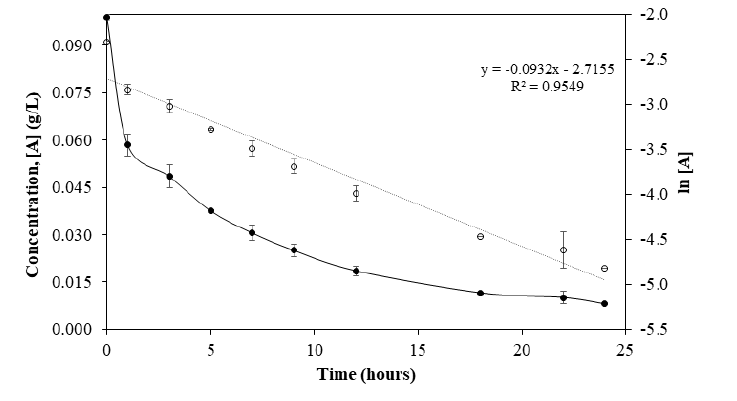
Figures 1 and 2 present the results of a kinetic analysis of Congo red decolorization by Rhodococcus biphenylivorans 's free and immobilized cells. The plots suggest that the first-order framework adequately illustrates the kinetics of decolorization of Congo red by both resting and immobilized cells, as confirmed by the strong linear relationship (R2) of 0.9834 and 0.9549, respectively, obtained for ln concentration (g/L) of Congo red [A] versus time (h).
The immobilized cells demonstrated an enhanced Congo red decolorization rate of 0.038 mM/h compared to the free cells' rate of 0.012 mM/h, resulting in a 3.17-fold rise in the decolourization rate. When free cells were employed for Congo red removal, the discoloration rate constant (k) was 0.0150 h−1. However, when immobilized cells were employed, the rate constant dramatically rose to 0.0932 h−1, indicating the effectiveness of the immobilization technique for Congo red removal by Rhodococcus biphenylivorans. Furthermore, the immobilized cells exhibited reduced susceptibility to environmental variations, particularly higher Congo red concentrations. This was demonstrated by the shorter half-life (t 1/2) value of 7.4 h, compared to the value of 46.2 h observed with free cells.
These findings strongly suggest that the immobilization technique provided expeditious and improved Congo red-decolorizing activity in comparison to the resting cells of Rhodococcus biphenylivorans, as demonstrated by the lower magnitude of half-life and greater value of the rate constant when using immobilized cells for the removal of Congo red. The discovery is in line with the investigation conducted by Satish and colleagues [28], who observed that the biodegradation of the azo dye Congo red by Staphylococcus aureus immobilized in calcium alginate follows a first-order model as confirmed by kinetic elucidation. However, this study recorded a rate constant of 0.0730 h−1, which is lower than the rate constant recorded in the present study.

Kinetics of Congo red decolorization by free cells of Rhodococcus biphenylivorans. The data presented are the means of triplicate samples ± standard errors. The decrease in the concentration of 0.1 g/L Congo red was measured at suitable intervals over 24 h at 30°C and pH 7 under static conditions. The error bars represent the standard error between the three determinations.
Kinetics of Congo red decolorization by immobilized cells of Rhodococcus biphenylivorans. The data presented are the means of triplicate samples ± standard errors. The decrease in the concentration of 0.1 g/L Congo red was measured at suitable intervals over 24 h at 30°C and pH 7 under static conditions. The error bars represent the standard error between the three determinations.
Effect of different immobilization factors on the decolorization of Congo red
The execution of Rhodococcus biphenylivorans as the biological agent in the removal of Congo red was found to be comparable after an incubation time of 24 h across different concentrations of alginate. Hence, to identify the best alginate concentration for the decolorization of Congo red by Rhodococcus biphenylivorans, the cultivation time was shortened to 12 h and the findings are presented in Table 2.
Table 2 reveals that increasing the concentration of alginate negatively impacted the decolorization of Congo red. Increasing the alginate concentration from 1% (w/v) to 5% (w/v) resulted in improved stability of the alginate beads, leading to the complete elimination of cell leakage. Nonetheless, surpassing a 4% (w/v) concentration of alginate led to a decline in the percentage of Congo red removal, reaching a mere 40c ± 1%. This signifies a substantial decrease of 37% in Congo red-decolorizing activity when compared to the utilization of a solution containing 4% (w/v) alginate concentration. Increasing the concentration of alginate resulted in beads with greater structural strength. However, this also led to narrower porosity of the beads, which meant that less volume of the substrate was able to enter the beads [29]. Furthermore, the immobilization efficiency decreased at higher alginate concentrations due to the increased viscosity of the beads [30] and limitations on substrate diffusion [31]. Conversely, cells encapsulated in lower concentrations of alginate had a more porous structure due to the alginate network being less tightly cross-linked and having weak mechanical strength, making them fragile, flaccid and challenging to handle [31].
The size of alginate beads could be the critical factor in achieving ideal immobilization of Rhodococcus biphenylivorans [32]. To create alginate beads of different sizes ranging from 1 mm to 3 mm, the diameter of the needle used to drop a mixture of free cells of Rhodococcus biphenylivorans and alginate into a CaCl2 solution was adjusted. Table 2 demonstrates a positive correlation between bead diameter and Congo red decolorizing activity, with an ascending trend observed as the diameter of the beads ranged from 1 mm to 3 mm. When using 1 mm diameter beads for the decolorization of Congo red, a Congo red-decolorizing activity of 58c ± 1% was detected. However, using beads with a diameter of 3 mm resulted in an increased Congo red removal efficiency of 97a ± 0%, showing a 67% increase in efficiency. The beads with smaller diameter sizes exhibited a higher surface-to-volume ratio than bulkier beads. Consequently, beads having a thickness of 3 mm showcased the utmost efficacy in removing Congo red. No substantial disparity was observed in Congo red-decolorizing activity when beads with a diameter of 4 mm and 5 mm, consisting of free cells of Rhodococcus biphenylivorans, were utilized for Congo red decolorization (p > 0.05). The Congo red removal efficiencies for the 4 mm and 5 mm beads were 74b ± 2% and 76b ± 0%, respectively, which were significantly different from the 3 mm beads. A notable decline of 22% in Congo red removal efficiency was observed when utilizing 5 mm beads in comparison to 3 mm beads, potentially attributable to the formation of a mass barrier. [32]. Moreover, employing 5 mm beads led to a cell escape of 0.048 ± 0.000 g/L, whereas no cell escape was detected with 3 mm beads. This can be attributed to the higher susceptibility of beads with a larger radius to swelling and cracking, which consequently releases a considerable number of cells into the experimentation medium.
It is essential to determine the lowest amount of beads required for efficient decolorization of Congo red in order to prevent overuse of the beads. The findings presented in Table 2 indicate that when the number of calcium alginate beads was increased to 50, there was a corresponding increase in Congo red-decolorizing activity, reaching 98a ± 0.%. This was in contrast to the activity of 73c ± 0% observed when only 30 beads were utilized. Using a smaller number of beads resulted in a reduction in the overall surface area of the encapsulated beads [33]. This, in turn, decreased the number of free cells that were available to decolorize Congo red. The utilization of a larger number of beads (60 to 70 beads), comprising resting cells of Rhodococcus biphenylivorans as the biological agent for Congo red elimination, resulted in comparable efficiencies of 96a ± 0% and 98a ± 0%, respectively. No discernible distinction was observed (p > 0.05) between these two results. These findings indicate that a subsequent increase in the number of beads did not result in a significant enhancement of Congo red-decolorizing activity. Therefore, utilizing 50 beads was deemed ideal for effective dye removal. It is worth noting that the enhancement process resulted in a significant reduction in the time required to achieve efficient removal of Congo red. Specifically, the time was reduced by 67%, from 24 h to 8 h.
Repeated use of the immobilized cells
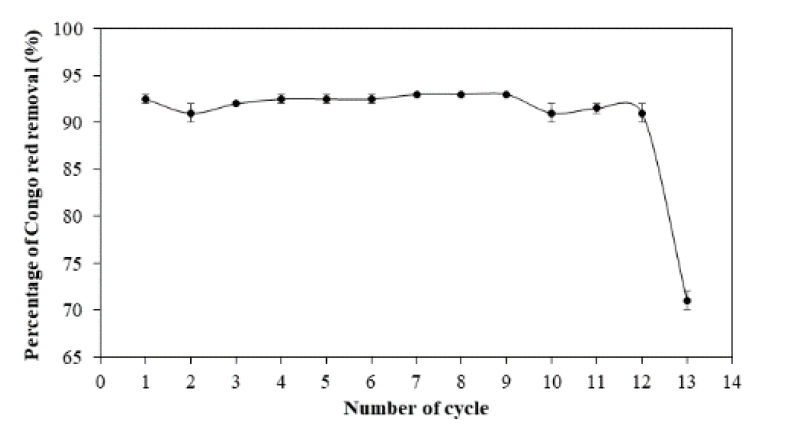
One of the primary objectives of utilizing biotechnological methods for wastewater treatment is to reduce costs, which can be accomplished by utilizing immobilized cells that can be reused multiple times. Therefore, the continuous use of calcium alginate-immobilized cells of Rhodococcus biphenylivorans was investigated to assess their effectiveness in decolorizing 0.10 g/L Congo red. The study showed that effective decolorization was achieved for up to 12 cycles, with an average decolorization efficiency of 90% as illustrated in Figure 3.
However, the Congo red-decolorizing activity decreased to 71% by the 13th cycle which may be caused by gradual enzyme inactivation [34]. The support matrix exhibited excellent mechanical strength and cell biomass preservation, as demonstrated by the absence of detectable cell leakage even after 13 consecutive cycles [35]. The current study exhibited better results compared to the findings of Hamad and Saied [36] who reported a significant decline in the decolorization percentage of 0.10 g/L Congo red, reaching only 72% during the sixth repeated cycle when they employed Aspergillus niger MK640786 immobilized cells on calcium alginate. Thus, it can be inferred that the results of this study offer a financially feasible and environmentally friendly approach for decolorizing wastewater that contains Congo red.
Decolorization of Congo red by immobilized cells of Rhodococcus biphenylivorans in calcium alginate for thirteen repeated batches. Control was established in the absence of immobilized cells of Rhodococcus biphenylivorans. The percentage of Congo red decolorization represents the means of triplicate samples ± standard errors. Each cycle was incubated under static conditions for 24 h at 30°C and pH 7. The error bars represent the standard error between the three determinations.
Phytotoxicity study
The results of the phytotoxicity analysis conducted on the original dye and its resulting by-products, following the complete removal of Congo red, are presented in Table 3. Triticum aestivum and Vigna radiata were employed as test plants for the analysis. The study revealed that the by-products obtained after the removal of Congo red did not exhibit any inhibitory effects on the sprouting of both plant species. Conversely, the untreated Congo red, at a concentration of 0.1 g/L, considerably suppressed the sprouting of Triticum aestivum and Vigna radiata, bringing about 37 ± 1% and 33 ± 2% inhibition of germination, respectively. Furthermore, the plumule and radicle lengths of the untreated Congo red-treated seeds were significantly reduced compared to the control set.
Interestingly, comparable results were recorded between the reference group and the test group treated with the decolorization by-products in terms of plumule and radicle lengths. These findings corroborate the previous research conducted by Du and coauthors [37], which proposed that the by-products generated after the elimination of Congo red were comparatively less detrimental than the original dye. Therefore, the use of Rhodococcus biphenylivorans for the decolorization of Congo red has the potential to produce a safe solution that can be used in practical applications such as field irrigation systems [38].
CONCLUSION
To the best of the authors' understanding, this study represents the first investigation of the decolorization kinetics of Congo red using both free and immobilized cells of tropical Rhodococcus biphenylivorans. The study discovered that when immobilized in calcium alginate, the cells of Rhodococcus biphenylivorans achieved a decolorization rate of 92 %, whereas free cells only managed to remove 29 % of 0.10 g/L Congo red after a cultivation time of 24 h. Furthermore, the process of immobilization led to the enhanced ability to withstand higher concentrations of the dye, allowing the biocatalysts to achieve nearly complete decolorization of 0.10 g/L Congo red within 24 h, as opposed to free cells. The use of calcium alginate as the carrier material for encapsulation led to nearly complete decolorization of Congo red after 8 h of incubation, whereas the non-immobilized counterpart achieved only 29% removal of Congo red after 24 h of incubation. The decolorization of Congo red by the Rhodococcus biphenylivorans adhered to the first-order kinetic model. The kinetic variables for immobilized cells, namely a half-life of 7.4 h and a rate constant of 0.0038 h−1, contributed to an improved Congo red-removal activity compared to resting cells. Moreover, the immobilized beads were capable of maintaining nearly complete removal of Congo red for twelve consecutive cycles, indicating their potential as a cost-effective approach for practical use in industrial wastewater treatment. The solution obtained from extracting metabolites during the Congo red decolorization process showed minimal restriction when tested with plant seeds. This indicates its safety and potential use for watering purposes in recreational parks, sports fields, agricultural fields and landscaping areas. Future research efforts should focus on optimizing the decolorization efficiency of the Rhodococcus biphenylivorans by adjusting various factors, including temperature and pH using the Response Surface Methodology approach. We have implemented the first-order kinetics model in the present study because it is often favored for dye decolorization due to its simplicity, ease of interpretation and broad applicability. However, in future studies, we plan to use more complex models, such as Monod and Haldane, to explore the relationship between substrate (dye) concentration and microbial growth or enzyme activity.
Acknowledgments
The authors would like to extend their sincere appreciation to the Institute of Bio-IT Selangor at University of Selangor for their generous support in providing access to their well-equipped laboratory facilities. This support was instrumental in the successful execution of the research presented in this paper
REFERENCES
- 1 ladoye PO, Bamigboye MO, Ogunbiyi OD, Akano MT. Toxicity and decontamination strategies of Congo red dye. Groundw Sustain Dev. 2022;19:100844.
- 2 Kulkarni RM, Vaidya R, Srinivas S, Anand S, Narayana B. Application of water hyacinth root powder for Congo red dye removal in batch and continuous packed bed operation. Nanotechnol Environ Eng. 2021;6(2):31.
- 3 Iark D, dos Reis Buzzo AJ, Garcia JA, Côrrea VG, Helm CV, Corrêa RC, et al. Enzymatic degradation and detoxification of azo dye Congo red by a new laccase from Oudemansiella canarii. Bioresour Technol. 2019;289:121655.
- 4 Edoamodu CE, Nwodo UU. Decolourization of synthetic dyes by laccase produced from Bacillus sp. NU2. Biotechnol Biotechnol Equip. 2022;36(1):95-106.
- 5 Tran T, Le DA, Hoa V, Tuong LQ, Nhung NT, Loc HH, et al. Studies on some selected microorganisms for biodegradation of congo red. In IOP Conference Series: Materials Science and Engineering 2020 (Vol. 736, No. 2, p. 022037). IOP Publishing.
- 6 Al-Ansari MM, Li Z, Masood A, Rajaselvam J. Decolourization of azo dye using a batch bioreactor by an indigenous bacterium Enterobacter aerogenes ES014 from the waste water dye effluent and toxicity analysis. Environ Res. 2022;205:112189.
- 7 Varjani S, Rakholiya P, Ng HY, You S, Teixeira JA. Microbial degradation of dyes: An overview. Bioresour Technol. 2020;314:123728.
- 8 Zampolli J, Zeaiter Z, Di Canito A, Di Gennaro P. Genome analysis and-omics approaches provide new insights into the biodegradation potential of Rhodococcus. Appl Microbiol Biotechnol. 2019;103:1069-80.
- 9 Cappelletti M, Presentato A, Piacenza E, Firrincieli A, Turner RJ, Zannoni D. Biotechnology of Rhodococcus for the production of valuable compounds. Appl Microbiol Biotechnol. 2020;104:8567-94.
- 10 Krivoruchko A, Kuyukina M, Ivshina I. Advanced Rhodococcus biocatalysts for environmental biotechnologies. Catalysts. 2019;9(3):236.
- 11 Mehrotra T, Dev S, Banerjee A, Chatterjee A, Singh R, Aggarwal S. Use of immobilized bacteria for environmental bioremediation: A review. J Environ Chem Eng. 2021;9(5):105920.
- 12 Labus K, Wolanin K, Radosiński Ł. Comparative study on enzyme immobilization using natural hydrogel matrices-experimental studies supported by molecular models analysis. Catalysts. 2020;10(5):489.
- 13 Sundarajoo A, Maniyam MN, Azman HH, Abdullah H, Yaacob NS. Rhodococcus strain UCC 0010 as green biocatalyst for enhanced biodecolourization of Congo red through response surface methodology. Int J Environ Sci Technol. 2022;1-8.
- 14 Hasdianty A, Suhaila YN, Hazwan AH, Maniyam MN, Fadzli AM, Ibrahim AL. Inferring the evolutionary relationship of 23 Malaysian Rhodococcus isolates with potential as cholesterol degrading bacteria. Biocatal Agric Biotechnol. 2020;30:101840.
- 15 Maniyam MN, Yaacob NS, Azman HH, Ab Ghaffar NA, Abdullah H. Immobilized cells of Rhodococcus strain UCC 0004 as source of green biocatalyst for decolourization and biodegradation of methyl orange. Biocatal Agric Biotechnol. 2018;16:569-78.
- 16 Viswanathan B. Photocatalytic degradation of dyes: An overview. Curr Catal. 2018;7(2):99-121.
- 17 Liu D, Yang X, Zhang L, Tang Y, He H, Liang M, et al. Immobilization of biomass materials for removal of refractory organic pollutants from wastewater. Int J Environ Res Public Health. 2022;19(21):13830.
- 18 Rajhans G, Sen SK, Barik A, Raut S. De‐colourization of textile effluent using immobilized Geotrichum candidum: An insight into mycoremediation. Lett Appl Microbiol. 2021;72(4):445-57.
- 19 Kurade MB, Waghmode TR, Xiong JQ, Govindwar SP, Jeon BH. Decolorization of textile industry effluent using immobilized consortium cells in upflow fixed bed reactor. J Clean Prod. 2019;213:884-91.
- 20 Hameed BB, Ismail ZZ. New application of Orchis mascula as a biocarrier for immobilization of mixed cells for biodegradation and detoxification of reactive azo dyes. Environ Sci Pollut Res. 2020;27:38732-44.
- 21 Majhi PK, Kothari R, Pandey A, Tyagi VV. Adsorptive behavior of free and immobilized Chlorella pyrenoidosa for decolorization. Biomass Convers Biorefine. 2021;11:3023-36.
- 22 Abou-El-Souod G, Hamouda RA, El-Sheekh M. Influence of heavy metal as co-contamination on biodegradation of dyes by free and immobilized Scenedesmus obliquus. Desalin. Water Treat. 2020;182:351-8.
- 23 Goswami M, Chaturvedi P, Sonwani RK, Gupta AD, Singhania RR, Giri BS, Rai BN, Singh H, Yadav S, Singh RS. Application of Arjuna (Terminalia arjuna) seed biochar in hybrid treatment system for the bioremediation of Congo red dye. Bioresour Technol. 2020;307:123203.
- 24 Sarim KM, Kukreja K, Shah I, Choudhary CK. Biosorption of direct textile dye Congo red by Bacillus subtilis HAU-KK01. Bioremediat J. 2019;23(3):185-95.
- 25 Moreno-García J, García-Martínez T, Mauricio JC, Moreno J. Yeast immobilization systems for alcoholic wine fermentations: Actual trends and future perspectives. Front Microbiol. 2018;9:241.
- 26 Bharti V, Vikrant K, Goswami M, Tiwari H, Sonwani RK, Lee J, et al. Biodegradation of methylene blue dye in a batch and continuous mode using biochar as packing media. Environ Res. 2019;171:356-64.
- 27 Liu J, Pan D, Wu X, Chen H, Cao H, Li QX, et al. Enhanced degradation of prometryn and other s-triazine herbicides in pure cultures and wastewater by polyvinyl alcohol-sodium alginate immobilized Leucobacter sp. JW-1. Sci Total Environ. 2018;615:78-86.
- 28 Sathish S. Stabilization of bacterial cells culture on immobilized alginate beads and optimization of Congo red decolorization. Indian J Chem Technol. 2019;26(6):544-52.
- 29 Gunam IB, Sitepu A, Antara NS, Triani IG, Arnata IW, Setiyo Y. Bacterial desulfurization of dibenzothiophene by Pseudomonas sp. strain KWN5 immobilized in alginate beads. J Teknol. 2021;83(2):107-15.
- 30 Wang Y, Tan C, Davachi SM, Li P, Davidowsky P, Yan B. Development of microcapsules using chitosan and alginate via W/O emulsion for the protection of hydrophilic compounds by comparing with hydrogel beads. Int J Biol Macromol. 2021;177:92-9.
- 31 Bilal M, Iqbal HM. Lignin peroxidase immobilization on Ca-alginate beads and its dye degradation performance in a packed bed reactor system. Biocatal Agric Biotechnol. 2019;20:101205.
- 32 Bilal M, Asgher M. Dye decolorization and detoxification potential of Ca-alginate beads immobilized manganese peroxidase. BMC Biotechnol. 2015;15:1-14.
- 33 Maniyam MN, Ibrahim AL, Cass AE. Enhanced cyanide biodegradation by immobilized crude extract of Rhodococcus UKMP-5M. Environ Technol. 2019;40(3):386-98.
- 34 Maniyam MN, Hari M, Yaacob NS. Enhanced methylene blue decolourization by Rhodococcus strain UCC 0003 grown in banana peel agricultural waste through response surface methodology. Biocatal Agric Biotechnol. 2020;23:101486.
- 35 Touloupakis E, Chatziathanasiou A, Ghanotakis DF, Carlozzi P, Pecorini I. Hydrogen production by immobilized Rhodopseudomonas sp. cells in calcium alginate beads. Energies. 2022;15(22):8355.
- 36 Hamad MT, Saied MS. Kinetic studies of Congo red dye adsorption by immobilized Aspergillus niger on alginate. Appl Water Sci. 2021;11:1-12.
- 37 Du LN, Li G, Zhao YH, Xu HK, Wang Y, Zhou Y, et al. Efficient metabolism of the azo dye methyl orange by Aeromonas sp. strain DH-6: Characteristics and partial mechanism. Int Biodeterior Biodegrad. 2015;105:66-72.
- 38 Zhao M, Sun PF, Du LN, Wang G, Jia XM, Zhao YH. Biodegradation of methyl red by Bacillus sp. strain UN2: decolorization capacity, metabolites characterization, and enzyme analysis. Environ Sci Pollut Res. 2014 May;21:6136-45.