 Absolute Microbial Abundance and Causal Inference as Foundations for a One Health Roadmap in Colorectal Cancer Diagnostics
Abstract
The rising global incidence of colorectal cancer (CRC) necessitates a shift toward a functional understanding of the intestinal ecosystem. Although the microbiome is implicated in oncogenesis, most studies rely on relative abundance metrics, which are vulnerable to compositionality bias. To address this limitation, this overview of systematic reviews (Umbrella Review) synthesized evidence from 28 systematic reviews and meta-analyses published between 2021 and 2026, adapting the PRISMA 2020 guidelines for secondary evidence synthesis. By integrating published Mendelian Randomization (MR) findings to appraise causal relationships and summarizing evidence from absolute abundance frameworks, a robust taxonomic consensus was established. Specifically, Fusobacterium nucleatum (Beta: 0.42) was identified as a causal driver, whereas Faecalibacterium prausnitzii (Beta: -0.35) demonstrated a significant causal protective role. Furthermore, multi-kingdom networks revealed that viral families (Microviridae) modulate bacterial fitness and host oncogenes (PCSK5). Absolute abundance approaches have been reported to achieve superior diagnostic performance, with AUC values up to 0.99 in retrospective settings. Ultimately, this synthesis highlights promising frameworks for next-generation CRC screening, showing that integrating absolute quantification with multi-kingdom networks holds strong translational potential, though rigorous clinical validation across diverse populations remains necessary to confirm diagnostic utility.
Keywords:
Colorectal Neoplasms; Gut Microbiota; Multi-kingdom Interactions; Quantitative Microbiome Profiling (QMP); Metagenome Pipeline.
HIGHLIGHTS
• Causal evidence identifies F. nucleatum and B. fragilis as core drivers of CRC.
• Mendelian Randomization confirms F. prausnitzii as a causal protective agent.
• Multi-kingdom networks reveal critical viral-bacterial synergies in oncogenesis.
• The One Health roadmap links Western diets to systemic microbial DNA damage.
INTRODUCTION
Despite significant advances in clinical oncology, colorectal cancer (CRC) remains the third most diagnosed malignancy and the second leading cause of cancer-related mortality worldwide, with approximately 1.9 million new cases and over 900,000 deaths annually [1]. The transition from a healthy colonic mucosa to an invasive carcinoma typically unfolds over decades and is classically described as a multistep process, driven by the accumulation of genetic and epigenetic alterations. This paradigm, however, is being increasingly challenged by the alarming global rise in early-onset CRC diagnosed in individuals younger than 50 years of age, now estimated at more than 184,000 cases worldwide [1,2]. This shift is clinically relevant because early-onset gastrointestinal cancers are among the fastest-rising cancer types in several regions and may present distinct pathological patterns and a more aggressive course [2,3].
While established risk factors such as age and familial predisposition remain central to CRC risk stratification, converging evidence implicates the human gut microbiome as an active contributor to oncogenic progression across all age groups [1,2,4]. In younger populations, the increase in CRC incidence has been linked to metabolic dysregulation and broader perturbations in the intestinal ecosystem, potentially driven by contemporary environmental exposures and low-quality dietary patterns [2,5]. Current research conceptualizes the microbiome not as a passive correlation, but as a dynamic ecological network influenced by ultra-processed diets and sedentary behavior, with plausible mechanistic links to early tumor initiation [4,5].
Understanding microbiome-associated pathways through high-resolution metagenomic approaches has become increasingly important, as microbial community structure and function can shape tumor biology and modulate host response to therapy [4]. These effects may be mediated, in part, by secreted bacterial factors, including nucleomodulins, which can access the host nucleus and influence transcriptional and epigenetic programs in colonocytes [6]. By inducing promoter hypermethylation of tumor suppressor genes, these pathogens can exert a lasting impact on host cell physiology even after the initial microbial insult has been cleared [6].
Nevertheless, the clinical utility of metagenomics has been limited by the compositionality problem, in which relative abundance measures can obscure the true biological thresholds for such high-impact pathogens. Large-scale studies indicate that fecal microbial load is a major source of microbiome variation, and that relying on relative microbiome profiles (RMP) may inflate or attenuate the abundance of disease-associated taxa depending on changes in overall biomass [7]. In CRC, this issue is particularly relevant because total microbial burden can differ meaningfully between patients and controls, supporting a shift toward quantitative microbiome profiling (QMP) to reduce density-driven bias [7].
Operationalizing QMP in clinical and population settings requires robust absolute quantification strategies, such as the Melody framework [8], which provides more stable and accurate estimates of the total microbial load by accounting for underlying density variations. The transition from relative to absolute metrics establishes a robust foundation for non-invasive diagnostics. Such frameworks facilitate the detection of subtle ecological perturbations and low-abundance pathogenic signatures, addressing a critical gap as early-onset CRC incidence rises, and conventional screening remains underutilized.
A comprehensive understanding of gut ecology requires extending beyond bacteria. The intestinal virome, particularly bacteriophages, constitutes a substantial yet incompletely characterized component of the ecosystem, with the capacity to modulate bacterial community structure, virulence potential, and downstream host immune responses. This broader perspective is consistent with a One Health framework, in which environmental exposures, such as Westernized dietary patterns and recurrent antibiotic use, can reshape gut ecology at the population level. Such exposures have been increasingly linked to the global rise in early-onset cases [2,4]. In contrast, fermentation of dietary fiber into short-chain fatty acids (SCFA) remains a key protective axis, supporting epithelial integrity and immunometabolic homeostasis.
Dietary fibers are fermented by the gut microbiota into SCFA, such as butyrate, which function as key metabolites within the colonic microenvironment. These metabolites provide a protective effect by directly inducing apoptosis in malignant colonocytes and modulating the activity of tumor-associated macrophages, thereby suppressing the pro-inflammatory signals that otherwise facilitate tumor growth [9]. This crosstalk between diet-derived metabolites and immune cell polarization is central to mucosal homeostasis. These environmental pressures trigger a cascade of dysbiosis and chronic inflammation that facilitates the transition from adenoma to carcinoma.
One of the primary challenges in microbiome research involves distinguishing between causal driver pathogens and opportunistic passenger bacteria that merely thrive within the tumor microenvironment (TME). Proving causality in human populations remains difficult because observational studies are often limited by confounding factors and the risk of reverse causation [10]. However, methodologies such as Mendelian Randomization have provided a robust approach to these hurdles. By using genetic variants as instrumental variables, this framework enables evaluation of causal relationships between specific gut microbiota and various cancer types, bypassing many of the biases inherent in traditional research [10,11].
This statistical approach has successfully identified significant causal associations between genetic liability in the gut microbiome and cancer risk, confirming that certain taxa are active participants in oncogenesis rather than secondary inhabitants [11]. By integrating these causal estimates with multi-kingdom interaction networks and high-resolution metabolic profiling, a comprehensive roadmap for early detection can be built. Such an integration serves as an analytical atlas for identifying high-risk microbial signatures, providing the necessary foundations for personalized screening and preventive strategies in colorectal oncology [10].
The integration of these disparate data sources is the cornerstone of the next generation of non-invasive diagnostic tools. As we transition toward personalized metagenomics, the challenge lies in translating complex ecological data into actionable insights for bedside use. The objective of this study is to synthesize state-of-the-art meta-analytic evidence to establish a multi-kingdom, functional roadmap of the colorectal cancer-associated microbiome. By integrating taxonomic consensus, metabolic correlation heatmaps, multi-kingdom interaction networks, and Mendelian Randomization causal estimates, we seek to validate a robust framework for early detection and provide a causal basis for personalized metagenomic diagnostics in colorectal oncology.
MATERIAL AND METHODS
This study was structured as an Overview of Systematic Reviews (Umbrella Review) to synthesize high-level secondary evidence. The literature search, screening, and selection processes were documented in accordance with the PRISMA 2020 guidelines [12]. While PRISMA2020 is designed for primary studies, its checklist and flow diagram were appropriately adapted to ensure methodological transparency in this secondary synthesis of meta-analyses. The flow diagram was generated using the PRISMA2020 Shiny app [13], a web-based tool designed to produce publication-quality flowcharts that ensure transparency in evidence synthesis (Figure 1). Data on the identification, screening, and inclusion of records were entered into the application using standardized templates to visualize record attrition throughout the review process.

PRISMA 2020 flow diagram of the study selection process for the systematic review. The flowchart illustrates the phases of identification, screening, eligibility, and inclusion. A total of 30 records were initially identified through a PubMed search, of which 28 articles met the eligibility criteria. Some manuscripts were excluded due to inconsistent full-text availability or repository access issues.
A systematic search was conducted in the PubMed (MEDLINE) database to identify relevant literature. The search utilized a combination of indexed MeSH (Medical Subject Headings) terms and specific keywords: ("Metagenomics"[MeSH] OR "Gastrointestinal Microbiome"[MeSH] OR "RNA, Ribosomal, 16S"[MeSH] OR "shotgun metagenomics" OR "16S rRNA") AND ("Colorectal Neoplasms"[MeSH] OR "Colorectal Cancer" OR "CRC").
To ensure the incorporation of state-of-the-art evidence, the selection process was guided by defined eligibility filters. Inclusion was restricted to:
-
Study Type: Meta-analysis and systematic reviews.
-
Timeline: Published between January 2021 and February 2026.
-
Language: English.
-
Subjects: Human-only studies.
-
Availability: Free full-text articles to guarantee transparency and reproducibility.
Preprints were strictly excluded to prioritize peer-reviewed findings and maintaining high methodological standards.
The initial search yielded 30 articles. Screening of titles and abstracts led to the technical exclusion of two manuscripts: one due to inconsistent full-text availability (DOI: 10.1002/iub.2908) and another due to repository access failures (DOI: 10.1719/dmp/183712). The final sample of 28 articles was organized into a primary metadata repository for both qualitative and quantitative analyses (Figure 1).
Data were extracted into a structured master database focusing on microbial signatures, clinical status (enriched/depleted), and metabolic correlations. To address the inherent challenges of microbiome meta-analysis, such as compositional bias and heterogeneity, this study incorporated recent bioinformatic advancements:
-
1. Signature Harmonization: We used the Melody framework [8] to evaluate microbial signatures based on absolute abundance estimates, mitigating the instability often observed in relative abundance data.
-
2. Batch Effect Mitigation: Global prevalence analysis was conducted using the ConQuR (Conditional Quantile Regression) methodology [14,15] to ensure cross-study comparability.
-
3. All statistical analyses and high-resolution visualizations were performed in R (version 4.5.2). The following analytical workflows were implemented:
-
4. Taxonomic Consensus: A consensus frequency analysis was performed to identify core CRC signatures using ggwordcloud and ggplot2.
-
5. Risk Estimation: Forest plots were constructed to visualize the Odds Ratios (ORs) and 95% Confidence Intervals (CIs) for primary biomarkers [16].
-
6. Multi-Kingdom Interaction Networks: Connectivity between the virome, bacteriome, and host metabolic genes was mapped using igraph, tidygraph, and ggraph.
-
7. One Health Pathway Analysis: A risk-flow synthesis was modeled using Sankey diagrams via the ggalluvial package [17] to link environmental exposures to clinical outcomes.
-
8. Causal Inference: Causal associations between the gut microbiota and CRC risk were evaluated using Mendelian Randomization (MR) estimates (Inverse Variance Weighted [IVW] and MR-Egger methods) [18-20].
RESULTS
Taxonomic Consensus and the Core Microbial Signature in CRC
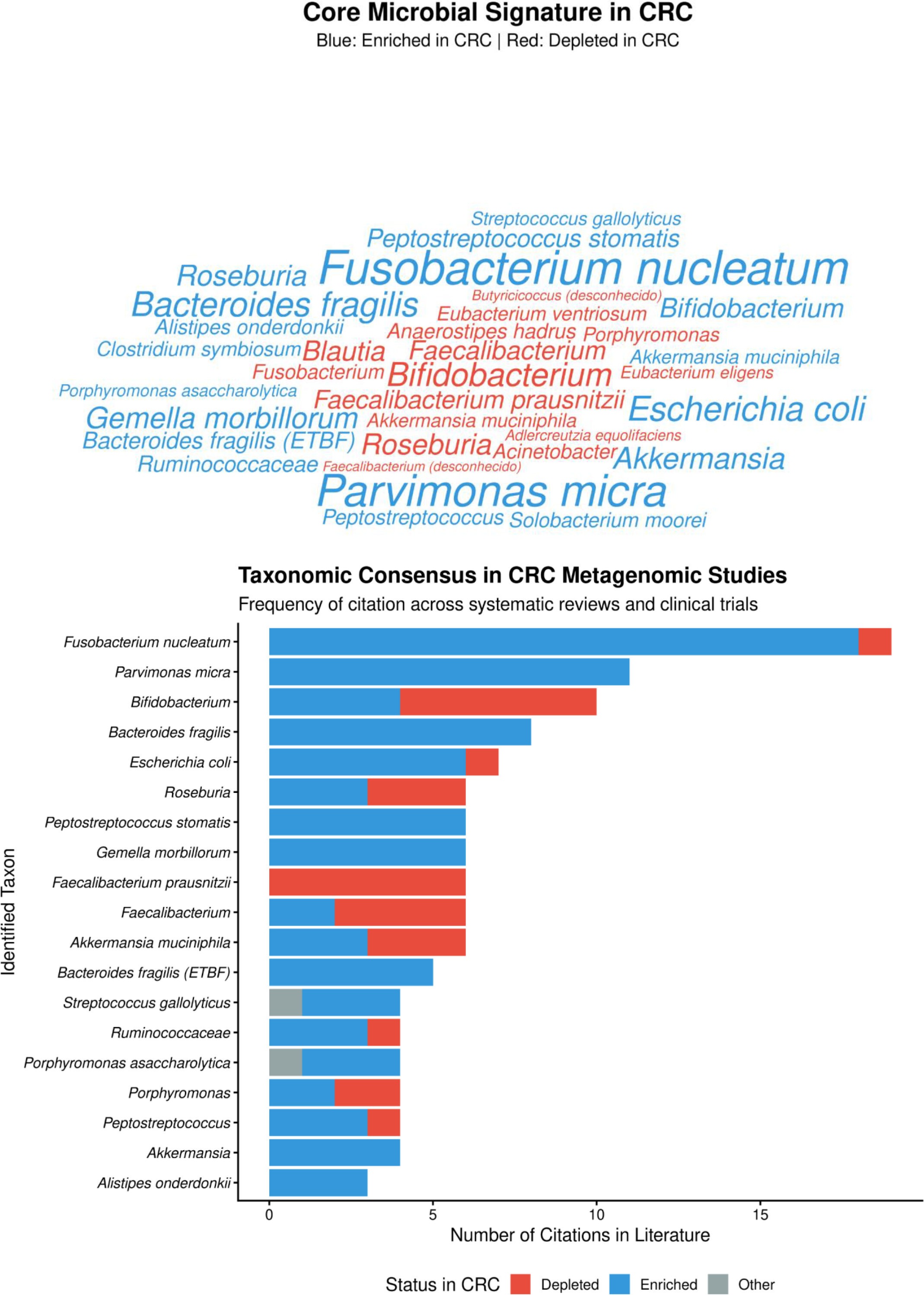
The qualitative synthesis of 28 included meta-analyses and systematic reviews revealed a robust taxonomic consensus on the CRC-associated microbiota. As illustrated in Taxonomic Consensus and the Core Microbial Word Cloud (Figure 2), Fusobacterium nucleatum emerged as the most consistently cited biomarker (enriched in 19/28 studies), followed by Parvimonas micra and Bacteroides fragilis. Conversely, a significant depletion of commensal taxa was observed, with Faecalibacterium prausnitzii and Bifidobacterium sp. being the most frequently reported protective species across the global literature synthesis.

Core microbial signature and taxonomic consensus. This visualization summarizes the most frequently cited taxa across the included systematic reviews. (A) The word cloud of the main species found and (B) the frequency bar plot both highlight the consistent enrichment of oral-derived anaerobic pathogens and the simultaneous depletion of commensal butyrate producers. In both cases, blue indicates taxa enriched in CRC, while red denotes depleted species.
Quantitative Assessment of Microbial Risk Factors
The meta-analytic risk estimation was summarized in the Microbial Risk Signatures Forest Plot (Figure 3), confirming a robust association between specific microbial taxa and CRC risk across high-impact datasets [21-23]. Among these signatures, Fusobacterium nucleatum exhibited the most pronounced effect size with an Odds Ratio (OR) of 6.93 (95% CI: 3.01-15.96), as reported by Kharofa and coauthors [21]. Statistically significant risk was also attributed to enterotoxigenic Bacteroides fragilis (ETBF), which yielded an OR of 2.54 (95% CI: 1.63-3.98) [22]. Furthermore, oral pathogens such as Porphyromonas gingivalis were associated with a significant contribution to risk (OR: 3.10; 95% CI: 1.50-5.20), providing quantitative validation of the oral-gut translocation hypothesis [24].

Microbial risk landscape in colorectal cancer. Odds ratios (OR) were calculated using a random-effects model to account for inter-study variability. Horizontal bars represent 95% Confidence Intervals (CI). Square sizes reflect the relative weighting of each study under the random-effects framework, while the pooled estimate (diamond) confirms the diagnostic potential of the integrated microbial signature. The I2 statistic quantifies heterogeneity among studies. Taxa are listed by risk magnitude, highlighting the dominance of F. nucleatum in CRC landscapes. Statistical significance is achieved when the CI whiskers do not intersect the null line (vertical dashed red line, OR = 1). This forest plot was made using metafor package [16].
The pooled synthesis yielded a significant combined Odds Ratio of 2.30 (95% CI: 1.33-3.97), reinforcing the integrated microbial signature as a valid indicator of malignancy. Statistical analysis using the Restricted Maximum Likelihood (REML) method revealed substantial heterogeneity among the included studies (Q=27.61, df=4, p<0.001; I2=92.52%; τ2=0.33) (Figure 3). This high degree of inconsistency likely reflects the inherent biological diversity among international cohorts and the technical sensitivity of absolute microbial quantification.
Ultimately, the overall effect test confirmed the strength of the combined biomarkers as a robust clinical predictor (Z=2.99; p=0.00283). However, the 95% prediction interval (0.66-7.99) suggests that while the integrated signature is a significant risk indicator on average, future study outcomes may exhibit wide variance and potentially cross the nullity threshold (OR=1), emphasizing the impact of high inter-study variability on individual predictive accuracy (Figure 3).
Multi-Kingdom Synergies and Functional Metabolic Profiling
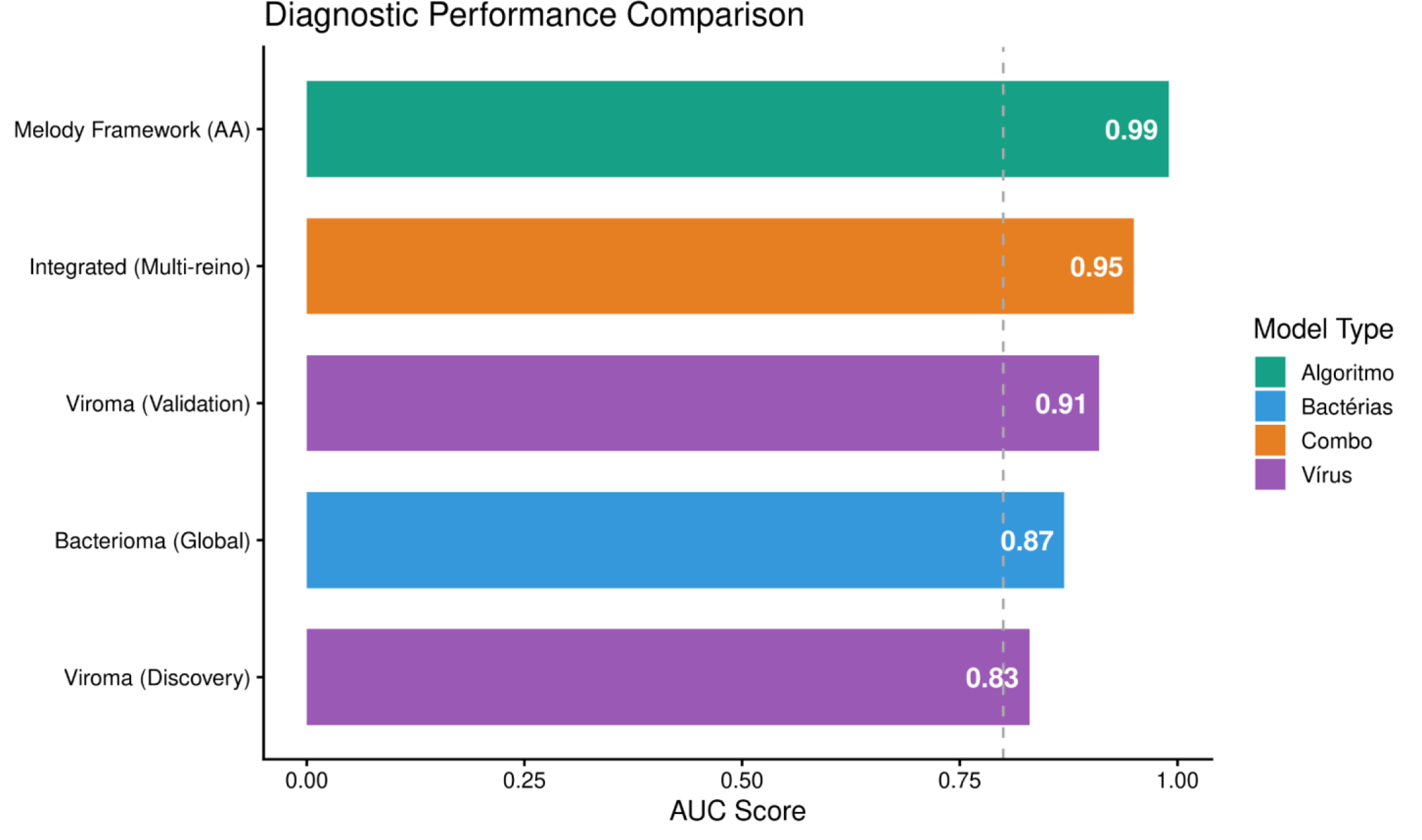
The Multi-Kingdom Interaction Network (Figure 4) highlights the complex interplay among biological kingdoms, centered on data from Chen and coauthors [25] and Xiang and coauthors [26]. Key findings reveal that the oncogenic microbiota does not operate in a vacuum; there is high connectivity between the Microviridae and Autographiviridae viral families and the abundance of key driver bacteria, such as F. nucleatum and P. micra. This viral-bacterial crosstalk suggests that bacteriophages may actively modulate the TME by driving bacterial fitness or lysogenic conversion, which, in turn, correlates with downstream regulation of host metabolic and oncogenic genes, notably PCSK5 and RYR3 [25]. Furthermore, integrative multi-kingdom diagnostic models incorporating these viral and genetic signatures achieved a high predictive AUC of 0.95, significantly outperforming bacteriome-only models (AUC 0.87), thereby demonstrating the independent diagnostic value of the intestinal virome and its systemic impact on host pathways.

Multi-kingdom interaction network delineating the colorectal cancer microenvironment. Nodes represent biological entities across different kingdoms (viral families, bacterial species, and host metabolic genes), while edges denote documented co-occurrence, metabolic cross-feeding, or regulatory interactions. Edge thickness is proportional to the strength of the association. The network explicitly highlights the integration of the intestinal virome, demonstrating significant viral-bacterial crosstalk centered on the Microviridae family and the pathogenic driver Fusobacterium nucleatum. These trans-kingdom synergies provide structural evidence for the virome's role in modulating bacterial oncogenicity and host gene expression (e.g., PCSK5 and RYR3).
This systemic interaction is complemented by the Functional Signature Heatmap (Figure 5), derived from metabolic meta-analyses [27,28]. A strong positive correlation was found between Peptostreptococcus stomatis and cadaverine (r = 0.85) [27], whereas protective taxa such as Faecalibacterium prausnitzii showed high positive correlations with butyrate (r = 0.70) [28], underscoring the loss of short-chain fatty acid (SCFA) production in CRC patients.

Functional signature heatmap of microbe-metabolite correlations. The heatmap shows metabolic reprogramming in the gut. Color intensity represents Pearson’s correlation coefficient (r) between identified microbial taxa and specific metabolites. Positive correlations (red) between oral pathogens and cadaverine contrast with the strong negative/protective associations (blue) between commensal Faecalibacterium prausnitzii and butyrate production. Statistical significance is denoted by threshold criteria following Benjamini-Hochberg correction (p<0.05).
Pathogenesis Flow and One Health Risk Factors
The One Health Pathogenesis Flow (Figure 6) integrates environmental exposures with microbial shifts, synthesized from the works of Liu and coauthors [29] and Ruiz-Malagón and coauthors [30]. The Sankey diagram demonstrates that Western diets and prolonged antibiotic exposure are the primary drivers of gut dysbiosis [30]. This flow culminates in the transition from healthy mucosa to adenoma and, eventually, CRC, with obesity-related bile acid metabolism (Deoxycholic acid [DCA]) acting as a critical secondary mediator in tumor progression [29].

One Health pathogenesis flows from environmental exposure to clinical outcome. This Sankey diagram models the progression of colorectal cancer across the One Health continuum. The flow links environmental stressors, such as Western diets and antibiotic overuse, to intermediary mechanisms of dysbiosis and inflammation, ultimately leading to DNA damage and tumor development. This Sankey Diagram was made using ggalluvial package [17].
Predictive Accuracy and Diagnostic Performance
The comparative analysis of diagnostic models (Figure 7) indicates that integrative approaches outperform single-kingdom signatures. While bacterioma-only models achieved an average AUC of 0.87 [31], multi-kingdom models incorporating viruses reached an AUC of 0.95 [25]. Notably, the Melody Framework, which uses absolute abundance estimates, achieved superior predictive accuracy, with an AUC of 0.99 [5], suggesting that absolute quantification is essential for reliable screening.

Comparative diagnostic performance of metagenomic signatures. Area Under the Curve (AUC) values derived from Receiver Operating Characteristic (ROC) analysis evaluating various predictive models. The bar plot compares the performance of traditional Relative Microbial Profiling (RMP) frameworks (single-kingdom) with Quantitative Microbial Profiling (QMP) in external validation cohorts. Integrative multi-kingdom approaches and absolute abundance frameworks, such as the Melody model, demonstrate superior diagnostic accuracy (AUC = 0.99) compared to baseline metrics.
Causal Inference through Mendelian Randomization
To distinguish causal drivers from passenger bacteria, Mendelian Randomization (MR) estimates from Li and coauthors (2023) were visualized (Figure 8) [32]. The IVW estimates confirmed a significant causal impact of F. nucleatum on CRC risk (Beta = 0.42 [95% CI: 0.18, 0.66], p < 0.001). Conversely, Faecalibacterium prausnitzii demonstrated a significant causal protective effect (Beta = -0.35 [95% CI: -0.57, -0.13]), providing robust genetic evidence for its role in maintaining colorectal health.

Mendelian Randomization causal estimates on colorectal cancer risk. The forest plot provides genetic evidence for the causal impact of gut microbiota on oncogenesis. Causal estimates were primarily generated using the Inverse-Variance Weighted (IVW) method and were compared with MR-Egger sensitivity models. The Beta coefficient represents the causal effect slope derived from instrumental variables (SNPs), with horizontal lines indicating 95% Confidence Intervals. Consistent positive estimates for F. nucleatum and negative estimates for F. prausnitzii confirm their respective roles as causal drivers and protective agents
DISCUSSION
The convergence of our taxonomic consensus (Figure 2) and Mendelian Randomization (MR) estimates (Figure 8) provides robust evidence for the driver-passenger model in CRC. While many taxa are associated with the tumor microenvironment, the significant causal effect of Fusobacterium nucleatum (Beta = 0.42, p < 0.001) and Porphyromonas gingivalis (Beta = 0.31) underscores the critical role of the oral-gut axis. These oral-derived pathogens do not merely inhabit the gut but actively promote oncogenesis through the Fada/E-cadherin signaling pathway and the recruitment of myeloid-derived suppressor cells. Our findings, grounded in the risk signatures of Kharofa and coauthors (2023) and Li and coauthors (2023) [21,32], suggest that these taxa are primary etiologic agents rather than opportunistic colonizers.
Beyond taxonomic shifts, the functional signature heatmap (Figure 5) elucidates a profound metabolic transition in the CRC gut. The strong correlation between Peptostreptococcus stomatis and cadaverine production (r = 0.85) highlights a shift toward proteolytic fermentation, which generates DNA-damaging polyamines. Concurrently, the depletion of butyrate-producing species like Faecalibacterium prausnitzii (r = 0.70 with butyrate) suggests a collapse of the mucosal barrier's energy source. This metabolic exhaustion creates an environment characterized by chronic inflammation and oxidative stress, as visualized in our pathogenesis flow (Figure 6), facilitating the adenoma-to-carcinoma transition.
Our interaction network (Figure 4) demonstrates that the bacteriome does not act in isolation. The synergy between Microviridae and F. nucleatum suggests that phage-host interactions may modulate bacterial virulence or horizontal gene transfer within the tumor niche. This systemic perspective aligns with the findings of [(25)], indicating that the virome is an essential, yet often overlooked, component of the CRC ecological network. Integrating viral signatures into diagnostic models is likely the next frontier in increasing screening sensitivity.
The Sankey risk flow (Figure 6) integrates environmental and lifestyle factors, emphasizing that CRC is a multifaceted disease. The transition from Western diets and antibiotic exposure to clinical outcomes via dysbiosis and DNA damage reinforces the One Health framework. This model suggests that successful CRC prevention must look beyond the host, targeting dietary patterns and antibiotic stewardship to preserve the commensal ecological shield provided by taxa such as Bifidobacterium and Akkermansia.
The superior performance of the Melody Framework (AUC = 0.99, Figure 7) marks a turning point in clinical diagnostics. Traditional Relative Microbial Profiling (RMP) models suffer from inherent compositionality bias: because relative abundances must sum to 100%, an increase in total microbial load, often seen in CRC dysbiosis, can artificially inflate the apparent presence of causal pathogens, masking their true biological thresholds. The Melody model overcomes this mathematical artifact by incorporating matching absolute abundance (QMP) estimates, which adjust for variations in total fecal microbial density. By quantifying the actual microbial payload rather than just proportions, this framework captures the true ecological expansion of low-abundance pathogens such as F. nucleatum and B. fragilis. Consequently, this resolution reduces the statistical noise in RMP, achieving near-perfect diagnostic accuracy and establishing absolute quantification as the higher standard for precision medicine.
This transition is precisely where technological innovation meets clinical need. The development of automated reporting systems enables the translation of these complex, multi-kingdom, and causal signatures into actionable clinical data. Implementing absolute quantification pipelines in routine screening could bridge the gap between academic meta-analyses and patient-side diagnostics, providing a faster, non-invasive alternative to traditional colonoscopy.
While the causal evidence from MR is compelling, the heterogeneity of human populations remains a challenge. Most included studies focused on global datasets; however, regional dietary habits significantly influence the baseline microbiome.
LIMITATIONS
This overview has several important limitations. First, the high degree of heterogeneity observed (I2=92.52%) reflects significant cohort and methodological variability across primary studies, including differences in DNA extraction and sequencing platforms. Second, while Mendelian Randomization mitigates confounding, causal estimates derived from genetic instruments do not automatically equate to clinical utility. Third, the remarkable diagnostic metrics reported by absolute abundance models carry a risk of overinterpretation, as they are often trained on retrospective cohorts. Their true generalizability remains unproven until subjected to prospective validation across diverse global populations.
CONCLUSION
In summary, this study consolidates the evidence that CRC is a multi-kingdom ecological disorder driven by specific causal pathogens. While bacterial drivers such as F. nucleatum are well-established, the integration of the intestinal virome is a necessary perspective within the One Health framework, given its crucial role in modulating bacterial virulence. The shift from relative to absolute abundance signatures, coupled with causal inference and systemic network analysis, provides a promising conceptual roadmap for early detection and personalized therapeutic strategies. However, the translation into clinical practice will require extensive validation to bridge the gap between bioinformatic modeling and bedside utility. Future research should focus on longitudinal tracking of absolute abundance to determine the precise window of intervention during the early adenoma phase.
-
Funding:
This research was supported by the Fundação Araucária de Apoio ao Desenvolvimento Científico e Tecnológico do Paraná (FA) through the following grants and public calls: Public Call 19/2022 (Programa Institucional de Apoio à Fixação de Jovens Doutores); Programa Genomas Paraná (Public Call 07/2022); and Projeto Sabiá (Public Call 37/2025).
-
Institutional Review Board Statement:
Not applicable. This study is an overview of systematic reviews and exclusively utilized publicly available, anonymized data from previously published studies; therefore, ethical committee approval was not required.
-
Informed Consent Statement:
Not applicable.
Acknowledgments:
The authors thank the State University of the Midwest (Unicentro) and the Graduate Program in Pharmaceutical Sciences for the institutional and academic framework. We acknowledge the strategic and technical partnership with the Institute for Cancer Research (IPEC) and Genobit, a biotechnology startup currently incubated at INTEG (Unicentro). Finally, we extend our gratitude to the reviewers and colleagues whose expertise and constructive comments contributed to the refinement of this work.
-
Use of Generative Artificial Intelligence:
During the preparation of this work, the authors used Grammarly for advanced English proofreading and stylistic refinement, and Google Gemini (Advanced/Professional) to troubleshoot and optimize the syntax of the R scripts used for data visualization. After using these tools/services, the authors thoroughly reviewed and edited the content as needed and take full responsibility for the final scientific content and conclusions of the publication.
Data Availability Statement:
Publicly available datasets were analyzed in this study. No new primary data were created or generated. The data supporting the quantitative synthesis, including pooled effect sizes and AUC values, were extracted entirely from the published systematic reviews and meta-analyses, which are properly cited in the reference list.
REFERENCES
-
1 Bray F, Laversanne M, Sung H, Ferlay J, Siegel RL, Soerjomataram I, et al. Global cancer statistics 2022: GLOBOCAN estimates of incidence and mortality worldwide for 36 cancers in 185 countries. CA Cancer J Clin. 2024 May;74(3):229-63. doi:10.3322/caac.21834
» https://doi.org/10.3322/caac.21834 -
2 Jayakrishnan T, Ng K. Early-Onset Gastrointestinal Cancers: A Review. JAMA. 2025 Oct 21;334(15):1373. doi:10.1001/jama.2025.10218
» https://doi.org/10.1001/jama.2025.10218 -
3 Weinberg BA, Murphy CC, Freyer DR, Greathouse KL, Blancato JK, Stoffel EM, et al. Rethinking the rise of early-onset gastrointestinal cancers: a call to action. JNCI Cancer Spectr. 2025 Jan 3;9(1):pkaf002. doi:10.1093/jncics/pkaf002
» https://doi.org/10.1093/jncics/pkaf002 -
4 Dai R, Kelly BN, Ike A, Berger D, Chan A, Drew DA, et al. The Impact of the Gut Microbiome, Environment, and Diet in Early-Onset Colorectal Cancer Development. Cancers. 2024 Feb 5;16(3):676. doi:10.3390/cancers16030676
» https://doi.org/10.3390/cancers16030676 -
5 Du M, Drew DA, Goncalves MD, Cao Y, Chan AT. Early-onset colorectal cancer as an emerging disease of metabolic dysregulation. Nat Rev Endocrinol. 2025 Nov;21(11):686-702. doi:10.1038/s41574-025-01159-z
» https://doi.org/10.1038/s41574-025-01159-z -
6 Anand S, Korgaonkar S, Bose C. Can Fusobacterium utilize nucleomodulins in the pathophysiology of CRC? Front Cell Infect Microbiol. 2025 Oct 30;15:1644443. doi:10.3389/fcimb.2025.1644443
» https://doi.org/10.3389/fcimb.2025.1644443 -
7 Nishijima S, Stankevic E, Aasmets O, Schmidt TSB, Nagata N, Keller MI, et al. Fecal microbial load is a major determinant of gut microbiome variation and a confounder for disease associations. Cell. 2025 Jan;188(1):222-236.e15. doi:10.1016/j.cell.2024.10.022
» https://doi.org/10.1016/j.cell.2024.10.022 -
8 Wei Z, Chen G, Tang ZZ. Melody: meta-analysis of microbiome association studies for discovering generalizable microbial signatures. Genome Biol. 2025 Aug 18;26(1):245. doi:10.1186/s13059-025-03721-4
» https://doi.org/10.1186/s13059-025-03721-4 -
9 Penarete-Acosta D, Mittal M, Chakraborty S, Han A, Jayaraman A. Interplay between dietary fiber, macrophages and colonocytes in a microfluidic model of host-microbiota interactions in colorectal cancer. Lab Chip. 2025;25(21):5482-96. doi:10.1039/D5LC00052A
» https://doi.org/10.1039/D5LC00052A -
10 Huang YX, Wu JH, Zhao YQ, Sui WN, Tian T, Han WX, et al. An atlas on risk factors for gastrointestinal cancers: A systematic review of Mendelian randomization studies. Prev Med. 2024 Dec;189:108147. doi:10.1016/j.ypmed.2024.108147
» https://doi.org/10.1016/j.ypmed.2024.108147 -
11 Long Y, Tang L, Zhou Y, Zhao S, Zhu H. Causal relationship between gut microbiota and cancers: a two-sample Mendelian randomisation study. BMC Med. 2023 Feb 21;21(1):66. doi:10.1186/s12916-023-02761-6
» https://doi.org/10.1186/s12916-023-02761-6 -
12 Page MJ, McKenzie JE, Bossuyt PM, Boutron I, Hoffmann TC, Mulrow CD, et al. The PRISMA 2020 statement: an updated guideline for reporting systematic reviews. BMJ. 2021 Mar 29;n71. doi:10.1136/bmj.n71
» https://doi.org/10.1136/bmj.n71 -
13 Haddaway NR, Page MJ, Pritchard CC, McGuinness LA. PRISMA2020: An R package and Shiny app for producing PRISMA 2020-compliant flow diagrams, with interactivity for optimised digital transparency and Open Synthesis. Campbell Syst Rev. 2022 Jun;18(2):e1230. doi:10.1002/cl2.1230
» https://doi.org/10.1002/cl2.1230 -
14 Yan R, Zheng R, Han Y, Song G, Huo B, Sun H. Meta-analysis of gut microbiome reveals patterns of dysbiosis in colorectal cancer patients. J Med Microbiol. 2025 Jul 30;74(7). doi:10.1099/jmm.0.002042
» https://doi.org/10.1099/jmm.0.002042 -
15 Ling W, Lu J, Zhao N, Lulla A, Plantinga AM, Fu W, et al. Batch effects removal for microbiome data via conditional quantile regression. Nat Commun. 2022 Sep 15;13(1):5418. doi:10.1038/s41467-022-33071-9
» https://doi.org/10.1038/s41467-022-33071-9 -
16 Viechtbauer W. Conducting Meta-Analyses in R with the metafor Package. J Stat Softw. 2010;36(3). doi:10.18637/jss.v036.i03
» https://doi.org/10.18637/jss.v036.i03 -
17 Brunson J. ggalluvial: Layered Grammar for Alluvial Plots. J Open Source Softw. 2020 May 21;5(49):2017. doi:10.21105/joss.02017
» https://doi.org/10.21105/joss.02017 -
18 Burgess S, Butterworth A, Thompson SG. Mendelian Randomization Analysis With Multiple Genetic Variants Using Summarized Data. Genet Epidemiol. 2013 Nov;37(7):658-65. doi:10.1002/gepi.21758
» https://doi.org/10.1002/gepi.21758 -
19 Bowden J, Davey Smith G, Burgess S. Mendelian randomization with invalid instruments: effect estimation and bias detection through Egger regression. Int J Epidemiol. 2015 Apr 1;44(2):512-25. doi:10.1093/ije/dyv080
» https://doi.org/10.1093/ije/dyv080 -
20 Hemani G, Zheng J, Elsworth B, Wade KH, Haberland V, Baird D, et al. The MR-Base platform supports systematic causal inference across the human phenome. eLife. 2018 May 30;7:e34408. doi:10.7554/eLife.34408
» https://doi.org/10.7554/eLife.34408 -
21 Kharofa J, Apewokin S, Alenghat T, Ollberding NJ. Metagenomic analysis of the fecal microbiome in colorectal cancer patients compared to healthy controls as a function of age. Cancer Med. 2023 Feb;12(3):2945-57. doi:10.1002/cam4.5197
» https://doi.org/10.1002/cam4.5197 -
22 Xia S, Ma L, Li H, Li Y, Yu L. Prevalence of enterotoxigenic Bacteroides fragilis in patients with colorectal cancer: a systematic review and meta-analysis. Front Cell Infect Microbiol. 2025 Mar 7;15:1525609. doi:10.3389/fcimb.2025.1525609
» https://doi.org/10.3389/fcimb.2025.1525609 -
23 Sameni F, Elkhichi PA, Dadashi A, Sadeghi M, Goudarzi M, Eshkalak MP, et al. Global prevalence of Fusobacterium nucleatum and Bacteroides fragilis in patients with colorectal cancer: an overview of case reports/case series and meta-analysis of prevalence studies. BMC Gastroenterol. 2025 Feb 10;25(1):71. doi:10.1186/s12876-025-03664-x
» https://doi.org/10.1186/s12876-025-03664-x -
24 Navarro-Sánchez A, Nieto-Vitoria MÁ, López-López JA, Martínez-Crespo JJ, Navarro-Mateu F. Is the oral pathogen, Porphyromona gingivalis, associated to colorectal cancer?: a systematic review. BMC Cancer. 2025 Mar 4;25(1):395. doi:10.1186/s12885-025-13770-4
» https://doi.org/10.1186/s12885-025-13770-4 -
25 Chen F, Li S, Guo R, Song F, Zhang Y, Wang X, et al. Meta-analysis of fecal viromes demonstrates high diagnostic potential of the gut viral signatures for colorectal cancer and adenoma risk assessment. J Adv Res. 2023 Jul;49:103-14. doi:10.1016/j.jare.2022.09.012
» https://doi.org/10.1016/j.jare.2022.09.012 -
26 Xiang Y, Zhang C, Wang J, Cheng Y, Wang L, Tong Y, et al. Identification of host gene-microbiome associations in colorectal cancer patients using mendelian randomization. J Transl Med. 2023 Aug 10;21(1):535. doi:10.1186/s12967-023-04335-9
» https://doi.org/10.1186/s12967-023-04335-9 -
27 He Y, Peng K, Tan J, Hao Y, Zhang S, Gao C, et al. Short-Chain Fatty Acids and Colorectal Cancer: A Systematic Review and Integrative Bayesian Meta-Analysis of Microbiome-Metabolome Interactions and Intervention Efficacy. Nutrients. 2025 Nov 14;17(22):3552. doi:10.3390/nu17223552
» https://doi.org/10.3390/nu17223552 -
28 Avuthu N, Guda C. Meta-Analysis of Altered Gut Microbiota Reveals Microbial and Metabolic Biomarkers for Colorectal Cancer. Claesen J, editor. Microbiol Spectr. 2022 Aug 31;10(4):e00013-22. doi:10.1128/spectrum.00013-22
» https://doi.org/10.1128/spectrum.00013-22 -
29 Liu YC, Tang XY, Lang JX, Qiu Y, Chen Y, Li XY, et al. Effects of antibiotic exposure on risks of colorectal tumors: a systematic review and meta-analysis. J Transl Med. 2025 Jun 18;23(1):682. doi:10.1186/s12967-025-06727-5
» https://doi.org/10.1186/s12967-025-06727-5 -
30 Ruiz-Malagón AJ, Rodríguez-Sojo MJ, Redondo E, Rodríguez-Cabezas ME, Gálvez J, Rodríguez-Nogales A. Systematic review: The gut microbiota as a link between colorectal cancer and obesity. Obes Rev. 2025 Apr;26(4):e13872. doi:10.1111/obr.13872
» https://doi.org/10.1111/obr.13872 -
31 Jin DM, Morton JT, Bonneau R. Meta-analysis of the human gut microbiome uncovers shared and distinct microbial signatures between diseases. Bartko A, editor. mSystems. 2024 Aug 20;9(8):e00295-24. doi:10.1128/msystems.00295-24
» https://doi.org/10.1128/msystems.00295-24 -
32 Li W, Zhou X, Yuan S, Wang L, Yu L, Sun J, et al. Exploring the Complex Relationship between Gut Microbiota and Risk of Colorectal Neoplasia Using Bidirectional Mendelian Randomization Analysis. Cancer Epidemiol Biomarkers Prev. 2023 Jun 1;32(6):809-17. doi:10.1158/1055-9965.EPI-22-0724
» https://doi.org/10.1158/1055-9965.EPI-22-0724
-
Editor-in-Chief:
Paulo Vitor Farago
-
Associate Editor:
Paulo Vitor Farago