 From a By-Product to an Active Raw Material: the Use of Brewers’ Spent Grain Extract in Cosmetic Masks
Abstract
Brewers’ spent grain (BSG) is the primary by-product of the brewing industry, being a source of phenolic compounds associated with antioxidant activity. In this study, starch/polyvinyl alcohol (PVA) films with BSG extract were developed as an alternative anti-aging and sustainable cosmetic mask. The influence of BSG extract (concentrations of 5% and 10%) on the structural, thermal, mechanical, and barrier properties of the starch/PVA films was evaluated and compared with the Control film (without BSG extract). The in vitro release of phenolic compounds from BSG extract incorporated in the films in water and skin simulant medium (pH 5.5) was also evaluated. By increasing the BSG extract concentration to 10%, the film matrix became more cohesive and homogeneous, as demonstrated by the FEG-SEM images, resulting in greater tensile strength when compared to the Control and 5% BSG extract films. The films with 10% BSG extract were more rigid (lower elastic modulus) and brittle (lower elongation at break). The yellow extract coloration increased the opacity of the film with 10% BSG extract and a reduction in water vapor permeability due to the lipophilic character of the extract. After 4 hours, all films evaluated showed a complete release of phenolic compounds from BSG extract, which indicates their active role as anti-aging cosmetics. Based on the results, films with 5% BSG extract present interesting characteristics to be a natural and eco-friendly alternative to facial beauty masks.
Keywords:
starch/PVA films; sustainable cosmetic; antioxidant activity; phenolic compounds; beauty mask.
HIGHLIGHTS
Brewers’ spent grain is the main residue of the beer industry, being a source of phenolic compounds.
The starch/polyvinyl alcohol films allow the controlled release of phenolic compounds.
The concentration of brewers’ spent grain extract influences the characteristics of films.
Films with brewers’ spent grain extract are biodegradable alternatives to cosmetic masks.

INTRODUCTION
By-products generated in the brewing industry can be reused to create sustainable products with high-added value and contribute to a circular economy [1]. Brewers' spent grain (BSG) is the solid residue obtained in the largest quantity (20 kg per hectoliter of beer) from breweries. BSG is mainly intended for supplementation in animal feed and is rich in proteins (19-30%), fibers (20-70%), and phenolic compounds (0.7-2%), especially hydroxycinnamic acids [2,3]. The antioxidant action of the phenolic compounds is due to hydroxyl groups that stabilize reactive oxygen species (ROS) through the transfer of hydrogen atoms or the donation of electrons [4,5].
Extrinsic and intrinsic skin aging may be linked to ROS-induced oxidative stress. Genetic factors are the cause of intrinsic aging, while environmental factors, such as exposure to ultraviolet radiation, are the cause of extrinsic aging. During the skin aging process, structural and functional impairment of the dermal extracellular matrix occurs, in addition to changes in enzymes responsible for the synthesis of collagen and elastin, leading to the degradation of these components and the consequent formation of wrinkles [6]. Preventing skin aging can be achieved by using phenolic compounds extracted from BSG as antioxidants in cosmetic products as a natural alternative.
There is a growing demand for sustainable raw materials and active ingredients in the development of cosmetic products, replacing synthetic materials that can result in environmental harm or even skin irritation and toxicity [7]. Biopolymers have become more popular in cosmetic formulations because of their biocompatibility, biodegradability, and compatibility with bioactive compounds, such as phenolic compounds [8]. Starch is an example of a low-cost biopolymer with film formation properties after gelatinization. Because of their high hydrophilicity and low strength, starch films must be blended with polymers that enhance their mechanical performance, such as poly (vinyl alcohol) (PVA) [9].
Beauty masks are a potential application of starch/PVA films in cosmetic products. Beauty masks are a popular cosmetic form in the skincare routine since they are practical and easy to apply to the face [10]. Studies performed by Coltelli and coauthors (2020) [11] and Trevisol and coauthors (2023) [10] associated starch with different polymers, such as poly (hydroxyalkanoates) (PHA) and carboxymethyl cellulose (CMC), respectively, for the production of beauty masks.
Starch/PVA films have been extensively researched in the food industry for packaging purposes. Despite this, the use of these films in cosmetic masks requires further exploration. In response to the growing demand for natural and eco-friendly cosmetic masks, this study aimed to produce starch/PVA cosmetic masks containing BSG extract. These materials were characterized by physicochemical analysis, and the in vitro release profile of phenolic compounds in a skin simulant medium (pH 5.5) was evaluated.
MATERIAL AND METHODS
BSG was supplied by Koch Ltda (Ponta Grossa, Brazil) and consisted of malt residues of Pilsen barley. The composition of BSG includes 14.89% protein, 11.84% total lipids, 24.57% dietary fiber, and 2.26% minerals. Cassava starch (Agricola Horizonte, Paraná, Brazil) (9.6% moisture; 20.8% amylose), PVA (87-89% degree of hydrolysis) (Sigma-Aldrich, USA), and double-distilled glycerol (Reatec, São Paulo, Brazil) were used to produce the biodegradable films. All other chemical reagents were of analytical grade.
Extraction of phenolic compounds in the BSG extract
The BSG extract was obtained through maceration and Soxhlet extraction processes. 20 g of BSG was kept at rest and in contact with 100 mL of the hydroalcoholic solution (70:30, ethanol: water v/v) for 7 days at 25 ºC. After 7 days, the extract was filtered to obtain the hydroalcoholic fraction (F1). Then, the solid portion of the BSG was dried at 60 ºC for 8 hours, and 2.5 g of the dried BSG was weighed in a cartridge for extraction with 150 mL of acetone in a Soxhlet extractor for 3 hours, obtaining the ketone fraction (F2). After concentrating the extract by rotary evaporation, the two fractions (F1 and F2) were combined and stored in an amber bottle at 8 ºC for later analysis.
Total phenolic content in the BSG extract
The total phenolic compound content was determined by the Folin-Ciocalteau method and performed in triplicate. For the reaction, 200 µL of the BSG extract 50 µL.mL-1 (v/v, BSG extract/hydroalcoholic solution 70:30 ethanol:water) was placed in contact with 7 mL of distilled water, 500 μL of the Folin-Ciocalteau reagent, and 2.5 mL of the 10.6% sodium carbonate solution (%, w/v). After 5 minutes of reaction in a water bath (Soc. Fabbe Ltda, São Paulo, Brazil) at 50 °C, the color changed from green to blue. The contents of the tube were transferred to a quartz cuvette for absorbance reading in a UV-Vis spectrophotometer (Bel Photonics, São Paulo, Brazil), with UV-Professional 2 software, and wavelength λ = 715 nm. The standard was gallic acid at concentrations of 800, 600, 400, 200, 100, 50, and 20 µg.mL-1 was used for the calibration curve.
Development of starch/PVA films
The starch/PVA films were produced by solvent casting method with 3% (%, w/v) cassava starch, 20% (%, w/v, based on the mass of starch) of glycerol, and 20% (%, w/v, based on the mass of starch) of PVA. The blend of components was heated until starch gelatinization, with constant stirring. BSG extract was used in two different concentrations (5.0 and 10.0 % w/v) and calculated based on the total mass of starch. A Control formulation (no extract added) was also produced. The extract was added during the cooling stage of the formulation (50 ºC). About 50 g of the solution was poured into acrylic dishes and then dried for 8 hours in an oven at 60 ± 2 °C (Lucadema, São Paulo, Brazil). The dried films were manually removed from the plates and stored at 25 ± 2 °C until characterization.
Characterization of starch/PVA films
Thickness, density, and apparent opacity
The thickness of the films was obtained by a digital micrometer (Carbon Fiber Composite Digital Thickness Gauge) with a resolution of 0.01mm. The results were presented as an average of ten random measurements of each sample.
To evaluate the density of the films, three samples of each film were dried for 7 days in a desiccator containing anhydrous calcium chloride (CaCl2) (RH ~ 0%). The weight and volume of the films were obtained to calculate the density, which was expressed in g.cm-3.
The apparent opacity was determined in triplicate using a colorimeter (HunterLab Mini Scan EZ) at an angle of 10°, using the illuminant D65 (daylight). Opacity was calculated as the ratio between the luminosity (L*) measured on the white and black patterns.
Water vapor permeability and water solubility
The water vapor permeability of the samples was determined according to the ASTM E-96-95 method (1995) [12] in triplicate. The films were fixed in a circular opening of the cell with a diameter of 60 mm, and the interior of the cells was filled with anhydrous calcium chloride (RH ~ 0%). The cells were weighed and placed in a saturated NaCl desiccator (RH = 75%). Successive weightings were carried out every 1 hour until 9 hours had elapsed and again after 24 hours.
The water solubility of the films was evaluated in three samples of each formulation (20 x 20 mm), pre-dried for 3 days in a desiccator containing anhydrous calcium chloride (CaCl2) (RH ~ 0%). The samples were weighed, immersed in 20 mL of distilled water, and stored at 25 ± 2 °C for 48 hours. The excess water was removed, and the samples were dried for 4 hours at 100 ± 2 °C. The water solubility (%) of the materials was calculated as the difference in mass before and after the process.
Scanning electron microscopy
The Tescan model Mira 3 scanning electron microscope (Tescan, Brno, Czech Republic) was used to analyze the fracture surface of the films. The samples were submerged in liquid nitrogen and broken (cryogenic fracturing). The gold coating was performed using a Sputter Coater (Shimadzu IC50 Ion Coater, Kyoto, Japan). Images of the fractured surface were obtained at 1000x magnification.
Thermogravimetric analysis (TGA)
The thermal stability of the starch, PVA, and films with and without the extract was determined by TGA using STA 600 equipment (Perkin Elmer, Waltham, United States); 5 to 10 mg of sample were weighed and analyzed over a temperature range of 25°C to 500°C at 10°C.min-1 under a nitrogen atmosphere (flow rate of 50 mL.min-1).
Fourier transform infrared spectroscopy (FTIR)
The samples were stored in a desiccator containing anhydrous calcium chloride (CaCl2) for 7 days before analysis. The analyses were performed in the 4000-400 cm-1 range, with a 32 scan.min-1 parameter and 4 cm-1 resolution, using a Shimadzu IRPrestige-21 FTIR with a MIRacle A module of Universal Attenuated Total Reflectance (UATR).
Mechanical properties
Before the mechanical test, the films were stored for 48 hours in a desiccator with RH ~ 56%. The Universal Testing Machine (Shimadzu, AG-I 10 kN, Kyoto, Japan) was used to determine the tensile properties of the films. The tensile tests were based on the American Society for Testing and Material standard (ASTM) D882-91 (2002) [13]. Ten samples of each formulation were cut lengthwise, 50 mm long and 20 mm wide, and fitted into the machine's grips. The tensile speed used was 50 mm.min-1, and the initial distance between the grips was 30 mm. Tensile strength (MPa), elongation at break (%), and elastic modulus (MPa) were determined.
Release of phenolic compounds
The films were cut to 2 x 2 cm and immersed in water and a pH 5.5 buffer solution (10 mL) at 25 ± 2 ºC and 32 ± 2 ºC. An aliquot of 1 mL was removed and replaced at 0.5, 1, 2, 3, and 4 hours. The total phenolic content was determined using the Folin-Ciocalteau method, in which 200 µL of the sample was placed in contact with 7 mL of distilled water, 500 µL of Folin-Ciocalteau reagent, and 2.5 mL of 10.6% (%, w/v) sodium carbonate. After 5 minutes of reaction at a temperature of 50 ºC, the absorbance was read in a spectrophotometer (Bel Photonics, Uv-M51, São Paulo, Brazil) at λ= 715 nm. The gallic acid calibration curve was obtained in the concentration range from 1 to 30 µg.mL-1. The results were expressed as a cumulative percentage of phenolic compounds.
Statistical analysis
The results were evaluated by analysis of variance (ANOVA), followed by Tukey's test (GraphPad Prism, v. 9.00), with a significance level of 5% (P < 0.05).
RESULTS
Total phenolic content in the BSG extract
The calibration curve of the standard gallic acid, used to calculate the concentration of phenolic compounds present in the BSG extract, is shown in Figure 1.

Calibration curve of the standard gallic acid, with equation of the straight line, coefficient of determination (R2), and coefficient of correlation (R).
Based on the equation of the straight line obtained, the concentration of phenolic compounds for the BSG extract was 2.82 ± 0.03 mg gallic acid equivalents per g of BSG extract (mg GAE.g-1).
Characterization of starch/PVA films
Thickness, density, and apparent opacity
The thickness, density, and apparent opacity data are shown in Table 1. The density analysis revealed an increase in this parameter for the film containing 5% extract (1.47 ± 0.09 g.cm-3) compared to the Control film (1.28 ± 0.04 g.cm-3).
Water vapor permeability and water solubility
The films exhibited water solubility values ranging between 55.71 and 67.26% (Table 2), indicating that these materials are highly soluble in water. The BSG extract did not interfere with water solubility, but there was a reduction in the water vapor permeability of the film with 10% BSG extract Film compared to the 5% BSG Extract Film.
Scanning electron microscopy
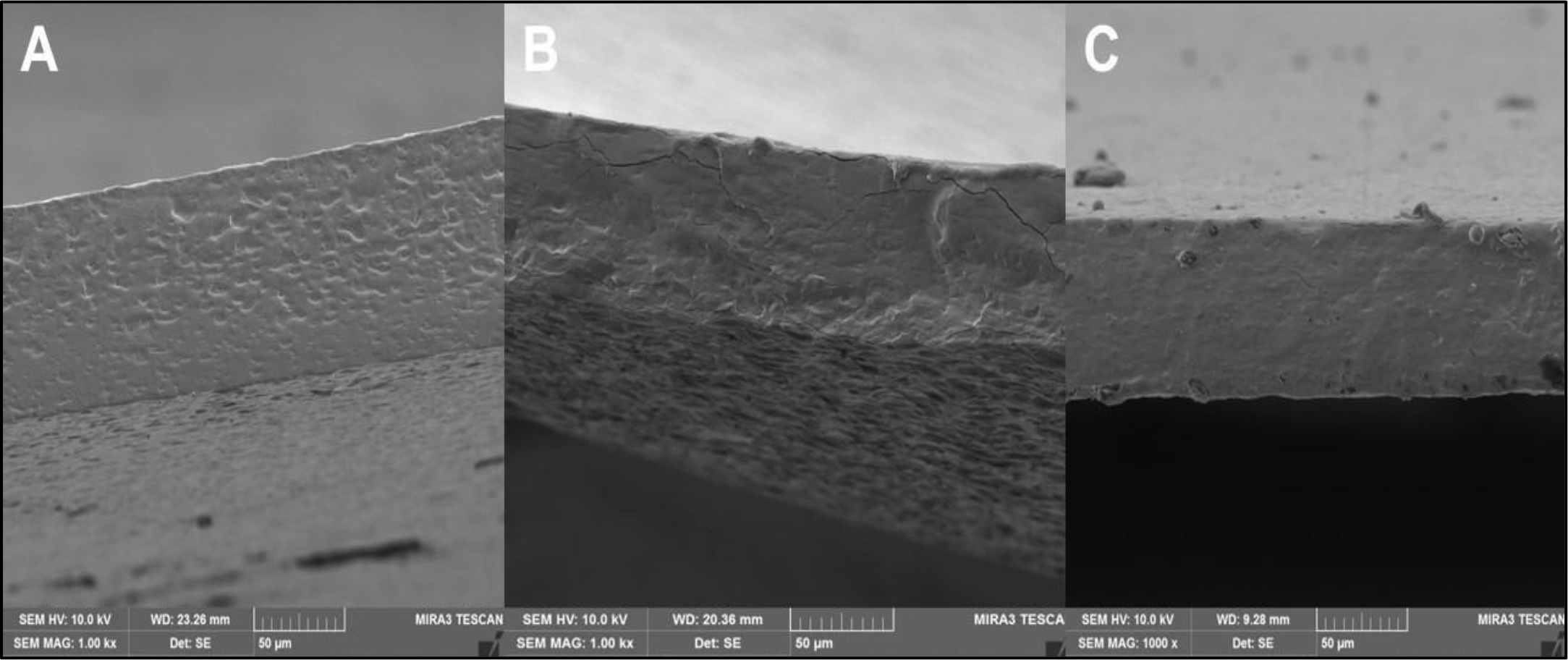
The electron microscopy of the cryofracture of the films, as illustrated in Figure 2, reveals that the Control film exhibited a more irregular and heterogeneous fracture surface. The film with 5% extract had a rougher surface, while the film with 10% extract had a smoother, more homogeneous surface.

Images of the cryofractures of the Control film (A), film with 5% BSG extract (B), and film with 10% BSG extract (C); Magnification 1000x.
Thermogravimetric analysis (TGA)
The TGA analysis determined the temperature range where the material undergoes the most significant degradation. In Figure 3, the TGA graphs of all the films showed three stages of thermal degradation.

TGA (A) and dTG (B) curves of starch and PVA polymers, Control film, and films with 5% and 10% BSG extract.
The analysis of dTG curves (Figure 3) demonstrates the maximum degradation temperature for the mixture of starch with PVA; it was slightly higher (317 °C) than pure starch (300 °C). Pure PVA exhibited the highest degradation temperature (333 °C) among the analyzed samples.
Fourier-transform infrared spectroscopy (FTIR)
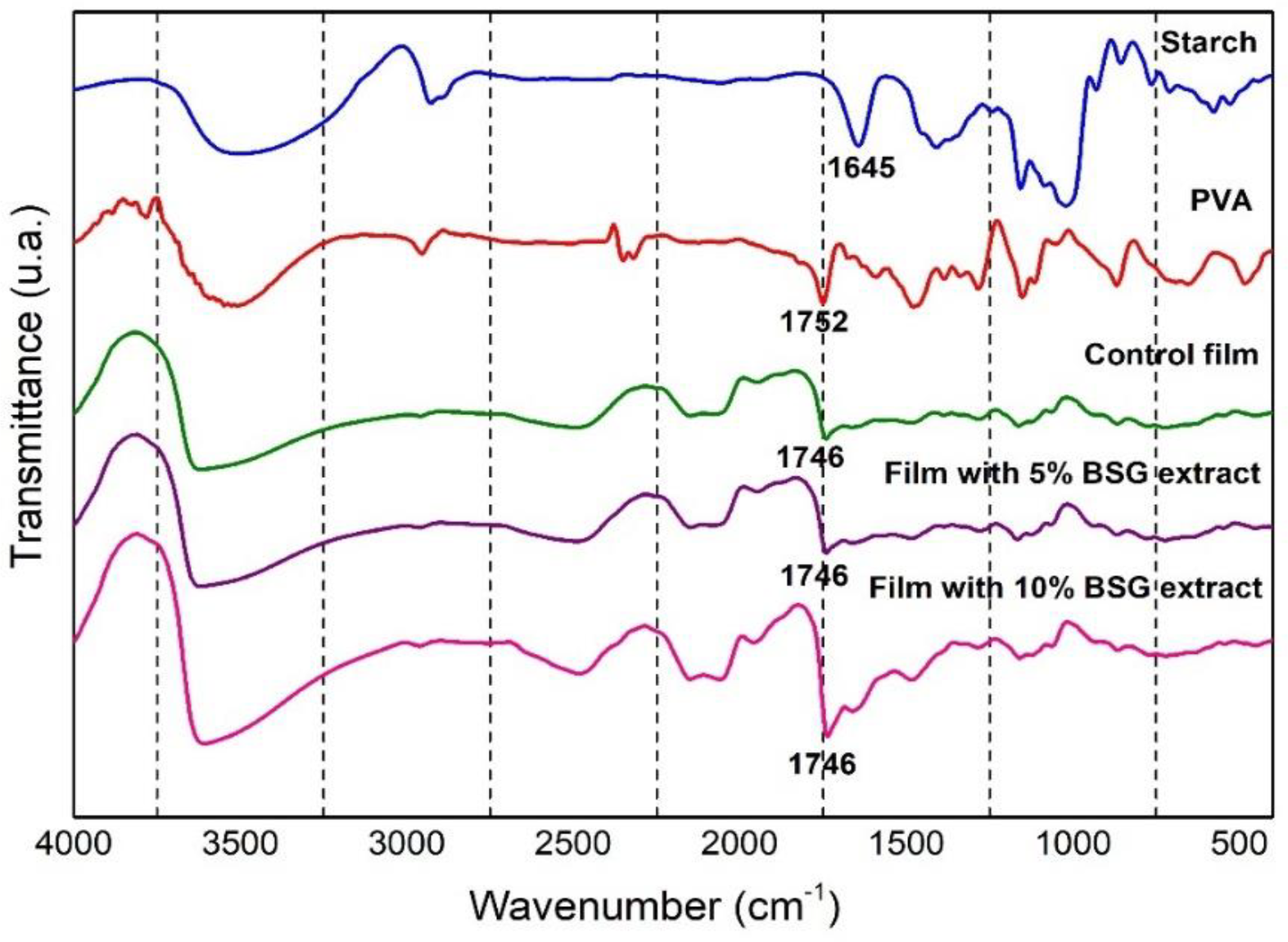
In Figure 4, the spectra related to the starch and PVA polymers and the Control films and films with 5% and 10% BSG extract are demonstrated.

FTIR spectra of starch and PVA polymers, Control film, and films with 5% and 10% BSG extract.
Mechanical properties
The tensile strength of the films with 10% extract was significantly higher than that observed for the Control film and film with 5% extract (Figure 5). However, these films with 10% BSG extract are less flexible and have lower elongations than the Control film.

Results of the tensile strength (A), elongation at break (B), and elastic modulus (C) for the Control film and films with 5% and 10% BSG extract.
Release of phenolic compounds
Figure 6 shows the release profile of phenolic compounds in films with 5% BSG extract.

Release profile of total phenolic compounds from films with 5% BSG extract in different media (water and skin simulant medium pH 5.5) and temperatures (25ºC and 32ºC).
Figure 7 shows a similar release profile for the films with 10% extract.

Release profile of total phenolic compounds from films with 10% BSG extract in different media (water and skin simulant medium pH 5.5) and temperatures (25ºC and 32ºC).
DISCUSSION
Total phenolic content in the BSG extract
The value obtained in the quantification of the content of total phenolic compounds in BSG (2.82 ± 0.03 mg GAE.g-1 BSG extract) was compared with the values obtained by other authors, such as Almeida and coauthors (2017) [14] with 3.80 mg EAG.kg-1 BSG, Lech; Labus (2022) [15] with 1.7 mg EAG.kg-1 BSG and Zuorro; Iannone and Lavecchia (2019) [16] with 4.126 mg EAG.g-1 and in this case using only acetone as the extraction solvent.
Almendinger, Rohn, and Pleissner (2020) [7] demonstrated that there is a difference between the concentration of phenolic compounds in darker BSG (5.1 mg GAE.g-1 BSG) and lighter BSG (1.8 mg GAE.g-1 BSG) due to the presence of high molecular weight melanoidins, which come from the Maillard reaction, in which the degradation of sugars and amino acids occurs. Melanoidins can also react with the Folin-Ciocalteau reagent, leading to a higher total phenolic compound value.
The concentrations of phenolic compounds in BSG can vary from 0.14 to 13.23 mg EAG.g-1 BSG, depending on the type of barley, pretreatment, and extraction method [17].
One of the main properties of phenolic compounds is antioxidant activity, which corresponds to the inhibition of reactive oxygen species (ROS) [7]. Due to the cosmetic application of the starch/PVA films developed in this study and described in the following topics, it is necessary to investigate the concentration of phenolic compounds present in the extract to evaluate the amount that is being released from the films, enabling them to exert antioxidant activity on the skin. Future studies are needed to prove the antioxidant property of phenolic compounds in films.
Characterization of starch/PVA films
Thickness, density, and apparent opacity
The increase in density can be explained by the hydrogen bonds that the compounds of the extract can have with other components of the film matrix. This causes the previously existing spaces to be filled, leading to a denser and more compact film structure [18].
The increase in extract concentration increased the film opacity. The film containing 10% extract revealed greater opacity when compared to the others. The increase in opacity can be attributed to the color of the polyphenols. Similarly, the BSG extract exhibited a yellowish coloration [19]. However, the extract did not impact film opacity at the lower concentration of 5% (film containing 5% BSG extract).
In recent years, there has been a preference for using beauty facial masks that are transparent (less opacity) and thin (with low thickness values) [10], results observed for the Control starch/PVA masks and with 5% BSG extract.
Water vapor permeability and water solubility
Water solubility is a parameter employed to assess whether the mixture of starch and PVA is easily soluble in water or resistant. Since the polymers and phenolic compounds in the extracts have many hydroxyl groups in their chemical structures, they bond together, leading to the solubilization of the films in water. Furthermore, the constituents of the film - starch, PVA, and glycerol - are hydrophilic. The high solubility of the films in water means that, on hydrated skin, the presence of water leads to faster disintegration of the polymeric structure. This, in turn, facilitates and releases the extract's phenolic compounds into the skin faster [9,20].
Water vapor permeability assesses moisture permeation through the film to the skin or other medium the film might contact. Permeability is a critical factor for films intended for skin application; they cannot be entirely occlusive, as they must allow for gas exchange between the skin and the external environment [20].
The 10% BSG Extract Film exhibited a lower water vapor permeability compared to the film with 5% extract. This phenomenon can be explained by the fact that water vapor has to follow a tortuous path formed by the increase in the concentration of extract in the polymer matrix. Furthermore, there was an increase in hydrophobicity due to adding extract to the film, which also hindered the passage of water vapor [9].
Patil and coauthors (2021) [20] reported that the water vapor permeability values for starch/PVA films ranged from 4.57 x 10⁻¹⁰ to 3.17 x 10⁻¹⁰ g.m-1.s-1.Pa-1 decreases with the increase in the proportion of PVA added to the film. The semi-crystalline nature of PVA and the occurrence of H-bonds between the OH groups of the polymer chains are possible explanations for the lower water vapor permeability values. The permeability results were consistent with the findings of Qin and coauthors (2020) [18], who also observed a reduced permeability with increasing extract concentration in the films. This reduction is attributed to hydrogen bonding interactions between betalains, starch, and PVA, which lead to a more compact structure with fewer pores for water vapor permeation.
The outermost layer of the skin, the epidermis, regulates transepidermal water loss (TEWL). Dryness and consequent skin irritation can be caused by low humidity environments or the continual use of cosmetic products containing anionic surfactants that perform a cleansing function but damage the skin barrier [21]. Skin moisturizing and the use of masks that are not occlusive and permeable to water vapor in the environment can prevent increased TEWL. In this context, the 5% BSG Extract Film, which proved to be more permeable when compared to the film with 10% BSG Extract Film, would be the most suitable for application in cosmetic facial masks.
Scanning electron microscopy
Qin and coauthors (2020) [18] observed that the films became more homogeneous as the concentration of the extract increased. This phenomenon occurred because the extract filled the free volume of the film matrix, interacting even more with other film components through hydrogen bonds.
Yu and coauthors (2022) [19] observed a decrease in film homogeneity with increasing concentrations of polyphenols (8% and 10%) within the polymer matrix. The excessive amount of tea polyphenols caused the structure of the film to break. In contrast, films formulated with lower polyphenol concentrations (2%, 4%, and 6%) maintained a uniform structure, possibly due to the interaction of polyphenols with starch and PVA through hydrogen bonds. Therefore, at the concentrations tested, it can be concluded that the material was homogeneous and showed no tendency toward phase separation. This demonstrates a good interaction between the matrix and the phenolic compounds. The homogeneous matrix of the films, without signs of instability caused by incompatibilities between the components, is a crucial attribute for its acceptance for commercialization.
Thermogravimetric analysis (TGA)
The TGA graphs of all the films showed three stages of thermal degradation. The initial mass loss (100ºC) is related to the evaporation of water and other volatile substances. In the second stage (200-300 ºC), the amylose and amylopectin chains of the starch are degraded, and the PVA is thermally degraded. In the third stage (400-500ºC), the probable oxidation of the sample occurs [20,22]. Incorporating poly(vinyl alcohol) facilitates interactions between starch and PVA due to the abundance of hydroxyl present in both polymers. These interactions can contribute to an enhancement of the thermal stability of the films [9].
The presence of the extract did not interfere with the thermal stability of the films. The films with 5% and 10% extract presented the same maximum degradation temperature (317 ºC) as the Control film.
The structure of the film remains intact until approximately 200 ºC, at which point the most significant mass loss (%) begins, as shown in Figure 3. This result proves that the biodegradable starch/PVA films with BSG extract are thermally stable during their production and at the skin temperature (37 ºC), as well as the storage conditions of the films in places with higher temperatures.
Fourier-transform infrared spectroscopy (FTIR)
In Figure 4, starch shows the band at 3387 cm-1 related to the stretching vibration of the OH group. At 2930 cm-1, there is CH2 stretching of the alkane group, and 1333 cm-1 corresponds to the C-H bending of the alkane group. The band at 1641 cm-1 is due to the bending of the OH group in the water molecule (starch hygroscopicity). The C=C stretching vibration may also occur in the 1652-1630 cm-1 range. At 1205 cm-1, C-OH bending occurs. At 1149 cm-1 and 1076 cm-1, the bands are characteristic of the C-O vibration and C-C stretching of the C-O-C groups of the glucose unit of starch [20].
In the PVA spectrum (Figure 4), the presence of the band at 3926 cm-1 is due to the presence of OH, which represents the intraand intermolecular hydrogen bond. The bands between 3000-2800 cm-1 correspond to the asymmetric stretching vibration of the C-H bond of the alkyl groups. The band at 1752 cm-1 is due to the C-O group of residual PVA acetates. At 1414 cm-1, CH-CH2 stretching vibration may occur. At wave number 1373 cm-1, there is a hydrocarbon (alkane) and the C-O vibration of the C-OH groups in the 1000-1250 cm-1 band [9,20].
In the Control films, containing starch and PVA, it can be seen that in the 3300-3000 cm-1 band (Figure 4), there is stretching vibration of the OH groups; at 2930 cm-1, there is the presence of the C-H group; at 1710 cm-1, there is the bending vibration of the hydrogen bond of the OH group and, at 1076 cm-1, the C-O stretching. The FTIR spectra show an interaction by hydrogen bonds between PVA and starch due to the presence of the OH and C-O groups [20]. The band at 1746 cm-1 can be attributed to the stretching vibration of C═O groups [23].
The FTIR spectra of the samples containing BSG extract exhibited similarities, resembling a combination of the spectra of the isolated polymers and without the appearance of new bands. This shows that no chemical bonds occurred between the extracts and the polymer matrix. This result is desirable since, during the application of the films as cosmetic formulations, it is hoped that the phenolic compounds will migrate from the matrix to the skin, thus performing their function as antioxidants.
Mechanical properties
Some factors, such as chemical interactions between phenolic compounds and other components, less mobility of the polymer chains, and the density of the polymer matrix, reduce flexibility and elongation at break [9].
The results were similar to those of Yu and coauthors (2022) [19], who developed starch and PVA films with tea polyphenols using solvent casting. They observed that the tensile strength also increased as the concentration of polyphenols increased. As there is an interaction between the polyphenol molecules, starch, and PVA, adding polyphenols in higher concentrations may have improved the structure of the film matrix, thereby improving tensile strength. As for elongation at break, when the concentration of polyphenols increased, the stability of the film's polymeric network was compromised, which caused elongation to decrease significantly [19].
In the study by Kumar and coauthors (2021) [24], it was observed that increasing the concentration of extract in rice starch/PVA films caused a reduction in elongation at break. Increasing the concentration of extract led to greater rigidity and less extensibility in the starch/PVA films.
The PVA/starch film with 5% BSG extract has the potential for cosmetic use in facial masks due to its greater flexibility (higher elongation at break when compared to the film with 10% BSG extract), which provides better adjustment for facial curves. The rapid release of phenolic compounds in skin that has been hydrated before applying masks is possible due to their readily soluble nature in aqueous media. Furthermore, films with 5% extract are more flexible than films with 10% extract, are not easily broken, and can be transported and handled more easily.
Release of phenolic compounds
For the skin simulant medium pH 5.5, 100% of the phenolic compounds present in the extract were released during the 4-hour test. The release profile was similar at different temperatures, considering the skin simulant medium as the dissolution medium. In the film with 5% BSG extract, with water, it was observed that the release reached a maximum of 50% during the 4-hour mark at a temperature of 32 ºC.
For the film with 10% BSG extract, in the skin simulant medium with pH 5.5, 100% of the phenolic compounds were released during the 4-hour mark at both temperatures (25 ºC and 32 ºC). The release was slightly over 60% at room temperature in the aqueous medium.
Phenolic compounds can be degraded when exposed to light and oxygen at high temperatures and an alkaline pH (pH>7.0) [25]. The pH of the skin (around 5.5) in acidic environments favors preserving the structure of the phenolic compounds, which can exert their antioxidant action on the skin. The application of the films as cosmetic masks should be for a relatively short period (~ 4 hours) to increase the adhesion of the product and possibly provide an anti-aging treatment. Based on this, the starch/PVA masks were considered appropriate because the films with 5% BSG extract and 10% BSG extract released 100% of the phenolic compounds in 2 hours and 4 hours, respectively, in a skin simulant medium (pH 5.5).
CONCLUSION
This study describes a new approach to a natural, inexpensive, sustainable, and eco-friendly cosmetic mask using BSG extract. The influence of BSG extract and its concentrations (5% and 10%) on the physicochemical properties of films was compared to the Control film (without BSG extract) in selecting a formulation, considering the most suitable characteristics for application in facial masks. The film with 5% BSG extract was less opaque and more transparent, more permeable to water vapor, ensuring that the skin is not occluded. The formulation with 5% extract exhibits a less rigid and brittle structure, which makes handling easier than the film with 10% BSG extract.
The FTIR spectra demonstrated that the functional groups of the phenolic compounds in the BSG extract did not change chemically in the films. According to the thermogravimetric analysis, starch-PVA films containing BSG extract exhibit excellent thermal stability and require three different stages of degradation. All the phenolic compound content in starch-PVA films that contain 5% and 10% BSG extract was released in a skin simulant medium for 4 hours (pH 5.5). The starch-PVA film with 5% BSG extract is an ideal alternative for anti-aging cosmetic masks, and a natural, sustainable, and biodegradable cosmetic was successfully obtained.
-
Funding:
This research received no external funding.
Acknowledgments:
The authors thank Koch Ltda for providing the brewers’ spent grain, the Coordenação de Aperfeiçoamento de Pessoal de Nível Superior (CAPES) - code 001 for financial support, and the Multiuser Laboratories of the State University of Ponta Grossa for technical support.
Data availability statement:
Research data are only available upon request for corresponding author.
REFERENCES
- 1 Pasquet PL, Villain-Gambier M, Trébouet D. By-Product Valorization as a Means for the Brewing Industry to Move toward a Circular Bioeconomy. Sustain. 2024;16(8).
-
2 Bonifácio-Lopes T, Vilas Boas AA, Coscueta ER, Costa EM, Silva S, Campos D, et al. Bioactive extracts from brewer’s spent grain. Food Funct [Internet]. 2020 [cited 2024 Jun 10];11(10):8963-77. Available from: http://xlink.rsc.org/?DOI=D0FO01426E
» http://xlink.rsc.org/?DOI=D0FO01426E - 3 Iadecola R, Ciccoritti R, Ceccantoni B, Bellincontro A, Amoriello T. Optimization of Phenolic Compound Extraction from Brewers’ Spent Grain Using Ultrasound Technologies Coupled with Response Surface Methodology. Sustain. 2022;14(6).
- 4 Verni M, Pontonio E, Krona A, Jacob S, Pinto D, Rinaldi F, et al. Bioprocessing of Brewers’ Spent Grain Enhances Its Antioxidant Activity: Characterization of Phenolic Compounds and Bioactive Peptides. Front Microbiol. 2020;11(July):1-15.
- 5 Lima DJ, Buzanello CV, Oliveira L, Silva RA. Polyphenols as natural antioxidants in cosmetics applications. J Cosmet Dermatol. 2020;19(1):33-7.
-
6 Avalos-Viveros M, Santolalla-Vargas CE, Santes-Hernández VF, Martínez-Flores HE, Torres-García E, López-Meza JE, et al. Valorization of avocado peels by conventional extraction and hydrothermal carbonization for cosmeceutical applications. Sustain Chem Pharm. 2023;36(November):101335. doi:1016/j.scp.2023.101335.
» https://doi.org/1016/j.scp.2023.101335. -
7 Almendinger M, Rohn S, Pleissner D. Malt and beer-related by-products as potential antioxidant skin-lightening agents for cosmetics. Sustain Chem Pharm. 2020;17(May):100282. doi:10.1016/j.scp.2020.100282.
» https://doi.org/10.1016/j.scp.2020.100282. - 8 Yao Y, Xu B. Skin Health Promoting Effects of Natural Polysaccharides and Their Potential Application in the Cosmetic Industry. Polysaccharides. 2022;3(4):818-30.
-
9 Abedi-Firoozjah R, Chabook N, Rostami O, Heydari M, Kolahdouz-Nasiri A, Javanmardi F, et al. PVA/starch films: An updated review of their preparation, characterization, and diverse applications in the food industry. Polym Test. 2023;118(December 2022):107903. doi:10.1016/j.polymertesting.2022.107903.
» https://doi.org/10.1016/j.polymertesting.2022.107903. - 10 Trevisol TC, Henriques RO, Souza AJA, Cesca K, Furigo A. Starchand carboxymethyl cellulose-based films as active beauty masks with papain incorporation. Int J Biol Macromol. 2023;231(July 2022).
- 11 Coltelli MB, Panariello L, Morganti P, Danti S, Baroni A, Lazzeri A, et al. Skin-compatible biobased beauty masks prepared by extrusion. J Funct Biomater. 2020;11(2).
- 12 American Society for Testing and Materials. ASTM. ASTM E 96-95. Standard test methods for water vapor transmission of materials. 1995;1-8.
- 13 American Society for Testing and Materials. ASTM. ASTM D-882-02 “Standard Test Method for Tensile Properties of Thin Plastic Sheeting.” 2002.
- 14 Almeida AR, Geraldo MRF, Ribeiro LF, Silva MV, Maciel MVOB, Haminiuk CWI. [Bioactive compounds from brewers’ spent grain: Phenolic compounds, fatty acids and in vitro antioxidant activity]. Acta Sci Technol. 2017; 39(3):269-77.
- 15 Lech M, Labus K. The methods of brewers’ spent grain treatment towards the recovery of valuable ingredients contained therein and comprehensive management of its residues. Chem Eng Res Des. 2022; 183: 494-511.
- 16 Zuorro A, Iannone A, Lavecchia R. Water-organic solvent extraction of phenolic antioxidants from brewers’ spent grain. Processes. 2019; 7(3).
-
17 Zago E, Tillier C, Leener G, Nandasiri R, Delporte C, Bernaerts KV, et al. Sustainable production of low molecular weight phenolic compounds from Belgian Brewers’ spent grain. Bioresour Technol Rep. 2021; 17(December 2021): 100964. doi:10.1016/j.biteb.2022.100964.
» https://doi.org/10.1016/j.biteb.2022.100964. -
18 Qin Y, Liu Y, Zhang X, Liu J. Development of active and intelligent packaging by incorporating betalains from red pitaya (Hylocereus polyrhizus) peel into starch/polyvinyl alcohol films. Food Hydrocoll. 2020;100(August 2019):105410. doi:10.1016/j.foodhyd.2019.105410.
» https://doi.org/10.1016/j.foodhyd.2019.105410. - 19 Yu X, Lin L, Mei L, Sun C, Zhu Z, Du X, et al. Development, characterization, and antioxidant evaluation of corn starch-based composite films containing tea polyphenols. J Appl Polym Sci. 2022;139(15):1-12.
-
20 Patil S, Bharimalla AK, Mahapatra A, Dhakane-Lad J, Arputharaj A, Kumar M, et al. Effect of polymer blending on mechanical and barrier properties of starch-polyvinyl alcohol based biodegradable composite films. Food Biosci. 2021;44(PA):101352. doi:10.1016/j.fbio.2021.101352.
» https://doi.org/10.1016/j.fbio.2021.101352. - 21 Kozlowska J, Tylkowski B, Stachowiak N, Prus-Walendziak W. Controlling the skin barrier quality through the application of polymeric films containing microspheres with encapsulated plant extract. Processes. 2020;8(5).
- 22 Zanela J, Olivato JB, Dias AP, Grossmann MVE, Yamashita F. Mixture design applied for the development of films based on starch, polyvinyl alcohol, and glycerol. J Appl Polym Sci. 2015;132(43).
- 23 Castanho MN, Souza K, Paiva JMF. Developing thermoplastic corn starch composites filled with brewer’s spent grain for applications in biodegradable films. Polym Compos. 2022;43(2):811-26.
-
24 Kumar P, Tanwar R, Gupta V, Upadhyay A, Kumar A, Gaikwad KK. Pineapple peel extract incorporated poly(vinyl alcohol)-corn starch film for active food packaging: Preparation, characterization and antioxidant activity. Int J Biol Macromol. 2021;187(July):223-31. doi:10.1016/j.ijbiomac.2021.07.136.
» https://doi.org/10.1016/j.ijbiomac.2021.07.136. - 25 Pasquet PL, Julien-David D, Zhao M, Villain-Gambier M, Trébouet D. Stability and preservation of phenolic compounds and related antioxidant capacity from agro-food matrix: Effect of pH and atmosphere. Food Biosci. 2024;57(September 2023).
-
Editor-in-Chief:
Paulo Vitor Farago
-
Associate Editor:
Paulo Vitor Farago