 The Ammonium Excreting Azospirillum brasilense Strain HM053 Enhances the Vegetative Development of Strawberry
Abstract
Strawberry is a small fruit with high commercial value and is globally appreciated for its organoleptic and nutraceutical characteristics. However, its production necessitates substantial inputs of nitrogen fertilizers, resulting in elevated production costs and environmental harm. Plant growth-promoting bacteria have been gaining prominence in sustainable agriculture for their ability to stimulate plant growth and partially replace nitrogen fertilizers. Among these microorganisms, the genus Azospirillum stands out as one of the most promising; nevertheless, its utilization in growing small fruits has received less attention. This study aimed to evaluate the impact of Azospirillum biofertilization on greenhouse-grown strawberry crops. For this, two strains from this genus (A. brasilense Ab-V5 and HM053), were individually evaluated in association with four different nitrogen doses. Additionally, two different inoculation methods were employed: soil inoculation and leaf aspersion. The research was conducted using a completely randomized design, with one strawberry plant per pot and six repetitions per treatment. The results indicate that the Florida Festival strawberry crop responded positively to inoculation with A. brasilense HM053 and Ab-V5. The best results were observed for plants inoculated with HM053 associated with 50% nitrogen, which achieved results comparable to treatments with a full dose of nitrogen and without inoculation and also showed a 2.74% increase in shoot fresh weight compared to the control. This could indicate a 50% reduction in the use of nitrogen fertilizer; reducing production costs by approximately 32 dollars per cultivated hectare, making A. brasilense HM053 a promising biofertilizer for strawberry cultivation.
Keywords:
Biotechnology; Nitrogen fertilization; Plant Growth-Promoting Bacteria; Sustainable Agriculture.
HIGHLIGHTS
The best results with the HM053 strain were observed at the lowest nitrogen doses.
Regardless of the inoculation method, strain HM053 improved the biometric parameters of strawberry plants.
Using strain HM053 can result in a 50% decrease nitrogen fertilizer usage.
INTRODUCTION
Strawberry (Fragaria x ananassa, Duch) is a small fruit with high commercial value, it is appreciated worldwide for its organoleptic, nutraceutical, and antioxidant characteristics. Global strawberry production was approximately 9.17 million tons on 389.6 thousand hectares in 2021 [1]. However, its production is intensive and requires high amounts of nitrogen fertilizers at various stages of its biological cycle, increasing the cost of production [2,3,4]. Adequate nitrogen supply to strawberry seedlings promotes vegetative performance, increases essential biochemical substances, such as proteins, enzymes, nucleic acids, amino acids, and chlorophyll, and leads to robust and healthy plants, satisfactory yields, and high-quality fruits [5]. Although chemical fertilizers are beneficial to increase crop yields, their intensive use causes severe impacts on the environment, such as groundwater contamination, soil quality degradation and biodiversity reduction, also affecting human health [6,3,2,7]. Thus, it becomes necessary to search for eco-friendly ways of cultivation, which maintain high productivity while protecting the environment.
A key component of the ecosystem are the soil microbial communities, which are responsible for nutrient cycling, regulation of soil fertility, and maintaining plant diversity [8]. Among the soil microbial communities, there are bacteria capable of stimulating plant development, called plant growth-promoting bacteria (PGPB) [9,10,11,12]. The PGPB stand out for their ability to promote plant growth, this can occur through biological nitrogen fixation (BNF), a complex and essentially microbiological process, in which nitrogen (N2) is reduced to ammonia (NH3) by the nitrogenase enzyme complex, production of phytohormones, mineral solubilization, stimulation of root growth, competition for nutrients with pathogens, inducing defense mechanisms in the host, and generating induced systemic resistance (ISR), among others [9,13,2,14,15,8,16].
The genus Azospirillum has emerged as one of the most promising PGPB. Currently, it is the most studied and used genus due to its ability to colonize the roots of over a hundred different plant species, most of them of agronomic interest, being able to increase productivity and to reduce the use of pesticides and nitrogen fertilizers [17,18,19,20,21,22]. Since 2009, A. brasilense strains Ab-V5 (=CNPSo 2083) and Ab-V6 (=CNPSo 2084) have been used to improve productivity in maize and wheat [22,23,24].
Azospirillum brasilense strain HM053 is a spontaneous mutant in glutamine synthetase (GS) and resistant to ethylenediamine (EDA) that is capable of excreting ammonia and fixing nitrogen constitutively, even in the presence of high concentrations of NH4+ [25,23,24]. This ability is related to low GS activity, resulting in deficiency in NH4+ assimilation and the elimination of excess ammonia produced during nitrogen fixation [26,25]. This A. brasilense strain showed promising results in wheat [24], maize [23] and barley crops [27].
The efficiency of A. brasilense as a plant growth promoter has been proven in various crops, including fruit trees, such as blackberry, apricot, cherry, and raspberry [28,29]. Considering the nutritional needs of strawberries, including the high inputs of nitrogen during its biological cycle, and the ability of A. brasilense to making nitrogen available to the plants and promote the growth, as well as the urgency to develop a sustainable agriculture, it is expected that the use of A. brasilense, especially the HM053 strain, can mitigate the nitrogen needs of strawberries, reducing production costs and improving plant development.
Therefore, the objective of this study was evaluate the effect of two Azospirillum brasilense strains, in combination with four different doses of nitrogen in two forms of inoculation (in the soil or by leaf aspersion), for the promotion of strawberries growth.
MATERIAL AND METHODS
Bacterial culture and plant material
The bacterial strains used, Azospirillum brasilense HM053 and Ab-V5 (=CNPSo 2083), are derived from Azospirillum brasilense Sp7 (Sp7 ATCC 29145, SmR, NalR) [25]. The strains were obtained respectively from the Department of Biochemistry and Molecular Biology, Federal University of Paraná (UFPR), Curitiba, Paraná, Brazil, and from the microbiological culture collection of Laboratory of Biology Molecular Microbial (LABMOM), State University of Ponta Grossa (UEPG), Ponta Grossa, Paraná, Brazil. The inoculants were prepared at UEPG. In sum, pure cultures of A brasilense, strains HM053 or Ab-V5, were grown in 2 mL of liquid NFB lactate medium [30], containing the appropriate antibiotics: nalidixic acid (10 µg ml-1) and streptomycin (80 µg ml-1), and supplemented with 50 mM phosphate solution, 20 mM ammonium chloride (NH4Cl) and 100 µg ml-1 of biotin, under orbital agitation at 180 rpm for 48 hours at 28 ± 2 ºC to prepare the pre-inoculum.
Inoculants were prepared from 200 µl of each pre-inoculum and individually inoculated into 50 mL of liquid NFB lactate medium, supplemented with 50 mM phosphate solution, 20 mM ammonium chloride (NH4Cl) and 100 µg ml-1 of biotin, in Erlenmeyer flasks (250 mL). They were kept under agitation in an orbital shaker at 180 rpm at 28 ± 2 ºC for 24 hours (Ab-V5) and 28 hours (HM053). After incubation, the optical density of the cultures was measured using a spectrophotometer at a wavelength of 600 nm. The final bacterial concentration for the strawberries inoculation was about 109 CFU ml-1 (OD 600nn ~1.0). Inoculation was performed either by leaf aspersion or on the soil, near the roots, according to the treatment.
Strawberry mother plants (Fragaria x ananassa, Duch), cultivate Florida Festival, were obtained from Multiplanta Tecnologia Vegetal, Andradas, Minas Gerais state, Brazil. The strawberry seedlings were placed in a cold chamber for 15 days for acclimatization and then transferred to a greenhouse at UEPG, Paraná state, Brazil (25°05'23.9"S 50°06'08.2"W), where they were transplanted into 3-liter plastic pots containing 0.0031 m3 of Latosol soil class. The soil was collected at Capão da Onça Farm School (FESCON, UEPG). After collection, the soil was sieved and the liming requirements were determined using the base saturation method in the Soil Fertility Laboratory, at UEPG (Table 1). Calcium carbonate and magnesium carbonate were added as required. All pots were maintained in the greenhouse from October 2019 to September 2020, and they were watered three times a week. Hoagland's nutrient solution without added nitrogen was used monthly as a source of nutrients.
Experimental Design
The experiment was conducted in a completely randomized design, in a 3x4x2 factorial scheme, with one strawberry plant per pot and six repetitions per treatment. The first factor was the inoculation of biofertilizers, A. brasilense Ab-V5 or A. brasilense HM053, either inoculated individually or without inoculation. The second factor consisted of the treatment with four different nitrogen concentrations [0%, 25% (92.5 mg), 50% (185 mg), and 100% (370 mg) of the recommendation for the crop in Brazil] [31]. The third factor was the inoculation method, either in the soil, near the roots, or by leaf aspersion. The treatments are described in Table 2.
Agricultural urea (CH4N2O - 46% N) diluted in water (1g of urea per 100 ml of ultrapure water) was used as a nitrogen source. The application occurred in two stages, at 15 and 90 days after transplanting the seedlings. The treatments without nitrogen were irrigated with the same amount of distilled water. The strawberry seedlings were inoculated 30 days after transplanting with 1 ml (109 CFU ml-1) of A. brasilense Ab-V5 or A. brasilense HM053 using the culture medium in which they were grown. Inoculation was carried out in the soil, in a small cavity close to the roots, or by foliar spraying. To prevent contact of the inoculant with the soil, the soil around the plants was covered with plastic sheeting. The treatments without inoculation were irrigated with the same amount of distilled water.
Biometric parameters
To increase plant vigor and improve growth, the first flowers were removed, and the stolons were pruned three times a week. The shoot length of aerial part, root length, and leaf area (average of the three largest leaves) were measured using a digital caliper and expressed in centimeters (cm). Shoot length and the number of leaves per plant were measured monthly from October 2019 to March 2020, however, only the data from the final measurement were considered. Total biomass was calculated as the sum of the dry weight of shoots and roots. Dry weight measurements were obtained by drying the aerial parts and roots in an oven at 60º C for 72 hours until a constant weight was reached [32,20]. The dry weight of each sample was then measured using a precision digital scale, and the values were recorded and expressed in grams (g).
Statistical Analysis
Statistical analyses were performed using RStudio software (R Core Team) [33]. The results were subjected to a one-way analysis of variance (ANOVA), and the normality and homogeneity of residuals were assessed for all variables using the Shapiro-Wilk test (p > 0.05). Mean comparisons were performed using Tukey´s test (p < 0.05) as a post hoc multiple comparison test, using the ExpDes.pt package [34].
RESULTS
Number of leaves and shoot length
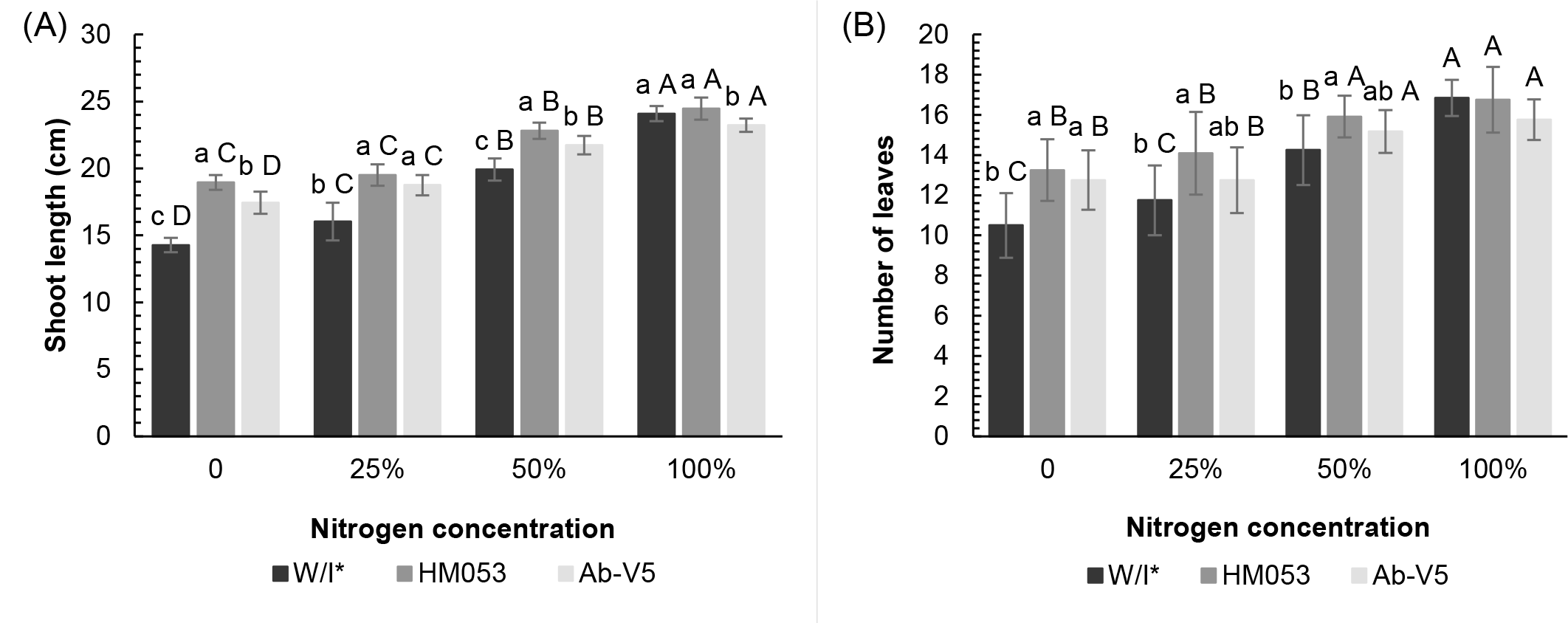
The results show that inoculation of A. brasilense strains Ab-V5 and HM053 had a positive effect on the shoot of strawberry plants. Furthermore, they indicate a significant interaction between the inoculated strains and the different nitrogen doses (Figures 1A and 1B). No significant differences were observed regarding the inoculation method (data not shown). Regardless of the inoculated strain, the full nitrogen dose resulted in plants with a higher shoot. However, the HM053 + 50% N treatment (22.81 ± 0.60 cm) showed a 12.86% and 8.37% increase in the shoot length of strawberries compared to the treatments without inoculation + 50% N (19.92 ± 0.82 cm) and Ab-V5 + 50% N (21.74 ± 0.69 cm), respectively, being equivalent to the treatment with complete application of nitrogen and without inoculation. Similar results were observed for the plants fertilized with 25% nitrogen, except that these were lower than those observed for the control with a full dose of nitrogen. On the other hand, the treatment with HM053 without nitrogen (18.96 ± 0.54 cm) led to an increase of 24.9% compared to the control without inoculation (14.28 ± 0.52 cm).

Shoot length (A) and number of leaves (B) of strawberries inoculated with A. brasilense Ab-V5, A. brasilense HM053 or without inoculation (W/I), associated with different doses of nitrogen (0, 25% (185 mg), 50% (370 mg) and 100% (740 mg)).
According to Figure 1B, the number of leaves was higher in treatments that received the full dose of nitrogen: without inoculation + 100% N (16.84 ± 0.89), HM053 + 100% N (16.75 ± 1.64) and Ab-V5 +100% N (15.75 ± 1.01). In comparison, HM053 + 50% N (15.91 ± 1.03) and Ab-V5 + 50% N (15.17 ± 1.06) demonstrated an increase in leaf number of 11.65% and 6.46%, respectively, compared to the treatment without inoculation + 50% N (14.2 ± 1.73), and also showed no significant difference when compared to the treatment without inoculation and a full dose of nitrogen. Similar to what was observed for the shoot, the strain HM053 without nitrogen addition (13.25 ± 1.53) was higher than the control without inoculation (10.5 ± 1.6) and comparable to the strain Ab-V5 without nitrogen addition (12.75 ± 1.47).
The data illustrates the interaction between nitrogen doses and inoculated microorganisms. Means with the same capital or lowercase letter do not differ statistically according to Tukey test at 5% significance. Lowercase letters indicate differences in bacterial strains, while capital letters indicate differences in nitrogen concentrations for each bacterial strain or treatment without inoculation.
Dry weight and fresh weight
Both the fresh weight and dry weight of the strawberries shoot exhibited high variability within treatments. This can be evidenced by the high coefficients of variation observed, 52.08% for fresh weight and 51.07% for dry weight, indicating a significant dispersion of the data about the average. Furthermore, standard deviations were high across all treatments (Tables 3A and 3B). For example, some treatments, such as strawberries inoculated in the soil with HM053 and associated with 50% nitrogen, plants sprayed with HM053 and associated with 100% nitrogen, and treatment control with a complete dose of nitrogen had fresh weights of 5.7 and 39 g, 3 and 29.2 g, and 11.3 and 33.5 g, respectively. At the same time, the dry weight showed variations of 10.26 and 1.94 g, 9.6 and 2.01 g and 9.15 and 3.7 g within the same treatments. Consequently, the average of fresh weight and dry weight of the shoot did not differ in most treatments.
Fresh weight (A) and dry weight (B) of the strawberries inoculated with A. brasilense strains Ab-V5 or HM053 by leaf aspersion or in the soil, and strawberries without inoculation (W/I), associated with four different nitrogen doses.
However, as shown in Tables 3A and 3B, there was a statistical difference in the method of inoculation in the treatments with A. brasilense HM053 + 50% N and without inoculation + 100% N. For both treatments, soil inoculation resulted in superior performance, with increases of 48.23% and 36.52% in fresh weight, and 42.52% and 38.28% in dry weight, respectively, in relation to inoculation by leaf aspersion. The treatment inoculated in the soil with HM053 + 50% N (21.77 ± 10.3 g) was also superior to the other treatments, with a 59.26% increase in fresh weight compared to the treatment without inoculation and nitrogen (8.87 ± 3.52 g), and with a 2.74% increase compared to the control treatment without inoculation with a full dose of nitrogen (21.19 ± 5.97 g).
Interaction among nitrogen doses (columns), inoculated microorganisms (rows), and inoculation method (leaf aspersion or in soil inoculation). Means are followed by their standard deviations. Means followed by the same capital or lowercase letter do not differ statistically according to Tukey's test at 5% significance. Lowercase letters indicate differences in bacterial strains, while capital letters indicate differences in nitrogen concentrations, and lowercase letters in italics and bold indicate differences in the inoculation method.
Root length, fresh and dry weights
No significant differences were observed for fresh and dry weights of the roots. However, the results presented in Table 4 show that there was a significant effect and interaction between the inoculated strains, nitrogen doses, and inoculation method for root length. Strawberries inoculated with strain HM053 did not differ from other treatments, however, the higher root length was observed in plants sprayed with HM053 + 25% N (34.08 ± 2.84 cm).
Root length of strawberries inoculated by leaf aspersion or in the soil with A. brasilense Ab-V5, A. brasilense HM053 or without inoculation (W/I), associated with four different nitrogen concentrations.
The nitrogen concentration was significant only for plants inoculated in the soil with A. brasilense Ab-V5, where the treatments associated with this strain and without nitrogen (33.91 ± 1.78 cm) or with 25% nitrogen (32.63 ± 2.88 cm) showed higher growth than the others. On the other hand, an increase of 32.50% in the length of the roots of strawberries inoculated by foliar spraying with A. brasilense Ab-V5 + 50% N was observed when compared to strawberries inoculated in soil with Ab-V5 + 50% nitrogen.
Total Biomass
Regarding the total biomass (Table 5), obtained by summing the dry weights of the root and shoot, significant differences were observed between the inoculated strains only for the concentrations of 25% (leaf aspersion) and 50% (soil inoculation) of nitrogen.
Total biomass of strawberries inoculated by leaf aspersion or in the soil with A. brasilense Ab-V5, A. brasilense HM053 or without inoculation (W/I), associated with four different nitrogen concentrations.
Among the plants inoculated by leaf aspersion and associated with 25% nitrogen (HN1F, AN1F, and ZN1F), the treatment without inoculation had the highest biomass value (13.94 ± 4.56 g), while the strawberries inoculated with the Ab-V5 strain had the lowest value (6.24 ± 4.07 g). For plants inoculated in the soil and associated with 50% nitrogen (HN2S, AN2S, and ZN2S), strain HM053 (12.44 ± 3.75 g) was superior to strain Ab-V5 (5.54 ± 3.19 g) and statistically equal to the treatment without inoculation (11.92 ± 5.04 g).
The soil inoculation with HM053 + 50% of nitrogen (12.44 ± 3.75 g) can also be considered statistically equal to the control treatment with 100% nitrogen (11.77 ± 4.10 g), showing a 35.21% increase over the treatment without inoculation and no nitrogen (8.06 ± 4.07 g).
Regardless of the inoculation method, the fresh and dry weights of the shoot and the total biomass tended to decrease for the full doses of nitrogen (370 mg per pot) associated with A. brasilense HM053. For example, the fresh weight of the treatment with HM053 + 100% of nitrogen inoculated in the soil (Table 3A) was 16.76% lower than that of the treatment with HM053 + 50% of nitrogen inoculated in the soil. As for the dry weight (Table 3B), the treatment sprinkled with HM053 + 100% of nitrogen was 8.13% lower than the treatment sprinkled with HM053 + 50% of nitrogen. Furthermore, a 7.07% reduction in total biomass (Table 5) was observed for the treatment with HM053 + 100% of nitrogen inoculated in the soil compared to treatment with HM053 + 50% of nitrogen in the same conditions.
DISCUSSION
In this study, two strains of A. brasilense (Ab-V5 and HM053) were evaluated as possible inoculants in strawberry cultures. Both strains have been reported in the literature for their ability to promote plant growth directly through Biological Nitrogen Fixation [23,24], phytohormone production [17,35], phosphate solubilization [36], siderophore production [32,37], biotic and abiotic stress control [35,14], or indirectly by inducing systemic resistance [15]. The results obtained in the present study are in agreement with those demonstrated by several authors for crops such as wheat, corn, and strawberry [17,38,2,39,24,40,36]. Overall, the use of the A. brasilense Ab-V5 and HM053 strains, associated with doses of 25% and 50% nitrogen, resulted in an increase in shoot length, number of leaves, root length, and total biomass compared to the other treatments, while being statistically equal to the treatment control without inoculation and full dose of nitrogen.
The full dose of nitrogen, regardless of inoculation, resulted in higher average shoot length. Similarly, Chandramohan Reddy and Goyal [38] obtained higher shoot length and number of leaves in strawberry plants grown in a greenhouse and inoculated with Azospirillum or Azotobacter associated with high nitrogen doses. However, de Andrade and coauthors [2], described higher shoot for cv. Aromas, grown in a greenhouse when inoculated with Enterobacter cloacae CCMA 1285, Azospirillum brasilense Ab-V5 + Burkholderia cepacia-CCMA 0056 and A. brasilense Ab-V5 + Burkholderia cepacia CCMA 0056 + Enterobacter cloacae CCMA 1285, with a 30%, 31% and 35% increase in shoot length, respectively, in relation to the control without inoculation. Silva and coauthors [36], cultivating strawberries, cv. Aromas, in a greenhouse, observed higher shoot growth after 15 days of inoculation associated with 30% of the recommended dose of nitrogen and phosphorus.
Each PGPB has different mechanisms to promote plant growth [9,10] Similarly, each strawberry cultivar responds differently to the use of biofertilizers [39,4]. Such characteristics, associated with the experiment's design, such as the frequency of reinoculation, in the case of Silva and coauthors [36], and the use of nutrient solutions, in the case of Andrade and coauthors [2], could explain the differences between their results and ours.
In contrast, Morais and coauthors [4], found no significant differences in shoot length or number of leaves after inoculating greenhouse-grown strawberry plants, though they noted a slight trend toward increased shoot length in inoculated plants. Our results, however, showed that when the A. brasilense HM053 was used in association with nitrogen doses of 0%, 25%, and 50%, both the number of leaves and shoots length were higher compared to the Ab-V5 strain and the plants without inoculation that were associated with the same nitrogen doses.
Regarding biomass, soil inoculation with HM053 + 50% nitrogen led to an increase of more than 30% compared to treatment without inoculation (ZN0). Similar results were described by Elias and coauthors [20], with a 51% increase in total biomass of strawberry plants inoculated with A. brasilense REC3 compared to the control without inoculation. De Andrade and coauthors [2] reported that in the presence of 50% nitrogen fertilizer, the association of PGPB Enterobacter cloacae CCMA 1285, A. brasilense Ab-v5 + Burkholderia cepacia-CCMA 0056 resulted in a 60.61% increase in total biomass in strawberries. Meanwhile de Moura and coauthors [39] reported a 279% increase in the biomass of plants inoculated with Brevibacillus fluminis (MET12M2) when compared to non-inoculated strawberries.
Such results suggest that the inoculated microorganisms were able to mitigate part of the nitrogen required by the Florida Festival cultivar. Well-nourished plants, with a good accumulation of nitrogen, usually show greater vegetative growth and, consequently, higher levels of photosynthesis, increasing the total biomass of the plant [38,2,20,41].
Root length was also significantly influenced by inoculation and nitrogen doses. One of the main characteristics of A. brasilense, other than the BNF, is the synthesis of phytohormones, such as indoleacetic acid (IAA) [10], and both Ab-V5 and HM053 strains are able to synthesize IAA [17,42]. Auxins are responsible for root elongation and induction of lateral roots [2,36], increasing root surface area and allowing the plant to explore new areas of soil in search of water and nutrients [17].
As previously described, plants inoculated in soil with the A. brasilense HM053 strain obtained higher biometric parameters compared to those inoculated with A. brasilense Ab-V5. These findings are consistent with numerous studies conducted with this strain on grasses. For example, Santos and coauthors [24] reported improvement in plant size, as well as a 30% and 49% increase in root and shoot dry weights, respectively, of wheat plants inoculated with HM053. In their investigation of the effects of the A. brasilense strain HM053, Pedrosa and coauthors [23] demonstrated a significant increase in corn yield (460.5 a 1769.3 kg ha-1) of cultivars inoculated with the strain and associated with base fertilization (30 kg ha-1 N). Housh and coauthors [42] reported that inoculation with HM053 improved iron assimilation and translocation in maize plants.
Although our study is a pioneer in testing the ability of A. brasilense HM053 as a growth promoter in fruit trees, especially in strawberry crops, its ability to fix nitrogen constitutively and excrete part of the fixed ammonium to the plant [26], as well as its positive effect on grasses, allows us to suggest that A. brasilense HM053 acted as a growth promoter, improving the biometric attributes of Florida Festival cultivar strawberries.
CONCLUSION
The benefits of inoculating A. brasilense HM053 on the biometric parameters of strawberry plants of the Florida Festival cultivar suggest that this plant growth-promoting bacteria may be a promising biofertilizer for strawberry cultivation. The effectiveness of this bacterium was noted when its application was associated with 50% nitrogen, achieving results comparable to treatments with a full application of nitrogen and without inoculation, and even presenting an increase of 2.74% in the shoot fresh weight about the treatment control.
The findings from inoculating A. brasilense HM053 suggest that this strain may be mitigating part of the daily nitrogen required for strawberry cultivation. This could lead to a reduction of up to 50% in the use of nitrogen fertilizers, potentially reducing production costs by approximately 32 dollars per cultivated hectare. Moreover, it could contribute to more sustainable and eco-friendly agriculture.
While the method of inoculant application was not significant for most treatments, soil inoculation showed advantages in some variables such as aerial part weights and total biomass. In contrast, inoculation by foliar spraying resulted in greater root length.
However, further studies are required to evaluate the effects of this strain on strawberry crops in open fields, ensuring its effectiveness and viability for large-scale production.
-
Funding:
This work was funded by the Coordination for the Improvement of Higher Education Personnel (CAPES, Brazil) and National Council for Scientific and Technological Development (CNPq, Brazil).
Acknowledgments:
The authors acknowledge Dr. Emanuel Maltempi de Souza and Dr. Fabio de Oliveira Pedrosa (Nucleus of Nitrogen Fixation, Federal University of Paraná (UFPR)) for their support with the strain Azospirillum brasilense HM053, and to the Academic Writing Center (Centro de Escrita Academica/CEA - https://www2.uepg.br/academic-writing/) from the State University of Ponta Grossa (State University of Ponta Grossa/UEPG) for assistance with English translation and developmental editing.
Data Availability Statement:
Research data are only available upon request for corresponding author.
REFERENCES
-
1 Food and Agriculture Organization of the United Nations - FAOSTAT. Production quantities of strawberries by country. 2021. Available online at: https://www.fao.org/faostat/en/#data/QCL/visualize
» https://www.fao.org/faostat/en/#data/QCL/visualize -
2 De Andrade FM, De Assis Pereira T, Souza TP, Guimarães PHS, Martins AD, Schwan RF, et al. Beneficial effects of inoculation of growth-promoting bacteria in strawberry. Microbiol. Res. 2019; 223:120-8. https://doi.org/10.1016/j.micres.2019.04.005
» https://doi.org/10.1016/j.micres.2019.04.005 - 3 Lovaisa NC, Guerrero Molina MF, Delaporte Quintana PAG, Salazar SM. Response of strawberry plants inoculated with Azospirillum and Burkholderia at field conditions. Rev. agron. noroeste arg. 2015;35(1): 33-6.
-
4 Morais MC, Mucha Â, Ferreira H, Gonçalves B, Bacelar E, Marques G. Comparative study of plant growth-promoting bacteria on the physiology, growth, and fruit quality of strawberry. J. Sci. Food Agric. 2019;99(12):5341-9. https://doi.org/10.1002/jsfa.9773
» https://doi.org/10.1002/jsfa.9773 -
5 Farjana S, Park IS, Choi JM. Impact of controlled nitrogen application in water solution on seedling growth, tissue and soil nutrient concentrations in vegetative propagation of strawberry. Hortic. Environ. Biote. 2023;64(1):41-50. https://doi.org/10.1007/s13580-022-00460-4
» https://doi.org/10.1007/s13580-022-00460-4 -
6 Zhang F, Shen J, Zhang J, Zuo Y, Li L, Chen X. Rhizosphere processes and management for improving nutrient use efficiency and crop productivity: implications for China. Adv. Agron. 2010;107:1-32. https://doi.org/10.1016/S0065-2113(10)07001-X
» https://doi.org/10.1016/S0065-2113(10)07001-X -
7 Agehara S, Nunes MCDN. Season and nitrogen fertilization effects on yield and physicochemical attributes of strawberry under subtropical climate conditions. Agron. 2021;11(7):139. https://doi.org/10.3390/agronomy11071391
» https://doi.org/10.3390/agronomy11071391 -
8 Ramakrishna W, Yadav R, Li K. Plant growth promoting bacteria in agriculture: two sides of a coin. Appl. Soil Ecol. 2019;138:10-8. https://doi.org/10.1016/j.apsoil.2019.02.019
» https://doi.org/10.1016/j.apsoil.2019.02.019 -
9 Azizoglu U, Yilmaz N, Simsek O, Ibal JC, Tagele SB, Shin JH. The fate of plant growth-promoting rhizobacteria in soilless agriculture: Future perspectives. 3 Biotech. 2021;11(8):1-13. https://doi.org/10.1007/s13205-021-02941-2
» https://doi.org/10.1007/s13205-021-02941-2 -
10 Cassán F, Coniglio A, López G, Molina R, Nievas S, de Carlan CLN, et al. Everything you must know about Azospirillum and its impact on agriculture and beyond. Biol. Fertil. Soils. 2020;56(4):461-79. https://doi.org/10.1007/s00374-020-01463-y
» https://doi.org/10.1007/s00374-020-01463-y - 11 Moreira FMS, Siqueira JO. [Soil microbiology and biochemistry]. In: Moreira FMS, Siqueira JO. [Biochemical transformations and element cycling in soil]. 2nd ed. Lavras, MG:UFLA. 2006. p. 313-404.
-
12 Prashar P, Kapoor N, Sachdeva S. Rhizosphere: its structure, bacterial diversity and significance. Rev. Environ. Sci. Biotechnol. 2014;13(1):63-77. https://doi.org/10.1007/s11157-013-9317-z
» https://doi.org/10.1007/s11157-013-9317-z - 13 Baldani JI, Reis VVM, Teixeira KRS, Baldani VLD. [Biotechnological potential of associative and endophytic diazotrophic bacteria]. In Serafini LA, Barros NM, Azevedo JL, editors. [Biotechnology: advances in agriculture and agroindustry]. Caxias do Sul: EDUCS. 2002; p.195-232.
-
14 Fukami J, Cerezini P, Hungria M. Azospirillum: benefits that go far beyond biological nitrogen fixation. AMB Express. 2018;8(1):73. https://doi.org/10.1186/s13568-018-0608-1
» https://doi.org/10.1186/s13568-018-0608-1 -
15 Hosseini A, Hosseini M, Schausberger P. Plant Growth-Promoting Rhizobacteria Enhance Defense of Strawberry Plants Against Spider Mites. Front. Plant Sci. 2022;12:825581. https://doi.org/10.3389/fpls.2021.783578
» https://doi.org/10.3389/fpls.2021.783578 -
16 Vejan P, Abdullah R, Khadiran T, Ismail S, Nasrulhaq Boyce A. Role of plant growth promoting rhizobacteria in agricultural sustainability - a review. Mol. 2016;21(5):573. https://doi.org/10.3390/molecules21050573
» https://doi.org/10.3390/molecules21050573 -
17 Barbosa JZ, Roberto de Almeida L, Hungria M, Corrêa RS, Magri E, Correia TD. Meta-analysis of maize responses to Azospirillum brasilense inoculation in Brazil: Benefits and lessons to improve inoculation efficiency. Appl. Soil Ecol. 2022;170:104276. https://doi.org/10.1016/j.apsoil.2021.104276
» https://doi.org/10.1016/j.apsoil.2021.104276 -
18 Bashan Y, De-Bashan LE. How the plant growth-promoting bacterium Azospirillum promotes plant growth-a critical assessment. Adv. Agron. 2010;108:77-136. https://doi.org/10.1016/S0065-2113(10)08002-8
» https://doi.org/10.1016/S0065-2113(10)08002-8 - 19 Döbereiner J. [Nitrogen fixation in association with grasses]. In: [Soil microbiology]. Sociedade Brasileira de Ciências do Solo. 1992;173-80.
-
20 Elias JM, Guerrero-Molina MF, Martínez-Zamora MG, Díaz-Ricci JC, Pedraza RO. Role of ethylene and related gene expression in the interaction between strawberry plants and the plant growth-promoting bacterium Azospirillum brasilense Plant Biol. 2018;20(3):490-6. https://doi.org/10.1111/plb.12697
» https://doi.org/10.1111/plb.12697 -
21 Fukami J, Nogueira MA, Araujo RS, Hungria M. Accessing inoculation methods of maize and wheat with Azospirillum brasilense AMB Express. 2016;6(1):3. https://doi.org/10.1186/s13568-015-0171-y
» https://doi.org/10.1186/s13568-015-0171-y -
22 Hungria M, Campo RJ, Souza EM, Pedrosa FO. Inoculation with selected strains of Azospirillum brasilense and A. lipoferum improves yields of maize and wheat in Brazil. Plant Soil. 2010; 331(1-2):413-25. https://doi.org/10.1007/s11104-009-0262-0
» https://doi.org/10.1007/s11104-009-0262-0 -
23 Pedrosa FO, Oliveira ALM, Guimarães VF, Etto RM, Souza EM, Furmam FG, et al. The ammonium excreting Azospirillum brasilense strain HM053: a new alternative inoculant for maize. Plant Soil. 2020;451(1):45-56. https://doi.org/10.1007/s11104-019-04124-8
» https://doi.org/10.1007/s11104-019-04124-8 -
24 Santos KFDN, Moure VR, Hauer V, Santos AS, Donatti L, Galvão CW, et al. Wheat colonization by an Azospirillum brasilense ammonium-excreting strain reveals upregulation of nitrogenase and superior plant growth promotion. Plant Soil. 2017;415(1):245-55. https://doi.org/10.1007/s11104-016-3140-6
» https://doi.org/10.1007/s11104-016-3140-6 -
25 Machado HB, Funayama S, Rigo LU, Pedrosa FO. Excretion of ammonium by Azospirillum brasilense mutants resistant to ethylenediamine. Can. J. Microbiol. 1991;37(7):549-53. https://doi.org/10.1139/m91-092
» https://doi.org/10.1139/m91-092 -
26 Ghenov F, Gerhardt ECM, Huergo LF, Pedrosa FO, Wassem R, Souza EM. Characterization of glutamine synthetase from the ammonium-excreting strain HM053 of Azospirillum brasilense Braz. J. Biol. 2022;82:e250730. https://doi.org/10.1590/1519-6984.250730
» https://doi.org/10.1590/1519-6984.250730 -
27 Santos ARS, Etto RM, Furmam RW, de Freitas DL, Santos KFDEN, de Souza EM, et al. Labeled Azospirillum brasilense wild type and excretion-ammonium strains in association with barley roots. Plant Physiol. Biochem. 2017;118:422-26. https://doi.org/10.1016/j.plaphy.2017.07.003
» https://doi.org/10.1016/j.plaphy.2017.07.003 -
28 Esitken A, Yildiz HE, Ercisli S, Donmez MF, Turan M, Gunes A. Effects of plant growth promoting bacteria (PGPB) on yield, growth and nutrient contents of organically grown strawberry. Sci. Hortic. 2010;124(1):62-6. https://doi.org/10.1016/j.scienta.2009.12.012
» https://doi.org/10.1016/j.scienta.2009.12.012 -
29 Pii Y, Graf H, ValentinuzzI IF, Cesco S, Mimmo T. The effects of plant growth-promoting rhizobacteria (PGPR) on the growth and quality of strawberries. In: VIII International Symposium on Mineral Nutrition of Fruit Crops; 2016 Aug 28-Sep 2; Bolzano, Italy. Acta Hortic. 2017;1217:231-8. https://doi.org/10.17660/ActaHortic.2018.1217.32
» https://doi.org/10.17660/ActaHortic.2018.1217.32 -
30 Baldani JI, Reis VM, Videira SS, Boddey LH, Baldani VLD. The art of isolating nitrogen-fixing bacteria from non-leguminous plants using N-free semi-solid media: a practical guide for microbiologists. Plant Soil. 2014;384(1-2):413-31. https://doi.org/10.1007/s11104-014-2186-6
» https://doi.org/10.1007/s11104-014-2186-6 - 31 Sociedade Brasileira de Ciência do Solo (SBCS). Núcleo Estadual do Paraná (NEPAR). [Fertilization and liming manual for the State of Paraná]. Curitiba. SBCS/NEPAR; 2017. p. 369-80.
-
32 Delaporte-Quintana P, Lovaisa NC, Rapisarda VA, Pedraza RO. The plant growth promoting bacteria Gluconacetobacter diazotrophicus and Azospirillum brasilense contribute to the iron nutrition of strawberry plants through siderophores production. Plant Growth Regul. 2020;91(2):185-99. https://doi.org/10.1007/s10725-020-00598-0
» https://doi.org/10.1007/s10725-020-00598-0 -
33 R Core Team. R: A language and environment for statistical computing [Software]. Vienna (Austria): R Foundation for Statistical Computing; 2021. Available from: https://www.R-project.org/
» https://www.R-project.org/ -
34 Ferreira EB, Cavalcanti PP, Nogueira DA. ExpDes.pt: Pacote Experimental Designs (Português) [R package version 1.2.2]. 2021. Available from: https://CRAN.R-project.org/package=ExpDes.pt
» https://CRAN.R-project.org/package=ExpDes.pt -
35 Fukami J, Ollero FJ, Megias M, Hungria M. Phytohormones and induction of plant-stress tolerance and defense genes by seed and foliar inoculation with Azospirillum brasilense cells and metabolites promote maize growth. AMB Express. 2017;7(1):153. https://doi.org/10.1186/s13568-017-0453-7
» https://doi.org/10.1186/s13568-017-0453-7 -
36 Silva LID, Oliveira IPD, Jesus EDC, Pereira MC, Pasqual M, Araújo RCD, et al. Fertilizer of the Future: Beneficial Bacteria Promote Strawberry Growth and Yield and May Reduce the Need for Chemical Fertilizer. Agron 2022;12(10):2465. https://doi.org/10.3390/agronomy12102465
» https://doi.org/10.3390/agronomy12102465 -
37 Da Silva JF, da Silva TR, Escobar IEC, Fraiz ACR, dos Santos JWM, do Nascimento TR, et al. Screening of plant growth promotion ability among bacteria isolated from field-grown sorghum under different managements in Brazilian drylands. World J. Microbiol. Biotechnol 2018;34:1-10. https://doi.org/10.1007/s11274-018-2568-7
» https://doi.org/10.1007/s11274-018-2568-7 -
38 Chandramohan Reddy G, Goyal RK. Growth, yield and quality of strawberry as affected by fertilizer N rate and biofertilizers inoculation under greenhouse conditions. J. Plant Nutr. 2020;44(1):46-58. https://doi.org/10.1080/01904167.2020.1806301
» https://doi.org/10.1080/01904167.2020.1806301 -
39 De Moura GGD, de Barros AV, Machado F, da Silva Dambroz CM, Glienke C, Petters-Vandresen DAL, et al. The Friend Within: Endophytic Bacteria as a Tool for Sustainability in Strawberry Crops. Microorganisms. 2022;10(12):2341. https://doi.org/10.3390/microorganisms10122341
» https://doi.org/10.3390/microorganisms10122341 - 40 Seema K, Mehta K, Singh N. Studies on the effect of plant growth promoting rhizobacteria (PGPR) on growth, physiological parameters, yield and fruit quality of strawberry cv. chandler. Chandler. J Pharmacogn Phytochem. 2018;7(2):383-7.
-
41 Guerrero-Molina MF, Lovaisa NC, Salazar SM, Díaz-Ricci JC, Pedraza RO. Elemental composition of strawberry plants inoculated with the plant growth-promoting bacterium Azospirillum brasilense REC3, assessed with scanning electron microscopy and energy dispersive X-ray analysis. Plant Biol. 2014;16(4):726-731. https://doi.org/10.1111/plb.12113
» https://doi.org/10.1111/plb.12113 -
42 Housh AB, Powell G, Scott S, Anstaett A, Gerheart A, Benoit M, et al. Functional mutants of Azospirillum brasilense elicit beneficial physiological and metabolic responses in Zea mays contributing to increased host iron assimilation. ISME J. 2021;15(5):1505-22. https://doi.org/10.1038/s41396-020-00877-7
» https://doi.org/10.1038/s41396-020-00877-7
-
Editor-in-Chief:
Bill Jorge Costa
-
Associate Editor:
Bill Jorge Costa