Herbicide programs for hairy fleabane control in Enlist® soybean systems
Background: Hairy fleabane (Conyza bonariensis L.) is a difficult weed to control in soybean production systems as it presents resistance to some herbicides; thus, leading to substantial grain yield losses.
Objective: The objective of this study was to evaluate the efficacy and selectivity of herbicides applied before and after soybean planting on glyphosate-resistant C. bonariensis.
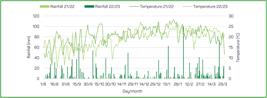
Methods: Field experiments were conducted over two soybean growing seasons in 2021/22 and 2022/23 near Erechim, Rio Grande do Sul, Brazil. Early weed management treatments included terbuthilazine (1,500 g ha−1), mesotrione+atrazine (120+1,200 g ha−1), metsulfuron-methyl (6 g ha−1), dicamba (720 g ha−1), 2,4-D amine (1,612 g ha−1), flumioxazin (50 g ha−1), diclosulam (35.28 g ha−1) and atrazine+simazine (1,500+1,500 g ha−1) applied 60 days before soybean planting. For pre-plant burndown, diquat + saflufenacil (600+70 g ha−1) were applied three days before soybean planting. For post-emergence weed control, 2,4-D choline+glyphosate (971.28+1232.65 g ha−1) were applied at the V3 to V4 soybean growth stage. The C. bonariensis plants present in the experimental area were resistant to the herbicide glyphosate.
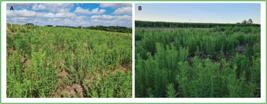
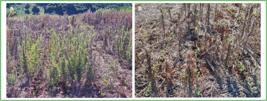
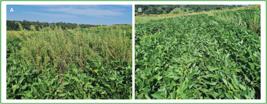
Results: The best early hairy fleabane control was achieved with mesotrione+atrazine, dicamba, and 2,4-D amine, providing more than 90% efficacy. Diquat+saflufenacil applied pre-plant burndown provided excellent level of control, particularly following dicamba in early management, reaching 100% control. Post-emergence application of 2,4-D choline+glyphosate after early treatments with mesotrione+atrazine or dicamba resulted in 100% control.
Conclusions: The combination of atrazine + simazine for early management, diquat + saflufenacil for pre-plant burndown, and 2,4-D choline+glyphosate post-emergence effectively controlled hairy fleabane and contributed to higher grain yield.
Keywords:
Conyza bonariensis
;
Glycine max
; Weed Management
 Thumbnail
 Thumbnail
 Thumbnail
 Thumbnail