
 Effect of chemical weed control in the soybean and maize production system in the floristic community in the Cerrado regions of central Minas Gerais state
Abstract
Background The study of the effects of different chemical management practices on the floristic composition of weeds in soybean and maize crops in succession is essential for understanding the population dynamics of the main species present in these cultivated areas.
Objective This study evaluated the impact of different weed control programs on the floristic community in a soybean-maize succession system, in the Cerrado regions of central Minas Gerais state.
Methods Five management systems were compared, ranging from low to high technology levels, including different combinations of herbicides, manual weeding, and winter fallow. The frequencies, densities, dominance, and Importance Value Index (IVI) of weeds were calculated. The similarity index between treatments in the two soybean crops was calculated. Dry biomass (DB) data and total plant density of Commelina benghalensis L. were analyzed at the end of the experiment using geostatistical methods. Results: In all phytosociological surveys, 31 weed species were identified. A predominance of weeds from the Poaceae and Asteraceae families was observed. The highest weed density was observed in the low technology system. Regardless of the technology level adopted, the greatest weed control occurred in the maize crop, reducing the total biomass of the species. In the spatial distribution mapping of C. benghalensis DB, the highest concentration occurred in the low technology system.
Conclusions The greater diversification of herbicides with different mechanisms of action provides less similarity between the weed population in different agricultural crops.
Glycine Max; Zea Mays; Herbicides; Phytosociology
1.Introduction
The national maize production in 2021/22 season was 114.7 million tons, with an increase of 31.7% compared to the 2020/21 and an average yield of 5,314 kg per hectare (Companhia Nacional de Abastecimento, 2022). in 2021/22 season, soybean production was 124 million tons, with reduction of 10.2% compared to the previous season and yield of 3,029 kg per hectare (Companhia Nacional de Abastecimento, 2022).
Among the factors that interfere with productivity and final product quality, there is weed competition. This is because weeds can compete with crops for water, light, nutrients and space, and even harbor host pests and diseases (Silva et al., 2021).
Among the direct losses, the losses in productivity, is what stands out. In soybean the interference by species of Urochloa plantaginea (Link) R. D. Webster, Digitaria horizontalis Willd., Ipomoea triloba L., Euphorbia heterophylla L., Amaranthus deflexus L., Commelina benghalensis L., Richardia brasiliensis Gomes, Bidens pilosa L. and Raphanus raphanistrum L. resulted in 52% yield reduction (Silva et al., 2015). Weed management is a necessary practice in the crop production system, and technical knowledge is essential to define management strategies. Thus understanding the dynamics and interaction of the weed community in the area is of paramount importance and to carry out the phytosociological survey is necessary to identify and quantify the composition of weed populations (Mueller-Dombois, Ellenberg, 1974). Population dynamics which refers to changes in the composition of the weed community over time, considers the number and relative dominance of each species as well as the variation in edaphic and climatic characteristics of the agronomic practices adopted (Zelaya et al., 1997).
Another reason for conducting phytosociological surveys is the possibility of evaluating the degree of weed interference on agricultural crops. This evaluation that is variable and depends on the species density and spatial distribution of the weeds, the period of coexistence between the crop and the weed community and the edaphoclimatic conditions in the cultivation region (Costa et al., 2021). In this context, analyzing the floristic composition of weeds is important, especially for the identification of the most problematic weed species in the study area to use specific mechanisms of action for the chemical management of these species.
The phytosociological survey provides knowledge about the weed community, important for management recommendations especially in early stages of the plant, creating a favorable environment for crop development and herbicide economy.
Phytosociological studies are important to optimize the management, through choices of efficient control methods for weed species in the area (Oliveira, Freitas, 2008).
Over the years, due to the recurrent use of reactive management in which weed management is done to control a species that is already with a high index of importance in the production area, there was an increase in the density of several weed species. However, for this, studies in several production systems and in several regions is important to evaluate the differences and trends of the weed community. Given the above, the objective of this study was to evaluate the floristic community of weeds in a system where soybeans and maize are grown in succession under different chemical control programs in the Cerrado of the central region of the Minas Gerais State, in Brazil.
2.Material and Methods
The phytosociological surveys were carried out in the 2019/20 and 2020/21 seasons at the time of harvest of soybean (Glycine max L. Merril) and maize (Zea mays L.) at Embrapa Milho e Sorgo in Sete Lagoas, Minas Gerais. The climate is Aw (Koppen), with dry winter and average air temperature of the coldest month exceeding 18 °C. Annual rainfall in the 2019/2020 agricultural year was 1,360 mm and in the 2020/2021 agricultural year 1,100 mm, with a higher incidence between the months of October and March (Instituto Nacional de Meteorologia, 2022).
In all soybean crops, the cultivar used was KWS 6813 sown on November 22, 2019 and November 5, 2020. The maize cultivars used were RB 9006 PRO2 and KWS 8774 PRO3, sown on March 18, 2020 and March 3, 2021, respectively with the technology developed by the Brazilian Agricultural Research Company (Embrapa) which allows the early intercropping of maize between soybean rows 20 days before the oilseed harvest (Karam et al., 2020). In all crops, crop spacing was 0.5 m between rows. In the soybean crop had a stand of 360,000 plants ha-1and in the maize crop 60,000 plants ha-1. The study was conducted in a no-till system and fertilization was carried out according to good agricultural practices.
The five management systems with low, medium and high technology using herbicides with different mechanisms of action and combinations for soybean and maize crops are described in Table 1. Herbicides were applied both in pre-plant, pre-emergence and post-emergence of weeds and at different doses. The systems were defined based on the level of technology adopted for each management program as described in Tables 2 and 3 for the agricultural years 2019/2020 and 2020/2021, respectively.
With the exception of the year 2020, the medium-tech+ system, with application of herbicides inhibitors of epsps and auxin mimetizers, remained fallow during the maize growing seasons. The applications were performed using a self-propelled sprayer equipped with TT 110.02 fan tips (Tecnologia Teejet®), spaced 0.50 m, with working pressure during application of 3.0 bar and displacement speed of 6.0 km h-1, with slurry volume of 150 L ha-1.
Before starting the experiment, the predominant species were D. insularis and Amaranthus spp. The phytosociological survey of the weed community was carried out in the harvest of the crops. The weed species were identified, quantified and collected with the method of square leaked inventory with 0.25 m2 released 36 times in each system with spacing between points of 10 m in the experimental area. The weed species identified were collected, cut close to the ground, packed in paper bags and taken to drying oven for 72 h and regulated at 65 °C. After this process, the dry biomass for each weed species collected was determined. The phytosociological parameters: absolute and relative frequency (FRE and FR), absolute and relative density (DEN and DR), absolute and relative dominance (DOM and DOR) and the importance value index (IVI) of weeds were determined as proposed by Mueller-Dombois and Ellenberg (1974), using equations:
The collected data were submitted to phytosociological analysis and the IVI data of each species within each management system were quantified. The figures with the IVI’s of the main species were plotted using Microsoft Office Excel 2016. The floristic similarity indexes between the collection periods were calculated using the Similarity Index (SI) of Sorensen (1972) based on the equation:
Where:
a = number of species in common between areas;
b = total number of species area 1;
c = total number of species area 2.
The level of total infestation of the area was determined by control through visual estimation performed by two evaluators on a scale of 0 to 100%, assigning 0 when there is no infestation and 100 when the area is completely infested. A similarity dendrogram built by the group average clustering method (UPGMA) on the level of infestation in the five management systems at the end of the experiment was processed using the statistical software R (R Development Core Team, 2020).
The dry biomass (DB) and total plant density (DEN) data of the C. benghalensis were analyzed at the end of the experiment by geostatistical methods and the maps were generated by the ordinary Kriging method using the QGis software version 3.22 with Smart-Map: Decision Support System for Precision Agriculture. The data were interpolated on a 1 x 1m grid.
3.Results and Discussion
According to the phytosociological survey, 31 weed species were identified in the pre-harvest soybean/maize systems evaluated (Table 4). Weed species were distributed in 11 families and 36% of the species found belong to the family Poaceae and 26% to Asteraceae. In a survey of weed flora carried out on grain crops in the Center-South region of Brazil, there was a predominance of species of the family Poaceae (Bordin et al., 2021).
Poaceae and Asteraceae are among the families with the highest number of species in the studies conducted in Brazil, due to the climatic characteristics that favor the development of these species (Silva, Coelho, Medeiros, 2008). In the soybean crop, species of the families Poaceae and Asteraceae were also the most important according to work carried out by Benedetti et al. (2009). Corroborating with these results, Oliveira and Freitas (2008) affirm that the families Poaceae and Asteraceae are the main families of weeds existing in Brazil.
The Poaceae family has a high number of perennial species with production of large numbers of seeds and morphophysiological structures that facilitate dispersion through environmental factors such as wind, man, animals and water (Holm et al., 1991). The Asteraceae family is also quite widespread because it has high capacity for environmental adaptation predominant in the Center-South region of the country (Correia et al., 2021).
The DEN, DB of weeds and total number of species of each experimental unit are described in Table 5. In the low technology system, despite the increase in the number of species, the DB and DEN decreased over time. For the three variables analyzed, compared to the soybean crops, the maize crop showed lower values. One of the reasons for the decrease in these values is the lower rainfall during the two maize crops compared to the rainfall in the soybean crops, hindering the development of weeds.
The IVI of the weed species varied with the systems applied. For the low-technology system (Figure 1), in the soybean crop 2019/20, volunteer maize accounted for 42% of the IVI and with DOR of 95% followed by C. benghalensis with an IVI of 19% and DOR of 2%. In the same year, in the maize crop, C. benghalensis was also the most important species, with an IVI of 69.3%, followed by Amaranthus sp. with an IVI of 30.7%. In the soybean harvest 2020/21 the volunteer maize had an IVI de 29% also followed by C. benghalensis. In the 2021 crop cultivated with maize, the Digitaria insularis (L.) Fedde presented high DOR, when compared to the other species (8%).
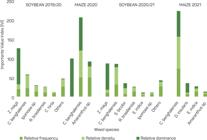
Weed importance value index in the low-tech system (two mechanisms of action), with glyphosate application only in all crops
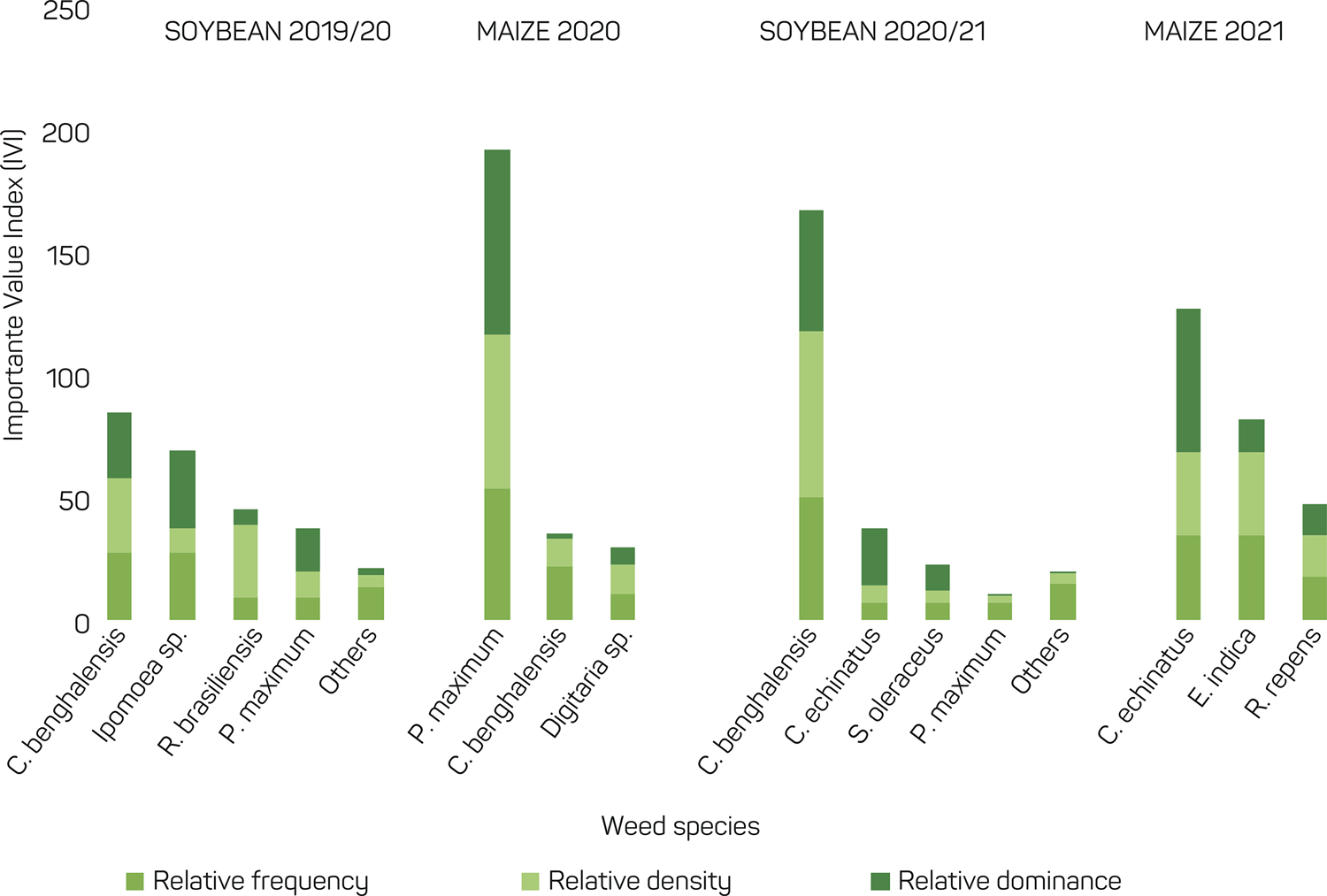
In the medium-tech system (Figure 2), the species with the highest IVI in all seasons was C. benghalensis except for maize grown in 2020 in which D. insularis had the highest IVI (44%). The IVI of C. benghalensis was 52, 46, 23 and 45 in the 2019/2020 and 2020/2021 soybean crop, and the 2020, and 2021 maize crop, respectively. The DOR of the C. benghalensis reached 17% in the 2019/2020 soybean crop.
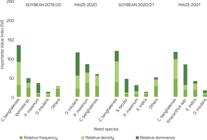
Value index of importance of weeds in the medium technology system (four mechanisms of action), with application of the herbicides glyphosate + fenoxaprop-p-ethyl + clethodim in soybean crops and glyphosate + atrazine + tembotrione in maize crops
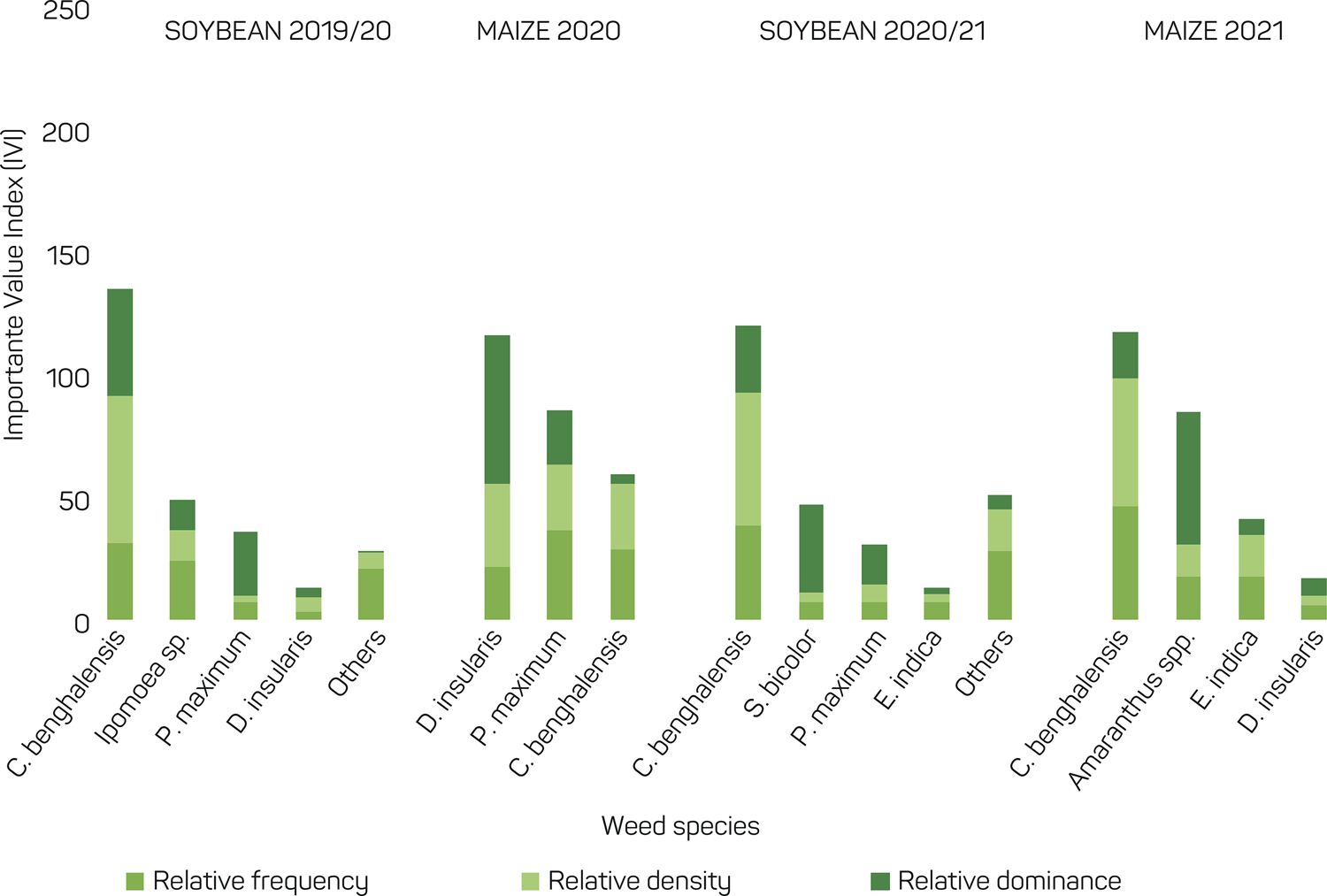
In the high-tech system (with six mechanisms of action) (Figure 3), IVI increased from the 2019/2020 soybean crop to the 2020/2021 crop, from 33% to 65%. In maize crops, species of the family Poaceae stood out. In the 2020 harvest, Panicum maximum Jacq. presented IVI of 75% while in the 2021 harvest, Cenchrus echinatus (L.) Pers. presented IVI of 50%.

Value index of importance of weeds in the high-tech system (six mechanisms of action), with application of glyphosate + phenoxaprop-p-ethyl + clethodim + diquat + metribuzin in soybean and glyphosate + atrazine + tembotrione crops
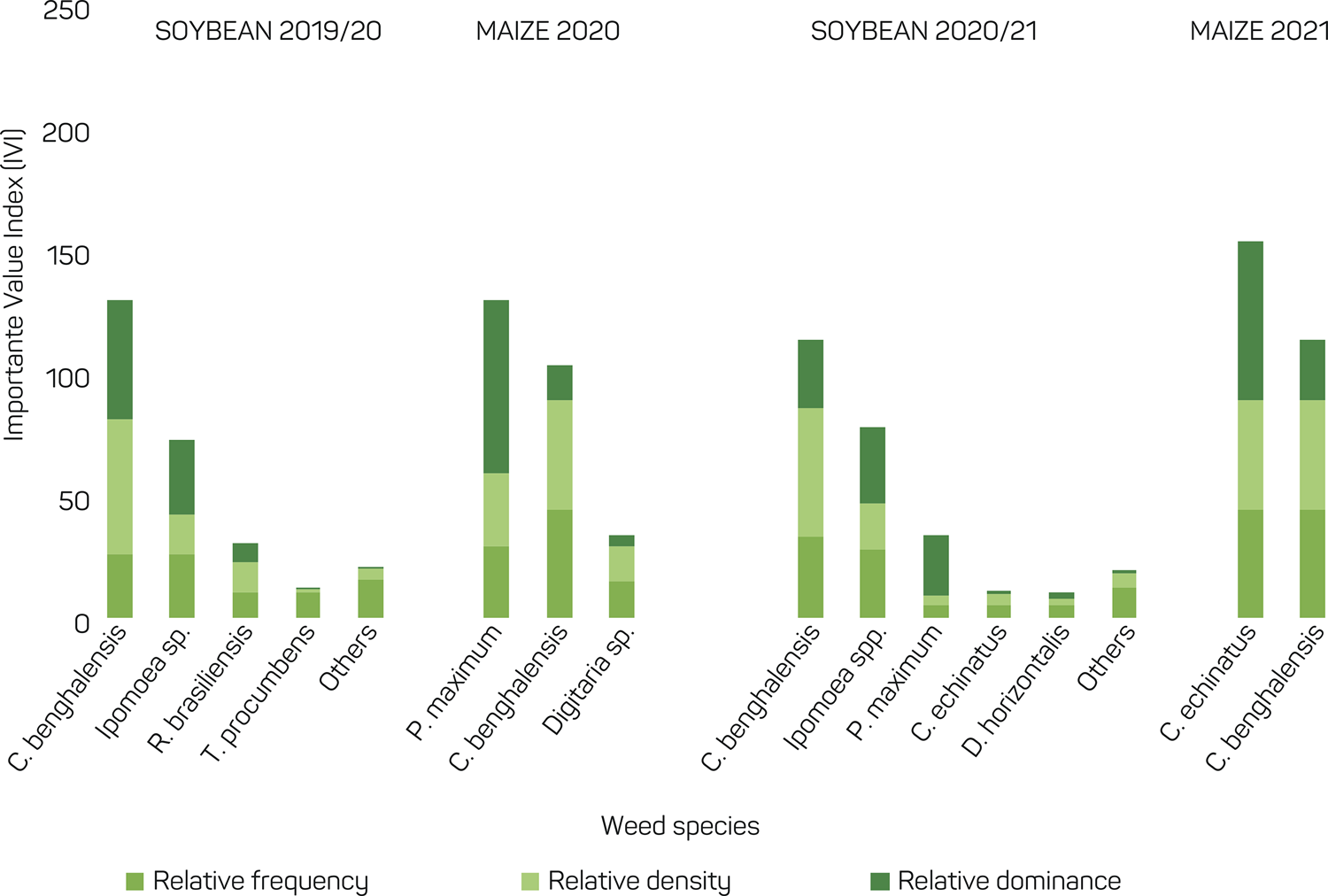
In the high-tech system + hand-weeding and also in the high-tech system (six mechanisms of action), C. benghalensis showed higher IVI’s in soybean crops while the grasses stood out in maize crops (Figure 4). However, when comparing the two soybean crops, in the high-tech system + hand weeding, the IVI of C.benghalen decreased from 49% to 43%. In maize crops of the maximum IVI values were 49% for P. maximum in 2020 and 58% for C. echinatus in the 2021 maize crop
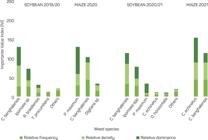
Value index of importance of weeds in the high-tech system (six mechanisms of action) + manual weeding, with application of the herbicides glyphosate + phenoxaprop-p-ethyl + clethodim + diquat + metribuzin + chlorimuron-ethyl in soybean crops and glyphosate + atrazine + tembotrione in maize crops
In the system of medium technology + fallow in winter, the difference between the IVI’s in the course of the harvests increased (Figure 5). In the soybean crop in the 2019/2020 and maize 2020, B. pilosa, and C. echinatus species had the highest IVI’s with values of 23% and 19% in the soybean crop and 31% and 34% in the maize crop, respectively. On the other hand, in the subsequent soybean and maize crops, the species with the highest IVI’s were C. benghalensis with 60% and P. maximum with 54% in soybean and maize crops, respectively.

Value index of importance of weeds in the system of medium technology (three mechanisms of action) + fallow in winter with application of glyphosate + 2,4-D + clethodim in soybean crops and glyphosate + 2,4-D in maize crops
The analysis of phytosociological parameters in the four harvests revealed that the difference in IVI between species over time indicates the selection of species more adapted to the soybean/maize second crop production system. The species C. benghalensis stood out the most in terms of DO and showed the greatest increase in IVI over the years, especially in management systems without the application of herbicides in the pre-emergence application of the soybean crop.
For, a weed that is difficult to control due to a double mechanism of reproduction (seeds and rooting of nodes), herbicides applied in pre-emergence are important for the management of this species (Wilson, 1981). Still, when analyzing the phytosociological parameters, the increase of DOR may indicate the late control of this species and tolerance to glyphosate. The use of different mechanisms of action and the application of herbicides in the pre-emergence treatment of weeds is an important technique for management, as it reduces the seed bank of the species (Dias et al., 2013).
In a phytosociological survey carried out in production systems with maize in succession to soybean in the north of the state of Paraná, the species that presented the highest IVI was the C. benghalensis due to the good adaptation to the coexistence conditions provided by the maize crop (Pasqualetto et al., 2001).
In the soybean crop, within the low-tech system, an analysis of the phytosociological parameters from the 2019/20 and 2020/21 growing seasons in Sete Lagoas revealed a significant presence of volunteer maize with a high Importance Value Index (IVI). This was attributed to the exclusive use of glyphosate and the previous cultivation of Roundup Ready (RR®) maize, which is resistant to this herbicide. The broad-spectrum action of glyphosate, its low cost, and the absence of residual effects on the soil are factors that have driven the increased use of this herbicide and, consequently, glyphosate-resistant cultivars in Brazil (Silva et al., 2018). As a management alternative, the herbicide clethodim has been used for the effective control of volunteer maize due to its efficacy against this species (Braz et al., 2018).
The presence or absence of weed species when launching a sampling frame in an area is quantified by frequency (Marinho et al., 2017). When analyzing this parameter, it was noticed a lower frequency of weeds in the maize crop due to the period with higher water deficit, as described data.
In the last phytosociological survey (2020/2021), it was observe that chemical control reduced the incidence of weeds. In addition, the use of herbicides in the pre-emergence of weeds reduced the IVI for C. benghalensis, demonstrating efficiency in the control of this species.
To define the level of similarity between two or more communities, the SI was calculated and there was change between the management systems in the two soybean crops over time (Tables 6 and 7). When comparing the weed flora of the high-tech systems with and without hand weeding with low- and medium-tech systems, hand weeding increased the similarity of this system with low- and medium-tech systems. On the other hand, the high-tech system, when comparing with other systems, the similarity over time decreased.
From the dendrogram, the level of weed infestation on the low and medium technology systems were not similar to the high-tech systems, at the time of harvest of the 2020/2021 soybean crop (Figure 6).

Similarity dendrogram constructed by the grouping method by the group average (UPGMA) of the level of weed infestation in the five systems at the end of the experiment, in the harvest of the 2020/2021 soybean in Sete Lagoas (R Development Core Team, 2020). Low = two mechanisms of action; medium = four mechanisms of action; high = six mechanisms of action; high + = six mechanisms of action + mechanical control; medium + = three mechanisms of action and fallow in winter.
Weed control with glyphosate without the use of complementary weed management practices has contributed significantly to the selection of tolerant weed species (Monquero et al., 2001). When this happens, the population dynamics of the main species present in the area undergoes changes that influence the management of these weeds. Linked to this, the system of cultivation in succession of soybean and maize second crop can also favor the selection of more adapted species. Therefore, establishing new strategies for chemical weed management is essential to increase the effectiveness of control.
Kriging is an interpolation technique that, through estimates of regionalized variables, uses parameters of semi-variograms and the values of samples made and georeferenced (Trangmar et al., 1985). When observing the spatial distribution of DB (Figure 7A) and DEN (Figure 7B) of C. benghalensis at the end of the experiment, in the low-tech system, the dominance rates for were higher (Figure 7A), indicating inefficient management of this species. For the density (Figure 7B) the total distribution in the area was higher, indicating a greater distribution of the species in the analyzed variable. However, in the mapping, despite the high variability in DEN, DB is concentrated in the system with the use of only two mechanisms of herbicide action, consequently increasing the importance of this species in this management system.

Map of spatial distribution of biomass (DB - g m2) and total density (DEN - plants m2) of Commelina benghalensis L. in the 2020/21 soybean crop. The green color gradient indicates lower concentration of the variables studied and, when the red color approaches, the highest concentration of these variables is observed. Low = two mechanisms of action; medium = four mechanisms of action; high = six mechanisms of action; high + = six mechanisms of action + mechanical control; medium + = three mechanisms of action and fallow in winter.
Weed species can be dispersed in total area or in windrows, due to aspects of weed biology and, for this, the mapping of their distributions in the field is performed (Shiratsuchi et al., 2003). The spatial distribution of C. benghalensis showed that the highest concentration of DB occurred in the low technology system (two mechanisms of action), indicating a high IVI for the species. This highlights the relevance of weed mapping and phytosociological surveys for the application of weed control methods.
The data of this study showed the difference in effectiveness in weed management and the importance of joining different mechanisms of action. However, it is expected that, over the years, to maintain the same control effectiveness, integrated weed management (IWM) using chemical weed control in association with other practices must be employed.
4.Conclusions
The phytosociological survey obtained for the soybean/maize second crop system indicates the predominance of the families Poaceae and Asteraceae.
The greater rotation of herbicides with different mechanisms of action results in species with l ower IVI’s.
The highest concentration in the spatial distribution of the DB of Commelina benghalensis L. was in the low-tech system.
Acknowledgements
Empresa Brasileira de Pesquisa Agropecuária (Embrapa); Universidade Federal de Viçosa, and Bayer S.A.
References
-
Benedetti JGR, Pereira L, Alves PLCA, Yamauti MS. [Period before weed interference in transgenic soybean]. Sci Agrar. 2009;10(4):289-95. Portuguese. Available from: https://doi.org/10.5380/rsa.v10i4.14801
» https://doi.org/10.5380/rsa.v10i4.14801 -
Bordin I, Buratto OM, Costa ACPR, Llanillo R. [Weed phytosociology in diversified soybean production systems]. Semin Ciênc Agrár, 2021;42(6):3567-80. Portuguese. Available from: https://doi.org/10.5433/1679-0359.2021v42n6Supl2p3567
» https://doi.org/10.5433/1679-0359.2021v42n6Supl2p3567 -
Braz LBP, Braz GBP, Procopio SO, Silva AG, Braz AJBP, Ferreira CJB. [Chemical control in different glyphosate resistant maize hybrids]. Rev Bras Milho Sorgo. 2018;17(3):535-47. Portuguese. Available from: https://doi.org/10.18512/1980-6477/rbms.v17n3p535-547
» https://doi.org/10.18512/1980-6477/rbms.v17n3p535-547 -
Companhia Nacional de Abastecimento - Conab. [Monitoring the brazilian harvest: grains 2021/22 harvest: eleventh survey]. Brasília: Companhia Nacional de Abastecimento; 2022. Portuguese. Available from: https://www.conab.gov.br/info-agro/safras/graos/boletim-da-safra-de-graos
» https://www.conab.gov.br/info-agro/safras/graos/boletim-da-safra-de-graos - Correia NM, Marchao RL, Vilela L. [Phytosociological survey of weeds in corn areas with and without intercropping with BRS Zuri]. Planaltina: Embrapa Cerrados; 2021. Portuguese.
-
Costa AGF, Bacha AL, Pires RN, Pavani MCMD, Alves PLCA. [Interference of Commelina benghalensis in the initial growth of Eucalyptus grandis in winter and summer]. Cienc Florest. 2021;31(2):590-606. Portuguese. Available from: https://doi.org/10.5902/1980509825556
» https://doi.org/10.5902/1980509825556 -
Dias ACR, Carvalho SJP, Christoffoleti PJ. [Phenology of bengal dayflower as indicator of glyphosate tolerance]. Planta Daninha. 2013;31:185-91. Portuguese. Available from: https://doi.org/10.1590/S0100-83582013000100020
» https://doi.org/10.1590/S0100-83582013000100020 - Holm LG, Pancho JV, Herberger JP, Plucknett DL. The world's worst weeds: distribution and biology. 2nd ed. Malabar: Krieger; 1991.
-
Instituto Nacional de Meteorologia - Inmet. [Meteorological database: station data table]. Brasília: Instituto Nacional de Meteorologia; 2022[access Aug 18, 2022]. Portuguese. Available from: https://tempo.inmet.gov.br/TabelaEstacoes/A001
» https://tempo.inmet.gov.br/TabelaEstacoes/A001 - Karam D, Borghi E, Magalhães PC, Paes MCD, Pereira Filho IA., Mantovani EC et al. [Anticipate: early intercropping]. Sete Lagoas: Embrapa Milho e Sorgo; 2020. Portuguese.
- Lorenzi H. [Weed identification and control manual]. 7th ed. Nova Odessa: Instituto Plantarum; 2014. Portuguese.
-
Marinho PHA, Sousa R, Medeiros PC, Silva T, Giongo M. [Phytosociological lifting of infestant plants in the experimental area of the Federal University of Tocantins submitted to different crops]. Agrar Acad. 2017;4(7): 314-24. Portuguese. https://doi.org/10.1590/S0100-83582001000300010
» https://doi.org/10.1590/S0100-83582001000300010 -
Monquero PA, Christoffoleti PJ, Santos CTD. [Glyphosate combined with alternative herbicides for vegetation management]. Planta Daninha. 2001;19(3):375-80. Portuguese. Available from: https://doi.org/10.1590/S0100-83582001000300010
» https://doi.org/10.1590/S0100-83582001000300010 - Mueller-Dombois D, Ellenberg H. Aims and methods of vegetation ecology. New Jersey: Blackburn; 1974.
-
Oliveira AR, Freitas SP. [Phyto-sociological survey of weed in sugarcane crop áreas]. Planta Daninha. 2008;26(1):33-46. Portuguese. Available from: https://doi.org/10.1590/S0100-83582008000100004
» https://doi.org/10.1590/S0100-83582008000100004 -
Pasqualetto A, Costa LM, Silva AA, Sediyama C. [Weeds in the double cropping with corn ( zea mays L.) under no-tillage]. Pesqu Agropec Trop. 2001; 31(2):133-8. Portuguese. Available from: https://doi.org/10.5216/pat.v31i2.2480
» https://doi.org/10.5216/pat.v31i2.2480 - R Core Team. R: a language and environment for statistical computing. Vienna: R Foundation for Statistical Computing; 2018.
- Shiratsuchi LS, ChristoffoletI PJ, Fontes JRA. [Mapping the spatial variability of weeds]. Planaltina: Embrapa Cerrados; 2003. Portuguese.
- Silva AF, Concenco G, Aspiazu I, Galon L, Ferreira EA. [Weed control methods]. In: Oliveira MF, Brighenti AM. [Weed control: physical, mechanical, cultural, biological and allelopathy methods]. Sete Lagoas: Embrapa Milho e Sorgo; 2018. p. 11-33. Portuguese.
-
Silva AMA, Coelho ID, Medeiros PR. [Floristic survey of weeds in a public park of Campina Grande, Paraíba, Brazil]. Biotemas; 2008;21(4):7-14. Portuguese. Available from: https://doi.org/10.5007/2175-7925.2008v21n4p7
» https://doi.org/10.5007/2175-7925.2008v21n4p7 -
Silva RP, Santos FFS, Oliveira TA, Silva BL, Cavalcante LS, Silva MC et al. [Phytosociological survey of invasive plants in cassava culture in Arapiraca, Alagoas]. Braz J Dev. 2021;6(9):71489-96. Portuguese. Available from: https://doi.org/10.34117/bjdv6n9-554
» https://doi.org/10.34117/bjdv6n9-554 -
Silva MVPP, Souza FC, Souza LS, Reis JC, Pereira JC, Souza RC. [Pre-emergent application of herbicide on sugarcane straw in the control of species of the family Convolvulaceae ]. Rev Agro@mb. 2015;9(2):184-93. Portuguese. Available from: https://doi.org/10.18227/1982-8470ragro.v9i2.2469
» https://doi.org/10.18227/1982-8470ragro.v9i2.2469 - Sorensen TA. [Method of stablishing groups equal amplitude in plant society based on similarity of species content]. In: Odum EP. [Ecology]. 3th ed. Ciudad de Mexico: Interamericana; 1972. p. 341-405. Spanish.
-
Trangmar BB, Yost RS, Uehara G. Application of geostatistics to spatial studies of soil properties. Adv Agron. 1985;38:45-94. Available from: https://doi.org/10.1016/S0065-2113 (08)60673-2
» https://doi.org/10.1016/S0065-2113 (08)60673-2 -
Wilson AK. Commelinaceae: a review of the distribution, biology and control of the important weeds belonging to this family. Trop Pest Manage. 1981;27(3):405-18. Available from: https://doi.org/10.1080/09670878109413812
» https://doi.org/10.1080/09670878109413812 - Zelaya IA, Owen MDK, Pitty A. Effect of tillage and environment on weed population dynamics in the dry tropies. Ceiba. 1997;38(2):123-35.
-
Funding:
Coordenação de Aperfeiçoamento de Pessoa de Nível Superior (Capes) and Bayer S.A.
Edited by
-
Editor:
Grace Bolfrey-Arku


 Low: two mechanisms of action; medium: four mechanisms of action; high: six mechanisms of action; high +: six mechanisms of action + mechanical control; medium +: three mechanisms of action and fallow in winter

