Differential Expression of Metabolic Genes Associated with Multiple Resistance to Propanil and Quinclorac in Echinochloa colona
Abstract:
Background: Multiple-herbicide-resistant (R) Echinochloa spp. are increasingly challenging global rice production. The adaptive mechanisms for herbicide resistance in Echinochloa populations remain poorly understood.
Objective: This study aimed to characterize the resistance profile of five Echinochloa accessions to propanil and quinclorac and investigate the expression patterns of candidate genes potentially associated with resistance.
Methods: Whole-plant dose-response assays were conducted to quantify resistance levels, while the expression of four cytochrome P450s and one glycosyl transferase was measured 12 h after herbicide treatment using quantitative PCR.
Results: Resistance profiles varied among accessions with resistance factors ranging from 6.4 to 12.0-fold for propanil and 8.0- to >309-fold for quinclorac. Differential induction of candidate genes was observed across resistant accessions. CYP709B1 was significantly upregulated by both herbicides in most R accessions indicating its involvement in multiple resistance. UGT75D1 was consistently induced by quinclorac in all resistant accessions and by propanil in all, except ECO-45. CYP709B2 and CYP72A14 were induced by quinclorac in four and five resistant accessions, respectively. CYP72A15 was notably induced only in ECO-45 by both herbicides suggesting a different metabolic process in this accession.
Conclusions: Phase 1 metabolism genes CYP709B1 and CYP709B2 and the conjugation gene UGT75D1 are associated with multiple resistance to propanil and quinclorac in E. colona. The coordinated and differential induction of Phase I and Phase II metabolic genes contributes to varying levels of multiple herbicide resistance across E. colona populations.
Keywords:
Cytochrome P450; Glycosyltransferase; Junglerice; Gene Expression; Metabolic Resistance; NTSR; Propanil; Quinclorac
1. Introduction
Chemical weed control is undoubtedly one of the indispensable tools of modern agriculture, enabling crop producers to achieve high yield potentials of contemporary crop varieties. Decades of herbicide selection pressure, however, have made contemporary weed populations tougher to control than their ancestral counterparts. So far, more than 60 populations from different species have been reported as resistant to two or more herbicide sites of action (SOA) (Heap, 2024). Among those, the Echinochloa complex stands out due to its broad geographical distribution, diverse genetic background, and high competitiveness (Fischer et al., 1993; Wu et al., 2022).
In rice cultivation, propanil and quinclorac are among the primary herbicides for grass weed control in the USA. There are at least 30 unique cases of multiple resistance at the population level among rice weeds with the highest number of traits being five, in a population of E. phyllopogon in California, USA (Roma-Burgos et al., 2018; Heap, 2024). This encompasses resistance to the major herbicides used to control weeds in rice including synthetic auxin (quinclorac) and inhibitors of acetyl CoA carboxylase (ACCase), acetolactate synthase (ALS), 1-deoxy-D-xylulose-5-phosphate (DOX-P) synthase, and lipid synthesis (Fischer et al., 2000; Yasuor et al., 2008; Yasuor et al., 2012). Globally, E. crus-galli and E. colona are the primary grass weeds of rice, which collectively had evolved resistance to 10 and 7 herbicide SOAs, respectively (Heap, 2024). These species infest many crops; therefore, the collective impact of multiple resistance in these species on the economy and food security is large. E. colona is the predominant Echinochloa species in the US mid-south, followed by E. crus-galli (Tahir, Roma-Burgos, 2021). Resistance to propanil occurs in about 50% of populations in both species and roughly one-fourth of populations are resistant to quinclorac (Rouse et al., 2018). This is expected since the primary selector for resistance among Echinochloa populations in the US mid-south is propanil (Talbert, Burgos, 2007). Multiple-resistant populations are increasing (Rouse et al., 2018). An extremely high level of resistance to propanil and quinclorac has been documented and attributed to a complex nontarget-site resistance (NTSR) mechanism involving cytochrome P450s and conjugation genes, among others (Rouse et al., 2019). Considering the widespread resistance to these herbicides, we believe that the same mechanism(s) could also confer resistance to both herbicides in other populations, and concomitantly, may impart low-level resistance to other herbicides with different SOAs. We aimed to determine the resistance level of selected E. colona populations to propanil and quinclorac, as well as investigate the molecular basis of resistance. Our approach involved analyzing the differential gene expression of NTSR genes that were previously identified through transcriptome analysis (Rangani et al., 2022).
2. Materials and Methods
2.1 Source of plant materials
Echinochloa samples used in this study were collected from rice and soybean fields in Arkansas, USA between 2010 and 2013 with the assistance of the University of Arkansas Extension personnel or farm consultants. Seed sampling, processing and initial herbicide resistance screenings were described in a previous publication (Rouse et al., 2018).
To confirm multiple resistance to propanil and quinclorac at the population level, five E. colona accessions; ECO-45, ECO-179, ECO-188, ECO-152 and ECO-158 were selected for follow-up assays. These accessions were planted in 0.4-L square pots filled with commercial medium (Sunshine® Premix #1, Sun Gro Horticulture, Bellevue, WA) and thinned to five seedlings per pot. At the 3-leaf stage, herbicides were applied in a spray chamber equipped with a motorized boom fitted with flat-fan 1100067 nozzles (Teejet, Wheaton, IL), calibrated to deliver 187 L ha−1 at 276 kPa. The herbicide treatments consisted of propanil at 4.48 kg ha−1 (Stam M4®, RiceCo LLC, Memphis, TN) or quinclorac at 0.56 kg ha−1 (Facet® L, BASF Corporation, RTP, NC). Nontreated checks were included. The experiment was conducted twice with four replications per herbicide treatment. Plant mortality was evaluated visually 21 d after treatment to confirm resistance and produce a line of 100% resistant plants.
2.2 Determination of resistance level to propanil and quinclorac
Resistance to propanil and quinclorac are the two major herbicide-resistance problems among Echinochloa populations in Arkansas. To determine the resistance level to these herbicides, we conducted whole-plant dose response assays on six accessions: five multiple-resistant (R) and one susceptible (S) (Table 1). Pure lines of ECO-45 and ECO-179, derived from two generations of survivors of high dose (4x) propanil treatment, were used; all other accessions were field-collected seeds. Multiple resistance to propanil and quinclorac was confirmed to occur in the same plant of ECO-45 and ECO-179 in previous assays as these were purified lines. All plants within each of these accessions were resistant to both quinclorac and propanil, and the response was homogeneous. For the other accessions, multiple resistance was confirmed only at the population level.
Resistance profiles of Echinochloa accessions from Arkansas, USA used in this research, Milo Shult Agricultural Research and Extension Center, University of Arkansas Division of Agriculture, Fayetteville, Arkansas, USA
The accessions were sown in trays filled with commercial potting soil, and seedlings were transplanted into 0.4-L pots at the 1-leaf stage. The R accessions were treated with a dose range of 0, 0.25, 0.5, 1, 2, 4, 8, and 16x of propanil, and up to 32x the field rate of quinclorac. The S accession was sprayed with 0, 0.0625, 0.125, 0.25, 0.5, 0.75, 1 and 2x rates of both herbicides. The 1x rates were 0.56 kg ae ha−1 for quinclorac and 4.5 kg ai ha−1 for propanil. Quinclorac was applied with 1% v/v crop oil concentrate.
The experiment was conducted in a completely randomized design with three replications. Each replication consisted of one pot with five plants. Nontreated checks for each accession were used as reference for evaluation. The herbicides were applied in a spray chamber when seedlings had 2 to 3 leaves, as previously described. Plant injury (%) was evaluated visually at 21 d after treatment (DAT) using a rating scale of 0 to 100%, where 0 = no injury, and 100% = dead (Burgos et al., 2013).
Plant injury data were analyzed by fitting a non-linear regression model using the drc package in R 4.0.3 (R Core Team, 2023). The 3-parameter log-logistic (Equation 1) and 3-parameter Weibull II (Equation 2) models were used with the quinclorac and propanil datasets, respectively. Models are shown below:
where Y is plant injury relative to the nontreated check (%), d is the upper horizontal asymptote, x is the herbicide dose, and b is the slope around e, which is the inflection point of the curve (Ritz et al., 2019). The herbicide dose that would cause 50% injury (ED50) was estimated for each herbicide-accession combination and compared using the confidence intervals at 95% significance.
2.3 Expression analysis of candidate genes in multiple-resistant Echinochloa accessions
Seeds of each accession were planted in pots filled with commercial potting soil. One week after emergence, seedlings were thinned to four per pot. To verify resistant plants within each R accession, the seedlings were sprayed with 1x rate of either propanil or quinclorac, as previously described. The treatments were replicated three times.
Leaf tissues were collected from each plant before (labelled as nontreated) and 12 h after herbicide application (labelled as treated) and stored at -80 °C until RNA extraction. At 14 d after treatment (DAT), each plant was visually evaluated for injury relative to the nontreated control group. Treated plants with no injury were tagged as resistant (R). Ideally, S plants from the R accessions should be included in the analysis, in addition to the standard S accession; however, no truly susceptible plants were found among the resistant accessions. Thus, leaf tissues (nontreated and treated) from three R plants selected from the five resistant accessions, and three S plants from the SS accession were used for total RNA extraction using an E.Z.N.A ® Plant RNA isolation kit (Omega Biotek, Norcross, GA). An aliquot of 1 µg total RNA from each sample was converted to cDNA using RevertAid First Strand cDNA Synthesis Kit (Thermo Fisher Scientific, Waltham, MA, USA) according to manufacturer's instructions. The expression of each gene was quantified by real-time quantitative PCR (qPCR) using iCycler real-time system (Bio-Rad). Each qPCR reaction contained 1x IQTM SYBR Green Supermix (2x) (Bio-rad Laboratories Inc.), 1 μl cDNA (1:5 diluted), and 0.5 μM gene-specific primers (Benedetti et al., 2020). Each sample was analyzed in three technical replicates using three biological replicates. OsUBQ and OsEF1 were used as internal control genes (Benedetti et al., 2020). The transcript abundance of five genes: UGT75D1, CYP709B1, CYP709B2, CYP72A14, CYP72A15 was calculated in treated (12 h after treatment) and nontreated (collected before application) for each accession and normalized to the internal control genes using the 2−ΔCt algorithm (Livak, Schmittgen, 2001). These genes were chosen from the list of genes identified in the transcriptome analysis of plants treated with quinclorac or propanil (Rangani et al., 2022; Rouse, 2017). We selected a focused subset of strong candidate genes (four CYPs and one UGT), based on their differential expression following quinclorac or propanil exposure, as well as their known mechanistic relevance to metabolic resistance. The fold change data were analyzed using a unifactorial completely randomized design, with ECO populations treated as the main factor. When the factor effect was significant (p < 0.05), mean comparisons were performed using Tukey's HSD test at a 95% confidence level within each time point. All analyses were conducted using JMP version 18.2.2.
3. Results and Discussion
3.1 Multiple resistance in Echinochloa spp. to propanil and quinclorac
All putative R accessions were confirmed to be multiple-resistant to propanil and quinclorac in the verification assays (data not shown). Some accessions had three-way resistance to cyhalofop-butyl or imazethapyr at the population level. Multiple resistance with propanil is not surprising as propanil was the first selector for resistance among Echinochloa populations in Arkansas, followed by quinclorac (Talbert, Burgos, 2007).
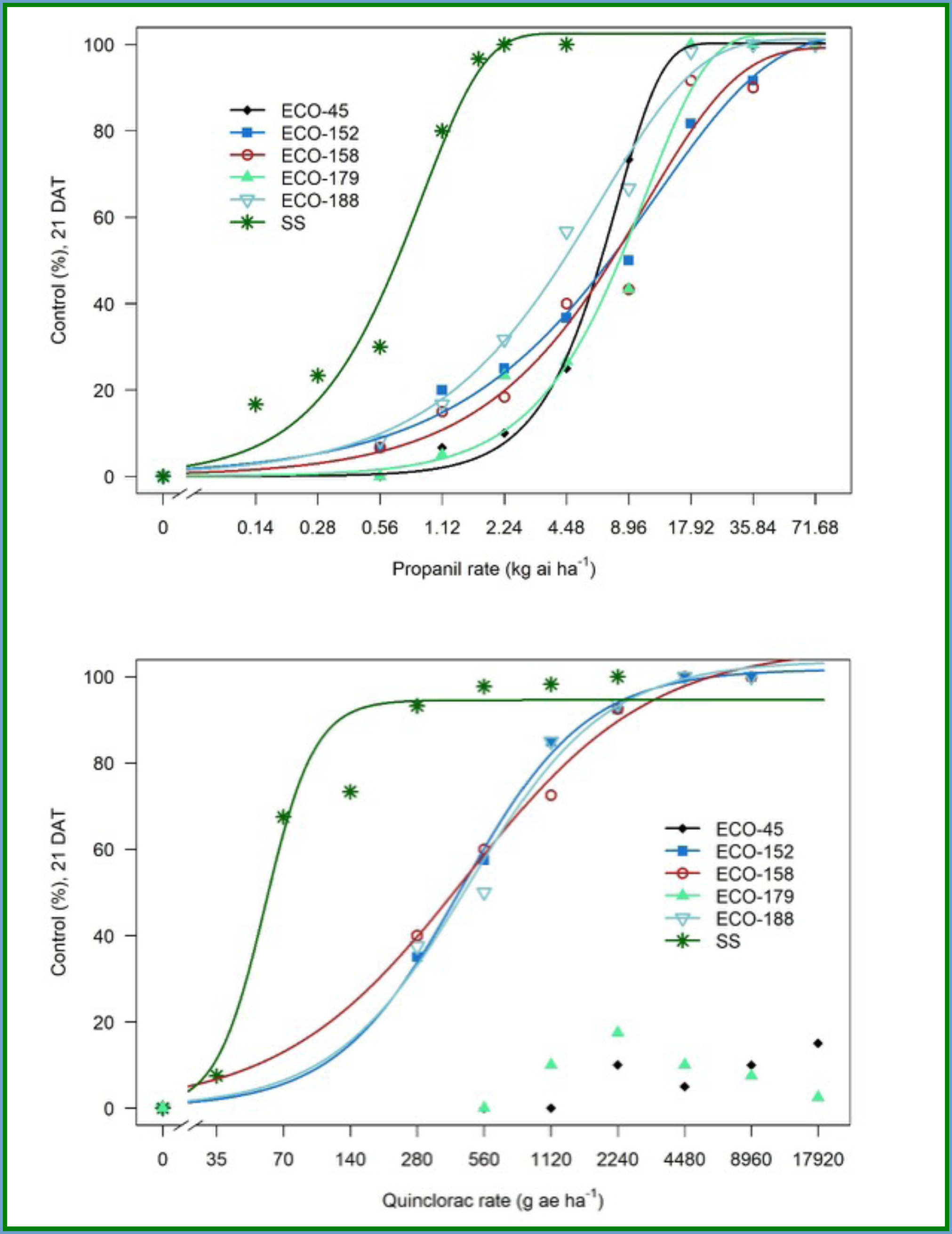
The resistance factor to propanil, based on ED50 values, ranged from 6.4-fold in ECO-188 to 12.0-fold in ECO-179, (Figure 1a, Table 1). The 12-fold resistance implies that 8.3 kg ha−1 of propanil is required to cause 50% injury to the resistant accession, while the same level of injury can be attained with only 0.69 kg ai ha−1 in the susceptible standard population. The least resistant accession had an ED50 value of 4.42 kg ha−1 propanil.
Dose-response to (A) propanil and (B) quinclorac of multiple-resistant Echinochloa colona in the greenhouse, Milo Shult Agricultural Research Center, University of Arkansas Division of Agriculture, Fayetteville, AR, USA
For quinclorac, the resistance level ranged from 8.0- to >309-fold (Figure 1b, Table 1). The ED50 values for ECO-45 and ECO-179 could not be determined, as even the highest rate tested (17.9 kg ha−1, 32X the labeled rate) did not cause the injury level required for a proper model fit. Thus, ECO-45 and ECO-179 exhibited extremely high resistance to quinclorac, although their precise resistance indices could not be determined.
3.2 Expression analysis of candidate NTSR genes in response to propanil
In this study, we considered a fold-change (FC) of 2 as the cutoff point for a gene to be biologically relevant (McCarthy, Smyth 2009). To facilitate data presentation and discussion, we categorized the FC values as follows: 2- to 4-fold = low, 5- to 7-fold = intermediate, and ≥8-fold = high.
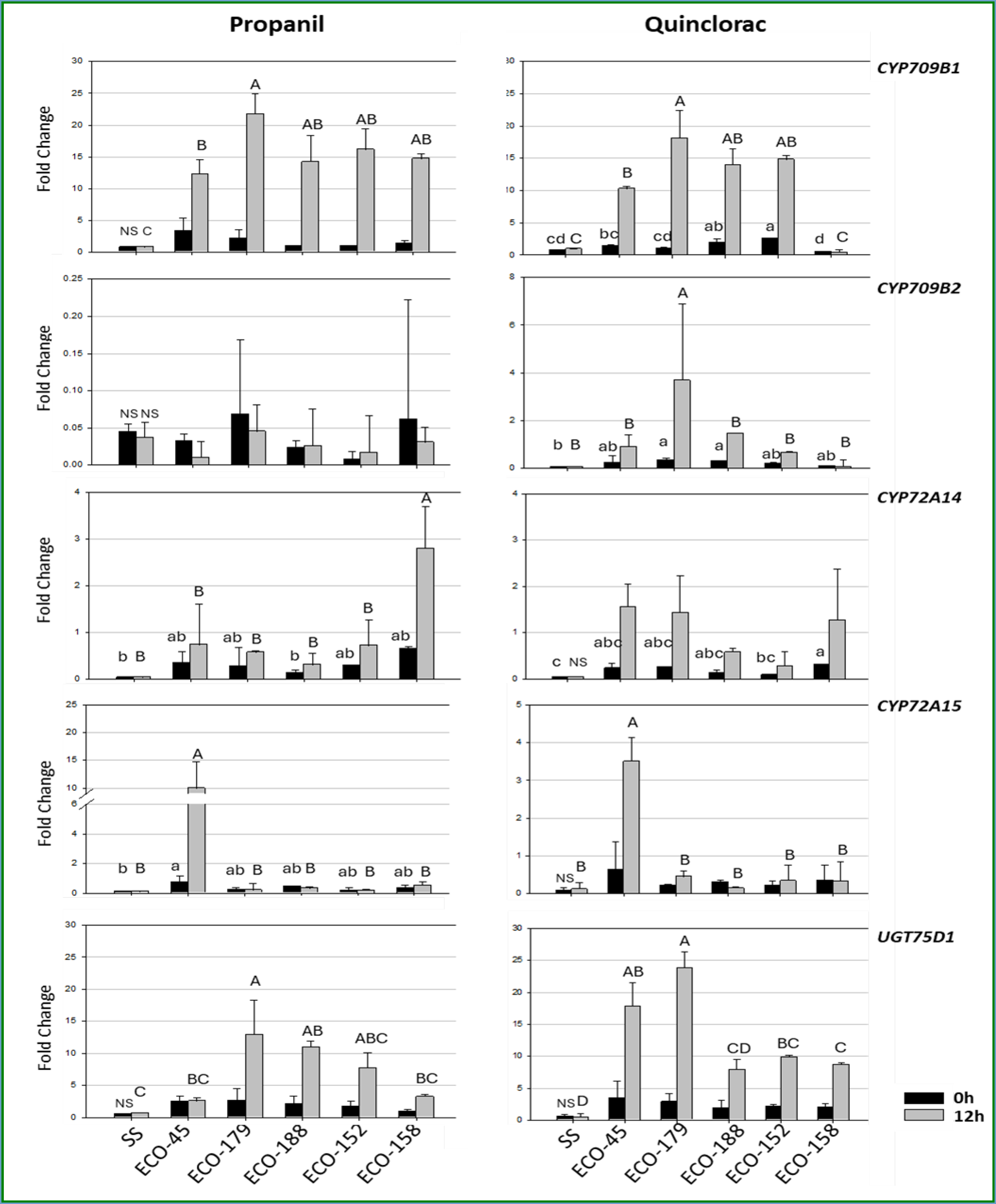
UGT75D1 was induced by propanil treatment 3.5- to 4.9-fold relative to the corresponding nontreated controls in all R accessions except in ECO-45, which remained constitutively expressed 12 h after treatment (Figure 2). Since ECO-45 is also highly resistant to propanil, the lack of UGT75D1 induction suggests the general role of UGT75D1 in mitigating propanil phytotoxicity but may not be as the sole resistance determinant. The moderate upregulation of UGT75D1 observed is unlikely to solely account for the high level of propanil resistance across accessions, indicating the involvement of other Phase II, and possibly Phase III, genes in the resistance mechanism. Among the four analyzed cytochrome P450 genes, CYP709B1 was upregulated 3.7- to 16-fold in all R accessions. CYP72A14 was also induced by propanil in all R accessions, but at generally lower levels (2- to 4-fold) compared to CYP709B1. CYP72A15 was specifically induced in ECO-45 (13.7-fold), while CYP709B2 was upregulated only in ECO-152 (about 2.1-fold). The expression data indicates that CYP709B1 is generally the principal candidate P450 gene involved in Phase I propanil detoxification across the resistant accessions. When CYP709B1 is not highly induced, as observed in ECO-45, other P450 genes fulfill the same role of detoxification thereby still providing high resistance to propanil. It also seemed that low-level induction of multiple P450 genes together with some induction of UGT75D1 could confer high resistance to propanil.
Expression profiles of selected candidate metabolic genes in Echinochloa colona (ECO) accessions from Arkansas, USA. The left and right panels show gene expression following propanil and quinclorac treatments, respectively. Relative expression (fold change) at 0 h (black bar) and 12 h (grey bar) after treatment was quantified for each accession and normalized to the housekeeping genes OsUBQ and OsEF1. Data represent means ± standard error (SE) of three biological replicates. Levels not connected by the same letter are significantly different for each gene and time point according to Tukey's HSD test (p < 0.05). Lowercase letters indicate differences at 0h, whereas uppercase letters indicate differences at 12h. NS denotes a non-significant difference
Resistance to propanil in Echinochloa spp. is primarily attributed to enhanced detoxification resulting from increased activity of the aryl acylamidase enzyme (Carey III et al., 1997; Lopez-Martinez et al., 2001; Hirase, Hoagland, 2006). However, the wide range in levels of resistance to propanil among Echinochloa populations cannot be fully explained by differential enzyme production in R plants alone. Moreover, there is no information in the literature regarding NTSR genes that confer very high resistance to propanil. A transcriptome study we conducted previously on ECO-45 in response to propanil revealed 12 cytochrome P450 gene transcripts that were significantly induced 24 h after propanil treatment. These transcripts belong to three subfamilies: CYP72A, CYP89A, and CYP709B (Rouse, 2017). The induction of a suite of cytochrome P450 genes by propanil accounts for the loss of resistance to propanil in the presence of cytochrome P450 inhibitors (Rouse et al., 2019).
Our current study supports the involvement of P450 genes, specifically one member of the CYP709B subfamily, in Phase I detoxification of propanil. CYP709B1 was generally induced at higher levels than other tested P450 genes across R populations (Figure 2). However, as only four candidate P450s were tested, we cannot conclusively state that CYP709B1 is the only P450 involved. Also, members of the CYP709B subfamily are stress-responsive; they are inducible by stress factors other than herbicides, such as IAA (Mao et al., 2013). The upregulation of many isoforms after propanil application may not all be related to breaking the propanil molecule. As for the CYP72A candidate genes, it appeared that their involvement in propanil NTSR is non-existent (i.e. CYP72A14) or minimal (i.e. CYP72A15). It is known that the CYP72A subfamily is highly diverse in terms of substrate reactivity. One member, CYP72A21, is inducible by 2,4-D, esprocarb, and chlorotoluron (Hirose et al., 2007). The P450 gene expression profile generated in this study suggests that multiple cytochrome P450s are involved, with various combinations contributing to different levels of resistance across populations as observed with CYP72A15 and CYP709B1 in ECO-45.
The ECO-45 transcriptome revealed that propanil induced the expression of nine glucosyltransferase (GT) transcripts within 24 h of application (Rouse, 2017). These belonged to three subfamilies: UGT73, UGT74, and UGT83. However, we prioritized testing UGT75D1, which was also highly induced 24 h after quinclorac application (Rouse, 2017; Rangani et al., 2022) to test the hypothesis that this particular UGT is responsive to both herbicides. The validation data (Figure 2) supported this hypothesis. Glucosyltransferases are key players in Phase II detoxification, facilitating the conjugation of herbicide metabolites with big sugar molecules for vacuole transport. A GT enzyme can potentially conjugate UDP-glucose to the propionic acid metabolite of propanil (Rouse 2017). Propanil induced UGT75D1 in all populations, except ECO-45, although at lower levels compared to induction by quinclorac. In this subset of R populations, ECO-45 was unique because not only did it not show upregulation of UGT75D1, but also it was the only one showing upregulation of CYP72A15, and at the highest level among P450s tested across populations. These findings suggest that the coordinated upregulation of CYP72A15 and UGT75D1 may contribute to propanil detoxification in ECO-45. Follow-up experiments are needed to characterize the role of these genes in endowing extremely high resistance to propanil.
3.3 Expression of candidate NTSR genes in response to quinclorac
Unlike propanil, quinclorac induced the expression of UGT75D1 in all R accessions 8- to 17-fold, whereas constitutive expression in the respective nontreated samples was 2–3-fold. (Figure 2). This consistent upregulation indicates that UGT75D1 plays a key role in metabolic detoxification of quinclorac among these accessions. Additionally, three of the four P450 genes (CYP72A14, CYP709B2, CYP709B1) were generally induced by quinclorac in the R accessions with varying patterns. CYP72A14 showed induction (3.1- to 6.5-fold) in all R accession, while CYP709B2 and CYP709B1 were induced (3.2- to 10.8-fold and 5.9- to 17.6-fold, respectively) compared to corresponding nontreated plants in four out of five R accessions. In contrast, CYP72A15 was induced only in ECO-45, and at a relatively low level (3.5-fold). ECO-45 and ECO-179 exhibited extremely high resistance to quinclorac (>32x the label rate) (Figure 1), but with distinct gene expression profiles. ECO-45 showed upregulation of all tested P450 genes (up to 17-fold) along with UGT75D1 (5.2-fold), while ECO-179 displayed higher induction of UGT75D1, CYP709B2, and CYP709B1 than ECO-45, but no induction of CYP72A15 compared to nontreated plants. Since CYP72A15 was induced only in ECO-45, we can deduce that this gene rarely plays a role in quinclorac detoxification. Intermediate-level co-induction of multiple P450 genes with UGT75D1 was still associated with 8- to 10-fold resistance to quinclorac in ECO-188, ECO-152, and ECO-158.
The strong induction of the conjugation enzyme UGT75D1 across R populations is a significant finding. UDP-glycosyltransferase genes facilitate the glycosylation of hormones or toxins (Tanaka et al., 2014). Auxin glycosylation is one of the important mechanisms by which auxin homeostasis is achieved in plants (Kantharaj et al., 2022, Casanova-sáez et al., 2021, Jin et al., 2013). Quinclorac is structurally homologous to the endogenous substrate of UGT75D1, kaempferol, as well as to some other substrates such as IAA. This suggests that UGT75D1 induction in R populations contributes to enhanced herbicide inactivation. The upregulation of UGT75D1, complemented by the induction of some P450 genes in four of five populations, suggests some level of increased quinclorac detoxification. However, this mechanism alone does not fully explain the observed whole-plant resistance levels. While cyanide metabolism could contribute to resistance, this was not observed in ECO-45, where β-CAS activity was the same as in ECO-SS (ROUSE et al., 2019). The complex nature of herbicide resistance mechanisms is evident from these findings, suggesting that multiple factors are involved in conferring high-level resistance to quinclorac. Given the incomplete understanding of the resistance mechanisms, further investigation is warranted to elucidate the full spectrum of factors contributing to quinclorac resistance in these Echinochloa populations.
Confronting multiple resistance to herbicides is the new normal in weed management. All the resistant populations used in this study were resistant to quinclorac and to at least two other herbicide SOAs. The predominant resistance trait combination in this subset was propanil+quinclorac. The majority had resistance to three SOAs, either with cyhalofop-butyl or ALS-inhibitor. This pattern reflects the overall resistance profile of Echinochloa populations in the US mid-south, where cases of multiple resistance (Rouse et al., 2018; Wright et al., 2018) are increasing. Multiple resistance arises from the accumulation of target site (TS) or nontarget site (NTS) resistance mechanisms, or a single NTS mechanism conferring resistance to multiple herbicide SOAs. NTSR mechanisms encompass modifications in plant physiology, biology, organ or cell structure, or phenology which are all geared toward reducing the phytotoxic effect of a herbicide (reviewed by Gaines et al. 2020). Some of these NTS adaptations to herbicide selection pressure, especially enhanced herbicide degradation, impart resistance to multiple SOAs and produce highly variable resistance patterns. Thus, metabolic resistance to herbicides is a serious threat to crop production (Yu, Powles, 2014). The accumulation of resistance mechanisms within weed populations is an inevitable consequence of sustained herbicide selection pressure regardless of SOA. As survivors interbreed and reproduce, multiple resistance mechanisms can stack within individual plants. Gene flow via seed or pollen dispersal can further introduce additional resistance mechanisms from proximal or distant fields. Accumulation of resistance traits also arises from strong, sequential selection with different herbicide SOAs, as exemplified by the prevalence of Echinochloa populations with multiple resistance to propanil and quinclorac (Talbert, Burgos, 2007; Rouse et al., 2018). In this scenario, the weed populations were exposed to persistent, strong selection pressure with propanil. When resistance to propanil evolved in the late ‘80s (Baltazar, Smith Jr, 1994; Carey III et al., 1995), producers switched to quinclorac to control propanil-resistant populations. Resistance to quinclorac evolved about seven years later (Lovelace et al., 2007).
NTSR can fall into two main categories: (1) reduction of herbicide quantity that reach the target, or (2) protection from the phytotoxic effect of the herbicide. Specific mechanisms include reduced absorption and translocation to the target site; increased detoxification a.k.a. metabolic resistance; and increased protection from damage primarily via upregulation of antioxidants (Délye, 2013). One way of reducing translocation to the target site is by sequestration of the herbicide in the vacuole such as observed in Erigeron canadensis (Ge et al., 2010). Metabolic resistance is becoming the most common NTSR mechanism. Some examples include Echinochloa spp. resistance to acetolactate synthase (ALS) inhibitors (Yasuor et al., 2009; Iwakami et al., 2014; Rouse et al., 2019), clomazone (Yasuor et al., 2010), propanil (Wright et al., 2018), acetyl coenzyme A carboxylase (ACCase) inhibitors (Iwakami et al., 2019); and quinclorac (Haq et al., 2020; Yang et al., 2020). NTSR mechanisms also endow multiple-resistance among the most notorious cool-season grasses such as Lolium spp. resistance to ACCase-, ALS-, microtubule- and very long chain fatty acid (VLCFA) synthesis inhibitors, glyphosate, and metribuzin (Ma et al., 2020); and Alopecurus spp. resistance to ACCase inhibitors (Chen et al., 2018; Tétard-jones et al., 2018).
The complexity of auxinic herbicide action is very difficult to overcome. For resistance to evolve, it is conceivable that several components of the tightly regulated auxin response would adapt in a coordinated fashion, even in small increments, to achieve a large effect. Several studies have identified concurrent mechanisms contributing to elevated quinclorac resistance in different Echinochloa species. Resistance to quinclorac in E. phyllopogon in California, USA was attributed to increased activity of β-cyanoalanine synthase (β-CAS) (Hagay et al., 2012). In susceptible species, quinclorac causes excessive ethylene production, which is detrimental. Ethylene synthesis produces a toxic by-product, cyanide, which is the primary phytotoxic compound that accumulates in shoots of sensitive species as a consequence of quinclorac action. β-CAS facilitates the catabolism of cyanide (Grossmann, Kwiatkowski, 1995; Grossmann, 2010). However, Hagay et al. (2012) reported that β-CAS activity in R plants was only 2- to 3-fold higher than that in S plants, which could not account for the resistance level of the population. They reported that quinclorac resistance was reversed by the addition of a P450-inhibitor, malathion. This indicates that while β-CAS is degrading cyanide, quinclorac is also being degraded.
Another example has been documented in E. crus-galli var. mitis (Haq et al., 2020). This complex mechanism involves the downregulation of 1-aminocyclopropane-1-carboxylic acid (ACC) synthase and ACC oxidase and a more efficient β-CAS enzyme. ACC synthase (ACS) catalyzes the synthesis of ACC, which is converted to ethylene by ACC oxidase (ACO). The ethylene biosynthesis pathway is tightly regulated because ethylene controls many physiological processes in the plant. Ethylene imbalance is detrimental to the point of plant death. In susceptible plants, quinclorac induces ACCs, providing excess supply of ACC, resulting in excessive ethylene production, which is lethal (Grossmann, 2010). Therefore, ‘control’ over ACS and ACO expression after quinclorac application inhibited the overproduction of ethylene and endowed resistance (Haq et al., 2020). Furthermore, Haq and colleagues discovered that β-CAS activity was higher in the resistant population than in the susceptible one, which means higher degradation of cyanide. The improved enzyme efficiency emanated from three amino acid mutations in EcCAS (Asn105Lys, Gln195Glu, Gly298-Val) that increased the β-CAS binding affinity with its cofactor and increased enzyme stability. Collectively, these adaptations resulted in 12- to 27-fold resistance across populations; higher than the resistance level of E. phyllopogon in California, but several magnitudes lower than that of ECO-45 and ECO-179 in our study.
Quinclorac-resistant populations of E. crus-galli var. zelayensis, also showed minimal ethylene synthesis upon quinclorac treatment compared to the S population (Xu et al., 2013). This was due to reduced activities of ACS and ACO and low production of ACC in R plants, the same mechanism in E. crus-galli var. mitis. The same R populations also showed higher constitutive β-CAS activity than S plants, but with no further induction upon quinclorac treatment (Gao et al., 2017). This elevated enzyme activity was supported by higher expression level of EcCAS in R vs. S plants. Gao et al. (2017) also discovered a single amino acid mutation in the EcCAS gene (Met295Lys) of R plants from two populations, although they did not report if such mutation changed the enzyme structure favorably. Follow-up studies further revealed that the quinclorac-resistant populations also exhibited maintenance, or rapid recovery, of photosynthesis-related gene expression upon quinclorac treatment while such genes were downregulated quickly and did not recover in the susceptible population (Gao et al., 2019). The authors hypothesized that protection of photosynthesis is another possible mechanism of resistance to quinclorac in these populations.
Further illustrating the complexity of auxinic herbicide action, yet another group of researchers hypothesized that in E. crus-pavonis, resistance to quinclorac is due to an alteration in auxin signal perception/transduction to the ethylene biosynthesis pathway and is likely controlled by a single major gene (Yang et al., 2020). If this is true, then this does not conform to the tenet of NTSR being multigenic and may be a novel TSR mechanism for quinclorac. This yet-to-be-resolved mechanism endowed resistance to up to 6.4 kg ha−1 quinclorac.
4. Conclusions
This study reveals complex herbicide resistance mechanisms in Echinochloa spp. to propanil and quinclorac with resistance factors ranging from 6.4- to 12.0-fold for propanil and 8.0- to >309-fold for quinclorac. Key genetic factors involved include cytochrome P450 genes (particularly CYP709B1) and the glucosyltransferase gene UGT75D1, which show differential expression patterns across resistant populations. Resistance mechanisms vary among accessions with some populations exhibiting unique gene expression profiles. Notably, while gene expression provides insights into resistance, multiple factors contribute to the high levels of resistance, indicating the need for further investigation to fully understand these complex mechanisms.
Data Availability Statement
The data availability policy does not apply.
Acknowledgements
The authors acknowledge the contributions of Drs. Rooksana Noorai, Vijay Shankar, Christopher Saski, and Amy Lawton-Rauh in analyzing the baseline transcriptome data for E. colona from which the candidate genes were identified.
References
-
Baltazar AM, Smith Jr RJ. Propanil-resistant barnyardgrass (Echinochloa crus-galli control in rice (Oryza sativa Weed Technol. 1994;8(3):576-81. Available from: https://doi.org/10.1017/S0890037X00039713
» https://doi.org/10.1017/S0890037X00039713 -
Benedetti L, Rangani G, Ebeling Viana V, Carvalho-Moore P, Rabaioli Camargo E, Avila LA et al. Recurrent selection by herbicide sublethal dose and drought stress results in rapid reduction of herbicide sensitivity in junglerice. Agronomy. 2020;10(11):1-19. Available from: https://doi.org/10.3390/agronomy10111619
» https://doi.org/10.3390/agronomy10111619 -
Burgos NR, Tranel PJ, Streibig JC, Davis VM, Shaner D, Norsworthy JK et al. Review: confirmation of resistance to herbicides and evaluationof resistance levels. Weed Sci. 2013;61(1):4-20. Available from: https://doi.org/10.1614/WS-D-12-00032.1
» https://doi.org/10.1614/WS-D-12-00032.1 -
Carey III VF, Hoagland RE, Talbert RE. Verification and distribution of propanil-resistant barnyardgrass (Echinochloa crus-galli in Arkansas. Weed Technol. 1995;9(2):366–72. Available from: https://doi.org/10.1017/S0890037X00023496
» https://doi.org/10.1017/S0890037X00023496 -
Carey III VF, Hoagland RE, Talbert RE. Resistance Mechanism of Propanil-Resistant Barnyardgrass: II. In-vivo Metabolism of the Propanil Molecule. Pestic Sci. 1997;49(4):333-8. Available from: https://doi.org/10.1002/(SICI)1096-9063(199704)49:4<333::AID-PS541>3.0.CO;2-0
» https://doi.org/10.1002/(SICI)1096-9063(199704)49:4<333::AID-PS541>3.0.CO;2-0 -
Casanova-Sáez R, Mateo-Bonmatí E, Ljung K. Auxin metabolism in plants. Cold Spring Harb Perspect Biol. 2021;13(3):1-22. Available from: https://doi.org/10.1101/cshperspect.a039867
» https://doi.org/10.1101/cshperspect.a039867 -
Chen G, Xu H, Zhang T, Bai C, Dong L. Fenoxaprop-P-ethyl resistance conferred by cytochrome P450s and target site mutation in Alopecurus japonicus. Pest Manag Sci. 2018;74(7):1694-703. Available from: https://doi.org/10.1002/ps.4863
» https://doi.org/10.1002/ps.4863 -
Délye C. Unravelling the genetic bases of non-target-site-based resistance (NTSR) to herbicides: a major challenge for weed science in the forthcoming decade. Pest Manag Sci. 2013;69(2):176-87. Available from: https://doi.org/10.1002/ps.3318
» https://doi.org/10.1002/ps.3318 -
Fischer AJ, Ateh CM, Bayer DE, Hill JE. Herbicide-resistant Echinochloa oryzoides and E. phyllopogon in California Oryza sativa fields. Weed Sci. 2000;48(2):225–30. Available from: https://doi.org/10.1614/0043-1745(2000)048[0225:HREOAE]2.0.CO;2
» https://doi.org/10.1614/0043-1745(2000)048[0225:HREOAE]2.0.CO;2 -
Fischer AJ, Lozano J, Ramirez A, Sanint LR. Yield loss prediction for integrated weed management in direct-seeded rice. Int J Pest Manag. 1993;39(2):175-80. Available from: https://doi.org/10.1080/09670879309371786
» https://doi.org/10.1080/09670879309371786 -
Gaines TA, Duke SO, Morran S, Rigon CAG, Tranel PJ, Küpper A et al. Mechanisms of evolved herbicide resistance. J Biol Chem. 2020;295(30):10307-330. Available from: https://doi.org/10.1074/jbc.REV120.013572
» https://doi.org/10.1074/jbc.REV120.013572 -
Gao Y, Pan L, Sun Y, Zhang T, Dong L, Li J. Resistance to quinclorac caused by the enhanced ability to detoxify cyanide and its molecular mechanism in Echinochloa crus-galli var. zelayensis. Pestic Biochem Physiol. 2017;143:231-8. Available from: https://doi.org/10.1016/j.pestbp.2017.08.009
» https://doi.org/10.1016/j.pestbp.2017.08.009 -
Gao Y, Pan X, Sun X, Li J, Dong L. Is the protection of photosynthesis related to the mechanism of quinclorac resistance in Echinochloa crus-galli var. zelayensis? Gene. 2019;683:133-48. Available from: https://doi.org/10.1016/j.gene.2018.10.022
» https://doi.org/10.1016/j.gene.2018.10.022 -
Ge X, d’Avignon DA, Ackerman JJ, Sammons RD. Rapid vacuolar sequestration: the horseweed glyphosate resistance mechanism. Pest Manag Sci. 2010 Apr;66(4):345-8. Available from: https://doi.org/10.1002/ps.1911
» https://doi.org/10.1002/ps.1911 -
Grossmann K. Auxin herbicides: current status of mechanism and mode of action. Pest Manag Sci. 2010;66(2):113-20. Available from: https://doi.org/10.1002/ps.1860
» https://doi.org/10.1002/ps.1860 - Grossmann K, Kwiatkowski J. Evidence for a causative role of cyanide, derived from ethylene biosynthesis, in the herbicidal mode of action of quinclorac in barnyard grass. Pestic Biochem Physiol. 1995;51(2):150-60.
-
Haq MZU, Zhang Z, Wei J, Qiang S. Ethylene Biosynthesis Inhibition Combined with Cyanide Degradation Confer Resistance to Quinclorac in Echinochloa crus-galli var. mitis Int J Mol Sci. 2020;21(5):1573. Available from: https://doi.org/10.3390/ijms21051573
» https://doi.org/10.3390/ijms21051573 -
Heap I. International survey of herbicide resistant weeds. Weedscience. 2024 [access Apr 24, 2026]. Available from: http://www.weedscience.org
» http://www.weedscience.org -
Hirase K, Hoagland RE. Characterization of aryl acylamidase activity from propanil-resistant barnyardgrass (Echinochloa crus-galli [L.] Beauv.). Weed Biol Manag. 2006;6(4):197-203. Available from: https://doi.org/10.1111/j.1445-6664.2006.00218.x
» https://doi.org/10.1111/j.1445-6664.2006.00218.x -
Hirose S, Kawahigashi H, Tagiri A, Imaishi H, Ohkawa H, Ohkawa Y. Tissue-specific expression of rice CYP72A21 induced by auxins and herbicides. Plant Biotechnol Rep. 2007;1(1):27-36. Available from: https://doi.org/10.1007/s11816-006-0003-2
» https://doi.org/10.1007/s11816-006-0003-2 -
Iwakami S, Kamidate Y, Yamaguchi T, Ishizaka M, Endo M, Suda H et al. CYP81A P450s are involved in concomitant cross-resistance to acetolactate synthase and acetyl-CoA carboxylase herbicides in Echinochloa phyllopogon New Phytol. 2019;221(4):2112-22. Available from: https://doi.org/10.1111/nph.15552
» https://doi.org/10.1111/nph.15552 -
Iwakami S, Uchino A, Kataoka Y, Shibaike H, Watanabe H, Inamura T. Cytochrome P450 genes induced by bispyribac-sodium treatment in a multiple-herbicide-resistant biotype of Echinochloa phyllopogon Pest Manag Sci. 2014;70(4):549-58. Available from: https://doi.org/10.1002/ps.3572
» https://doi.org/10.1002/ps.3572 -
Jin SH, Ma XM, Han P, Wang B, Sun YG, Zhang GZ et al. UGT74D1 is a novel auxin glycosyltransferase from Arabidopsis thaliana PLoS One. 2013;8(4):1-11. Available from: https://doi.org/10.1371/journal.pone.0061705
» https://doi.org/10.1371/journal.pone.0061705 -
Kantharaj V, Ramasamy NK, Yoon YE, Cheong MS, Kim YN, Lee KA et al. Auxin-glucose conjugation protects the rice (Oryza sativa L.) seedlings against hydroxyurea-induced phytotoxicity by activating UDP-glucosyltransferase enzyme. Front Plant Sci. 2022;12:1-15. Available from: https://doi.org/10.3389/fpls.2021.767044
» https://doi.org/10.3389/fpls.2021.767044 -
Lopez-Martinez N, Gonzalez-Gutierrez J, De Prado R. Propanil activity, uptake and metabolism in resistant Echinochloa spp. biotypes. Weed Res. 2001;41(2):187-96. Available from: https://doi.org/10.1046/j.1365-3180.2001.00231.x
» https://doi.org/10.1046/j.1365-3180.2001.00231.x - Lovelace M. Quinclorac absorption and translocation characteristics in quinclorac- and propanil-resistant and -susceptible barnyardgrass (Echinochloa crus-galli biotypes. Weed Technol. 2007;21(3):683-7.
-
Ma H, Lu H, Han H, Yu Q, Powles S. Metribuzin resistance via enhanced metabolism in a multiple herbicide resistant Lolium rigidum population. Pest Manag Sci. 2020;76(11):3785-91. Available from: https://doi.org/10.1002/ps.5929
» https://doi.org/10.1002/ps.5929 -
R Core Team. R: A language and environment for statistical computing. Vienna: R Foundation for Statistical Computing; 2023. Available from: https://www.R-project.org/
» https://www.R-project.org/ -
Rangani G, Rouse CE, Saski C, Noorai RE, Shankar V, Lawton-Rauh AL et al. High resistance to quinclorac in multiple-resistant Echinochloa colona associated with elevated stress tolerance gene expression and enriched xenobiotic detoxification pathway. Genes. 2022;13(3):1-19. Available from: https://doi.org/10.3390/genes13030515
» https://doi.org/10.3390/genes13030515 - Ritz C, Baty F, Streibig JC, Gerhard D. Dose-response analysis using R. Boca Raton: CRC Press; 2019.
- Roma-Burgos N, Rouse C, Heap IM, Lawton-Rauh A. Evolution of herbicide-resistant weeds. In: Korres NE, Roma-Burgos N, Duke SO, editores. Weed control: sustainability, hazards, and risks in cropping systems worldwide. Boca Raton: CRC Press; 2018.
- Rouse CE. Characterization of multiple-herbicide-resistant Echinochloa colona from Arkansas [thesis]. Fayetteville: University of Arkansas; 2017.
-
Rouse CE, Roma-Burgos N, Barbosa Martins BA. Physiological assessment of non-target site resistance in multiple-resistant junglerice (Echinochloa colona Weed Sci. 2019;67(6):622-32. Available from: https://doi.org/10.1017/wsc.2019.52
» https://doi.org/10.1017/wsc.2019.52 -
Rouse CE, Roma-Burgos N, Norsworthy JK, Tseng T-M, Starkey CE, Scott RC. Echinochloa resistance to herbicides continues to increase in Arkansas rice fields. Weed Technology. 2018;32(1):34–44. Available from: https://doi.org/10.1017/wet.2017.82
» https://doi.org/10.1017/wet.2017.82 -
Tahir H, Roma-Burgos N. Fecundity and Seed Dormancy Variation Within and Among Echinochloa Species. Front Agron. 2021;3:1-9. Available from: https://doi.org/10.3389/fagro.2021.623425
» https://doi.org/10.3389/fagro.2021.623425 -
Talbert RE, Burgos NR. History and management of herbicide-resistant barnyardgrass (Echinochloa crus-galli in Arkansas rice. Weed Technol. 2007;21(2):324–31. Available from: https://doi.org/10.1614/WT-06-084.1
» https://doi.org/10.1614/WT-06-084.1 -
Tanaka K, Hayashi K, Natsume M, Kamiya Y, Sakakibara H, Kawaide H et al. UGT74D1 catalyzes the glucosylation of 2-oxindole-3-acetic acid in the auxin metabolic pathway in Arabidopsis Plant Cell Physiol. 2014;55(1):218-28. Available from: https://doi.org/10.1093/pcp/pct173
» https://doi.org/10.1093/pcp/pct173 -
Tétard-Jones C, Sabbadin F, Moss S, Hull R, Neve P, Edwards R. Changes in the proteome of the problem weed blackgrass correlating with multiple-herbicide resistance. Plant J. 2018 May;94(4):709-720. Available from: https://doi.org/10.1111/tpj.13892
» https://doi.org/10.1111/tpj.13892 -
Wright AA, Rodriguez-Carres M, Sasidharan R, Koski L, Peterson DG, Nandula VK, et al. Multiple Herbicide-Resistant Junglerice (Echinochloa colona: Identification of Genes Potentially Involved in Resistance through Differential Gene Expression Analysis. Weed Sci. 2018;66(3):347–54. Available from: https://doi.org/10.1017/wsc.2018.10
» https://doi.org/10.1017/wsc.2018.10 -
Wu D, Shen E, Jiang B, Feng Y, Tang W, Lao S et al. Genomic insights into the evolution of Echinochloa species as weed and orphan crop. Nat Commun. 2022 Feb 3;13(1):1-16. Available from: https://doi.org/10.1038/s41467-022-28359-9
» https://doi.org/10.1038/s41467-022-28359-9 -
Xu J, Lv B, Wang Q, Li J, Dong L. A resistance mechanism dependent upon the inhibition of ethylene biosynthesis. Pest Manag Sci. 2013;69(12):1407-14. Available from: https://doi.org/10.1002/ps.3524
» https://doi.org/10.1002/ps.3524 -
Yang X, Han H, Cao J, Li Y, Yu Q, Powles SB. Exploring quinclorac resistance mechanisms in Echinochloa crus-pavonis from China. Pest Manag Sci. 2021;77(1):194-201. Available from: https://doi.org/10.1002/ps.6007
» https://doi.org/10.1002/ps.6007 -
Yasuor H, Milan M, Eckert JW, Fischer AJ. Quinclorac resistance: a concerted hormonal and enzymatic effort in Echinochloa phyllopogon Pest Manag Sci. 2012;68(1):108-15. Available from: https://doi.org/10.1002/ps.2230
» https://doi.org/10.1002/ps.2230 -
Yasuor H, Zou W, Tolstikov VV, Tjeerdema RS, Fischer AJ. Differential oxidative metabolism and 5-ketoclomazone accumulation are involved in Echinochloa phyllopogon resistance to clomazone. Plant Physiol. 2010;153(1):319-26. Available from: https://doi.org/10.1104/pp.110.153296
» https://doi.org/10.1104/pp.110.153296 -
Yasuor H, Osuna MD, Ortiz A, Saldaín NE, Eckert JW, Fischer AJ. Mechanism of resistance to penoxsulam in late watergrass [Echinochloa phyllopogon (Stapf) Koss.]. J Agric Food Chem. 2009;57(9):3653-60. Available from: https://doi.org/10.1021/jf8039999
» https://doi.org/10.1021/jf8039999 -
Yasuor H, TenBrook PL, Tjeerdema RS, Fischer AJ. Responses to clomazone and 5-ketoclomazone by Echinochloa phyllopogon resistant to multiple herbicides in Californian rice fields. Pest Manag Sci. 2008;64(10):1031-9. Available from: https://doi.org/10.1002/ps.1604
» https://doi.org/10.1002/ps.1604 -
Yu Q, Powles S. Metabolism-based herbicide resistance and cross-resistance in crop weeds: a threat to herbicide sustainability and global crop production. Plant Physiol. 2014;166(3):1106-18. Available from: https://doi.org/10.1104/pp.114.242750
» https://doi.org/10.1104/pp.114.242750
Edited by
-
Editor in Chief:
Carol Ann Mallory-Smith
-
Associate Editor:
Todd Gaines