
 Connecting for Change: Intermediary Actions to Incentivize Marine Conservation Transitions in Chilean Patagonia
Abstract
Intermediary actions play a crucial role in promoting the transition towards marine sustainability. Recent research on marine conservation suggests that innovation emerges from collective actions led by institutional entrepreneurs embedded in action networks. This article illustrates how collective efforts were mobilized to promote inclusive marine conservation in northern Patagonia, Chile, departing from past exclusionary practices. Using mixed methods -including semi-structured interviews, social network analyses, and ethnography- the study underscores how institutional entrepreneurs connect diverse actors and convey a unified framework to guide collective action. This research contributes to current discussions on marine transformations by pinpointing key intermediary actions that can accelerate global progress towards marine sustainability.
Keywords:
Intermediary actions; institutional entrepreneurs; action-network; marine conservation; marine sustainability transitions
Resumen
Las acciones intermedias son un factor clave para incentivar la transición hacia la sostenibilidad marina. Investigaciones recientes sobre conservación marina revelan que la innovación surge de acciones colectivas lideradas por emprendedores institucionales integrados en redes de acción. Este artículo muestra cómo se movilizaron acciones colectivas para promover una conservación marina inclusiva en el norte de la Patagonia, Chile, cambiando la trayectoria excluyente que caracterizó los años anteriores. Utilizando métodos mixtos que incluyen entrevistas semiestructuradas, análisis de redes sociales y etnografía, los resultados destacan cómo los emprendedores institucionales conectan a diversos actores y comunican un marco común para guiar la acción colectiva. El documento contribuye a los debates actuales sobre transformaciones marinas al identificar la acción intermediaria clave que puede catalizar transiciones hacia la sostenibilidad marina a nivel global.
Palavras clave:
Acciones intermediarias; emprendedores institucionales; red de acción; conservación marina; transiciones hacia la sostenibilidad marina
Resumo
As ações intermediárias desempenham um papel crucial na promoção da transição para a sustentabilidade marinha. Pesquisas recentes sobre conservação marinha sugerem que a inovação surge de ações coletivas lideradas por empreendedores institucionais inseridos em redes de ação. Este artigo ilustra como esforços coletivos foram mobilizados para promover a conservação marinha inclusiva no norte da Patagônia, Chile, afastando-se das práticas excludentes do passado. Utilizando métodos mistos - incluindo entrevistas semiestruturadas, análises de redes sociais e etnografia -, o estudo destaca como os empreendedores institucionais conectam diversos atores e transmitem uma estrutura unificada para orientar a ação coletiva. Esta pesquisa contribui para as discussões atuais sobre as transformações marinhas, identificando ações intermediárias fundamentais que podem acelerar o progresso global em direção à sustentabilidade marinha.
Palavras-chave:
Ações intermediárias; empreendedores institucionais; rede de ação; conservação marinha; transições para a sustentabilidade marinha
1. Introduction
Globally, Marine Protected Areas (MPAs) serve as the forefront of ocean sustainability (MAESTRO et al., 2019). In regions with diverse interests and competing economic pressures, MPAs play a crucial role in conserving biodiversity and promoting human well-being, in addition to implementing protective measures that benefit a variety of local livelihoods, including indigenous and traditional communities, rural populations, and small-scale fisheries (BAN; FRID, 2018). Moreover, MPAs enhance ecosystem services such as food security, climate regulation, coastal disaster resilience, and cultural significance (RASHEED, 2020).
In recent years, Chile has emerged as a marine conservation leader in the Americas. With over 40% of its Exclusive Economic Zone (EEZ) designated as protected areas, the country has met international targets such as those set by the Sustainable Development Goals (SDGs) and the Kunming-Montreal Biodiversity Framework (https://mpatlas.org/). Currently, Chile has 36 MPAs covering a total surface area of 1,501,555 km2 (https://simbio.mma.gob.cl/). More than 90% of these areas are expansive conservation zones encompassing oceanic islands and offshore waters, including the Rapa Nui Marine Protected Area, established in 2018 (580,000 km2) and the Nazca-Desventuradas Marine Park, established in 2015 (300,000 km2) (ABURTO et al., 2020).
However, the coastal zones of Chile remain inadequately protected, with limited coverage restricted to specific MPAs located in areas subject to multiple economic interests and environmental impacts (ANBLEYHT-EVANS, 2019). For example, in the Chilean Patagonia, recent progress in marine protection is threatened by the unchecked expansion of industrial aquaculture, fishing, and potential future seabed mining (ANBLEYTH-EVANS et al., 2020). Additionally, marine conservation efforts in Chile are predominantly supported within a fragile and fragmented institutional framework characterized by top-down decision-making processes and minimal incentives for bottom-up local conservation initiatives (ARAOS; THER, 2017). Therefore, Chile’s MPAs serve as a significant example of the challenges facing global sustainability transitions, dealing with the structural pressures of the blue growth paradigm (ANBLEYTH-EVANS et al., 2024).
Recent studies highlight several successful initiatives where local communities have played a pivotal role in protecting threatened marine ecosystems in Chile. With bottom-up decision-making processes, initiatives such as Multiple Use Marine Protected Areas (MU-MPAs), artisanal fishers’ Natural Sanctuaries, and Marine and Coastal Areas of Indigenous Peoples have reshaped the institutional marine conservation landscape in Chile. These efforts prioritize the protection of local livelihoods and human well-being (ARAOS; FERREIRA, 2013; GELCICH et al., 2015; OYANADEL et al., 2016; ARAOS, 2018; HIRIART-BERTRAND et al., 2020; ARAOS et al., 2020; ABURTO et al., 2020; ARAOS et al., 2023), and the underlying conservation movements involve small-scale fishers’ organizations, indigenous communities, local activists, municipal governments, and NGOs. These diverse action networks bridge local demands with national-level policies and global conservation targets (ARAOS et al., 2023), and their analysis highlights the critical role of intermediary actors -particularly institutional entrepreneurs- in organizing collective action and driving institutional change (ARAOS; THER, 2017).
The literature on sustainability transitions identifies intermediaries as key actors in their ability to articulate new visions, demands, and expectations (KIVIMAA, 2014), assigning them a crucial role in connecting stakeholders, facilitating knowledge exchange, and building networks that help scale sustainable innovations. They link emerging niches with established regimes, fostering the dissemination of new technologies, practices, and policies. Through their actions, intermediaries can either support or challenge existing systems, depending on their agency, objectives, and position within the socio-political landscape (KIVIMAA et al., 2019).
This article examines the action networks of institutional entrepreneurs who were responsible for establishing a bottom-up MPA: the Pitipalena Añihué Multiple Use Marine Protected Area in Northern Patagonia, Chile. Drawing on mixed methods (ALEXANDER et al., 2015), this study discusses their intermediary roles as well as the context conditions that enabled their agency. Adopting a relational and functional analytical lens, the paper offers empirical insights that contribute to advancing the literature on sustainability transitions.
2. Theoretical Framework
Contemporary social theory increasingly rejects dichotomous perspectives between structure and agency, favouring relational approaches to understand the construction of social order. Scholars advocating relational approaches view the evolution of the social world as a non-linear process involving interactions between social structures and agency within specific historical and territorial contexts (DELANDA, 2006; DONATI; ARCHER, 2015). In the context of environmental sustainability, this approach implies a shift towards posing new questions and objectives (ARAOS et al., 2020), seeking to explore the connections and configurations of diverse agents that emerge within specific socio-environmental pathways, and how such heterogeneous configurations sustain their influence and functionality amidst internal tensions (LI, 2007; BRIASSOULIS, 2017; REYERS et al., 2018).
Thus, the concept of sustainability transitions can be understood as a relational phenomenon which fosters the emergence of new groups and institutions that influence the stability of various socio-environmental configurations (WESTLEY et al., 2013). According to the literature on sustainability transition, these changes often originate in “niches” -spaces of institutional innovation and experimentation-and scale up to transform “regimes” and “landscapes” encompassing practices, institutions, and socio-technical knowledge (GEELS; RAVEN, 2006; GEELS; SCHOT, 2007).
Intermediary action plays a crucial role in catalysing changes by bridging bottom-up innovations with the broader institutional landscape (GEELS; DEUTEN, 2006). Intermediaries fulfil various functions such as systemic, regime-based, niche, process, and user intermediaries, depending on the type of action and the level at which they facilitate change. These roles range from structural contexts, such as intermediaries like governments or industrial players, to localized settings, such as user intermediaries like grassroots organizations or local activists. The role of intermediaries can vary significantly, prompting the development of multiple classifications (KIVIMAA et al., 2019).
This paper specifically examines the intermediary action carried out by Institutional Entrepreneurs (IEs) embedded within action-networks. These actors connect bottom-up innovations with the broader institutional environment, creating potential “niches” for experimentation and transformative change. Institutional entrepreneurship responds to windows of opportunity and resource flows within specific contexts. Often, these opportunities arise from internal or external crises within socio-ecological systems, where the diversity and varying degrees of institutionalization among organizational forms play a crucial role in driving socio-ecological system transformation and fostering adaptive governance. IEs employ mobilization and sense-making strategies to unite organizations, creating shared interpretations, meaningful narratives, visions, and goals that serve as focal points for collective action and resource allocation. Additionally, IEs facilitate the continuous emergence of innovative ideas and the transformation of partnerships into viable alternative configurations. Once established, these platforms allow IEs to leverage resources and harness political support for integrated ideas, laying the foundations for the emergence of new institutional contexts. Successful institutional entrepreneurship agency involves facilitating connectivity among actors and mediating relationships, information, and resources (WESTLEY et al., 2013).
IEs can operate systemically, aligning with the notion of systemic intermediaries as defined by KIVIMAA et al. (2019): actors who operate across every level of the socio-technical system (niche, regime, landscape), advance an explicit transition agenda, and drive across the board systemic changes. Building on this perspective, KANDA et al. (2020) propose three levels of systemic engagement based on the functions of intermediation, the scope of potential benefits, and the types of entities involved: (i) Among actors within a single network; (ii) among distinct networks; and (iii) across actors, networks, and institutions. This typology provides a conceptual framework to analyse the scale and nature of systemic influence, as well as its enactment mechanisms.
3. Methods
The research resorted to a mixed methods approach, integrating social network analyses, semi-structured interviews, and direct observation. This methodology was utilized to identify and analyse the key structural attributes of the action-network and the social dynamics associated with intermediary actions during the establishment of the Pitipalena-Añihué MPA.
3.1 The Study Area
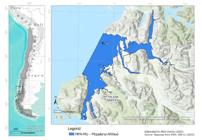
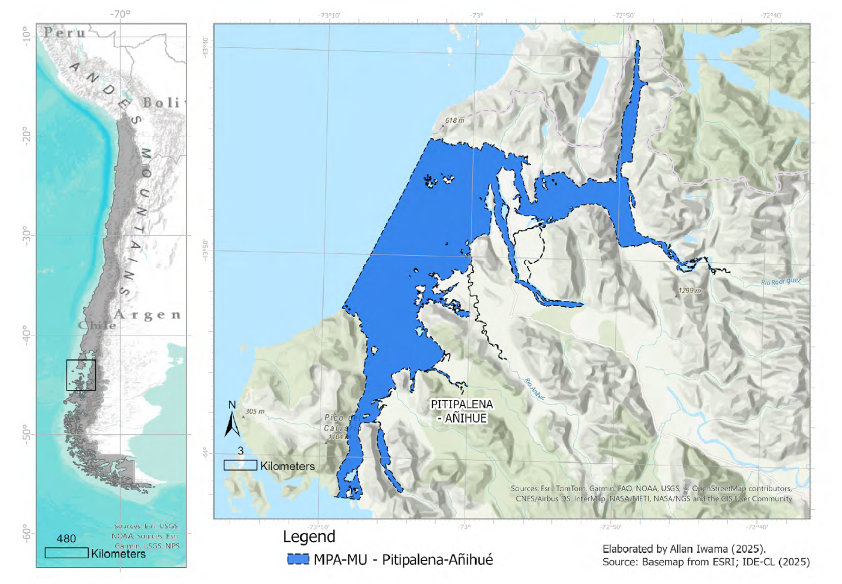
The Pitipalena-Añihué MPA was officially established in 2014 under Supreme Decree No. 13, issued on February 18, 2014, by the Ministry of the Environment. Located in the Aysén Region, Northern Patagonia, Chile, the MPA covers a surface area of 237,3564 km2, encompassing the Pitipalena fjord and its adjacent marine areas.
The MPA is located within the Chiloé-Taitao marine ecoregion, specifically in the Patagonian channels’ ecosystem. This ecoregion encompasses a diverse range of habitats, including riverine, estuarine, and marine ecosystems. The MPA is located within the coastal basin of the Palena river and is surrounded by areas of high biodiversity value, including a network of public and private parks and reserves that hold significant potential for nature-related travel in the Aysén Region. To the north, the area is adjacent to Corcovado National Park, renowned for its diverse landscape featuring over 80 lakes surrounded by native forests. The park also encompasses the Corcovado and Tictoc estuaries, which flow into the Corcovado Gulf.
At the mouth of the Palena river, commune of Puerto Cisnes, is the town of Raúl Marín Balmaceda, home to approximately 300 residents mostly devoted to artisanal fishing, tourism, and public services; next to it lies the Añihué private reserve and the Tic Toc Marine Park. Heading south, the MPA borders Melimoyu National Park, which is characterized by a complex network of channels and fjords, numerous islands, and a landscape dominated by the Valdivian temperate rainforest extending to the sea. The park is also home to the Melimoyu volcano, adding to the area’s natural diversity and ecological significance (HUCKE-GAETE et al., 2010). All these areas contribute to this region’s biodiversity and conservation efforts. Notwithstanding, despite its ecological wealth, the region has also attracted significant economic interests, notably aquaculture and industrial fishing, which have been extensively discussed in the literature (ANBLEYTH-EVANS et al., 2019).
3.2. Data Collection
The fieldwork for this study was conducted between December 2014 and January 2017. Ethnographic research included visits to Raúl Marín Balmaceda in February and September 2016, as well as in January 2017. 30 in-depth interviews were conducted with key actors involved in the establishment of the MPA, along with individuals engaged in the Gulf of Corcovado’s overall conservation efforts. 20 of the 30 interviewees were recorded and used in the social network analysis, namely: three public managers from the Aysén and Los Lagos regions; five members of domestic and international non-governmental organizations (NGOs); five scientists; and seven local community leaders. The interview consisted of 20 questions on the following topics: characterization of the natural resource system; use conflicts; motivations for the creation of the MPA; support and information during the creation process; associated conflicts; resources mobilized; governance system; participation in the management plan; MPA threats and challenges; and overall assessment. The potential over-representation of certain actors was regulated through information triangulation with the semi-structured interviews and fieldwork. The research followed national ethical procedures and was approved by the Universidad de Los Lagos ethics committee (Audit No. 2/2017, Project No. 3150341).
From 2018 to 2023, the MPA’s Management Plan was monitored holding informal conversations with the stakeholders involved in the MPA’s governance network (e.g. WWF, Pitipalena-Añihué Foundation, Aysén Mira el Mar Foundation). It is worth mentioning that the political scenario was more favourable to conservation initiatives during those years. This situation has changed in the past two years, mainly after conservation initiatives led by indigenous peoples through the establishment of the Marine and Coastal Spaces of Indigenous Peoples (ECMPO in Spanish), a new institutional marine conservation and sustainability arrangement implemented across Patagonia (Araos et al. 2023). This political environment has created a highly conflictive setting between conservation initiatives and the salmon industry -the most important economic activity in the area- influencing other MPAs. In this sense, the study’s conclusions and recommendations should be considered in the light of this context, which is also useful to assess how institutional scenarios constrain or encourage the development of an inclusive marine conservation paradigm.
The methodological design included a closed questionnaire applied to 20 key actors during the in-depth interview for the purpose of network analysis, during February and September 2016, as well as in January 2017. The questionnaire had two questions: i. With which of the following actors have you been involved in terms of receiving or providing support during the Pitipalena-Añihué MPA creation and management process?; ii. How often (how many times) have you been in contact with actors associated with the Pitipalena-Añihué MPA creation and management process?
Sample selection was conducted using snowball sampling, a method where initial key informants recommend additional actors within their network for interviews (Huberman; Miles, 2002). The sampling process began with members of the Pitipalena-Añihué Marine Protected Area Foundation (PAMPAF) directly involved in the conservation initiative, and expanded to include other indirect stakeholders such as NGOs, artisanal fishers from Raúl Marín Balmaceda, and scientists from several Chilean universities. The questionnaire focused on understanding how members of the MPA’s governance network perceived their roles, support, and participation during the MPA establishment and implementation process.
3.3. Social Network Analyses
Governmental and publicly available data were analyzed using Social Network Analysis methods to identify actors involved in providing or receiving support during the establishment of the Pitipalena-Añihué MPA. This data includes ministerial-level reports such as the “Technical Report for the creation of the Pitipalena-Anihué Multiple Use Marine and Coastal Protected Area (MU-MPA)” (Ministerio de Medio Ambiente, 2013) and the Pitipalena-Añihué Management Plan (Ministerio de Medio Ambiente, 2020); publications by the Melimoyu Foundation such as the “Tictoc-Melimoyu Marine Protected Area Project” (Melimoyu Foundation, 2009); WWF reports; the database of the Fisheries Undersecretariat; reports authored by Ballena Azul NGO; and social media reports by the Pitipalena-Añihué Foundation, such the Pitipalena-Añihué Multiple Use Marine and Coastal Protected Area booklet, among others. The analysis used Gephi (BASTIAN et al., 2009) and UCINET (BORGATTI et al., 2002) software, applying algorithms to derive metrics that are crucial for understanding this research’s social network dynamics.
The analysis focused on identifying key players within the actor-actor relations network. These actors play pivotal roles in catalyzing, accelerating, and disseminating best practices, technologies, and innovations. They are essential for maintaining network cohesion; without them, the network could fragment, hindering relevant stakeholder connections. Typically, these key actors occupy central positions within the network and wield influence over directly or indirectly connected players. Their influence is reflected in their high “in-degree or out-degree centrality”, “closeness centrality” in facilitating quick access to resources, and “betweenness centrality” in mediating information flow (BORGATTI et al., 2018, SCOTT, 2000; FREEMAN et al., 1991).
Moreover, their significance may stem from their roles within sub-networks or communities. A community denotes a subgroup of actors more closely linked to each other than to outsiders. Two community measures are of interest: 1) Centrality of communities crucial for network cohesion (Kp-player neg) and expansive connectivity (Kp- player pos) (BORGATTI, 2006), and 2) Modularity class, measuring network division into distinct cohesive groups (NEWMAN, 2006). High modularity indicates strong intra-group connections but sparse inter-group connections.
We measured influential attributes at the node level, including centrality measures (in-degree, out-degree, closeness, and betweenness), and at the community level, identified k-players crucial for community centrality within the network and assessed network modularity. These analytical tools elucidated influential actors and cohesive groups within the governance network of the Pitipalena-Añihué MPA, offering insights into their roles and interactions during the MPA’s establishment and ongoing management.
4. Results
4.1. The Northern Patagonia Marine Conservation Route: Describing a Window of Opportunity for a New Governance System
Over the past three decades, two major structural forces have significantly transformed this region. Firstly, and playing a pivotal role is the development of the salmon industry in southern Chile. Secondly, there has been a growing interest in biodiversity conservation, which has shaped sustainable development models for Patagonia (ARAOS, 2018). Salmon farming in the area has become a central discussion topic around the establishment of MPAs and serves as a common thread in narratives highlighting the disruption of Patagonia’s pristine natural landscapes and related environmental impacts on local ecosystems. The creation of the Pitipalena-Añihué MPA was influenced by these territorial tensions stemming from the expansion of industrial aquaculture across Patagonia and the emergence of marine conservation efforts aimed at mitigating salmon farm-driven environmental impacts.
The collective action leading to the creation of the Pitipalena-Añihué MPA was the culmination of over two decades of social mobilization and advocacy involving various stakeholders. These included domestic and foreign NGOs, public officials, scientists, and local activists engaged in diverse marine conservation projects aimed at protecting northern Patagonia. One outstanding initiative was the Chiloé-Corcovado MPA project, which began in the early 2000s and initially focused on whale conservation (HUCKE-GAETE et al., 2010). The Corcovado Gulf was identified by scientists who led the project as a crucial feeding and nursing ground for blue whales in the southern hemisphere (HUCKE-GAETE et al., 2004). However, despite its scientific importance, local support on behalf of artisanal fishers and other NGOs was weak, leading to fragmentation within its backing network that hindered MPA declaration (ARAOS, 2018). Concurrently to this initiative, other conservation projects were underway in northern Patagonia. Some of them focused on protecting fjords within the coastal zone, while others aimed at preserving habitats critical for marine resources. These parallel efforts underscored the complex landscape of marine conservation in northern Patagonia, highlighting both successes and challenges in mobilizing diverse stakeholders towards the sustainable management and protection of marine ecosystems.
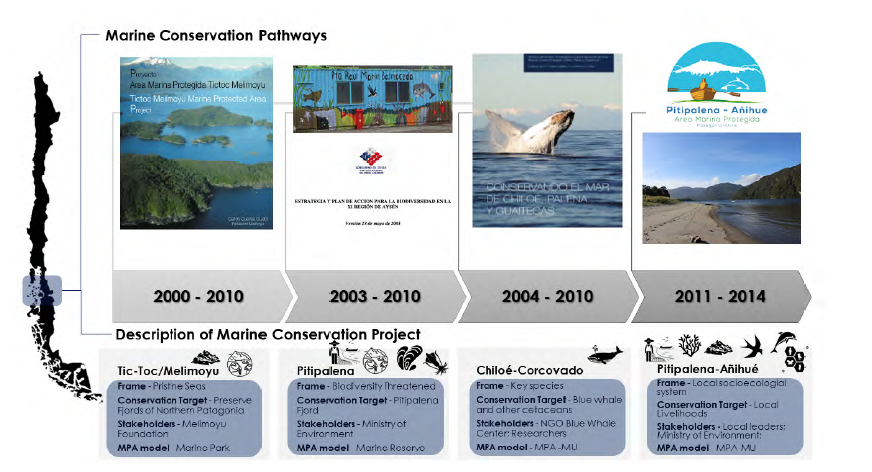
Therefore, to grasp the complexity of marine conservation efforts, the multitude of actors, environmental challenges, goals, and perspectives that have converged over the past two decades need to be crucially acknowledged. Figure 2 shows four key marine conservation projects in northern Patagonia, including the Pitipalena-Añihué MPA. These initiatives display different ways of framing threats, targets, stakeholders, and the MPA institutional framework, reflecting how conservation approaches have evolved in the region. Beginning with the first marine park supported by private donors, the conservation model progressively incorporated local stakeholders and their concerns. The institutional framework also developed with the introduction of co-management strategies to MPA governance (ARAOS, 2018).
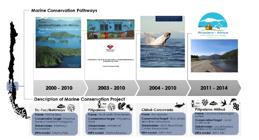
The conservation projects in northern Patagonia were framed differently based on the key stakeholders involved in the collective action, guided by distinct conservation priorities such as pristine seas, biodiversity conservation, protection of flagship species, and the preservation of the local socio-ecological system. These diverse conservation frames influenced how threats were identified and addressed. For example, the Tic-Toc / Melimoyu Marine Park project -aimed at establishing a restrictive marine protected area- originated from private donors concerned over the expansion of salmon farming throughout Patagonia’s pristine fjords who highlighted the importance of preserving untouched marine environments. For its part, the Pitipalena Marine Reserve was established under Government conservation plans and objectives, which recognized the Pitipalena fjord as a biodiversity hotspot, emphasizing the need to protect its unique ecological features and marine resources.
Despite the presence of agents with political power and sufficient financial resources to officially create an MPA, all of the initiatives prior to the Pitipalena-Añihué MPA failed to materialize. Unlike previous projects, the Pitipalena-Añihué MPA was established through community participation, acknowledging the shared threat posed by salmon farming and overfishing, with conservation objectives specifically focused on safeguarding local livelihoods and sustaining natural resources.
Additionally, the Pitipalena-Añihué MPA successfully brought together all stakeholders and coordinated the resources involved in previous initiatives. Notably, this was achieved through the establishment of the Pitipalena-Añihué Marine Protected Area Foundation (PAMPAF), a local institutional framework that unified key actors identified in this study’s social network analysis: Fishermen’s union representatives, the Ministry of the Environment, and NGOs. As detailed in the following section, these and other IEs played a critical role in facilitating intermediary actions by networking actors and fostering interactions across different scales.
4.2. Institutional Entrepreneurs (IEs)
Networking was one of the main intermediary actions observed in Pitipalena-Añihué MPA establishment process. The results of the social network analysis have yielded a network composed by a total of 25 actors (20 legal organizations and five individuals) and 243 relationships among them, in a single component (Table 1).
The results regarding betweenness centrality indicate that the four most significant actors are the Ministry of the Environment (38.56), WWF (33.78), RMB Fishermen’s Union (29.97), and Añihué Reserve (28.80). While these are remarkable players in terms of intermediation, their degree and centrality distribution -although higher- appear relatively balanced (15 to 20). Their closeness centrality is intermediate (28 to 48). On the other hand, Subpesca, Sernapesca, PDI, the Marine government, Aqua Chile, Universidad Austral, Universidad de Concepción, and CIEP exhibit higher closeness centrality values (58 to 96), compared to the Ministry of the Environment, WWF, RMB Fishermen’s Union, and Añihué Reserve.
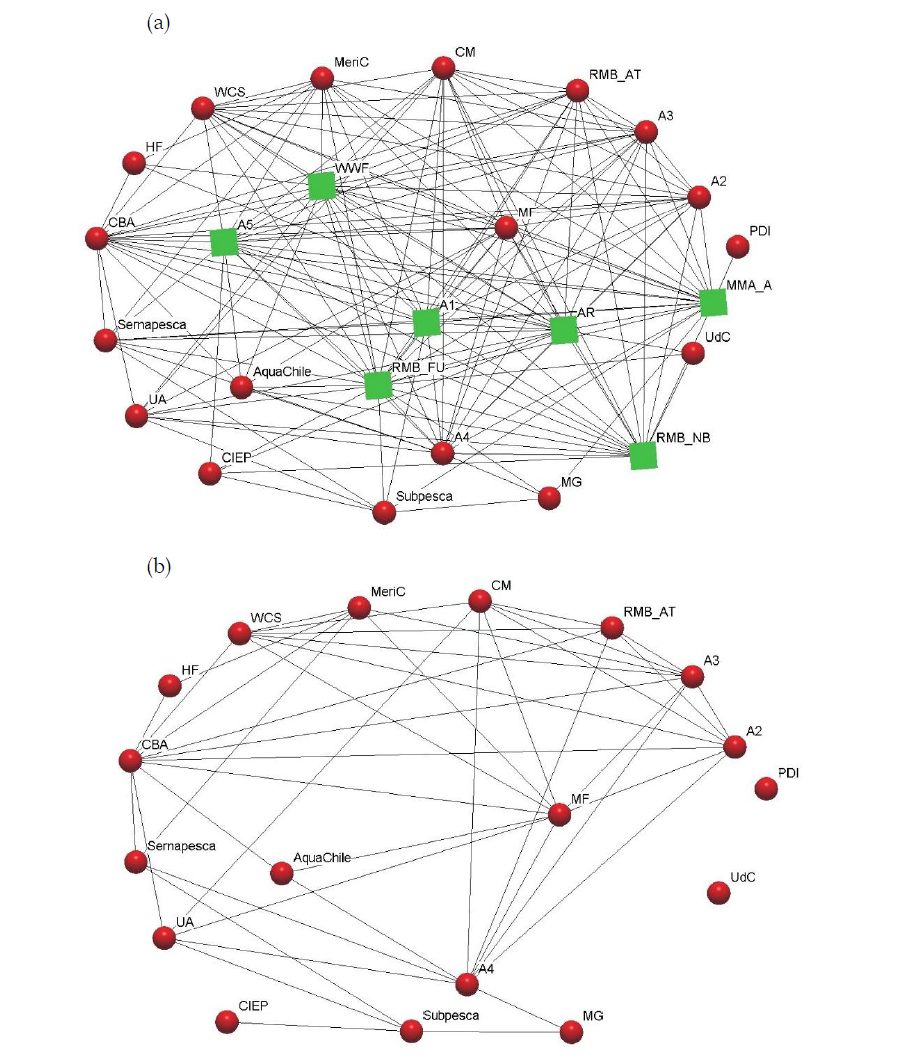
In terms of community centrality, actors with higher betweenness centrality were found to collectively play a significant role in maintaining overall network connectivity. The network suffers a fragmentation of more than 80% when the set including the Ministry of the Environment, RMB Fishermen’s Union, Añihué Reserve, WWF, RMB_NB, and local agents 1 and 5 is removed (kp-player 7; figure 3). On the other hand, the change in coverage analysis shows that the Ministry of the Environment, RMB Fishermen’s Union, and Añihué Reserve are the agents reaching to most of the other network agents (100% coverage). It should be noted that the kp-player 7 group comprises most of the PAMPAF agents.
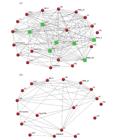
The group formed by RMB_FU, AR, WWF, A1, A5, MMA_A, RMN_NB is crucial for maintaining the connectivity of the entire network.
Notably and regarding inter-actor mediation, these prominent actors (in bold in table 2) are present in the four modules, which complements the previous analysis.
Additionally, it is worth noting that local agents who are members of the PAMPAF exhibit high degrees of in-degree and out-degree centrality. They are also part of different modules, linking both local and national-level public and private organizations, as well as NGOs. For example, local agents 1, 2, 3, and 5 belong to Module 2, which includes the tourism association, the Municipality of Puerto Cisnes, and WCS NGO. Agent 4 connects with MMA_A, Sernapesca, the Subpesca, Marine Government and PDI (Module 3). In essence, these actors connect nodes with high closeness centrality, facilitating indirect connections in the network and enabling resources and information exchanges. While this pattern may point to the extent to which the administrative process has been institutionalized within the coordinating body of the Pitipalena-Añihué MPA, in our view it is evidence that the functional role of the innovation intermediary was that of a systemic intermediary, primarily connecting actors within a single network.
5. Discussion
MPAs are critical tools for advancing towards marine sustainability (WORM, 2017). However, their weaknesses in promoting social inclusion and embracing social justice in decision-making processes is a significant limitation, undermining their effectiveness in supporting sustainability transitions (BENNET et al., 2019). While recent progress in the marine protection of the Chilean Patagonia faces threats from expanding unregulated industrial aquaculture, fisheries, and potential seabed mining (ANBLEYTH-EVANS et al., 2020), marine conservation efforts rely heavily on a fragile and fragmented institutional framework characterized by top-down decision-making and limited incentives for local bottom-up conservation initiatives (ARAOS; THER 2017).
The case of the Pitipalena-Añihué MPA, however, is a potential shift in marine conservation approaches, featuring significant local engagement in decision-making and the inclusion of socio-ecological goals in its conservation strategies (e.g., support for fishers’ livelihoods, among others) (ARAOS, 2018). This transformative potential was facilitated by IEs who bridged diverse actors and multiple knowledge systems, creating an integrative framework that addresses the complexity of the marine environment (RUDOLPH et al., 2020). In this context, IEs capitalized on the window of opportunity presented by socio-environmental challenges arising from salmon farming in the region.
Indeed, in Pitipalena-Añihué, none of the actors who had previously led three conservation projects (NGOs, the State, and scientists) prevailed in the action network. Instead, different IEs played intermediary roles at various stages of the initiative, driving collective action. From the outset, IEs like the Melimoyu Foundation acted as cross-scale connectors, linking local organizations with national environmental agencies. Concurrently, local leaders fostered political alliances within the community and as the project progressed, other players -such as WWF NGO, MMA Aysén, and RMB Fishermen’s Union- undertook intermediary roles, particularly at niche levels, serving as user or process intermediaries (KIVIMAA et al., 2019). As leaders of their respective network modules (NGOs, State, local organizations) they operated as bridging nodes, integrating social complexity.
Following the three system intermediation levels proposed by KANDA et al. 2020: (i) Level 1: In-between actors in a network; ii. Level 2: In-between networks; (iii) Level 3: In-between actors, networks, and institutions, we can understand IEs actions as an innovation process that starts with niche collaborations at the core group to establish the first coastal protection agreements and commitments (level 1), and expands through vertical networks (e.g., with government agencies acting at the national level) and horizontal networks (e.g., with other NGOs such as WCS or CBA), through to the official MPA establishment (levels 2 and 3). The activities at these two higher levels are responsible for the creation of new infrastructure (e.g. a visitor center); the gathering of technical and financial support; the collection of funds to implement the management plan; and the development of socio-environmental monitoring, fostering innovations at the regime level (GEELS; RAVEN, 2006).
Thus, despite the diversity of actors and interests involved, as illustrated in figures 2 and 3, a management model was established that integrated local perspectives through the creation of the Pitipalena-Añihué Marine Area Foundation in 2015. This multisectoral foundation became the central hub where all the connections of the broader governance network converge, involving actors with significant intermediation levels such as the Ministry of the Environment and the Raúl Marin Balmaceda Fisher Union, and positioning it as a leader in MPA implementation. In 2017 and 2018, the PAMPAF collaborated with WWF NGO and the Ministry of the Environment to develop the MPA Management Plan. Subsequently, they engaged the local community of Raúl Marín Balmaceda through education and outreach activities, thereby increasing local awareness about the MPA and its implications for natural resource use.
Undoubtedly, a critical success factor will be the implementation of fishery and aquaculture management restrictions, and how effectively managers can handle arising conflicts. Establishing new intermediary actions and scaling up innovations to other social and political arenas will be crucial. The participatory approach achieved by the Pitipalena-Añihué MPA, facilitated through intermediary actions by IEs embedded in the action network, represents the major innovation of this conservation initiative. Following this argument, we observe that the deployment of conservation action networks in northern Patagonia is the main mechanism for promoting marine conservation and sustainability, including indigenous peoples’ action networks that promote the establishment of ECMPO (ARAOS et al., 2021; 2023). Both experiences prove that the presence of dense networks composed by autonomous governance cores, communicated by key actors or IE, are the main governance mechanism that sustains conservation in the Chilean blue Patagonia. This movement could play a pivotal role in supporting a potential transition to inclusive and participatory marine conservation at landscape levels (KIVIMAA et al., 2019), promoting a transformation of the whole Chilean conservation system. The implementation of the new biodiversity conservation policy framework -composed by a new biodiversity agency and protected areas system enacted in 2023- could be the window of opportunity to do so.
The study highlights a potential shift in the Chilean marine conservation institutional framework, from “recreating the wilderness” to a more “people-oriented approach” (MACE, 2014). Subject to conflicts and regressions, the process requires permanent efforts by the initiatives’ advocates, as well as adjustments to the action networks based on the region’s new political and economic scenarios. This process underscores the importance of integrating and supporting bottom-up, multi-agent network approaches into environmental governance for the future of Chilean conservation policies.
Finally, the study shows the local and regional effort led by multiple-agent networks to advance in the implementation of the global biodiversity agenda, including the Sustainable Development Goals (SDGs), the Kunming-Montreal Global Biodiversity Framework, or the recent UNOC Nice Commitments for the Ocean, demonstrating the capacity of local agents to generate innovations with the potential to promote systemic transformations.
Conclusions
Research on marine conservation intermediary actions indicates that innovation increases its success when developed through horizontal and vertical networks integrating bottom-up and top-down approaches. The case of the Pitipalena-Añihué MPA highlights the crucial role of Institutional Entrepreneurs in fostering the transition towards marine sustainability. These entrepreneurs facilitate interaction among diverse actors and promote a shared framework to guide collective action. In addition, the size and orientation towards the sustainable use of the area’s marine resources also bears an impact on the initiative’s success, creating synergy with the governance structure based on the action networks.
The study emphasizes that networking and framing are key intermediary actions of institutional entrepreneurship, undertaken by various agents at different stages of the conservation process. The establishment of people-oriented marine protected areas in the Chilean Patagonia may be pointing to the emergence of a niche for equitable transitions towards sustainable futures. Further research is necessary to explore the expansion of this shift and its potential implications for systemic transformation. Designing conservation policies that support inter-scalar interactions and encourage intermediation actions is a key measure to achieve long-term ocean sustainability.
References
-
ABURTO, Jaime.; GAYMER, Carlos.; GOVAN, Hugh. A large-scale marine protected area for the sea of Rapa Nui: From ocean grabbing to legitimacy. Ocean & Coastal Management, v. 198, 2020. Available at: https://doi.org/10.1016/j.ocecoaman.2020.105327 Accessed on: 04 July. 2024.
» https://doi.org/10.1016/j.ocecoaman.2020.105327 -
ALEXANDER, Steven.; ARMITAGE, Derek.; CHARLES, Anthony. Social networks and transitions to co-management in Jamaican marine reserves and small-scale fisheries. Global Environmental Change, v.35, 2015. Available at: https://doi.org/10.1016/j.gloenvcha.2015.09.00 Accessed on: 11 May. 2024.
» https://doi.org/10.1016/j.gloenvcha.2015.09.00 -
ANBLEYTH-EVANS, Jeremy.; LACY, Shaw. Feedback between fisher local ecological knowledge and scientific epistemologies in England: building bridges for biodiversity conservation. Maritime Studies, v. 18, 2019. Available at: https://doi.org/10.1007/s40152-019-00136-3 Accessed on: 11 July. 2024.
» https://doi.org/10.1007/s40152-019-00136-3 -
ANBLEYTH-EVANS, Jeremy.; ARAOS, Francisco.; GAYMER, Carlos. From a Brown to a blue economy in Chile. Environmental Challenges, v. 14. 2024. Available at: https://doi.org/10.1016/j.envc.2024.100846 Accessed on: 25 July. 2024.
» https://doi.org/10.1016/j.envc.2024.100846 -
ANBLEYTH-EVANS, Jeremy.; ARAOS, Francisco.; THER, Francisco.; SEGOVIA, Ricardo.; HÄUSSERMANN, Vreni.; AGUIRRE, Carolina. Toward marine democracy in Chile: Examining aquaculture ecological impacts through common property local ecological knowledge. Marine Policy, v.113, 2020. Available at: https://doi.org/10.1016/j.marpol.2019.103690 Accessed on: 11 November. 2024.
» https://doi.org/10.1016/j.marpol.2019.103690 -
ARAOS, Francisco.; FERREIRA, Lúcia. The construction of an environmental arena for marine conservation in Chile. Ambiente e Sociedade, v. 16, 2013. Available at: http://dx.doi.org/10.1590/S1414-753X2013000300008 Accessed on: 11 April. 2024.
» http://dx.doi.org/10.1590/S1414-753X2013000300008 -
ARAOS, Francisco.; THER, Francisco. How to Adopt an Inclusive Development Perspective for Marine Conservation: Preliminary Insights from Chile. Curr. Opin. in Environ. Sustain., v. 24, 2017. Available at: https://doi.org/10.1016/j.cosust.2017.02.008 Accessed on: 11 July. 2024.
» https://doi.org/10.1016/j.cosust.2017.02.008 -
ARAOS, F. Navegando en aguas abiertas: tensiones y agentes en la conservación marina en la Patagonia chilena. Revista de Estudios Sociales, v. 64: 2018. Available at: https://doi.org/10.7440/res64.2018.03 Accessed on: 11 July. 2024.
» https://doi.org/10.7440/res64.2018.03 -
ARAOS, Francisco.; ANBLEYTH-EVANS, Jeremy.; RIQUELME, Wladimir.; HIDALGO, Carlos.; BRAÑAS, Francisco.; CATALÁN, Emilia.; DIESTRE, Florencia. Marine Indigenous Areas: conservation assemblages for sustainability in southern Chile. Coastal Management, v. 48, n. 4, p. 289-307, 2020. DOI: https://doi.org/10.1080/08920753.2020.1773212 Accessed on: 11 July. 2024
» https://doi.org/10.1080/08920753.2020.1773212 -
ARAOS, Francisco.; ANBLEYTH-EVANS, Jeremy.; RIQUELME, Wladimir. Marine Indigenous Areas: Conservation Assemblages for Sustainability in Southern Chile. Coastal Management, v. 48, 2023. Available at: https://doi.org/10.1080/08920753.2020.1773212 Accessed on: 11 July. 2024.
» https://doi.org/10.1080/08920753.2020.1773212 -
ARAOS, Francisco.; HIDALGO, Carlos.; BRAÑAS, Francisco. Facing the blue Anthropocene in Patagonia by empowering indigenous peoples’ action networks. Marine Policy, v. 147, 2023. Available at: https://doi.org/10.1016/j.marpol.2022.105397 Accessed on: 11 July. 2024.
» https://doi.org/10.1016/j.marpol.2022.105397 -
BAN, Natalie. C.; FRID, Alejandro. Indigenous peoples’ rights and marine protected areas. Marine Policy, v.87, 2018. Available at: https://doi.org/10.1016/j.marpol.2017.10.020 Accessed on: 11 July. 2024.
» https://doi.org/10.1016/j.marpol.2017.10.020 -
BASTIAN, Mathieu.; HEYMANN, Sebastien.; JACOMY, Mathieu. Gephi: an open source software for exploring and manipulating networks. International AAAI conference on weblogs and social media, v.3, 2009. Available at: https://doi.org/10.1609/icwsm.v3i1.13937 Accessed on: 11 July. 2024.
» https://doi.org/10.1609/icwsm.v3i1.13937 -
BENNETT, Nathan.; BLYTHE, Jessica.; CISNEROS-MONTEMAYOR, Andrés.;SINGH, Gerald.; SUMAILA, Rashid. Just transformations to sustainability. Sustainability, v. 11, 2019. Available at: https://doi.org/10.3390/su11143881 Accessed on: 11 July. 2024.
» https://doi.org/10.3390/su11143881 -
BORGATTI, Stephen.; EVERETT, Martin.; FREEMAN, Linton. Ucinet 6 for Windows: Software for Social Network Analysis. Harvard, MA: Analytic Technologies. 2002. Available at: http://www.analytictech.com/archive/ucinet.htm Accessed on: 11 July. 2024
» http://www.analytictech.com/archive/ucinet.htm -
BORGATTI, S.P. Identifying sets of key players in a social network. Computational and Mathematical Organization Theory, v. 12, 2006. Available at: http://doi.org/10.1007/s10588-0067084-x Accessed on: 11 July. 2024.
» http://doi.org/10.1007/s10588-0067084-x - BORGATTI, Stephen.P.; EVERETT, Martin; JOHNSON, Jeffrey. Analyzing Social Networks. Sage Publications. 2nd Edition, 2018.
-
BRIASSOULIS, H. Response assemblages and their socioecological fit: Conceptualizing human responses to environmental degradation. Dialogues in Human Geography, vol 7, 2017. Available at: http://doi.org/1177/2043820617720079 Accessed on: 10 July. 2024.
» http://doi.org/1177/2043820617720079 - DELANDA, M. A. New Philosophy of Society. Assemblage Theory and Social Complexity. Nueva York: Continuum, 2006
- DONATI, Pierpaolo.; ARCHER, Margaret. The Relational Subject. Cambridge: Cambridge University Press, 2015.
- FREEMAN, Linton.; BORGATTI, Stephen. P.; WHITE, Douglas. Centrality in valued graphs: a measure of betweenness based on network flow. Social Networks, v. 13, n. 2, p. 141-154, 1991.
-
GEELS, Frank.; DEUTEN, Jasper. Local and global dynamics in technological development: a socio-cognitive perspective on knowledge flows and lessons from reinforced concrete. Sci. Public Policy, vol. 33, 2006. Available at: https://doi.org/10.3152/147154306781778984 Accessed on: 7 July. 2024.
» https://doi.org/10.3152/147154306781778984 -
GEELS, Frank.; RAVEN, Rob. Non-linearity and expectations in niche-development trajectories: ups and downs in Dutch biogas development (1973-2003). Technol. Anal. Strat. Manag., vol.18, 2006. Available at: https://doi.org/10.1080/09537320600777143 Accessed on: 5 July. 2024.
» https://doi.org/10.1080/09537320600777143 -
GEELS, Frank.; SCHOT, Johan. Typology of sociotechnical transition pathways. Res. Policy, v. 36, 2007. Available at: https://doi.org/10.1016/j.respol.2007.01.003 Accessed on: 11 October. 2024.
» https://doi.org/10.1016/j.respol.2007.01.003 -
GELCICH, Stefan.; PERALTA, Leonardo.; DONLAN, Josh.; GODOY, Natalio.; ORTIZ, Veronica.; TAPIA-LEWIN, Sebastien.; VARGAS, Camila.; KEIN, Andres.; CASTILLA, Juan Carlos.; FERNÁNDEZ, Miriam. & GODOY, Francisco. Alternative strategies for scaling up marine coastal biodiversity conservation in Chile. Maritime Studies, v. 14, 2015. Available at: https://doi.org/10.1186/s40152-015-0022-0 Accessed on: 11 July. 2024.
» https://doi.org/10.1186/s40152-015-0022-0 -
HIRIART-BERTRAND, Luciano.; SILVA, Juan.; GELCICH, Stefan. Challenges and opportunities of implementing the marine and coastal areas for indigenous people’s policy in Chile. Ocean & Coastal Management, v. 193, 2020. Available at: https://doi.org/10.1016/j.ocecoaman.2020 Accessed on: 18 July. 2024.
» https://doi.org/10.1016/j.ocecoaman.2020 - HUBERMAN, Michael.; MILES, Matthew. B. (Eds.). The qualitative researcher’s companion. Thousand Oaks: Sage, 2002. 410 p.
-
HUCKE-GAETE, Rodrigo.; OSMAN, Layla.; MORENO, Carlos.; FINDLAY, Ken.; LJUNGBLAD, Don. Discovery of a Blue Whale Feeding and Nursuring Ground in Southern Chile. Proceedings Biological Sciences, v. 271, 2004. Available at: https://doi.org/10.1098/rsbl.2003.0132 Accessed on: 11 July. 2024.
» https://doi.org/10.1098/rsbl.2003.0132 -
HUCKE-GAETE, Rodrigo.; LO MORO, Pablo.; RUIZ, Jorge. (eds). Conservando el mar de Chiloé, Palena y las Guaitecas. Síntesis del estudio Investigación para el desarrollo de Área Marina Costera Protegida Chiloé, Palena y Guaitecas. Puerto Montt: Ediciones Universidad Austral de Chile; Gobierno Regional de Los Lagos, 2010. Available at: http://awsassets.panda.org/downloads/conservando_el_mar_online_1.pdf Accessed on: 23 August. 2024
» http://awsassets.panda.org/downloads/conservando_el_mar_online_1.pdf -
KANDA, Wisdom.; KUISMA, Mika.; KIVIMA, Paula.; HJELM, Olof. Conceptualising the systemic activities of intermediaries in sustainability transitions. Environmental Innovation and Societal Transitions, v. 36., 2020. Available at: https://doi.org/10.1016/j.eist.2020.01.002 Accessed on: 15 April. 2024.
» https://doi.org/10.1016/j.eist.2020.01.002 -
KIVIMAA, Paula.; BOON, Walter.; HYYSALO, Sampsa.; KLERKX, Lauren. Towards a typology of intermediaries in sustainability transitions: A systematic review and a research agenda. Research Policy, v. 48, 2019. Available at: https://doi.org/10.1016/j.respol.2018.10.006 Accessed on: 11 July. 2024.
» https://doi.org/10.1016/j.respol.2018.10.006 -
KIVIMAA, P. Government-aliated intermediary organisations as actors in system-level transitions. Res. Policy, v. 43, 2014. Available at: https://doi.org/10.1016/j.respol.2014.02.007 Accessed on: 15 April. 2025.
» https://doi.org/10.1016/j.respol.2014.02.007 -
LI, T. Practices of assemblage and community forest management. Economy and Society, v. 36, 2007. Available at: https://doi.org/10.1080/03085140701254308 Accessed on: 11 July. 2024.
» https://doi.org/10.1080/03085140701254308 -
MACE, G.M. Whose conservation? Changes in the perception and goals of nature conservation require a solid scientific basis. Science, v. 345, 2014. Available at: https://doi.org/10.1126/science.1254704 Accessed on: 11 July. 2024.
» https://doi.org/10.1126/science.1254704 -
MAESTRO, María.; PÉREZ-CAYEIRO, Luisa.; CHICA-RUIZ, Juan Adolfo.; REYES, Harry. Marine protected areas in the 21st century: Current situation and trends. Ocean & Coastal Management, v. 171, 2019. Available at: https://doi.org/10.1016/j.ocecoaman.2019.01.008 Accessed on: 11 July. 2024.
» https://doi.org/10.1016/j.ocecoaman.2019.01.008 -
MELIMOYU FOUNDATION. Tictoc Melimoyu Marine Protected Area Project. 2009. Available at: https://drive.google.com/file/d/18EyfcFgE_iGKhvkxIw_rhzR2xMrtT3CH/view Accessed on: 11 July. 2024.
» https://drive.google.com/file/d/18EyfcFgE_iGKhvkxIw_rhzR2xMrtT3CH/view - MINISTERIO DEL MEDIO AMBIENTE. Informe técnico bases para la creación de un Área marina y costera protegida de múltiples usos (AMCP-MU) ‘Pitipalena-Anihué. 2013.
-
MINISTERIO DEL MEDIO AMBIENTE. Plan de Manejo Área Marina Costera Protegida de Múltiples Usos Pitipalena-Añihué. 2020. Available at: https://drive.google.com/file/d/14Qc8bWeMT3Ns0kuQyBYL5a2Zsvc1tYPX/view Accessed on: 19 July. 2024.
» https://drive.google.com/file/d/14Qc8bWeMT3Ns0kuQyBYL5a2Zsvc1tYPX/view -
NEWMAN, M. E. Modularity and community structure in networks. Proceedings of the national academy of sciences, v. 103, n.23, 2006. Available at: https://doi.org/10.1073/pnas.0601602103 Accessed on: 21 June. 2024.
» https://doi.org/10.1073/pnas.0601602103 -
OYANEDEL, Rodrigo.; MARIN, Andrés; CASTILLA, Juan Carlos.; GELCICH, Stefan. Establishing marine protected areas through bottom-up processes: insights from two contrasting initiatives in Chile. Aquat. Conserv. Mar. Freshwater Ecosyst., v. 26, 2016. Available at: http://dx.doi.org/10.1002/aqc.2546 Accessed on: 1 July. 2024.
» http://dx.doi.org/10.1002/aqc.2546 -
RASHEED, A. R. Marine protected areas and human well-being-A systematic review and recommendations. Ecosystem Services, v. 41, 2020. Available at: https://doi.org/10.1016/j.ecoser.2019.101048 Accessed on: 11 July. 2024.
» https://doi.org/10.1016/j.ecoser.2019.101048 -
REYERS, Belinda.; FOLKE, Carl.; MOORE, Michele.; BIGGS, Reinette.; GALAZ, Victor. Social-ecological systems insights for navigating the dynamics of the Anthropocene. Annual Review of Environment and Resources, v. 43, 2018. Available at: https://doi.org/10.1146/annurev-environ-110615-085349 Accessed on: 11 July. 2024.
» https://doi.org/10.1146/annurev-environ-110615-085349 -
RUDOLPH, Tanya.; RUCKELSHAUS, Mary.; SWILLING, Mark.; ALLISON, Edward.; ÖSTERBLOM, Henrik.; GELCICH, Stefan.; MBATHA, Philile. A transition to sustainable ocean governance. Nature communications, v. 11, 2020. Available at: https://doi.org/10.1038/s41467-020-17410-2 Accessed on: 11 July. 2024.
» https://doi.org/10.1038/s41467-020-17410-2 - SCOTT, J. Social network analysis: A handbook. (2nd ed.). California: Sage Publications, 2000.
-
WESTLEY, Frances.; TJORNBO, Ola.; SCHULTZ, Lisen.; OLSSON, Per. A theory of transformative agency in linked social-ecological systems. Ecology & Society, v. 18, 2013. Available at: https://doi.org/10.5751/ES-05072-180327 Accessed on: 11 July. 2024.
» https://doi.org/10.5751/ES-05072-180327 -
WORM, B. Marine conservation: how to heal an ocean. Nature, v. 543, 2017. Available at: https://doi.org/10.1038/nature21895 Accessed on: 11 July. 2024.
» https://doi.org/10.1038/nature21895
-
Funding:
This work was supported by ANID/FONDECYT Project N. 1220430, ANID/FONDECYT Project N. 3150341, CITEC NCS2024_006.
-
Data Availability Statement:
The authors state that all data used in the research have been publicly made available and can be accessed through the platform: https://doi.org/10.34691/UCHILE/HBNAOJ
The authors state that all data used in the research have been publicly made available and can be accessed through the platform: https://doi.org/10.34691/UCHILE/HBNAOJ

 Source: Elaborated by the authors, 2025.
 Source: Elaborated by the authors using figures from http://thenounproject.com; Pitipalena-Añihué MPA website, and publicly-available reports.
 Source: Elaborated by the authors, 2025.