
 Effects of feeding flaxseed to adult sheep on the fatty acid profile of freshly produced sausages
ABSTRACT.
Sheep meat, especially from adult animals, is high in saturated fatty acids due to extensive biohydrogenation of unsaturated fatty acids in their diet. This study explored how feeding sheep flaxseed could increase beneficial fatty acids in the meat and addresses a gap in the literature regarding the fatty acid profile of fresh sausages made from flaxseed-fed sheep meat. Fresh mixed sausage formulations were created with varying proportions of sheep and pork meat (100:0; 90:10; 80:20; 70:30, sheep:pork), with sheep fed a diet containing 15% flaxseed for 30, 45, and 60 days. The main fatty acids identified were oleic acid (C18:1 ω9c), palmitic acid (C16:0), and stearic acid (C18:0). The proportion of sheep meat did not significantly affect the fatty acid content of the sausages. However, sausages made with sheep meat from those fed flaxseeds for longer periods had higher levels of linolenic acid (C18:3 ω3) and conjugated linoleic acid (CLA, C18:2C9T11), along with a reduced ω6/ω3 ratio (4:1). TGA and DSC analyses showed lower stability and melting temperatures of fat from sausages with longer flaxseed feeding. Flaxseed inclusion in sheep diets resulted in a final product with higher nutritional value.
Keywords:
animal nutrition; flaxseed; lipid profile; CLA; thermal stability; lipid oxidation
Introduction
Several studies indicate a reduction in the intake of saturated fatty acids with substitution by unsaturated fats, including polyunsaturated fatty acids (PUFAs) and monounsaturated fatty acids (MUFAs). The substitution of saturated fatty acids (SFAs) for unsaturated fats, but not sugars, is associated with a decrease in coronary heart disease events and mortality (Kris-Etherton & Krauss, 2020).
Sheep meat, especially from adult animals, is considered rich in saturated fatty acids due to extensive biohydrogenation of unsaturated fatty acids in the diet by rumen microorganisms (Díaz et al., 2011). Various factors can influence the fatty acid composition, with notable contributions from diet composition, breed, and management system (Tibaoui et al., 2020; Alencar et al., 2022; Fu et al., 2022).
Studies have demonstrated that the feeding of small ruminants, such as sheep, with flaxseed and the duration of feeding lead to an increase in the muscular content of linolenic acid (Bas et al., 2007; Peng et al., 2010; Díaz et al., 2011; Kouba & Mourot, 2011), eicosapentaenoic acid (EPA) (Wachira et al., 2002; Bas et al., 2007; Peng et al., 2010; Díaz et al., 2011; Kouba & Mourot, 2011; Realini et al., 2017), and total n-3 fatty acids (Realini et al., 2017). Additionally, there is an increase in monounsaturated fatty acids (MUFA) and oleic acid, along with a decrease in saturated fatty acids (SFA) and stearic acid with longer periods of dietary supplementation (e.g., 8.3% extruded flaxseed administered for 83 days) (Realini et al., 2017).
While the meat of young sheep is appreciated by many consumers, adult sheep, especially cull ewes, are less favored. Therefore, the creation of products such as fresh sausage with this type of meat can be an alternative for better consumption, aiding in flavor enhancement, and adding value to this raw material.
There is current literature on the production of fresh sausage with sheep meat, evaluating different fat content levels (Alamin, 2019; Teixeira et al., 2020; Iswoyo et al., 2023). Flaxseed oil was also pre-emulsified as a substitute for animal fat in sheep meat sausages (Lima et al., 2021). However, there is a gap in the literature regarding the assessment of the fatty acid profile of fresh sausage produced with meat from cull ewes previously fed with flaxseed. Therefore, the objective of this study was to evaluate the effect of flaxseed supplementation in the diet of adult sheep and feeding duration on the fatty acid composition and thermal properties of meat, as well as on the formulations of fresh mixed sausages. These sausages were prepared with different concentrations of sheep and pork meat, examining the influence on lipid oxidation during storage.
Material and methods
Experimental design and animal handling
Twenty-four late-reproductive-phase ewes (above 5 years old) were divided into three groups of eight animals each. The adult sheep were confined during the experiment and fed ad libitum for 30, 45, and 60 days with a complete mixed and pelleted diet composed of 15% brown flaxseed, 50.52% soybean hulls, 20.97% Coast Cross hay, and 13.51% ground corn. The diet used in the feeding of adult sheep contained 17% saturated fatty acids, 35% monounsaturated fatty acids, and 48% polyunsaturated fatty acids.
Upon reaching the designated slaughter period, the sheep underwent a solid 16-hour fasting. Animal stunning for slaughter was performed through a 220-volt electric shock for 8 seconds, followed by bleeding through the sectioning of the jugular veins and carotid arteries, skinning, and removal of internal organs. Subsequently, the carcasses were weighed and transferred to a cold chamber, where they remained for 24h at a temperature of 4°C. The slaughter was carried out by trained personnel from the slaughterhouse of the State University of Maringa and was inspected by a veterinarian from the veterinary surveillance of the municipality of Maringá/PR/Brazil. After slaughter, the carcasses were chilled at 4°C for 24h. For this experiment, lamb legs were utilized, deboned, and frozen at -18°C until the products were prepared. The study was accepted by the Ethics Committee on Animal use in experimentation, under protocol DZO 073/2014 - State University of Maringa/PR/Brazil.
Sausage production
Twelve formulations of mixed fresh sausage were developed, incorporating varying proportions of lamb leg meat and adult pork (100% lamb and 0% pork; 90% lamb and 10% pork; 80% lamb and 20% pork; and 70% lamb and 30% pork). The lamb meat used was from sheep fed with flaxseed before slaughter for durations of 30, 45, and 60 days.
The lamb and pork meats were thawed at 4°C for 24h, and cartilage, tendons, and excess fat were removed. Subsequently, the meats were ground using an 8 mm grinder disc. Other ingredients were then added: water (6%), salt (2%), curing agent (0.25%), Tuscan sausage seasoning (0.5%), garlic powder (0.1%), pepper (0.02%), monosodium glutamate (0.1%), oregano (0.02%), dehydrated parsley (0.02%), and the antioxidant erythorbate (0.25%). The mixture was kept at 4°C for 48h for the curing process.
The blend was stuffed into hog casings (30 mm caliber, prehydrated in a 1% saline solution), and the sausages were packed in polyethylene bags, vacuum-sealed (Tecmac TM250), and stored under refrigeration (4°C) until analytical determinations were conducted.
Fatty acids analysis
Extraction of total lipids from sausage fat samples was performed following the method of Bligh and Dyer (1959) with some changes. Sausage samples (3.5 g) were homogenized in chloroform-methanol-water (1:2:0.8 v v-1) for 30 min. Subsequently, 10 mL of chloroform and 10 mL of a 1.5% sodium sulfate solution were added to the samples and homogenized for an additional 2 min. The samples were centrifuged at 3,000 rpm for 5 min (Centribio TDL80-2B) until layer separation occurred. The supernatant was evaporated using an evaporator until the solvent completely evaporated.
Methyl esters were prepared through transesterification (Hartman & Lago, 1973) using a solution of ammonia and sulfuric acid in methanol as the esterifying agent. Fatty acid esters were isolated and analyzed by gas chromatography (Shimadzu model GC-FID 2010) coupled with a Shimadzu mass spectrometer detector (GCMS-QP 2010) using an RT-x Wax Polyethylene Glycol column (30 m x 0.25 mm) with helium as the carrier gas. The injector and detector temperatures were set at 250ºC. The oven temperature was programmed to start at 80°C, held for 5 min., ramped to 190 at 5°C min.-1, held at 190°C for 5 min., ramped to 220 at 2°C min.-1, held for 5 min., and finally increased to 240 at 5°C min.-1, remaining at this temperature until the end of the program. The process took 50 min. Fatty acids were identified by comparing their retention times with those of standard fatty acid samples.
Thermal analysis
For these analyses, fat samples (10 g) were extracted from the sausages using the method of Bligh and Dyer (1959). Thermogravimetry (TG) analysis was conducted using a thermogravimetric analyzer (TG-DTG 60H, Shimadzu). The temperature range was set from 25 to 800°C, with a heating rate of 10°C min.-1, under an inert atmosphere of nitrogen, and a gas flow of 50 mL min.-1.
Differential Scanning Calorimetry (DSC) analysis was carried out using a thermal analyzer (TA Instruments, V4.7a DSC) with a heating rate of 5°C min.-1, under a nitrogen atmosphere (50 mL min.-1), and a temperature range of 0-80°C.
TBARS analysis
Lipid oxidation was assessed in the formulations of mixed fresh sausage during storage at 4°C on the 1st, 3rd, 6, 12, 15, 18th, and 21st days, through the analysis of thiobarbituric acid reactive substances (TBARS) (Raharjo et al., 1992; Wang et al., 2002). TBARS values were expressed in milligrams of malondialdehyde per kilogram equivalent of sample.
The first-order kinetic model represented by Equation (1) was applied for the concentration of TBARS as a function of storage time.
[B(t)]=[B0] exp(kBt) (1)
where [B(t)] is the value of TBARS (mg malondialdehyde kg-1) at time t (days), [B0] is the initial TBARS value, and k B is the rate constant per day.
Statistical analysis
Data were subjected to analysis of variance, regression and averages using the program SAEG version 9.0 and the kinetic model with the aid of the software Statistica, version 5.0 (StatSoft, Inc., 1995), with a significance level of 95%. In addition, the principal component analysis (PCA) was performed using XLSTAT software, free version.
Results and discussion
Sheep meat fatty acid profile
Table 1 shows the fatty acid profile of the meat from ewes fed with 15% flaxseed for 30, 45, and 60 days, as well as the control group (without flaxseed).
An increase in the levels of polyunsaturated fatty acids, mainly linoleic, linolenic and conjugated fatty acids, was observed in relation to the control (sheep without linseed feeding) and in relation to the time of linseed feeding, with a consequent reduction in saturated fatty acids.
Sausage fatty acids
The fatty acid composition of the fat extracted from sausages is presented in Table 2. The primary fatty acids present in the sausage samples were oleic acid (C18:1 ω9c), palmitic acid (C16:0), and stearic acid (C18:0). These fatty acids constitute the majority of those found in ruminant fat (Russo et al., 1999; Banskalieva et al., 2000). The content of caprylic acid (C8:0), palmitic acid (C16:0), heptadecanoic acid (C17:0), arachidic acid (C20:0), behenic acid (C22:0), docosapentaenoic acid (C22:5 ω3), and arachidonic acid (C20:4 ω6) in sausages was not affected by the flaxseed feeding period and the proportion of meat from adult sheep in the formulations. There was no significant effect of the proportion of meat from adult sheep on the content of analyzed fatty acids.
For stearic acid (C18:0) in sausage samples, there was a linear effect of the feeding period, with a reduction in content as the flaxseed feeding period increased (Table 2). This trend is also evident in the Principal Component Analysis (Figure 1), where the fatty acid formulations of sausages are represented as vectors. The longer the vector, the better the explanation of variability among formulations. The stearic acid vector/variable was positioned closer to formulations made with sheep meat from sheep fed a flaxseed-containing diet for 30 and 40 days.
The oleic acid (C18:1 ω9c) and palmitoleic acid (C16:1) exhibited a positive linear effect in relation to the flaxseed feeding period, with the highest levels corresponding to formulations containing 100, 90, and 80% sheep meat from sheep fed a flaxseed-based diet for 45 days (Table 2). This trend is also evident in the Principal Component Analysis (PCA) (Figure 1). Peng et al. (2010) similarly observed an increase in the oleic acid content in the intramuscular fat of adult sheep fed with flaxseed.
Fatty acids of particular interest due to their beneficial effects on human health are linolenic acid (C18:3 ω3) and linoleic acid (C18:2 ω6), considered essential. The low intake of unsaturated fatty acids (especially Omega-3) along with the excessive consumption of long-chain saturated fatty acids is a major driver of metabolic disorders attributed to the diet, particularly obesity and its cardiometabolic complications (Bordoni et al., 2023).
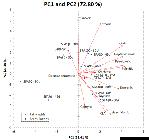
Main Component Analysis (PCA) of the Fatty Acid Profile of Sausage Formulations with Sheep Meat (100, 90, 80, and 70%) from Lambs Fed with Extruded Flaxseed for 30, 45, and 60 days.
The linoleic acid content (C18:2 ω6) did not show an effect from the flaxseed feeding period and the proportion of meat from adult sheep in the sausages. However, significant positive effects of the flaxseed feeding period were observed for linolenic acid (C18:3 ω3) and conjugated linoleic acid - CLA (C18:2C9T11) (Table 2). This indicates that sheep fed diets containing 15% flaxseed for 60 days experienced an increase in linolenic acid (C18:3 ω3) and conjugated linoleic acid - CLA (C18:2C9T11) levels in the product. This trend is also visually apparent in the Principal Component Analysis (PCA) (Figure 1), where the vectors of both fatty acids are situated close to formulations made with sheep meat (80, 90, and 100%) fed flaxseed for 60 days.
Furthermore, a decrease in the ω6/ω3 ratio was observed, falling within the recommended range (4:1), imparting healthier characteristics to the food product. This meets the demands of health-conscious consumers due to the low SFA content and a healthy ω6/ω3 ratio (Mukhametov et al., 2022).
Feeding adult sheep with flaxseed appears to be a promising alternative for the lipid profile of meat. The increased levels of CLA, linolenic acid, and the decreased ω6/ω3 ratio, coupled with a longer flaxseed feeding period, indicate a promising alternative for the production of meats and derived products with higher concentrations of these health-beneficial acids.
Thermal analysis of fresh sausage
Table 3 shows the temperature ranges of stability and final temperature of decomposition of fat for the samples of the formulations by thermogravimetric (TG) analysis. The temperature of stability and decomposition (maximum rate of mass loss) of the fat in the formulations reduced with increasing time of feeding with linseed. This result is due to the lower content of polyunsaturated fatty acids in the formulations after 30 days of flaxseed feeding.
Table 3 shows the melting peaks obtained by differential scanning calorimetry (DSC) of fat samples. The onset and peak temperatures were higher after 30 days compared to 60 days of linseed feeding in the first and second melting peak. A reduction in melting temperatures was also observed with the reduction of sheep fat content in the formulations.
The higher starting and peak temperatures of fat samples from formulations with 30 days of flaxseed feeding can be attributed to a higher percentage of saturated fatty acids in relation to samples from formulations with 60 days, which were shown to contain a higher content of fatty acids unsaturated. Highly saturated fatty acids generally have a higher melting point than unsaturated fatty acids (Sathivel et al., 2008).
Stability and decomposition temperatures of fat samples by thermogravimetric (TG) analysis and temperature values of onset (Tonset) and peak (Tpeak) obtained from melting peaks of fat samples by DSC.
TBARS analysis of fresh sausage
The TBARS values of the mixed fresh sausage formulations over storage time are presented in Figure 2. A positive correlation was observed (p < 0.05), with an increase in TBARS values during the storage period of the formulations. However, the values remained below 0.95 mg malonaldehyde kg-1 on the 21st day of storage.
The first-order kinetic model for lipid oxidation (Table 4) showed that the rate constant (kB) is the same for all mixed fresh sausage formulations. This indicates that different proportions of sheep meat (70 to 100%) and the flaxseed feeding period (30, 45 and 60 days) did not influence lipid oxidation. In other words, the increase in levels of linolenic acid (C18:3 ω3) and conjugated linoleic acid - CLA (C18:2C9T11) did not result in an increase in TBARS levels. Souza et al. (2005) evaluating fresh sausages with sheep meat found values of 1.39 to 1.70 mg malonaldehyde kg-1 of samples.
Wachira et al. (2002) and Berthelot et al. (2012) also observed that feeding linseed to lambs during the post-weaning period significantly increased the proportions of CLA and n-3 PUFA in tissues. Bas et al. (2007) found an increase in the amounts of linoleic acid (3.3 to 3.7 g 100 g-1), linolenic acid (0.51 to 1.15 g 100 g-1) and CLA (0.02 to 0.07 g 100 g-1) in 3-year-old sheep fed linseed. Díaz et al. (2011) evaluated the fatty acid content of lambs fed extruded linseed for 40 days compared to a control diet without linseed and observed an increase in linolenic and linoleic acid when fed with linseed.
It is worth highlighting the reduction of approximately 27% in the ω6/ω3 ratio in sheep meat (Table 1) compared to the control diet (without linseed). Reducing the ω6/ω3 ratio is a major challenge for the development of healthier meat products. Therefore, the Food and Agriculture Organization of the United Nations (FAO/WHO) recommends balanced intake of ω6 and ω3 fatty acids, recommending that the ω6/ω3 ratio in meat is less than 4, thus reducing the risk of health problems (Wood et al., 2004; Lee et al., 2012).
The values of other saturated fatty acids did not show an effect from the variables studied. This result contrasts with that obtained by Peng et al. (2010), who, in analyzing the effect of different oilseeds on the adipose tissue of adult sheep, observed a decrease in palmitic acid (C16:0) from 28.70 to 27.65 g 100 g-1 between the control and animals fed with flaxseed. Palmitic acid (C16:0) is associated with an increase in blood cholesterol, while stearic acid (C18:0) does not have such an effect (Russo et al., 1999; Banskalieva et al., 2000).
Increased ω3 deposition in meat has also been reported in other studies using flaxseed supplementation in the diets of sheep (Doreau et al., 2009; Realini et al., 2017) and pigs (De Tonnac et al., 2017; Jiang et al., 2017). These findings correlate with the lipid profile of flaxseed oil, characterized by its high content of PUFA (45 to 55% of total fatty acids), especially ω3, moderate MUFA, and low SFA.
A reduction in the temperature of fat stability and decomposition was also observed with the reduction in the proportion of sheep meat in the formulations, due to the higher content of saturated fatty acids in adult sheep meat compared to pork used in the mixture (Díaz et al., 2011; Seifdavati & Taghizadeh, 2023).

Lipid oxidation (TBARS) of mixed fresh sausage formulations made with sheep meat fed with linseed for 30 (a), 45 (b) and 60 days (c).
Kinetic parameters of the first-order kinetic model for lipid oxidation behavior (TBARS) in fresh sausages made with meat from sheep fed with linseed for 30, 45 and 60 days.
Conclusion
Feeding adult sheep with 15% flaxseed for up to 60 days increased polyunsaturated fatty acids, especially linolenic and CLA, and reduced the ω6/ω3 ratio to healthier levels in meat and fresh sausages. Thermal analyses (TG and DSC) indicated lower stability and melting temperatures of fats with longer supplementation periods. The variation in the proportion of sheep and pork meat did not affect lipid oxidation, showing that flaxseed inclusion enhances the nutritional value without compromising the product’s stability.
Data availability
Data will be made available on request.
References
- Alamin, S. A.. (2019). A study of sensory evaluation of sausages from beef and sheep meat. International Journal of Scientific Progress and Research, 162(62), 37-43.
-
Alencar, R. T., Vega, W. H. O., Silva, L. N. C. D. A., Costa, H. H. A., Parente, M. O. M., Lima, L. D. D. E. & Landim, A. V.. (2022). Changes on the physicochemical and fatty acid profile of meat induced by inclusion of biscuit bran in lamb diet. Anais da Academia Brasileira de Ciências, 94(4), e20201365. https://doi.org/10.1590/0001-3765202220201365
» https://doi.org/https://doi.org/10.1590/0001-3765202220201365 -
Banskalieva, V., Sahlu, T. & Goetsch, A. L.. (2000). Fatty acid composition of goat muscles and fat depots: a review. Small Ruminant Research, 37(3), 255-268. https://doi.org/10.1016/S0921-4488(00)00128-0
» https://doi.org/https://doi.org/10.1016/S0921-4488(00)00128-0 -
Bas, P., Berthelot, V., Pottier, E. & Normand, J.. (2007). Effect of level of linseed on fatty acid composition of muscles and adipose tissues of lambs with emphasis on trans fatty acids. Meat Science, 77(4), 678-688. https://doi.org/10.1016/j.meatsci.2007.05.022
» https://doi.org/https://doi.org/10.1016/j.meatsci.2007.05.022 -
Berthelot, V., Bas, P., Pottier, E. & Normand, J.. (2012). The effect of maternal linseed supplementation and/or lamb linseed supplementation on muscle and subcutaneous adipose tissue fatty acid composition of indoor lambs. Meat Science, 90(3), 548-557. https://doi.org/10.1016/j.meatsci.2011.09.014
» https://doi.org/https://doi.org/10.1016/j.meatsci.2011.09.014 -
Bligh, E. G. & Dyer, W. J.. (1959). A rapid method of total lipid extraction and purification. Canadian Journal of Biochemistry and Physiology, 37(8), 911-917. https://doi.org/10.1139/o59-099
» https://doi.org/https://doi.org/10.1139/o59-099 -
Bordoni, L., Zec, M., Naumovski, N. & Sergi, D.. (2023). Editorial: The role of dietary fatty acids in metabolic health. Frontiers in Physiology, 14(1), 1-3. https://doi.org/10.3389/fphys.2023.1211151
» https://doi.org/https://doi.org/10.3389/fphys.2023.1211151 -
De Tonnac, A., Karim-Luisset, S. & Mourot, J.. (2017). Effect of different dietary linseed sources on fatty acid composition in pig tissues. Livestock Science, 203(1), 124-131. https://doi.org/10.1016/j.livsci.2017.03.022
» https://doi.org/https://doi.org/10.1016/j.livsci.2017.03.022 -
Díaz, M. T., Cañeque, V., Sánchez, C. I., Lauzurica, S., Pérez, C., Fernández, C. & De la Fuente, J.. (2011). Nutritional and sensory aspects of light lamb meat enriched in n−3 fatty acids during refrigerated storage. Food Chemistry, 124(1), 147-155. https://doi.org/10.1016/j.foodchem.2010.05.117
» https://doi.org/https://doi.org/10.1016/j.foodchem.2010.05.117 -
Doreau, M., Aurousseau, E. & Martin, C.. (2009). Effects of linseed lipids fed as rolled seeds, extruded seeds or oil on organic matter and crude protein digestion in cows. Animal Feed Science and Technology, 150(3), 187-196. https://doi.org/10.1016/j.anifeedsci.2008.09.004
» https://doi.org/https://doi.org/10.1016/j.anifeedsci.2008.09.004 -
Fu, Y., Cao, S., Yang, L. & Li, Z.. (2022). Flavor formation based on lipid in meat and meat products: a review. Journal of Food Biochemistry, 46(12), e14439. https://doi.org/10.1111/jfbc.14439
» https://doi.org/https://doi.org/10.1111/jfbc.14439 - Hartman, L. & Lago, R. C.. (1973). Rapid preparation of fatty acid methyl esters from lipids. Laboratory Practice, 22(6), 475-476.
-
Iswoyo, S & Setyawardani, T.. (2023). Physical characteristics of emulsion-type sausage from lamb meat with varying fat levels. IOP Conference Series: Earth and Environmental Science, 1177(1), 12034. https://doi.org/10.1088/1755-1315/1177/1/012034
» https://doi.org/https://doi.org/10.1088/1755-1315/1177/1/012034 -
Jiang, J., Tang, X., Xue, Y., Lin, G. & Xiong, Y. L.. (2017). Dietary linseed oil supplemented with organic selenium improved the fatty acid nutritional profile, muscular selenium deposition, water retention, and tenderness of fresh pork. Meat Science, 131(1), 99-106. https://doi.org/10.1016/j.meatsci.2017.03.014
» https://doi.org/https://doi.org/10.1016/j.meatsci.2017.03.014 -
Kouba, M. & Mourot, J.. (2011). A review of nutritional effects on fat composition of animal products with special emphasis on n-3 polyunsaturated fatty acids. Biochimie, 93(1), 13-17. https://doi.org/10.1016/j.biochi.2010.02.027
» https://doi.org/https://doi.org/10.1016/j.biochi.2010.02.027 -
Kris-Etherton, P. M. & Krauss, R. M.. (2020). Public health guidelines should recommend reducing saturated fat consumption as much as possible: YES. The American Journal of Clinical Nutrition, 112(1), 13-18. https://doi.org/10.1093/ajcn/nqaa110
» https://doi.org/https://doi.org/10.1093/ajcn/nqaa110 -
Lee, S. P. S., Dart, A. M., Walker, K. Z., Dea, K., Chin-Dusting, J. P. F. & Skilton, M. R.. (2012). Effect of altering dietary n-6:n-3 PUFA ratio on cardiovascular risk measures in patients treated with statins: a pilot study. British Journal of Nutrition, 108(7), 1280-1285. https://doi.org/10.1017/S0007114511006519
» https://doi.org/https://doi.org/10.1017/S0007114511006519 -
Lima, T. L. S., Costa, G. F., Cruz, G. R. B., Ribeiro, N. L., Filho, E. M. B., Domínguez, R. & Lorenzo, J. M.. (2021). Pre-emulsioned linseed oil as animal fat replacement in sheep meat sausages: Microstructure and physicochemical properties. Journal of Food Processing and Preservation, 45(1), e15051. https://doi.org/10.1111/jfpp.15051
» https://doi.org/https://doi.org/10.1111/jfpp.15051 -
Mukhametov, A., Yerbulekova, M., Aitkhozhayeva, G., Tuyakova, G. & Dautkanova, D.. (2022). Effects of ω-3 fatty acids and ratio of ω-3/ω-6 for health promotion and disease prevention. Food Science and Technology, 42(1), e58321. https://doi.org/10.1590/fst.58321
» https://doi.org/https://doi.org/10.1590/fst.58321 -
Peng, Y. S., Brown, M. A., Wu, J. P. & Liu, Z.. (2010). Different oilseed supplements alter fatty acid composition of different adipose tissues of adult ewes. Meat Science, 85(3), 542-549. https://doi.org/10.1016/j.meatsci.2010.03.003
» https://doi.org/https://doi.org/10.1016/j.meatsci.2010.03.003 -
Raharjo, S., Sofos, J. N. & Schmidt, G. R.. (1992). Improved speed, specificity, and limit of determination of an aqueous acid extraction thiobarbituric acid-C18 method for measuring lipid peroxidation in beef. Journal of Agricultural and Food Chemistry, 40(11), 2182-2185. https://doi.org/10.1021/jf00023a027
» https://doi.org/https://doi.org/10.1021/jf00023a027 -
Realini, C. E., Bianchi, G., Bentancur, O. & Garibotto, G.. (2017). Effect of supplementation with linseed or a blend of aromatic spices and time on feed on fatty acid composition, meat quality and consumer liking of meat from lambs fed dehydrated alfalfa or corn. Meat Science, 127(1), 21-29. https://doi.org/10.1016/j.meatsci.2016.12.013
» https://doi.org/https://doi.org/10.1016/j.meatsci.2016.12.013 -
Russo, C., Preziuso, G., Casarosa, L., Campodoni, G. & Cianci, D.. (1999). Effect of diet energy source on the chemical-physical characteristics of meat and depot fat of lambs carcasses. Small Ruminant Research, 33(1), 77-85. https://doi.org/10.1016/S0921-4488(98)00200-4
» https://doi.org/https://doi.org/10.1016/S0921-4488(98)00200-4 -
Sathivel, S., Prinyawiwatkul, W., Negulescu, I. I. & King, J. M.. (2008). Determination of melting points, specific heat capacity and enthalpy of catfish visceral oil during the purification process. Journal of the American Oil Chemists’ Society, 85(3), 291-296. https://doi.org/10.1007/s11746-007-1191-9
» https://doi.org/https://doi.org/10.1007/s11746-007-1191-9 -
Seifdavati, J. & Taghizadeh, A.. (2023). Fatty acid composition of meat from lambs fed diets containing moist-heat treated legume grains. African Journal of Food Science Research, 11(1), 1-8. https://doi.org/10.46882/AJFSR/1153
» https://doi.org/https://doi.org/10.46882/AJFSR/1153 - Souza, H. B. A., Silva-Sobrinho, A. G., Zeola, N. M. B. L., Pelicano, E. R. L., Souza, P. A., Leonel, F. R., Oba, A. & Lima, T. M. A.. (2005). Avaliação de diferentes teores de gordura e antioxidante natural nos parametros qualitativos e sensoriais de embutido fresco de carne ovina. ARS Veterinaria, 21(3), 315-319.
- StatSoft, Inc.. (1995). Statistica (data analysis software system), version 5. 0. StatSoft, Inc.
-
Teixeira, A., Silva, S., Guedes, C. & Rodrigues, S.. (2020). Sheep and goat meat processed products quality: a review. Foods, 9(7), 960. https://doi.org/10.3390/foods9070960
» https://doi.org/https://doi.org/10.3390/foods9070960 -
Tibaoui, S., Smeti, S., Essid, I., Bertolín, J. R., Joy, M. & Atti, N.. (2020). Physicochemical characteristics, fatty acid profile, alpha-tocopherol content, and lipid oxidation of meat from ewes fed different levels of distilled myrtle residues. Molecules, 25(21), 4975. https://doi.org/10.3390/molecules25214975
» https://doi.org/https://doi.org/10.3390/molecules25214975 -
Wachira, A. M., Sinclair, L. A., Wilkinson, R. G., Enser, M., Wood, J. D. & Fisher, A. V.. (2002). Effects of dietary fat source and breed on the carcass composition, n-3 polyunsaturated fatty acid and conjugated linoleic acid content of sheep meat and adipose tissue. British Journal of Nutrition, 88(6), 697-709. https://doi.org/10.1079/BJN2002727
» https://doi.org/https://doi.org/10.1079/BJN2002727 -
Wang, B., Pace, R. D., Dessai, A. P., Bovell-Benjamin, A. & Phillips, B.. (2002). Modified extraction method for determining 2-thiobarbituric acid values in meat with increased specificity and simplicity. Journal of Food Science, 67(8), 2833-2836. https://doi.org/10.1111/j.1365-2621.2002.tb08824.x
» https://doi.org/https://doi.org/10.1111/j.1365-2621.2002.tb08824.x -
Wood, J. D., Richardson, R. I., Nute, G. R., Fisher, A. V, Campo, M. M., Kasapidou, E., Sheard, P. R. & Enser, M.. (2004). Effects of fatty acids on meat quality: a review. Meat Science, 66(1), 21-32. https://doi.org/10.1016/S0309-1740(03)00022-6
» https://doi.org/https://doi.org/10.1016/S0309-1740(03)00022-6


