 Assessment of Roadsides Polluted with Heavy Metals in Mosul City, Iraq
ABSTRACT.
A major challenge in soil pollution research is the accumulation of heavy metals from human activities, which threatens environmental integrity and public health. Transport vehicles contribute significantly to metallic particles, such as nickel and cadmium, from the wear and tear of brakes and tires. The study aimed to determine the content of heavy metals in the roadside soils of crowded roads in Mosul city. The study was conducted on 51 roadside soil samples collected from seventeen crowded roads. The samples analyzed by X-ray fluorescence spectrometer. The contamination and level of pollution risk were assessed using the contamination factor, pollution load index, ecological risk, potential risk index, and the degree of contamination. The results of the study revealed that the mean of heavy metals was 2.60, 0.20, 25.87, 36.40, 125.57, 113.05, 8.36, and 5.81 ppm for Pb, Cd, Zn, Cu, Ni, Cr, Co, and As, respectively. The contamination factor values were within no pollution and moderate pollution levels for the majority of elements except Ni, which was within very high pollution levels in some sites, which led to a rise in the degree of contamination. A low risk level was recorded by calculating the potential ecological risk index because the individual ecological risk factor had a low value at all sites. The pollution load index values at all sites were within the pollution level, except for two.
Keywords:
Contamination factor; Degree of contamination; Potential risk index
Introduction
The increasing advancement civilization has given rise to significant environmental pollution (Zhao & Jin, 2021; Hu et al., 2023). Many sectors, including industry, agriculture, and road transportation, stand out as primary contributors to the pollution of heavy metals in urban environments (Goya-Heredia et al., 2023). Heavy metals are persistent and it is difficult to be destroyed or degraded (Majeed & Ibraheem, 2024). High concentrations of metalloids and heavy metals have the potential to harm humans and other species by influencing food chains because of their ability to remain and accumulate biologically in food crop plants (Priya et al., 2023). Research has demonstrated a substantial correlation between exhaust emissions and the adverse health impacts of people living close to roads (Ajayi et al., 2023). Heavy metals have been identified as the most harmful pollutants and possible carcinogens because they are non-degradable; thus, humans may be exposed to heavy metals through ingestion, inhalation, or skin contact, which may have both carcinogenic and non-carcinogenic consequences (He et al., 2021). Recently, the exponential increase in the number of automobiles has been closely linked to increased heavy metal contamination of soil and groundwater and the emission of numerous amounts of chemical substances caused by fuel combustion into the atmosphere, such as hydrocarbon particles, CO, NOx, and VOCs (Usmanova et al., 2021). Chemical substances resulting from vehicles, such as particulate matter (PM10, PM2.5), CO, NOx, and VOCs, may enter the human body and cause diseases such as cancer, vascular diseases, and respiratory system diseases (Usmanova et al., 2021; Al-Afify & Abdel-Satar, 2022). Pollution stemming from road transportation identified as a major environmental risk factor associated with global premature mortality (Villaveces Sanhueza et al., 2020; Malta et al., 2023). Despite widespread common misconceptions attributing air pollution solely to incomplete fuel combustion, it is essential to acknowledge that the primary sources of these emissions are non-combustion particle emissions, which are produced by the scraping of discs and clutch pads, tire wear, road surface deterioration, and abrasion of vehicle parts (Jin et al., 2021; Kuklová et al., 2022). Due to processes of adsorption that affect the binding of organic and inorganic pollutants, soil is considered a pollutants repository (Alvarenga, 2022; Guagliardi et al., 2022). The factors that determine the heavy metal content in soils are type of soil (Li et al., 2023), climate (Paltseva & Neaman, 2020), anthropogenic activity (Anaman et al., 2022), atmospheric conditions (such as wind and type of precipitation), (Weber et al., 2020), topographical characteristics, and vegetation presence (Leventeli & Yalcin, 2021). The atmospheric dust produced from the top layer of roadside soil in crowded cities is considered to be contaminated with heavy metals (Newaz et al., 2021). Significant amounts of heavy metals such as nickel, chromium, zinc, copper, lead, and cadmium release from lubricating oils, brake pads, tire wear, combustion of fuel, corrosion car parts, chrome accessories and entering the environment (Skorbiłowicz et al., 2021). There are certain pollution indices which are mathematical models used for the calculation of large amounts of data to evaluate the probable dangers resulted by exposure to heavy metals (Ahirvar et al., 2023). Many studies utilize pollution indices to calculate the amount of heavy metal pollution in soils and water, such as Hoque et al. (2023); Su et al. (2023). Due to the continuous increase in the number of vehicles in the city and the absence of studies on the concentration of heavy metals in the city's roadside soils, this study can take into account the unique reference, accuracy, and reliability of the heavy metal content in the roadside soils of Mosul, offering important information in assessing heavy metal values in the city. The study aims in measuring the concentration of heavy metals in roadside soils that lie on the crowded roads within Mosul city, and to obtain a general environmental perspective about the influence of vehicles emissions on roadside soils within the city using some pollution indices such as contamination factor, degree of contamination, ecological risk, potential ecological risk index, and pollution load index. Furthermore, this study is considered as a novel intimation in the city to discover how automobiles affect the level of heavy metals in roadside soils; thus, this study is a reference for future studies conducted in this field.
Material and methods
Study area
Mosul is the second-biggest city in Iraq. It is located in the north of the Iraqi capital (Baghdad), approximately 400 km away, and it is an important commercial center in Iraq. It is located between 41°10′21′′-43°42′50′′ longitude and, 37°06′3.5′′-34°52′25′′ latitude with a rise of 223 meter above sea level (masl), The Tigris River divides Mosul city into right and left banks. The topography of the city is predominantly flat, with some tops, slops, and valleys that were exploited to design the city. The general climates in the city range from semi-arid to dry, with Mediterranean climates Sometimes, temperatures range from cool to cold in the winter, while summer temperatures often range from hot to very hot (more than 45 °C). Over 90% of the precipitation falls between November and April of each year, with an average of 365 mm of rainfall (Faisal & Abdaki, 2021). It has five bridges, a large number of factories, including those that produce cement and textiles, various markets, and transportation lines that connect to Syria and Turkey. Recently, the city population has grown, and its urban area has expanded. Statistics indicate that more than 1700000 people live in the city (Al-Jawadi et al., 2022; Abdaki et al., 2024). A sharp rise in the number of imported cars from various manufacturers (more than 730000 vehicles in the city) (Al-Jawadi et al., 2022). The majority of these cars run on leaded petrol. Since highways are vital components of the city's infrastructure, they are crucial for promoting both social and economic activity. Nothing was done to upgrade these roads or make them more capable of handling the significant rise in the number of cars on the route. This resulted in congested roads and traffic jams, which eventually caused significant environmental damage. The dust, soil, and plants around highways became more and more contaminated with various heavy metals in both rural and urban locations. 17 crowded roads were chosen for sampling for the evaluation of heavy metal concentration levels within the city's roadside soils.
Soil sampling and preparation
The study included conducting a field survey of the selected main roads in Mosul city to select the sites using the Global Positioning System (GPS) version (Garmin GPS Map 60 CSX). The study was conducted on fifty-one soil samples collected from seventeen sites (30 samples from the left bank and 21 samples from the right bank) during three months, starting from June 2021 until September 2021, and the distance between one site and another was approximately 2-3 km. The number of samples was collected from sites shown in (Figure 1) after being determined at a distance of 1-3 m and with of 0-10 cm in depth, starting from road edges. Three replications of samples were collected from each site using a stainless-steel hand-driven auger. The storage of samples was in polyethylene bags after recording the information and notes on each polyethylene bag. Also, the samples were air-dried, removing coarse particles, gravel, and plant residues by passing through a sieve of 2 mm, and taken to the laboratory (Korzeniowska, 2022). Soil samples analyzed according to Briffa et al. (2022) using an X-ray fluorescence spectrometer (Genuis9000 Handheld).

Pollution assessment
Many indices and methods are employed to provide a thorough evaluation of roadside soil contaminated with heavy metals. The contamination factor, pollutant load index, ecological risk, degree of contamination, and ecological risk index are the most commonly used indices. The indices calculated depending on the background of heavy metal content that naturally occur in soils (Al-Obeidi & Al-Jumaily, 2020). The utilization of background data in the computation has a great effect on the evaluation of heavy metals in roadside soil using pollution indices (Xia et al., 2022). Contamination factor applied to single pollutants that represent contamination level for each heavy metal. Ecological risk and Pollution load index used to evaluate cumulative impacts of different contaminations on the environment and associate them, as well as to express their ecological risk. Degree of contamination used to measure the soil quality according to its degree of pollution. The ecological risk factor and the potential ecological risk index of pollutants are described by a risk index (Dytłow & Górka-Kostrubiec, 2021). Therefore, we selected these indices because they are easy to calculate and understand and can be compared to cases around the world.
Contamination factor (CF)
The contamination factor is the ratio of a heavy metal's concentration in a roadside soil sample to the soil's background level of that same heavy metal. (CF) is calculated as in the following equation:
CFi = Ci/Si (1)
where Ci is the concentration of heavy metal in the roadside soil and Si is the background heavy metal value in uncontaminated soil (standard value), the standard value in this study was obtained from previously published (Al-Obeidi & Al-Jumaily, 2020). The pollution according to contamination factor (CF) is classified into four levels: CF < 1, no pollution; 1 ≤ CF < 3, moderate pollution; 3 ≤ CF ≤ 6, considerable pollution; and CF > 6, very high pollution, these levels proposed by Hakanson (1980).
Pollution load index (PLI)
The pollution load index provides a notion of the accumulated metal load from the total of heavy metals on site. It is defined as the nth root of the CF multiplication of metals at the same site. The PLI index was calculated from:
PLI= (2)
|where CF refers for the heavy metal contamination factor. According to Bhutiani et al. (2017), PLI was divided into four categories: PLI < 1, no pollution; 1 < PLI < 2, moderate pollution; 2 < PLI < 3, heavy pollution; and 3 < PLI, very heavy pollution.
Ecological risk (Er)
Quantitative expression of the potential ecological risk associated with a certain contaminant in a specific region. It is calculated by multiplying the toxicity of heavy metals in the environment by their contamination factor. The following equation used to calculate the Er value:
Er = CF × Tr (3)
where CF refers to the contamination factor of metal, while Tr represents the level of metal toxicity in the environment. The Tr values for (Pb), (Cd), (Zn), (Cu), (Ni), (Cr), (Co), and (As) are 5, 30, 1, 5, 5, 2, 5, and 10 respectively (Li et al., 2023). Er falls into one of the following categories, according to Tamanna et al. (2023) the categories of Er are; Er < 40, low ecological risk; 40 < Er < 80, moderate ecological risk; 80 < Er < 160, considerable ecological risk; 160 < Er < 320, high ecological risk, and Er > 320, severe ecological risk.
Risk Index (RI)
Used to determine the combination between the contamination factor and the potential ecological risk index values of the heavy metals. The formula of RI is:
RI = ∑Er (4)
where Er is ecological risk factor of metals. There are five different ranks for the RI values; RI < 150, low ecological risk; 150 < RI < 300, moderate ecological risk; 300 < RI < 600, considerable ecological risk, and RI > 600, very high ecological risk (Hakanson, 1980; Miranzadeh Mahabadi et al., 2020).
Degree of Contamination (C d )
Degree of contamination refers to the environmental case (measure soil quality in this study).
The following formula is used to calculate C d value:
Cd = ∑CF (5)
where CF refers to the metal contamination factor. The C d classified to four groups: C d <6, low degree of contamination; 6 ≤ C d < 12, moderate degree of contamination; 12 ≤ C d < 24, considerable degree of contamination; and C d ≥ 24, very high degree of contamination (Sahoo & Sahu, 2022).
Statistical analysis
A thorough analysis was conducted for the data obtained from the roadside soils using simple descriptive statistical analysis. The mean metal concentrations were calculated for every soil sample that was collected from the chosen roads (Leventeli & Yalcin, 2021). Furthermore, columns were employed to represent the metal levels at various sampling locations as well as the average concentration of heavy metals on all roads. The coefficient of variation (CV%) and standard deviation (SD) were employed to evaluate significant differences in accumulation of heavy metals for different sampling points and roads. Additionally, Pearson’s correlation was employed to explore the relationships among the metals under investigation. All statistical tests were conducted at significance levels of p < 0.05. Statistical program (SPSS) version 25 was used to analyze the results.
Results and discussion
Heavy metal concentrations
The heavy metal concentrations for every site of sampling found in roadside soils in the present study are displayed in (Table 1). The concentration ranges of heavy metals in roadside are as follows: Pb: 0.96 - 6.60 ppm; Cd: 0.09 - 0.38 ppm; Zn: 5.66 - 90.73 ppm; Cu: 13.40 - 55.63 ppm; Ni: 46.62 - 203.66 ppm; Cr: 69.90 - 202.33 ppm; Co: 5.82 - 14.01 ppm and As: 0 - 12.74 ppm. Mean concentration of the metals were Pb: 2.606 ppm; Cd: 0.201 ppm; Zn: 25.878 ppm; Cu: 36.402 ppm; Ni: 125.579 ppm; Cr: 113.054 ppm; Co: 8.366 ppm; and As: 5.818 ppm. Considering the following order of the metals in this region, from higher to lower mean content: Ni > Cr > Cu > Zn > Co > As > Pb > Cd.
Descriptive statistics and comparisons between the studied sites
Table 1 shows the coefficient of variation clarifies the degree of variance in heavy metal content between sampling locations. The only two heavy metals (Zn and As) have the highest coefficient of variation (more than 75%). On contrary, the concentrations of four heavy metals (Ni, Cr, Cu, and Co) show a constant pattern within the research locations, staying within the limited range of 29% to 33%. Interestingly, Pb and Cd show a degree of variability between the two groups mentioned, with coefficients of variation ranging from 51% to 56%. This emphasizes a unique pattern in the distribution of heavy metals throughout the studied areas, emphasizing the intricate nature of their spatial concentrations.
The heavy metal values (ppm) and the results of descriptive statistics at the studied sites.
Correlation of heavy metals in study sites
The Pearson correlation coefficient was applied to generate the correlation matrix for the heavy metals samples, as shown in Table 2. The results revealed a negative correlation between Pb and Cd, with a value of -0.216, while the relationship between Pb and Zn had a statistically insignificant correlation at a p-value greater than 5%. Additionally, positive correlations were identified between Cu and Pb (0.415) and between Cr and Pb (0.275). Furthermore, a strong negative correlation was observed between Pb and As, with a value of -0.591. Concerning the relationships among the other elements, negative correlations were detected between Cd and Zn, Cu, and Co, whereas positive correlations were observed between Zn and Cu, Cr, and Ni. Similarly, positive correlations were observed between Cu and Ni, Cr, and Co, as well as between Ni, Cr, and Co. These results demonstrate that the heavy metals in the investigated samples had a statistically significant correlation with one another, which can be utilized to comprehend the interactions between these elements and their potential impacts on the ecosystem.
Assessment of contamination factors (CF) and degree of contamination (C d )
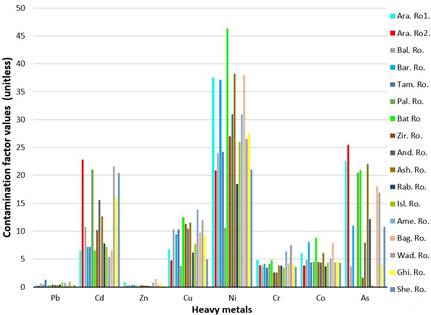
The (CF) is used to calculate the enrichment degree for each metal during a given time period. (Table 3; Figure 2) show (CF) values for all the heavy metals in each site and can be organized as follows: Pb ranged from 0.038 to 0.264, Cd ranged from 0.18 to 0.76, Zn ranged from 0.089 to 1.44, Cu ranged from 0.76 to 2.781, Ni ranged from 2.119 to 9.257, Cr ranged from 1.294 to 3.746, Co ranged from 0.736 to 1.773, and As ranged from 0 to 2.548. In addition, it can be observed that more than 52.2% of (CF) values fall into the no pollution range, and 34.5% of CF values fall into the moderate pollution range, 7.3% fall into considerable pollution except (CF) of Ni values, which fall within the very high pollution range in some sites and represent only 5% of all studied sites. According to the average (CF) values, the following sequence can be seen in the Table 4: Ni > Cr > Cu > As > Co > Zn > Cd > Pb. Kaur et al. (2022) demonstrated how the content of heavy metals in the research area is influenced by transportation media, with very high levels of contamination factor reaching 9 at the Buddha Nullah region in Ludhiana, Punjab, India. Furthermore, in relation to vehicle emissions to roadside soils, Skorbiłowicz et al. (2021) found very high values in (CF) of investigated heavy metals at Białystok-Budzisko Route in Northeastern Poland. (C d ) values for heavy metals displayed that the studied sites were divided into two categories: moderate and considerable contamination (Table 4; Figure 3). The values were 15.89, 11.395, 14.768, 10.322, 8.837, 18.504, 10.805, 12.096, 16.081, 9.353, 10.038, 14.299, 16.774, 15.318, 11.897, and 9.779 for sites Ara. Ro1., Ara. Ro2., Bal. Ro., Bar. Ro., Tam. Ro., Pal. Ro., Bat. Ro., Zir. Ro., And. Ro., Ash. Ro., Rab. Ro., Isl. Ro., Ame. Ro., Bag. Ro., Wad. Ro., Ghi. Ro., and She. Ro., respectively. The results agree with Abou El-Anwar (2019), through his study on the soil of Upper Egypt, recorded high levels of (C d ) index because increasing (CF) of heavy metal concentrations. Emenike et al. (2019) reported that due to the discharge of heavy metals from car parts into the roadside soils, the heavy metals pollution index in roadside dust at Ado-Odo Ota, Southwest Nigeria, is moderate. Conversely, Kumar et al. (2019) showed that heavy metals values of roadside soils in the region of Punjab, India, recorded a low degree of pollution (C d < 6). We can draw the conclusion that the (C d ) increased as a result of a rise in the (CF) of heavy metal.

Contamination factors (CF) and degrees of contamination (C d ) of metals at the studied sites.

Assessment of ecological risk (Er)
The ecological risk index of heavy metals is calculated using Er indicators, helping in evaluating the danger of heavy metal pollution and associated hazards in the areas under study.
Ecological risk factor (Er)
According to Table 5, (Er) values of heavy metals are classified as low ecological risk because the average Er values of metals were less than 40 in all the studied sites. The average of Er values for lead, cadmium, zinc, copper, nickel, chromium, cobalt, and arsenic were 0.519, 12.105, 0.41, 9.126, 28.538, 4.186, 5.292, and 11.649, respectively. The following sequence: Zn ˂ Pb ˂ Cr ˂ Co ˂ Cu ˂ As ˂ Cd ˂ Ni as demonstrated in (Table 5; Figure 4) The obtained results show that greatest significant ecological risk in roadside soils at Mosul city is nickel, ranging from 10.595-46.285, while zinc has the lowest ecological risk, ranging from 0.089-1.44. Duan et al. (2024) obtained a similar result during their study of the roadside soils of intercity railway at Huanghuai Plain, China. They found that (Er) values for all investigated heavy metals were low, except for Cd, which was high. Yu et al. (2021) also reported low (Er) for all studied heavy metals except Cd in the roadside of Guizhou, China.
Potential ecological risk index (RI)
The (RI) values were 85.613, 82.076, 58.378, 77.754, 51.16, 65.051, 100.51, 58.152, 72.536, 95.006, 52.803, 50.257, 63.211, 86.277, 90.288, 66.513, and 65.515 in sites Ara. Ro1., Ara. Ro2., Bal. Ro., Bar. Ro., Tam. Ro., Pal. Ro., Bat. Ro., Zir. Ro., And. Ro., Ash. Ro., Rab. Ro., Isl. Ro., Ame. Ro., Bag. Ro. Wad. Ro., Ghi. Ro., and She. Ro., respectively. All studied areas were at low-risk index level because (RI) values less than 150 (Table 5). The result agree with Sulaiman et al. (2018) mentioned that (RI) values of metals in roadside soils lie within a low risk index range of 19.706 - 103.487 at Gombe Traffic Circles, Northern Nigeria. In addition, Agbaje et al. (2023) showed similar results in assessing heavy metals in roadside soils at Osogbo Metropolis, South West Nigeria, (RI) values of heavy metals were at a low ecological risk index level. In contrast, Movafagh et al. (2018) indicate considerable (RI) values of heavy metals in roadside beside Hemmat highway in Tehran, Iran; the values of metals were more than 300. We can conclude that the rising of (RI) levels are associated with rising of (Er) for heavy metals.
Assessment of pollution load index (PLI)
An assessment of the level of heavy metal pollution at each of the seventeen sites was conducted using (PLI) in order to compare them effectively at the contamination level, (PLI) were 0.979, 0.732, 0.754, 0.872, 0, 0.673, 0.941, 0.629, 0.755, 0.97, 0.659, 0.5, 0, 1.095, 1.181, 0.834, and 0.64 in sites Ara. Ro1., Ara. Ro2., Bal. Ro., Bar. Ro., Tam. Ro., Pal. Ro., Bat. Ro., Zir. Ro., And. Ro., Ash. Ro., Rab. Ro., Isl. Ro., Ame. Ro., Bag. Ro., Wad. Ro., Ghi. Ro., and She. Ro., respectively. All studied sites except two (Bag. Ro. and Wad. Ro.) were categorized as having uncontaminated because PLI values were less than 1 (Table 6). Similar to this result, Negahban & Mokarram (2021) reported that the (PLI) values of investigated heavy metals in roadside collected from locations along the Darb-Fasa Road in the southern province of Fars, Iran, was classified as uncontaminated except for two sites. In addition, in the municipality of Bangladesh, Diganta et al. (2020) showed that the value of (PLI) in the studied sites was uncontaminated. Conversely, Dibert et al. (2019) discovered that (PLI) of heavy metals was very high in dust collected from the roadside in Abidjan city, Côte d'Ivoire.

Conclusion
The current study, which uses both single and integrated pollution indicators, shows how the roadside soils of Mosul city polluted with heavy metals. The results demonstrated that the pollution index values of single heavy metals such as (CF) were within no pollution and moderate pollution levels for the majority of elements except Ni, which exceeded very high pollution levels. Whereas. The values of (C d ) were within a moderate and considerable degree level because of the cumulative impact of the heavy metals. In risk assessment, the values of (RI) in all studied sites were within the low risk level, associated with the individual ecological risk index (Er) that recorded the low values for all metals. The values of (PLI) were within the range of the pollution level in all sites except two. Additionally, I can conclude that individual metal contamination status provides the status of soil contamination, whether high, moderate, or low. Furthermore, the result demonstrates that the cumulative influence of metals from transportation activities on roadside soils caused an elevation in the levels of both single and integrated pollution indices. Generally, the ecological perspective of roadside soils within Mosul city was at a non-effected and acceptable level.
Data availability
All data generated and analyzed in this study are included in the body of the article. No additional data are available.
References
- Abdaki, M., Alobaydy, O., Al-Samman, S. & Ahmed, H. (2024). Spatiotemporal analysis of extreme climate indices in Nineveh Governorate, northern Iraq: Four decades study from 1981 to 2022 using NASA-Power dataset. Modeling Earth Systems and Environment, 10(4), 5553-5572.
- Abou El-Anwar, E. A. (2019). Assessment of heavy metal pollution in soil and bottom sediment of Upper Egypt: Comparison study. Bulletin of the National Research Centre, 43, 1-11.
- Agbaje, W. B., Fakunle, M. A., Azeez, L. A., Olabode, O. A. & Akintade, O. O. (2023). Road construction and vehicular activities as indicators for heavy metal pollution in Osogbo metropolis, South West Nigeria. Suan Sunandha Sci Technol J, 10(1), 92-104.
- Ahirvar, B. P., Das, P., Srivastava, V. & Kumar, M.. (2023). Perspectives of heavy metal pollution indices for soil, sediment, and water pollution evaluation: An insight. Total Environment Research Themes, 6, 100039.
- Ajayi, S. A., Adams, C. A., Dumedah, G., Adebanji, O. A., Ababio-Donkor, A., Ackaah, W. & Kehinde, A. (2023). Public perceptions of vehicular traffic emissions on health risk in Lagos metropolis Nigeria: A critical survey. Heliyon, 9(5).
- Al-Afify, A. D. G. & Abdel-Satar, A. M.. (2022). Heavy metal contamination of the River Nile environment, Rosetta branch, Egypt. Water, Air, & Soil Pollution, 233(8), 302.
- Al-Jawadi, A. S., Ali, S. H. & Adeeb, H. G. M.. (2022). Engineering investigation of the geological problems for Old Mosul City by remote sensing and GIS. IOP Conference Series: Earth and Environmental Science, 1080(1), 12018.
- Al-Obeidi, A. H. & Al-Jumaily, H. A. A. (2020). Geochemistry and environmental assessment of heavy metals in surface soil in Al-Hawija, southwest Kirkuk. The Iraqi Geological Journal, 36-61.
- Alvarenga, P. (2022). Soil pollution assessment and sustainable remediation strategies. In Environments, 9(4), p. 46. MDPI.
- Anaman, R., Peng, C., Jiang, Z., Liu, X., Zhou, Z., Guo, Z. & Xiao, X.. (2022). 1 Identifying sources and transport routes of heavy metals in soil with different land uses around a smelting site by GIS based PCA and PMF. Science of the Total Environment, 823, 153759.
- Bhutiani, R., Kulkarni, D. B., Khanna, D. R. & Gautam, A. (2017). Geochemical distribution and environmental risk assessment of heavy metals in groundwater of an industrial area and its surroundings, Haridwar, India. Energy, Ecology and Environment, 2, 155-167.
- Briffa, J., Blundell, R., Sinagra, E. & Grech, J. (2022). Validation of X-ray fluorescence spectrometer technique to determine heavy metal concentrations in soil samples. Global Journals Inc.
- Dibert, K. L., Goffri, M. C. K., Ofosu, F. G. & Nuviadenu, C. K. (2019). Heavy metal concentrations in road dust in Abidjan, Côte d’Ivoire. Research Journal of Environmental and Earth Sciences, 11(2), 14-18.
- Diganta, M. T. M., Sharmi, T. T., Saifullah, A. S. M., Uddin, M. J. & Sajib, A. M. (2020). Appraisal of heavy metal contamination in road dust and human health risk in a municipality of Bangladesh. Environmental Engineering & Management Journal (EEMJ), 19(12).
- Duan, H., Peng, C., Liu, Y., Guo, C., Wang, Y. & Wang, Y. (2024). Spatial distribution, risk assessment and sources of heavy metals in roadside soils exposed to the Zhengzhou-Kaifeng intercity railway in Huanghuai Plain, China. Soil and Sediment Contamination: An International Journal, 1-22.
- Dytłow, S. & Górka-Kostrubiec, B. (2021). Concentration of heavy metals in street dust: An implication of using different geochemical background data in estimating the level of heavy metal pollution. Environmental Geochemistry and Health, 43, 521-535.
- Emenike, C. P., Okwuonu, E. J., Tenebe, I. T., Omole, D. O., Nwani, M., Afolayan, O. D. & Oniemayin, B. I.. (2019). Ecological risk estimation of heavy metal pollution in roadside dust of Ado-Odo Ota, Southwestern Nigeria. IOP Conference Series: Materials Science and Engineering, 640(1), 12100.
- Faisal, R. M. & Abdaki, M. (2021). Multi-criteria analysis for selecting suitable sites of water harvesting in northern Al Tharthar watershed. J. Sustain. Sci. Manag, 16, 218-236.
- Goya-Heredia, A. V., Zafra-Mejía, C. A. & Rondón-Quintana, H. A.. (2023). Spatial analysis of heavy metal pollution in road-deposited sediments based on the traffic intensity of a megacity. Atmosphere, 14(6), 1033.
- Guagliardi, I., Astel, A. M. & Cicchella, D.. (2022). Exploring soil pollution patterns using self-organizing maps. Toxics, 10(8), 416.
- Hakanson, L. (1980). 2 An ecological risk index for aquatic pollution control. A sedimentological approach. Water Research, 14(8), 975-1001.
- He, Y., Zhang, Y., Peng, C., Wan, X., Guo, Z. & Xiao, X.. (2021). Distribution characteristics and risk assessment of heavy metals in soil and street dust with different land uses, a case in Changsha, China. International Journal of Environmental Research and Public Health, 18(20), 10733.
- Hoque, M. M., Islam, A., Islam, A. R. M. T., Pal, S. C., Mahammad, S. & Alam, E.. (2023). Assessment of soil heavy metal pollution and associated ecological risk of agriculture dominated mid-channel bars in a subtropical river basin. Scientific Reports, 13(1), 11104.
- Hu, J., Wu, Y., Irfan, M., & Hu, M. (2023). Has the ecological civilization pilot promoted the transformation of industrial structure in China? Ecological Indicators, 155, 111053.
- Jin, R., Zheng, M., Yang, L., Zhang, Q., Fu, J., Yang, R., Liu, Q., Shi, J., Liu, G. & Jiang, G. (2021). Indoor exposure to products of incomplete combustion of household fuels in rural Tibetan Plateau. Environmental Science & Technology, 56(8), 4711-4714.
- Kaur, J., Bhat, S. A., Singh, N., Bhatti, S. S., Kaur, V. & Katnoria, J. K.. (2022). Assessment of the heavy metal contamination of roadside soils alongside Buddha Nullah, Ludhiana,(Punjab) India. International Journal of Environmental Research and Public Health, 19(3), 1596.
- Korzeniowska, J.. (2022). Heavy metal content in the soil along the Road No. 7 near chyżne. Atmosphere, 14(1), 2.
- Kuklová, M., Kukla, J., Hniličková, H., Hnilička, F. & Pivková, I.. (2022). Impact of car traffic on metal accumulation in soils and plants growing close to a motorway (Eastern Slovakia). Toxics, 10(4), 183.
- Kumar, R., Kumar, V., Sharma, A., Singh, N., Kumar, R., Katnoria, J. K., Bhardwaj, R., Thukral, A. K. & Rodrigo-Comino, J. (2019). Assessment of pollution in roadside soils by using multivariate statistical techniques and contamination indices. SN Applied Sciences, 1, 1-11.
- Leventeli, Y. & Yalcin, F.. (2021). Data analysis of heavy metal content in riverwater: Multivariate statistical analysis and inequality expressions. Journal of Inequalities and Applications, 2021(1), 14.
- Li, Y., Liu, J., Wang, Y., Tang, X., Xu, J. & Liu, X.. (2023). Contribution of components in natural soil to Cd and Pb competitive adsorption: Semi-quantitative to quantitative analysis. Journal of Hazardous Materials, 441, 129883.
- Majeed, O. S. & Ibraheem, A. K. (2024). Using heavy metals pollution indices for assessment of Tigris River water within Al-Tarmiya City, Northern Baghdad, Iraq. 3 Ecological Engineering & Environmental Technology, 25(3), 113-123.
- Malta, D. C., Veloso, G. A., Teixeira, R. A., Cunningham, M., Magalhães Cardoso, L. S., Morais Neto, O. L. & Naghavi, M. (2023). Mortality by road transport injury in Brazilian municipalities between 2000 and 2018. Public Health, 220, 120-126.
- Miranzadeh Mahabadi, H., Ramroudi, M., Asgharipour, M. R., Rahmani, H. R. & Afyuni, M.. (2020). Evaluation of the ecological risk index (Er) of heavy metals (HMs) pollution in urban field soils. SN Applied Sciences, 2(8), 1420.
- Movafagh, A., Mansouri, N., Moattar, F. & Vafaeinejad, A. R. (2018). Distribution and ecological risk assessment of heavy metals in roadside soil along the Hemat highway of Tehran, Iran. Environment Protection Engineering, 44(3).
- Negahban, S. & Mokarram, M.. (2021). Potential ecological risk assessment of Ni, Cu, Zn, Cd, and Pb in roadside soils. Earth and Space Science, 8(4), e2020EA001120.
- Newaz, K. K., Pal, S. K., Hossain, S. & Karim, A. (2021). Evaluation of heavy metal pollution risk associated with road sediment. Environmental Engineering Research, 26(3).
- Paltseva, A. A. & Neaman, A. (2020). An emerging frontier: Metal (loid) soil pollution threat under global climate change. Environmental Toxicology and Chemistry, 39(9), 1653-1654.
- Priya, A. K., Muruganandam, M., Ali, S. S. & Kornaros, M.. (2023). Clean-up of heavy metals from contaminated soil by phytoremediation: A multidisciplinary and eco-friendly approach. Toxics, 11(5), 422.
- Sahoo, B. P. & Sahu, H. B.. (2022). Assessment of metal pollution in surface water using pollution indices and multivariate statistics: A case study of Talcher coalfield area, India. Applied Water Science, 12(9), 223.
- Skorbiłowicz, M., Skorbiłowicz, E. & Rogowska, W.. (2021). Heavy metal concentrations in roadside soils on the Białystok-Budzisko route in northeastern Poland. Minerals, 11(11), 1290.
- Su, Q., Zhang, X., Zhang, Y., Sun, G., Li, Z., Xiang, L. & Cai, J.. (2023). Risk assessment of heavy metal pollution in agricultural soil surrounding a typical pharmaceutical manufacturing complex. Frontiers in Environmental Science, 10, 1105910.
- Sulaiman, M. B., Santuraki, A. H. & Babayo, A. U. (2018). Ecological risk assessment of some heavy metals in roadside soils at traffic circles in Gombe, Northern Nigeria. Journal of Applied Sciences and Environmental Management, 22(6), 999-1003.
- Tamanna, T., Tonni, S., Shammi, R. S., Khan, M. M. H., Islam, M. S., Hoque, M. M. M., Meghla, N. T. & Kabir, M. H. (2023). Comprehensive evaluation of heavy metals in surface water of the upper Banar River, Bangladesh. In ternational Journal of Agricultural Research, Innovation and Technology (IJARIT), 13(1), 110-122.
- Usmanova, R. M., Sattarova, N. A. & Boyko, N. N.. (2021). Influence of automobiles on environmental pollution. IOP Conference Series: Materials Science and Engineering, 1079(6), 62040.
- Villaveces, A., Sanhueza, A., Henríquez Roldán, C. F., Escamilla-Cejudo, J. A. & Rodrigues, E. M. S. (2020). Transport modes and road traffic mortality in the Americas: Deaths among pedestrian and motorcycle users through the lifespan. International Journal of Injury Control and Safety Promotion, 28(1), 103-112.
- Weber, C. J., Santowski, A. & Chifflard, P. (2020). Spatial variability of heavy metal concentration in urban pavement joints-A case study. SOIL Discussions, 2020, 1-26.
- Xia, F., Fan, T., Chen, Y., Ding, D., Wei, J., Jiang, D. & Deng, S.. (2022). Prediction of heavy metal concentrations in contaminated sites from portable X-ray fluorescence spectrometer data using machine learning. Processes, 10(3), 536.
- Yu, G., Chen, F., Zhang, H. & Wang, Z.. (2021). Pollution and health risk assessment of heavy metals in soils of Guizhou, China. Ecosystem Health and Sustainability, 7(1), 1859948.
- Zhao, L. & Jin, S.. (2021). Research on the impact of ecological civilization construction on environmental pollution control in China—based on differential game theory. Discrete Dynamics in Nature and Society, 2021(1), 5552069.
Edited by
-
Associate Editor in charge:
Leandro Dalcin Castilha