 Sperm quality of drones of Apis mellifera L. selected for royal jelly production
ABSTRACT.
Royal jelly is importance within the hive colony for feed and regulation of sex hormones. The objective of this study was to evaluate the reproductive characteristics of drones with D and E alleles (high production of royal jelly), compared with at least one F or G alleles (lower production of royal jelly). Drones were created from selected colonies and an analysis of the semen quality and weight of each drone was performed. The colonies with alleles D and E had a higher drone production but with lower. However, there was no interference from the alleles on the sperm quality of the drone, which presented: survival 88.38%, volume 1.2 µL, mass motility 5. The abnormalities were bent tail, headless and tailless sperm, and bifurcated tail. The alleles D and E influenced the weight and quantity of the drones but not their sperm quality.
Keywords:
sperm abnormalities; Brazil; MRJP3; semen; swirling.
Introduction
Royal jelly is a food of great importance in the colony of Apis mellifera honeybees. The main factor in the synthesis of royal jelly is ribosomal proteins, which regulate the secretory activity of the hypopharyngeal glands (Han et al., 2019). On the other hand, the honeybee species also affects the characteristics of the hypopharyngeal glands due to the adaptation of subspecies to their respective environments, which includes changes in the nutritional requirements of each (Albert et al.,1999; Qu et al., 2008; Helbing et al., 2017). These changes cause variations in the production capacity of royal jelly, related to the development of improved structures in the cytoskeleton and the morphology of the acini in the hypopharyngeal gland cells (Baitala et al., 2010; Parpinelli et al., 2014; Han et al., 2019). The difference is highlighted by the identification of the expression of alleles of the protein associated with higher royal jelly production (MRJP3), which may vary among some subspecies (Ostroverkhova et al., 2018a).
Baitala et al. (2010) working with MRJP3 microsatellites as molecular markers in Africanized honeybees (A. mellifera), identified seven alleles: A (410 bp), B (460 bp), C (480 bp), D (510 bp), E (530 bp), F (580 bp), and G (610 bp). Among these alleles, C, D, and E are associated with colonies that exhibit higher royal jelly production, alleles that are maintained and frequently observed over time in colonies producing greater quantities of royal jelly (Baitala et al., 2010; Parpinelli et al., 2014; Ostroverkhova et al., 2018a). Therefore, MRJP3 is utilized for the selection of colonies aimed at improving royal jelly production (Baitala et al., 2010; Ostroverkhova et al., 2018a,b).
In honey bee breeding programs, it is crucial to ensure the selection of the best queens and drones, the latter being particularly important as they transmit 100% of their genetics to their offspring (Koeniger et al., 2014a, 2014b, 2014c; Widdicombe, 2015a, 2015b, 2015c; Frost, 2016a, 2016b; Polkovnikova & Pershina, 2017; Jourdan-Pineau et al., 2021). Considering this, the rearing of drones requires good protein availability in their diet, as this is positively correlated with drone weight, ease of ejaculation, volume and viability of sperm, and, to a lesser extent, is also related to the number of drones reared and sperm concentration (Czekońska et al., 2015; Rousseau & Giovenazzo, 2016).
Taking all of the above into account, the objective of this study was to evaluate the sperm quality of drones from colonies exhibiting two alleles reported for higher production (DE and EE) versus colonies that possess at least one allele associated with lower royal jelly production (EF and EG), based on the premise that colonies with higher royal jelly production (DE, EE) can better feed the drones, thereby enhancing sperm quality.
Material and methods
Location of the experiment
The experiment was done in the Beekeeping laboratory of the Experimental Farm of Iguatemi, belonging to the State University of Maringá - UEM, located in the city of Maringá, PR, Brazil. Molecular analyses were performed in the Animal Genetics, Tissue Culture and Plant Electrophoresis and Quantitative Methods Applied to Animal Science laboratories.
The research was based on the identification of two groups by means of MRJP3 microsatellite marker. The first group refers to colonies with two alleles of higher royal jelly production (C, D and E); and the second, colonies with at least one allele of lower royal jelly production (A, B, F and G). For both analyses, data from Baitala et al. (2010) were used.
Drone rearing
A drone comb was left in a cage made of wood and with a screen to exclude the queens. The cage was placed in the middle of the selected colonies and the queen was caged for 48 hours to lay the drone eggs. Then the cage was removed, the queen was released, and the combs with laying eggs were left in the same position in the middle of the hive. Subsequently, the colonies received 2400 mL of energy supplement (sucrose syrup and water, in a ratio of 1:1) and 80 g of protein feed (made of honey and pollen in a ratio of 1:1).
The drones used in semen collection had a daily follow-up to have their age known with a variation of ± 24 hours of emergence date. Daily, the drones that emerged were marked and all of them were reintroduced into the colonies. After a period of 15 to 18 days, semen was collected for analysis.
Drone weight and semen quality
For semen quality analysis, the previously marked drones in each colony were collected and transported to the laboratory. They were then weighed on a 0.001 g precision analytical scale and left in a fly cage, and with the aid of some cotton, the drones were fed with sucrose syrup (water: sugar in a 1:1 ratio) to help them maintain their activity. Also, at one of the edges of the frame a lamp was placed so that the red light could stimulate the cleaning flight. Altogether, 30 drones from each colony were used for the analyses with the following results: volume (n=6), morphological abnormalities (n:10) and survival (n=14). Only in two colonies it was not possible to analyse 30 drones due to mortality and semen absence. Of these two colonies between 12 and 15 drones were analysed. All analyses were evaluated individually and, to collect the semen, the eversion of the drone endophallus was performed manually (Cobey et al., 2013). For the mass motility, the methods of the Brazilian College of Animal Reproduction (Neves & Jobim, 2013a) were adopted. Thus, sperm survival was verified with an eosin-nigrosine stain using the method described by Swanson and Berden (1951). For the analysis of abnormalities in sperm morphology, the method of Oberlender et al. (2012) was used; and the staining and classification of these abnormalities were according to the parameters of CBRA (Colégio Brasileiro de Reprodução Animal), combining the two classifications described in the manual (Neves & Jobim, 2013a, 2013b).
Statistical analysis
In all data, descriptive analysis using tables and Boxplot was used to extract the initial information. Regarding the diagnostic analysis of the model, for each variable we used the normal probability plot with a simulated envelope. Due to the diversity of the response variables, different statistical analyses were used for each variable, as we will see below.
-Weight and volume: the Shapiro-Wilk test was used for the assumption of normality of the response variable, considering a significance level at 5%. To verify the assumption of homogeneity of variances in volume we used the Bartlett test with a 5% significance level. To verify if there are significant effects of the treatment on the response variables, we used the effects model (Equation 1), in which the blocks correspond to three weeks when the experiment was conducted. The diagnostic analysis of the model was performed using the semi-normal probability graphic with simulated envelope and QQ-Plot.
- Model of effects:
yijk = μ+τ i +β k + ϵ ij {I = 1,2j = 1 … nk=1,2,3 (1)
yijk the effect of i-th treatment, the j-th repetition and the k-th block;
μ general mean;
τi effect of i-th treatment (DE, EE alleles and EF, EG alleles);
βk effect of the k-th block (the blocks were week one, two and three);
ϵij random error component.
- Mass motility: to evaluate the motility scale of spermatozoa considering the effect of the genetics of these individuals, the multinomial regression was used, by which the logistic model of reference category was adjusted. Regarding the diagnostic analysis of the model, we used the Pearson's residue graph.
- Sperm Survival: The Kruskal-Wallis test was used to check differences in sperm mortality according to the treatment, considering the 5% significance level. Deviance was used for the quality of the model adjustment and the logistic regression model was used to check if the effect of the treatment on sperm mortality is significant.
- Morphological abnormalities: The Kruskal-Wallis test was used considering the 5% significance level. The variables considered were HS-Headless Sperm, TS-Tailless Sperm, BIT-Bifurcated Tail, and BT-Bent Tail. All data were analysed in R version 3.6.0 software (Kleinbaum & Klein, 2002; Paula, 2004; R Development Core Team, 2014; Montgomery, 2017).
Results and discussion
Semen volume
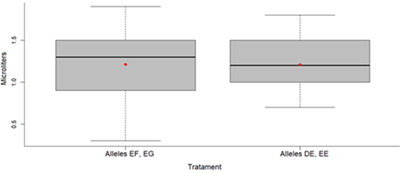
Variability regarding the amount of semen produced per drone was higher in the treatment with EF and EG alleles (of low royal jelly production), as well as the average amount of semen produced (Figure 1). Based on the Shapiro-Wilk test, the volume variable follows a normal distribution (p-value = 0.68).
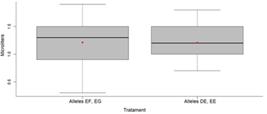
Semen volume produced by drones, mean of 1.21 µL for EF and EG allele of low royal jelly production, and 1.20 µL for DE and EE allele of high royal jelly production, p-value = 0.96.
We performed the analysis of variance of the adjusted model at a 5% significance level, in which the results obtained were not significant for the treatment (F=0; p-value = 0.96), but there was an effect for the block (F=8; p-value = 0.008). To confirm this, the hypothesis test for normality of Shapiro-Wilk was performed and the result was (p-value = 0.44). Thus, the hypothesis of normality was not rejected, but the hypothesis of homogeneity by the Bartlett test was (p-value = 0.64).
The result of semen volume per drone is in accordance with those presented by other authors: 0.88 µL to 1.8 µL (Abdelkader et al., 2014; Yániz et al., 2020). This result is inversely proportional to the age of the drone, being 1.02 µL at 15 days and 0.88 µL at 30 days. The amount is related to the origin of the drone (worker or queen bee) and the colony supplementation (Czekońska et al., 2013; Gençer et al., 2014; Rousseau et al., 2015; Rousseau & Giovenazzo, 2016). The previous factors (age and supplementation) were homogeneous in both groups tested. Thus, the absence of significant difference between the results confirms that the genetics selected for royal jelly production does not influence the volume of semen produced by drone.
Mass motility or mass movement
The mass motility refers to the movement of the semen caused by sperm vigour, and is categorized from 1 to 5, evaluating the size of the wave (base and height). When less than 10% of the semen present high waves with narrow base, it is characterized as category 1; between 20 and 40%, category 2; between 45 and 75%, category 3; between 75 and 85%, category 4; and category 5 when 90% of the semen have these characteristics (Neves & Jobim, 2013a).
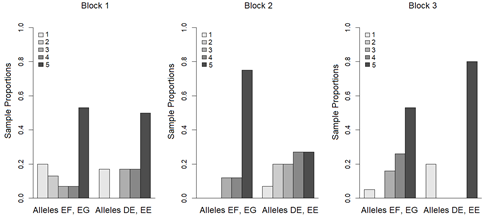
The Y response variable (degree of motility) is polytomic and presents five categories: Mass motility-1, Mass motility-2, Mass motility-3, Mass motility-4, and Mass motility-5, referring to the scale of mass movement of drone semen. It was observed that there is a higher proportion of drones whose semen exhibits a motility of category 5 at each genetic level (Figure 2). That is, there is a significant proportion of semen whose movement in the form of waves is predominant in those of elevated height and narrow base.
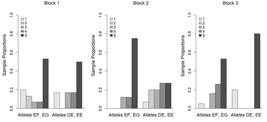
Degree of mass motility considering drone genetics. The colour represents each category of mass motility, given by the proportion displayed by high-wave semen with narrow base. 1:<10%; 2: between 20 and 40%; 3: between 45 and 75%; 4: between 75 and 80% and 5: >90%.
Table 1 contains the parameter estimates of the adjusted model and Table 2 presents, for the logits, the expressions and estimates on the chance of response occurrence of category j, j = 1.2.3.4 in relation to category r = 5 for a given vector x = (x1, x2).
Expressions and estimates on the chance of response occurrence regarding category j in relation to category r, p_j (x)/p_r (x), j=1,2,3,4 and r 5.
From the estimates presented in Table 2, in block 1 (week one of the experiment) the chance of semen having a degree of mas motility-5, whose genetics is of EF and EG alleles, was 1/0.62 equal to (=) 1.6 times the chance of semen having a degree of mass motility 1. When the genetics of DE and EE alleles was considered, the chance of semen having a degree of mass-motility-5 was 1/0.28 equal to (=) 3.57 times the chance of semen having a degree of mass motility-1.
In block 2 (week two of the experiment), the chance of semen having a degree of mass-motility-5, whose genetics is of the alleles EF and EG was 1/0.12, equal to (=) 8.3 times the chance of semen having a degree of mass motility-1. In genetics of DE and EE alleles, the chance of semen having a degree of mass-motility-5 was 1/0.05 equal to (=) 20 times the chance of semen having a degree of mass-motility-1.
In the sperm of block 3 (week three of the experiment), the chance of semen having a degree of mass motility-5, whose genetics is of the alleles EF and EG was 1/0.25 equal to (=) 4 times the chance of semen having a degree of mass motility-1. For genetics of the DE and EE alleles, the chance of semen having a grade of mass motility-5 was 1/0.11 equal to (=) 9 times the chance of semen having a grade of mass-motility-1.
When compared to other degrees of motility, the estimates contained in Table 2 presented predominance of semen with mass-5 motility scale. It can be noted that these results are in accordance with those presented in Figure 4, which evidence a high proportion of semen with a degree of mass motility 5, particularly for blocks 2 and 3.
Mass movement is determined by the amount and vigour of live sperm and is evaluated in species with higher sperm concentration (Neves & Jobim, 2013a). The data from this study presented that the treatment of DE and EE alleles with higher royal jelly production presents that they are more likely to obtain maximum mass movement than the treatment of EF and EG alleles with low royal jelly production. The first treatment represents sperm with greater vigour and movement that will have a better chance of migrating to the spermatheca. It is likely that within the treatment with two alleles of royal jelly production there will be a relationship between the alleles and mass motility. The motility was good, and as reported, it is important for sperm to arrive the spermatheca (Wegener et al., 2012; Yaniz et al., 2019).
Spermatozoa Survival
It was observed that the variability and survival of spermatozoa were higher in the treatment of DE and EE alleles (higher real jelly production). Regarding the mean, both treatments presented similar results: DE and EE alleles = 177.40 live spermatozoa, equivalent to 88.7%; EF and EG alleles (low royal jelly production) = 176.10 live spermatozoa, equivalent to 88.05%.
The Kruskal-Wallis test highlighted there were no significant differences in spermatozoa mortality or spermatozoa survival per drone according to the treatments (p-value = 0.88, P-value = 0.79).
In terms of mortality, we can see that the treatment variable is not significant, but there was an effect of the block (Table 3). Regarding the assumption of lack of model adjustment, the hypothesis has not been violated, presenting that the model was adequate for such situation (p-value = 0.74).
The survival of the spermatozoa was evaluated with eosin-nigrosine which penetrates the plasma membranes of dead spermatozoa, leaving the living ones uncoloured, but not all living ones are viable. Propidium iodide is used to determine semen viability (Blom, 1950; Herman & Madden, 1994; Valczircel et al., 1994) and in drones the viability or vitality assessments range from 60 to 98% (Taylor et al., 2009; Gençer & Kahya, 2011; Czekońska et al., 2013; Rousseau et al., 2015; Metz & Tarpy, 2019; Yániz et al., 2020; Bratu et al., 2022).
In research developed by Pintado et al. (2000) and Brito et al. (2003) evaluating bovine semen, they observed a high correlation (r=0.83; p-value=0.009 and r-0.89; p-value <0.01, respectively) between eosin/nigrosine (live/dead) and propídeo iodide (viable/inviable). It should be noted that samples using eosin are much smaller and do not require a fluorescence microscope like those using propidium iodide (Williams & Pollak, 1950).
Morphological abnormalities of spermatozoa
Table 4 contains the mean values of the variables for each treatment, noting that the highest mean recorded for HS and TS was in the treatment of one allele with lower real jelly production. In turn, for BIT and BT the highest means occurred in the treatment with two alleles of high production. The Kruskal-Wallis test evidenced there were no significant differences regarding morphological abnormalities HS, TS, BIT and BT according to genetic character (p-value=0.48; p-value=0.41; p-value=0.16 and p-value=0.24, respectively).
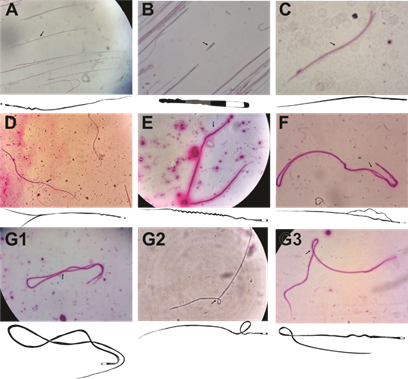
Regarding the uni-varied descriptive analysis, it was observed that colonies with the genetic character of DE and EE alleles of high production of royal jelly admits, on average, a greater number of spermatozoa with the abnormalities bent tail and double tail. In turn colonies with the genetic character of the alleles EF and EG of low royal jelly production admits, on average, a higher number of spermatozoa with the abnormalities headless sperm and tailless sperm. Figure 3 presents graphically the abnormalities found.
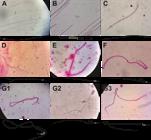
Abnormalities of the sperm of Apis mellifera L. A: Most common pattern. B: Headless sperm; C: Tailless sperm; D: Bifurcated tail; E: Tail with corkscrew shape; F: imperfect tail formation; G1-G2-G3: Bent tail.
The abnormalities found in this experiment presented no difference between the treatments due to the previously reported conditions. Because there were no official criteria for analysis of drone semen, we adapted the criteria of the manual on andrological examination for mammals and fish (Neves & Jobim, 2013a, 2013b). However, there is a morphological difference between the sperm of the drone and that of mammals, mainly in the size of the head, so some of their abnormalities cannot be identified.
In a study conducted by Bratu et al. (2022) comparing the weight of drones and anomalies, the authors reported that greater weight was associated with higher quantities of anomalies. However, our results did not presented significant differences. This may be due to the subspecies of the honeybees, as the weight of our Africanized drones did not exceed 210 mg, while their weights were greater than 240 mg.
Drones weight
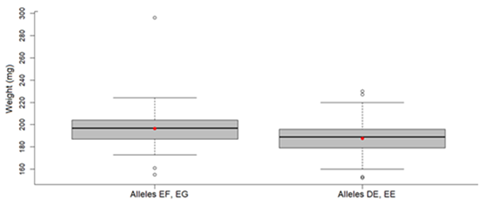
We observed that the weight variability of the drones in terms of genetics was similar. However, the mean weight was higher in the treatment with EF and EG alleles of low royal jelly production (Figure 4). We performed the analysis of variance of the adjusted model at a 5% significance level, in which the results obtained determined a significant difference both in block as in genetics (F=13.46, p-value= 0.008 and F=4.193, p-value= 0.016, respectively).
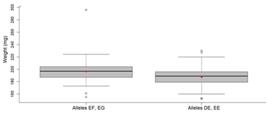
Weight in mg of mature drones, with a mean of 196.6 and 187.8 mg for EF and EG alleles (low royal jelly production), and for DE and EE alleles (high royal jelly production), respectively, p-value = 0.016.
Colonies with the presence of DE and EE alleles of higher royal jelly production have raised drones with lower weight, a factor related to low sperm quality, and which is a disadvantage for nuptial flight (Szentgyörgyi et al., 2017). However, in this study the results presented no significant difference in semen quality. Nevertheless, for the drones to have a higher weight, it is important that the colony invests more in food collection and nutrition work to attend the demand (Rortais et al., 2005; Mandla & Kumar 2016).
It was observed that colonies with lighter drones can raise more drones - on average 1010 individuals - than those with heavier drones - on average 840 individuals, that differs from the results presented by Halak et al. (2020). Only a portion of the total drones was used to assess the quality of the semen, what could favour genetic improvement programs using instrumental insemination. This is because it would be possible to obtain a larger number of individuals that, even being light, would have seminal quality like heavier drones. The results obtained in this study presented that in each of the treatments the colonies had the E allele with higher royal jelly production, but as their expression in the honeybees and the royal jelly production of the colonies were not evaluated, it was not possible to know the amount of food supplied to the drone larvae. This factor could explain why no significant differences in sperm quality were found, since the larvae of both treatments may have been fed similar amounts of royal jelly.
Sperm development occurs during the pre-pupa phase (Cruz-Landim et al., 1980) and is influenced by the amount of food offered to the pre-pupa larval phase and ambient temperature (Boes, 2010; Bieńkowska et al., 2011; Wegener et al., 2012). Moreover, the experiment was developed in late winter and early spring, a time that offered good availability of food, presented in the pollen combs within the colonies. Thus, there was enough resource for the development of the drones within the colony under similar conditions in both treatments.
Conclusion
The evaluated genotype did not significantly influence the quality of semen from Africanized honeybee drones. However, the genotype is related to the weight of the drones because the colonies with royal jelly selection invest in rearing more drones with a lower weight. Higher drone production can be an advantage because light drones use less energy and, in the environment, there would be more of them available for mating. Thus, in breeding programs, using instrumental insemination, greater availability of drones with desirable alleles could be used to inseminate more queens for colony selection to increase royal jelly production.
Data availability
We inform you that the data used in the research were made publicly available and can be accessed via the link https://drive.google.com/drive/folders/1glP9HftjK2dSZQ1OgbnTQlQZPjQphR0l?usp=drive_link
Acknowledgements
We thank Coordination of Improvement of Higher Level Personnel (CAPES) process number 88882.181502/2018-01 for financial support.
References
-
Abdelkader, F. B., Kairo, G., Tchamitchian, S., Cousin, M., Senechal, J., Crauser, D., Vermandere, J. P., Alaux, C., Le Conte, Y., Belzunces, L. P., Barbouche, N., & Brunet, J. L. (2014). Semen quality of honey bee drones maintained from emergence to sexual maturity under laboratory, semi-field and field conditions. Apidologie, 45, 215-223. https://doi.org/10.1007/s13592-013-0240-7
» https://doi.org/https://doi.org/10.1007/s13592-013-0240-7 - Albert, Š., Klaudiny, J., & Šimúth, J. (1999). Molecular characterization of MRJP3, highly polymorphic protein of honeybee (Apis mellifera) royal jelly. Insect biochemistry and insect molecular biology, 29, 427-434.
-
Baitala, T. V., Faquinello, P., Toledo, V. D. A. A., Mangolin, C. A., Martins, E. N., & Ruvolo-Takasusuki, M. C. C. (2010). Potential use of major royal jelly proteins (MRJPs) as molecular markers for royal jelly production in Africanized honeybee colonies. Apidologie , 41, 160-168. https://doi.org/10.1051/apido/2009069
» https://doi.org/https://doi.org/10.1051/apido/2009069 - Bieńkowska, M., Panasiuk, B., Wegrzynowicz, P., & Gerula, D. (2011). The effect of different thermal conditions on drone semen quality and number of spermatozoa entering the spermatheca of queen bee. Journal of Apicultural Science, 55, 161-168.
- Blom, E. (1950). A one-minute live-dead sperm stain by means of eosin-nigrosin. Fertility and Sterility, 1, 176-177.
-
Boes, K. E. (2010). Honeybee colony drone production and maintenance in accordance with environmental factors: an interplay of queen and worker decisions. Insectes Sociaux, 57(1), 1-9. https://doi.org/10.1007/s00040-009-0046-9
» https://doi.org/https://doi.org/10.1007/s00040-009-0046-9 -
Bratu, I. C., Igna, V., Simiz, E., Dunea, I. B., & Pătruică, S. (2022). The Influence of body weight on semen parameters in Apis mellifera drones. Insects, 13(12), 1141. https://doi.org/10.3390/insects13121141
» https://doi.org/https://doi.org/10.3390/insects13121141 -
Brito, L. F. C., Barth, A. D., Bilodeau-Goeseels, S., Panich, P. L., & Kastelic, J. P. (2003). Comparison of methods to evaluate the plasmalemma of bovine sperm and their relationship with in vitro fertilization rate. Theriogenology, 60(8), 1539-1551. https://doi.org/10.1016/s0093-691x(03)00174-2
» https://doi.org/https://doi.org/10.1016/s0093-691x(03)00174-2 - Neves, J. P., & Jobim, M. I. M. (2013a). Introdução ao exame andrológico. In J. P. Neves, & M. I. M. Jobim (Orgs.), Manual para exame andrológico e avaliação do sêmen animal (pp. 20-25). CBRA.
- Neves, J. P., & Jobim, M. I. M. (2013b). Anexos. In J. P. Neves, & M. I. M. Jobim (Orgs.), Manual para exame andrológico e avaliação do sêmen animal (pp. 85-90). CBRA.
-
Cobey, S. W., Tarpy, D. R., & Woyke, J. (2013). Standard methods for instrumental insemination of Apis mellifera queens. Journal of Apicultural Research, 52(4 part 2), 1-18. https://doi.org/10.3896/IBRA.1.52.4.09
» https://doi.org/https://doi.org/10.3896/IBRA.1.52.4.09 -
Cruz-Landim, C., Beig, D., & Moraes, R. L. M. S. (1980). The process of differentiation during spermatogenesis in bees (Hymenoptera, apidae). Caryologia, 33(1), 1-15. http://dx.doi.org/10.1080/00087114.1980.10796814
» https://doi.org/http://dx.doi.org/10.1080/00087114.1980.10796814 -
Czekońska, K., Chuda-Mickiewicz, B., & Chorbiński, P. (2013). The influence of honey bee (Apis mellifera) drone age on volume of semen and viability of spermatozoa. Journal of Apicultural Sciences , 57(1), 61-65. https://doi.org/10.2478/jas-2013-0007
» https://doi.org/https://doi.org/10.2478/jas-2013-0007 - Czekońska, K., Chuda-Mickiewicz, B., & Samborski, J. (2015). Quality of honeybee drones reared in colonies with limited and unlimited access to pollen. Apidologie , 46, 1-9.
- Frost, E. (2016a). Breeding stock evaluation and maintenance. In E. Frost, Queen bee breeding (pp. 55-74). NSW Government.
- Frost, E. (2016b). Selective breeding programs. In E. Frost, Queen bee breeding (pp. 79-84). NSW Government.
-
Gençer, V. H., & Kahya, Y. (2011). Are sperm traits of drones (Apis mellifera L.) from laying worker colonies noteworthy? Journal of Apicultural Research , 50(2), 130-137. https://doi.org/10.3896/IBRA.1.50.2.04
» https://doi.org/https://doi.org/10.3896/IBRA.1.50.2.04 -
Gençer, H. V., Kahya, Y., & Woyke, J. (2014). Why the viability of spermatozoa diminishes in the honeybee (Apis mellifera) within short time during natural mating and preparation for instrumental insemination. Apidologie , 45, 757-770. https://doi.org/10.1007/s13592-014-0295-0
» https://doi.org/https://doi.org/10.1007/s13592-014-0295-0 -
Halak, A. L., Santos, P. R., Rossi, R. M., Wielewski, P., Moraes, G.V., & Toledo, V. A. A. (2020). Drone production, semen viability and spermatozoa longevity of Africanized Apis mellifera Acta Scientiarum. Animal Sciences, 42(1), e49050. https://doi.org/10.4025/actascianimsci.v42i1.49050
» https://doi.org/https://doi.org/10.4025/actascianimsci.v42i1.49050 - Han, H., Gebreamlak, B., Mao, F., Qiaohong, W., Xufeng, Z., Wu, F., Meng, L., Fang, Y., Han, B. J. L. (2019). In-depth proteome of the hypopharyngeal glands of honeybee workers reveals highly activated protein and energy metabolism in priming the secretion of royal jelly. Molecular & Cellular Proteomics, 18, 606-621.
- Herman, H. A., & Madden, F. W. (1994). Evaluation of semen-live-dead (Vital)stainig. In H. A. Herman, & J. R. Mitchell, Artificial insemination and embryo transfer dairy beef cattle (pp. 81-83). Interstate Printers & Publishers.
-
Jourdan-Pineau, H., Antoine, G., Galataud, J., Delatte, H., Simiand, C., & Clémencet, J. (2021). Estimating heritability in honeybees: comparison of three major methods based on empirical and simulated datasets. Ecology and Evolution, 11(13), 8475-8486 https://doi.org/10.1002/ece3.7389
» https://doi.org/https://doi.org/10.1002/ece3.7389 -
Helbing, S., Lattorff, H. M. G., Moritz, R. F. A., & Buttstedt, A. (2017). Comparative analyses of the major royal jelly protein gene cluster in three Apis species with long amplicon sequencing. DNA Research, 24(3), 279-287. https://doi.org/10.1093/dnares/dsw064
» https://doi.org/https://doi.org/10.1093/dnares/dsw064 - Kleinbaum, D. G., & Klein, M. (2002).Logistic regression Springer-Verlag.
- Koeniger, G., Koeniger, N., Ellis, J., & Connor, L. (2014a). Drone monogamy, queen polyandry and the function of the mating sign. In G. Koeniger, N. Koeniger, J. Ellis, & L. Connor, Mating biology of honeybees (Apis mellifera) (pp. 87-96). Wicwas Press LLC.
- Koeniger, G., Koeniger, N., Ellis, J., & Connor, L. (2014b). Drone quality influences the fecundity of queens. In G. Koeniger, N. Koeniger, J. Ellis, & L. Connor, Mating biology of honeybees (Apis mellifera) (pp. 116-123). Wicwas Press LLC.
- Koeniger, G., Koeniger, N., Ellis, J., & Connor, L. (2014c). Relationships within the honeybee colony. In G. Koeniger, N. Koeniger, J. Ellis, & L. Connor, Mating biology of honeybees (Apis mellifera) (pp. 130-135). Wicwas Press LLC.
- Mandla, R., & Kumar, N. R. (2016). Comparison of carbohydrates in the worker, drone and queen brood food of Apis mellifera during spring. Journal of Global Bioscience, 5(3), 3765-3768.
-
Metz, B. N., & Tarpy, D. R. (2019). Reproductive senescence in drones of the honey bee (Apis mellifera). Insects, 10(1), 11. https://doi.org/10.3390/insects10010011
» https://doi.org/https://doi.org/10.3390/insects10010011 - Montgomery, D. C. (2017). Design and analysis of experiments Jhon Wiley & Sons.
- Oberlender, G., Murgas, L. D. S., Zangeronimo, M. G., Silva, A. C., Pereira, L. J., & Muzzi, R. A. L. (2012). Comparison of two different methods for evaluating boar semen morphology. Archivos de Medicina Veterinaria, 205, 201-205.
- Ostroverkhova, N. V., Kucher, A. N., Babushkina, N. P., & Konusova, O. L. (2018a). Sequence of the mrjp3 microsatellite locus in honeybees of different origin. Russian Journal of Genetics, 54, 322-327.
- Ostroverkhova, N. V., Kucher, A. N., Konusova, O. L., & Sharakhov, I. V. (2018b). Honeybee subspecies or / and royal jelly productivity. Far Eastern Entomologist, 353, 24-28.
- Parpinelli, R. S., Ruvolo-Takasusuki, M. C. C., & Toledo, V. A. A. (2014). MRJP microsatellite markers in Africanized Apis mellifera colonies selected on the basis of royal jelly production. Genetics and Molecular Research, 13, 6724-6733.
- Paula, G. A. (2004). Modelos de regressão: com apoio computacional IME-USP.
- Pintado, B., De La Fuente, J., & Roldan, E. R. S. (2000). Permeability of boar and bull spermatozoa to the nucleic acid stains propidium iodide or Hoechst 33258, or to eosin: Accuracy in the assessment of cell viability. Journal of Reproduction and Fertility, 118(1), 145-152.
- Polkovnikova, V. I., & Pershina, N. S. (2017). Efficiency of instrumental insemination use of bee queens. Agriculture, 4(58), 160-163.
- Qu, N., Jiang, J., Sun, L., Lai, C., Sun, L., & Wu, X. (2008). Proteomic characterization of royal jelly proteins in Chinese (Apis cerana cerana) and European (Apis mellifera) honeybees. Biochemical, 73, 676-680.
- R Development Core Team. (2014) R: a language and environment for statistical computing R Foundation for Statistical Computing.
-
Rortais, A., Arnold, G., Halm, M. P., & Touffet-Briens, F. (2005). Modes of honeybees exposure to systemic insecticides: estimated amounts of contaminated pollen and nectar consumed by different categories of bees. Apidologie , 36(1), 71-83. https://doi.org/10.1051/apido:2004071
» https://doi.org/https://doi.org/10.1051/apido:2004071 -
Rousseau, A., Fournier, V., & Giovenazzo, P. (2015). Apis mellifera (Hymenoptera: Apidae) drone sperm quality in relation to age, genetic line, and time of breeding. Canadian Entomologist, 147(6), 702-711. https://doi.org/10.4039/tce.2015.12
» https://doi.org/https://doi.org/10.4039/tce.2015.12 -
Rousseau, A., & Giovenazzo, P. (2016). Optimizing drone fertility with spring nutritional supplements to honey bee (Hymenoptera: Apidae) colonies. Journal of Economy Entomology, 109(3), 1009-1014. https://doi.org/10.1093/jee/tow056
» https://doi.org/https://doi.org/10.1093/jee/tow056 -
Swanson, E. W., & Bearden, H. J. (1951). An Eosin-Nigrosin stain for differentiatinglLive and dead bovine spermatozoa. Journal of Animal Science, 10(4), 981-987. https://doi.org/10.2527/jas1951.104981x
» https://doi.org/https://doi.org/10.2527/jas1951.104981x -
Szentgyörgyi, H., Czekońska, K., & Tofilski, A. (2017). The effects of starvation of honey bee larvae on reproductive quality and wing asymmetry of honey bee drones. Journal of Apicultural Science , 61(2), 233-243. https://doi.org/10.1515/JAS-2017-0018
» https://doi.org/https://doi.org/10.1515/JAS-2017-0018 -
Taylor, M. A., Guzmán-Novoa, E., Morfin, N., & Buhr, M. M. (2009). Improving viability of cryopreserved honey bee (Apis mellifera L.) sperm with selected diluents, cryoprotectants, and semen dilution ratios. Theriogenology , 72(2), 149-159. https://doi.org/10.1016/j.theriogenology.2009.02.012
» https://doi.org/https://doi.org/10.1016/j.theriogenology.2009.02.012 -
Valczircel, M. A., De las Heras, L., Perez, D. F. M., & Baldassarre, H. (1994). Fluorescent staining as a method of assessing membrane damage and post-thaw survival of ram spermatozoa. Theriogenology , 41(2), 483-488. https://doi.org/10.1016/0093-691x(94)90084-v
» https://doi.org/https://doi.org/10.1016/0093-691x(94)90084-v -
Wegener, J., May, T., Knollmann, U., Kamp, G., Müller, K., & Bienefeld, K. (2012) In vivo validation of in vitro quality tests for cryopreserved honeybee semen. Cryobiology, 65(2), 126-131. https://doi.org/10.1016/j.cryobiol.2012.04.010
» https://doi.org/https://doi.org/10.1016/j.cryobiol.2012.04.010 - Widdicombe, J. (2015a). The theory of bee improvement. In J. Widdicombe, The principles of bee improvement (pp. 5-22). Northern Bee Books.
- Widdicombe, J. (2015b). Assessment of stock (ii) selecting within a strain. In J. Widdicombe, The principles of bee improvement (pp. 23-29). Northern Bee Books.
- Widdicombe, J. (2015c). Queen mating- the role and importance of the drone. In J. Widdicombe, The principles of bee improvement (pp. 62-66). Northern Bee Books.
- Williams, W. W., & Pollak, O. J. (1950). Study of sperm vitality with the aid of Eosin-Nigrosin stain. Fertility and Sterility , 1, 178-181.
-
Yániz, J., Palacin, I., & Santolaria, P. (2019). Efeito das características da câmara, incubação e diluente na motilidade do esperma do zangão da abelha (Apis mellifera). Apidologie , 50, 472-481. 10.1007/s13592-019-00659-y
» https://doi.org/10.1007/s13592-019-00659-y -
Yániz, J. L., Silvestre, M. A., & Santolaria, P. (2020). Sperm quality assessment in honey bee drones. Biology, 9(7), 174. https://doi.org/10.3390/biology9070174
» https://doi.org/https://doi.org/10.3390/biology9070174