 Impact of Crossing Golden Sabahia and White Leghorn Chickens on Performance Traits: An Analysis of Heterosis, Additive Effects, and Performance Curves
ABSTRACT.
The current study was conducted to investigate the effect of crossbreeding between Golden Sabahia (GS) and White Leghorn (WL) strains on body weight (BW) and egg production traits and estimate crossbreeding parameters such as direct heterosis, additive effect and evaluating the growth and egg production curves. GS pure line had the significantly highest BW0, BW56, BW70 and BW84, however, it had a significantly lower BW14 than the crossbreds. Furthermore, the GS - sired crossbred was significantly heavier in BW14, BW28 and BW42 than the pure lines and the reciprocal cross. GS × WL cross showed significantly higher daily body weight gains than the reciprocal cross except for BWG8 - 12. WL purebred line had the lowest EW90 among the strain groups, meanwhile, EW10 was at its highest mean in the GS × WL crossbred. Moreover, WL × GS crossbred had the lowest performance among the groups in terms of P10. Positive direct additive effects were shown for body weights and most egg production traits, indicating GS’s superior genetic potential. The direct additive effects were positive for the egg production traits studied apart from P10. Overall, the GS - sired crossbreds displayed the best performance in terms of growth rate and egg production, making them a promising option for poultry breeding programs.
Keywords:
Crossing; direct heterosis; additive effect; golden sabahia; white leghorn; growth curve
Introduction
Poultry production is a crucial component of the global agricultural industry, providing a significant source of protein through both meat and eggs. Genetic improvement in chickens has been a key driver in enhancing productivity and overall performance in the poultry sector. Among the various strategies for genetic improvement, crossbreeding has been widely employed, especially in developed countries, to combine desirable traits from different breeds, such as resilience and adaptivity and maximizing heterosis (hybrid vigor) to improve performance characteristics such as growth and egg production (Pym, 2013; Van Tijen, 1977).
The White Leghorn Strain is an exotic breed known for its exceptional egg - laying capabilities, has long been a cornerstone in the egg production industry. With its high rate of lay, superior egg quality, and adaptability to various environmental conditions, White Leghorn has been extensively utilized in breeding programs aimed at improving egg production traits, it has been adapted and acclimatized to the Egyptian environment for more than 20 years (Cole & Hutt, 1973; Hosny, 2006).
On the other hand, Golden Sabahia as a newly developed Egyptian chicken strain, which contributes 87.5% blood of Lohman brown (LB) commercial strain and 12.5% blood of four developed strains, is known for its resilience and adaptability to environmental conditions, along with respectable growth rates and body weight. However, its egg production traits may not match those of specialized breeds like the White Leghorn (Afiffi et al., 2024; Ghanem et al., 2017; Habashy & Adomako, 2023).
The crossbreeding of White Leghorn and Golden Sabahia strains presents an opportunity to harness the strengths of both breeds. By combining the prolific egg - laying ability of the White Leghorn with the robustness and adaptability of the Golden Sabahia strain, it is possible to develop a hybrid with enhanced performance traits, particularly in challenging environments where the Golden Sabahia can develop.
This study aims to evaluate the effects of crossing White Leghorn and Golden Sabahia strains on various performance traits, including body weight, body weight gain, egg weight, egg number, age at sexual maturity and egg mass. By assessing genetic potential and heterosis in these traits, we seek to identify the most promising crossbred genotypes that could contribute to improved poultry production in diverse environmental settings.
Materials and methods
The study was conducted at the Poultry Research Unit (El - Bostan farm), Department of Animal and Poultry Production, Faculty of Agriculture, Damanhour University, Egypt, during the period from October 2023 to August 2024. Experimental procedures were conducted in accordance with the Damanhour University Animal Care and Use in Research Committee (DUFA - 2024 - 13).
This work aimed to improve performance and egg production traits in Golden Sabahia (GS) through crossing with White Leghorn (WL) raised under Egyptian environmental conditions. Golden Sabahia strain was developed for egg production in El Sabahia Poultry Station. Golden Sabahia strain contributes 7/8 (87.5%) blood of Lohman brown (LB) commercial strain and 1/8 (12.5%) blood from four developed strains (Mandarh, Baheije, Silver Montazah and Golden Montazah) using systems of breeding coupled with selection (Afiffi et al., 2024). Hens of each strain were classified into two groups, first one was mated with cocks from the same strain, the second was mated with cocks from the other strain. Pedigreed and fertilized eggs were collected from each mating daily for one week and incubated in a commercial hatcher. The hatched day - old healthy chicks were numbered with wing bands to save their genetic groups, then weighed and placed in floor brooders at a starting brooding temperature of 32°C during first week, then the temperature was reduced by 2 - 3°C each week thereafter. All birds were housed in the same room to keep temperature, humidity, light intensity and other variables uniform as possible. Females were moved to individual laying cages (20 × 45 × 40 cm) at 18 weeks of age. All chicks were fed ad libitum on a commercial starter diet containing 20% crude protein and 2900 K Cal. ME kg¹ diet until 7 weeks of age, after those birds received a diet containing 18% crude protein and 2800 K Cal. ME kg¹ diet until 18 weeks of age. During the egg production period, they were fed on a layer diet containing 16% crude protein, 2750 K Cal. ME kg¹ diet, 3.5% calcium and 0.5% available phosphorus. The lighting period decreased to 8 - 10 h a day at 8 - 18 weeks of age and increased to 16 h per day during the laying period. All birds were housed under the same managerial and environmental conditions.
Studied traits
Growth traits
Individual body weights (BW) in grams were recorded at hatch, 2, 4 ,6 ,8 ,10 and 12 wks of age. body weight gain during the different growth periods studied (BWG0 -4, BWG4 - 8, BWG8 - 12, BWG4 - 12 and BWG 0 - 12 weeks), was calculated as follows:
Body Weight gain = (W2 - W1)/ Length of period (days).
where:
W1 = weight at the beginning of the period (g), and
W2 = weight at the end of the period (g).
Egg production traits
Body weight at sexual maturity (BSM), Age at sexual maturity (ASM), which is the period from hatching to the day of laying the first egg, was recorded in days for each female. The duration of laying the first ten eggs (P10), which is the number of days for each female needed to give its first ten eggs, and average egg weight was estimated in grams during the first ten days of egg production (EW10) were determined. Egg number was counted as the number of eggs laid during the first 90 days of laying (EN90) and mean weight (EW90) of eggs were determined for each female during the first 90 days of laying. Egg mass (EM) was also determined for each female, which is the total egg weight during the first 90 days of laying.
Statistical analysis
Data of BW at different ages, body weight gains during different periods and egg production traits were analyzed using GLM procedure of Statistical Analysis System software (SAS Institute, 2013). The significant tests for the differences between each two means of each trait were done according to Duncan's multiple range test (Duncan, 1955). Significance of the effects was tested at probability levels P < 0.05 (*). P < 0.01 (**) and P < 0.001 (***) with appropriate F statistic. Values of probability higher than 0.05 were deemed non - significant.
The BW, BWG data at different ages and egg production traits were analyzed according to the following linear model:
Yij = μ + G i + e ij
where:
Yij is the observation of a dependent variable,
μ is the overall mean,
Gi is the effect of ith genetic group,
eij is the random error.
Growth curves
Growth curves for different groups (pure line and crossbreed) were obtained by regression of body weight values at the age of weighing.
Egg production curves
Egg production curves for different groups (pure line and crossbreed) were obtained by regression of the weekly egg production values.
Estimation of cross breeding components
Direct heterosis and additive effects were calculated according to Dickerson (1993) as per the following equations:
Individual Heterosis: h i = 0.5 ((GS × WL + WL × GS) ( (GS × GS + WL × WL))
Heterosis%:
Direct Additive Effect: g i (GS - WL) ) = 0.5 ((GS × GS + GS × WL) ( (WL × WL + WL × GS))
Results and discussions
Data in (Table 1) shows the least square means of body weight, in grams, during the first 12 weeks of age among the pure lines and their respective crosses. The results indicate that Sabahia pure line had the significantly highest body weights at hatch, 56, 70 and 84 days of age, however, it had a significantly lower BW14 than the crossbreds. Furthermore, the GS - sired crossbred was significantly heavier in body weight at 14, 28 and 42 days of age than the pure lines and the reciprocal cross. On the other hand, the WL - sired crossbred showed the lowest body weights at 56, 70 and 84 days of age. Habashy et al. (2023) reported similar body weight means in GS and WL strains. Furthermore, significant differences favoring GS strain were observed at body weeks starting from 2 to 12 weeks of age (Habashy et al., 2021).
The Sabahia pure chickens were superior in terms of daily body weight gain demonstrating significant difference over the other genotypes in all periods studied except for BWG0-4, meanwhile, GS × WL cross showed significantly higher daily body weight gains than the reciprocal cross in all intervals except between 8 and 12 weeks of age where the difference was non - significant (Table 2).
Table 3 demonstrates the least square means of egg production traits for the pure lines and their respective crosses. The results indicate that ASM was not affected by the strain group, similarly, neither EN90 nor EM were affected. However, both crosses had a lower BSM than the pure line with the WL × GS crossbred having a significantly lower BSM than the reciprocal cross. On the other hand, the White Leghorn purebred line had the lowest EW90 among the strain groups, meanwhile, EW10 was in its highest mean in the GS × WL crossbred. Moreover, WL × GS crossbred had the lowest performance among the groups in terms of P10, spending 17.81 days on average to reach the first 10 eggs of production.
The observed BSM of GS strain does not agree with the means of 1800 g cited by Afiffi et al. (2024), however, they reported egg weight at 36 weeks of age equivalent to the current estimates. Additionally, Iraqi et al. (2012) noticed earlier age of sexual maturity and heavier BSM in the WL group, however, their reports of EN90 and EM were lower.
Direct additive effect, heterosis estimates and heterosis percentages for body weight at different ages are given in Table 4. The heterosis estimates of body weight were significantly positive at 14 and 28 days of age, meanwhile, they were significantly negative at the ages of 56, 70 and 84 days. The large negative heterosis indicates the possibility of major genes in the populations that reduce BW (Rezvannejad et al., 2013). Also, Mai et al. (2021) reported that nonadditive genes and their related oxidative phosphorylation were the major genetic and molecular factors in the negative heterosis of growth in chickens. Vali (2009) also estimated percent heterosis for BW at 1 to 63 d of age that was positive at 1, 14, 21, 28, 49, 56, and 63 d of age, but negative at other ages. The inconsistency in the direct heterosis estimates relative to the means of the purelines suggests that the hybrid vigor for bodyweight is age - dependent, these arguments are supported by studies (El-Tahawy & Habashy, 2021; Iraqi et al., 2013).
Results of direct additive effect show significant positive effects (P < 0.0001) on all body weights starting from hatch up to 12 weeks of age, suggesting that the Sabahia chicken genotype has a higher genetic potential for growth than the WL genotype.
In contrast, the heterosis estimates for body weight gains were significantly negative, except for BWG0-4, reflecting the outbreeding depression of the crossbred. Meanwhile, the significant positive direct additive effect values for the BWGs have confirmed the superior growth performance of the Sabahia - sired (Table 5).
Table 6 manifests the direct additive effect, heterosis estimates and heterosis percentages for egg production traits. The results indicate that the heterosis estimates were statistically non - significant for most of the traits except for BSM and P10. Moreover, the heterotic effect was negative for both BSM and EW10. The negative value for the BSM’s heterosis means that the crossbred reached sexual maturity at lower body weights. The heterosis percentage was the highest for P10 with 12.05% meaning that the crossbred would probably spend more time laying the first ten eggs while the negative percentage of 5.92% in the heterosis estimate of BSM reflects that the crossbred manifested lower body weight when giving the first egg than both purebreds.
The direct additive effects were positive for the egg production traits studied apart from P10. Furthermore, significant effects were observed on BSM, P10 and EW10 despite being non - significant on EN90, EW90 and EM. The positive effects on the figures of egg weight and laying rate were in benefit of the Sabahia strain, consequently, chickens sired by the Sabahia genotype could be utilized as breeders to enhance these traits. Other reviews described that egg production traits of crossbred chickens displayed positive direct additive effect (Iraqi et al., 2012).
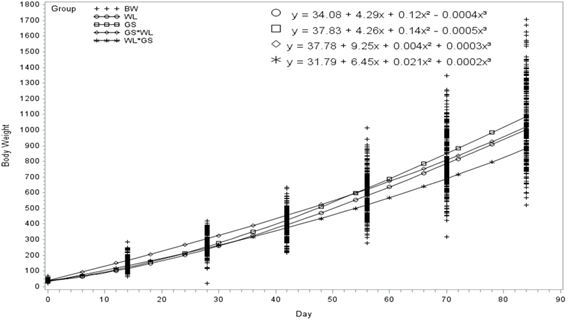
Figure 1 graphically illustrates the growth curves for the pure lines and their crosses, the equations used to obtain those curves are shown on the same figure. Determination Coefficients 𝑅2 for studied curves were high and ranged from 0.90 to 0.93 indicating the goodness - of - fit for the model used. According to the profile analysis, no parallelism in growth was observed between the groups while the contrast became more obvious starting from the fourth week of age where GS pure line displayed a higher growth, meanwhile, for the Sabahia - sired cross which manifested rapid growth since hatch. The slow growth rate of WL compared to GS chickens was also reported by Habashy et al. (2023) who returned this to the lack of a genetic improvement program and inadequate sanitary management.
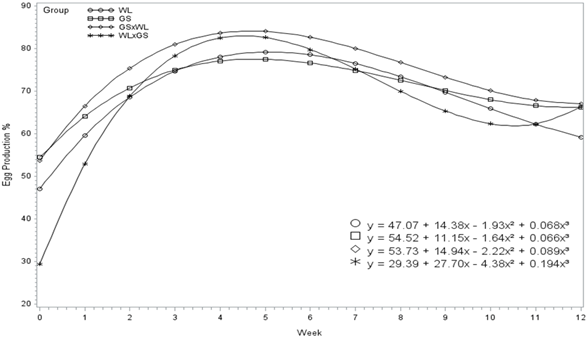
Figure 2 describes graphically the course of egg production increase with age for the pure lines and their crosses along with their relevant equations. The curves reveal the superior egg production rate of the Sabahia - sired cross which reached a peak of 84% at 32 days of egg production. Furthermore, despite the slow start of the White Leghorn - sired cross, the cross started to overtake both pure lines between weeks 2 and 6 of egg production before exhibiting a sharp decline.
Conclusion
Crossbreeding Golden Sabahia (GS) with White Leghorn (WL) strains significantly improved body weight and egg production. The GS pure line grew faster, especially in later stages, while GS - sired crossbreds had higher body weight gains and egg production features than pure lines and reciprocal crosses. The direct additive effects were positive for the majority of body weights and egg production parameters, demonstrating that the GS genotype has a better genetic potential for growth and production. Overall, GS - sired crossbreds performed the best in terms of growth rate and egg production, indicating that they are a good option for poultry breeding programs.
Data availability
Data will be made available on request.
References
-
Afiffi, Y. K., Balat, M. M., El-Sahn, A. A., El - Turky, A. I., Mosaad, N. A. & Ghanem, H. H.. (2024). Evaluating the geometrical and egg quality characters for two developed laying strains. Egyptian Poultry Science Journal, 44(2), 191-201. https://doi.org/10.21608/epsj.2024.359077
» https://doi.org/https://doi.org/10.21608/epsj.2024.359077 - Cole, R. K. & Hutt, F. B.. (1973). Selection and heterosis in Cornell White Leghorns: A review, with special consideration of interstrain hybrids. Animal Breeding Abstracts, 41(3), 103-118.
- Dickerson, G. E. (1993). Evaluation of breeds and crosses of domestic animals (FAO Animal Production and Health Paper No. 108). Food and Agriculture Organization of the United Nations.
-
Duncan, D. B.. (1955). Multiple range and multiple F tests. Biometrics, 11(1), 1-42. https://doi.org/10.2307/3001478
» https://doi.org/https://doi.org/10.2307/3001478 -
El-Tahawy, W. S. & Habashy, W. S.. (2021). Genetic effects on growth and egg production traits in two - way crosses of Egyptian and commercial layer chickens. South African Journal of Animal Science, 51(3), 349-354. https://doi.org/10.4314/sajas.v51i3.8
» https://doi.org/https://doi.org/10.4314/sajas.v51i3.8 -
Ghanem, H. H., El-Turky, A. I., Abou El-Ghar, R. S. H., Aly, O. M., Nawar, A. N., Shalan, H. I. & Mahmoud, T. H.. (2017). Golden Sabahia: A new strain of chickens. Egyptian Poultry Science Journal, 37(1), 57-63. https://doi.org/10.21608/epsj.2017.5411
» https://doi.org/https://doi.org/10.21608/epsj.2017.5411 -
Habashy, W. S. & Adomako, K.. (2023). The relationship between egg production, reproductive hormones, and the GDF9 gene in three different chicken strains. Animal Gene, 27, Article 200147. https://doi.org/10.1016/j.angen.2023.200147
» https://doi.org/https://doi.org/10.1016/j.angen.2023.200147 -
Habashy, W. S., Elkhaiat, I. A. & Abd El-Latif, G. M.. (2023). Estimation of heritability, genetic correlation of body weight, and modeling of growth curve in two chicken strains. Egyptian Poultry Science Journal, 43(2), 308-318. https://doi.org/10.21608/epsj.2023.305131
» https://doi.org/https://doi.org/10.21608/epsj.2023.305131 -
Habashy, W. S., Enab, A. A. & El-Tahawy, W. S.. (2021). Prediction of body weight and other linear body weight measurements of Leghorn versus two Egyptian strains of chicken. Journal of Animal and Poultry Production, 12(8), 287-291. https://doi.org/10.21608/jappmu.2021.188242.1017
» https://doi.org/https://doi.org/10.21608/jappmu.2021.188242.1017 - Hosny, F. A. (2006). The structure and importance of the commercial and village based poultry systems in Egypt (Poultry Sector Country Review). Food and Agriculture Organization of the United Nations.
-
Iraqi, M. M., Khalil, M. H. & El - Attrouny, M. M.. (2012). Estimation of crossbreeding parameters for egg production traits in crossing Golden Montazah with White Leghorn chicken. Livestock Research for Rural Development, 24(4), Article 55. http://www.lrrd.org/lrrd24/4/iraq24055.htm
» http://www.lrrd.org/lrrd24/4/iraq24055.htm - Iraqi, M. M., Khalil, M. H., & El-Attrouny, M. M. (2013, October 3-5). Estimation of crossbreeding components for growth traits in crossing Golden Montazah with White Leghorn chickens (Paper presentation). VIth International Conference: Balnimalcon (Balkan Animal Science Conference), Tekirdag, Turkey.
-
Mai, C., Wen, C., Xu, Z., Xu, G., Chen, S., Zheng, J. & Yang, N.. (2021). Genetic basis of negative heterosis for growth traits in chickens revealed by genome - wide gene expression pattern analysis. Journal of Animal Science and Biotechnology, 12(1). https://doi.org/10.1186/s40104-021-00574-2
» https://doi.org/https://doi.org/10.1186/s40104-021-00574-2 - Pym, R. (2013). Poultry genetics and breeding in developing countries. In Poultry Development Review. (pp. 80-83). Food and Agriculture Organization of the United Nations.
-
Rezvannejad, E., Pakdel, A., Ashtianee, S. M., Yeganeh, H. M. & Yaghoobi, M. M. (2013). Analysis of growth characteristics in short - term divergently selected Japanese quail lines and their cross. Journal of Applied Poultry Research, 22(4), 663-670. https://doi.org/10.3382/japr.2011 - 00332
» https://doi.org/https://doi.org/10.3382/japr.2011 - 00332 - SAS Institute (2013). SAS/STAT 9.4 user's guide. SAS Institute Inc.
-
Van Tijen, W. F.. (1977). Crossbreeding in poultry. World’s Poultry Science Journal, 33(2), 105-110. https://doi.org/10.1079/WPS19770010
» https://doi.org/https://doi.org/10.1079/WPS19770010 -
Vali, N.. (2009). Growth, feed consumption and carcass composition of Coturnix japonica, Coturnix ypsilophorus and their reciprocal crosses. Asian Journal of Poultry Science, 3(4), 132-137. https://doi.org/10.3923/ajpsaj.2009.132.137
» https://doi.org/https://doi.org/10.3923/ajpsaj.2009.132.137
Edited by
-
Associate Editor in charge:
Leandro Dalcin Castilha