 Variability and prediction of protein-nutritional traits in grains of maize of different types of hybrids and varieties
ABSTRACT.
The objectives of this study were to determine whether there is variability in the protein-nutritional composition of grains among single-cross, triple-cross, and double-cross hybrids and OPVs and different sowing dates and to develop models for amino acid prediction based on the CP content. A total of 773 grain samples from four maize cross-types cultivated with ten sowing dates were evaluated by Near Infrared Reflectance Spectroscopy. Descriptive statistics were applied and simple linear regression models were developed for protein-nutritional traits for different cross-types and sowing dates. Principal component analysis was used to group data on the protein-nutritional composition of grains and meteorological variables, by cross-types and by sowing dates. Open-pollinated varieties of maize had the highest means of crude protein, lysine, methionine, cystine, threonine, tryptophan, valine, isoleucine, leucine, histidine and arginine in the grains, compared to single-cross, triple-cross and double-cross hybrids regardless of the sowing date. Methionine, cystine, threonine, tryptophan, valine, isoleucine, leucine, histidine and arginine in maize grains can be predicted from their crude protein with high precision in single-cross, triple-cross and double-cross hybrids and open-pollinated varieties.
Keywords:
Zea mays; animal feed; crude protein; essential amino acids
Introduction
The main crossing types of maize are single-cross, triple-cross, and double-cross hybrids and open-pollinated varieties (OPVs), which are categorized based on the breeding methods used in their development. The crossing type directly influences the production potential, genetic variability, and production stability of plants. Single-cross, triple-cross, and double-cross hybrids, in this order, are generally characterized by high yield but with less genetic variability due to the smaller number of parents involved in the crosses (Sorsa et al., 2023), whereas OPVs, with a broad genetic variability, offer greater stability in unfavorable environments (Loro et al., 2025). Although the variability of productive, phenological, and morphological traits has been well documented (Sorsa et al., 2023; Loro et al., 2025), the average amino acid composition in grains between these crossing types still needs to be determined to define a more accurate nutritional profile.
The average protein and amino acid composition of cereal grains has been studied, revealing a diversified profile important for nutritional assessment (Alves et al., 2016; Alves & Cargnelutti Filho, 2017; Loro et al., 2023; Simões et al., 2023; Mohapatra et al., 2025). Maize grains contain essential amino acids, such as lysine (LYS), methionine (MET), and tryptophan (TRP); however, the LYS and TRP levels are quite low in conventional maize, limiting its nutritional value for poultry and pig diets compared to other protein sources, such as soybean (Sriperm et al., 2010). In Brazil, maize grains have average values of approximately 8.19 g 100 g-1 for protein, 0.23 g 100 g-1 for LYS, 0.16 g 100 g-1 for MET, and 0.06 g 100 g-1 for TRP (Simões et al., 2023).
The amino acid profile of a protein is an indicator of nutritional quality, which is important in animal feed formulation. Therefore, it is essential to determine both the protein content and amino acid profile of maize grains. Feed formulation for poultry and pigs is generally based on the average reference values of maize, as established in ingredient composition tables (Rostagno & Albino, 2024). However, considerable variability has been observed in the protein and nutritional traits of maize in relation to soil water conditions (Guo et al., 2023; Safian et al., 2022), sowing dates (Mehta et al., 2020), endosperm types ( Álvarez-Iglesias et al., 2021; Simões et al., 2023), and biotechnological events (Vidal et al., 2024), highlighting the importance of a more detailed analysis to optimize animal nutrition.
Chemical laboratory analysis is the most accurate method for determining the nutritional content, but the high cost and need for quick results are significant challenges. Therefore, many nutritionists use predictive methods to estimate the essential amino acid content as accurately as possible using statistical methods, such as least squares regression. Regression models for amino acid prediction based on crude protein (CP) have been developed for wheat (Olukosi & Adebiyi, 2013), maize (Sriperm et al., 2010; Olukosi & Adebiyi, 2013; Sheikhhasan et al., 2020; Simões et al., 2023), and soybean (Sriperm et al., 2010). These studies show the importance of conducting new research to improve the accuracy of amino acid prediction from the CP content of grains, especially considering a greater number of samples and variability.
Research has focused on maize grain samples without considering the types of crosses that were used to produce them and the growing conditions. Knowing the variability and composition of nutritional traits from maize grain samples of known origin maximizes the potential of using this information. For example, determining the nutritional composition of grains based on the crossing type of maize and the growing conditions can guide the selection of more efficient genotypes for different environments, resulting in more sustainable agricultural practices and products with a higher nutritional value. In addition, the formulation of animal diets can be improved since the precise nutritional value of maize, associated with its crossing type and cultivation environment, contributes to the development of more appropriate and effective diets. In this context, the objectives of this study were to determine whether there is variability in the protein-nutritional composition of grains among single-cross, triple-cross, and double-cross hybrids and OPVs and different sowing dates and to develop models for amino acid prediction based on the CP content.
Material and methods
The experiments were carried out at the Plant Science Department of the Federal University of Santa Maria, located at 29°42' S, 53°49' W and 95 m altitude. According to Köppen’s classification, the climate of the region is humid subtropical Cfa, with hot summers and no defined dry season (Alvares et al., 2013). The soil of the region is classified as Argissolo Vermelho distrófico arênico (Ultisol) (Santos et al., 2018).
In the 2021/2022 season, maize genotypes were evaluated at five sowing dates: September 21, 2021, October 20, 2021, November 20, 2021, December 20, 2021, and January 30, 2022. A total of 78 maize genotypes (single-cross, triple-cross, and double-cross hybrids and OPVs) were sown on all dates (Table 1). However, on September 21, 2021, only 71 genotypes were sown. In the 2022/2023 season, the same 78 maize genotypes were evaluated at 5 sowing dates: September 6, 2022, October 14, 2022, November 24, 2022, December 30, 2022, and February 6, 2023. The experiments were conducted without supplemental irrigation.
On each sowing date, maize genotypes were sown in single-row plots arranged side by side. Each plot consisted of one 5-m row, with 0.80 m spacing between rows and 0.20 m between plants within the row, resulting in a total area of 4 m2. The planting density was adjusted by thinning to 62,500 plants ha−1 (25 plants per plot). Border rows of maize were established along the sides and ends of each block to minimize edge effects. In this study, each genotype was evaluated at 10 sowing dates, representing temporal replications under distinct environmental conditions. Descriptive statistics, principal component analysis, and simple linear regression were performed based on these replicates. The absence of replications per treatment is due to the exploratory nature of the study, whose focus was to characterize the average patterns of nutritional composition among maize genetic groups in multiple environments and not to perform statistical comparisons between individual genotypes. The area was harrowed and fertilized with 415 kg ha−1 of chemical fertilizer with 5-20-20 NPK. Nitrogen fertilization with urea (N, 46%) was split, with the first application of 250 kg ha−1 at the V4 stage and the second of 150 kg ha−1 at the V6 stage. Other crop management operations, such as weed, pest, and disease control, were carried out based on the technical indications for the maize crop, homogeneously in all genotypes (Fancelli & Dourado Neto, 2009).
A 100-g sample of maize grains was collected from each genotype considering each sowing date (773 samples), packed in paper bags, and dried in a forced air circulation oven to reach 13% moisture. Grain samples, obtained by open pollination, were evaluated for their nutritional composition based on maize genetic groups to identify patterns associated with genetic diversity. Subsequently, the grains were ground in a Retsch Mill (model ZM 200) coupled with a 1-mm mesh sieve to obtain samples. Ground samples were scanned using near infrared reflectance spectroscopy (NIRS FOSS DS2500, Adisseo Brasil Nutrição Animal). Based on the absorbance spectra generated for each sample, nutritional values were predicted using multivariate calibration for ground maize on the Precision Nutrition Evaluation (PNE) platform. For each sample, the following protein-nutritional traits were determined in g 100 g-1 of dry matter: CP (g 100 g-1), LYS (g 100 g-1), MET (g 100 g-1), cystine (CYS, g 100 g-1), threonine (THR, g 100 g-1), TRP (g 100 g-1), valine (VAL, g 100 g-1), isoleucine (ILE, g 100 g-1), leucine (LEU, g 100 g-1), phenylalanine (PHE, g 100 g-1), histidine (HIS, g 100 g-1), and arginine (ARG, g 100 g-1). Detailed information on the wet chemistry analyses used to calibrate the NIRS curves can be obtained in Oviedo-Rondón et al. (2024).
Meteorological variables were obtained at a station of the National Institute of Meteorology (INMET), located 100 m from the experimental area. Hourly global solar radiation (MJ m−2 h−1), hourly maximum and minimum temperatures (°C), and rainfall (mm) were recorded daily for the period between sowing and harvest of each genotype, referring to the sowing date. The daily global solar radiation (MJ m−2 day−1) was obtained by summing the hourly global solar radiation (MJ m−2 h−1). Considering each sowing date, the daily global solar radiation for each genotype was used to determine the global solar radiation accumulated in the following subperiods: sowing to female flowering (RSFF, MJ m−2) and female flowering to harvest (RFFH, MJ m−2).
For each day, the hourly maximum (Tmax) and minimum temperatures (Tmin) were used to calculate the mean hourly temperature. The mean daily air temperature (Tmean, in °C) was calculated by the average of the 24 mean hourly temperature values. The degrees days (DD, in °C) were calculated using the method proposed by Arnold (1960) using the following equation: DD = Tmean − Tb, where Tmean is the mean daily air temperature (°C) and Tb is the lower base temperature (10°C). Tb is the temperature below which plant development does not occur and if any development does occur, it is at a significantly reduced rate. When Tmean ≤ Tb, DD was considered equal to zero. For each genotype, the thermal sum was obtained at each sowing date by summing the DD values of each of the following subperiods: sowing to female flowering (SSFF, °C day) and female flowering to harvest (SFFH, °C day). For each genotype, the cumulative rainfall at each sowing date was calculated in each of the following subperiods: sowing to female flowering (PSFF, mm) and female flowering to harvest (PFFH, mm).
For each protein-nutritional trait, the following statistics were calculated at each sowing date: minimum, mean, maximum, and coefficient of variation. For each trait, considering each sowing date and crossing type, the mean was calculated, and a boxplot graph was constructed to represent the distribution of protein-nutritional traits. Principal component analysis was applied to group the data by crossing types and sowing dates in relation to protein-nutritional traits and meteorological variables. For each maize crossing type, simple linear regression models of LYS (y), MET (y), CYS (y), THR (y), TRP (y), VAL (y), ILE (y), LEU (y), PHE (y), HIS (y), and ARG (y) were calculated as a function of CP (x). All statistical analyses were performed using R software (R Core Team, 2025).
Results
Variability of protein-nutritional traits
The highest means for all protein-nutritional traits were observed in the 2022/2023 season (Table 2). In the 2021/2022 season, sowing carried out on October 20 led to the highest means for all traits, which were higher than the overall means at the 10 sowing dates. On the other dates in the same season, the means were similar for all traits but lower than the overall mean. On these dates, more than half of the genotypes evaluated showed values below the overall mean for the evaluated traits.
Minimum (Min), mean (Mean), maximum (Max) values and coefficient of variation (CV, %) of protein-nutritional traits: crude protein (CP), lysine (LYS), methionine (MET), cystine (CYS), threonine (THR), tryptophan (TRP), valine (VAL), isoleucine (ILE), leucine (LEU), phenylalanine (PHE), histidine (HIS) and arginine (ARG) of single-cross, triple-cross and double-cross hybrids and open-pollinated varieties sown on ten sowing dates in the 2021/2022 and 2022/2023 seasons.
In the 2022/2023 season, except for sowing on February 6, all dates led to means of the 12 traits above the overall mean. The highest means of the 12 traits for sowing on November 24 were observed during this season, with a gradual reduction for the first (September 6) and fifth (February 6) sowing dates. There were variations in the concentrations of CP and amino acids, with greater variability in ILE, LEU, and PHE (CV ≥ 13.028%) compared to the other traits.
The variability in these traits decreased in the following order: LEU, PHE, ILE, THR, VAL, TRP, CP, HIS, CYS, ARG, LYS, and MET (8.584% ≤ CV ≤ 15.449%). Sowing carried out on September 21, 2021, December 20, 2021, and February 06, 2022 resulted in the highest variations of 9 of the 12 traits (CP, CYS, THR, TRP, VAL, ILE, LEU, PHE, and ARG), whereas the smallest variations were observed with sowing carried out on November 20, 2021 (TRP), September 06, 2022 (VAL, ILE, PHE, HIS, and ARG), and November 24, 2022 (CP, LYS, MET, CYS, THR, and LEU). Some amino acids did not follow the same pattern of variation as CP between sowing dates, such as LYS, MET, and HIS.
On average, single-cross, triple-cross, and double-cross hybrids and OPVs showed higher values of all traits in the 2022/2023 season (Table 3 and Figures 1 and 2). In the 2021/2022 season, single-cross, triple-cross, and double-cross hybrids and OPVs showed higher means for all traits when sown on October 20, with performance above the overall mean. On the other dates of the same season, the means of the single-cross and triple-cross hybrids were similar to each other but lower than the overall mean. In this season, all crossing types showed the highest means for the 12 traits with sowing on November 24, with a gradual reduction with sowing on September 6 and February 6.
Mean values of protein-nutritional traits: crude protein (CP, g 100 g-1), lysine (LYS, g 100 g-1), methionine (MET, g 100 g-1), cystine (CYS, g 100 g-1), threonine (THR, g 100 g-1) and tryptophan (TRP, g 100 g-1), valine (VAL, g 100 g-1), isoleucine (ILE, g 100 g-1), leucine (LEU, g 100 g-1), phenylalanine (PHE, g 100 g-1), histidine (HIS, g 100 g-1), and arginine (ARG, g 100 g-1) of single-cross (SH), triple-cross (TH) and double-cross (DH) hybrids and open-pollinated varieties (VA) sown on ten sowing dates in the 2021/2022 and 2022/2023 seasons.

Boxplot representing the distribution of data of the protein-nutritional traits: crude protein (CP, g 100 g-1), lysine (LYS, g 100 g-1), methionine (MET, g 100 g-1), cystine (CYS, g 100 g-1), threonine (THR, g 100 g-1), and tryptophan (TRP, g 100 g-1) of single-cross, triple-cross and double-cross hybrids and open-pollinated varieties sown on ten sowing dates in the 2021/2022 and 2022/2023 seasons. Date1: 09/21/2021; Date2: 10/20/2021; Date3: 11/20/2021; Date4: 12/20/2021; Date5: 01/30/2022; Date6: 09/06/2022; Date7: 10/14/2022; Date8: 11/24/2022; Date9: 12/30/2022; Date10: 02/06/2023. UL: upper limit; LL: lower limit; and IQR: interquartile range. Dotted line represents the overall mean of each trait.
There were distinct effects of crossing type for all evaluated traits. The OPVs showed the highest means for all traits at the 10 sowing dates. In general, the means of the traits decreased in the following order: OPVs, double-cross hybrids, triple-cross hybrids, and single-cross hybrids. The superiority of the OPVs, based on the average at the 10 sowing dates, varied from 4.57 to 13.82%, 5.07 to 12.10%, and 4.05 to 10.85% compared to the single-cross, triple-cross, and double-cross hybrids, respectively, for all traits. The greatest difference was observed for LYS between OPVs and single-cross hybrids with sowing on November 21, 2021 (26.42%). The greatest differences between OPVs and the crossing types were observed in the following traits, in descending order: LEU, PHE, ILE, VAL, CP, THR, TRP, HIS, CYS, MET, ARG, and LYS. All crossing types showed variations in trait values, and the magnitude of these variations was determined by the crossing type and sowing date.

Boxplot representing the distribution of the data of the protein-nutritional traits: valine (VAL, g 100 g-1), isoleucine (ILE, g 100 g-1), leucine (LEU, g 100 g-1), phenylalanine (PHE, g 100 g-1), histidine (HIS, g 100 g-1), and arginine (ARG, g 100 g-1) of single-cross, triple-cross and double-cross hybrids and open-pollinated varieties sown on ten sowing dates in the 2021/2022 and 2022/2023 seasons. Date1: 09/21/2021; Date2: 10/20/2021; Date3: 11/20/2021; Date4: 12/20/2021; Date5: 01/30/2022; Date6: 09/06/2022; Date7: 10/14/2022; Date8: 11/24/2022; Date9: 12/30/2022; Date10: 02/06/2023. UL: upper limit; LL: lower limit; and IQR: interquartile range. Dotted line represents the overall mean of each trait.
The first two principal components explained 79.30% of the total variability in the data (Figure 3). OPVs had the highest means for the protein-nutritional traits. In the two agricultural seasons (experiments), the sowing dates were distributed as follows: the first in September (09/21/2021 and 09/06/2022), the second in October (10/20/2021 and 10/14/2022), the third in November (11/20/2021 and 11/24/2022), the fourth in December (12/20/2021 and 12/30/2022), and the fifth in January and February (01/30/2022 and 02/06/2023). The differences in sowing dates between the two agricultural seasons, considering day and month, were insignificant, with variations of only 15, 6, 4, 10, and 7 days for the first, second, third, fourth, and fifth sowing dates, respectively.
Sowing carried out in October and November led to higher means for nutritional traits. RSFF and SSFF showed a positive correlation with all nutritional traits, and PSFF and PFFH showed a negative correlation. Sowing carried out in December and in January and February had the highest PSFF and PFFH and lowest RSFF, RFFH, SSFF, and SFFH, which were associated with lower values for nutritional traits. In contrast, sowing in October and November exhibited a lower PSFF and PFFH and higher RSFF and SSFF and were associated with higher values for protein-nutritional traits.
Models for amino acid prediction
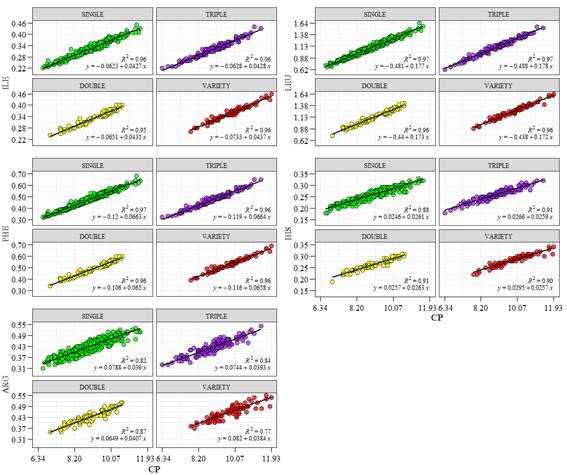
There was a positive and significant linear relationship between CP and amino acids, with variations in the degree of relationship between crossing types (Figures 4 and 5). The coefficient of determination ranged from 0.44 to 0.97 and was ≥ 0.72 for all maize crossing types in 10 of the 11 traits. Amino acids VAL, ILE, LEU, and PHE showed the highest degree of association with CP for all maize crossing types, as observed by the high coefficients of determination (0.93 ≤ R² ≤ 0.97). However, a low degree of association between LYS and CP was observed for all maize crossing types, with a coefficient of determination ≤ 0.58.

Data variability (n = 773 samples) represented by two principal components stratified by four cross-types and ten sowing dates. RSFF: cumulative global solar radiation from sowing to female flowering, in MJ m-2; RFFH: cumulative global solar radiation from female flowering to harvest, in MJ m-2; SSFF: thermal sum from sowing to female flowering, °C day; SFFH: thermal sum from female flowering to harvest, in °C day; cumulative rainfall from sowing to female flowering (PSFF, mm); and cumulative rainfall from female flowering to harvest (PFFH, mm). Larger circles correspond to the average performance of each group. Date1: 09/21/2021; Date2: 10/20/2021; Date3: 11/20/2021; Date4: 12/20/2021; Date5: 01/30/2022; Date6: 09/06/2022; Date7: 10/14/2022; Date8: 11/24/2022; Date9: 12/30/2022; Date10: 02/06/2023.

Simple linear regression between crude protein (CP, g 100 g-1) (x) and lysine (LYS, g 100 g-1), methionine (MET, g 100 g-1), cystine (CYS, g 100 g-1), threonine (THR, g 100 g-1), tryptophan (TRP, g 100 g-1), and valine (VAL, g 100 g-1) for single-cross, triple-cross and double-cross hybrids and open-pollinated varieties sown on ten sowing dates in the 2021/2022 and 2022/2023 seasons. The parameters of all simple linear regression models were significant by the Student’s t-test at 5%.

Simple linear regression between crude protein (CP, g 100 g-1) (x) and isoleucine (ILE, g 100 g-1), leucine (LEU, g 100 g-1), phenylalanine (PHE, g 100 g-1), histidine (HIS, g 100 g-1), and arginine (ARG, g 100 g-1) for single-cross, triple-cross and double-cross hybrids and open-pollinated varieties sown on ten sowing dates in the 2021/2022 and 2022/2023 seasons. The parameters of all simple linear regression models were significant by the Student’s t-test at 5%.
Triple-cross and double-cross hybrids showed higher angular coefficients for amino acids THR, LEU, and PHE and MET, CYS, ARG, and HIS. OPVs showed higher angular coefficients for amino acids LYS, TRP, VAL, and ILE. All traits were evaluated using the same unit of measurement, ensuring the comparability of the results.
Discussion
Variability of protein-nutritional traits
Many factors contribute to the variability in the composition of amino acids and CP in maize grains. Therefore, it was predicted that the use of a range of sources of maize grain samples could capture much of the existing variability. This enabled the development of an acceptable prediction since the study was based on 773 maize grain samples from 4 crossing types cultivated at 10 sowing dates.
The lowest values for LYS, MET, and TRP and the highest values for LEU may be associated with the storage proteins in maize grains. Storage proteins, especially zein, contribute more than 60% to the amino acid composition in maize grains but have low quality due to the limitations of essential amino acids, such as LYS, MET, and TRP (Shewry, 2007). The results of this study revealed the influence of sowing date and crossing type on protein-nutritional traits in maize, with variations between the 2021/2022 and 2022/2023 seasons. This indicates that the growing environment affects the expression of the genes responsible for amino acid synthesis. Studies have reported variation in the protein-nutritional composition of grains in maize between sowing dates (Mehta et al., 2020), endosperm types (Álvares-Iglesias et al., 2021), soil water conditions (Guo et al., 2023), and biotechnological events (Vidal et al., 2024) and in wheat between cultivation environments and genotypes (Loro et al., 2023). However, we found no studies evaluating the influence of crossing type on the expression of these traits.
The increase in RSFF and SSFF, combined with the reduction in PSFF and PFFH, favored the increase in CP and amino acids. This explains the higher means of the traits observed with sowing in October and November (> RSFF and RFFH and < PSFF and PFFH). This result is consistent with that observed by Safian et al. (2022), who reported that water deficit in maize plants increased the protein content of the grains. Water deficit after the emergence of maize stigmas reduced the enzymatic activities related to starch biosynthesis and increased the enzymatic activities involved in protein synthesis during the grain filling process, thus increasing the protein content in the grains (Guo et al., 2023). These results indicate the importance of synchrony between the maize development stage and environmental conditions, maximizing the accumulation of nutritional components.
The variability observed among the amino acids, especially ILE, LEU, and PHE, suggests the regulation of the synthesis of these components in response to cultivation conditions. The greater variability in LEU, PHE, and ILE may be related to the greater sensitivity of these amino acids to environmental factors, which affect plant metabolism. In addition, the variation pattern observed for amino acids with sowing on September 21, 2021 and February 6, 2022 promoting the greatest variations indicates that these dates may have provided variable environmental conditions, influencing nutritional trait stability.
After egg fertilization, the synthesis of certain amino acids in maize grains follows a pattern until maturity. Studies such as that by Mehta et al. (2020) have demonstrated a reduction in LYS and TRP contents from 20 days after pollination. This phenomenon was shown by Shrestha et al. (2022), who observed an initial reduction in THR, followed by an increase at 18 days after pollination. In contrast, MET showed a continuous and gradual decrease, while ARG, PHE, LYS, and HIS showed an initial increase up to 18 days after flowering, followed by a decrease. These patterns of amino acid synthesis explain the variation observed between environments. In addition to genotypes responding to variable environmental conditions, amino acids show distinct syntheses after pollination, resulting in amino acid-specific variability.
Regarding the crossing types, OPVs stood out with the highest means for all traits considering the 10 sowing dates, indicating the superior genetic potential for protein and amino acid synthesis. The superiority of the OPVs compared to the hybrids indicates greater phenotypic plasticity, enabling them to better adjust their metabolism in response to environmental variations. This is relevant for the choice of genetic materials for cultivation in regions subject to climate variability.
The negative relationship between CP and grain yield in maize (Alves et al., 2016; Alves & Cargnelutti Filho, 2017; Guo et al., 2023) indicates that the genetic improvement of maize to exclusively increase grain yield may lead to the indirect selection of plants with a lower protein content in the grains. In the present study, the lower CP and amino acid values, especially in single-cross hybrids, reflect this dynamic since the focus of the programs is on the selection and development of high-yield hybrids. Therefore, OPVs that maintain greater genetic variability present higher CP and amino acid contents in the grains, serving as essential sources of favorable alleles for nutritional quality.
All maize grain samples came from genotypes grown in the same cultivation area; thus, the differences in nutritional composition could not have been associated with soil physical or chemical characteristics or agronomic management. Genetic variability enables plant breeders to use this variation to develop superior genotypes that meet the nutritional demand for human or animal diets. The greater and lesser variability observed based on the sowing date and traits indicate that the environment strongly affects the expression of these traits. Knowledge of this variation is important to determine which environmental conditions promote these protein-nutritional traits in maize.
Models for amino acid prediction
Amino acid values can be predicted from the CP content. The predictions were highly accurate for all amino acids, except LYS. Therefore, the use of CP as a predictor of amino acid content can be efficient in the formulation of animal feed, particularly for regression models with R2 ≥ 0.80. The variability in CP and amino acids in maize grains contributes to the generalization of prediction models. These results suggest that maize crossing types respond differently to increased CP. In addition, all traits were evaluated with the same unit of measurement, ensuring comparable results.
The positive and significant linear relationship observed between CP and amino acids, especially for VAL, ILE, LEU, and PHE, indicates that the increase in CP is associated with an increase in the synthesis of these essential amino acids. The low linear relationship between CP and LYS, observed by the low coefficient of determination, suggests that LYS should be determined by other factors. Therefore, predicting LYS using CP cannot be done using linear models, and studies with non-linear models may be necessary. The low linear relationship between CP and LYS has also been reported in wheat (Olukosi & Adebiyi, 2013) and maize (Alves et al., 2016; Simões et al., 2023) and may be associated with the absence of LYS in the zein protein, which makes up more than 60% of the protein in the maize grain (Shewry, 2007). Models for predicting LYS based on CP have shown unsatisfactory results in maize and soybean (R² ≤ 0.20) (Sriperm et al., 2010; Alves et al., 2016). These results differ from those reported by Sheikhhasan et al. (2020), who observed a good fit for the regression model for LYS prediction based on 12 maize grain samples.
The different responses of the crossing types to the increase in CP, such as the higher angular coefficients observed for THR, LEU, and PHE in triple-cross hybrids and MET, CYS, ARG, and HIS in double-cross hybrids, indicate that the response profiles for CP are not uniform among the crossing types. This can be exploited in breeding programs to select genotypes that maximize the synthesis of specific amino acids in response to increased CP. Laboratory analysis of amino acids requires a high cost and long time for determination. Model development for predicting amino acids through CP can reduce costs and the time needed to evaluate genotypes in breeding programs. In addition, it makes it possible to improve the accuracy of diet formulation for poultry and pigs, which are generally formulated based on the average reference values of maize grains (Rostagno & Albino, 2024), without considering the variability among crossing types and cultivation conditions. This study also contributes to increasing the efficiency in feed formulation due to the mean values of CP and amino acids considering different maize crossing types and sowing dates.
The results indicate that an appropriate sowing date, associated with the selection of the crossing type, is important for optimizing the nutritional quality of maize under different cultivation conditions. This information is important for developing management and breeding strategies to obtain maize genotypes with high nutritional quality, especially in terms of protein and amino acids. From a practical perspective, the results provide technical guidance for the proper positioning of genetic materials in the field based sowing periods and environmental conditions, improving the efficiency of genotype recommendations and evaluations. In addition, the findings offer valuable insights for breeding programs seeking to develop superior genotypes with enhanced nutritional profiles. Further research should be conducted to determine variability and improve amino acid prediction models, especially for LYS prediction, for which prediction was less accurate. To our knowledge, no previous studies have evaluated the differences among maize crossing types in relation to the protein-nutritional composition of grains; therefore, this study is considered pioneering.
Conclusion
There is variation in the composition of crude protein, lysine, methionine, cystine, threonine, tryptophan, valine, isoleucine, leucine, histidine and arginine of the grains between single-cross, triple-cross and double-cross hybrids and OPVs and sowing dates. OPVs had the highest means of crude protein, lysine, methionine, cystine, threonine, tryptophan, valine, isoleucine, leucine, histidine and arginine in the grains, compared to single-cross, triple-cross and double-cross hybrids, regardless of the sowing date. Sowing carried out in October and November lead to higher means of crude protein, lysine, methionine, cystine, threonine, tryptophan, valine, isoleucine, leucine, histidine and arginine in maize grains, compared to sowing in September, December, January, and February, regardless of the cross-type. Methionine, cystine, threonine, tryptophan, valine, isoleucine, leucine, histidine and arginine in maize grains can be predicted from their crude protein with high precision, in single-cross, triple-cross and double-cross hybrids and open-pollinated varieties.
Data availability
The data can be provided by the authors upon prior request.
References
-
Alvares, C. A., Stape, J. L., Sentelhas, P. C., Moraes Gonçalves, J. L. & Parovek, G.. (2013). Köppen’s climate classification map for Brazil. Meteorologische Zeitschrift, 22(6), 711-728. https://doi.org/10.1127/0941-2948/2013/0507
» https://doi.org/https://doi.org/10.1127/0941-2948/2013/0507 -
Álvarez-Iglesias, L., Malvar, R. A., Garzón, R., Rosell, C. M. & Revilla, P.. (2021). Nutritional value of whole maize kernels from diverse endosperm types and effects on rheological quality. Agronomy, 11(12), 1-9. https://doi.org/10.3390/agronomy11122509
» https://doi.org/https://doi.org/10.3390/agronomy11122509 -
Alves, B. M. & Cargnelutti Filho, A.. (2017). Linear relationships between agronomic and nutritional traits in transgenic genotypes of maize. Journal of Cereal Science, 76, 35-41. https://doi.org/10.1016/j.jcs.2017.05.010
» https://doi.org/https://doi.org/10.1016/j.jcs.2017.05.010 -
Alves, B. M., Cargnelutti Filho, A., Burin, C. & Toebe, M.. (2016). Correlações canônicas entre caracteres agronômicos e nutricionais proteicos e energéticos em genótipos de milho. Revista Brasileira de Milho e Sorgo, 15(2), 171-185. https://doi.org/10.18512/1980-6477/rbms.v15n2p171-185
» https://doi.org/https://doi.org/10.18512/1980-6477/rbms.v15n2p171-185 - Arnold, C. Y.. (1960). Maximum-minimum temperatures as a basis for computing heat units. Proceedings of the American Society for Horticultural Science, 76, 682-692.
- Fancelli, A. L. & Dourado Neto, D. (2009). Milho: manejo e produtividade. ESALQ/USP Embrapa Arroz e Feijão.
-
Guo, J., Qu, L., Wang, L., Lu, W. & Lu, D.. (2023). Effects of post silking drought stress degree on grain yield and quality of waxy maize. Journal of the Science of Food and Agriculture, 103(3), 1530-1540. https://doi.org/10.1002/jsfa.12250
» https://doi.org/https://doi.org/10.1002/jsfa.12250 -
Loro, M. V., Carvalho, I. R., Cargnelutti Filho, A., Hoffmann, J. F. & Kehl, K.. (2023). Wheat grain biofortification for essential amino acids. Pesquisa Agropecuária Brasileira, 58, 1-4. https://doi.org/10.1590/S1678-3921.pab2023.v58.02860
» https://doi.org/https://doi.org/10.1590/S1678-3921.pab2023.v58.02860 -
Loro, M. V., Cargnelutti Filho, A., Reis, M. B., Andretta, J. A., Ortiz, V. M. & Schuller, B. R.. (2025). Desempenho fenotípico de bases genéticas de milho em relação às variáveis meteorológicas. Journal of Environmental Analysis and Progress, 10(1), 12-22. https://doi.org/10.24221/jeap.10.1.2025.6864.012-022
» https://doi.org/https://doi.org/10.24221/jeap.10.1.2025.6864.012-022 -
Mehta, B. K., Muthusamy, V., Baveja, A., Chauhan, H. S., Chhabra, R., Bhatt, V., Chand, G., Zunjare, R. U., Singh, A. K. & Hossain, F.. (2020). Composition analysis of lysine, tryptophan and provitamin-A during different stages of kernel development in biofortified sweet corn. Journal of Food Composition and Analysis, 94, 103625. https://doi.org/10.1016/j.jfca.2020.103625
» https://doi.org/https://doi.org/10.1016/j.jfca.2020.103625 -
Mohapatra, S. S., Bagchi, T. B., Mahanty, A., Adak, T., Panda, M. K. & Chattopadhyay, K.. (2025). Development of prediction models for high throughput phenotyping of protein and essential amino acids content in rice grain using the Near Infrared Reflectance Spectroscopy. Journal of Food Composition and Analysis, 142, 107453. https://doi.org/10.1016/j.jfca.2025.107453
» https://doi.org/https://doi.org/10.1016/j.jfca.2025.107453 -
Olukosi, O. A. & Adebiyi, A. O.. (2013). Chemical composition and prediction of amino acid content of maize-and wheat-distillers’ dried grains with soluble. Animal Feed Science and Technology, 185(3-4), 182-189. https://doi.org/10.1016/j.anifeedsci.2013.08.003
» https://doi.org/https://doi.org/10.1016/j.anifeedsci.2013.08.003 -
Oviedo-Rondón, E. O., Toscan, A., Fagundes, N. S., Vidal, J. K., Barbi, J. & Thiery, P.. (2024). Soybean meal nutrient composition, amino acid digestibility, and energy content according to the country of origin and year of harvest evaluated via NIRS. Journal of Applied Poultry Research, 33(3), 1-17. https://doi.org/10.1016/j.japr.2024.100448
» https://doi.org/https://doi.org/10.1016/j.japr.2024.100448 -
R Core Team. (2025). R: A language and environment for statistical computing. R Foundation for Statistical Computing. https://www.R-project.org
» https://www.R-project.org - Rostagno, H. S. & Albino, L. F. T. (2024). Tabelas brasileiras para aves e suínos. Composição de alimentos e exigências nutricionais 5. ed.. Embrapa Suínos e Aves.
-
Safian, N., Naderi, M. R., Torabi, M., Soleymani, A. & Salemi, H. R.. (2022). Corn (Zea mays L.) and sorghum (Sorghum bicolor (L.) Moench) yield and nutritional quality affected by drought stress. Biocatalysis and Agricultural Biotechnology, 45, 102486. https://doi.org/10.1016/j.bcab.2022.102486
» https://doi.org/https://doi.org/10.1016/j.bcab.2022.102486 -
Santos, H. G., Jacomine, P. K. T., Anjos, L. H. C., Oliveira, V. A., Lumbreras, J. F., Coelho, M. R., Almeida, J. A., Araújo Filho, J. C., Oliveira, J. B. & Cunha, T. J. F. (2018). Sistema Brasileiro de Classificação de Solos 5. ed.. Embrapa. https://www.infoteca.cnptia.embrapa.br/handle/doc/1094003
» https://www.infoteca.cnptia.embrapa.br/handle/doc/1094003 -
Shewry, P. R.. (2007). Improving the protein content and composition of cereal grain. Journal of Cereal Science, 46(3), 239-250. https://doi.org/10.1016/j.jcs.2007.06.006
» https://doi.org/https://doi.org/10.1016/j.jcs.2007.06.006 -
Sheikhhasan, B. S., Moravej, H., Ghaziani, F., Esteve-Garcia, E. & Kim, W. K.. (2020). Relationship between chemical composition and standardized ileal digestible amino acid contents of corn grain in broiler chickens. Poultry Science, 99(9), 4496-4504. https://doi.org/10.1016/j.psj.2020.06.013
» https://doi.org/https://doi.org/10.1016/j.psj.2020.06.013 -
Shrestha, V., Yobi, A., Slaten, M. L., Chan, Y. O., Holden, S., Gyawali, A., Flint-Garcia, S., Lipka, A. E. & Angelovici, R.. (2022). Multiomics approach reveals a role of translational machinery in shaping maize kernel amino acid composition. Plant Physiology, 188(1), 111-133. https://doi.org/10.1093/plphys/kiab390
» https://doi.org/https://doi.org/10.1093/plphys/kiab390 -
Simões, C. T., Vidal, J. K., Tyska, D., Mallmann, A. O., Madalosso, T. & Mallmann, C. A.. (2023). Assessment of field traits, nutrient composition and digestible amino acids of corns with different endosperm textures for poultry and swine. Animal Feed Science and Technology, 295, 115510. https://doi.org/10.1016/j.anifeedsci.2022.115510
» https://doi.org/https://doi.org/10.1016/j.anifeedsci.2022.115510 -
Sorsa, Z., Mohammed, W., Wegary, D. & Tarkegne, A.. (2023). Performances of three-way cross hybrids over their respective single crosses and related heterosis of maize (Zea mays L.) hybrids evaluated in Ethiopia. Heliyon, 9(5), 1-12. https://doi.org/10.1016/j.heliyon.2023.e15513
» https://doi.org/https://doi.org/10.1016/j.heliyon.2023.e15513 -
Sriperm, N., Pesti, G. M. & Tillman, P. B.. (2010). The distribution of crude protein and amino acid content in maize grain and soybean meal. Animal Feed Science and Technology, 159(3-4), 131-137. https://doi.org/10.1016/j.anifeedsci.2010.05.009
» https://doi.org/https://doi.org/10.1016/j.anifeedsci.2010.05.009 -
Vidal, J. K., Simões, C. T., Mallmann, A. O., Tyska, D., Pereira, H. V. & Mallmann, C. A.. (2024). A three-year study on the nutritional composition and occurrence of mycotoxins of corn varieties with different transgenic events focusing on poultry nutrition. Veterinary Sciences, 11(2), 1-14. https://doi.org/10.3390/vetsci11020097
» https://doi.org/https://doi.org/10.3390/vetsci11020097