 Dry matter and minerals in the aerial part of the banana tree ‘BRS SCS Belluna’
ABSTRACT.
Brazil is a large banana producer, and technological advances have resulted in gains in national productivity. Developing new cultivars is part of the technological package that ensures the success of this activity. Among these cultivars, the ‘BRS SCS Belluna’ banana tree launched in 2016 through a partnership between Embrapa and Epagri, presents important agronomic characteristics for the sector and appears to be an option for market diversification with its small, sweet fruit. Banana trees are plants with high rates of phytomass production, which is regulated by the mineral distribution between their organs and influences mineral cycling and export. Thus, the objective of this study was to evaluate the phytomass and minerals in the aerial part of the BRS SCS Belluna banana tree. Two production cycles were evaluated. The organs and tissues of the aerial part were separated into the pseudostem, inflorescence, stalk, leaves, peel, and pulp. The pulp had the highest dry matter content, and the pseudostem had the highest accumulation, resulting in an average cycling of 64% of the produced dry matter. Potassium and manganese were the most accumulated macro- and micronutrients in the organs and tissues evaluated, except for the leaves, where nitrogen and calcium were predominant. In general, the inflorescences and leaves had the highest mineral concentrations, whereas the pseudostem had the highest exports. The highest cycling rates were observed for calcium and magnesium (macronutrients) and manganese (micronutrient). The highest removal rates were observed for nitrogen and phosphorus (macronutrients) and boron (micronutrient).
Keywords:
Musa spp.; cycling and export; production.
Introduction
Brazil is the fourth largest banana producer in the world, and its production (6.75 million tons) is distributed throughout Brazil. Due to technological advances, Brazilian banana farming has experienced gains in productivity over the last two decades. Among these technological advances, new cultivars have been launched periodically to address adversities in the sector and meet consumer demand (Donato et al., 2021). In 2016, Embrapa, in partnership with Epagri, launched the ‘BRS SCS Belluna’ cultivar with small, nutritious, and sweet fruit, giving it the potential for commercialization via government purchases for schools and green fruit processing. The cultivar has shown resistance and moderate resistance to the sector’s main pests and diseases (Donato et al., 2021; Reis et al., 2019; Scherer et al., 2020).
From a morphophysiological perspective, the growth and development of higher green plants are regulated by source and sink relationships between their organs and/or tissues. This relationship is characterized by the direction of assimilate transport through the phloem (Epstein & Bloom, 2006; Fagan et al., 2016). For banana trees, the source and sink relationships vary depending on the phenological stage of the plant. In its initial stages, its leaf area quickly increases so that it can support the rapid and necessary growth of the pseudostem in the next stage. Subsequently, the leaves and pseudostem reserves are redistributed to the rhizome, which becomes the main drain, and redistributes its accumulation to the sucker and bunch in the next stage (Donato et al., 2021).
In addition to the importance of nutrient cycling and incorporation of organic matter into the system (Donato et al., 2021), knowledge of the minerals and dry matter mass present in the aerial part of the banana tree is important for providing researchers with subsidies from different background lines, which may allocate these organs or tissues to other purposes, depending on their capabilities, as alternative sources for animal and human food, plant nutrition, biofuels, cellulose, and effluent treatment (Barboza et al., 2024; Carvalho et al., 2014; Gerassev et al., 2013; Jiang et al., 2023; Phirke et al., 2001; Ramdhonee & Jeetah, 2017; Taib et al., 2021; Zaini et al., 2023).
We tested three hypotheses to determine the mass distribution of dry matter and minerals in the aerial part of the BRS SCS Belluna banana tree: i) the organs or tissues contribute equally to the content and accumulation of dry matter mass over two cycles; ii) the organs or tissues contribute equally to the mineral content and accumulation over two cycles; and iii) the minerals are present in equal amounts over two cycles in the organs and tissues of the shoot.
Material and methods
The experiment was conducted in the interior of the state of São Paulo, Brazil, 763 meters above sea level, with an annual average air temperature of 22oC and precipitation of 1,376 mm and a climate characterized by a hot, rainy summer and a cold, dry winter (Cunha & Martins, 2009; Franco et al., 2023). Based on granulometry, the soil was classified as loamy sand (up to 20 cm deep) or sandy loam (20-40 cm deep). Pre-planting chemical analysis indicated the following: pH CaCl, 5.4; organic matter, 11 g dm−3; Presin, 9.0 mg dm−3; sulfur (S), 2.0 mg dm−3; potassium (K), 1.08 mmolc dm−3; calcium (Ca), 16 mmolc dm−3; magnesium (Mg), 6.0 mmolc dm−3; iron (Fe), 32 mg dm−3; copper (Cu), 2.4 mg dm−3; manganese (Mn), 8.5 mg dm−3; zinc (Zn), 2.2 mg dm−3; boron (B), 0.2 mg dm−3; CTC, 38 mmolc dm−3; and V%, 60. Prior to planting, the experimental area was fallow and occupied with a mix of green manure species that were mowed and incorporated during soil preparation for the implementation of the experiment.
Micro-propagated seedlings of banana cultivar BRS SCS Belluna were used in this study. The seedlings were grown in a nursery for 60 days (40 days in a mini tunnel and 20 days in full sun) and transplanted to the field in December 2019. The spacing was 2.0 × 2.5 m (2,000 plants ha−1). Planting, formation, and summer fertilization were performed based on soil analyses (0-20 cm depth). Fertilizers were applied to each plant (family), and the doses were calculated based on the recommendations of Bulletin 200 (Teixeira et al., 2014). Thus, the following were applied: 80 kg P2O5 ha−1, 310 kg K2O ha−1, and 190 kg N (planting + training); 80 kg P2O5 ha−1, 150 kg K2O ha−1, and 190 kg N (summer 2020/21); 50 kg P2O5 ha−1, 150 kg K2O ha−1, and 190 kg N ha−1 (summer 2021/22); and 80 kg P2O5 ha−1, 150 kg K2O ha−1, and 190 kg N ha−1 (summer 2022/23). The sources used were thermophosphate (P), urea, ammonium sulfate (N), and potassium chloride (K). Ammonium sulfate was used in summer fertilization as a source of S to guarantee a dosage of 30 kg S ha−1 year−1 (Teixeira et al., 2014).
The experiment was conducted in a rainfed manner; however, due to the prolonged drought and its severity caused by an extension of the La Niña phenomenon (Gomes et al., 2021), a localized irrigation system was installed and managed via drip by gravity. The system was activated during the months with the lowest rainfall, that is, from April to September.
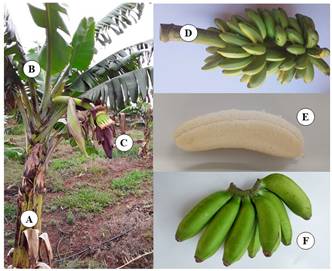
Two production cycles were monitored. The first cycle began in October 2021, and the second cycle began in the second half of 2022. The last evaluation was conducted in May 2023. The aerial part organs: leaves (limb + petiole), pseudostem, inflorescence (flower bud), stalk, peel, and pulp of the fruit were sectioned (Figure 1), washed with deionized water, dried at 65℃ for 60h, and ground in a knife mill. Samples of the pseudostem, leaf, stalk, peel, and pulp tissues were obtained at harvest. Inflorescence sampling was performed as a cultural treatment (inflorescence removal). The fruit was evaluated at the first stage of maturation, which, according to the Von Loesecke scale, had a completely green peel (Programa Brasileiro para a Modernização da Horticultura & Produção Integrada de Frutas, 2006).
Organs and tissues were analyzed for dry matter mass and minerals. Nitrogen (N), phosphorus (P), K, Mg, Ca, S, Mn, B, Fe, Zn, and Cu were determined following the method described by Malavolta et al. (1997). Dry matter mass was expressed based on its content (g 100 g−1), accumulation (g plant−1), production (kg ha−1), cycling (%), and removal (%). Minerals were expressed based on their content (mg 100 mg−1 or g 100 g−1), export (kg ha−1), cycling (%), and removal (%). For cycling, the accumulated values (dry matter or mineral mass) of the organs that were returned to the orchard soil after bunch harvest (i.e., pseudostem, inflorescence, leaf, and stalk) were considered. Therefore, the accumulated values (mass of dry matter or minerals) of the fruit tissues (i.e., peel and pulp) were considered for removal.
A completely randomized factorial design was used for statistical analysis. The factorial scheme for the first and second hypotheses was 6 × 2 with 6 organs or tissues (inflorescence, pseudostem, leaf, stalk, peel, and pulp) and 2 harvest cycles. For the third hypothesis, the factorial schemes were 6 × 2 for macronutrients (N, P, K, Ca, Mg, and S) and 5 × 2 for micronutrients (B, Cu, Fe, Mn, and Zn), evaluated in 2 harvest cycles (second factor). In all cases, 5 replicates were used, each consisting of 4 plants sampled from the same crop row for a total of 20 sampled plants per crop cycle. Thus, the means were subjected to analysis of variance, and when significant differences were found using the F test, they were subjected to the Scott-Knott mean test (p ≤ 0.05) using AgroStat software (Barbosa & Maldonado Junior, 2015).
Organs and tissues evaluated in the shoot of the ‘BRS SCS Belluna’ banana tree. Pseudostem (A), leaves (limb + petiole) (B), inflorescence (C), stalk (D), pulp (E), and peel (F).
Results and discussion
The pulp had the highest dry matter mass content and the second highest accumulation (Table 1), which were very close to those found by other authors in the BRS SCS Belluna banana pulp (i.e., 28.1 g 100 g−1) (Reis et al., 2019). After its appearance, the bunch becomes the plant’s main drain, and reserves from the leaves, pseudostems, and rhizomes contribute to fruit filling (Donato et al., 2021). Most of the dry matter mass of pulp is composed of starch, representing more than 90% of its total mass (Reis et al., 2019).
The pseudostem had the lowest dry matter mass content; however, because of its size in relation to the aerial part of the plant, it had the greatest accumulation (Table 1). The pseudostem is an organ that stores carbohydrates, minerals, and water. The pseudostem is the main storage organ for fresh (59.7%) and dry (33.1%) matter in relation to the total weight of the banana tree at harvest. After the appearance of the bunch, the appearance of leaves and, thus, the growth of the pseudostem cease. Therefore, this accumulation is important for the formation of a stem that is robust enough to support the weight of the bunch (Donato et al., 2021).
Content (g 100−1), accumulation (g plant−1), production (kg ha−1), percentage of cycling, and percentage of dry matter mass removal of organs and tissues of the aerial part of banana cultivar ‘BRS SCS Belluna’ and ordinal classification of this phytomass in organs and tissues, São Manuel, São Paulo State, Brazil, 2023.
The greater total production of the aerial parts obtained in the second cycle was due to the increase in pseudostem and pulp production (Table 1). The bunch and pseudostem are the organs that accumulate the largest amounts of dry matter mass at the time of harvest (Donato et al., 2021), and both continue to grow mainly in the interval between the first and third cycles, with the size stabilizing in later cycles (Oliveira e Silva et al., 2002). This accumulation in the bunch is driven by the pulp content (30.1%), which is more concentrated than that in the fruit peel (12.8%) (Aquino et al., 2017).
After 2 cycles, the fruit removed 3.01 t ha−1 of dry matter mass produced by the aerial parts, accounting for 36.1% of the total mass produced. Thus, the total cycling of the aerial part recorded at the time of harvest was 63.9% (5.34 t ha−1) (Table 1). Cycling of 66-80% of the dry plant mass at the time of harvest has been shown for the ‘Grande Naine’, ‘Pacovan’, ‘Prata-Anã’, and ‘Princesa’ cultivars (Donato, et al., 2021). Banana trees are the largest known herbaceous plants and have one of the highest biomass production rates among tropical perennial crops. The cycling of crop residues is important for the soil structure, providing protection against the impact of raindrops and supplying organic matter, which contributes to its physical and chemical properties. Its use has resulted in production gains (Donato et al., 2021).
In addition to the pseudostem, cycling is promoted by leaves, stalks, and inflorescences. Throughout their cycle, banana trees produce up to 60 leaves while they cease flowering. The number of leaves at harvest depends mainly on climatic conditions (wind, temperature, and precipitation) and management (fertilization, irrigation, defoliation, and disease). Leaves constitute the main photosynthetic organ of banana trees, promote plant growth, and are important for fruit filling, which in adequate numbers, provide greater production and better quality fruits (Donato et al., 2021; Rodrigues et al., 2009). The inflorescence of the banana tree (flower bud) is considered a drain of minerals and photoassimilates for most commercial cultivars. Therefore, its removal after the issuance of the last commercial hand is recommended to increase production and fruit quality (Donato et al., 2021). The stalk represented only 6.4% of the total dry mass of the bunches (Table 1). Other authors have shown relationships between the rachis mass and the bunch mass of 8% for the cultivar ‘Nanicão’ (AAA) and 6.7 to 7.3% for Cavendish-type cultivars (Kluge et al., 2000). The stalk is responsible for supporting male and female flowers, and its green color is due to chlorophyll synthesis in its cells (Donato et al., 2021); in general, its mass is positively correlated to the bunch mass, which is responsible for supporting the hands (Donato et al., 2006).
The mineral content of the aerial parts of the banana tree (Table 2) depends on ion uptake by the roots and transport and mobility in the phloem (Fagan et al., 2016). As with the leaves, the mother plant stopped emitting roots after the bunch. Thus, mineral absorption from the roots of the daughter plant begins to make a greater contribution to the clump and to the relationships between the source and sink for translocation to the fruit. This knowledge is important for the correct direction of fertilizers and for carrying out cultural practices, such as defoliation, thinning, and inflorescence removal (Donato et al., 2021).
Content and export of macro- and micronutrients to the different organs and tissues of the aerial parts of banana cultivar ‘BRS SCS Belluna’, São Manuel, São Paulo State, Brazil, 2023.
The inflorescence, pseudostem, and leaves stood out as the tissues that presented the highest mineral content or accumulation (Table 3). In general, the pseudostem was the place of the greatest export because of its high dry matter production, which was higher than that of other organs or tissues (Table 1).
The aerial parts exported the most K and Mn as macro- and micronutrients, respectively, while P and S were the least exported minerals (Table 4). K is the most abundant mineral in banana cells and is important for sugar transport and accumulation and fruit filling. Among the micronutrients analyzed, Cu had the lowest presence in the aerial parts, with B and Zn often deficient in banana plantations, limiting their production (Donato et al., 2021; Moreira & Fageria, 2009).
Although P is the macronutrient least required by banana plants, several studies have shown the importance of this nutrient for plant growth and for the physical and nutritional qualities of the fruit (Cândido et al., 2024). Furthermore, this mineral presents the lowest percentage of return to the soil after harvest for many cultivars, reflecting the fact that fruit are where P accumulates the most (Donato et al., 2021). This P content in the fruit reflects the removal of minerals, which, along with N, presented the highest values (Table 4). In addition, P and N are mobile in the phloem (Fagan et al., 2016; Lima et al., 2018) and, together with K, are the macronutrients with the highest retranslocation in banana trees (Donato et al., 2021).
Overall, Ca, Mg, and Mn were the nutrients with the highest return to the soil through the cycling of the aerial part of the banana tree (Table 4). This reflects the levels and accumulation of these minerals, mainly in the leaves and pseudostem. Leaves had the highest Ca content, whereas the pseudostem was the main accumulator (Table 3). Because it has low mobility in the phloem and depends on the transpiration flow for its transport in the xylem, Ca accumulates in tissues with greater transpiration (Fagan et al., 2016; Lima et al., 2018). In banana trees, these regions are the leaves, containing 45-66 stomata mm−2 (adaxial side) and 135-170 stomata mm−2 (abaxial side). Although low compared to that of the leaves, the banana pseudostem, with a stomatal density of 7-12 stomata mm−2, also performs gas exchange (Donato et al., 2021). Furthermore, it produced the highest dry matter mass from the aerial parts (Table 1).
The functions of Mg and Mn in plants are similar; however, Mn is present at much lower concentrations. Both are related to the chlorophyll molecule, synthesis, and/or structure and are moved by the transpiration current. However, unlike Ca, Mg is mobile in the phloem, whereas Mn has low mobility, which is why it is mainly concentrated in the leaves, where it is a micronutrient present in greater quantities (Dechen et al., 2018; Donato et al., 2021; Fagan et al., 2016; Lima et al., 2018). In addition to Mg being a structural part of the chlorophyll molecule, which partly explains its accumulation in green tissues, such as leaves and pseudostems, despite being mobile in the phloem, it presents biochemical cycling from 15.0% to almost 20% lower than that of the macronutrients N, P, and K (Donato et al., 2021), which corroborates the high cycling observed in the aerial part (Table 4).
With the exception of leaves, which mainly accumulated N and Ca, K levels were highest among the organs and tissues (Table 5). This reflects its absorption by banana trees, which, in general, are the nutrient most absorbed and quantitatively accumulated (Donato et al., 2021).
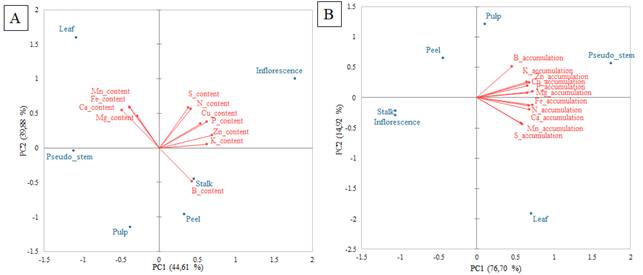
Principal component analysis explained 84.5% of the variation observed for content (Figure 2A) and 91.6% for mineral accumulation (Figure 2B). In general, the inflorescence and leaves were the primary sites of mineral concentration, while the pulp had the lowest concentration, followed by the pseudostem (Figure 2A). Unlike the results for content, mineral accumulation occurred predominantly in the pseudostem due to its high dry matter content. The leaves were the second most significant site of mineral accumulation, which can be attributed to the concentration and accumulation of dry mass in this organ. The sites with the lowest accumulation were inflorescence and stalk (Figure 2B).
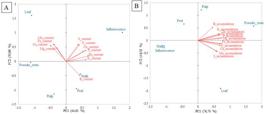
Principal component analysis of mineral content and accumulation in organs or tissues of the ‘BRS SCS Belluna’ banana plant.
Conclusion
The highest dry matter mass content was found in the pulp, whereas the pseudostem was responsible for the largest accumulation, which resulted in 64% dry matter mass cycling after two harvest cycles. Overall, K and Mn were the macro- and micronutrients accumulated the most in the aerial parts. Both accumulated in greater quantities in all organs or tissues evaluated, except for the leaves, which accumulated mainly N and Ca as macronutrients. The heart and leaves had the highest levels of most of the nutrients, whereas the pseudostem had the highest nutrient accumulation. The highest cycling rates for minerals occurred for Ca, followed by Mg for macro- and Mn for micronutrients. The highest removal rates were found for macronutrients N and P and micronutrient B.
Data availability
The data used in the research were made publicly available and can be accessed via the link https://docs.google.com/spreadsheets/d/1uBLUZxn2MeF5hOuP0KQImqtV3e6N7qRU/edit?gid=993507982#gid=993507982
Acknowledgements
Conselho Nacional de Desenvolvimento Científico e Tecnológico (Grant No: GD no. 140924/2020-5) .
References
-
Aquino, C. F., Salomão, L. C. C., Cecon, P. R., Siqueira, D. L. & Ribeiro, S. M. R.. (2017). Physical, chemical and morphological characteristics of banana cultivars depending on maturation stages. Revista Caatinga, 30(1), 87-96. https://doi.org/10.1590/1983-21252017v30n110rc
» https://doi.org/https://doi.org/10.1590/1983-21252017v30n110rc - Barbosa, J. C. & Maldonado Junior, W. (2015). Experimentação agronômica & AgroEstat: Sistemas para análises estatísticas e ensaios agronômicos. Gráfica Multipress Ltda.
-
Barboza, J. A. T., Penido, E. S. & Ferreira, G. M. D.. (2024). Production of surfactant-modified banana peel biosorbents applied to treatment and decolorization of effluents. Colloids and Surfaces A: Physicochemical and Engineering Aspects, 680, 132650. https://doi.org/10.1016/j.colsurfa.2023.132650
» https://doi.org/https://doi.org/10.1016/j.colsurfa.2023.132650 -
Cândido, H. T., Leonel, M., Nomura, E. S. & Leonel, S. (2024). O fósforo no cultivo de bananeiras. In E. D. Santos, M. S. Barbosa & R. G. Mello (Orgs.), Ciências agrárias e da natureza: novas abordagens para a coexistência e o desenvolvimento sustentável (1. ed., pp. 212-228). Editora e-Publicar. https://doi.org/10.47402/ed.ep.c240217820935
» https://doi.org/https://doi.org/10.47402/ed.ep.c240217820935 -
Carvalho, C. S. M., Sales-Campos, C., Aguiar, L. V. B., Minhoni, M. T. A. & Andrade, M. C. N.. (2014). Composição mineral de substratos à base de resíduos de bananeira durante o cultivo de Pleurotus ostreatus. Arquivos do Instituto Biológico, 81(3), 272-281. https://doi.org/10.1590/1808-1657000522012
» https://doi.org/https://doi.org/10.1590/1808-1657000522012 -
Cunha, A. R. & Martins, D.. (2009). Classificação climática para os municípios de Botucatu e São Manuel, SP. Irriga, 14(1), 1-11. https://doi.org/10.15809/irriga.2009v14n1p1-11
» https://doi.org/https://doi.org/10.15809/irriga.2009v14n1p1-11 - Dechen, A. R., Nachtigall, G. R., Carmello, Q. A. C., Santos, L. A. & Sperandio, M. V. L. (2018). Micronutrientes. In M. S. Fernandes, S. R. Souza & L. A. Santos (Orgs.), Nutrição mineral de plantas (2. ed., pp. 491-562). Sociedade Brasileira de Ciência do Solo.
- Donato, S. L. R., Borém, A. & Rodrigues, M. G. V. (2021). Banana: do plantio à colheita. Epamig.
-
Donato, S. L. R., Oliveira e Silva, S., Lucca Filho, O. A., Lima, M. B., Domingues, H. & Alves, J. S.. (2006). Correlações entre caracteres da planta e do cacho em bananeira (Musa spp). Ciência e Agrotecnologia, 30(1), 21-30. https://doi.org/10.1590/S1413-70542006000100003
» https://doi.org/https://doi.org/10.1590/S1413-70542006000100003 - Epstein, E. & Bloom, A. J. (2006). Nutrição mineral de plantas: princípios e perspectivas (2. ed.). Editora Planta.
- Fagan, E. B., Ono, E. O., Rodrigues, J. D., Soares, L. H. & Dourado Neto, D. (2016). Fisiologia vegetal: metabolismo e nutrição mineral. Editora Andrei.
-
Franco, J. R., Dal Pai, E., Calça, M. V. C., Raniero, M. R., Dal Pai, A., Sarnighausen, V. C. R. & Sánchez-Román, R. M.. (2023). Update of climatological normal and Köppen climate classification for the municipality of Botucatu-SP. Irriga, 28(1), 77-92. https://doi.org/10.15809/irriga.2023v28n1p77-92
» https://doi.org/https://doi.org/10.15809/irriga.2023v28n1p77-92 - Gerassev, L. C., Moreira, S. J. M., Alves, D. D., Aguiar, A. C. R., Monção, F. P., Santos, A. C. R., Santana, C. J. L. & Viegas, C. R. (2013). Viabilidade econômica da utilização dos resíduos da bananicultura na alimentação de cordeiros confinados. Revista Brasileira de Saúde e Produção Animal, 14(4), 734-744.
-
Gomes, M. S., Cavalcanti, I. F. A. & Muller, G. V.. (2021). 2019/2020 drought impacts on South America and atmospheric and oceanic influences. Weather and Climate Extremes, 34, 1-13. https://doi.org/10.1016/j.wace.2021.100404
» https://doi.org/https://doi.org/10.1016/j.wace.2021.100404 -
Jiang, F., Cao, D., Zhang, Y., Hu, S., Huang, X., Ding, Y., Wu, C., Li, Y., Ding, Y. & Liu, K. (2023). Combustion of the banana pseudo-stem hydrochar by the high-pressure CO₂-hydrothermolysis: Thermal conversion, kinetic, and emission analyses. Fuel, 331(Part 2), 125798. https://doi.org/10.1016/j.fuel.2022.125798
» https://doi.org/https://doi.org/10.1016/j.fuel.2022.125798 -
Kluge, R. A., Scarpare Filho, J. A., Victória Filho, R. & Jacomino, A. P.. (2000). Produção e relação ráquis/cacho da bananeira ‘Nanicão’ em diferentes densidades e arranjos de plantio. Pesquisa Agropecuária Brasileira, 35(9), 1759-1764. https://doi.org/10.1590/S0100-204X2000000900008
» https://doi.org/https://doi.org/10.1590/S0100-204X2000000900008 - Lima, E., Vitti, G. C., Santos, L. A. & Cicarone, F. (2018). Cálcio e magnésio. In M. S. Fernandes, S. R. Souza & L. A. Santos (Orgs.), Nutrição mineral de plantas (2. ed., pp. 465-490). Sociedade Brasileira de Ciência do Solo.
- Malavolta, E., Vitti, G. C. & Oliveira, S. A. (1997). Avaliação do estado nutricional das plantas: princípios e aplicações (2. ed.). Potafos.
-
Moreira, A. & Fageria, N. K.. (2009). Repartição e remobilização de nutrientes na bananeira. Revista Brasileira de Fruticultura, 31(2), 574-581. https://doi.org/10.1590/S0100-29452009000200036
» https://doi.org/https://doi.org/10.1590/S0100-29452009000200036 -
Oliveira e Silva, S., Flores, J. C. O. & Lima Neto, F. P.. (2002). Avaliação de cultivares e híbridos de bananeira em quatro ciclos de produção. Pesquisa Agropecuária Brasileira, 37(11), 1567-1574. https://doi.org/10.1590/S0100-204X2002001100007
» https://doi.org/https://doi.org/10.1590/S0100-204X2002001100007 - Programa Brasileiro para a Modernização da Horticultura & Produção Integrada de Frutas (2006). Normas de classificação de banana. CEAGESP.
-
Phirke, N. V., Patil, R. P., Chincholkar, S. B. & Kothari, R. M.. (2001). Recycling of banana pseudostem waste for economical production of quality banana. Resources, Conservation and Recycling, 31(4), 347-353. https://doi.org/10.1016/S0921-3449(00)00092-6
» https://doi.org/https://doi.org/10.1016/S0921-3449(00)00092-6 -
Ramdhonee, A. & Jeetah, P.. (2017). Production of wrapping paper from banana fibres. Journal of Environmental Chemical Engineering, 5(5), 4298-4306. https://doi.org/10.1016/j.jece.2017.08.011
» https://doi.org/https://doi.org/10.1016/j.jece.2017.08.011 -
Reis, R. C., Viana, E. S., Assis, S. L. F., Sena, L. O., Souza, A. S. & Amorim, E. P.. (2019). Promising green banana and plantain genotypes for making flour. Pesquisa Agropecuária Brasileira, 54, 1-9. https://doi.org/10.1590/S1678-3921.pab2019.v54.01303
» https://doi.org/https://doi.org/10.1590/S1678-3921.pab2019.v54.01303 -
Rodrigues, M. G. V., Dias, M. S. C. & Pacheco, D. D.. (2009). Influência de diferentes níveis de desfolha na produção e qualidade dos frutos da bananeira ‘Prata-anã’. Revista Brasileira de Fruticultura, 31(3), 755-762. https://doi.org/10.1590/S0100-29452009000300019
» https://doi.org/https://doi.org/10.1590/S0100-29452009000300019 -
Scherer, R. F., Lichtemberg, L. A., Maro, L. A. C., Beltrame, A. B., Klabunde, G. H. F., Sônego, M., Peruch, L. A. M., Amorim, E. P., Serejo, J. A. S., Ferreira, C. F. & Haddad, F. (2020). BRS SCS Belluna - a new banana cultivar for processing and fresh consumption. Agropecuária Catarinense, 33(1), 32-37. https://doi.org/10.52945/rac.v33i1.532
» https://doi.org/https://doi.org/10.52945/rac.v33i1.532 -
Taib, R. M., Abdullah, N. & Aziz, N. S. M.. (2021). Bio-oil derived from banana pseudo-stem via fast pyrolysis process. Biomass and Bioenergy, 148, 106034. https://doi.org/10.1016/j.biombioe.2021.106034
» https://doi.org/https://doi.org/10.1016/j.biombioe.2021.106034 - Teixeira, L. A. J., Nomura, E. S., Damatto Junior, E. R. & Fuzitani, E. J. (2014). Banana Musa spp. In A. T. E. Aguiar, C. Gonçalves, M. E. A. G. Z. Paterniani, M. L. S. Tucci & C. E. F. Castro (Eds.), Instruções agrícolas para as principais culturas econômicas (7. ed., pp. 46-51). Instituto Agronômico de Campinas.
-
Zaini, H. M., Saallah, S., Roslan, J., Sulaiman, N. S., Munsu, E., Wahab, N. A. & Pindi, W.. (2023). Banana biomass waste: A prospective nanocellulose source and its potential application in food industry - A review. Heliyon, 9(8), 1-16. https://doi.org/10.1016/j.heliyon.2023.e18734
» https://doi.org/https://doi.org/10.1016/j.heliyon.2023.e18734
Edited by
-
Associate Editor in charge:
Alessandro Lucca BracciniCarlos Alberto Scapim