 A simple approach for obtaining unsaturated hydraulic conductivity based on the soil water content
ABSTRACT.
Knowledge of soil hydraulic conductivity is indispensable due to its application in studies of soil water dynamics, water balance, and irrigation management in crops that directly affect water and soil conservation. The objective of this study was to propose two alternatives for determining unsaturated hydraulic conductivity using existing methodologies in the literature based on the variation in soil moisture and water storage monitored using a moisture sensor in a drainage lysimeter and under field conditions. Two experiments were conducted, one in a drainage lysimeter and the other in the field at Embrapa Cassava and Fruit Farming, Cruz das Almas, Bahia State, Brazil. A comparison of moisture and storage variation between the proposed methodologies was carried out based on statistical coefficients. The methods based on moisture and storage variation in a layer estimated the unsaturated hydraulic conductivity with good accuracy compared to Hillel’s method. Hydraulic conductivity showed greater variation in the initial phase of water redistribution in the soil, either in the lysimeter test or in the field application after irrigation. The proposed methods based on moisture and storage variation can be applied to studies on soil water dynamics in the soil moisture profile using soil water sensors.
Keywords:
variation in average moisture; water storage; moisture sensor; water redistribution
Introduction
Unsaturated hydraulic conductivity (K(θ)) is a property of great importance for studies on soil water dynamics aiming at practical aspects such as the soil-water-plant relationship, which are very useful in irrigation water management, drainage, modeling of hydro-agricultural processes, and modeling of water movement in watersheds. Unsaturated hydraulic conductivity can be determined or estimated using direct and indirect methods. The direct method known as the instantaneous profile method for the determination of K(θ) under field conditions was proposed by Hillel et al. (1972), whose method is based on the process of internal drainage with the absence of flow on the soil surface. The application of this method consists of measuring soil moisture profiles with sensors that do not destroy the site’s structure and measuring the matric potential in these profiles directly with tensiometers to determine the potential gradient. The internal soil drainage process is slowed down over time, and the values of soil water storage, potential, and soil moisture (θ) can be explained mathematically by a linear function (Reichardt & Timm, 2022). Other authors have used the instantaneous profile of Hillel et al. (1972) to evaluate saturated hydraulic conductivity (Ghiberto & Moraes, 2011; Libardi et al., 1980).
Among the indirect methods, several are determined using data obtained in the laboratory from the soil water retention curve fitted using the van Genuchten (1980) model. Several approximations for estimating unsaturated hydraulic conductivity have been found in the literature (Karim et al., 2011; Lo et al., 2013; Rudiyanto et al., 2020; Usowicz et al., 2024). Other models predict unsaturated hydraulic conductivity, including EMFX-K (Wang et al., 2017) and fractal-based models (Alfaro Soto et al., 2017).
Hydraulic conductivity estimation methods predict values using daily scales (Ghanbarian & Hunt, 2017). However, research on soil water dynamics on short time scales, applied, for example, in water flow, have the potential to generate erroneous estimates that can compromise the accuracy of soil water balance estimates (Sousa, 2011). Working with drainage lysimeters using the instantaneous profile method, Silva and Coelho (2014) obtained estimates of percolation at a time scale of less than 24 h. Although there are methods in the literature for determining the hydraulic conductivity of unsaturated soil, methods based on simpler measurements, such as soil moisture, present themselves as good alternatives, given the easy access and availability of equipment for determining soil moisture directly.
The present study presents an approach for determining the unsaturated hydraulic conductivity based on the water flow defined by the Darcy-Buckingham equation. Equation 1 (Reichardt & Timm, 2022) represents the general form of unsaturated hydraulic conductivity, a function of water flow in the soil at a given time from a change in the total water potential at two points at a distance z from each other.
(1)
where θ is the soil water content (cm³ cm−3); t is time; H is the total water potential; and z is depth.
The numerator of Equation 1 refers to the water flow in the 0-z profile, which represents only the vertical flow under the conditions of Hillel’s internal drainage method, with the soil surface covered. The present study used this methodology proposed by Hillel et al. (1972), with two propositions to determine the function of unsaturated hydraulic conductivity, adding the possibility of determining K(θ) below the root zone even under unsaturated conditions with localized irrigation. The propositions consider that hydraulic conductivity can be estimated from soil moisture monitoring profiles consisting of moisture sensor grids with a representative number of sensors, according to Silva and Coelho (2013), who worked with drainage lysimeters with sandy clay soil and found that time-domain reflectometry (TDR) probes are sufficient to estimate percolation in the profile. When evaluating K(θ) under unsaturated field conditions in the presence of crops, the sensors should be positioned in a soil profile grid at an effective root system depth and below it, making it possible to monitor drainage losses below the root zone.
Thus, in addition to TDR probes, other indirect soil moisture meters can be used, such as frequency domain reflectometry (FDR) probes, including capacitance probes, tensiometers, neutron probes, and other indirect moisture sensors, which may or may not be coupled to an automatic data acquisition system. Thus, it is possible to select sensors with smaller acquisition costs, considering the number that will make up the sampling points of the profile. Flow calculation need to be delimited in a soil profile with at least two points of soil moisture monitoring, zi and zi+1, so the flow is the variation of the average moisture of the two depths or layers (Δz = zi+1 − zi) at time 2 (ti+1) and 1 (ti) over the variation of elapsed time (Equation 2).
(2)
where water flow (mm h−1); Δz is the depth of the soil layer (mm); ∆t is the time variation between moisture readings (hours); θ̄ tj is the average soil moisture calculated at time j (m³ m−3); and θ̄ tj+1 is the average soil moisture calculated at time j+1 (m³ m-³) or Equation 3:
(3)
Another way to evaluate the flow is to calculate the water depth stored at the 0−z depth of the soil, which is used in the estimation of unsaturated hydraulic conductivity using the instantaneous profile. In this proposal, the variation in water storage in the zi-zi+1 layer of the soil profile is obtained from storage in zi (Equation 4) and zi+1 (Equation 5) at time tj and from storage in zi (Equation 6) and zi+1 (Equation 7) at time tj+1. The water flow (q) that passes through a given depth can be estimated by the difference between the storage differences in the zi-zi+1 layer in the interval tj-tj+1 (Equation 8). Hydraulic conductivity was estimated by dividing the flow by the hydraulic gradient.
(4)
(5)
(6)
(7)
(8)
where Stj zi is the soil water storage in layer 0-zi (mm) at time tj (h); θ is the soil moisture (cm3 cm−3) at times tj and tj+1; and q is the water flow in the soil layer (mm h−1).
The advantage of this approach is the applicability under conditions used in the instantaneous profile method (Hillel et al., 1972) and under unsaturated conditions, including in the presence of the crop, in which case the approximation is applied to the layer below the effective root zone. In this layer, water absorption by plants and capillary rise due to evaporation on the soil surface is disregarded; that is, vertical flow is assumed to be only subject to gravitational gradients.
In both flow propositions, potentials are calculated from the soil moisture data at each depth with the fitted parameters from the van Genuchten (1980) model (Tables 1, 2, and 3) by Equation 9 for the zi and zi+1 depths, which are the limits of the soil profile layers evaluated.
(9)
where θ is the volumetric moisture (cm3 cm−3); h is the matric (cm H2O); θr and θs are the residual and saturation volumetric moisture (cm3 cm−3); and α, m, and n are model fitting parameters.
The potential gradient is calculated at time tj and tj+1 for depths zi and zi+1 (Equations 10, 11, and 12).
(10)
(11)
(12)
where ∆H is the potential gradient; and h̄ is the soil water potential (cm H2O).
The unsaturated hydraulic conductivity K(θ) is obtained by the Darcy-Buckingham equation by dividing the flow of water that passes through layer zi-zi+1 by the hydraulic gradient ∆H. Equations 13 and 14.
(13)
(14)
Thus, the present study aimed to propose an approximation for determining the unsaturated hydraulic conductivity based on (i) the variation in the soil moisture content in the discretization of soil layers and (ii) the variation in storage in the soil profile.
Material and methods
Characterization of experiments
The study was carried out in the experimental area (12º48' S; 39º06' W; 225 m) at Embrapa Cassava and Fruits in Cruz das Almas, Bahia State, Brazil, in two experiments, one in a drainage lysimeter and the other in an experimental area, both with banana crops.
The lysimeter was filled with sandy clay soil, which showed the following attributes and physical characteristics in the 0.20-0.40 m layer: bulk density (BD), 1.41 g cm−3; sand content, 514 g kg−1; silt content, 101 g kg−1; and clay content, 385 g kg−1. In the 0.40-0.60 m layer, the values were as follows: BD, 1.46 (g cm−3); sand content, 476 g kg−1; silt content, 99 g kg−1; and clay content, 425 g kg−1. In the 0.60-0.80 m layer, the values were as follows: BD, 1.34 (g cm−3); sand content, 514 g kg−1; silt content, 71 g kg−1; and clay content, 415 g kg−1 (Teixeira et al., 2017). Soil water retention of the lysimeter for different tensions and van Genuchten’s model parameters are presented in Table 1.
In the 0-0.20 m layer, the classification of the soil under field conditions was sandy clay loam with the following physical characteristics: total sand, 571 g kg−1; silt, 103 g kg−1; clay, 290 g kg−1; and BD, 1.65 g cm-³. In the 0.40-0.70 m layer, the characteristics were as follows: total sand, 600 g kg−1; silt, 77 g kg−1; clay, 323 g kg−1; and BD, 1.43 g cm-3 (Teixeira et al., 2017). The values of water retention in the soil and the parameters of van Genuchten’s (1980) model are presented in Table 2.
Soil moisture (cm³ cm−3) in the lysimeter for the different tensions in sandy clay soil to obtain the parameters of van Genuchten’s (1980) model. Source: Conceição et al. (2017).
Soil moisture (cm3 cm−3) in the field for the different tensions in sandy clay soil to obtain the parameters of van Genuchten’s (1980) model in the experimental area.
Tests to determine hydraulic conductivity in the lysimeter and in the field
Soil moisture collection was performed continuously using a lysimeter with an automatic data acquisition system every 20 min. and a TDR100 reflectometer connected to a datalogger and multiplexers. Three-rod probes, 0.10 m long each, were installed within the soil profiles, representing two-dimensional planes, with horizontal distances of 0.20, 0.40, 0.60, and 0.80 m from the center of the lysimeter and at depths of 0.20, 0.40, 0.60, and 0.80 m, totaling 16 sensors per grid. Tensiometers were installed at depths of 0.10, 0.30, 0.50, and 0.70 m to determine the matric potential (Equation 9). The TDR calibration curve for the soil of the experiment followed the methodology described by Silva and Coelho (2013) (Equation 15).
θ=6E - 5Ka3 - 0.0032Ka2 + 0.0631Ka-0.242 R² = 0.980 (15)
where θ is the soil moisture (cm3 cm−3); and Ka is the soil dielectric constant.
At the beginning of the experiment, an internal water redistribution test was conducted in the soil without plants using the lysimeter (Hillel et al., 1972). Saturation was performed until a hydraulic head of 0.05 m was maintained on the surface of the soil and then covered with plastic tarpaulin to prevent water evaporation. Then, the test was carried out with moisture readings every 20 min. using the automatic data acquisition system and the collection of drained water volumes according to the methodology described by Conceição et al. (2017) to determine the k(θ) function. The methods of k(θ) determination with the flow obtained by the moisture difference in the Δz layer and with the flow obtained by the storage difference in the same layer were employed using an instantaneous profile test.
Unsaturated hydraulic conductivity was determined using a lysimeter cultivated with the ‘Prata Gorutuba’ banana. Soil moisture was collected between two irrigation events with a one-day interval. The data were used to generate the k(θ) functions, which were applied separately for depths of 0.40-0.60 and 0.60-0.80 m. Irrigation was performed by micro-sprinklers with a fixed flow rate of 56 L h−1, with 3 sprinklers on each side of the plant and a Christiansen’s uniformity coefficient of 89%.
Unsaturated hydraulic conductivity was determined in an area cultivated with banana cv ‘BRS Princesa’ in a 2.50 × 2.50 m spacing. Irrigation was applied by a drip system with three emitters per plant with a flow rate of 4.0 L h−1 and by a micro-sprinkler with a flow rate of 64 L h−1 positioned in the middle of four plants in an irrigation line between two plant rows. The distribution uniformity coefficient was of 90%. Water replacement was based on the maximum reference evapotranspiration (ETo) according to Allen et al. (2006), obtained from an automatic weather station located in the experimental area.
Unsaturated hydraulic conductivity in the field was determined in 48-h intervals between two irrigation events in drip- and micro-sprinkler-irrigated treatments in soil covered with banana straw. In the calculation of the flow by storage differences, it was assumed that no evaporation occurred in the covered soil, only losses due to water extraction from the soil by plant roots in the 0.0-0.60 m layer and losses due to deep drainage outside the root system in the 0.60-0.80 m layer (Santos et al., 2016). TDR probes were installed in soil profiles in the planting row between two plants for the drip irrigation system and between the plant and the micro-sprinkler for the micro-sprinkler system. The distances from the plant were 0.25, 0.5, 0.75, and 1.0 m, and depths were 0.20, 0.40, 0.60, and 0.80 m, totaling 16 units. The calibration curve of the TDR probe for the soil of the area corresponded to a 3rd degree polynomial equation, with R² = 0.9916 (Equation 16).
θ= 5.65E - 5Ka3 - 0.0035160Ka2 + 0.0804390Ka - 0.4327136 (16)
Soil moisture was monitored during the field experiment by a TDR equipment connected to a datalogger in an automatic data collection system, with an average reading every 15 min.
Unsaturated hydraulic conductivity was estimated using the flow obtained by the moisture difference during a time, flow by moisture storage difference, and van Genuchten’s model methods. The depths considered for the flow determined by moisture difference (Equations 2 and 3) and by van Genuchten’s model were 0.40-0.60 and 0.60-80 m, which were outside the region of greater water extraction by the roots (Sant’ana et al., 2012; Santos et al., 2016). The flow obtained by the storage difference (Equations 4 and 8) corresponded to the depths of 0.0-0.60 and 0.0-0.80 m.
The hydraulic conductivity of the soil in the lysimeter was determined following the method described by Hillel et al. (1972), applied to the data of an internal water redistribution test in the drainage lysimeter, in the absence of cultivation. In the redistribution test, the hydraulic conductivity was determined separately at depths of 0.20-0.40 and 0.40-0.60 m. Equations 2 and 3 were used to determine the K(θ) functions by the variation in moisture in the zi−zi+1 layer, as described in the proposition. (Equations 4 and 8) were used to determine the K(θ) functions by the storage variation in the zi-zi+1 layer.
Evaluation of unsaturated hydraulic conductivity using the propositions to obtain water flow by average moisture and water storage in the soil
Unsaturated hydraulic conductivity estimates were validated by the propositions soil moisture variation (∆θ), soil water storage variation (∆S), and hydraulic conductivity estimated following the method described by Hillel et al. (1972). K(θ) functions resulting from Hillel’s method and from the propositions obtained during the internal water redistribution test in the soil were applied to the moisture data measured during the banana cultivation in the lysimeter in a total of four replicates, within the moisture ranges for which the functions were fitted.
The unsaturated hydraulic conductivity estimates obtained by the propositions were compared between themselves by the following statistical indicators: (i) root mean squared error (RMSE), (ii) mean absolute error (MAE), and (iii) standard deviation of squared error (SDSE) according to Equations 17 and 19, respectively, and by the Student’s t-test.
(17)
(18)
(19)
where Oi is the value estimated by the instantaneous profile method; and Ee is the value estimated by the methods for obtaining the flow.
The validated propositions were used both in the soil of the lysimeter and in the unsaturated and covered soil of the field under drip and micro-sprinkler irrigation conditions.
Evaluation of unsaturated hydraulic conductivity by van Genuchten’s method
Unsaturated hydraulic conductivity was also determined with van Genuchten’s (1980) model from the fitted parameters of the model for evaluation in comparison to the model of Hillel et al. (1972) (Equations 20 and 21).
(20)
(21)
where θe is the effective saturation (cm3 cm−3); θr is the residual moisture (cm3 cm−3); θs is the saturation moisture (cm3 cm−3); and θ is the soil moisture (cm3 cm−3).
Van Genuchten’s method was applied to soil moisture data from the lysimeter and the field used in the application of the ∆θ and ∆S methods during the cultivation season to check the proximity of the proposed methodologies and van Genuchten’s method in relation to the method of Hillel et al. (1972). The comparison was also carried out based on RMSE, MAE, and SDSE.
Results and discussion
K(θ) by moisture variation (Δθ) and storage variation (ΔS) in soil profile layers with a drainage lysimeter
The propositions for estimating the unsaturated hydraulic conductivity, K(θ), showed satisfactory performance compared to the method described by Hillel et al. (1972) in the test of the internal redistribution of water in the soil.
The soil-moisture variation method led to RMSE, SDSE, and MAE values of 0.32 mm h−1, 0.41 mm h−1, and 10.1%, respectively, within the 0.20-0.40 m layer. The K(θ) estimate by the moisture variation in the layer showed a small error, with RMSE, SDSE, and MAE values of 0.27 mm h−1, 0.34 mm h−1, and 7.0%, respectively. Considering the storage variation method, the differences were more significant, with an MAE of 26.82% (Table 3).
Evaluation of the estimate of hydraulic conductivity (mm h−1) in drainage lysimeters from the methods determining soil moisture variation (∆θ) and soil water storage variation (∆S) in relation to the method of Hillel et al. (1972) at depths of 0.20-0.40 and 0.40-0.60 m.
The coefficients shown by the proposed methods can be applied to determine K(θ). However, the differences in K(θ) compared to the method of Hillel et al. (1972), which was considered the standard, can be attributed to variations in the volumetric water content of the soil, as observed by Ghiberto and Moraes (2011). When using different methods to estimate hydraulic conductivity, these authors observed that variations in soil moisture alter the parameters of the K(θ) functions and that the methods had limitations close to saturation moisture. Variations in the measurement of soil moisture using different instruments cause discrepancies in the K(θ) values, as observed by Teixeira et al. (2005).
Validation of the estimation of unsaturated hydraulic conductivity using a lysimeter
The statistical indicators obtained in the validation of the methods based on moisture variation and storage variation in the soil layer show good prediction of K(θ) for moisture ranges within which the equation was generated (Table 4). The evaluation coefficients RMSE, SDSE, and MAE in the moisture variation method were 0.08 mm h−1, 0.09 mm h−1, and 0.60%, respectively. For the estimation of K(θ) using the storage variation method, there was a greater error with RMSE, SDSE, and MAE values of 0.11 mm h−1, 0.12 mm h−1, and 1.22%, respectively.
The methods proposed for the determination of K(θ) provided results significantly different from those obtained with Hillel’s method according to the t-test (Table 4), which was expected and corroborates the results of Ghiberto and Moraes (2011). Using the Willmott et al. (2012) index agreement, these authors observed that flow-based (Libardi et al., 1980) and moisture-based (Libardi et al., 1980) methods had limitations in the estimation of K(θ) compared to Hillel’s method. However, Willmott’s index indicates the proximity of the estimates, which is justified by the fact that both methods are direct, in agreement with Silva and Coelho (2014), who observed similar estimates using the method of Libardi et al. (1980).
Validation of the estimation of unsaturated hydraulic conductivity from the equations of the internal redistribution of water in the soil test using the methods of soil moisture variation (∆θ) and water storage variation (∆S) in the soil compared to the method described by Hillel et al. (1972).
Propositions for K(θ) determination by moisture variation and storage variation in layers of the soil profile under irrigated cultivation conditions
The indicators for evaluating the accuracy of K(θ) determination by the proposed methods in the field with banana cultivation showed a greater inconsistency at the 0.40-0.60 m depth (Table 5). In this case, van Genuchten’s method showed the greatest difference from Hillel’s method, with RMSE, SDSE, and MAE values of 0.67 mm h−1, 0.87 mm h−1, and 45.10%, respectively.
Evaluation of unsaturated hydraulic conductivity using the methods of soil moisture variation (∆θ), soil water storage variation (∆S), and van Genuchten’s method (VG) in comparison to the method of Hillel et al. (1972) during banana cultivation in a drainage lysimeter between two irrigation events.
In the 0.60-0.80 m layer, except for van Genuchten’s method, the indicators of accuracy of the propositions showed better consistency of these propositions with the method of Hillel et al. (1972), especially the storage variation method, whose indicators did not differ from those of the method considered as a reference (Table 5).
The evaluation indicators were similar to those observed by Alfaro Soto et al. (2017) for hydraulic conductivity estimation from fractal-based models based on soil pore structure, with low RMSE values compared to the model by Brooks and Corey (1964). The proximity in the validation among the proposed methods (Table 5), based on the methodology presented by Reichardt and Timm (2022), is probably due to the similarity to the method of Hillel et al. (1972). The smaller difference between the propositions and Hillel’s method in the 0.60-0.80 m layer may be because the chances of water extraction by the roots and upward flow due to evaporation on the soil surface are minimal in this layer. Thus, the predominance of vertical flow due to gravitational gradients allows for better performance of the propositions since they use the same principles as Hillel’s method.
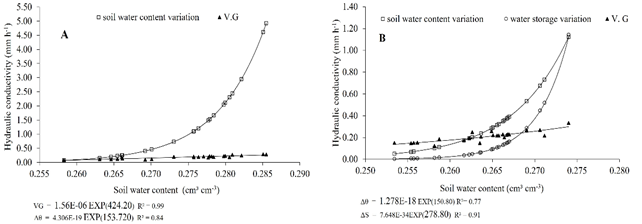
The observed values are estimates resulting from the K(θ) functions determined by the proposed methodologies, ∆θ (Figure 1A), ∆S (Figure 1B), and van Genuchten’s model (VG) during the banana cultivation period in the lysimeter. For the 0.40-0.60 m layer, the two propositions had similar values only for the lowest moisture contents, and the estimates became more distant from each other as the soil moisture content increased.
For the 0.60-0.80 m soil layer, the estimates under field conditions were similar for the lowest moisture contents using the 3 methods (Figure 1B); however, the propositions based on moisture variation and water storage variation in a layer showed similar behaviors, with a higher K(θ) estimate for the moisture variation over the entire range of soil moisture.
Application of the proposed methods for determining hydraulic conductivity in field data during the banana cycle
The evaluation indicators obtained in the determination of hydraulic conductivity by the two propositions, ∆θ and ∆S, for the 0.40-0.60 m depth (Table 6) under field conditions and drip irrigation show a greater discrepancy between van Genuchten’s method and the proposition based on storage variation. In the 0.60-0.80 m layer, the smallest discrepancy occurred between the proposition based on storage variation and van Genuchten’s method, with RMSE, SDSE, and MAE values of 0.63 mm h−1, 0.73 mm h−1, and 16.65%, respectively, under drip irrigation and soil covered with banana straw.
Estimated values of unsaturated soil hydraulic conductivity in the lysimeter determined by the soil moisture variation (∆θ) and van Genuchten’s method (VG) for the 0.40-0.60 m depth (A) and ∆θ, VG (moisture variation), and storage variation (∆S) for the 0.60-0.80 m depth (B) during the banana cultivation cycle between two irrigation events.
The greatest differences between the moisture variation and water-storage variation propositions also occurred in the 0.40-0.60 m layer (Table 6), whereas the differences between the water storage proposition and van Genuchten’s method under micro-sprinkler irrigation were greater in the 0.60-0.80 m layer. However, the differences were smaller than the ones observed under the drip irrigation conditions, indicating a difference in the estimation of unsaturated hydraulic conductivity by the same methods in the same soil under different irrigation conditions for water application. When working with the method proposed to improve the estimates of hydraulic conductivity by van Genuchten, Terleev et al. (2017) also observed this pattern.
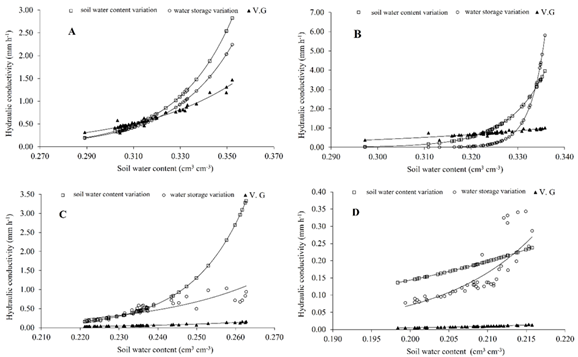
The values of K(θ) estimated by the approaches based on moisture and storage variation and on van Genuchten’s method (Figure 2A-D) showed similar behavior for the lower soil moisture. The differences increased with the increase in the soil water content. This behavior was also observed in the validation of the propositions within the lysimeter. A more significant variation in the estimates was observed for the micro-sprinkler irrigation system (Figure 2C and D).
The differences between van Genuchten’s method and the proposed ones were expected (Hmadi et al., 2015; Mohammadi et al., 2014; Wang et al., 2017). The two proposed forms are based on the direct method of Hillel et al. (1972), while van Genuchten’s model is an indirect method that depends on soil water retention curve data obtained in the laboratory from small samples of the physical-hydraulic attributes of the soil profile. The saturation moisture (θ0) and residual moisture (θr) are determined in the laboratory, unlike direct methods. In this case, it is necessary to wait to choose θ0. The selection of different times implies different K(θ) values in the initial phase of the redistribution process (Ghiberto & Moraes, 2011; Gonçalves & Libardi, 2013; Libardi & Melo Filho, 2006; Reichardt & Timm, 2022; Silva & Coelho, 2014).

Estimated values of unsaturated soil hydraulic conductivity in the field by the methods of moisture variation, storage variation, and van Genuchten (VG) at two depths: 0.40-0.60 m (A) and 0.60-0.80 m (B) using the drip irrigation system and 0.40-0.60 m (C) and 0.60-0.80 m (D) using the micro-sprinkler irrigation system.
According to Reichardt and Timm (2022), each variation in soil moisture represents a change in hydraulic conductivity. Gallage et al. (2013) stated that hydraulic conductivity is directly related to the volumetric fraction of the pore space available for liquid flow, which is directly described by the volumetric water content and the degree of saturation.
The type of instrument influenced the dispersion among the methods for estimating hydraulic conductivity during the initial phase of the redistribution process (Ghiberto & Moraes, 2011). There is variability in the estimation of hydraulic conductivity K(h) by indirect models at a given tension (Reichardt et al., 1998), as reported by Adhanom et al. (2012), who observed a coefficient of variation of 137% for a tension of 3 kPa, applying indirect methods in the prediction of k(h).
Conclusion
The methods for obtaining water flow by moisture variation and by soil water storage variation in a layer estimated the unsaturated hydraulic conductivity with good accuracy compared to Hillel’s method. Hydraulic conductivity showed greater variation in the initial phase of water redistribution in the soil, both in the lysimeter test and in field application after irrigation. The approximation for estimating the unsaturated hydraulic conductivity by the propositions based on moisture and storage variation to determine the water flow in the porous medium is an alternative that can be applied in studies on soil water dynamics of the soil moisture profile formed by sensors.
Data availability
Not applicable.
References
-
Adhanom, G. T., Stirzaker, R. J., Lorentz, S. A., Annandale, J. G. & Steyn, J. M.. (2012). Comparison of methods for determining unsaturated hydraulic conductivity in the wet range to evaluate the sensitivity of wetting front detectors. Water SA, 38(1), 67-76. https://doi.org/10.4314/wsa.v38i1.9
» https://doi.org/https://doi.org/10.4314/wsa.v38i1.9 -
Alfaro Soto, M. A., Chang, H. H. & Genuchten, M. T.. (2017). Fractal-based models for the unsaturated soil hydraulic functions. Geoderma, 306, 144-151. https://doi.org/10.1016/j.geoderma.2017.07.019
» https://doi.org/https://doi.org/10.1016/j.geoderma.2017.07.019 -
Allen, R. G., Pereira, L. S. & Raes, D. (2006). Evapotranspiration del cultivo: guias para la determinación de los requerimientos de água de los cultivos. FAO. (Estudio FAO Riego y Drenaje, 56). https://www.fao.org/4/x0490s/x0490s00.htm
» https://www.fao.org/4/x0490s/x0490s00.htm -
Brooks, R. H. & Corey, A. T. (1964). Hydraulic properties of porous media (Hydrology Paper, v. 3). Colorado State University. https://www.wipp.energy.gov
» https://www.wipp.energy.gov -
Conceição, B. S., Coelho, E. F., Martinez, M. A., Santana, J. A. V., Silva Junior, J. J. & Silva, A. J. P.. (2017). Coeficiente de cultivo e extração de nitrato e potássio da bananeira prata Gorutuba. Irriga, 22(4), 832-846. https://doi.org/10.15809/irriga.2017v22n4p832-846
» https://doi.org/https://doi.org/10.15809/irriga.2017v22n4p832-846 -
Gallage, C., Kodikara, J. & Uchimura, T.. (2013). Laboratory measurement of hydraulic conductivity functions of two unsaturated sandy soils during drying and wetting processes. Soils and Foundations, 53(3), 417-430. https://doi.org/10.1016/j.sandf.2013.04.004
» https://doi.org/https://doi.org/10.1016/j.sandf.2013.04.004 -
Ghanbarian, B. & Hunt, A. G.. (2017). Improving unsaturated hydraulic conductivity estimation in soils via percolation theory. Geoderma, 303, 9-18. https://doi.org/10.1016/j.geoderma.2017.05.004
» https://doi.org/https://doi.org/10.1016/j.geoderma.2017.05.004 -
Ghiberto, P. J. & Moraes, S. O.. (2011). Comparação de métodos de determinação da condutividade hidráulica em um Latossolo Vermelho-Amarelo. Revista Brasileira de Ciência do Solo, 35(4), 1177-1188. https://doi.org/10.1590/S0100-06832011000400011
» https://doi.org/https://doi.org/10.1590/S0100-06832011000400011 -
Gonçalves, A. D. M. A. & Libardi, P. L.. (2013). Análise da determinação da condutividade hidráulica do solo pelo método do perfil instantâneo. Revista Brasileira de Ciência do Solo, 37(5), 1174-1184. https://doi.org/10.1590/S0100-06832013000500007
» https://doi.org/https://doi.org/10.1590/S0100-06832013000500007 -
Hillel, D., Krentos, V. D. & Stylianov, Y.. (1972). Procedure and test of an internal drainage method for measuring soil hydraulic characteristic in situ. Soil Science, 114(5), 395-400. https://doi.org/10.1097/00010694-197211000-00011
» https://doi.org/https://doi.org/10.1097/00010694-197211000-00011 -
Hmadi, S. H., Sepaskhah, A. R. & Fooladmand, H. R.. (2015). A simple approach to predicting unsaturated hydraulic conductivity based on empirically scaled microscopic characteristic length. Hydrological Science Journal, 60(2), 326-335. https://doi.org/10.1080/02626667.2014.959445
» https://doi.org/https://doi.org/10.1080/02626667.2014.959445 -
Karim, M. R., Manivannan, G., Gnanendran, C. T. & Lo, S.. (2011). Predicting the long-term performance of a geogrid-reinforced embankment on soft soil using two-dimensional finite element analysis. Canadian Geotechnical Journal, 48(5), 741-753. https://doi.org/10.1139/t10-104
» https://doi.org/https://doi.org/10.1139/t10-104 -
Libardi, P. L. & Melo Filho, J. F.. (2006). Análise exploratória e variabilidade dos parâmetros da equação da condutividade hidráulica em um experimento de perfil instantâneo. Revista Brasileira de Ciência do Solo, 30(2), 197-206. https://doi.org/10.1590/S0100-06832006000200001
» https://doi.org/https://doi.org/10.1590/S0100-06832006000200001 -
Libardi, P., Reichardt, K., Nielsen, D. R. & Biggar, J. W.. (1980). Simple field methods for estimating soil hydraulic conductivity. Soil Science Society of America Journal, 44(1), 3-7. https://doi.org/10.2136/sssaj1980.03615995004400010001x
» https://doi.org/https://doi.org/10.2136/sssaj1980.03615995004400010001x -
Lo, S., Karim, M. R. & Gnanendran, C. T. (2013). Consolidation and creep settlement of embankment on soft clay: prediction versus observation. In J. Chu, S. P. R. Wardani & A. Iizuka (Eds.), Geotechnical predictions and practice in dealing with geohazards. (pp. 77-94). Springer. https://doi.org/10.1007/978-94-007-5675-5_6
» https://doi.org/https://doi.org/10.1007/978-94-007-5675-5_6 -
Mohammadi, M. H., Khatar, M. & Vanclooster, M.. (2014). Combining a single hydraulic conductivity measurement with particle size distribution data for estimating the full range partially saturated hydraulic conductivity curve. Soil Science Society of America Journal, 78(5), 1594-1605. https://doi.org/10.2136/sssaj2014.03.0098
» https://doi.org/https://doi.org/10.2136/sssaj2014.03.0098 -
Reichardt, K. & Timm, L. C. (2022). Solo, planta e atmosfera: conceitos, processos e aplicações (4. ed.). Manole. https://repositorio.usp.br/item/003103881
» https://repositorio.usp.br/item/003103881 -
Reichardt, K., Portezan, O., Libardi, P. L., Bacchi, O. O. S., Moraes, S. O., Oliveira, J. C. M. & Falleiros, M. C.. (1998). Critical analysis of the field determination of soil hydraulic conductivity functions using the flux-gradient approach. Soil and Tillage Research, 48(1-2), 81-89. https://doi.org/10.1016/S0167-1987(98)00093-2
» https://doi.org/https://doi.org/10.1016/S0167-1987(98)00093-2 -
Rudiyanto, M, Shah, R. M., Setiawan, B. I. & Genuchten, M. T.. (2020). Simple functions for describing soil water retention and the unsaturated hydraulic conductivity from saturation to complete dryness. Journal of Hydrology, 558, 125041. https://doi.org/10.1016/j.jhydrol.2020.125041
» https://doi.org/https://doi.org/10.1016/j.jhydrol.2020.125041 -
Sant’ana, J. A. V. , Coelho, E. F., Faria, M. A., Silva, E. L. & Donato, S. L. R.. (2012). Distribuição de raízes de bananeira ‘Prata-Anã’ no segundo ciclo de produção sob três sistemas de irrigação. Revista Brasileira de Fruticultura, 34(1), 124-133. https://doi.org/10.1590/S0100-29452012000100018
» https://doi.org/https://doi.org/10.1590/S0100-29452012000100018 -
Santos, M. R., Coelho, E. F., Donato, S. L. R. & Rodrigues, M. G. V.. (2016). Distribuição de raízes e extração de água da bananeira ‘BRS Princesa’ sob diferentes configurações de irrigação. Engenharia na Agricultura, 24(6), 513-522. https://doi.org/10.13083/reveng.v24i6.701
» https://doi.org/https://doi.org/10.13083/reveng.v24i6.701 -
Silva, A. J. P. & Coelho, E. F.. (2013). Water percolation estimated with time domain reflectometry (TDR in drainage lysimeters. Revista Brasileira de Ciência do Solo, 37(4), 920-927. https://doi.org/10.1590/S0100-06832013000400009
» https://doi.org/https://doi.org/10.1590/S0100-06832013000400009 -
Silva, A. J. P. & Coelho, E. F.. (2014). Estimation of water percolation by different methods using TDR. Revista Brasileira de Ciência do Solo, 38(1), 73-81. https://doi.org/10.1590/S0100-06832014000100007
» https://doi.org/https://doi.org/10.1590/S0100-06832014000100007 -
Sousa, V. F., Maroulli, W. A., Coelho, E. F., Pinto, J. M. & Coelho Filho, M. A. (2011). Irrigação e fertirrigação em fruteiras e hortaliças. Embrapa Informação Tecnológica. http://www.alice.cnptia.embrapa.br/alice/handle/doc/907498
» http://www.alice.cnptia.embrapa.br/alice/handle/doc/907498 -
Teixeira, C. F. A., Moraes, S. O. & Simonete, M. A.. (2005). Desempenho do tensiômetro, TDR e sonda de nêutrons na determinação da umidade e condutividade hidráulica do solo. Revista Brasileira de Ciência do Solo, 29(2), 161-168. https://doi.org/10.1590/S0100-06832005000200001
» https://doi.org/https://doi.org/10.1590/S0100-06832005000200001 -
Teixeira, P. C., Donagemma, G. K., Fontana, A. & Teixeira, W. G. (2017). Manual de métodos de análise de solo (3. ed.). Embrapa. http://www.infoteca.cnptia.embrapa.br/infoteca/handle/doc/1085209
» http://www.infoteca.cnptia.embrapa.br/infoteca/handle/doc/1085209 -
Terleev, V. V., Mirschel, W., Badenko, V. L. & Guseva, Y.. (2017). An improved Mualem-van Genuchten method and its verification using data on beit netofa clay. Eurasian Soil Science, 50(4), 445-455. https://doi.org/10.1134/S1064229317040135
» https://doi.org/https://doi.org/10.1134/S1064229317040135 -
Usowicz, B., Lipiec, J. & Siczek, A.. (2024). Fitting the van Genuchten model to the measured hydraulic parameters in soils of different genesis and texture at the regional scale. International Agrophysics, 38(4), 373-382. https://doi.org/10.31545/intagr/191380
» https://doi.org/https://doi.org/10.31545/intagr/191380 -
Genuchten, M. T.. (1980). A closed-form equation for predicting the hydraulic conductivity of unsaturated soils. Soil Science Society of America Journal, 44(5), 892-898. https://doi.org/10.2136/sssaj1980.03615995004400050002x
» https://doi.org/https://doi.org/10.2136/sssaj1980.03615995004400050002x -
Wang, Y., Ma, J., Guan, H. & Zhu, G.. (2017). Determination of the saturated film conductivity to improve the EMFX model in describing the soil hydraulic properties over the entire moisture range. Journal of Hydrology, 549, 38-49. https://doi.org/10.1016/j.jhydrol.2017.03.063
» https://doi.org/https://doi.org/10.1016/j.jhydrol.2017.03.063 -
Willmott, C., Robeson, S. M. & Matsuura, K.. (2012). A refined index of model performance. International Journal of Climatology, 32(13), 2088-2094. https://doi.org/10.1002/joc.2419
» https://doi.org/https://doi.org/10.1002/joc.2419
Edited by
-
Associate Editor in charge:
Alessandro Lucca BracciniCarlos Alberto Scapim