 Effects of sodium hypochlorite on seed germination and seedling emergence in Rangpur lime
ABSTRACT.
Citrus seedlings are typically propagated through grafting, using rootstocks grown from seeds. However, the coating of citrus rootstock seeds can hinder germination. Therefore, applying sodium hypochlorite (NaClO) provides an alternative to manually removing the seed coat, potentially enhancing seed germination and seedling emergence. This study investigates the use of sodium hypochlorite (NaClO) as a scarification agent on freshly harvested Rangpur lime seeds to improve germination and seedling emergence. The experiment employed a completely randomized design with a 3 × 3 factorial arrangement and an additional treatment across four replications. The variables assessed included three NaClO concentrations (0.0% - distilled water; 2.5%, and 5.0% active chlorine) and three soaking durations (3, 6, and 9 hours), with a control of unsoaked seeds retaining their coats. The evaluated parameters were germination rate, first germination count, seedling emergence, speed index, and mean seedling emergence time. Results showed that NaClO effectively degrades the seed coat, with a 2.5% concentration for 6 hours optimizing germination. While NaClO treatment did not alter emergence rates, it reduced the average time to seedling emergence. Conversely, a 5.0% concentration for 9 hours detrimentally affected germination and vigor. Sodium hypochlorite soaking presents a viable alternative for seed coat removal, accelerating germination and emergence processes in Rangpur lime tree seeds, potentially enhancing seedling production efficiency.
Keywords:
Citrus limonia Osbeck; NaClO; scarification; seed coat; vigor
Introduction
Citrus cultivation is a highly significant agricultural activity globally, and it occupies a prominent position in Brazil, one of the top producers of fruit crops with high production volumes and values. Brazil ranks as the world's second-largest citrus producer and is the leading global producer of oranges and orange juice (Girardi et al., 2021; United States Department of Agriculture [USDA], 2023). According to the Food and Agriculture Organization of the United Nations (2024), sweet orange trees covered 589,610 hectares in Brazil in 2019, with an average yield of 28.95 t ha-1 (Food and Agriculture Organization of the United Nations [FAO] 2024). Production is primarily concentrated in the southeastern region, especially in the citrus belt of São Paulo and Triângulo/Southwest Minas Gerais. For the 2023/24 season, the harvest is projected to reach 307.22 million boxes, each weighing 40.8 kg (Fundo de Defesa da Citricultura, 2023).
In commercial rootstock production, seed propagation is the primary method used to obtain new plants for grafting (Carvalho et al., 2002; Albrecht et al., 2020). The development time for rootstocks typically ranges from six to eight months across most Brazilian states (Sarmiento et al., 2016), due to the slow and irregular seed germination process. This delay is often caused by the seed coat, which has a compact structure that acts as a physical barrier, limiting water imbibition and gas diffusion. Furthermore, the seed coat may contain inhibitors that disrupt the uniformity of embryonic development and germination in various citrus rootstock varieties (Baskin & Baskin, 2014; Alves-Junior et al., 2020).
When treatments that facilitate the rupture or removal of the seed coat are applied, germination among certain citrus varieties becomes more uniform, thereby reducing the time needed for rootstock formation (Silva & Carvalho, 2007; Zucareli et al., 2009; Moreira et al., 2010). However, the predominant method for removing the seed coat from citrus seeds is manual, which is labor-intensive and costly. This process involves handling each seed individually, requiring skilled labor to avoid embryo damage (Oliveira & Scivittaro, 2007; Silva & Carvalho, 2007).
To enhance seed germination and citrus seedling production, it is crucial to develop new, economically viable methods (Wilson, 2022). Sodium hypochlorite (NaClO) offers a promising solution for seed conditioning, addressing key challenges in this area, particularly for large-scale nursery operations. Known for its effectiveness and low cost, NaClO is accessible and cost-effective, making it a popular choice within the nursery community (Maia et al., 2024). Strategic use of NaClO can improve seed germination rates and citrus seedling production, marking significant progress in the agricultural sector's efficiency and economic performance related to citrus cultivation.
Sodium hypochlorite (NaClO) is commonly used for seed disinfection and as a treatment for other dispersal units (Brasil, 2009). Its effectiveness in promoting germination and breaking dormancy has been demonstrated across various crops, including Arabica coffee (Sofiatti et al., 2008; 2009), Conilon coffee (Rubim et al., 2010), papaya (Jesus et al., 2015; Jesus et al., 2016a), safflower (Ramos et al., 2018), tobacco (Lopes et al., 2019), and rice (Cigel et al., 2020). As a potent oxidant, NaClO at high concentrations facilitates seed coat scarification, enhancing its porosity. This increased porosity aids in gas diffusion and water uptake, which are crucial for embryo development and subsequent germination (Bewley & Black, 1982). Moreover, due to its ability to degrade lignin in the seed’s protective structure-a process analogous to its use in the pulp industry for lignin removal-NaClO significantly improves the efficiency of germination.
NaClO is widely used for disinfection of citrus seeds, as evidenced by studies such as Moreira et al. (2010), Faddetta et al. (2021), and Ragagnin et al. (2022). Additionally, Wilson (2022) explored the impact of NaClO on the germination and early seedling growth of sweet orange (Citrus sinensis L. Osbeck) and acid lime (Citrus aurantifolia Swingle) under greenhouse conditions.
Building on this foundation, the current study aims to assess the efficacy of NaClO as a scarification agent for freshly harvested seeds of the Rangpur lime (Citrus limonia Osbeck), specifically its effects on seed germination and seedling emergence time.
Material and methods
The experiment was conducted at the Seed Research Laboratory and greenhouse facilities of the Department of Agronomy, Federal University of Viçosa, Viçosa, Minas Gerais State, Brazil. The evaluated Rangpur lime seeds (Citrus limonia Osbeck) were sourced from mature fruits harvested in August 2023 from a rural property in São José do Triunfo, Viçosa, Minas Gerais State, Brazil (20°44'40.1" S, 42°50'00.0" W, altitude 674 m). Sodium hypochlorite (NaClO) used in the experiment was procured locally and its active chlorine concentration was determined using the iodometric method at the Cellulose and Paper Laboratory of the Department of Forestry Engineering.
The Rangpur lime fruits, characterized as late-season and identified by their mature yellow-orange epicarp (Morelli et al., 2019), were manually harvested in August 2023. They were then transported in plastic crates (36.5 × 55 × 31 cm) to the Multi-User Laboratory of the Department of Agronomy for seed processing.
For manual seed extraction, a superficial cut was made around the equatorial region of each fruit to the seeds, and the halves were then separated using a twisting motion by hand. The fruit halves were squeezed over a sieve, and the seeds were washed under running water as recommended by Oliveira et al. (2016). After washing, the seeds were placed in a water-filled tray to separate out the remaining pulp and any poorly formed seeds.
Seeds that floated were deemed non-viable and discarded (Wilson, 2022). Viable seeds were then manually rubbed with quicklime (CaO) to remove mucilage, a method detailed by Carvalho et al. (2005), for 60 seconds, followed by a thorough rinse under running water to eliminate any lime residue. Subsequently, the seeds were spread out on two Germitest paper sheets in a layer 1.5 cm thick and left to dry in the shade. They were kept in the laboratory environment for one hour to remove surface moisture.
After surface drying, four 50-seed subsamples were collected for initial moisture content measurement, following the guidelines outlined in the Rules for Seed Analysis (Brasil, 2009), and results were expressed as percentages. The seeds were then placed in transparent plastic Gerbox containers with lids, each containing 220 mL of sodium hypochlorite (NaClO) solution at three concentrations of active chlorine (0.0% - distilled water, 2.5, and 5.0%) and subjected to three immersion times (3, 6, and 9 hours). An additional control group consisted of intact seeds with the seed coat, not immersed in any solution. A proportion of 220 mL of solution was used for each sample of 200 seeds. The 2.5% active chlorine solution was prepared by diluting commercial sodium hypochlorite in distilled water shortly before use.
To ensure the seeds remained submerged, appropriate mesh screens were placed in the Gerbox containers. The containers were then sealed and placed in a Biological Oxygen Demand (B.O.D.) chamber set at a constant temperature of 25°C, in the absence of light. After each specified immersion period, the seeds were rinsed under running water for 60 seconds to remove any residual sodium hypochlorite and pre-dried in the shade for 30 minutes. Following this, they underwent physiological seed quality evaluation tests as prescribed by the Rules for Seed Analysis (Brasil, 2009). Seeds from the 0.0% active chlorine group were also similarly washed.
Germination testing: Germination tests were conducted using a paper roll method. Four 50-seed subsamples were placed on three Germitest paper sheets moistened with distilled water, equivalent to 2.5 times the dry weight of the paper. Prior to setup, seeds were treated with Captan® fungicide at a concentration of 4 mL per liter of water, based on the commercial product. The fungicide was applied using a manual sprayer until the seeds were visibly moist. The prepared rolls were then placed inside plastic bags and stored in a Biological Oxygen Demand (B.O.D.) chamber maintained at a constant temperature of 30°C and subjected to an 8-hour photoperiod using a compact fluorescent lamp (white light). Evaluation occurred 30 days post-sowing, with the number of normal seedlings counted (Ávila et al., 2019), and the results expressed as a percentage.
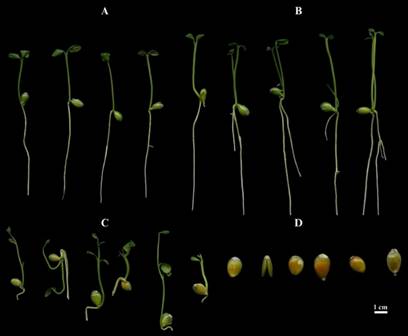
First germination count: This assessment was conducted concurrently with the germination test, with evaluations made 21 days after sowing to calculate the percentage of normal seedlings, as defined by Ávila et al. (2019). Results were expressed as a percentage. Normal seedlings were identified by the presence of a root length of at least 2 cm, well-developed hypocotyl, and visible or well-formed cotyledons without damage (Figure 1A). Seedlings arising from polyembryonic seeds were assessed and counted as a single unit (Figure 1B). In contrast, abnormal seedlings were those that did not meet the normal criteria but showed some development, such as root emergence or hypocotyl deformation (Figure 1C). Dead seeds were identified by the lack of germination signs and were often soft and/or attacked by microorganisms (Figure 1D).

Classification standards used in the germination test of Rangpur lime seedlings: normal seedlings without polyembryony (A), normal seedlings with polyembryony (B), abnormal seedlings (C), and dead seeds (D).
Emergence in a greenhouse: For the seedling emergence test, four 25-seed replications per treatment were sown. Each seed was placed micropyle down, in individual cells of plastic trays with 128 cells (5 cm height), perforated at the base, and filled with a commercial substrate (MecPlant®) based on composted pine bark. Seeds were sown at a depth of 1 cm (Struiving et al., 2013). These trays were positioned on wooden benches 70 centimeters above the ground within the greenhouse at the Agronomy Valley of the DAA. The substrate was periodically moistened, as necessary. Seedling emergence was monitored until stabilization, which occurred 40 days after sowing. Seedlings were considered to emerge if the plumule extended at least 2 cm above the substrate, and results were expressed as a percentage. Throughout the evaluation period, maximum and minimum air temperatures and relative humidity levels were recorded daily using a digital thermometer (Figure 2). Observations were made at the same time each day.

Measurements of temperature (°C) and relative humidity (%) throughout the evaluation period in a greenhouse. Tmax: maximum temperature; Tmin: minimum temperature; RHmax: maximum relative humidity; and RHmin: minimum relative humidity.
Emergence Speed Index (ESI): Conducted concurrently with the emergence test, the ESI was determined using the method described by Magüire (1962). This involved performing daily counts of newly emerged seedlings, noting only those that had emerged since the previous day’s count, and continuing until no further emergence was observed, indicating stand stabilization.
Mean Emergence Time (MET; days): MET was calculated using the same data collected for the Emergence Speed Index (ESI), estimating the average number of days until complete seedling emergence according to Labouriau (1983). Daily counts of emerged seedlings were performed for each replication until the stand reached complete stabilization, beginning the day after test installation.
The germination test in the laboratory utilized a completely randomized design in a 3 × 3 factorial arrangement with an additional control, consisting of four replications and 50 seeds per plot. The factors evaluated included three concentrations of NaClO (0.0% - distilled water; 2.5% and 5.0% active chlorine), three immersion times (3, 6, and 9 hours), and the control (seeds with tegument, not immersed in distilled water or NaClO solution). The same design was applied to the greenhouse emergence test, with four replications and 25 seeds per plot.
An analysis of variance (ANOVA) was performed at a significance level of p < 0.05. For significant interactions, factors were further analyzed (Table 1). Means were compared using Tukey's test at a 5% probability level. All treatments were also compared with the control (intact seeds with tegument and without immersion in water or NaClO solution) using Dunnett's test at the same probability level. Analyses were conducted using R software version 4.3.2.
For daily seedling emergence behavior, emergence distribution graphs over time were created, and non-linear regression curves were fitted using SigmaPlot 14.5. The model used was the sigmoidal function: , where: y represents the accumulated emergence over time x; α is the maximum accumulated emergence (asymptotic value); x 0 is the time required for half of the maximum asymptotic value; and β is the growth rate to reach the asymptotic maximum (Sousa et al., 2014).
Results and discussion
Immediately after extraction and processing, freshly harvested Rangpur lime seeds had an initial moisture content of 41.2%. Other authors have already reported a similar moisture content, suggesting the characteristics of recalcitrant seeds (Carvalho et al., 2002; Dantas et al., 2010).
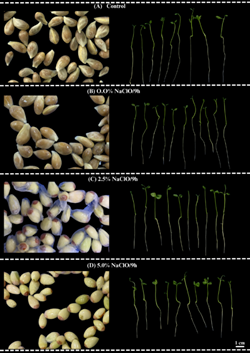
Visual observations indicated that seeds in the control treatment (Figure 3A) appeared like those immersed in distilled water for 9 hours (Figure 3B); therefore, this treatment (0.0% NaClO/9h) was ineffective in degrading seed coats. Conversely, seeds treated with 2.5% NaClO for 9 hours showed efficient seed coat degradation, which became gelatinous and translucent (Figure 3C). Seeds exposed to 5.0% NaClO for the same duration exhibited complete degradation of the seed coat (Figure 3D).
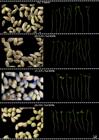
Visual appearance of Rangpur lime seeds and seedlings after processing: control (A), immersion in distilled water (B), and in 2.5% sodium hypochlorite (C) and 5.0% sodium hypochlorite (D), each for 9 hours.
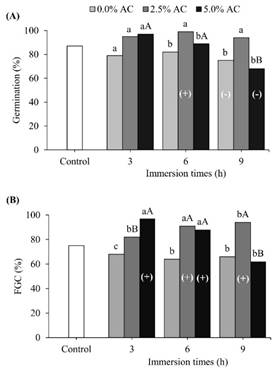
At the 3-hour imbibition period (Figure 4A), no significant differences in germination percentage were observed between the concentrations. At 6 hours of immersion, the 2.5% concentration achieved the highest germination rate of 99%, significantly outperforming the other concentrations. After 9 hours of immersion, the 2.5% concentration again resulted in the highest germination percentage (94%), which was statistically distinct from the other concentrations.
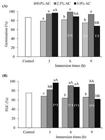
Germination (A) and first germination count (B) of Rangpur lime seeds as a function of the sodium hypochlorite concentrations and immersion times. AC = active chlorine. Identical lowercase letters across time points and identical uppercase letters across concentrations indicate no significant differences, based on the Tukey test at a 5% probability level. The symbols (-) and (+) denote significant differences compared to the control (intact seeds with seed coat and without immersion in water or NaClO solution), as determined by Dunnett's test at a 5% probability level, for lower and higher values, respectively.
When analyzing the concentrations during seed immersion times (Figure 4A), germination rates did not differ among treatments. However, the 5.0% concentration with a 9-hour immersion period was an exception, showing the lowest mean germination rate and statistically differing from the other durations. While the germination rates for the 2.5% concentration were consistently high, a 6-hour immersion yielded a remarkable 99% success rate. Similarly, immersing seeds for 3 hours in a 5.0% solution achieved 97% germination. These treatments are advantageous due to their speed and potential for process optimization. Similarly, pre-soaking Arabica coffee seeds (Catuaí Vermelho IAC 44 variety) in 6% sodium hypochlorite for 3 hours effectively degrades the parchment layer and enhances germination (Sofiatti et al., 2008). Likewise, immersing Golden papaya seeds from the "Solo" group in a 2% active chlorine sodium hypochlorite solution (10 seeds per 200 mL) for 24 hours promotes germination (Jesus et al., 2016a).
Figure 4A shows that the 2.5%/6-hour treatment significantly outperformed the control, which had an average germination of 87%. Conversely, the 0.0%/9-hour and 5.0%/9-hour treatments showed lower averages and were statistically inferior to the control, indicating their ineffectiveness. However, seeds immersed in distilled water for 3 and 6 hours, 2.5% NaClO for 3 and 9 hours, and 5.0% NaClO for 3 and 6 hours did not statistically differ from the control, suggesting no negative effects on final germination percentages. Manual removal of the seed coat in Rangpur lime seeds does not alter final germination rates but enhances germination speed (Silva & Carvalho, 2007). Similar effects were observed in this study, where NaClO degraded the seed coat. These findings align with Lopes et al. (2019), who reported that sodium hypochlorite as a conditioning agent does not affect the physiological quality of CSC 439 Virginia tobacco seeds. However, for SCS 122 Miura rice seeds, immersion in 0.5% sodium hypochlorite for 24 hours negatively impacted seed physiological quality and vigor (Cigel et al., 2020).
In the first germination count at 21 days, a significant interaction between NaClO concentrations and immersion times was noted (Figure 4B). For the 3-hour treatment, the percentage of normal seedlings increased with higher active chlorine concentrations at 21 days, reaching a peak of 97% in the 5.0%/3-hour treatment. For the 6-hour period, the highest average (91%) was observed at the 2.5% concentration, which was statistically different only from seeds immersed in distilled water. At the 9-hour period, the 2.5% concentration achieved 94% normal seedlings, significantly outperforming the other concentrations.
Figure 4B shows that immersing seeds in distilled water (0.0% NaClO) showed no significant effect on germination across various durations. Conversely, seeds immersed in a 2.5% NaClO solution exhibited increasing germination percentages with extended immersion times, reaching a peak of 94% at 9 hours. This peak was statistically significant compared to the 3-hour immersion. However, seeds exposed to a 5.0% NaClO concentration experienced a reduction in germination as immersion times increased, with the lowest mean germination rate (62%) occurring at 9 hours, indicating a statistically significant decline compared to shorter periods. This suggests that the 9h/5.0% treatment combination adversely affects germination, as corroborated by the initial count of the test (Figure 4B).
Furthermore, Figure 4B also indicates that the concentrations of 0.0% NaClO, 2.5%/3h, and 5.0%/9h yielded germination percentages statistically equivalent to the control, regardless of the immersion time. Notably, the seeds treated with 5.0%/3h NaClO achieved an impressive 97% germination rate, indicating higher effectiveness.
The combination of 5.0%/9h might have had a toxic impact on the seeds. This treatment, which visually led to the complete degradation of the seed coat (Figure 3D), potentially damaged the embryonic axis or the seed reserve tissues. It also resulted in a higher percentage of dead seeds and abnormal seedlings-14% and 18%, respectively (data not shown), due to the seeds absorbing more active chlorine, thus impairing germination. Additionally, the study observed a decrease in the percentage of normal seedlings as the immersion time of the seeds in the solutions increased, with this trend becoming more pronounced at the 9-hour mark. Therefore, it is suggested that immersion times exceeding 6 hours detrimentally affect both germination and seed vigor.
Jesus et al. (2015) observed a similar result for Golden papaya seeds from the 'Solo' group, where an increase in active chlorine concentration led to reduced germination rates. Further examination through scanning electron microscopy revealed that immersion in sodium hypochlorite solutions damaged the seeds’ structure. Similarly, Jesus et al. (2016b) reported that using sodium hypochlorite at a 6% concentration (380 seeds per 127 mL solution) for 12 hours, although effective at removing the sarcotesta, negatively impacted germination. Comparable effects were noted in two species of crotalaria (Crotalaria paulinea and Crotalaria spectabilis), where immersion in an 8% active chlorine solution for six and eight hours resulted in a higher percentage of dead seeds, particularly in Crotalaria paulinea (Maia et al., 2024). These effects may be attributed to the accelerated oxidation process induced by higher concentrations and proportions of active chlorine in the solution.
Regarding the seedling emergence percentage for the Rangpur lime (Figure 5A), no significant differences were observed between the immersion times at concentrations of 0.0% and 2.5% active chlorine. However, for the 5.0% concentration combined with a 9-hour immersion, a marked decrease in emergence was noted, with the lowest emergence rate among the treatments at 63%. This result mirrors the trends seen in both the germination rate and the first germination count (Figure 4A and B), where the 5.0%/9h combination also displayed the lowest mean values, reinforcing that both the concentration and the immersion duration critically affect the germination process for this rootstock. Notably, the 5.0%/9h treatment, which visibly resulted in complete degradation of the seed coat (Figure 3D), allowed direct contact of NaClO with the embryo, potentially exerting a toxic effect on the seeds.
Figure 5A highlights that none of the treatments statistically surpassed the control, which showed a seedling emergence rate of 95%. The exception was the 5.0%/9h treatment, which registered a lower average of 63%, indicating that the other treatments did not adversely affect the emergence of Rangpur lime seedlings. Although no NaClO treatment differed statistically from the control, the 2.5%/9h concentration achieved an identical average (95%), suggesting that the use of NaClO does not inherently enhance emergence rates. This indicates that while NaClO immersion may promote seed coat degradation, it does not compromise the integrity of tissues crucial for germination and the formation of normal seedlings. Wilson (2022) also noted promising results with sweet orange seeds, where a 10% NaClO solution for 20 minutes significantly improved seedling emergence compared to untreated seeds. Emergence percentage is critical for estimating the germination capacity of seed lots under field conditions and serves as a reference for vigor assessments (Padilha et al. 2022).
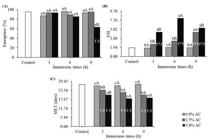
Emergence (A), speed index (B), and mean emergence time (C) of Rangpur lime seedlings as a function of the sodium hypochlorite concentration and immersion time. AC = active chlorine. Identical lowercase letters across immersion times and identical uppercase letters across concentrations indicate no significant differences by Tukey's test at a 5% probability level. The symbols (-) and (+) denote significant differences compared to the control (intact seeds with seed coat and without immersion in water or NaClO solution), as determined by Dunnett's test at a 5% probability level, indicating both lower and higher differences, respectively.
Regarding the Emergence Speed Index (ESI) as shown in Figure 5B, there was an increase in ESI when comparing immersion times within the same NaClO concentrations. Notably, the highest speed indices were observed at the 5.0% concentration, with the peak ESI (8.21) occurring at 6 hours, which statistically differed from other concentrations and durations. The degradation of the seed coat by NaClO enabled quicker water absorption, facilitating rapid progression through early germination stages and resulting in faster root protrusion and seedling emergence compared to seeds immersed solely in distilled water, where the lowest rates were recorded.
When analyzing concentrations within the immersion times (Figure 5B), immersing seeds solely in distilled water showed no significant effect on seedling emergence. However, the 2.5% NaClO concentration reached its highest ESI (5.18) after a 9-hour immersion, significantly differing from shorter durations. Similarly, the 5.0% concentration achieved its peak ESI (8.21) at the 6-hour mark. These findings suggest that treating Rangpur lime seeds with NaClO under these conditions can shorten the interval between sowing in the nursery and seedling emergence when compared to just using distilled water. Seed coat degradation by NaClO promotes the emergence of more vigorous seedlings.
Consequently, lower ESI values imply a longer duration for seedlings to develop, as rootstocks require more time to reach the ideal grafting (budding) stage. Extended germination and emergence periods can expose seeds and seedlings to various environmental stresses, potentially undermining their viability, uniformity, and vigor. Therefore, achieving a uniform stand is crucial as it enhances management and cultural practices in the nursery (Krzyzanowski et al., 2018).
When seeds were immersed in distilled water without NaClO (0.0% active chlorine), ESI was comparable to the control, averaging 1.89 (Figure 5B). Seeds immersed for 3 and 6 hours in 2.5% active chlorine also showed similar ESIs, but numerically higher than the control. Notably, the 2.5%/9h treatment and all treatments using 5.0% concentration at various immersion times significantly outperformed the control, confirming that NaClO effectively accelerates the emergence of Rangpur lime seedlings under these conditions.
Wilson (2022) reported similar positive effects on the emergence speed of seedlings in two citrus species using a 10% active chlorine NaClO solution for 20 minutes. Additionally, treatments with sodium hypochlorite also enhanced the emergence speed of tobacco seedlings in the commercial cultivar CSC 439 from the Virginia varietal group, albeit with a lower concentration of 1% and shorter immersion times of 180, 30, and 15 minutes (Lopes et al., 2019), supporting the notion that optimal concentration and immersion time depend on the species.
Figure 5C illustrates a reduction in the mean emergence time (MET) for Rangpur lime seedlings with NaClO use at the studied concentrations and times. A consistent decrease in MET was observed as the NaClO concentration increased, regardless of the immersion duration (Figure 5B) The shortest METs were recorded with the 5.0% NaClO concentration at 6 and 9 hours, which were statistically indistinguishable from each other. Conversely, the longest METs occurred when seeds were immersed in distilled water, with delays in seedling emergence relative to NaClO treatments.
The seedling emergence delay in seeds with intact seed coats (control) and those immersed only in distilled water (0.0% active chlorine), regardless of immersion time, as indicated by both ESI and MET (Figure 5B and C), can be attributed to the physical barrier to embryo growth imposed by the seed coat's rigidity (Oliveira et al., 2006; Oliveira & Scivittaro, 2007; Sarmiento et al., 2016). Likewise, Silva and Carvalho (2007) also supported the notion that seed coat removal facilitates faster germination in Rangpur lime. Similar results were reported for citrumelo rootstocks 'Swingle' and 'Flying Dragon,' where seed coat removal not only sped up germination time but also enhanced germination rates (Moreira et al., 2010). Therefore, the seed coat in citrus seeds impedes both germination and seedling emergence.
In the control treatment, seeds took an average of 27 days to emerge, a duration significantly longer than that observed in the NaClO treatments (Figure 5C). Seeds treated with a 5.0% NaClO solution for 6 and 9 hours reduced the emergence time by about 9 days. Although the time gain with a 2.5% NaClO concentration was less pronounced, it was still statistically significant compared to the control. Conversely, seeds immersed in distilled water showed no statistical difference in emergence time compared to the control. Wilson (2022) similarly reported a reduction in the time from sowing to seedling emergence in sweet orange and acid lime using a 10% NaClO solution, with emergence occurring as early as 10 and 20 days after sowing, respectively, following a 10-minute immersion.
Rodrigues et al. (2015) observed that the 'Santa Cruz' Rangpur lime typically requires 33 days for seedling emergence. This duration aligns closely with the findings in our control and distilled water immersion treatments and is longer than the emergence times recorded for the NaClO treatments (Figure 5C). These results underline the benefits of treatments that facilitate seed coat rupture, leading to faster and more uniform germination and emergence, thus shortening the time needed for rootstock development. Accordingly, accelerating the grafting timeline can enhance the production and availability of seedlings, meeting annual demands for the expansion of new citrus orchards, or the renewal of existing ones (Barbosa et al., 2023).
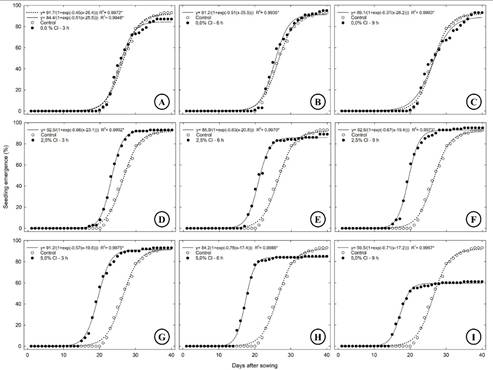
According to the daily frequency distribution of emergence (Figure 6), seeds immersed solely in distilled water exhibited similar emergence patterns to the control across all tested durations (Figure 6A, B, and C). However, seeds treated with a 2.5% active chlorine NaClO solution showed quicker and more uniform emergence compared to the control (Figure 6D, E, and F). Increasing the immersion time in this concentration further enhanced the speed and consistency of emergence. With a 5.0% active chlorine concentration, emergence commenced more rapidly than in the control and other treatments (Figure 6G, H, and I). Notably, in the 5.0%/9h treatment, while emergence stabilized more swiftly, a high number of dead seeds was also recorded (Figure 6I).
In treatments where seeds were immersed in distilled water (Figure 6A, B, and C), the observed delay in the emergence and stabilization of seedlings led to uneven formation and subsequent development. Conversely, seeds treated with NaClO solutions at concentrations of 2.5 and 5.0% exhibited more uniform emergence, potentially enhancing the initial development of more vigorous seedlings.
Synchrony in seedling emergence is crucial as it can hinder grafting since some seedlings may not be ready yet, delaying rootstock formation (Sousa et al., 2002), directly impacting the seedling acquisition phase and reducing the time required for grafting the desired scion cultivar. Thus, the use of sodium hypochlorite offers substantial benefits in agricultural settings. By accelerating germination and reducing the time needed for seedling establishment, it minimizes exposure to adverse conditions. Given its market accessibility, low cost, and ease of handling (Maia et al., 2023), sodium hypochlorite stands out as a viable option. More importantly, the method of immersing Rangpur lime seeds in sodium hypochlorite solution not only contributes to resource optimization but also cuts costs related to labor, irrigation, and management, enhancing the efficiency and sustainability of agricultural processes.
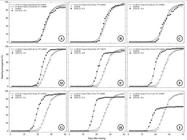
Frequency distribution of seedling emergence of Rangpur lime as a function of the sodium hypochlorite concentration and immersion time. A, B, and C represent seeds immersed in distilled water; D, E, and F represent seeds immersed in 2.5% sodium hypochlorite; and G, H, and I represent seeds immersed in 5.0% sodium hypochlorite for 3, 6, and 9 hours, respectively. *Significant at 1% probability. Where: Cl = active chlorine; h = hours.
Conclusion
Immersing freshly harvested seeds in sodium hypochlorite effectively degrades the seed coat, particularly at concentrations of 2.5 and 5.0% active chlorine. A 2.5% sodium hypochlorite solution for 6 hours notably increased germination rates. However, immersing seeds in a 5.0% concentration for 9 hours adversely affected both germination and vigor. Notably, sodium hypochlorite immersion did not impact seedling emergence but did facilitate faster emergence speeds and shorter average emergence times, especially with 2.5% concentrations for both 6 and 9 hours and 5.0% for 3 and 6 hours. Using sodium hypochlorite for immersing freshly harvested seeds offers a viable alternative for removing seed coats and accelerating germination and emergence. This method can provide significant advantages in the nursery production of Rangpur lime rootstocks.
Data availability
The data supporting the findings of this study are available in the institutional repository of the Federal University of Viçosa, Viçosa, Minas Gerais State, Brazil, linked to the doctoral thesis of the corresponding author. The material can be accessed at: https://locus.ufv.br/handle/123456789/33932
Acknowledgements
This study was financed in part by the Coordenação de Aperfeiçoamento de Pessoal de Nível Superior - Brasil (CAPES) - Finance Code 001. The authors would also like to thank the Conselho Nacional de Desenvolvimento Científico e Tecnológico (CNPq), the Fundação de Amparo à Pesquisa do Estado de Minas Gerais (FAPEMIG), and the Cellulose and Paper Laboratory at the Department of Forestry Engineering of the Federal University of Viçosa.
References
-
Albrecht, U., Bodaghi, S., Meyering, B. & Bowman, K. D.. (2020). Influence of rootstock propagation method on traits of grafted sweet orange trees. HortScience, 55(5), 729-737. https://doi.org/10.21273/HORTSCI14928-20
» https://doi.org/https://doi.org/10.21273/HORTSCI14928-20 -
Alves-Junior, C., Silva, D. L. S., Vitoriano, J. O., Barbalho, A. P.C. B. & Sousa, R. C.. (2020). The water path in plasma-treated leucaena seeds. Seed Science Research, 30(1), 13-20. https://doi.org/10.1017/S0960258520000045
» https://doi.org/https://doi.org/10.1017/S0960258520000045 -
Ávila, M. R. , Barbosa, J., Fonseca Júnior, N. S., Nagashima, G. T., Oliveira, C. M. G. & Garcia, E. B.. (2019). Dynamics of the rangpur lime seed germination test conducted under different temperatures. Journal of Seed Science, 41(3), 344-351. https://doi.org/10.1590/2317-1545v41n3219001
» https://doi.org/https://doi.org/10.1590/2317-1545v41n3219001 -
Barbosa, V. R., Bizari, D. R., Azevedo, F. A., Yaly, M. C., Rodrigues, J. & Gonçalves, A. O.. (2023). Crescimento inicial de citrandarins para produção de mudas cítricas. Revista Ciência, Tecnologia & Ambiente, 13(1), 1-6. https://doi.org/10.4322/2359-6643.13235
» https://doi.org/https://doi.org/10.4322/2359-6643.13235 - Baskin, C. C. & Baskin, J. M. (2014). Seeds: ecology, biogeography, and evolution of dormancy and germination (2nd ed.). Academic/Elsevier.
- Bewley, J. D. & Black, M. (1982). Physiology and biochemistry of seeds in relation to germination: viability, dormancy and environmental control. Springer - Verlag.
- Brasil (2009). Regras para análise de sementes. Ministério da Agricultura, Pecuária e Abastecimento.
-
Carvalho, J. A., Von Pinho, E. V. R., Oliveira, J. A. & Bonome, L. T.. (2002). Qualidade de sementes de limão-cravo (Citrus limonia Osbeck) durante o armazenamento. Revista Brasileira de Sementes, 24(1), 286-298. https://doi.org/10.1590/S0101-31222002000100040
» https://doi.org/https://doi.org/10.1590/S0101-31222002000100040 - Carvalho, S. A., Graf, C. C. D. & Violante, A. R. (2005). Produção de material básico e propagação. In D. Mattos Junior, J. D. De Negri, R. M. Pio & J. Pompeu Junior (Eds.), Citros. (pp. 279-316). Instituto Agronômico: Fundag.
-
Cigel, C., Coelho, C. M. M., Uarrota, V. G., Kandler, R. & Silva, E. R.. (2020). Qualidade fisiológica de sementes de arroz submetidas à solução de hipoclorito de sódio. Acta Biológica Catarinense, 7(2), 120-127. https://doi.org/10.21726/abc.v7i2.152
» https://doi.org/https://doi.org/10.21726/abc.v7i2.152 -
Dantas, Í. B. , Guimarães, R. M. & Carvalho, M. L. M.. (2010). Osmotic priming methodologies in relation to the physiological performance of Rangpur lime seeds (Citrus limonia Osbeck). Revista Brasileira de Sementes, 32(3), 141-151. https://doi.org/10.1590/S0101-31222010000300016
» https://doi.org/https://doi.org/10.1590/S0101-31222010000300016 -
Faddetta, T., Abbate, L., Alibrandi, P., Arancio, W., Siino, D., Strati, F., De Filippo, C., Del Bosco, S. F., Carimi, F., Puglia, A. M., Cardinale, M., Gallo, G. & Mercati, F.. (2021). The endophytic microbiota of Citrus limon is transmitted from seed to shoot highlighting differences of bacterial and fungal community structures. Scientific Reports, 11(7078), 1-12. https://doi.org/10.1038/s41598-021-86399-5
» https://doi.org/https://doi.org/10.1038/s41598-021-86399-5 -
Food and Agriculture Organization of the United Nations. (2024). Citrus Fruit Statistical Compendium 2020. https://openknowledge.fao.org/server/api/core/bitstreams/4760a5b5-f3b2-41c7-8713-ccdb1a5f8c08/content
» https://openknowledge.fao.org/server/api/core/bitstreams/4760a5b5-f3b2-41c7-8713-ccdb1a5f8c08/content -
Fundo de Defesa da Citricultura. (2024). Inventário de árvores e estimativa da safra de laranja do cinturão citrícola de São Paulo e Triângulo/Sudoeste Mineiro. https://sl1nk.com/RYjRo
» https://sl1nk.com/RYjRo - Girardi, E. A., Pompeu Jr, J., Teófilo Sobrinho, J., Soares Filho, W. S., Passos, O. S., Cristofani-Yaly, M., Sempionato, O. R., Stuchi, E. S., Donadio, L. C., Mattos Jr, D., Bassanezi, R. B., Garcia, L. A. P. & Ayres, A. J. (2021). Guia de reconhecimento dos citros em campo: Um guia prático para o reconhecimento em campo de variedades de laranjeira-doce e outras espécies de citros cultivadas no Estado de São Paulo e Triângulo Mineiro. Fundecitrus.
-
Jesus, V. A. M., Araujo, E. F., Santos, F. L., Alves, E. & Dias, L. A. S.. (2015). Sodium hypochlorite for sarcotesta remotion from papaya seeds: anatomical studies. Journal of Seed Science, 37(4), 228-235. https://doi.org/10.1590/2317-1545v37n4153890
» https://doi.org/https://doi.org/10.1590/2317-1545v37n4153890 -
Jesus, V. A. M., Araujo, E. F., Neves, A. A., Santos, F. L., Dias, L. A. S. & Silva, R. F.. (2016a). Ratio of seeds and sodium hypochlorite solution on the germination process of papaya seeds. Journal of Seed Science, 38(1), 57-61. https://doi.org/10.1590/2317-1545v38n1151150
» https://doi.org/https://doi.org/10.1590/2317-1545v38n1151150 -
Jesus, V. A. M., Araujo, E. F., Santos, F. L., Dias, L. A. S. & Silva, R. F.. (2016b). Sodium hypochlorite for removal of the sarcotesta from newly extracted and stored papaya seeds. Journal of Seed Science, 38(4), 358-364. https://doi.org/10.1590/2317-1545v38n4159502
» https://doi.org/https://doi.org/10.1590/2317-1545v38n4159502 - Krzyzanowski, F. C., França-Neto, J. B. & Henning, A. A. (2018). A alta qualidade da semente de soja: fator importante para a produção da cultura. Embrapa Soja.
- Labouriau, L. G. (1983). A germinação das sementes. Secretaria da OEA.
-
Lopes, C. A., Carvalho, M. L. M., Guimarães, R. M., Oliveira, A. M. S. & Andrade, D. B.. (2019). Sodium hypochlorite in the priming of tobacco seeds. Journal of Seed Science, 41(1), 108-111. https://doi.org/10.1590/2317-1545v41n1211719
» https://doi.org/https://doi.org/10.1590/2317-1545v41n1211719 -
Magüire, J. D.. (1962). Speed of germination-aid in selection and evaluation for seedling emergence and vigor. Crop Science, 2(2), 176-177. https://doi.org/10.2135/cropsci1962.0011183X000200020033x
» https://doi.org/https://doi.org/10.2135/cropsci1962.0011183X000200020033x -
Maia, W. M. P., Araujo, E. F., Silva, A. V. & Silva, C. M.. (2024). Superação da dormência tegumentar em sementes de Crotalaria spectabilis e Crotalaria paulinea. Revista de Gestão Social e Ambiental, 18(1), 1-13. https://doi.org/10.24857/rgsa.v18n1-035
» https://doi.org/https://doi.org/10.24857/rgsa.v18n1-035 -
Morelli, M., Azevedo, F. A., Conceição, P. M. & Souza, A. J. B.. (2019). Maturation and physiological quality of IAC-863 Rangpur lime seeds. Comunicata Scientiae, 10(4), 454-460. https://doi.org/10.14295/cs.v10i4.3161
» https://doi.org/https://doi.org/10.14295/cs.v10i4.3161 -
Moreira, R. A., Ramos, J. D. & Cruz, M. C. M.. (2010). Caracterização de frutos e poliembrionia em sementes de ‘Flying Dragon’ e de híbridos de porta-enxerto de citros. Revista Brasileira de Fruticultura, 32(2), 486-492. https://doi.org/10.1590/S0100-29452010005000056
» https://doi.org/https://doi.org/10.1590/S0100-29452010005000056 -
Oliveira, R. P., Scivittaro, W. B. & Radmann, E. B.. (2006). Escarificação química da semente para favorecer a emergência e o crescimento do porta-enxerto Trifoliata. Pesquisa Agropecuária Brasileira, 41(9), 1429-1433. https://doi.org/10.1590/S0100-204X2006000900012
» https://doi.org/https://doi.org/10.1590/S0100-204X2006000900012 -
Oliveira, R. P. & Scivittaro, W. B.. (2007). Formação do porta-enxerto Trifoliata: época de semeadura e tegumento na emergência de plântulas. Ciência Rural, 37(1), 281-283. https://doi.org/10.1590/S0103-84782007000100047
» https://doi.org/https://doi.org/10.1590/S0103-84782007000100047 - Oliveira, R. P., Ueno, B., Scivittaro, W. B., Carvalho, F. L. C., Petry, H. B. & Moreno, M. B. (2016). Produção de sementes de porta-enxertos de citros. Embrapa Clima Temperado.
-
Padilha, M. S., Coelho, C. M. M., Andrade, G. C. & Ehrhardt-Brocardo, N. C. M.. (2022). Seed vigor in reserve mobilization and wheat seedling formation. Revista Brasileira de Ciências Agrárias, 17(3), 1-8. https://doi.org/10.5039/agraria.v17i3a1477
» https://doi.org/https://doi.org/10.5039/agraria.v17i3a1477 -
Ragagnin, A. L. S. L., Rodrigues, C. D. M., Costa, G. S., Silva, G. Z., Machado, C. G., Cruz, S. C. S. & Silva, D. F. P.. (2022). Morphology of seeds and seedlings, and substrates in germination of Citrus limetta. Ciência Rural, 52(8), 1-7. https://doi.org/10.1590/0103-8478cr20210377
» https://doi.org/https://doi.org/10.1590/0103-8478cr20210377 -
Ramos, A. R., Silva, G. H., Ferreira, G. & Zanotto, M. D.. (2018). Efeito da temperatura na germinação de sementes de diferentes genótipos de Carthamus tinctorius. Acta Iguazu, 7(1), 22-31. https://doi.org/10.48075/actaiguaz.v7i1.16415
» https://doi.org/https://doi.org/10.48075/actaiguaz.v7i1.16415 -
Rodrigues, M. J. S., Silva Ledo, C. A., Girardi, E. A., Almeida, L. A. H. & Soares Filho, W. S.. (2015). Caracterização de frutos e propagação de porta-enxertos híbridos de citros em ambiente protegido. Revista Brasileira de Fruticultura, 37(2), 457-470. https://doi.org/10.1590/0100-2945-068/14
» https://doi.org/https://doi.org/10.1590/0100-2945-068/14 -
Rubim, R. F., Vieira, H. D., Araujo, E. F., Viana, A. P. & Coelho, F. C.. (2010). Tratamento com hipoclorito de sódio para remoção do pergaminho e aceleração da germinação de sementes de café conilon. Revista Brasileira de Sementes, 32(4), 88-98. https://doi.org/10.1590/S0101-31222010000400010
» https://doi.org/https://doi.org/10.1590/S0101-31222010000400010 -
Sarmiento, A. I. P., Giuliani, J. C. & Souza, P. V. D.. (2016). Morfologa de frutos e sementes de porta-enxertos de citros cultivados em ambiente protegido. Revista U.D.C.A Actualidad & Divulgación Científica, 19(1), 17-24. https://doi.org/10.31910/rudca.v19.n1.2016.106
» https://doi.org/https://doi.org/10.31910/rudca.v19.n1.2016.106 - Silva, L. F. C. & Carvalho, S. A.. (2007). Germinação da semente de porta-enxertos de citros em função da presença do tegumento e sua orientação no substrato. Laranja, 28(1-2), 47-59.
-
Sofiatti, V., Araujo, E. F., Araujo, R. F., Reis, M. S., Silva, L. V. B. D. & Cargnin, A.. (2008). Uso do hipoclorito de sódio para degradação do endocarpo de sementes de cafeeiro com diferentes graus de umidade. Revista Brasileira de Sementes, 30(1), 150-160. https://doi.org/10.1590/S0101-31222008000100019
» https://doi.org/https://doi.org/10.1590/S0101-31222008000100019 -
Sofiatti, V., Araujo, E. F., Araujo, R. F., Cargnin, A., Reis, M. S. & Silva, L. V. B. D.. (2009). Uso de hipoclorito de sódio para acelerar a emergência das plântulas e o desenvolvimento das mudas de cafeeiro. Bragantia, 68(1), 233-240. https://doi.org/10.1590/S0006-87052009000100025
» https://doi.org/https://doi.org/10.1590/S0006-87052009000100025 -
Sousa, H. U., Ramos, J. D., Pasqual, M. & Ferreira, E. A.. (2002). Efeito do ácido giberélico sobre a germinação de sementes de porta-enxertos cítricos. Revista Brasileira de Fruticultura, 24(2), 496-499. https://doi.org/10.1590/S0100-29452002000200043
» https://doi.org/https://doi.org/10.1590/S0100-29452002000200043 -
Sousa, I. F., Kunzle Neto, J. E., Muniz, J. A., Guimarães, R. M., Savian, T. V. & Muniz, F. R.. (2014). Fitting nonlinear autoregressive models to describe coffee seed germination. Ciência Rural, 44(11), 2016-2021. http://dx.doi.org/10.1590/0103-8478cr20131341
» https://doi.org/http://dx.doi.org/10.1590/0103-8478cr20131341 -
Struiving, T. B., Machado, D. L. M., Santos, D., Siqueira, D. L., Lucena, C. C. & Matarazzo, P. H. M.. (2013). Qualidade fisiológica de sementes de citros durante o armazenamento em ambiente refrigerado. Ciência Rural, 43(10), 1777-1782. https://doi.org/10.1590/S0103-84782013001000008
» https://doi.org/https://doi.org/10.1590/S0103-84782013001000008 -
United States Department of Agriculture. (2023). Citrus: World Markets and Trade. Global Market Analysis - July of 2023. https://apps.fas.usda.gov/psdonline/circulars/citrus.pdf.
» https://apps.fas.usda.gov/psdonline/circulars/citrus.pdf. -
Wilson, V.. (2022). Effect of sodium hypochlorite on seed germination and early seedling growth of sweet orange (Citrus sinensis (L). Osbeck) and lime (Citrus aurantifolia Swingle). Asian Journal of Plant and Soil Sciences, 7(1), 84-92. https://journalplantsoil.com/index.php/AJOPSS/article/view/80
» https://doi.org/https://journalplantsoil.com/index.php/AJOPSS/article/view/80 -
Zucareli, V., Bonjovani, M. R., Cavariani, C. & Nakagawa, J.. (2009). Tolerância à dessecação e influência do tegumento na germinação de sementes de citrumelo ‘Swingle’ (Citrus paradisi MACF X Poncirus trifoliata (L) RAF.). Revista Brasileira de Fruticultura, 31(1), 291-295. https://doi.org/10.1590/S0100-29452009000100042
» https://doi.org/https://doi.org/10.1590/S0100-29452009000100042