 Hygroscopicity and thermodynamic properties of grains of Moringa oleifera L.
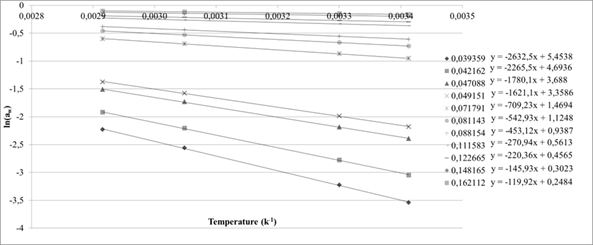
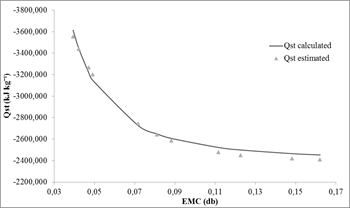
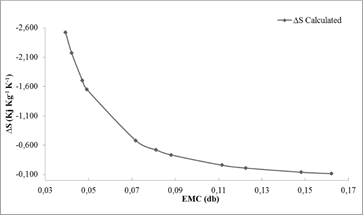
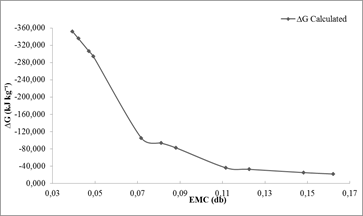
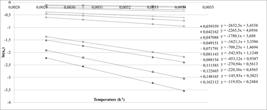
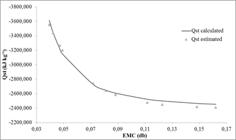
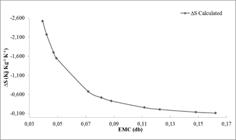
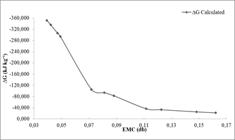
The Moringa plant, widely recognized for its uses in both animal and human nutrition as well as in medicine, has seeds rich in oil and protein. For their maintenance and processing, safe storage conditions are needed, in addition to an understanding of the energy required for this process. The objective of this work was to study the hygroscopic and thermodynamic properties of moringa grains. The static gravimetric method was used at temperatures of 20-70°C and relative humidities of 10.75-85.11%. Nine mathematical models were fitted to the experimental water sorption data. The modified Halsey model provided the best fit, with an R2 of 97.72%, P of 6.71%, and SE of 0.01, and was therefore used to calculate the thermodynamic properties. An increase in the equilibrium water content from 0.039 to 0.162 (db) resulted in a decrease in the energy released during adsorption (Qst) from -3613.589 to -2453.029 kJ kg-1, the differential entropy (∆S) from -2.519 to -0.115, and Gibbs free energy (∆G) from -351.897 to -21.773. This process was considered spontaneous.
Keywords:
mathematical modelling; isosteric heat; Gibbs free energy, entropy
 Thumbnail
 Thumbnail
 Thumbnail
 Thumbnail