 Hygroscopicity and thermodynamic properties of grains of Moringa oleifera L.
ABSTRACT.
The Moringa plant, widely recognized for its uses in both animal and human nutrition as well as in medicine, has seeds rich in oil and protein. For their maintenance and processing, safe storage conditions are needed, in addition to an understanding of the energy required for this process. The objective of this work was to study the hygroscopic and thermodynamic properties of moringa grains. The static gravimetric method was used at temperatures of 20-70°C and relative humidities of 10.75-85.11%. Nine mathematical models were fitted to the experimental water sorption data. The modified Halsey model provided the best fit, with an R2 of 97.72%, P of 6.71%, and SE of 0.01, and was therefore used to calculate the thermodynamic properties. An increase in the equilibrium water content from 0.039 to 0.162 (db) resulted in a decrease in the energy released during adsorption (Qst) from -3613.589 to -2453.029 kJ kg-1, the differential entropy (∆S) from -2.519 to -0.115, and Gibbs free energy (∆G) from -351.897 to -21.773. This process was considered spontaneous.
Keywords:
mathematical modelling; isosteric heat; Gibbs free energy, entropy
Introduction
Known as the miracle tree, Moringa oleifera is native to northern India (Tshabalala et al., 2019). Moringa oleifera Lamark is the best-known, most widely cultivated and most distributed species of the Moringaceae family (Matic et al., 2018). According to Su et al. (2023), several parts of the plant are used in human and animal medicine and nutrition.
Moringa grains contain 27-41.7% oil, are rich in omega 9, 6 and 3 fatty acids (Gharsallah et al., 2023), that oil is resistant to degradation (Saa et al., 2019). Furthermore, Moringa grains have high protein contents, part of that allow for clarification during water treatment (Padilla et al., 2023).
Agricultural products can gain or lose water until they reach equilibrium with environmental conditions, including temperature and relative humidity (RH). Furthermore, data on the desorption and adsorption of water are plotted, and depending on the hygroscopic characteristics of the product, different sorption curves may be drawn (Isquierdo et al., 2020). According to Brooker et al. (1992), grains with high lipid content tend to have lower equilibrium water content than those with high starch content, due to their hydrophobic nature. At the same air temperature and relative humidity, two different equilibrium water contents may be observed depending on whether the food was initially drier or wetter in relation to the environmental conditions. This phenomenon is known as hysteresis (Peleg, 2020). The intensity of hysteresis varies among seeds of different species, generally being higher in starchy seeds than in oilseeds (Hay et al., 2022).
According to Labuza (1968), the hysteresis effect is typical of the capillary condensation region and can extend into the multilayer formation region and, in very rare cases, reach the monolayer region. The impact of temperature on the intensity of hysteresis may vary among different food products. For some, the phenomenon may be eliminated as temperature increases, while for others, hysteresis may remain constant or even increase with rising temperature (Barbosa-Cánovas & Vega-Mercado, 1996). As demonstrated in studies on high-oil-content grains-peanuts (Kaur et al., 2023), canola and yellow mustard (Rezaei et al., 2024), and soybeans (Zeymer et al., 2023) -the degree of hysteresis in water sorption isotherms generally decreases as temperature increases, with this reduction being more pronounced at low water activity (aw) levels.
The equilibrium water content of the grains under specific temperatures and relative humidities can be predicted by mathematical models called sorption isotherms, which aid in decision-making in the food processing industry and in the design of drying, packaging and storing systems through these data (Labuza & Altunakar, 2020).
Sorption isotherms are represented graphically by relating the equilibrium water content of the product and the relative humidity of the environment at a fixed temperature. At this equilibrium point, the relative humidity of the environment is approximately equal to the water activity of the product. Specifically, through sorption isotherms, it is possible to predict the water content of a product at different temperatures and relative humidities in the environment (Zhu et al., 2021).
The qualities of products can be affected by environmental temperatures and relative humidities (Xing et al., 2023). According to Moraes et al. (2021), the stabilities and qualities of agricultural products are related to their water activities. According to Mubvuma et al. (2013), the germination percentages and qualities of moringa seeds can be improved or maintained by controlling the storage times and temperatures for a maximum duration of three months, after which the qualities begin to deteriorate.
Specific thermodynamic properties, such as the isosteric heat of sorption, entropy and Gibbs free energy, help to understand the energy during heat and mass transfer processes. These thermodynamic properties can be calculated using the product hygroscopicity data Polachini et al. (2023).
By considering the importance of conserving agricultural products and seeking to improve processing conditions, the objective of this work was to determine the adsorption isotherms and thermodynamic properties of Moringa oleifera L. grains under the conditions studied.
Material and methods
The present study was carried out at the Federal University of Lavras. The moringa grains were obtained in the state of Pará. Then, the grains were homogenized and dried at 40°C to a water content of approximately 0.066 (decimal, db) in an oven for 24h (Brasil, 2009); this water content was considered the initial value for the hygroscopicity experiment.
The hygroscopicity test was performed by the static gravimetric method applied in Isquierdo et al. (2020); three repetitions of approximately 0.90 ± 0.26 g of moringa grains were manufactured and placed in aluminium foil moulds. The samples were placed in a Gerbox containing saturated solutions and sealed with tape to provide airtightness. The Gerbox was placed in a biochemical oxygen demand (BOD) device, which exposed the samples to temperatures of 20, 30, 55, and 70°C. When exposed to specific temperatures, saline solutions exhibited different relative humidities (Table 1). The grains were weighed every 24 hours until they reached a constant mass, with no variation greater than 0.001 g over three consecutive measurements. Then, the water content was determined and considered the equilibrium value. At this point, the water activity of the grains was approximately equal to the relative humidity of the air in decimals.
In the hygroscopicity test, the different temperatures and relative humidities generated distinct equilibrium water contents, which were used to adjust the mathematical models (Table 2) through the Statistica 5.0® program (StatSoft Inc., 1999) and the Quasi-Newton method.
where, Xe = equilibrium water content (db); T = ambient air temperature (°C); Tabs = absolute ambient air temperature, (K); aw = water activity, (decimal); a, b, c = parameters that depend on the nature of the product.
The best model was chosen based on the coefficient of determination (R2), the relative mean error (P; %) and the estimated mean error (SE; decimal), according to Equations 10 and 11.
(10)
(11)
where, Yobs = water content observed experimentally; Ŷest = water content estimated by the model; n = number of experimental observations; DF = degrees of freedom of the model (the number of experimental observations minus the number of model coefficients).
The mathematical model that best fit the experimental data was used to calculate the thermodynamic properties of Moringa oleifera L. grains, where the predicted water activity was used for each combination of equilibrium water content and temperature.
The net isosteric heat of adsorption for each equilibrium water content was obtained using Equation 12. The "+" and "-" signs were related to the direction of heat transfer. The positive sign was used for the adsorption calculations (Corrêa et al., 2012):
(12)
where, qst = net isosteric heat of adsorption (kJ kg-1); Tabs = absolute temperature (K); R = universal gas constant for water vapour (0.4619 kJ kg-1 K-1); ∆S = differential entropy of adsorption (kJ kg-1 K-1).
According to Fasina (2006), isosteric heat provided the minimum energy required to transfer water molecules in the vapour state to a product surface. The latent heat of condensation of water vapour and the calculated isosteric heat of adsorption were calculated by Equations 13 and 14, respectively (Chaves et al., 2015). The theoretical isosteric heat was adjusted and calculated by Equation 15.
L = -2502.2 + 2.39 . T m (13)
Qst = q st + L(14)
Qst = a.exp(b.Xe) + L(15)
where, Qst = integral isosteric heat of adsorption (kJ kg-1); L = latent heat of condensation of water vapour (kJ kg-1); Tm = average temperature range of the study (°C).
According to Silva et al. (2021), for a water-product system, the analysis of the degree of order or disorder could be understood by the differential entropy, which was calculated from the Gibbs‒Helmholtz equation (Equation 16) (Rizvi, 2014):
(16)
where, ∆S = differential entropy (kJ kg-1 K-1); ∆G = Gibbs free energy (kJ kg-1)
A process was considered spontaneous if the Gibbs free energy was negative and not spontaneous if the Gibbs free energy was positive (Matos et al., 2022). The Gibbs free energy was calculated from Equation 17 (Oliveira et al., 2013):
∆G = R . T abs . ln(a w ) (17)
where, aw= water activity (decimal).
Results and discussion
Table 3 shows the different mathematical models that were adjusted to the water adsorption experimental data from the grains of Moringa oleifera L. The best models were Sigma-Copace, modified Halsey, Copace and modified Guggenheim-Anderson-De Boer (GAB), with R (%) values of 98.1, 97.7, 96.5, and 94.8, respectively, and P (%) values of 6.2, 6.7, 9.4, and 9.3, respectively.
According to Zhu et al. (2021), different mathematical models have been designed to create water sorption isotherms for use in different foods, as demonstrated in the following studies with oilseeds: the modified Halsey model in soybeans (Zeymer et al., 2023), the Chug-Pfost model in safflower seeds (Bessa et al., 2021), the Peleg model in Camellia oleifera seeds and kernels (Zhu et al., 2021), the GAB and Double Log Polynomial models in peanuts (Kaur et al., 2023), and the modified Chung-Pfost, modified GAB, modified Henderson, modified Owsin and modified Caurie in Coix seeds (Luo et al., 2024).
Mathematical models adjusted to water adsorption experimental data of Moringa oleifera L. grains with parameters and adjustment evaluators.
According to Mohapatra and Rao (2005), models with mean relative error values (P; %) below 10 are acceptable for describing the process. According to Siqueira et al. (2018), the statistical parameters of the coefficient of determination (R; %) and estimated mean error (SE; decimal) aid in choosing the best model. Thus, the closer the SE is to 0, the better the fit of the model to the process (Siqueira et al., 2012).
Siqueira et al. (2018) determined the sorption curves of Niger grains (Guizotia abyssinica (L.f.) Cass.), using the static gravimetric method at temperatures of 30, 35 and 40°C and relative humidities ranging from 0.07 to 0.79 (decimal). The models by Chung-Pfost, modified Henderson, Oswin, Sabbah, Sigma-Copace, modified Halsey, Smith and Copace adjusted adequately to the experimental data. By studying water adsorption isotherms in Moringa oleifera seeds, Alimi et al. (2017) fit different mathematical models to the experimental data. All models achieved good fits, with the linear fraction (LF) model notably having an R2 of 0.99.
The modified Halsey model was chosen because it did not present negative signs when calculating the water activities at each temperature and equilibrium water content under study. The water contents calculated and estimated by the modified Halsey model are shown in Table 4. At the same temperature, the higher the relative humidity is, the greater the equilibrium water content of the moringa grains. Bessa et al. (2021), studying the sorption curves of safflower grains (Carthamus tinctorius L.), reported an increase in water activity when the equilibrium water content is increased at the same temperature.
Equilibrium water content estimated by the modified Halsey model for Moringa oleifera L. grains.
The water activities estimated by the modified Halsey model for each combination of equilibrium water content (db) and temperature (°C) are shown in Table 5. For the same equilibrium water content, when the temperature increases, the water activity (aw) increases. Zhu et al. (2021), studying the sorption isotherms of Camellia oleifera seeds, showed that the oil concentration contributes to the equilibrium water content being less than that of a seed without oil under experimental conditions of 25°C and water activities in the range of 0.2-0.9. This study showed that oilseeds tend to adsorb less water during adsorption process than seeds without oil.
The compositions of the grains greatly influence water sorption when exposed to different environmental conditions, resulting in different formats of the curve, which are used to understand the drying, storage and packaging processes of food (Isquierdo et al., 2020). In the study by Alimi et al. (2017), the sorption isotherms of moringa seeds followed sigmoidal curves. This tendency in water adsorption is typical of cereals with microcapillary structures, and it occurs in the form of multiple layers (Ertugay & Certel, 2000).
In practice, according to Labuza and Altunakar (2007), understanding water activity (aw) under different conditions to which food may be exposed allows for the identification of critical points where chemical reactions or physical changes occur. For example, at water activity levels between 0.2 and 0.3, corresponding to the approximate monolayer moisture content, foods reach their maximum shelf life. Below this range, lipid oxidation begins. According to (Tapia et al., 2020), water activity above 0.7 in dry matter food can lead to microorganism growth.
The physical, chemical and microbiological stabilities of foods and the energies required for heat and mass transfer can be effectively understood through thermodynamic properties, which are calculated through sorption isotherms (Polachini et al., 2023).
Water activity estimated by the modified Halsey model for Moringa oleifera L. grains according to equilibrium water content (db) and temperature (°C).
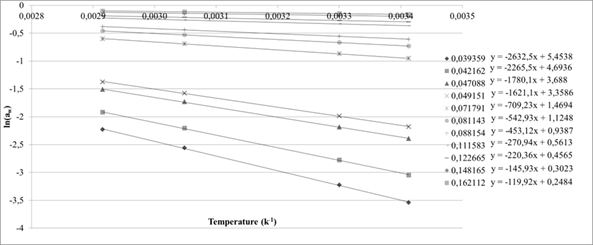
Figure 1 shows that the higher the equilibrium water content is, the lower the coefficient of inclination of the straight line and, consequently, the lower the net and integral isosteric heat of adsorption, as observed by Teixeira et al. (2018).
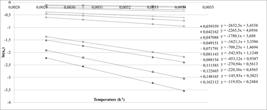
Values of slope angle coefficients for each equilibrium water content (db) for Moringa oleifera L. grains.
The net isosteric heat of sorption is calculated using Equation 12 by considering the angular coefficient of the straight line (ln(aw)×(Tabs -1)) for each estimated equilibrium water content. The angular coefficients are shown in Figure 1. By using Equation 13, the latent heat of condensation of water vapour can be calculated using the average temperature in the experiment: 43.750°C. The resulting value is -2397.638 kJ kg-1.
The decrease in the differential enthalpy with the increase in the product water content in at values close to 0 shows that the most active sorption sites are occupied. Relatively low-energy levels of bonding between the water molecules are reached, thus decreasing the sorption heat. Santos Cotta et al. (2024), studying the thermodynamic properties of cassava starch, observed that the differential enthalpy (also called the net isosteric heat of sorption) curve approaches 0 exponentially as the level of water adsorption increases. Conversely, at low water contents, the scholars observed relatively high interaction energies between water molecules and sorption sites.
According to the study by Santos Cotta et al. (2024), the differential enthalpy calculated through the water sorption isotherms of cassava starch is negative, demonstrating a release of energy. This energy release indicates that the total energy adsorbed in the breaking of the bond between the water molecules and the sorption sites is less than the total energy released in the union of the water molecules and sorption sites.
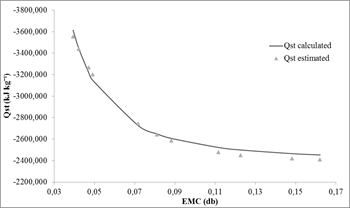
Figure 2 shows the highest value of integral isosteric heat of adsorption with decreasing water content, indicating that the highest amount of energy is released by the system in which water vapour is transferred to the product surface. Notably, the integral isosteric heat has a negative sign, which is characteristic of an exothermic process, as observed in chia seeds (Oliveira et al., 2022) and pumpkin seeds (Teixeira et al., 2018). The isosteric heat values may vary according to the product, composition and physical characteristics (Siqueira et al., 2018). The integral isosteric heat of adsorption calculated and estimated by the model according to Equation 15 can be observed in Table 6. The model used to calculate the integral isosteric heat of adsorption is adequately adjusted, with R2 values of 98.99% (a: 5000.881 and b: -37.218). This finding suggests that this model can be satisfactorily used by changing the input variables of the latent heat of condensation of water vapour and the equilibrium water content.
Line slope coefficient, net isosteric heat, and integral isosteric heat of adsorption calculated and estimated by the model for Moringa oleifera L. grains.
Figure 2 also shows the calculated integral isosteric heat and the heat estimated by the model as a function of the equilibrium water content (decimal, db). For equilibrium water contents in the range from 0.039 to 0.162 (decimal, db), the integral isosteric heat of adsorption ranges from -3613.589 to -2453.029 kJ kg-1, as observed by Corrêa et al. (2016) and Teixeira et al. (2018).
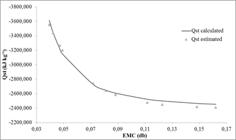
Calculated and estimated integral isosteric heats of adsorption as a function of equilibrium water content (db) for Moringa oleifera L. grains.
Siqueira et al. (2018) determined the integral isosteric heat of desorption of Niger (Guizotia abyssinica (L.f.) Cass.), with values ranging from 2539.62 to 3081.48 kJ kg-1, and equilibrium water contents ranging from 0.024 to 0.122 (decimal, db). The results are similar, with different signs due to the direction of energy transfer.
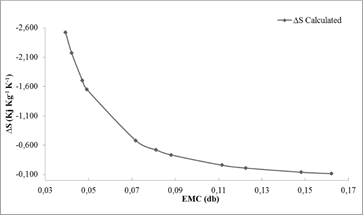
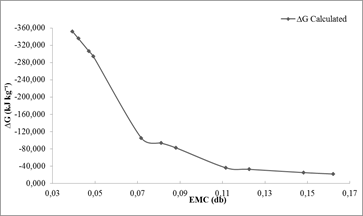
The differential entropy and Gibbs free energy for each equilibrium water content (db) are calculated using Equations 16 and 17, respectively. These data are presented in Figures 3 and 4, respectively.
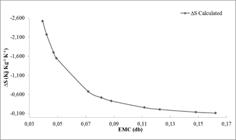
Calculated differential Entropy of adsorption as a function of equilibrium water content (db) for Moringa oleifera L. grains.
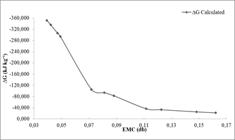
Calculated Gibss Free Energy of adsorption as a function of equilibrium water content (db) for Moringa oleifera L. grains.
As moringa grains adsorb water from 0.039 to 0.162 (db), the differential entropy ranged from -2.519 to -0.115 kJ kg-1 K-1 (Figure 3). The same trend was observed for Gibbs free energy, which ranged from -351.897 to -21.773 kJ kg-1 (Figure 4). The same trend was found by Teixeira et al. (2018) for pumpkin seeds and by Corrêa et al. (2016) for medium-light-roasted Conilon coffee with different particle sizes when they studied the thermodynamic properties calculated from adsorption isotherm data.
Silva et al. (2021) state that differential entropy is associated with the number of available sorption sites at a specific energy level, as well as the spatial arrangement of water within the food matrix. Santos Cotta et al. (2024) calculated the differential entropy through the sorption isotherms of cassava starch, demonstrating that at low values of water content, there are higher values for this property in addition to a negative value, meaning that the water adsorption process for that study occurred in an organized way.
Rizvi and Benado (1984) explained that two entropic contributions influence the adsorption phenomenon in food products: a decrease in entropy due to water immobilization, and an increase in entropy resulting from structural modifications as certain components dissolve and expand. Iglesias et al. (1976) attributed the negative entropy values to the occurrence of chemical adsorption or structural changes in the adsorbent material. The Gibbs free energy provides information about the spontaneity of the sorption process and it quantifies the energy available in the process and the absorbate-sorbent affinity (Rizvi, 2014).
Conclusion
The Sigma-Copace, modified Halsey, Copace and modified GAB models represent the optimal adsorption isotherms of Moringa oleifera L. grains. A water content of 0.081 (decimal, db) for Moringa oleifera L. grains approximates the maximum safe range for the undeveloped microorganisms. An increase in the equilibrium water content during adsorption releases a reduced amount of energy during water vapour-product interactions and also reduces the differential entropy and Gibbs free energy. The water adsorption of Moringa oleifera L. grains in this study is spontaneous.
Data availability
The data used in the search were made available publicly, and can be accessed through the link https://drive.google.com/drive/folders/10fxCuGBJvnSoUqZwy2iBzwjBJyw1wN_y?usp=drive_link
References
-
Alimi, B. A., Workneh, T. S., Oke, M. O. & Tesfay, S. Z. (2017). Moisture sorption isotherm characteristics of moringa seed at two different temperatures. In VII International Conference on Managing Quality in Chains (MQUIC2017) and II International Symposium on Ornamentals in 1201 (pp. 191-196). https://doi.org/10.17660/ActaHortic.2018.1201.26
» https://doi.org/https://doi.org/10.17660/ActaHortic.2018.1201.26 -
Andrade, E. T., Figueira, V. G., Teixeira, L. P., Taveira, J. H. S. & Borém, F. M.. (2017). Determination of the hygroscopic equilibrium and isosteric heat of aji chili pepper. Revista Brasileira de Engenharia Agrícola e Ambiental, 21(12), 865-871. https://doi.org/10.1590/1807-1929/agriambi.v21n12p865-871
» https://doi.org/https://doi.org/10.1590/1807-1929/agriambi.v21n12p865-871 - Barbosa-Cánovas, G. V. & Vega-Mercado, H. (1996). Dehydration of foods. Chapman & Hall.
-
Bessa, J. F. V., Resende, O., Oliveira, D. E. C., Lima, R. R., Quequeto, W. D. & Siqueira, V. C.. (2021). Adsorption isotherms and thermodynamic properties of Carthamus tinctorius L. seeds. Revista Brasileira de Engenharia Agrícola e Ambiental, 25(10), 696-702. https://doi.org/10.1590/1807-1929/agriambi.v25n10p696-702
» https://doi.org/https://doi.org/10.1590/1807-1929/agriambi.v25n10p696-702 - Brasil (2009). Ministério da Agricultura, Pecuária e Abastecimento. Secretaria de Defesa Agropecuária. Regras para análise de sementes. MAPA/ACS.
- Brooker, D. B., Bakker-Arkema, F. W. & Hall, C. W. (1992). Drying and storage of grains and oilseeds. The AVI Publishing Company.
-
Brunauer, S., Emmett, P. H. & Teller, E.. (1938). Adsorption of gases in multimolecular layers. Journal of the American Chemical Society, 60(2), 309-319. https://doi.org/10.1021/ja01269a023
» https://doi.org/https://doi.org/10.1021/ja01269a023 -
Chaves, T. H., Resende, O., Oliveira, D. E. C., Smaniotto, T. A. S. & Sousa, K. A.. (2015). Isotermas e calor isostérico das sementes de pinhão-manso. Revista Engenharia na Agricultura, 23(1), 9-18. https://doi.org/10.13083/reveng.v23i1.591
» https://doi.org/https://doi.org/10.13083/reveng.v23i1.591 -
Chung, D. S. & Pfost, H. B.. (1967). Adsorption and desorption of water vapor by cereal grains and their products Part II: Development of the general isotherm equation. Transactions of the ASAE, 10(4), 552-555. https://doi.org/10.13031/2013.39727
» https://doi.org/https://doi.org/10.13031/2013.39727 - Corrêa, P. C., Martins, D. S. R. & Melo, E. C. (1995). Umigrãos: Programa para o cálculo do teor de umidade de equilíbrio para os principais produtos agrícolas. Centro Nacional de Treinamento em Armazenagem/UFV.
- Corrêa, P. C., Oliveira, G. D. & Santos, E. D. S. (2012). Thermodynamic properties of agricultural products processes. In I. Arana (Org.), Physical properties of foods: Novel measurement techniques and applications. (pp. 131-141). CRC Press.
- Corrêa, P. C., Oliveira, G. H. H., Oliveira, A. P. L. R. D., Rodrigues, A. P. L., Vargas-Elías, G. A. & Baptestini, F. M.. (2016). Particle size and roasting on water sorption in conilon coffee during storage. Coffee Science, 11(2), 221-233.
-
Ertugay, M. F. & Certel, M.. (2000). Moisture sorption isotherms of cereals at different temperatures. Molecular Nutrition & Food Research, 44(2), 107-109. https://doi.org/10.1002/(SICI)1521-3803(20000301)44:2<107::AID-FOOD107>3.0.CO;2-F
» https://doi.org/https://doi.org/10.1002/(SICI)1521-3803(20000301)44:2<107::AID-FOOD107>3.0.CO;2-F -
Fasina, O. O.. (2006). Thermodynamic properties of sweetpotato. Journal of Food Engineering, 75(2), 149-155. https://doi.org/10.1016/j.jfoodeng.2005.04.004
» https://doi.org/https://doi.org/10.1016/j.jfoodeng.2005.04.004 -
Gharsallah, K., Rezig, L., Rajoka, M. S. R., Mehwish, H. M., Ali, M. A. & Chew, S. C.. (2023). Moringa oleifera: Processing, phytochemical composition, and industrial application. South African Journal of Botany, 160, 180-193. https://doi.org/10.1016/j.sajb.2023.07.008
» https://doi.org/https://doi.org/10.1016/j.sajb.2023.07.008 -
Greenspan, L.. (1977). Humidity fixed points of binary saturated aqueous solutions. Journal of Research of the National Bureau of Standards-A, Physics and Chemistry, 81(1), 89. https://doi.org/10.6028/jres.081A.011
» https://doi.org/https://doi.org/10.6028/jres.081A.011 -
Hay, F. R., Rezaei, S. & Buitink, J.. (2022). Seed moisture isotherms, sorption models, and longevity. Frontiers in Plant Science, 13(891913), 1-14. https://doi.org/10.3389/fpls.2022.891913
» https://doi.org/https://doi.org/10.3389/fpls.2022.891913 -
Iglesias, H. A. & Chirife, J.. (1976). Prediction of the effect of temperature on water sorption isotherms of food material. International Journal of Food Science & Technology, 11(2), 109-116. https://doi.org/10.1111/j.1365-2621.1976.tb00707.x
» https://doi.org/https://doi.org/10.1111/j.1365-2621.1976.tb00707.x -
Iglesias, H. A., Chirife, J. & Viollaz, P.. (1976). Thermodynamics of wáter sorption by sugar beet root. International Journal of Food Science & Technology, 11(1), 91-101. https://doi.org/10.1111/j.1365-2621.1976.tb00705.x
» https://doi.org/https://doi.org/10.1111/j.1365-2621.1976.tb00705.x -
Isquierdo, E. P., Siqueira, V. C., Borém, F. M., Andrade, E. T., Luz, P. B. & Quequeto, W. D.. (2020). Isotermas de sorção e propriedades termodinâmicas de sementes de maracujá doce. Research, Society and Development, 9(5), 1-18. https://doi.org/10.33448/rsd-v9i5.2884
» https://doi.org/https://doi.org/10.33448/rsd-v9i5.2884 -
Kaur, G., Sidhu, G. K. & Kaur, P.. (2023). Moisture sorption isotherms characteristics for shelf‐life prediction of peanuts (Arachis hypogaea L. ). Journal of the Science of Food and Agriculture, 103(6), 3077-3092. https://doi.org/10.1002/jsfa.12475
» https://doi.org/https://doi.org/10.1002/jsfa.12475 - Labuza, T. P.. (1968). Sorption phenomena in foods. Food Technology, 22(3), 15-19.
-
Labuza, T. P. & Altunakar, B. (2007). Water activity prediction and moisture sorption isotherms. In G. V. Barbosa-Cánovas, A. J. Fontana Jr., S. J. Schmidt & T. P. Labuza (Eds.), Water activity in foods: fundamentals and applications. (pp. 109-154). Blackwell Publishing Ltd. https://doi.org/10.1002/9780470376454.ch5
» https://doi.org/https://doi.org/10.1002/9780470376454.ch5 -
Labuza, T. P. & Altunakar, B. (2020). Water activity prediction and moisture sorption isotherms. In G. V. Barbosa-Cánovas, A. J. Fontana Jr., S. J. Schmidt & T. P. Labuza (Eds.), Water activity in foods: fundamentals and applications. (pp. 161-205). John Wiley & Sons. https://doi.org/10.1002/9781118765982.ch7
» https://doi.org/https://doi.org/10.1002/9781118765982.ch7 -
Luo, X., Liu, C., Wang, M., Li, X. & Jiang, Y.. (2024). The hygroscopic properties and sorption isosteric heat of coix seeds. Food Science and Engineering, 5(2), 255-270. https://doi.org/10.37256/fse.5220244583
» https://doi.org/https://doi.org/10.37256/fse.5220244583 -
Matic, I., Guidi, A., Kenzo, M., Mattei, M. & Galgani, A.. (2018). Investigation of medicinal plants traditionally used as dietary supplements: A review on Moringa oleifera. Journal of Public Health in Africa, 9(3), 191-199. https://doi.org/10.4081/jphia.2018.841
» https://doi.org/https://doi.org/10.4081/jphia.2018.841 -
Matos, J. D. P., Figueirêdo, R. M. F., Queiroz, A. J. M., Moraes, M. S., Silva, S. N. & Silva, L. P. F. R.. (2022). Foam mat drying kinetics of jambolan and acerola mixed pulp. Revista Brasileira de Engenharia Agrícola e Ambiental, 26(7), 502-512. https://doi.org/10.1590/1807-1929/agriambi.v26n7p502-512
» https://doi.org/https://doi.org/10.1590/1807-1929/agriambi.v26n7p502-512 - Mesquita, J. B., Andrade, E. T. & Corrêa, P. C.. (2001). Modelos matemáticos e curvas de umidade de equilíbrio de sementes de jacarandá-da-bahia, angico-vermelho e óleo-copaíba. Cerne, 7(2), 12-21.
-
Mohapatra, D. & Rao, P. S.. (2005). A thin layer drying model of parboiled wheat. Journal of Food Engineering, 66(4), 513-518. https://doi.org/10.1016/j.jfoodeng.2004.04.023
» https://doi.org/https://doi.org/10.1016/j.jfoodeng.2004.04.023 -
Moraes, M. S., Figueirêdo, R. M. F., Queiroz, A. J. M., Silva, L. P. F. R., Gonçalves, M. G., Oliveira, A. P., Esmero, J. A. D., Mascarenhas, N. M. H., Matos, J. D. P., Silva, S. N., Quirino, D. J. C., Oliveira, A. G. V, Araújo, M. A., Neto, M. S. M., Santos, F. S., Rodrigues, R. C. M. & Costa, M. M.. (2021). Elaboration of blends of pitaya pulps with acerola. Journal of Agricultural Science, 13(3), 53-60. https://doi.org/10.5539/jas.v13n3p53
» https://doi.org/https://doi.org/10.5539/jas.v13n3p53 -
Mubvuma, M. T., Mapanda, S. & Mashonjowa, E.. (2013). Effect of storage temperature and duration on germination of moringa seeds (Moringa oleifera). Greener Journal of Agricultural Sciences, 3(5), 427-432. https://doi.org/10.15580/GJAS.2013.3.121912328
» https://doi.org/https://doi.org/10.15580/GJAS.2013.3.121912328 -
Oliveira, G. H. H., Oliveira, A. P. L. R., Corrêa, P. C., Baptestini, F. M. & Zeymer, J. S.. (2022). Adsorção de água em sementes de chia: modelagem e propriedades termodinâmicas. Brazilian Journal of Animal and Environmental Research, 5(3), 2892-2909. https://doi.org/10.34188/bjaerv5n3-023
» https://doi.org/https://doi.org/10.34188/bjaerv5n3-023 -
Oliveira, D. E. C., Resende, O., Smaniotto, T. A. S., Sousa, K. A. & Campos, R. C.. (2013). Propriedades termodinâmicas de grãos de milho para diferentes teores de água de equilíbrio. Pesquisa Agropecuária Tropical, 43(1), 50-56. https://doi.org/10.1590/S1983-40632013000100007
» https://doi.org/https://doi.org/10.1590/S1983-40632013000100007 -
Padilla, J. R. R., Andrade, E. T., Araújo, B. L. O. & Rios, P. A.. (2023). Moringa oleifera L. cake as a potential substitute for aluminum sulphate coagulant for the treatment of surface water. Theoretical and Applied Engineering, 7(3), 10-18. https://doi.org/10.31422/taae.v7i3.51
» https://doi.org/https://doi.org/10.31422/taae.v7i3.51 -
Peleg, M.. (2020). Models of sigmoid equilibrium moisture sorption isotherms with and without the monolayer hypothesis. Food Engineering Reviews, 12, 1-13. https://doi.org/10.1007/S12393-019-09207-x
» https://doi.org/https://doi.org/10.1007/S12393-019-09207-x -
Polachini, T. C., Morales, S. A. V., Peixoto Filho, L. R., Ribeiro, E. F., Saraiva, L. S. & Basso, R. C.. (2023). Physical properties and molecular interactions applied to food processing and formulation. Processes, 11(7), 1-26. https://doi.org/10.3390/pr11072181
» https://doi.org/https://doi.org/10.3390/pr11072181 -
Rezaei, S., Buitink, J. & Hay, F. R.. (2024). Seed responses to change in ambient humidity and the consequences for storability. Journal of Stored Products Research, 109, 1-7. https://doi.org/10.1016/j.jspr.2024.102477
» https://doi.org/https://doi.org/10.1016/j.jspr.2024.102477 - Rizvi, S. S. H. (2014). Thermodynamic properties of foods in dehydration. In M. A. Rao, S. S. H. Rizvi & A. K. Datta (Eds.), Engineering properties of foods. (pp. 359-436). Taylor & Francis Group.
-
Rizvi, S. S. H. & Benado, A. L.. (1984). Thermodynamic analysis of drying foods. Drying Technology, 2(4), 471-502. https://doi.org/10.1080/07373938408959849
» https://doi.org/https://doi.org/10.1080/07373938408959849 -
Saa, R. W., Fombang, E. N., Ndjantou, E. B. & Njintang, N. Y.. (2019). Treatments and uses of Moringa oleifera seeds in human nutrition: A review. Food Science & Nutrition, 7(6), 1911-1919. https://doi.org/10.1002/fsn3.1057
» https://doi.org/https://doi.org/10.1002/fsn3.1057 -
Santos Cotta, A. A. R., Ferreira, L. F., Borges, S. V., Souza Nascimento, B., Cotta, A. A. C. & Dias, M. V.. (2024). Biodegradation, Water sorption isotherms and thermodynamic properties of extruded packaging composed of cassava starch with tomato peel. Journal of Polymers and the Environment, 32(5), 2221-2238. https://doi.org/10.1007/s10924-023-03094-4
» https://doi.org/https://doi.org/10.1007/s10924-023-03094-4 -
Silva, K. S., Polachini, T. C., Luna-Flores, M., Luna-Solano, G., Resende, O. & Telis Romero, J.. (2021). Sorption isotherms and thermodynamic properties of wheat malt under storage conditions. Journal of Food Process Engineering, 44(9), 1-12. https://doi.org/10.1111/jfpe.13784
» https://doi.org/https://doi.org/10.1111/jfpe.13784 -
Siqueira, V. C., Resende, O. & Chaves, T. H.. (2012). Drying kinetics of Jatropha seeds. Revista Ceres, 59(2), 171-177. https://doi.org/10.1590/S0034-737X2012000200004
» https://doi.org/https://doi.org/10.1590/S0034-737X2012000200004 -
Siqueira, V. C., Silva, F. P., Quequeto, W. D., Jordan, R. A., Leite, R. A. & Mabasso, G. A.. (2018). Desorption isotherms and isosteric heat of niger grains (Guizotia abyssinica (L. f.) Cass.). Revista Agro@mbiente On-line, 12(2), 124-133. https://doi.org/10.18227/1982-8470ragro.v12i2.4908
» https://doi.org/https://doi.org/10.18227/1982-8470ragro.v12i2.4908 - Statsoft Inc (1999). Statistica for Windows - computer program manual. StatSoft.
-
Su, X., Lu, G., Ye, L., Shi, R., Zhu, M., Yu, X., Li, Z., Jia, Z. & Feng, L.. (2023). Moringa oleifera Lam.: A comprehensive review on active components, health benefits and application. RSC Advances, 13(35), 24353-24384. https://doi.org/10.1039/D3RA03584K
» https://doi.org/https://doi.org/10.1039/D3RA03584K -
Tapia, M. S., Alzamora, S. M. & Chirife, J. (2020). Effects of water activity (aw) on microbial stability as a hurdle in food preservation. In G. V. Barbosa-Cánovas, A. J. J. R. Fontana, S. J. Schmidt & T. P. Labuza (Eds.), Water activity in foods: fundamentals and applications. (pp. 323-355). John Wiley & Sons. https://doi.org/10.1002/9781118765982.ch14
» https://doi.org/https://doi.org/10.1002/9781118765982.ch14 -
Teixeira, L. P., Andrade, E. T. & Devilla, I. A.. (2018). Isosteric heat, entropy, and gibbs free energy of pumpkin seeds (Cucurbita moschata). Engenharia Agrícola, 38(1), 97-102. https://doi.org/10.1590/1809-4430-Eng.Agric.v38n1p97-102/2018
» https://doi.org/https://doi.org/10.1590/1809-4430-Eng.Agric.v38n1p97-102/2018 -
Thompson, T. L., Peart, R. M. & Foster, G. H.. (1968). Mathematical simulation of corn drying - A new model. Transaction of the ASAE, 11(4), 582-586. https://doi.org/10.13031/2013.39473
» https://doi.org/https://doi.org/10.13031/2013.39473 -
Tshabalala, T., Ncube, B., Madala, N. E., Nyakudya, T. T., Moyo, H. P., Sibanda, M. & Ndhlala, A. R.. (2019). Scribbling the cat: a case of the “miracle” plant, Moringa oleifera. Plants, 8(11), 1-23. https://doi.org/10.3390/plants8110510
» https://doi.org/https://doi.org/10.3390/plants8110510 - Van Den Berg, C. (1984). Description of water activity of foods for engineering purposes by means of the GAB model of sorption. In B. M. McKenna (Ed.), Engineering science in the food industry. (pp. 311-321). Elsevier.
-
Xing, T., Luo, X., Li, M., Wang, Y., Deng, Z., Yao, M., Zhang, W., Zhang, Z. & Gao, M.. (2023). Study on drying characteristics of Gentiana macrophylla under the interaction of temperature and relative humidity. Energy, 273, 127261. https://doi.org/10.1016/j.energy.2023.127261
» https://doi.org/https://doi.org/10.1016/j.energy.2023.127261 -
Zeymer, J. S., Corrêa, P. C., Oliveira, G. H. H., Araujo, M. E. V., Guzzo, F. & Baptestini, F. M.. (2023). Moisture sorption isotherms and hysteresis of soybean grains. Acta Scientiarum. Agronomy, 45(1), 1-11. https://doi.org/10.4025/actasciagron.v45i1.56615
» https://doi.org/https://doi.org/10.4025/actasciagron.v45i1.56615 -
Zhu, G., Jin, Q., Liu, Y., Lin, Y., Wang, J. & Li, X.. (2021). Moisture sorption and thermodynamic properties of Camellia oleifera seeds as influenced by oil content. International Journal of Agricultural and Biological Engineering, 14(1), 251-258. https://doi.org/10.25165/j.ijabe.20211401.5457
» https://doi.org/https://doi.org/10.25165/j.ijabe.20211401.5457
Edited by
-
Associate Editor in charge:
Alessandro Lucca BracciniCarlos Alberto Scapim