 Application of the Bayesian multi-trait model to estimate genetic covariance and heritability in the evaluation of Coffea canephora in an agroecological-based system
ABSTRACT.
The purpose of this study is to analyze the genetic and residual variability of the grain yield trait in Coffea canephora using the Bayesian multi-trait model. Thirty-six varieties of conilon coffee were used. The design was randomized blocks, with three replications, nine plants per plot. Data was analyzed using multi-trait Bayesian models with an arbitrary number of random effects, employing a Gibbs sampler. The covariance matrix of the random effects is assigned as a prior Inverse Wishart distribution. A total of 1,800,000 samples were generated, with a burn-in of 5,000 and a thin of 5 interactions, resulting in 1,795,000 samples. The broad-sense heritability, residual and genetic variations were calculated from the posterior distribution. The variance-covariance matrix for the genetic factor shows significant variability among the traits. The 95% credibility intervals for the variances and covariances are narrow, indicating accurate estimates. The data is adequate to provide reliable estimates, indicating significant genetic effects on most traits. The residual variance-covariance matrix reveals heteroscedasticity among the traits. According to the results, accurate estimates of broad-sense heritability obtained by the Bayesian methods can guide breeding programs, in addition to identifying traits with high genetic variability and potential for response to selection. The Bayesian approach provided robust and detailed estimates, aligning with previous studies and offering valuable insights for breeding programs.
Keywords:
genetic parameter; conilon; biometrics; inverse wishart; bayesian inference
Introduction
Brazil is the largest coffee producer worldwide, responsible for around 70% of global exports (Companhia Nacional de Abastecimento, 2025). In 2025, the Brazilian total harvest yield is expected to reach approximately 56 million 60-kilogram bags of processed coffee, a 2.70% increase compared to the previous year. In this harvest, conilon coffee production is estimated at 18.71 million bags, representing a 28.30% increase. In Minas Gerais, the expectation is for 43.70 thousand bags, with a 25% growth in grain yield (Companhia Nacional de Abastecimento, 2025).
To achieve high grain yield, breeding techniques can be used, such as selection or development of cultivars with high yield, resistance to abiotic and biotic stresses, and adapted to the target environment (Silva Júnior et al., 2023). To this end, breeders invest considerable resources in the detailed phenotypic evaluation of germplasm and in the selection of multiple traits. The evaluation of several traits in plant breeding seeks to maximize yield potential (Liang et al., 2021; Azevedo et al., 2023). Phenotypic evaluations are conducted on multiple traits and in different environments, which represents a significant challenge for breeders (Torres et al., 2018; Volpato et al., 2019; Peixoto et al., 2021; Silva Júnior et al., 2022). Especially in the breeding of coffee crops, which have biannual cycles. Covre et al. (2022) argue that these challenges are due to the long reproductive cycle of perennial crops, high annual variation, differences in precocity between genotypes and productive longevity. Therefore, biometric studies that fill these gaps are important to identify productive cultivars adapted to the environment, which is the main component of coffee crops' competitiveness.
The difficulties inherent to this crop, in addition to the lack of information targeted at important regions, represent problems for statistical models. Therefore, using an accurate modeling approach can undoubtedly save resources and increase the chances of successful perennial orchards. In this context, the bayesian inference has become a valuable statistical tool for dealing with models involving multiple traits (Torres et al., 2018; Silva Júnior et al., 2022).
The bayesian inference allows modeling variations in the genotype relative ranking under different environmental conditions, providing accurate estimates. Furthermore, this approach allows the incorporation of prior information about the probability distribution of the parameters, which can help reduce uncertainty in the estimates (Peixoto et al., 2021; Azevedo et al., 2023; Silva Júnior et al., 2024). However, setting up bayesian models for trait selection is more complex, and the availability of multi-trait bayesian models for trait selection is quite limited. Peixoto et al. (2021) report that the multi-trait model tends to be the best alternative for analyzing the same trait repeated in several harvests, since it considers genetic and residual correlations between measurements and improves selective precision. They concluded, based on the results, that the bayesian multi-trait model allowed reliable selection of Jatropha curcas superior progenies and recommended this model for genetic evaluation of perennial plants.
Several studies have highlighted the bayesian approach potential in genetic evaluation for plant breeding, especially when considering models with multiple traits (Torres et al., 2018; Volpato et al., 2019; Dunson, 2001; Peixoto et al., 2021; Silva Júnior et al., 2022). According to Azevedo et al. (2023), among the multi-trait models used to jointly model several traits and the environment, the bayesian approach has been a preferred tool in building a more complex and biologically realistic model. Silva Junior et al. (2023) used the bayesian multi-trait model to estimate the genetic parameters of Arabica coffee grown under low nitrogen conditions. Based on the results obtained by the authors, they were successful in combining multi-trait models under a Bayesian view to select Arabica coffee cultivars.
Given the above, the purpose of this study was to analyze genetic and residual variability, identify genetic correlations, and evaluate the accuracy of grain yield variance and covariance estimates in five consecutive conilon coffee harvests, using the bayesian multi-trait model.
Material and methods
Field experiments
Thirty-six conilon coffee clones, originating from the Instituto Capixaba de Pesquisa, Assistência Técnica e Extensão Rural (INCAPER), were evaluated at the Campo Experimental de Leopoldina (CELP) from Empresa de Pesquisa Agropecuária do Estado de Minas Gerais (EPAMIG), located in the municipality of Leopoldina, Minas Gerais State, Brazil (21º31'55" S, 42º38'35" W, 212 m). The experiment was installed in a randomized block design, with three replications, nine plants per plot, and a 1.0 x 2.5 m spacing between plants and rows, respectively
During the experiment, fertilization and crop treatments were conducted according to the recommendations for conilon coffee cultivation (Ferrão et al., 2017). Based on the soil analysis results, soil acidity was corrected when necessary. In top dressing, priority was given to the use of chicken litter as a source of macronutrients and, when necessary, supplemented with chemical fertilizers, and foliar fertilization was carried out with a micronutrient solution. All fertilization was divided into three applications during the rainy season, at 30 to 60-day intervals. To manage weeds, mowing was used between the rows, and the residues were used as mulch.
Grain productivity was evaluated over five consecutive harvests, in 60-kilogram bags of processed coffee per hectare (bags ha-1) (GY).
Statistical analyses
Data was analyzed using the bayesian multi-trait models with an arbitrary number of random effects using a Gibbs sampler. The multi-trait model was given by:
y = 1µ1 + XFjβFj + X1βj1 + + Xkβjk+ uj1+ ujp - εj
where: y is the n-dimensional response vector of phenotypes with y ij representing the phenotypic ith for the jth trait; µ1 is an intercept; X F j is a matrix of fixed effects; β Fj is a vector of fixed effects; X s is an incidence matrix for predictors that are common for all the individuals, s= 1, ..., k; β js is a vector of regression coefficients, s= 1, ..., k. Different priorities were assigned to the regression coefficients (Gaussian), and the regression coefficients are correlated among the traits; u jr is the n-dimensional vector of random effects and ε j is an n-dimensional vector of residuals.
The model residuals are assumed to follow a multivariate normal distribution, with null mean and covariance matrix:
Cov(e'1, … e'n)' = R0 ⊗ I
where: R 0 is a t x t covariance matrix of model residuals and n-dimensional identity matrix.
The prior distribution is hierarchically structured. The prior first level specifies the distribution of the fixed and random effects given the dispersion parameters (the covariance matrices of random effects).
The intercepts and vectors of fixed effects are assigned flat prior (each unknown is assigned a Gaussian prior with null mean and very large variance). The vectors of random effects u r are assigned independent multivariate normal priors with null mean and covariance matrices:
Cov(ur) = Gr ⊗ Kr
where: u r , represents the vector of effects for the rth random effects, G r is an t x t covariance matrix of the rth random effect, and K r is a user-defined covariance matrix for the rth random effect.
The covariance matrix of random effects is assigned Inverse Wishart priors that are structured according to a model (diagonal, factor analytic, or recursive). In total, 1,800,000 samples were generated. Burn-in of 5,000 and thin of 5 iterations were conducted, resulting in a total of 1,795,000 samples. The MCMC convergence was verified by the Geweke (1992) criterion, using the R packages boa (Smith, 2007) and convergence diagnosis and output analysis (CODA) (Plummer et al., 2006).
The broad-sense heritability, residual and genetic variations were calculated from the posterior distribution. The package “boa” (Smith, 2007) was used to calculate the intervals of highest posterior density (HPD) for all parameters. The later estimates for the broad-sense heritability of grain yield for each interaction were calculated from the later samples of the variance components obtained by the model, using the expression:
where: ( g 2(i) , and ( ε 2(i) are the genetic and residual variations for each trait, respectively.
Results and discussion
The posterior inferences for the mean and highest posterior density (HPD) range considering the Bayesian multi-trait model are described in Table 1. The mean values for the grain yield trait ranged from 15.94 to 77.96 bags ha-1 (95% probability). Regarding the HPD upper estimates highest values, posterior density (HPD) ranges for the main grain productivity, GY1 and GY4 stood out, corresponding to 89.95 and 75.05 bags ha-1 respectively. On the other hand, the lowest estimates were GY2 and GY3. The bayesian credibility interval is a statistical measure used to estimate uncertainty around a mean. This means that there is a 95% probability that the true mean grain yield is within the lower and upper bounds of this range, given the previous data and information. This result can identify which conditions were most favorable for grain production, such as GY1 and GY4, since the coffee trees were in full production and after their renewal, respectively, allowing the optimization of agricultural practices. Peixoto et al. (2021) argued that the Bayesian inference advantage over the frequentist inference is the possibility of obtaining HPD intervals. HPD intervals are more accurate when compared to the frequentist inference confidence intervals, which increases the reliability of variance components and genetic parameters estimated through the bayesian inference. These authors observed high values of selective precision, which indicates high reliability and a favorable scenario for genetic selection, since high precision allows the correct classification of genotypes.
Table 2 presents the inferences for the estimates of genetic and residual variance, mode, mean, median, and the highest posterior density (HPD) range, considering the Bayesian multi-trait model. The results indicated that the genetic means presented an approximately normal distribution, while the genetic and residual variances showed significant heterogeneity among the analyzed traits.
The inclusion of informative prior information improved the accuracy of estimates (Azevedo et al., 2022; Morris et al., 2013; Parvis, 1994), especially in small populations. Azevedo et al. (2023) reported that the Bayesian approach when using informative prior distributions should be preferable for breeding purposes aiming to improve selection accuracy. According to Dunson (2001), the use of prior probability distributions represents a powerful mechanism for incorporating information from previous studies and for controlling confounding factors. Azevedo et al. (2023) used phenotypic data from three traits associated with eighteen rice genotypes evaluated in five harvests to evaluate informative prior distributions for multi-trait analysis. The authors demonstrated the proposed multi-trait, multi-environment bayesian model viability for plant breeding. For them, prior distributions are more informative and enable the detection of genetic correlations between traits, and they observed that this was not feasible with the use of non-informative prior distributions.
Measures of central tendency, such as mode, mean, and median, were calculated for each trait. Mode represented the most frequent estimate of the posterior distributions, while the mean provided a central estimate sensitive to all estimates. The median, in turn, offered a robust measure against extreme values. The highest posterior density (HPD) range was used to determine the credibility intervals of the estimates, providing a clear view of the uncertainty associated with each parameter (Table 3). The results highlight the importance of considering the heterogeneity of variances when making genetic inferences. The Bayesian inference approach has been shown to be effective in estimating variance components, especially when prior information was incorporated (Morris et al., 2013; Parvis, 1994). Measures of central tendency and HPD provided a comprehensive understanding of posterior distributions, allowing for a more accurate interpretation of genetic and residual parameters.
The Bayesian multi-trait analysis revealed complex interactions between traits, suggesting that simpler models may not adequately capture the genetic variability present. The use of this model is, therefore, recommended for future studies aiming at a more detailed understanding of genetic relationships. From the Bayesian inference approach, we obtained robust estimates of broad-sense heritability (H 2 ) for grain productivity in coffee trees, in five different harvests. The posterior distributions of H 2 were obtained through Markov Chain Monte Carlo (MCMC), ensuring the estimate convergence and accuracy. The results indicated that the traits' H 2 ranged between 0.000243 and 0.8849, for GY4 and GY1, respectively (Table 3).
In GY4, it was considered weakly heritable, with Bayesian credibility interval (95% probability): H 2 = 0.000243 - 0.412056. The Bayesian credibility intervals' interpretation is fundamentally different from that of conventional confidence intervals (Casella & Berger, 2024). The 95% Bayesian credibility interval means that there is a 95% chance that the credibility interval contains the parameter true value based on the observed data (Yuan & Mackinnon, 2009). The low heritability estimate observed does not depend on the number of evaluated samples, since the Bayesian structure used is essentially recommended for situations involving small samples (Azevedo et al., 2022). Azevedo et al. (2022) demonstrated in their research the multi-trait and multi-environment Bayesian model viability, proposed for plant breeding, involving a low number of genotypes evaluated for multiple traits in multiple environments. However, the grain yield trait is largely influenced by the environment, as it is a quantitative trait (Cruz et al., 2014), which reflects this low heritability estimate. In other crops, this estimate was highly heritable, above 0.80. These estimates suggest a significant genetic contribution to the observed phenotypic variation. The Bayesian inference has the ability to incorporate prior information, as it provides a more informative analysis (Morris et al., 2013; Parvis, 1994), especially for small or unbalanced data. Furthermore, the Bayesian methods provide a complete estimate of the parameter posterior distribution, allowing a more detailed assessment of the uncertainty associated with the estimates.
The results of the posterior density estimation for broad-sense heritability estimation are shown in Figure 1. This Figure shows that the probability distribution of H 2 follows an apparently normal distribution. The results show that this estimate was consistent across different harvests for conilon coffee. The Bayesian inference offers a robust approach to estimating H 2 , allowing the incorporation of prior information and observed data to generate detailed probability distributions.
The results from this study have important implications for genetic selection and plant breeding. Accurate estimates of broad-sense heritability obtained by the Bayesian methods can guide breeding programs by identifying traits with high genetic variability and potential for response to selection. Furthermore, the Bayesian approach can be applied to a wide range of traits and species, making it a valuable tool in quantitative genetics. However, it is important to acknowledge the Bayesian inference limitations due to the choice of prior distributions that can influence the results, and the need for intensive computational techniques that can be challenging in studies with large volumes of data.

Posterior density for estimating broad-sense heritability using the Bayesian multi-trait model.
Posterior variance-covariance (VCV) density estimation was performed using the Bayesian multi-trait model. This estimate density is presented in Figure 2. From this Figure, the mean estimates of the variance components revealed chi-square density and normal distributions. The results show that the estimated density is consistent with previous studies, as indicated by Silva Junior et al. (2022).
The Bayesian multi-trait model simultaneously considers multiple traits to provide a grain production comprehensive view. This model can include variables such as yield, grain quality, pest resistance, and resource use efficiency. For this study, grain yield in different harvests was considered, which constitutes several traits. By using VCV and the Bayesian inference, we estimate the influence of each trait and their interactions, allowing a more detailed analysis.

Posterior variance-covariance density (VCV) of grain yield in five conilon coffee harvests by the Bayesian multi-trait model.
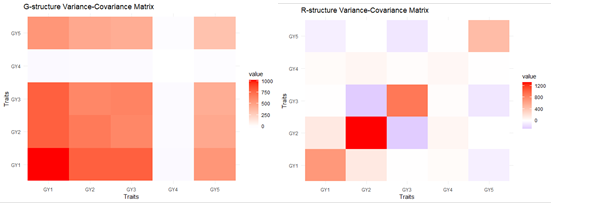
Figure 3 shows the variance-covariance matrices for genetics and structured residuals. The variance-covariance matrix for the genetic factor (G) presents significant variability between the traits. The covariance between GY1 and GY2 is high, indicating that these traits are similarly influenced by genetic factors. However, the 95% credibility intervals for the variances and covariances are narrow, suggesting precise estimates. The covariance between GY3 and GY4 is notably lower, indicating less genetic correlation between these traits. Regarding the data effective size, it is adequate, which provides reliable estimates of this study on conilon coffee, when considering the Bayesian multi-trait model. This can be proven due to the Markov Monte Carlo MCMC simulation p-values, that indicate significant genetic effects in most traits.

The residual variance-covariance matrix shows heteroscedasticity among the traits. This matrix corresponds to the variance of the errors, and these are not constant throughout all observations. This shows that the variance of the errors is not equal across all observations. GY3 has a larger residual variance compared to GY1, indicating a more unexplained variability. However, the 95% credibility intervals for the residual variances are wider, reflecting greater uncertainty within these estimates. Effective sample sizes are sufficient for robust estimation, and p-values indicate significant residual effects, highlighting the importance of accounting for residual variability.
The G structure reveals significant genetic effects on the studied traits. The high covariance between GY1 and GY2 suggests that these traits are similarly influenced by genetic factors, which may be due to shared genetic pathways or pleiotropy. The lower covariance between GY3 and GY4 indicates distinct genetic influences on these traits. These findings are consistent with previous studies (McGuirl et al., 2020), which reported significant genetic correlations between similar traits. Our results provide further evidence of the complex genetic architecture underlying these traits.
The R framework highlights the importance of accurately modeling residual variances. The observed heteroscedasticity among traits suggests that different traits have varying levels of unexplained variability. This may be due to environmental factors or measurement errors. The R framework flexibility in capturing residual variability leads to a better-fitting model. This improves our estimate and inference accuracy and reliability by providing a detailed understanding of the factors that affect these traits.
Our study demonstrates the importance of using unstructured variance-covariance matrices for genetic and residual effects. The G-structure and R-structure provide valuable insights into the genetic and residual variability of the studied traits, contributing to a deep understanding of their underlying mechanisms. These findings have important implications for future research and breeding programs aimed at improving these traits. Therefore, our findings are consistent with previous studies, such as those by McGuirl et al. (2020), which reported significant genetic correlations between similar traits. These authors found that the genetic factor had substantial impact on traits such as grain yield, with high covariance indicating shared genetic pathways. Similarly, our study observed high covariance between GY1 and GY2, suggesting that these traits are influenced by similar genetic mechanisms. Furthermore, they highlighted the importance of accounting for residual variability, observing heteroscedasticity among traits. Our results align with these observations, as the R structure in our model captured varying levels of residual variance across traits, emphasizing the need for flexible modeling approaches to accurately reflect the underlying data structure.
These findings reinforce the conclusions of McGuirl et al. (2020) and contribute to a deeper understanding of the genetic and residual variability of the studied traits. By comparing our results with the established literature, we provide further evidence of the complex genetic architecture and the importance of robust statistical modeling in trait analysis.
Conclusion
The results showed that the Bayesian inference is a robust tool for the genetic analysis of grain yield, providing more accurate estimates of heritability and genetic correlations between different traits. The high heritability estimates in certain crops indicate great potential for effective genetic selection, while the low heritability of GY4 reinforces the environmental influence on this trait. Furthermore, the genetic and residual variance-covariance modeling revealed complex interactions between the evaluated traits, demonstrating the need for advanced statistical approaches for reliable data interpretation. This model allowed a more precise statistical approach, simultaneously incorporating previous information and considering multiple traits to optimize the selection of more productive cultivars adapted to different environments. Therefore, we confirm that the multi-trait Bayesian model is an essential tool for conilon coffee breeding, allowing efficient cultivar selection and contributing to the crop sustainable productivity.
Data availability
The dataset analyzed in this study are not publicly available due to internal restrictions of the project that funded the data collection; however, they can be provided by the authors upon prior request.
Acknowledgements
We thank the Research Support Foundation of the State of Minas Gerais (FAPEMIG) and the National Council for Scientific and Technological Development (CNPq) for the financial support for this research and grants granted to the authors
References
-
Azevedo, C. F., Barreto, C. A. V., Suela, M. M., Nascimento, M., Silva Júnior, A. C., Nascimento, A. C. C., Cruz, C. D. & Soares, P. C.. (2023). Updating knowledge in estimating the genetics parameters: Multi-trait and multi-environment Bayesian analysis in rice. Scientia Agricola, 80, 1-11. https://doi.org/10.1590/1678-992X-2022-0056
» https://doi.org/https://doi.org/10.1590/1678-992X-2022-0056 -
Azevedo, C. F., Carvalho, I. R., Nascimento, M., Silva, J. A. G., Nascimento, A. C. C., Cruz, C. D., Huth, C. & Alemeida, H. C. F.. (2022). Informative prior distribution applied to linseed for the estimation of genetic parameters using a small sample size. Pesquisa Agropecuária Brasileira, 57, 1-10. https://doi.org/10.1590/S1678-3921.pab2022.v57.02793
» https://doi.org/https://doi.org/10.1590/S1678-3921.pab2022.v57.02793 -
Casella, G. & Berger, R. (2024). Statistical inference (2nd ed.). Chapman and Hall/CRC. https://doi.org/10.1201/9781003456285
» https://doi.org/https://doi.org/10.1201/9781003456285 - Companhia Nacional de Abastecimento (2025). Segundo levantamento da safra de café. Acompanhamento da safra brasileira de café. CONAB.
-
Covre, A. M., Silva, F. A., Oliosi, G., Correa, C. C. G., Viana, A. P. & Partelli, F. L.. (2022). Multi-environment and multi-year Bayesian analysis approach in Coffee canephora. Plants, 11(23), 1-14. https://doi.org/10.3390/plants11233274
» https://doi.org/https://doi.org/10.3390/plants11233274 - Cruz, C. D., Carneiro, P. C. S. & Regazzi, A. J. (2014). Modelos biométricos aplicados ao melhoramento genético (3. ed.). UFV.
-
Dunson, D. B.. (2001). Commentary: practical advantages of Bayesian analysis of epidemiologic data. American Journal of Epidemiology, 153(12), 1222-1226. https://doi.org/10.1093/aje/153.12.1222
» https://doi.org/https://doi.org/10.1093/aje/153.12.1222 - Ferrão, R. G., Ferrão, M. A. G., Volpi, P. S., Fonseca, A. F. A., Verdin Filho, A. C. & Comério, M. (2017). Cultivares de cafés Conilon e Robusta. Embrapa.
- Geweke, J. (1992). Evaluating the accuracy of sampling-based approaches to the calculation of posterior moments. In J. M. Bernardo, J. O. Berger, A. P. Dawid & A. F. M. Smith (Eds.), Bayesian statistics (v. 4, pp. 625-631). Oxford University Press.
-
Liang, Y., Nan, W., Qin, X. & Zhang, H.. (2021). Field performance on grain yield and quality and genetic diversity of overwintering cultivated rice (Oryza sativa L.) in southwest China. Scientific Reports, 11(1846), 1-16. https://doi.org/10.1038/s41598-021-81291-8
» https://doi.org/https://doi.org/10.1038/s41598-021-81291-8 -
McGuirl, M. R., Smith, S. P., Sandstede, B. & Ramachandran, S.. (2020). Detecting shared genetic architecture among multiple phenotypes by hierarchical clustering of gene-level association statistics. Genetics, 215(2), 511-529. https://doi.org/10.1534/genetics.120.303096
» https://doi.org/https://doi.org/10.1534/genetics.120.303096 -
Morris, W. K., Vesk, P. A. & McCarthy, M. A.. (2013). Profiting from pilot studies: Analysing mortality using Bayesian models with informative priors. Basic and Applied Ecology, 14(1), 81-89. https://doi.org/10.1016/j.baae.2012.11.003
» https://doi.org/https://doi.org/10.1016/j.baae.2012.11.003 -
Parvis, M.. (1994). Using a-priori information to enhance measurement accuracy. Measurement, 12(3), 237-249. https://doi.org/10.1016/0263-2241(94)90030-2
» https://doi.org/https://doi.org/10.1016/0263-2241(94)90030-2 -
Peixoto, M. A., Evangelista, J. S. P. C., Coelho, I. F., Alves, R. S., Laviola, B. G., Fonseca e Silva, F., Resende, M. D. V. & Bhering, L. L.. (2021). Multiple-trait model through Bayesian inference applied to Jatropha curcas breeding for bioenergy. PLoS ONE, 16(3), 1-11. https://doi.org/10.1371/journal.pone.0247775
» https://doi.org/https://doi.org/10.1371/journal.pone.0247775 - Plummer, M., Best, N., Cowles, K. & Vines, K.. (2006). CODA: Convergence diagnosis and output analysis for MCMC. R News, 6(1), 7-11.
-
Silva Júnior, A. C., Anna, I. C., Silva Siqueira, M. J., Cruz, C. D., Azevedo, C. F., Nascimento, M. & Soares, P. C.. (2022). Multi-trait and multi-environment Bayesian analysis to predict the G x E interaction in flood-irrigated rice. PLoS ONE, 17(5), 1-13. https://doi.org/10.1371/journal.pone.0259607
» https://doi.org/https://doi.org/10.1371/journal.pone.0259607 -
Silva Júnior, A. C., Moura, W. M., Torres, L. G., Santos, I. G., Silva, M. J., Azevedo, C. F. & Cruz, C. D. (2023). Multiple-trait model by Bayesian inference applied to environment efficient Coffea arabica with low-nitrogen nutrient. Bragantia, 82, 1-11. https://doi. org/10.1590/1678-4499.20220157
» https://doi.org/https://doi. org/10.1590/1678-4499.20220157 - Silva Júnior, A. C., Costa, W. G., Guimaraes, A. G., Moura, W. M., Campos, L. J. M., Rodrigues, R. C., Bhering, L. L., Cruz, C. D. & Evaristo, A. B.. (2024). Bayesian inference applied to soybean grown under different shading levels using the multiple-trait model. Scientia Agricola, 81, 1-7.
-
Smith, B. J.. (2007). Boa: An R package for MCMC output convergence assessment and posterior inference. Journal of Statistical Software, 21(11), 1-37. https://doi.org/10.18637/jss.v021.i11
» https://doi.org/https://doi.org/10.18637/jss.v021.i11 -
Torres, L. G., Rodrigues, M. C., Lima, N. L., Trindade, T. F. H., Fonseca e Silva, F., Azevedo, C. F. & DeLima, R. O.. (2018). Multi-trait multi-environment Bayesian model reveals G x E interaction for nitrogen use efficiency components in tropical maize. PLoS ONE, 13(6), 1-15. https://doi.org/10.1371/journal.pone.0199492
» https://doi.org/https://doi.org/10.1371/journal.pone.0199492 -
Volpato, L., Alves, R. S., Teodoro, P. E., Resende, M. D. V., Nascimento, M., Nascimento, A. C. C., Ludke, W. H., Silva, F. L. & Borém, A.. (2019). Multi-trait multi-environment models in the genetic selection of segregating soybean progeny. PLoS ONE, 14(4), 1-22. https://doi.org/10.1371/journal.pone.0215315
» https://doi.org/https://doi.org/10.1371/journal.pone.0215315 -
Yuan, Y. & MacKinnon, D. P.. (2009). Bayesian mediation analysis. Psychological Methods, 14(4), 301-322. https://doi.org/10.1037/a0016972
» https://doi.org/https://doi.org/10.1037/a0016972
Edited by
-
Associate Editor in charge:
Alessandro Lucca BracciniCarlos Alberto Scapim