 Long-term effects of cover crops and nitrogen on soil and grain yield in an Oxisol from southern Brazil
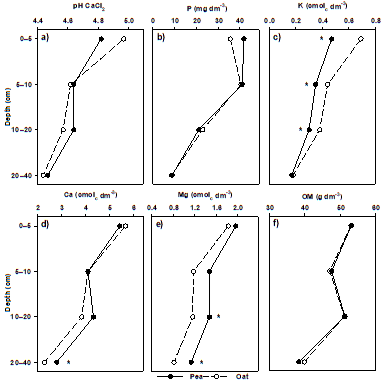
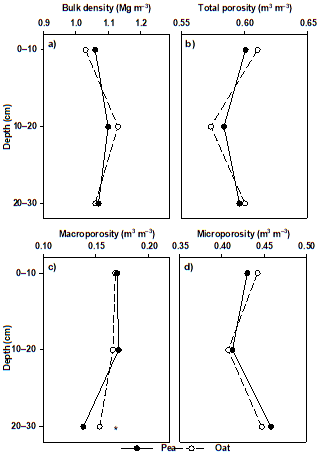
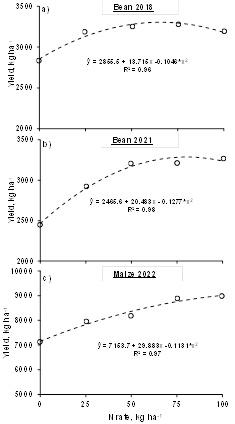
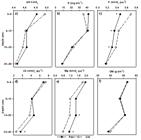
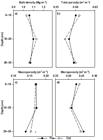
Despite the improvements in soil properties and grain yield obtained by using cover crops, there is little information on their long-term effects and associated nitrogen topdressing fertilization on subsequent crops grown in the same field. Thus, this study aimed to determine the effects of cover crops and nitrogen topdressing fertilization on the soil chemical and physical properties and yield of subsequent grain crops over eight years. The experiment was conducted on soil classified as Oxisol in southern Brazil using a randomized block design in split plots, with five replications. The main plots were divided by winter cover crop (black oat (Avena strigosa Schreb), and pea (Pisum sativum ssp. arvense)), and the subplots had differing nitrogen topdressing application rates (0, 25, 50, 75, and 100 kg N ha−1) and summer grain crops (bean (Phaseolus vulgaris), maize (Zea mays L.), and soybean (Glycine max (L.) Merr.)). In March 2022, after the eighth year of crop rotation, samples were collected in 0-5, 5-10, 10-20, and 20-30 cm soil layers to determine the chemical properties and in 0-5, 5-10, 10-20, and 20-40 cm layers to determine the physical properties. The pH, phosphorus content, and organic matter values were not influenced by the cover crop. A higher soil potassium content was observed at depths of 0-5, 5-10, and 10-20 cm in oat. Oat also showed increased soil macroporosity compared to pea in the 20-30 cm layer. Pea only increased the grain yield in one season with bean and one season with maize. Nitrogen fertilization increased the yield in only some seasons, two seasons with bean and one season with maize. The results of this study can be used to guide cover crop management in no-tillage cropping systems to maximize the positive effects on soil quality.
Keywords:
Oxisol; cover crops; grain crops; soil quality
 Thumbnail
 Thumbnail
 Thumbnail
 Thumbnail