 Color analysis and UV-VIS-NIR spectroscopy in the selection of Passiflora edulis hybrids for fresh consumption
ABSTRACT.
In this study, an alternative method was developed to evaluate fruit and pulp color, using the CIE-L*a*b* kernel space and near-infrared reflectance spectroscopy in predicting the chemical characteristics of Passiflora edulis fruits. Five passion fruit hybrids were evaluated, four with purple-skinned (H09-163, H09-164, H09-166, and H09-125) and one with yellow--skinned (H09-165), in addition to BGP418 (control, yellow-skinned). BGP418 stood out for most physical characters, mainly in the weight of the fruits (224.67 g) and the pulp with seeds (112.77 g). However, its pulp yield was 11% lower compared to other genotypes. Cluster analysis based on fruit skin and pulp color using CIE-L*a*b* space, revealed greater consistency of groups compared to using the conventional method with a color palette. A higher soluble solids content was recorded in fruits with light purple-skinned and light-yellow pulp. Based on the skin and pulp color, the other chemical characteristics did not differ between the groups formed. With UV-VIS-NIR spectra, it was possible to distinguish the genotypes in the 350 and 2,500 nm spectra and the separation between the purple and yellow-skinned l genotypes. However, there was no consistent grouping in relation to the skin and pulp color or relationship with the chemical characteristics of the fruits. The breeding program can utilize the information generated to continue the development of cultivars for fresh consumption.
Keywords:
purple passion fruit; fruit acidity; post-harvest; CIE-L*a*b* colors; infra-red
Introduction
In Brazil, sour or yellow passion fruit (Passiflora edulis Sims) is cultivated in more than 90% of commercial orchards (Zeraik et al., 2010; Meletti, 2011). In 2024, the national production was 736 thousand tons, hence the country was characterized as the main producer and consumer in the world (Instituto Brasileiro de Geografia e Estatística, 2025). This species, in addition to producing yellow fruits, presents a wide color variation from reddish to purple. This darker skin color is sometimes confused with the pure purple passion fruit or gulupa (Passiflora edulis f. edulis Sims), although they are distinct varieties (Jesus et al., 2023). In Brazil, the production and consumption of passion fruit is concentrated on the yellow-skinned passion fruit. Purple-skinned P. edulis is neglected mainly due to lack of dissemination, because it is a new variety with few studies and is less popular among consumers (Jesus et al., 2023).
In terms of its physical and chemical attributes, purple-skinned passion fruit differs from yellow passion fruit, mainly due to its lower mass, lower acidity and sweeter flavor, presenting potential for fresh consumption (Reis et al., 2018; Silva et al., 2021; Jesus et al., 2023; Muñoz-Ordoñez et al., 2023). The pigments found in purple-colored fruits are associated with the presence of anthocyanins, and are considered powerful antioxidants (Vagula et al., 2021). In the purple-skinned passion fruit, high levels of different types of anthocyanins were observed (cyanin, delphinidin-3,5-glucoside, cyanidin-3-glucoside, pelargonidin-3-glucoside, aglycone delphinidin), and quantification of the yellow passion fruit was not possible (Reis et al., 2018).
Countries such as South Africa, Kenya, Australia, and New Zealand are expanding the production of purple passion fruit, aiming to export fresh fruits to Europe (Meletti et al., 2005; Fischer & Miranda, 2021). In this scenario, Colombia stands out as the largest exporter of purple passion fruit or gulupa (Passiflora edulis f. edulis Sims) (Asociación Nacional de Comercio Exterior, 2020; Fischer & Miranda, 2021). In Brazil, there are two passion fruit cultivars that produce fruits with purple-skinned and are recommended for production in the southeast of the country (Meletti et al., 2005). It is necessary to develop cultivars adapted to the conditions of the Brazilian semi-arid region, where the main producing regions are concentrated (Instituto Brasileiro de Geografia e Estatística [IBGE], 2025).
During cultivar development, genotypes are selected that present greater productivity, skin with uniform color and a pleasant flavor. At this stage, populations are evaluated to identify the potential of each genotype (Jesus et al., 2023). However, due to the high number of progenies generated, post-harvest evaluations of passion fruit using conventional methodologies are expensive, in addition to the generation of waste and the use of chemical substances or solvents (Santos et al., 2021; Jesus et al., 2022). To increase the efficiency of evaluations, it is necessary to adopt new approaches for post-harvest characterization.
Among the techniques, Near-Infrared Spectroscopy (NIRS) stands out, which can be used to indirectly determine the levels of soluble solids, acidity and vitamin C in fruits, thereby facilitating the early selection of superior genotypes (Silva et al., 2021). In addition to chemical aspects, visual appeal is essential for the acceptance of fruits on the market; therefore, fruit color can determine the acceptance and commercialization of the product (Muniz et al., 2023). Skin and pulp color assessments are often carried out using a rating scale (Jesus et al., 2017), which can be quite subjective depending on the evaluator, or using a bench colorimeter, which is expensive and sometimes unavailable in laboratories (Ruslan & Roslan, 2016). In this sense, a model was evaluated and validated for determining the main color parameters based on the images of fruits obtained by a camera.
Therefore, the objective of this study was to evaluate the physical and chemical properties of purple-colored passion fruit hybrids, and to apply visible and short-wave infrared (Vis-SWIR) spectroscopy to the pulp of both purple and yellow-skinned passion fruits. This was aimed at associating these characteristics with chemical and color properties, and to employ an alternative methodology to fruit color characterization.
Material and methods
Experiment location
The experiment was conducted in Dom Basílio, Bahia State, Brazil (13°45'36" S, 41°46'15" W, 440 m) with a predominant hot and dry (BSh) climate in transition to a semi-arid climate with minimum temperature of 15ºC and maximum of 30ºC, soil characterized as a eutrophic cambisoil with clayey texture, air humidity around 60% and average annual precipitation of 741.0 mm per year (Köppen & Geiger, 1928).
The plants were maintained in field conditions and the cultivated area had a spacing of 3.0 x 3.0 m between plants and rows. To support the plant, vertical espaliers were utilized at a height of 2.0 m. Cultural treatments were carried out as indicated for passion fruit cultivation (Lima et al., 2011).
Experimental design and plant material
The experiment was conducted in a randomized block design with five Passiflora genotypes (H09-125; H09-163; H09-164; H09-165; H09-166), obtained through open pollination (half-siblings), resulting from crosses of Passiflora edulis Sims with purple-skinned. The fruits were harvested at full ripeness, the seeds were washed under running water and dried for one week at room temperature (Souza et al., 2024). As a control, a yellow-skinned P. edulis accession (BGP418) belonging to the Passion Fruit Germplasm Active Bank from Embrapa Mandioca e Fruticultura was used. The genotypes were distributed in five blocks (repetition) with at least 10 plants per block.
For physical-chemical analyses, at the peak of genotypes production (eight months after planting), the following were randomly collected from the planting area: 50 fruits of genotypes H09-163, H09-164, and H09-166, corresponding to 10 fruits per block; 40 fruits of H09-165, corresponding to eight fruits per block; 20 fruits of H09-125 and BGP418, corresponding to four fruits per block.
Physical and chemical analyses
The physical and chemical analyses of the fruits were conducted at the Post-harvest Laboratory of Embrapa Mandioca e Fruticultura, Cruz das Almas, Bahia State, Brazil. The attributes evaluated were: fruit weight (FW) in g, peel (skin) color (PeC) and pulp color (PC), using a color scale and an alternative methodology was used to assess fruit length (FL), fruit diameter (FD) in mm, FL/FD ratio, peel weight (PW), pulp weight with seed (PWS), and pulp weight without seed (PWWS) in g. Also evaluated were peel thickness (PT) in mm, pulp yield (PY) in %, soluble solids (SS) in ºBrix, total acidity (TA) in %, hydrogen potential (pH), and SS/TA ratio (Jesus et al., 2017).
Based on conventional methodology, peel color (PeC) was evaluated using eight classes namely: 1. Green, 2. Yellow-green, 3. Yellow, 4. Orange, 5. Pink, 6. Red-orange, 7. Red, and 8. Purple. For pulp coloring (PC), seven classes were used: 1. Whitish, 2. Greenish-yellow, 3. Yellow, 4. Light orange, 5. Dark orange, 6. Orange-red, and 7. Purple (Jesus et al., 2017).
Colorimetric analysis
The fruits before physical-chemical analysis and the pulp after analysis were photographed with a white background under laboratory conditions. A digital camera (Canon SX-30IS) was used to record images. The images (fruits and pulp) were loaded and read from the Colorimeter android application (App Colorimetro®) where the reading was done. Color measurements were taken in regions of higher uniformity to represent fruit skin and flesh, using the CIE Lab color space.
Use of Ultraviolet-Visible-Infrared Spectroscopy (UV-VIS-NIRS)
The analysis was carried out per fruit, with the pulp separated from the seed and placed in a crucible with an average volume of 45 mL. The reading was carried out with a portable near-infrared spectrometer (NIR ASD (Analytical Spectral Devices) QualitySpec, United Kingdom), the amount of pulp per fruit varied between 40 and 50 mL. To increase data reliability, two readings were performed on each sample. To collect spectral data, the diffuse reflectance mode was used at a resolution of 8 cm-1 in the waveband of 350-2,500 nm. Each spectrum collected corresponded to an average of 20 spectra collected over a five-second period.
Statistical analysis
The physical and chemical data of fruits were subjected to analysis of variance, and when significant, the means were grouped using the Scott-Knott test (p ≤ 0.05). An application was used to compare the skin and pulp color with the conventional method used by (Jesus et al., 2017), who analyzed classes of descriptors using multivariate statistics, group analysis (clusters), Euclidean distance and the unweighted pair group method with arithmetic mean (UPGMA). At points of major change in the cluster branches of each analysis, groups were visually defined. Based on the groups formed, chemical data were subjected to an analysis of variance and Scott-Knott cluster test (p ≤ 0.05) and the results were presented in the form of boxplots.
After obtaining the UV-VIS-NIRS spectra, data were pre-processed using the Savitzky-Golay second derivative (Savitzky & Golay, 1964). This was followed by the standard normal variation transformation (SNV) and centered to remove noise from the spectrum and correct data dispersion. Preprocessing was performed using the Prospectr package (Stevens et al., 2013) in R software v 4.2.1 (R Core Team, 2022). After data normalization, line graphs were generated for each genotype and between the average of the yellow and purple-skinned genotypes, aiming to verify which region of the spectrum had the greatest variation and whether there was a relationship between these spectra and the skin and/or pulp color groupings, as well as the chemical characteristics SS, TA, SS/TA, and pH. Furthermore, after obtaining the dispersion lines of the purple and yellow-skinned fruits, the region with the greatest variation was selected, where the data were plotted in a box plot and the values were subjected to the t-test, to determine the variation between both groups. Finally, with the average values of the entire spectrum of the six evaluated genotypes, grouping was performed using the UPGMA clustering method and Euclidean distance.
Results
The results of the four genotypes with purple-skinned (H09-125; H09-166; H09-163; H09-164) and two with yellow-skinned, one being BGP418 (control) and the other the hybrid (H09-165) coming from purple parents, revealed variation in all evaluated physical and chemical characteristics. BGP418 was outstanding in terms of physical attributes, but recorded the lowest (50.20%) yield of pulp with seeds compared to the genotypes evaluated (Table 1).
Among the purple hybrids, H09-165 stood out for presenting a pulp yield above 66%, soluble solids above 14.8 °Brix and an SS/TA ratio of 3.85. Similar results were recorded in H09-125 and H09-163 in the SS/TA ratio (Table 1). There was no block effect for any of the evaluated characteristics, thereby indicating homogeneity in the planting area.
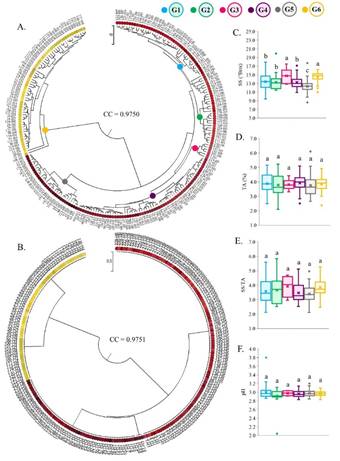
The grouping of 230 fruits from six genotypes revealed a distinction between the groupings obtained by application and through descriptors (conventional method). Using the CIE-L*a*b* color space, six groups (G1 to G6) of skin color were formed. This variation was due to the different shades of purple and yellow present in the fruits (Figure 1A). For the conventional method, four groups were formed, corresponding to the classes observed in the descriptor for skin color (Figure 1B).
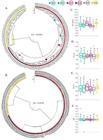
Cluster analysis and comparison of means between groups considering two methodologies for evaluating the color of passion fruit. A. Dendrogram of CIE-L*a*b* color space data of skin color via application; B. Dendrogram with skin color classification via descriptor classes for Passiflora; C-F. Boxplots of the groups formed in the dendrogram based on the application for the characters: C. Soluble solids; D. Total acidity; E. Soluble solids and total acidity ratio; and F. pH. Using the Scott-Knott test at 5%, equal letters do not differ from each other in each characteristic. H1: H09-125; H2: BGP418; H3: H09-166; H4: H09-165; H5: H09-163; H06: H09-164. CC: conphentic coefficient.
Under the conditions of this study, the purple and yellow-skinned fruits and their variations were indecisive for the chemical composition of the fruits, with the exception of the soluble solids content, which was 16% higher in the fruits that formed G3 (14.73 ºBrix) in comparison with G5 which recorded the lowest soluble solids value of 12.32 ºBrix (Figure 1C-F).
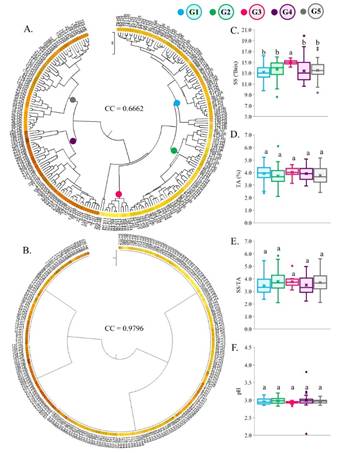
The same trend was observed when analyzing pulp color, but there was greater distinction between groups when using the application, in addition to showing the formation of subgroups with similar pulp color. When conventional descriptors for Passiflora were used, only four groups were formed, and there was no clear distinction of colors within each group (Figure 2A and B).
Regarding the analyses of chemical characteristics carried out according to the groups formed with the pulp color data via CIE-L*a*b*, variation was observed only for the soluble solids content, which was higher in fruits with light yellow pulp (G3), in relation to the other groups (Figure 2C). For the other chemical attributes, there were no statistical differences (Figure 2D-F).
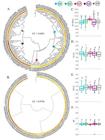
Cluster analysis and comparison of means between groups considering two methodologies for evaluating the pulp color of passion fruit with purple and yellow-skinned. A. Dendrogram based on colorimetric analysis of the pulp via the application; B. Dendrogram with pulp color classification via Passiflora descriptor; C-F. Box-plots of the groups formed in the dendrogram based on application to the characters; C. Soluble solids-SS; D. Total acidity-TA; E. Soluble solids and total acidity ratio SS/TA and F. pH. Equal letters do not differ from each other in each characteristic, using the Scott-Knott test at 5%. H1: H09-125; H2: BGP418; H3: H09-166; H4: H09-165; H5: H09-163; H06: H09-164. CC: conphentic coefficient.
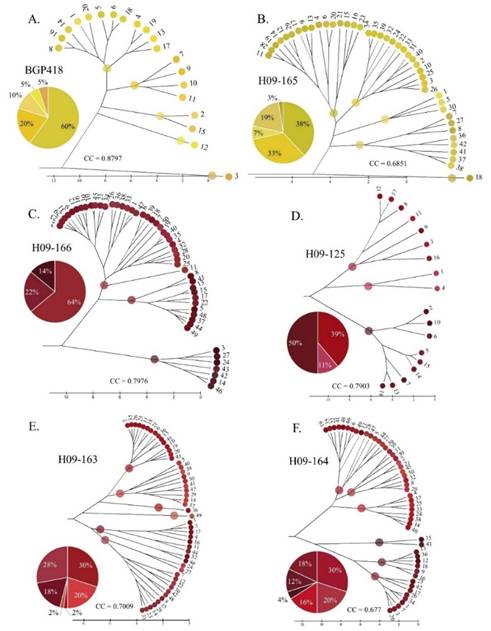
Regarding the analysis of the range of skin color within the genotypes, there was wide variation in the six hybrids evaluated (Figure 3A-F). Genotypes BGP418 and H09-166 (Figure 3A and C) were the most uniform, as they presented the same color tone in at least 60% of the fruits. Genotypes H09-166 and H09-125 showed less variation, with three color groups, differentiating them from the others that presented at least four groups.
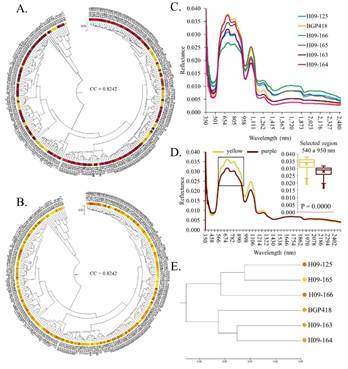
UV-VIS-NIRS spectra analysis conducted on the pulps of six genotypes, showed some consistency between the groups formed based on the absorbance and skin color. However, in some groups there was a mixture of purple and yellow fruits (Figure 4A). At a wavelength of 1070 nm, a strong similarity was observed in the curve of the yellow-skinned (BGP418 and H09-165) and purple-skinned (H09-125, H09-163, H09-164 and H09- 166), indicating a possible separation based on skin color in this spectrum (Figure 4C). In the scatter plot of the yellow and purple-skinned genotypes, it was possible to verify a greater distance in the spectrum curves between the range of 566 to 782 nm, in the visible region, indicating color differences between the genotypes (Figure 4D). Considering the mean absorbance of the genotypes, cluster analysis allowed us to distinguish all evaluated hybrids (Figure 4E).
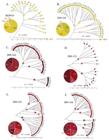
Dendrogram for skin color in yellow and purple-skinned passion fruit with reading using alternative methodology via CIE-L*a*b*. A. BGP418; B. H09-165; C. H09-166; D. H09-125; E. H09-163; F. H09-164. CC: conphentic coefficient.
Discussion
The development of a cultivar involves several stages, including evaluation of the attributes of the fruits, especially when seeking to develop a product for a specific market niche. In Brazil, the production of purple-skinned passion fruit is low compared to yellow passion fruit (Jesus et al., 2023). However, there is a purple gulupa variety (Passiflora edulis f. edulis Sims) that is widely appreciated and consumed in Europe due to its organoleptic and nutritional characteristics, in addition to its medicinal benefits (Fonseca et al., 2022). This acceptance in the foreign market has created a demand which encourages the production of a purple-skinned hybrid adapted to the semi-arid conditions of Northeast Brazil, mainly aimed at export. The fruits evaluated in this study present standards suitable for export in terms of physical characteristics, with an average weight of 102 g, fruit length and diameter of 68 and 66 mm, respectively. These values are like those reported by Muñoz-Ordoñez et al. (2023), who obtained an average weight of around 50 g and a fruit length and diameter of 51 and 58 mm, respectively. In the first production cycle, studies were carried out on gulupa produced in Colombia for export.
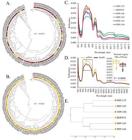
Near infrared spectroscopy (NIR) analysis on the pulps of the six genotypes. A. Dendrogram generated with NIR data of passion fruit pulp with yellow and purple-skinned in relation to the color pattern of the skin obtained by the application in RGB (Red, Green, and Blue); B. Dendrogram of pulp NIR data in relation to the pulp color pattern obtained by the application in RGB (Red, Green and Blue); C. Line graph of the spectra obtained (350 to 2500 nm) per evaluated genotype; D. Line graph of the average spectra obtained (350 to 2500 nm) by skin colors; E. Dendrogram based on average pulp NIR data for the evaluated genotypes. The filled circles in the dendrogram indicate the color patterns of the skin and/or pulp obtained through applications in the RGB space. H1: H09-125; H2: BGP418; H3: H09-166; H4: H09-165; H5: H09-163; H06: H09-164. CC: conphentic coefficient.
Low variation in chemical attributes was recorded between genotypes, which may be associated with the narrow genetic base used in crossings, making it necessary to incorporate other genotypes or evaluate a greater number of progenies. However, it is important to highlight that the chemical attributes of fruits can be influenced by the harvest time, stage of fruit maturation, plant nutrition and consequently their flavor (Santos et al., 2013). The SS and TA values presented in this study corroborate Muñoz-Ordoñez et al. (2023) who evaluated gulupa passion fruit, and obtained an average SS of 11.8 °Brix and TA of 3.4%, indicating that the chemical characteristics of the fruits are in accordance with the foreign market requirements. Furthermore, it is important to highlight that the taste of sweet flavor in bright purple passion fruit is because of its low acidity, thus increasing the SS/AT ratio. Therefore, breeding programs can adopt as a strategy the selection of genotypes with lower acidity, which will result in more palatable fruits (Jesus et al., 2023).
Based on this study, it was not possible to obtain a strong relationship between the chemical characteristics of the fruits and the skin or pulp color, with the only variation in the soluble solids content, being higher in fruits with light yellow pulp (Figure 2C). Fruits with lower flavonoid content, the main compound responsible for the yellow color of passion fruit, tend to have higher levels of soluble solids. Studies with red-skinned dragon fruit (Hylocereus undatus) and yellow-skinned dragon fruit (Selenicereus megalanthus) also reported this inversely proportional relationship between the content of soluble solids and flavonoids (Lima et al., 2013). However, as the fruits mature, it is common for the flavonoid content to increase, in parallel, the SS content also tends to increase. In this sense, new investigations are necessary to elucidate the relationship between the chemical composition of passion fruit and the pulp color, as the selection of purple passion fruit progenies as the most promising for fresh consumption, was not directly based on pulp color (Jesus et al., 2023).
The use of an application for color capture, conversion of colors into CIE-L*a*b* values, followed by applying this data for cluster analysis using the UPGMA method and Euclidean distance, enabled the formation of groups consistent with strong similarity in the skin and pulp color, unlike the conventional method which showed a mixture between colors when using a rating scale (Figures 1 and 2). The same trend was highlighted in another study with passion fruit (Jesus et al., 2023), and thus validates the methodology, allowing crossbreeding to be directed more precisely, to obtain homogeneous hybrids in terms of skin color. The genotype H09-166 (Figure 3C) showed 64% uniformity of purple skin color, higher than that recorded in BGP418 (Figure 3A), which is a commercial cultivar. This demonstrated that (H09-166) presents a considerable percentage of color fixation, although the plants evaluated are progenies of half siblings. However, the tested hybrids are still in the process of establishing several attributes. The genotypes H09-163, H09-164 and H09-165 were more heterogeneous for this characteristic, making it necessary to carry out new cycles of recombination based on these results.
Among the genotypes evaluated, H09-165 and H09-125 stood out for most of the physical and chemical attributes evaluated, with values within the average required for commercialization and like those reported in gulupa passion fruit intended for export (Muñoz-Ordoñez et al., 2023). H09-165 produces yellow-skinned fruits; however, this emanates from a cross with one of the purple-skinned parents, from which it might have benefited its chemical attributes, enabling greater commercial acceptability in Brazil because the yellow skin is already known and appreciated by consumers. Conversely, H09-125 has a purple skin color (Figure 3D), and presents greater potential for export.
In the progeny selection process, the visual aspect in terms of appearance, color uniformity and shade of purple are fundamental attributes for a purple passion fruit cultivar, especially when intended for fresh consumption. Consequent upon their importance, it has become necessary to develop new methods of obtaining and analyzing these colors, as characterization via the Passiflora descriptor method (Jesus et al., 2017) can be subjective, as demonstrated in this study.
UV-VIS-NIRS analysis revealed that there was no strong relationship between NIRS data and the skin or pulp color, and there was heterogeneity in most of the groups formed (Figure 4). The absence in the relationship may be associated with low variation in the chemical characteristics of the fruits (Figure 2). To obtain high accuracy prediction models, it is necessary to explore a wide variability in the predicted characteristics, as reported in the study by Maniwara et al. (2019), who successfully estimated the soluble solids content and total acidity in the purple passion fruit (gulupa), based on the assessment of NIRS and considering the spectrum from 800 to 1094 nm. Similarly, Pratiwi et al. (2023) estimated the soluble solids content in banana, sapodilla, tomato, guava and dragon fruit. Based on NIRS, it is also possible to determine the ripeness point of apple, mango, grape, peach, pear and melon (Shah et al., 2020). However, the authors highlighted that models created for one variety may not be directly applicable to other varieties of the same species and could require adjustments to the equation or a new model with more sample readings. Therefore, the greater the variability used to train the model, the greater the reliability in the prediction.
At wavelength 1,070 nm, similarity was observed between the yellow -skinned genotypes (BGP418 and H09-165), which could be a region of the spectrum with potential for separation between purple and yellow-skinned genotypes and could be related to the chemical properties of the fruits. Strong variation between genotypes also occurred in the shortwave infrared (SWIR) region ranging from 1,100-2,500 nm and was affected by water content and leaf biochemistry (Sahoo et al., 2015). This distinction is possible because NIRS emits light with known spectral properties and different molecules absorb light at specific frequencies. By measuring the amount of reflected light at different wavelengths in the near-infrared spectrum, the constituents of the sample can be identified and quantified (Shah et al., 2020; Beć et al., 2020; Hakkel et al., 2022).
Betemps et al. (2011) were able to evaluate the quality of mango genotypes using NIRS. In the cluster analysis, it was possible to differentiate between genotypes (Figure 4E). These results are preliminary for passion fruit crops produced in Brazil, and requires further investigations to expand the variability of characteristics that will be evaluated by conventional methodology and UV-VIS-NIRS.
Conclusion
Genotypes H09-125 and H09-163 presented the best values for the ratio, with these materials having a purple skin color, thereby demonstrating superior quality for this attribute. However, new recombination cycles are necessary to improve color uniformity for H09-165, H09-164, and H09-166. The application-based colorimetric analysis accurately determined both skin and pulp colors in a cost-effective and portable manner. However, in the breeding population, no correlation was found between these color groups and the fruits' chemical properties. Furthermore, the UV-VIS-NIRS methodology successfully differentiated between genotypes and between purple and yellow varieties, but it did not correlate skin and pulp colors with the spectral readings.
Data availability
All data generated or analyzed during this study are included in this published article.
Acknowledgements
The authors thank the Fundação de Amparo à Pesquisa do Estado da Bahia for the master's research scholarship awarded to the first author (M.A.S.) and financial support (PPP 0026/2024 The authors acknowledge the Conselho Nacional de Desenvolvimento Científico e Tecnológico (CNPq) for support through research productivity fellowships and financial assistance (Process Nos. 311495/2021-4; 402359/2023-2). Finally, we thank Embrapa who provided the plant material along with experimental, technical and financial assistance.
References
-
Asociación Nacional de Comercio Exterior. (2020). Exportación de gulupa en 2020. https://www.analdex.org/2021/02/25/exportacion-de-gulupa-en-2020
» https://www.analdex.org/2021/02/25/exportacion-de-gulupa-en-2020 -
Beć, K. B., Grabska, J. & Huck, C. W. (2020). Near-infrared spectroscopy in bio-applications. Molecules, 25(12), 1-36. https://doi.org/10.3390/molecules25122948
» https://doi.org/https://doi.org/10.3390/molecules25122948 -
Betemps, D. L., Fachinello, J. C. & Galarça, S. P. (2011). Visible spectroscopy and near infrared (VIS/NIR), in assessing the quality of mangoes Tommy Atkins. Revista Brasileira de Fruticultura, 33(spe 1), 306-313. https://doi.org/10.1590/S0100-29452011000500038
» https://doi.org/https://doi.org/10.1590/S0100-29452011000500038 -
Fischer, G. & Miranda, D. (2021). Review on the ecophysiology of important Andean fruits: Passiflora L. Revista Facultad Nacional de Agronomía Medellín, 74(2), 9471-9481. https://doi.org/10.15446/rfnam.v74n2.91828
» https://doi.org/https://doi.org/10.15446/rfnam.v74n2.91828 -
Fonseca, A. M. A., Geraldi, M. V., Maróstica Junior, M. R., Silvestre, A. J. D. & Rocha, S. M. (2022). Purple passion fruit (Passiflora edulis f. edulis): A comprehensive review on the nutritional value, phytochemical profile and associated health effects. Food Research International, 160, 1-24. https://doi.org/10.1016/j.foodres.2022.111665
» https://doi.org/https://doi.org/10.1016/j.foodres.2022.111665 -
Hakkel, K. D., Petruzzella, M., Ou, F., Klinken, A., Pagliano, F., Liu, T., Veldhoven, R. P. J. & Fiore, A. (2022). Integrated near-infrared spectral sensing. Nature Communications, 13(103), 1-8. https://doi.org/10.1038/s41467-021-27662-1
» https://doi.org/https://doi.org/10.1038/s41467-021-27662-1 -
Instituto Brasileiro de Geografia e Estatística. (2025). Produção agrícola municipal 2022. https://sidra.ibge.gov.br/tabela/5457
» https://sidra.ibge.gov.br/tabela/5457 - Jesus, O. N., Oliveira, E. J., Faleiro, F. G., Soares, T. L., & Girardi, E. A. (2017). Illustrated morpho-agronomic descriptors for Passiflora spp. (1. ed.). Embrapa.
-
Jesus, O. N., Lima, L. K. S., Soares, T. L., Silva, L. N., Santos, I. S., Sampaio, S. R. & Oliveira, E. J.. (2022). Phenotypic diversity and alternative methods for characterization and prediction of pulp yield in passion fruit (Passiflora spp. ) germplasm. Scientia Horticulturae, 292, 110573. https://doi.org/10.1016/j.scienta.2021.110573
» https://doi.org/https://doi.org/10.1016/j.scienta.2021.110573 -
Jesus, O. N., Lima, L. K. S., Santos, I. S., Santos, M. A. & Rosa, R. C. C.. (2023). Bright red passion fruit: Evaluation of colorimetry and physicochemical quality for the fresh fruit market. Scientia Horticulturae, 317, 112016. https://doi.org/10.1016/j.scienta.2023.112016
» https://doi.org/https://doi.org/10.1016/j.scienta.2023.112016 - Köppen, W., & Geiger, R. (1928). Klimate der Erde. Gotha: Verlag Justus Perthes. Wall-map 150 cm × 200 cm.
- Lima, A. A., Borges, A. L., Fancelli, M. & Cardoso, C. E. L. (2011). Maracujá: sistema de produção convencional. In M. M. Pires, A. R. São José & A. O. Conceição (Orgs.), Maracujá: avanços tecnológicos e sustentabilidade. (pp. 203-237). Editus.
-
Lima, C. A., Faleiro, F. G., Junqueira, N. T. V., Cohen, K. O. & Guimarães, T. G. (2013). Características físico-químicas, polifenóis e flavonoides amarelos em frutos de espécies de pitaias comerciais e nativas do cerrado. Revista Brasileira de Fruticultura, 35(2), 565-570. https://doi.org/10.1590/S0100-29452013000200027
» https://doi.org/https://doi.org/10.1590/S0100-29452013000200027 -
Maniwara, P., Nakano, K., Ohashi, S., Boonyakiat, D., Seehanam, P., Theanjumpol, P. & Poonlarp, P.. (2019). Evaluation of NIRS as non-destructive test to evaluate quality traits of purple passion fruit. Scientia Horticulturae, 257, 108712. https://doi.org/10.1016/j.scienta.2019.108712
» https://doi.org/https://doi.org/10.1016/j.scienta.2019.108712 -
Meletti, L. M. M. (2011). Avanços na cultura do maracujá no Brasil. Revista Brasileira de Fruticultura, 33(Spe1), 83-91. https://doi.org/10.1590/S0100-29452011000500012
» https://doi.org/https://doi.org/10.1590/S0100-29452011000500012 -
Meletti, L. M. M., Soares-Scott, M. D. & Bernacci, L. C. (2005). Caracterização fenotípica de três seleções de maracujazeiro-roxo (Passiflora edulis Sims). Revista Brasileira de Fruticultura, 27(2), 268-272. https://doi.org/10.1590/S0100-29452005000200020
» https://doi.org/https://doi.org/10.1590/S0100-29452005000200020 -
Muniz, V. R. G. F., Ribeiro, I. S., Beckmam, K. R. L. & Godoy, R. C. B. (2023). The impact of color on food choice. Brazilian Journal of Food Technology, 26, 1-12. https://doi.org/10.1590/1981-6723.08822
» https://doi.org/https://doi.org/10.1590/1981-6723.08822 -
Muñoz-Ordoñez, F. J., Gutiérrez-Guzmán, N., Hernández-Gómez, M. S. & Fernández-Trujillo, J. P. (2023). The climactic conditions limit fruit production and quality in gulupa (Passiflora edulis Sims f. edulis) under integrated fertilization. South African Journal of Botany, 153, 147-156. https://doi.org/10.1016/j.sajb.2022.11.043
» https://doi.org/https://doi.org/10.1016/j.sajb.2022.11.043 -
Pratiwi, E. Z. D., Pahlawan, M. F. R., Rahmi, D. N., Amanah, H. Z. & Masithoh, R. E. (2023). Non-destructive evaluation of soluble solid content in fruits with various skin thicknesses using visible-shortwave near-infrared spectroscopy. Open Agriculture, 8(1), 1-12. https://doi.org/10.1515/opag-2022-0183
» https://doi.org/https://doi.org/10.1515/opag-2022-0183 -
R Core Team. (2022). R: A language and environment for statistical computing (Version 4.2.0) Computer software. R Foundation for Statistical Computing. https://www.r-project.org/
» https://www.r-project.org/ -
Reis, L. C. R., Facco, E. M. P., Salvador, M., Flôres, S. H. & Rios, A. O. (2018). Antioxidant potential and physicochemical characterization of yellow, purple and orange passion fruit. Journal of Food Science and Technology, 55, 2679-2691. https://doi.org/10.1007/s13197-018-3190-2
» https://doi.org/https://doi.org/10.1007/s13197-018-3190-2 - Ruslan, R. & Roslan, N. (2016). Assessment on the skin color changes of Carica papaya L. cv. Sekaki based on CIE L* a* b* and CIE L* C* h color space. International Food Research Journal, 23(Suppl.), 173-178.
- Sahoo, R. N., Ray, S. S. & Manjunath, K. R. (2015). Hyperspectral remote sensing of agriculture. Current Science, 108(5), 848-859.
-
Santos, I. S., Lima, L. K. S., Sampaio, S. R., Soares, T. L., & Jesus, O. N. (2021). Phenological precocity and resistance to CABMV in passion fruit progenies of the third-generation backcross ((P. edulis × P. cincinnata) × P. edulis). Euphytica, 217(112). https://doi.org/10.1007/s10681-021-02842-8
» https://doi.org/https://doi.org/10.1007/s10681-021-02842-8 -
Santos, J. L. V., Resende, E. D., Martins, D. R., Gravina, G. A., Cenci, S. A. & Maldonado, J. F. M. (2013). Determinação do ponto de colheita de diferentes cultivares de maracujá. Revista Brasileira de Engenharia Agrícola e Ambiental, 17(7), 750-755. https://doi.org/10.1590/S1415-43662013000700009
» https://doi.org/https://doi.org/10.1590/S1415-43662013000700009 -
Savitzky, A. & Golay, M. J. (1964). Smoothing and differentiation of data by simplified least squares procedures. Analytical Chemistry, 36(8), 1627-1639. https://doi.org/10.1021/ac60214a047
» https://doi.org/https://doi.org/10.1021/ac60214a047 -
Shah, S. S. A., Zeb, A., Qureshi, W. S., Arslan, M., Malik, A. U., Alasmary, W. & Alanazi, E.. (2020). Towards fruit maturity estimation using NIR spectroscopy. Infrared Physics & Technology, 111, 103479. https://doi.org/10.1016/j.infrared.2020.103479
» https://doi.org/https://doi.org/10.1016/j.infrared.2020.103479 -
Silva, L. R., Figueiredo, A. R., Cunha Júnior, P. C., Barbosa, M. I. M. J., Oliveira, M. M. T., Rosa, R. C. C. & Morais, L. A. S. (2021). Caracterização pós-colheita de frutos de maracujá-roxo cultivados em sistema convencional e orgânico. Nativa, 9(5), 551-557. https://doi.org/10.31413/nativa.v9i5.13069
» https://doi.org/https://doi.org/10.31413/nativa.v9i5.13069 -
Souza, L. R., Lima, L. K. S., Aud, F. F., Junghans, T. G., Costa, E. M. R., Santos, I. S., Sampaio, S. R., Gonçalves, Z. S., Soares, T. L. & Jesus, O. N. (2024). Physiological quality of Passiflora edulis Sims seeds evaluated by different processing methods, storage times and packages. New Zealand Journal of Crop and Horticultural Science, 53(5), 1890-1907. https://doi.org/10.1080/01140671.2024.2424851
» https://doi.org/https://doi.org/10.1080/01140671.2024.2424851 - Stevens, A., Ramirez-Lopez, L., Stevens, M. A. & Rcpp, L. (2013). Prospectr: miscellaneous functions for processing and sample selection of vis-NIR diffuse reflectance data. R package version 0.1.3. R Foundation for Statistical Computing.
-
Vagula, J. M., Cruz, V. H. M., Ponhozi, I. B. & Visentainer, J. V. (2021). Biochemical constituents of the fruits of Solanum americanum Mill., a potential non-conventional edible plant. Brazilian Journal of Development, 7(8), 78698-78705. https://doi.org/10.34117/bjdv7n8-204
» https://doi.org/https://doi.org/10.34117/bjdv7n8-204 -
Zeraik, M. L., Pereira, C. A. M., Zuin, V. G. & Yariwake, J. H. (2010). Maracujá: um alimento funcional? Revista Brasileira de Farmacognosia, 20(3), 459-471. https://doi.org/10.1590/S0102-695X2010000300026
» https://doi.org/https://doi.org/10.1590/S0102-695X2010000300026
Edited by
-
Associate Editor in charge:
Alessandro Lucca BracciniCarlos Alberto Scapim