 Carbon and nitrogen stocks and organic fractions in areas under different land uses in the cerrado
ABSTRACT.
The replacement of native vegetation with nonnative vegetation for different land uses, which is a consequence of the intensification and expansion of agricultural production, significantly alters the dynamics of soil organic fractions. The aim of this study was to evaluate the changes in carbon and nitrogen contents and stocks, as well as the chemical fractions of organic matter, caused by different land uses in Cerrado areas. The selected areas were conventional tillage (CTS), no-tillage (NTS), eucalyptus cultivation (EC) and native Cerrado vegetation (NC) in the regions of Barreiras and Luís Eduardo Magalhães, Bahia State, Brazil. The highest carbon contents and stocks were found under NTS up to 10 cm, and these values, as well as those of EC, were equal to those found under NC below 10 cm. The same phenomenon was not verified for the nitrogen contents and stocks in the soil up to 20 cm deep. The values of carbon in the fulvic acid fraction (C-FAF) under NTS and EC were equal to those of NC up to 10 cm deep, but only EC was equal to NC below this layer. At the 10-20 cm depth, the C-FAF increased by 1.23 g kg-1 and 0.95 g kg-1 under NTS compared with those under EC and NC, respectively. With respect to the correlations between carbon fractionation and total organic carbon, the nonextractable humic fraction (C-HUM) had the strongest correlation with the TOC content, with r2 = 96 (p < 0.001). Over time, the input of residues in the NTS and EC areas contributed to increasing soil carbon stocks and organic matter quality, with a recovery of up to 84% of the carbon in humin.
Keywords:
organic matter; no-tillage; management; eucalyptus; conventional tillage
Introduction
Currently, the Cerrado is a biome of great importance for agricultural exploitation and is cultivated under different forms of land use, such as pastures and annual crops. However, the removal of native Cerrado vegetation to establish agricultural areas significantly affects the dynamics of organic fractions, modifying carbon and nitrogen stocks in the soil and thereby affecting the maintenance of its agricultural sustainability (Almeida et al., 2021).
The use of sustainable management practices, which minimize soil turning, has emerged as an alternative to reduce the negative effects caused to the soil by the different forms of land use because the absence of turning in the surface layer considerably increases the soil organic matter content.
In areas cultivated under different types of soil management, a reduction in carbon and nitrogen contents has been observed (Gmach et al., 2018; Tesfaye et al., 2016). However, other authors have reported increases, mainly in carbon, in areas where native vegetation has been replaced with crops such as eucalyptus (Costa et al., 2020b) and where no-tillage has been applied (Guareschi et al., 2014; Wink et al., 2015). Hickmann and Costa (2012) verified the partial recovery of carbon content in soils under no-tillage compared with that of native vegetation. Crop rotation, which is practiced in these land uses, as well as the action of organic matter in the aggregation of soil particles, positively influences carbon protection (Silva et al., 2016).
Further evidence of changes caused by forms of land use in terms of carbon variations is observed when the fractions of soil organic matter (SOM), namely, physical fractions and chemical fractions, are quantified (Almeida et al., 2021). Ebiling et al. (2011) reported that the greatest carbon losses associated with humic fractions were obtained in the humic acid and fulvic acid fractions. Conversely, Costa et al. (2020b) reported no difference in the carbon content in the humin fraction of soil after four years of no-tillage compared with that of native Cerrado vegetation. However, these authors reported an increase of up to 21% compared with the conventional tillage system in the surface layer of 0-5 cm, in addition to observing similar phenomena in an area under eucalyptus cultivation, but at depths below 15 cm. Higher values of organic carbon in the humin fraction indicate greater resistance to microbial decomposition due to its greater stability with soil mineral colloids and the larger size of its molecules, in addition to its high molecular weight (Schmidt et al., 2011).
The objective of this study was to evaluate the changes in carbon and nitrogen contents and stocks, as well as in the chemical fractions of organic matter, under different land uses in the Cerrado.
Material and methods
The study was conducted in commercial crop fields in the municipalities of Barreiras (12°10’29” S and 44°59’26” W) and Luís Eduardo Magalhães (12°05'25" S and 45°46'49" W), which are located in the far west of Bahia State, Brazil, with altitudes of 455 m and 772 m, respectively (Figure 1).

Locations of the study areas under different land uses in the Cerrado of Bahia State, Brazil.
The average annual rainfall of the region is 1,000 mm, with a hot and dry climate, Aw type, according to Köppen and Geiger (Alvares et al., 2013), with a rainy season between October and March and an average temperature of 22 to 30°C.
In the study areas, there is a predominance of deep, well-drained Neossolos Quartzarênicos (Quartzipsamments), with sandy texture and low contents of organic matter.
Four areas under different land uses were selected:
Area under conventional tillage (CTS): Located in the municipality of Barreiras at the Araucária Farm, whose coordinates are 12°20'10.9" S and 45°25'13" W. This area has been under the conventional tillage system since 1990, wherein fertilization, liming and gypsum applications have been carried out according to soil analysis and recommendations for the Cerrado. In the last three seasons, the area was cultivated with maize (years 2015/2016), soybean (years 2016/2017) and sorghum (years 2017/2018). Fertilization in the last season consisted of 354 kg ha-1 urea, 204 kg ha-1 single superphosphate and 350 kg ha-1 potassium chloride;
Area under no-tillage (NTS): Located in the municipality of Luís Eduardo Magalhães at the Colorado farm, whose coordinates are 12°04'48" S and 46°08'10" W. In this area, no-tillage has been adopted since 2004. This system consists of the absence of soil turning, planting Brachiaria grass in the off-season for straw formation, and crop rotation. In previous seasons, the area was cultivated with maize/soybean (2015/2016), sorghum/soybean (2016/207) and maize/cotton (2017/2018) rotations. The recommendations regarding fertilization are based on soil analyses for the Cerrado region.
Area under eucalyptus cultivation (EC): Located in the municipality of Barreiras on the São João Farm, whose coordinates are 11°57'87" S and 49°02'22" W. The crop was planted in 2012 at a spacing of 2.0 × 2.0 m, with a total of 2,500 plants ha-1. Eucalyptus fertilization consisted of 250 kg of urea, which was split into 100 kg in the first month and 150 kg in the third month; 70 kg of potassium chloride was applied together with nitrogen fertilization, and 200 kg ha-1 of single superphosphate was applied. At 15 months after planting, top-dressing fertilization with nitrogen and potassium was repeated.
Area under native Cerrado sensu stricto (NC): Located in the municipality of Barreiras at São João Farm, whose coordinates are 11°57'32" S and 45°09'45" W, with native vegetation of the Cerrado without any history of exploitation or human interference.
In each study area, disturbed soil samples were collected at 0-20 cm depth with a sampler and taken to the Soil Physics and Chemistry Laboratory of Bahia State University, where they were air dried, pounded to break up clods and passed through 2-mm-mesh sieves to obtain air-dried fine earth (ADFE). After sample preparation (ADFE), chemical and particle size characterization was performed, and the results are presented in Tables 1 and 2 (Empresa Brasileira de Pesquisa Agropecuária [Embrapa], 2017).
In each area, a plot of 1 ha (100 × 100 m) was randomly selected, and five soil pits were opened with dimensions of approximately 1.5 m in length, 1 m in width and 0.5 m in depth. In each of the soil pits, in the different areas, undisturbed soil samples were collected with a volumetric ring at depths of 0-10, 10-20, 20-30, 30-40, and 40-50 cm to determine the bulk density. Disturbed samples were collected at the same depths and in each soil pit and taken to the Physics and Chemistry Laboratory of Bahia State University, where they were air dried, pounded to break up clods and passed through 2-mm mesh sieves to obtain air-dried fine earth (ADFE).
The organic C content was quantified by the wet oxidation of organic matter with potassium dichromate in a sulfuric medium, and the total N content was determined by Kjeldahl steam distillation, both of which followed the methods of Empresa Brasileira de Pesquisa Agropecuária (2017).
The C and N stocks were obtained by correcting the soil mass using the layer and the equivalent soil mass through the reference soil mass (Ellert et al., 2001). The equivalent mass was calculated considering the relative soil mass in the different land uses according to Equation 1.
Msoil = BD x T x A (1)
where: Msoil - soil mass, Mg ha-1; BD - bulk density, Mg m-3; T - layer thickness, m; and A - area, 10,000 m2.
After the soil mass was defined, the area under native Cerrado (NC) vegetation was considered a reference area. The soil layers to be added or subtracted were subsequently calculated to equalize the soil masses of the treatments. The layers to be added or subtracted were calculated using Equation 2.
TLadd/sub = (Mref - Marea) x fha/BD (2)
where: TLadd/sub - thickness of the soil layer to be added (+) or subtracted (-), expressed in m; Mref - equivalent soil mass of the reference area, NC, Mg ha-1; Marea - equivalent soil mass of the area, Mg ha-1; fha - factor of conversion from ha to m2, 0.0001 ha m-2; and, BD - bulk density, Mg m-3.
The C and N stocks in the equivalent mass were obtained by Equation 3:
S = (cc x BD x (T ± TLadd/sub) x A x Fkg (3)
where: S - C or N stock per unit area in the equivalent layer, Mg ha-1; cc - C or N content, g kg-1; BD - bulk density, Mg m-3; T - thickness of the studied soil layer, m; TLadd/sub = thickness of the soil layer to be added (+) or subtracted (-), m; A - area, considering 1 ha, that is, 10,000 m2; and Fkg - factor of conversion from kg to Mg, 0.001 Mg ha-1.
The chemical fractionation of SOM was determined by the extraction of humic substances through the quantitative fractionation of humic substances described by Swift (1996). On the basis of the different levels of solubility of humic substances in alkaline and acidic media, the C contents associated with the humic acid (C-HAF), fulvic acid (C-FAF), and humin (C-HUM) fractions were determined according to Yeomans and Bremner (1988). The ratio between the C contents associated with the humic acid and fulvic acid fractions was calculated by dividing the carbon of the humic acid fraction by the carbon of the fulvic acid fraction (C-HAF/C-FAF), whereas the ratio between humin and the more soluble fractions was determined by the division between the carbon of humin and the carbon of the other fractions (C-HUM/C-FAF+C-HAF).
The obtained data were analyzed in accordance with a completely randomized design, with five replicates. The results were subjected to analysis of variance, and the means were compared via Tukey’s test at p ≤ 0.05. As a multivariate technique, principal component analysis was used to identify the similarity between areas under different land uses. Eigenvalues above 1 with accumulated variance above 70% were used as criteria to choose the number of components. Statistical analysis was performed using the SAS (Statistical Analysis System, 2003).
Results and discussion
Compared with conventional tillage, eucalyptus cultivation and native Cerrado vegetation, no-tillage increased the total organic carbon content in the surface soil layer up to 10 cm by 69%, 26%, and 27%, respectively (Table 3). The increase in TOC in the surface layers of the soil under NTS may be related to the release of nutrients by the different crop rotations, the root architecture and the exudation of carbon compounds in the soil, which can reach between 11 and 27% of the carbon photosynthesized by plants (Jones et al., 2009; Bais et al., 2006). In addition, under NTS, slow decomposition and mineralization of organic matter are promoted by the absence of soil turning, which prevents fragmentation of aggregates (Nouwakpo et al., 2018). On the other hand, the increase in TOC under NTS compared with that under NC may be related to the high nitrogen contents found in the latter, resulting in greater microbial activity and, consequently, greater mineralization of organic matter, thus generating greater carbon losses. Similar results were reported by Costa et al. (2020a), who worked with a Latossolo (Oxisol) and reported an increase in carbon content under no-tillage in the surface layer up to 5 cm compared with the area of native Cerrado vegetation.
The lower TOC in the system with eucalyptus cultivation (EC) than in the system with NTS (0-10 cm) may be related to the release of phenolic compounds by the leaves (Soumare et al., 2015), which inhibit the soil microbial community (Chen et al., 2013) and may interfere with the decomposition of plant residues and organic carbon contents in the soil.
Compared with eucalyptus cultivation and native Cerrado vegetation, the no-tillage system maintained the carbon contents at depths below 10 cm, and this effect is associated with the long duration of implementation, 16 years, because the accumulation of carbon in the soil, in areas without turning, occurs slowly, taking more than 10 years to become significant (Guareschi et al., 2014). In addition, the input of plant residues to the soil significantly contributes to an increase in organic matter along the profile, which explains why the EC area exhibited similar phenomena to that of the native Cerrado area. In sandy agricultural land, after 20 years of cultivation, the total organic carbon can be restored to the level found in native vegetation (Campos et al., 2020). Recent studies have evaluated the proper management of sandy soils (Donagemma et al., 2016; Gmach et al., 2018; Ferreira et al., 2020).
Regardless of depth, compared with NTS, EC and NC, CTS reduced the carbon content by up to 57, 50 and 54%, respectively, with values below 5.70 g kg-1 (Table 3); these levels are considered low, though they are typical of Neossolos Quartzarênicos (Quartzipsamments). The small specific surface area and low capacity to form aggregates favoring the limitation of chemical and physical protection, in addition to the high O2 flux in these land uses, contribute significantly to the loss of organic matter, especially in Neossolos Quartzarênicos (Quartzipsamments), the soil class studied here, which has low clay contents. In addition, high temperatures limit biomass production, favoring the mineralization of organic matter, especially when the soil is turned, as in conventional tillage. Similar results were reported by Sharma et al. (2014) and Tesfaye et al. (2016), who reported variations in the carbon content in areas under the conversion of natural vegetation cover to agricultural use.
The total nitrogen content varied at all depths for the different land uses, except in the 20-30 cm layer (Table 3). Given the continuous input of plant residues under NC and the high levels of nitrogen fertilization applied under CTS, no difference was observed between these land uses at depths up to 20 cm, which contrasts with the results reported by Torres et al. (2020), who reported higher nitrogen contents in areas under conventional tillage than in areas with native vegetation in Amazon soil.
There was also a significant difference in nitrogen content between EC and the other land uses (CTS and NTS) at depths below 30 cm, and NTS and CTS presented the lowest values. Therefore, the increase in total nitrogen in the subsurface layers may be associated with greater production of soil organic matter from deeper root systems, especially in sandy soils. In addition, the lower C/N ratio found under EC contributes to increasing nitrogen contents in this area.
Compared with the other land uses, the NTS increased the carbon stocks in the surface layer up to 10 cm, with a value of 24.64 Mg ha-1, which represents increases of up to 6.54 Mg ha-1, 6.73 Mg ha-1 and 17.01 Mg ha-1 compared with those of the EC, NC and CTS, respectively. Ferreira et al. (2020) reported values higher than 60 Mg ha-1 in layers up to 40 cm. The increases in carbon stocks in the surface layer are due to greater deposition of residues from crop rotation and the absence of soil turning (Sainju et al., 2020; Costa et al., 2020b), in addition to the exudation of organic compounds released into the rhizosphere (Vives-Peris et al., 2020). For the same authors, conservation practices tend to increase carbon stocks due to greater physical protection of organic compounds against decomposer agents, whereas areas under conventional tillage in sandy soils, such as Neossolos (Entisols), may present carbon stocks of approximately 13.3 Mg ha-1 (Santos et al., 2020).
At the other depths up to 50 cm, NTS and EC did not increase carbon stocks compared with NC, indicating an input of organic material similar to that of areas under native Cerrado vegetation for sandy soils. Martín et al. (2016) highlighted that low levels of carbon stock are associated with agricultural use of soil; however, the same authors reported no differences between areas under forest and pasture in Spain, thus demonstrating that the input of organic material in the soil is fundamental for the maintenance of carbon stocks. Belowground biomass from forest vegetation areas is important for increasing carbon stocks, with contributions greater than 10% of the total carbon of the entire forest (Gurung et al., 2015).
In relation to the nitrogen stocks, in general, there were significant changes regardless of depth (Table 3). NTS and EC did not differ for depths up to 20 cm and presented lower nitrogen stocks than did CTS and NC. The losses in nitrogen contents found in sandy soils due to nitrate leaching and ammonia volatilization, in addition to the sandier texture in Neossolos Quartzarênicos (Quartzipsamments), significantly reduce nitrogen stocks. On the other hand, the maintenance of organic matter along the profile helps increase the nitrogen content at greater depths, as observed under EC.
The C-FAF contents were greater under NTS, NC and EC than under CTS at all depths evaluated (Table 4), indicating a greater sensitivity of C-FAF to this land use, where the exposure of organic matter accelerated the humification of the labile material. The reductions in C-FAF were more significant under CTS and NTS, with reductions of up to 57 and 68% at depths of 0-10 and 10-20 cm, respectively. The reductions in C-FAF under CTS were approximately 53 and 49%, respectively, in the 0-10 cm layer and 51 and 41%, respectively, in the 10-20 cm layer. In the 10-20 cm layer, compared with EC and NC, NTS increased the C-FAF by 1.23 and 0.95 mg, respectively. The restoration of C-FAF is closely associated with the absence of soil turning, promoting more favorable conditions for the formation of new molecular compounds. On the other hand, the losses under CTS are due to the change in land use to conventional cultivation with annual crops, since this management favors a greater reduction in root biomass (Tang et al., 2019).
No-tillage resulted in a C-HAF similar to that of NC, and only CTS and EC reduced the carbon content in the humic acid fraction (Table 4).
In relation to the reduction observed in C-HAF, under CTS, there was an average reduction of 71% in the 0-10 cm layer, whereas in the 10-20 cm layer, the reduction was only 53% compared with that in the NC treatment. The recovery of C-HAF under NTS is closely linked to the long adoption time of this production system because, as C-HAF is composed of heavier organic chains, the restoration of C-HAF requires a long time.
The highest carbon contents were found in the humin fraction (HUM), regardless of depth (Table 4). The soil under NTS differed from those under the other forms of land use, showing increases in C-HUM of 27, 31, and 68% compared with those under the EC, NC, and CTS, respectively, at depths of up to 10 cm. This increase indicates better performance of the properties of the colloidal fraction of soil organic matter, such as water retention, better soil aggregation and higher cation retention, in addition to greater resistance of this fraction to microbial action, owing to the presence of aliphatic hydrocarbon groups (Hayes et al., 2017).
With respect to the carbon in humic substances (C-HS), NTS presented higher values than did CTS and EC at depths up to 20 cm (Table 4). The use of no-tillage in place of eucalyptus cultivation and conventional tillage led to average increases in C-HS of up to 27 and 65%, respectively, only in the surface layer up to 10 cm. For the 10-20 cm layer, increases of 31 and 52% were observed with the use of no-tillage. The higher values of C-HS are related to the low rates of decomposition and mineralization of SOM, resulting from the length of time that no-tillage has been used.
The quality of the humified material can be assessed on the basis of the C-HAF/C-FAF ratio (Table 4). For NC, the C-HAF/C-FAF values were approximately 1.41 mg g-1 at depths up to 10 cm, indicating a predominance of HAF over FAF. Notably, ratios higher than 1.0 indicate that the polymerization and condensation process is favorable, indicating the enrichment of SOM in C-HAF. Thus, the accumulation of organic residues causes an increase in the proportion of components with higher molecular weights, and areas without soil turn contribute to increasing the reserve of organic matter fractions. Under CTS, the increase in the C-HAF/C-FAF ratio occurred mainly at depths ranging from 10 to 20 cm, whereas under NTS and EC, more soluble compounds were lost in the soil.
Carbon contents in fulvic acid (C-FAF), humic acid (C-HAF) and humin (C-HUM) fractions; total carbon content in humic substances (HS); C-FAF/C-HAF ratio; and C-HUM/C-FAF+C-HAF ratio in a Neossolo Quartzarênico (Quartzipsamment) subjected to different land uses at depths of 0-10 and 10-20 cm in Cerrado areas.
Under NTS and EC, the C-HUM/C-FAF+C-HAF ratios were higher than those in the other land uses at depths up to 10 cm (Table 4), indicating intense transformation of organic matter and, consequently, greater synthesis of the humin fraction in the soil surface layer. The same phenomena was not observed at depths of 10-20 cm, with the EC having relatively high values.
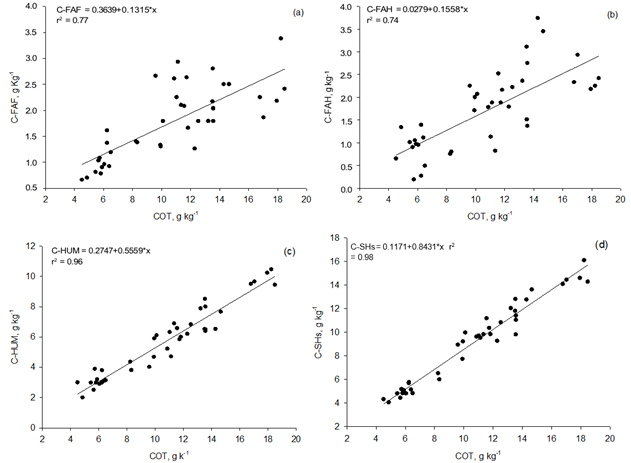
Regarding the correlations between carbon fractionation and total organic carbon, the C-FAF fraction stood out with r2 = 0.77 (Figure 2a), followed by C-HAF, with r2 = 0.74 (Figure 2b). The best correlation was found for the nonextractable humic fraction (C-HUM), with r2 = 0.96 (p < 0.001) (Figure 2c). Similar results were reported by Caetano et al. (2013). These results demonstrate greater solubility with high mobility for C-FAF according to the adopted land use.
Considering the sum of the carbon contents in the humic fraction (C-HS), a significant correlation was observed with the TOC content, with r2 = 0.98 (p < 0.001) (Figure 2d). The recovery of C-HS was 84% compared with that of TOC, of which 52, 16, and 16% were C-HUM, C-FAF, and C-HAF, respectively.
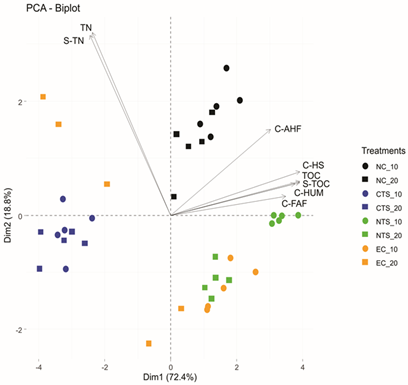
/The analysis of the principal components (PCs) discriminated the different land uses at different depths, where the distribution of the variables explained 74.4 and 18.8% of the variance in the data for principal components 1 (PC1) and 2 (PC2), respectively, which accounted for 93.2% of the total variance in the data (Figure 3).
Relationships between total organic carbon (TOC) and carbon contents in fulvic acid (C-FAF) (a), humic acid (C-HAF) (b) and humin (C-HUM) (c) fractions and the method recovery factor (C-HS), sum of C-FAF+C-HAF+C-HUM fractions (d), and Neossolo Quartzarênico (Quartzipsamment) in four areas under different land uses with conventional tillage, no-tillage, eucalyptus cultivation and native Cerrado vegetation at two sampling depths (0-10 and 10-20 cm) (n = 40). **: (p < 0.001).

Dispersion of variables analyzed across different land uses and depths of 0-10 cm and 10-20 cm in the Cerrado.
The correlations of the variables in relation to the principal components are presented in Table 5.
The first principal component (PC1) was correlated with the whole set of variables, thus showing that the different land uses influenced different soil attributes. In this context, the carbon content in the soil was inversely correlated only with the nitrogen contents and stocks, which was not the case for the carbon stocks and contents in the organic fractions. The input of organic matter promoted an increase in the carbon contents in the soil and in the different fractions of the organic constituents but reduced the nitrogen contents and stocks in the soil. Owing to its greater mobility in the soil, nitrogen is lost more readily by leaching and volatilization, especially in sandy soils, where the absence of electrical charges prevails, such as Neossolos Quartzarênicos (Quartzipsamments). The second principal component was correlated, through the eigenvectors, only with the variables of the nitrogen content and stock in the soil, as shown in Table 5. The increase in nitrogen content promoted an increase in its stocks.
The distributions of the variables associated with the different forms of land use at depths of 0-10 and 10-20 cm are shown in Figure 3.
The area under no-tillage (NTS) at depths up to 10 cm stood out because of the variables C-FAF, C-HUM, and carbon stocks and contents (S-TOC and TOC, respectively). This pattern indicates that the replacement of no-tillage with native Cerrado vegetation favors an increase in these variables, corroborating the results presented in Tables 3 and 4; however, there was no well-defined phenomenon for this land use at depths below 20 cm, despite the increasing trend in these variables. Similar phenomena was observed in the area under native Cerrado vegetation, with a trend toward an increase in the carbon content of the fulvic acid fraction.
At depths below 10 to 20 cm for eucalyptus cultivation, regardless of the depth of the area under conventional tillage, there was an antagonistic phenomenon in the variables related to carbon contents and stocks in the soil, as well as its contents in the fractions of humic substances.
Conclusion
Over time, areas under no-tillage increase the contents and consequently the stocks of total organic carbon, with values of at least 26 Mg ha-1 in the surface layer up to 10 cm, and, along with eucalyptus cultivation, become equivalent to the area under native Cerrado vegetation in the layers below 20 cm in Neossolos Quartzarênicos (Quartzipsamments). Eucalyptus cultivation contributes to increasing nitrogen stocks at depths below 20 cm. In comparison with conventional tillage, no-tillage altered the quality of the soil organic matter, increasing the carbon contents in the fulvic acid and humic acid fractions in the layer up to 20 cm, whereas eucalyptus cultivation stood out in terms of these two variables only in the surface layer up to 10 cm. The reduction in the humic acid to fulvic acid ratio observed under EC (depth up to 20 cm) and NTS (depth below 10 cm) was associated with lower losses of compounds with higher solubilities. Compared with that of total organic carbon, the recovery of carbon in humic substances reached 84%, with C-HUM standing out, followed by C-HAF. The principal component analysis was used to verify that the variables related to carbon in the fractionation of soil organic matter, as well as carbon stocks, influence the different impacts of different land uses.
Data availability
The data that support the findings of this study are available from the corresponding author upon reasonable request.
References
-
Almeida, L. L. S., Frazão, L. A., Lessa, T. A. M., Fernades, L. A., Velosso, A. L. C., Lana, A. M. Q., Souza, I. A., Pegoraro, R. F. & Ferreira, E. A.. (2021). Soil carbon and nitrogen stocks and the quality of soil organic metter under silvopastoral systems in the Brazilian Cerrado. Soil and Tillage Reserch, 205, 104785. https://doi.org/10.1016/j.still.2020.104785
» https://doi.org/https://doi.org/10.1016/j.still.2020.104785 -
Alvares, C. A., Stape, J. L., Sentelhas, P. C., Gonçalves, J. L. M. & Sparovek, G.. (2013). Koopen´s climate classification map of Brazil. Meteorologische Zeitschrift, 22(6), 711-728. https://doi.org/10.1127/0941-2948/2013/0507
» https://doi.org/https://doi.org/10.1127/0941-2948/2013/0507 -
Bais, H. P., Weir, T. L., Perry, J. G., Gilroy, S. & Vivanco, J. M.. (2006). The role of root exudates in rhizosphere interactions with plants and other organisms. Annual Review of Plant Biology, 57, 233-266. https://doi.org/10.1146/57.032905.105159
» https://doi.org/https://doi.org/10.1146/57.032905.105159 -
Caetano, J. O., Benites, V. M., Silva, G. P., Silva, I. R., Assis, R. L. & Cargnelutti Filho, A.. (2013). Dinâmica da matéria orgânica de um neossolo quartzarênico de cerrado convertido para cultivo em sucessão de soja e milheto. Revista Brasileira de Ciência do Solo, 37(5), 1245-1255. https://doi.org/10.1590/S0100-06832013000500014
» https://doi.org/https://doi.org/10.1590/S0100-06832013000500014 -
Campos, R., Pires, G. F. & Costa, M. H.. (2020). Soil carbon sequestration in rainfed and irrigated production systems in a new brazilian agricultural frontier. Agriculture, 10(5), 1-14. https://doi.org/10.3390/agriculture10050156
» https://doi.org/https://doi.org/10.3390/agriculture10050156 -
Chen, F., Zheng, H., Zhang, K., Ouyang, Z., Li, H., Wu, B. & Shi, Q.. (2013). Soil microbial Community struture and funetion responses to successive planting of Eucalyptus. Journal of Environmental Sciences, 25(10), 2102-2111. https://doi.org/10.1016/51001-0742(12)60319-2
» https://doi.org/https://doi.org/10.1016/51001-0742(12)60319-2 -
Costa, A. A., Dias, B. O., Fraga, V. S., Santana, C. C., Sampaio, T. F. & Silva, N.. (2020a). Physical fractionation of organic carbon in areas under different land uses in the Cerrrado. Revista Brasileira de Engenharia Agrícola e Ambiental, 24(8), 534-540. https://doi.org/10.1590/1807-1929/agriambi.v24n8p534-540
» https://doi.org/https://doi.org/10.1590/1807-1929/agriambi.v24n8p534-540 -
Costa, A. A., Dias, B. O., Fraga, V. S., Santana, C. C. & Silva, N.. (2020b). Carbon and nitrogen stocks in soils under different forms of use in the Cerrado. Revista Brasileira de Engenharia Agrícola e Ambiental, 24(8), 528-533. https://doi.org/10.1590/1807-1929/agriambi.v24n8p528-533
» https://doi.org/https://doi.org/10.1590/1807-1929/agriambi.v24n8p528-533 -
Donagemma, G. K., Freitas, P. L., Balieiro, F. C., Fontana, A., Spera, S. T., Lumbreras, J. F., Viana, J. H. M., Araújo Filho, J. C., Santos, F. C., Albuquerque, M. R., Macedo, M. C. M., Teixeira, P. C., Amaral, A. J., Bortolon, E. & Bortolon, L.. (2016). Characterization, agricultural potential, and perspectives for the management of light soils in Brazil. Pesquisa Agropecuária Brasileira, 51(9), 1003-1020. https://doi.org/10.1590/S0100-204X2016000900001
» https://doi.org/https://doi.org/10.1590/S0100-204X2016000900001 -
Ebiling, A. G., Anjos, L. H. C., Pereira, M. G., Pinheiro, E. F. M. & Valladares, G. S.. (2011). S. Substâncias húmicas e relações com atributos edáficos. Bragantia, 70(1), 157-165. https://doi.org/10.1590/S0006-87052011000100022
» https://doi.org/https://doi.org/10.1590/S0006-87052011000100022 - Ellert, B. H., Janzer, H. H. & Mcconkey, B. G. (2001). Measuring and comparing soil carbon storage. In R. Lal, J. M. Kimbler, R. F. Follet & B. A. Stewart (Eds.), Assessment methods for soil carbon. (pp. 131-146). Lewis Publishers.
- Empresa Brasileira de Pesquisa Agropecuária (2017). Manual de métodos e análise de solo (3. ed.). Embrapa Solos.
-
Ferreira, A. C. B., Borin, A. L. D. C., Lamas, F. M., Bogian, J. C., Silva, M. A. S., Silva Filho, J. L. & Staut, L. A.. (2020). Soil carbono accumulation in cotton production systems in the Braziliam Cerrado. Acta Scientiarum. Agronomy, 42(1), 1-8. https://doi.org/10.4025/actasciagron.v42i1.43039
» https://doi.org/https://doi.org/10.4025/actasciagron.v42i1.43039 -
Guareschi, R. F., Pereira, M. G. & Perin, A.. (2014). Carbono, nitrogênio e abundância natural de δ13C e δ15N em um Cronossequência de agricultura sob plantio direto no cerrado goiano. Revista Brasileira de Ciência do Solo, 38(4), 1135-1142. https://doi.org/10.1590/S0100-06832014000400009
» https://doi.org/https://doi.org/10.1590/S0100-06832014000400009 -
Gurung, M. B., Bigsby, H., Cullen, R. & Manandhar, U.. (2015). Estimation of carbon stock under different management regimes of tropical forest in the Tera Arc Landscape, Nepal. Forest Ecology and Management, 356, 144-152. https://doi.org/10.1016/jforeco.20150.07.024
» https://doi.org/https://doi.org/10.1016/jforeco.20150.07.024 -
Gmach, M. R., Dias, B. O., Silva, C. A., Nóbrega, J. C. A., Lustosa-Filho, J. F. & Siqueira-Neto, M.. (2018). Soil organic matter dynamics and land-use change on Oxisols in the Cerrado, Brazil. Geoderma Regional, 14, 00178. https://doi.org/10.1016/j.geodrs.2018.e00178
» https://doi.org/https://doi.org/10.1016/j.geodrs.2018.e00178 -
Hayes, M. H. B., Mylotte, R. & Swift, R. S.. (2017). Humin: its composition and importance in soil organic matter. Advances in Agronomy, 143, 47-138. https://doi.org/10.1016/bs.agron.2017.01.001
» https://doi.org/https://doi.org/10.1016/bs.agron.2017.01.001 -
Hickmann, C. & Costa, L. M.. (2012). Estoque de carbono no solo e agregados em Argissolo sob diferentes manejos de longa duração. Revista Brasileira de Engenharia Agrícola e Ambiental, 16(10), 1055-1061. https://doi.org/10.1590/S1415-43662012001000004
» https://doi.org/https://doi.org/10.1590/S1415-43662012001000004 -
Jones, D. L., Nguyen, C. & Finlay, R. D.. (2009). Carbon flow in the rhizosphere: carbon trading at the soil-root interface. Plant and Soil, 321(1-2), 5-33. https://doi.org/10.1007/511104-009-9925-0
» https://doi.org/https://doi.org/10.1007/511104-009-9925-0 -
Martín, J. A. R., Fluentes, J., Gonzalo, J., Gil, C., Ramos-Miras, J. J., Grau Corbí, J. M. & Boluda, R. (2016). Assessment of the soil organic carbon stock in Spain. Geoderma, 264(Part A), 117-125. https://doi.org/10.1016/j.geoderma.2015.10.010
» https://doi.org/https://doi.org/10.1016/j.geoderma.2015.10.010 -
Nouwakpo, S. K., Song, J. & Gonzalez, J. M.. (2018). Soil structural stability assessment with the fluidized bed, aggregate stability, and rainfall simulation on long-term tillage and crop rotation systems. Soil and Tillage Research, 178, 65-71. https://doi.org/10.1016/j.still.2017.12.009
» https://doi.org/https://doi.org/10.1016/j.still.2017.12.009 -
Schmidt, M. W. I., Torn, M. S., Abiven, S., Dittmar, T., Guggenberger, G., Janssens, I. A., Kleber, M., Kögel-Knabner, I., Lehmann, J., Manning, D. A. C., Nannipieri, P., Rasse, D. P., Weiner, S. & Trumbore, S. E.. (2011). Persistence of soil organic matter as an ecosystem property. Nature, 478, 49-56. https://doi.org/10.1038/nature10386
» https://doi.org/https://doi.org/10.1038/nature10386 -
Sainju, U. M., Allen, B. L., Jabro, J. D. & Stevens, W. B.. (2020). Soil inorganic carbon under no-till drylan crop rotations. Agrosystems, Geosciences & Environment, 3(1), 1-8. https://doi.org/10.1002/agg2.20073
» https://doi.org/https://doi.org/10.1002/agg2.20073 -
Santos, A., Matos, E. S., Freddi, O. S., Galbieri, R. & Lal, R.. (2020). Cotton production systems in the Brazilian Cerrado: The impacto f soil atributes on field-scale yied. European Journal of Agronomy, 118, 126090. https://doi.org/101016/j.eja.2020.126090
» https://doi.org/https://doi.org/101016/j.eja.2020.126090 - Statistical Analysis System (2003). SAS System for windows. version 9.1. SAS Institute Inc.
-
Sharma, V., Hussain, S., Sharma, K. R. & Ayra, V. M. (2014). Labile carbon pools and soil organic stocks in the foothill Himalayas under different land use systems. Geoderma, 232-234, 81-87. https://doi.org/10.1016/j.geoderma.2014.04.039
» https://doi.org/https://doi.org/10.1016/j.geoderma.2014.04.039 -
Silva, A. N., Figueiredo, C. C., Carvalho, A. M., Soares, D. S., Santos, D. C. R. & Silva, V. G.. (2016). Effects of cover crops on the physical protection of organic matter and soil aggregation. Australian Journal of Crop Sciecne, 10(12), 1623-1629. https://doi.org/10.21475/ajcs.2016.10.12.PNE164
» https://doi.org/https://doi.org/10.21475/ajcs.2016.10.12.PNE164 -
Soumare, A., Manga, A., Fall, S., Hafidi, M., Ndove, I. & Duponnois, R.. (2015). Effects of Eucalyptus camaldvlensis amendment on soil chemical properties enzymatic activity acacia species growth and roots symbyoses. Agroforestry Systems, 89, 97-106. https://doi.org/10.1007/s10457-014-9744-z
» https://doi.org/https://doi.org/10.1007/s10457-014-9744-z -
Swift, R. S. (1996). Organic matter characterization. In D. L. Sparks, A. L. Page, P. A. Helmke, R. H. Loeppert, P. N. Soltanpour, M. A. Tabatabai, C. T. Johnston & M. E. Sumner (Eds.), Methods of soil analysis. (pp. 1011-1069). Soil Science Society of America. https://doi.org/10.2136/sssabookser5.3.c35
» https://doi.org/https://doi.org/10.2136/sssabookser5.3.c35 -
Tang, S., Guo, J., Li, S., Li, J., Xie, S., Zhai, X., Zhang, Y. & Wang, K.. (2019). Synthesis of soil carbono losses in response to conversion of grassland to agriculture land. Soil and Tillage Research, 185, 29-35. https://doi.org/10.1016/j.still.2018.08.011
» https://doi.org/https://doi.org/10.1016/j.still.2018.08.011 -
Tesfaye, M. A., Bravo, F., Ruiz-Peinado, R., Pando, V. & Bravo-Oviedo, A.. (2016). Impact of changes in land use, species and elevation on soil organic carbon and total nitrogen in Ethiopian Central Highlands. Geoderma, 261, 70-79. https://doi.org/10.1016/j.geoderma.2015.06.022
» https://doi.org/https://doi.org/10.1016/j.geoderma.2015.06.022 -
Torres, C. M., Pinheiro, A. D. S., Hungria, L. G., El-Husny, J. C., Sacramento, P. P. & Andrade, I. P.. (2020). Inorganic nitrogen fractions in soil under different uses and management systems in the Brazilian Eastern Amazon. Journal of Agricultural Studies, 8(4), 32-43. https://doi.org/10.5296/jas.v8i4.17080
» https://doi.org/https://doi.org/10.5296/jas.v8i4.17080 -
Yeomans, J. C. & Bremner, J. M.. (1988). A rapid and precise method for routine determination of organic carbon in soil. Communications in Soil Science and Plant Analysis, 19(13), 1467-1476. https://doi.org/10.1080/00103628809368027
» https://doi.org/https://doi.org/10.1080/00103628809368027 -
Vives-Peris, V., Ollas, C., Gómez-Cadenas, A. & Pérez-Clemente, R. M.. (2020). Root exudates: from plant to rhizosphere and beyond. Plant Cell Reports, 39(1), 3-17. https://doi.org/10.1007/s00299-019-02447-5
» https://doi.org/https://doi.org/10.1007/s00299-019-02447-5 -
Wink, C., Reinert, D. J., Tornquist, C. G. & Silva, I. R.. (2015). Dinâmica do carbono e nitrogênio em plantações de eucalipto no Rio Grande do Sul. Revista Brasileira de Ciência do Solo, 39(6), 1623-1632. https://doi.org/10.1590/01000683rbcs20140182
» https://doi.org/https://doi.org/10.1590/01000683rbcs20140182
Edited by
-
Associate Editor in charge:
Alessandro Lucca BracciniCarlos Alberto Scapim