Morpho-functional groups of periphytic algae from rivers of La Planada Reserve and their bioindicator role
Abstract
Freshwater periphytic algae play a vital ecological role in aquatic ecosystems. In this study, we examined the morphological features of periphytic algae in four rivers of the La Planada Reserve. We collected samples by scraping rocks, identified the algae, measured their morphological dimensions, and conducted descriptive and multivariate statistical analyses. We identified 59 morphospecies, mainly belonging to the classes Bacillariophyceae and Cyanophyceae. The functional groups identified included mucilage-forming colonies, simple filaments, hetero-filamentous algae, non-specialized algae, and non-flagellated siliceous algae. The community-weighted mean and variance (CWM and CWV, respectively) of morphological variables did not differ significantly between rivers. In the first-order river, the algae tended to be smaller and had a lower surface-to-volume ratio. Simple filamentous algae and small algae lacking specialized features seem to indicate nutrient-deficient waters. Non-flagellated, silica-shelled algae (diatoms) probably serve as indicators of moderate flow rates, higher nutrient levels, and clearer water. Colonial algae with mucilage tend to prefer waters with moderate to high nutrient concentrations and faster current speeds. Hetero-filamentous algae appear to indicate rivers with low light exposure and slow flow velocity. This initial investigation into the morpho-functional study of periphytic algae suggests that morphology-based groupings could help reflect river environmental conditions through the ecological responses of functional algal associations.
Keywords:
biogeographic Chocó; functional ecology; phycoperiphyton
Resumo
Algas perifíticas de água doce desempenham funções ecológicas importantes em ecossistemas aquáticos. Este estudo analisa a morfologia funcional do ficoperifíton em quatro rios da Reserva La Planada. As algas foram raspadas de rochas, identificadas e suas dimensões morfológicas foram medidas e analisadas por meio de métodos estatísticos descritivos e multivariados. Foram encontradas 59 morfoespécies, com predominância de Bacillariophyceae e Cyanophyceae. Os grupos funcionais foram: colônias com mucilagem, filamentos simples, heterofilamentos, algas não especializadas e algas siliciosas não flageladas. A média ponderada (MPC) e a variância ponderada da comunidade (VPC) das variáveis morfológicas não apresentaram diferenças estatisticamente significativas entre os rios. Algas filamentosas simples e pequenas, sem características especializadas, parecem indicar águas com deficiência de nutrientes. Algas não flageladas com carapaça de sílica (diatomáceas) provavelmente indicam vazões moderadas, níveis mais altos de nutrientes e águas mais claras. Algas coloniais com mucilagem tendem a preferir águas com concentrações de nutrientes moderadas a altas e correntes mais rápidas. Algas heterofilamentosas parecem indicar rios com baixa exposição à luz e baixa velocidade de fluxo. Essa abordagem inicial ao estudo morfofuncional do ficoperifíton sugere que agrupamentos morfológicos podem ser empregados para evidenciar as condições ambientais dos rios por meio das respostas ecológicas dessas assembleias de algas.
Palavras-chave:
Chocó biogeográfico; ecologia funcional; ficoperifíton
1. INTRODUCTION
Aquatic microalgae are photoautotrophic microorganisms that live freely suspended in water (phytoplankton) or attached to submerged surfaces (phycoperiphyton) (Hamer et al., 2025). They are excellent indicators of ecological conditions in both lentic and lotic water bodies, as they respond directly to changes in water's physical and chemical factors (Gökçe, 2016). Additionally, they are the primary energy receptors in aquatic ecosystems. Their small size and rapid life cycles allow them to respond quickly to environmental changes in the water over short periods (Yong et al., 2016; Agbogidi et al., 2022). These organisms have developed various adaptive strategies, some related to their external morphology, to survive in the diverse environments they inhabit (Jebali et al., 2022). This enables algae to optimize the use of light energy and nutrients and, in the case of planktonic algae, to counteract sedimentation (Naselli-Flores and Barone, 2011). These traits are referred to as “functional morphology” (Muñoz-López et al., 2017; Zabala-Agudelo et al., 2019).
Microalgae exhibit unique traits that distinguish them from all other organisms, whether in planktonic or periphytic environments. Certain species have flagella that facilitate movement, enabling them to cover considerable distances at the microscopic level (Brewer et al., 2022). However, this movement is limited on a larger scale, making them highly sensitive to water turbulence (Margalef, 1978; Peters and Marrasé, 2000). For planktonic algae, sedimentation is a significant factor influencing their growth, as they are denser than water. Consequently, they develop various strategies to stay suspended, such as secreting mucilage, accumulating lipids, and forming gas vacuoles, among others. These adaptations help them control sinking and floating, which is crucial for survival (Naselli-Flores and Barone, 2011). Additionally, sedimentation helps eliminate dead cells, replenish deep nutrients, and remove waste (Ramírez, 2000; Bodel et al., 2025). Whether unicellular or colonial, these adaptations have evolved over evolutionary time.
Literally, periphyton means "around a plant" (Ramírez-Restrepo et al., 2022). Periphytic organisms are mostly algae, which do not penetrate the substrate but grow on it (Sládecková, 1962; Gubelit and Grossart, 2020). Wetzel (1983) defined periphyton as a complex community of microbiota (algae, bacteria, fungi, animals, and organic and inorganic detritus) attached to a substrate, whether organic or inorganic, living or dead. Functionally, it is a microcosm in which internal processes and exchanges with the external environment occur simultaneously. For easier study, this community is mainly divided into animal (zooperiphyton) and algal (phycoperiphyton) components (Wu, 2016).
Periphyton plays a vital role in maintaining aquatic ecosystems, mainly by providing nourishment for various organisms across the food chain. In some environments, like shallow lakes, it can account for 40% to 97% of total production (Roldán-Pérez and Ramírez-Restrepo, 2008; Wu, 2016). This community also includes many organisms that find shelter and help in nutrient recycling. Periphytic algae and their biofilms have been used as bioindicators of water quality (Wu, 2016). The idea of using periphyton for this purpose began with Patrick (1949), who classified water currents based on this community. Palmer (1977) further categorized freshwater algae by their environment and forms, including both clean and polluted waters, algae that affect water flavor and odor, and planktonic algae in lakes and reservoirs. His classification covered 42 species of algae attached to substrates. The bioindicator role of periphyton mainly stems from some species preferring oligotrophic conditions and others thriving in eutrophic environments, as well as from differences in taxa's resilience to chemical contamination or their ability to withstand it (Roldán-Pérez and Ramírez-Restrepo, 2008; Lamprecht et al., 2022).
The growth and morphology of algae are important features that help evaluate their survival success under specific physical conditions (Margalef, 1978; Yan et al., 2021). These features allow organisms with similar survival adaptations to be grouped by their environments and constraints. Studying these traits through the size and shape of individuals or colonies enables classification into established groups, forming the basis of functional morphology (Chen et al., 2015). One of the earliest studies on the functional morphology of algae was conducted by Munk and Riley (1952), who demonstrated the connection between cell shape, sinking, and nutrient absorption. Many influential studies followed (Margalef, 1978; Reynolds, 1984; Reynolds et al., 2002), including an examination of the surface area-to-volume ratio in phytoplankton and its effect on light and nutrient uptake (Lewis, 1976). Analyzing the morphological flexibility of algae and their relationship to abiotic factors shows that, in environments with similar physical and chemical features, phytoplankton tend to display morphological similarities, sometimes even at the taxonomic level (Reynolds, 1984; Naselli-Flores and Padisák, 2024). This indicates a directional influence of the aquatic environment on the organization of microalgal communities (Reynolds, 1980; Lukács et al., 2024).
In Colombia, research on periphyton has primarily focused on its taxonomy and descriptive structure, providing a comprehensive overview of microalgal communities and their application as bioindicators (Montoya Moreno and Aguirre R, 2013). Various studies have been conducted on Colombian fluvial systems, such as the Bogotá River (Díaz-Quirós and Rivera-Rondón, 2004), the La Plata and La Venta Rivers in the Santurbán páramo (Ramírez and Plata-Díaz, 2008), and the Anchique River (Huertas-Farías et al., 2019), among others. However, research on the morphological and functional aspects of phycoperiphyton is still limited and in its early stages in Colombia. One of the earliest efforts was made by Guerrero Lizarazo et al. (2021), who conducted a preliminary analysis of the morphological features of phycoperiphyton in several rivers within the La Planada Reserve (Nariño, Biogeographic Chocó). Their work contributed to ongoing research on the functional morphology of periphytic algae in that reserve by comparing size and categorical traits with the physical and chemical variables of different flowing-water systems examined in the region. The main idea of this study was to adapt the phytoplankton morphofunctional traits to periphyton communities and use this strategy to bioindicate the environmental conditions of the La Planada Reserve rivers.
2. MATERIAL AND METHODS
2.1. Sampling sites
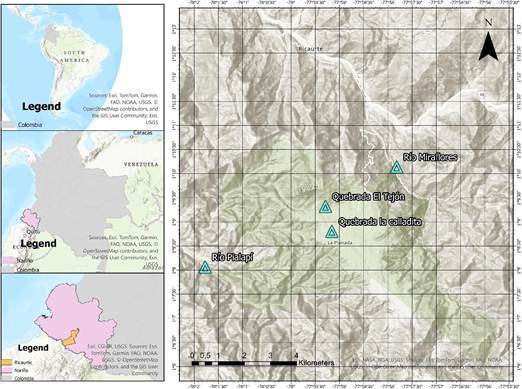
La Planada Nature Reserve is a 3,200-ha protected area located in the municipality of Ricaurte, Nariño department, on the western slope of the Western Cordillera, ranging from 300 to 2,500 meters above sea level (Guerrero-Lizarazo et al., 2021). It is part of the Colombian Pacific region and situated in the Chocó Biogeographic Region, one of the most biodiverse areas on the planet (Rangel-Ch, 2004). For this study, two rivers and two small streams within La Planada Reserve, which have significantly different environmental conditions, were examined (Figure 1). These water systems were visited between May 20 and 24, 2019.
The Pialapí River, also known as the San Martín River, is a third-order stream and the most important in the municipality of Ricaurte (Guerrero-Lizarazo et al., 2021). It flows through the Andean and sub-Andean cloud forests of the region and is mainly situated in an area with minimal human impact within the La Planada Reserve. This river provides ecosystem services to the AWA indigenous community and flows through small towns such as Cuchilla del Palmar, Pueblo Viejo, Palapí, Casa Grande, Curcuel, and Yaré. Its watershed covers 10,990 ha, which accounts for about 7% of the municipality’s land area. The sampling site on the Pialapí River was located at coordinates 1°8'3.6'' N and 78°1'46.3'' W, at an elevation of 1,240 meters above sea level. The Miraflores River originates in the northeast of the Cumbal municipality and flows through the Ricaurte municipality, where it joins the Güiza River. This river faces various human-made disturbances along its course. The sampling site was located at coordinates 1°10'8.1'' N and 77°57'49'' W, at an elevation of 1,340 meters above sea level, near a bridge in the San Isidro area. The site is located in an area influenced by livestock and farming activities, adjacent to a sugarcane panela production mill. The El Tejón stream is a crystal-clear waterway within the La Planada Reserve. Much of its course runs through the 25-ha permanent plot established by the Alexander Von Humboldt Institute inside the reserve. The sampling site in El Tejon was situated at 1°9'19'' N and 77°59'17.2'' W, at an elevation of 1,750 meters above sea level. La Calladita Creek is a first-order stream that originates in the La Planada Reserve and flows into El Tejón Creek. The sampling point in La Calladita was positioned at coordinates 1°8'47.9'' N and 77°59'9.3'' W, at an elevation of 1,783 meters above sea level, near its source, with a mainly clayey substrate and a closed canopy that limited sunlight penetration.
2.2. Sampling and data analysis
Dissolved oxygen, percent oxygen saturation, temperature, pH, electrical conductivity, and total dissolved solids were measured in triplicate at each river using a Hach HQ40D multiparameter device probe. Alkalinity and hardness were determined using Hanna titration kits (HI3811 and HI38033, respectively). Width and mean depth were measured with a decameter, and current velocity was assessed through the floating object method. Water transparency was evaluated using the horizontal Secchi disk technique (Pinilla, 2017). Water samples for chemical analysis were collected, refrigerated, and analyzed using a Hach DR2000 spectrophotometer at the Ecology Laboratory of the Biology Department at the Universidad Nacional de Colombia, Bogotá. Nutrients such as nitrites (detection via diazotization), nitrates (reduction with cadmium), ammonium (using Nessler's reagent), orthophosphates (with ascorbic acid), and sulfates (with SulfaVer 4) were measured following standard APHA methods (APHA et al., 2012).
Periphytic algae scrapings were collected with a brush from known areas of rocky substrates (epilithon). For these collections, 150 m sections were selected in each river, and three sampling sites were established within them. The samples were preserved in Transeau solution, a mixture of 95% ethanol, distilled water, and 40% formalin in a 3:2:1 ratio (Whitford and Schumacher, 1969). The algae were photographed at the Optical Equipment Laboratory of the Biology Department at the Universidad Nacional de Colombia, using a Nikon Eclipse E100 optical microscope. ImageJ software (Rueden et al., 2017) was used for measurements. Taxonomic keys (e.g., Whitford and Schumacher, 1969; Ramírez, 2000; Bicudo and Meneses, 2006; Necchi, 2016) were employed to identify the organisms. The algae were classified into the morphofunctional groups proposed by Kruk et al. (2010), with adaptations for the periphytic microalgal community. Counts were conducted in the Limnology Laboratory of the Biology Department at the Universidad Nacional de Colombia, using an Advanced Optical XD-202 inverted microscope and the Utermöhl sedimentation chamber technique (Lund et al., 1958). A magnification of 40 X 10 was used, and in each sample, counts of organisms from all taxa were made in random fields of the camera until reaching 100 individuals of the most abundant morphospecies. The APHA equation (APHA et al., 2012) was used to calculate periphytic density, which considers the total number of organisms counted, the total area of the base of the Utermöhl chamber used, the surface area of the fields counted in the chamber, and the volume of settled water. Each unicellular alga or colony (coenobium or filament) was regarded as an individual. Morphological measurements included volume and surface area (Hillebrand, 1999; Sun and Liu, 2003), the surface-to-volume ratio (S/V), and the maximum linear dimension. For plasmodial and coenobial forms, the entire colony, including the mucilage, was examined, and the presence or absence of aerotopes, flagella, mucilage, heterocysts, and silica exoskeletal structures was recorded.
Each algal taxon was classified into one of the following morphofunctional groups: Group 1, small organisms with a high surface area-to-volume ratio; Group 2, small flagellated organisms with silica exoskeletal structures; Group 3, long, filamentous organisms with or without aerotopes; Group 4, medium-sized organisms lacking specialized features; Group 5, medium- to large-sized flagellated unicellular organisms; Group 6, non-flagellated organisms with silica exoskeletons; and Group 7, large colonies with mucilage (Kruk et al., 2010). An additional group, Group 8, composed of hetero-filamentous microalgae, was created; these are complex organisms that form branching filaments attached to the substrate through specialized structures or by mucilage (Stevenson et al., 1996).
For numerical data analysis, principal component analysis (PCA) was performed to identify the most representative abiotic variables, and canonical correspondence analysis (CCA) was used to examine relationships between abiotic variables and the composition and abundance of periphytic algae, both from a morphometric and a functional-group perspective. The free software PAST 4.02 (Hammer et al., 2001) was used for these statistical analyses. The community-weighted mean (CWM) and community-weighted variance (CWV) were calculated according to Hulshof et al. (2013) to assess how morphometric traits vary across sampled locations within the communities. An ANOVA was performed to verify whether there were significant differences in CWV and CWM between the rivers.
3. RESULTS
3.1. Physicochemical environment of rivers
The four water bodies displayed varying physicochemical characteristics (Figure 2). The Miraflores River had a faster current and showed a high concentration of total dissolved solids (17.12 mg L-1), moderate alkalinity (37 mg CaCO3 L-1), and medium hardness (23.1 mg L-1 CaCO3 L-1), indicating a higher level of mineralization compared to the other rivers. The Pialapí River had elevated levels of phosphates (0.24 mg L-1) and nitrites (0.008 mg L-1), along with greater width and high flow (4.5 m3 s-1). The La Calladita and El Tejón streams, grouped together in Figure 2, were characterized by low mineralization, shallower flow and depth, and limited nutrient availability. These creeks are first- and second-order systems, with low flow and small basins, and they have minimal ion concentrations, as reflected in their very low electrical conductivity (9.35 µS cm-1 and 9.33 µS cm-1, respectively). The physical, chemical, and hydrological features of the fluvial systems studied are presented in Table 1.

Principal component analysis of the physicochemical variables of the rivers in La Planada Reserve.
3.2. General characterization of the phycoperiphyton of the La Planada Reserve
In the rivers of La Planada, 59 morphospecies belonging to 47 genera of periphytic algae were collected. The most abundant and common species were Cymbella sp., Tabellaria sp., Encyonopsis sp., and Diadesmis sp. The most representative algal divisions identified were Bacillariophyceae and Cyanophyceae. The number of genera in each functional group is shown in Table 2. Five of the eight proposed groups were present; the missing groups were those of small organisms with a high S/V ratio, small flagellated cells with siliceous exoskeletal structures, and medium- to large-sized unicellular flagellated algae. Measurements of the morphometric variables of the 47 collected genera are provided as supplementary material (Table S1).
Values of the physical, chemical, and hydrological variables for the rivers studied in the La Planada Reserve. Data for pH, temperature, electrical conductivity, total dissolved solids, dissolved oxygen, oxygen saturation, and transparency are reported as averages. ND: not detected.
Algae genera richness within the phycoperiphyton functional groups of the rivers studied at La Planada Reserve.
3.3. Variations in CWM and CWV of phycoperiphyton between ecosystems
The differences in the morphometric variables, after being transformed to CWM and CWV, were plotted for the studied rivers (Figure 3). For the CWM, it appears that the maximum dimension (Figure 3A) was statistically similar across all river systems. In contrast, biovolume (Figure 3C) was apparently significantly smaller in La Calladita compared to the Pialapí and Miraflores rivers, while the S/V ratio and surface area (Figures 3B and 3D) seem to be statistically smaller in La Calladita-specifically, the biovolume compared to the Pialapí and Miraflores rivers, and the surface area compared to El Tejón stream and the Pialapí River. However, the ANOVA results do not confirm these differences (Table 3).

Means and whiskers of the Community-Weighted Mean (CWM) and Community-Weighted Variance (CWV) for the morphometric variables. A. CWM - Maximum linear dimension. B. CWM - Surface area to biovolume ratio. C. CWM - Biovolume. D. CWM - Surface area. E. CWV - Maximum linear dimension. F. CWV - Surface area to biovolume ratio. G. CWV - Biovolume. H. CWV - Surface area.
Results of ANOVA of the CWM (Community-Weighted Mean) and CWV (Community-Weighted Variance) between rivers of the La Planada Reserve.
Regarding the CWV of the morphometric variables, no morphological traits showed differences between the water bodies, as indicated by both the boxplots (Figure 3) and the ANOVA results (Table 3). However, there was considerable variation in the CWV of the maximum dimension (Figure 3E) and in the CWV of the S/V ratio (Figure 3F) across all sampling sites. Biovolume (Figure 3G) and surface area (Figure 3H) generally exhibited little variation, except at the El Tejón stream, where the dispersion of the weighted variance was notably higher.
3.4. Relationships among the abiotic environment, morphometric features, and morphofunctional groups of phycoperiphyton
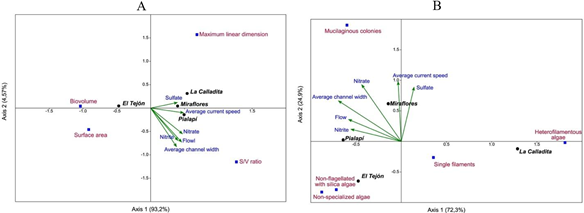
The S/V ratio was associated with large rivers with nitrogen-rich waters; in contrast, biovolume and surface area were linked to El Tejón creek, an oligotrophic system with low current velocities (Figure 4A). Therefore, the environmental conditions at El Tejón seem to favor a periphytic algal community with higher biovolume and surface area than at the other sampled sites. Regarding the morphofunctional groups (Figure 4B), colonial algae with mucilage appear to benefit greatly from nutrient-rich waters with high water velocities; hetero-filamentous algae are associated with low to medium velocity and oligotrophic waters. Simple filamentous algae prefer sites with moderate current speeds and low to intermediate trophic levels. Both non-flagellated algae with silica exoskeletons and non-specialized algae appear to be found in environments with low current speeds and moderate nitrogen levels.

Canonical correspondence analysis between the primary environmental variables and the functional traits of the phycoperiphyton in the La Planada Reserve. A. Morphometric variables. B. Morphofunctional groups.
4. DISCUSSION
From an environmental perspective, clear differences were observed among the studied water bodies. The La Calladita and El Tejón are minor streams with small basins that originate within the La Planada Reserve, which explains their low alkalinity and hardness. Conversely, water bodies flowing through areas of human settlement - whether indigenous or peasant - like the Pialapí and Miraflores rivers, are more enriched with ions and nutrients, which might result not only from human activity but also from soil properties that could contribute to these elements to the streams (Vallejo et al., 2004; Guerrero Lizarazo et al., 2021). Further detailed studies are needed to determine the sources of these substances, but they may partly originate in agricultural activities along the watercourse, as observed in the river Las Piedras, a similar basin in the Colombian Andes (Ruiz et al., 2017). There are no studies on the matter, but it is logical to assume that the waste from the panela mills and the sewage from the human settlements near these rivers are dumped into them. Additionally, the Miraflores River has a large basin, originating in Cumbal Lake (Cortés et al., 2021), which receives a higher influx of natural mineral inputs, as well as those of anthropogenic origin. The differences between the use of the Pialapí and Miraflores rivers are influenced by the type of human communities along their banks. Indigenous communities tend to be less dense and more dispersed than peasant and urban populations, and also typically have a culture of environmental stewardship, leading them to limit waste disposal into water bodies (Pai, 2012; Fernández-Llamazares et al., 2020).
Concerning the morphofunctional traits of algae, the first noticeable point is the absence of Groups 1 (small organisms with a high surface area-to-volume ratio), 2 (small flagellated organisms with silica exoskeletal structures), and 5 (medium- to large-sized flagellated unicellular organisms). The absence of flagellate groups 2 and 5 may be due to the fact that these algae can only grow in periphytic environments when current velocity is especially low (Larson and Passy, 2012), which is not the case in the rivers studied. More accurately, the flagella function as an adaptation for cell movement in the water column (Ramírez, 2000; Kiørboe et al., 2025), that is, in the planktonic environment. Flagellated algae are not well-suited to thrive in a river periphytic microhabitat, especially when flow is rapid and strong (Biggs et al., 1998). As Wetzel (1983) noted, such environments favor microalgae that develop adhesion strategies to attach to substrates and become part of the biofilm. Therefore, the ecological niche of flagellated algae is planktonic rather than benthic, as discussed by Raven and Beardall (2022) and demonstrated in this study.
The absence of Group 1 organisms can be explained in a similar way. Kruk et al. (2010) described Group 1 as made up of small individuals (maximum linear dimension <2 µm), characterized by a high surface area-to-volume ratio, fast growth and reproduction rates, a strong ability to acquire resources, and low losses from sinking in the planktonic environment, which are typical traits in the water column. Some organisms found in the periphyton of the studied rivers exhibit many of these traits but have a low surface area-to-volume ratio (<5 µm-1), likely because in riverbed habitats, very small cells with high S/V ratios can be dragged by water, while larger algae (with lower S/V ratios) tend to resist current in motion better. Passy (2007) compared benthic and planktonic diatom sizes in US water bodies, finding the largest cells in riverbeds and the smallest in plankton. These differences suggest habitat conditions influence algal size, favoring larger benthic cells and smaller planktonic ones.
Group 3 (simple filaments with or without aerotopes), which was partially associated with La Calladita stream and the Miraflores River, consists of periphytic genera with high ecological plasticity (Necchi, 2016). Kruk et al. (2010) included only taxa with aerotopes (simple filamentous cyanobacteria) in this group. However, in this study, it was deemed important to also include simple filaments of Bacillariophyceae and Chlorophyceae algae-organisms without aerotopes-because they, like filamentous cyanobacteria, have high cell biovolume and share similar morphology. According to Law (2011), filamentous or stalked organisms are better adapted for nutrient retrieval and light capture. In the original classification by Kruk et al. (2010), this group is abundant in water bodies with low nitrogen levels due to the nitrogen-fixing capacity of some filamentous cyanobacteria genera in this association. Since the rivers of La Planada have low nitrogen concentrations, the modification made here (adding simple filamentous Chlorophyceae) does not alter the functional response of group three. Nonetheless, the available data are very limited and do not allow for a definitive conclusion. More detailed, prolonged, and extensive studies are needed to determine whether the proposed modification to Kruk et al.’s (2010) classification is valid for phycoperiphyton communities or if it would be better to create a new group of periphytic filamentous algae without aerotopes.
The El Tejón stream was closely linked with Groups 4 (non-specialized organisms) and 6 (non-flagellated silica-containing algae), which were affected by higher nitrite and phosphate levels, low flow, and shallow channels. Group 4 includes small organisms with moderate tolerance to resource limitations (Kruk et al., 2010). Group 6 consists mainly of diatom genera that sink readily due to their high cell density and lack of motility (Kruk et al., 2010). Therefore, in planktonic environments, they depend heavily on turbulence. In benthic river habitats, turbulence is a constant, high-energy process, which favors diatoms (Necchi, 2016; Behrenfeld et al., 2021). Based on this, the nutrient and hydrological features of the Pialapí River, along with its transparency, create ideal conditions for Group 6; the system exhibited moderate current speed and good nitrogen and phosphorus levels, which are typically limiting nutrients for this type of organism (Roldán-Pérez and Ramírez-Restrepo, 2008; Yaakob et al., 2021). Additionally, the high Secchi transparency in this river (5.57 m) could support diatom photosynthesis, with their growth and spread potentially counteracting entrainment caused by the current.
Group 7 (colonies with mucilage) was linked to the Miraflores River. According to Kruk et al. (2010), the colonies in this group produce high amounts of mucilage and lipids, and some have aerotopes. In the benthic habitat, these features help the algae survive as resting colonies in the sediment (Reynolds et al., 1981; Ellegaard and Ribeiro, 2018). Colonial species with mucilage are sensitive to resource shortages (Kruk et al., 2010), which aligns with the physicochemical features of this mid-order (third-order) river, which exhibit moderate nutrient levels and high flow. The algae in this group include cyanobacterial taxa that can produce toxins and allelopathic substances (Kruk et al., 2010); their abundance may be linked to the higher sulfate concentration (9 mg L-1) in this river, since the increase in this element seems to help decrease nitrogen availability, which promotes the growth of diazotrophic cyanobacteria (Patiño et al., 2023).
The La Calladita stream was clearly linked to Group 8 (hetero-filamentous algae). This group was defined and included in the present study as a set of branching filamentous microalgae that grow epilithically (on rocks). The grouping did not depend on any specific environmental variable. However, the ecosystems where these hetero-filamentous algae were found (La Calladita and El Tejón) received very little sunlight due to the closed canopies covering the channels. Therefore, this group seems to thrive in low-light and low-flow conditions. More research is needed on the presence and adaptations of this hetero-filamentous algal group in the periphyton of Colombian rivers to better understand their responses to environmental changes.
The link between high S/V ratios and sites with greater mineralization may stem from the fact that these environments support large mucilaginous colonies (Group 7), which may also prosper at high ion and nutrient levels (Kruk et al., 2010). A similar pattern was observed in shallow lakes of the Salado River basin (Argentina), where colonial morphofunctional groups of cyanobacteria and chlorophytes were associated with waters of higher conductivity (Sánchez et al., 2021). Conversely, the connection between lower current velocities and reduced mineralization, along with increased biovolume and surface area-characteristics typical of filamentous and hetero-filamentous algae-appears to arise from the fact that these morphofunctional groups thrive better at low speeds and moderate nutrient levels (Horner et al., 1990), and some of them (filamentous diazotrophic cyanobacteria) can even fix atmospheric nitrogen (Kruk et al., 2010).
The lack of significant differences in CWM and CWV occurs because these metrics represent the average traits of a community. Therefore, this absence of significance might be due to these metrics masking the underlying dynamics of species and being influenced by factors like individual variation and sampling bias. Thus, it can be inferred that the studied algal communities have similar mean trait values (CWM) and trait dispersion (CWV), which could result from compensatory changes among species (Gaüzère et al., 2019).
5. CONCLUSIONS
Although this study is a preliminary step in examining the morphofunctional aspects of phycoperiphyton in Colombia, organizing algae into groups based on functional morphology appears suitable for representing how algal assemblages respond ecologically to environmental conditions. Therefore, the original model proposed by Kruk et al. (2010) for planktonic algae in lentic environments appears applicable to periphyton algae in flowing-water systems. However, some of the morphofunctional groups proposed by Kruk et al. (2010) for planktonic algae are not appropriate for periphytic environments, as their development primarily occurs in still water systems. This is especially true for very small algal associations (Group 1) and flagellated algae (Groups 2 and 5). Moreover, the presence of hetero-filamentous algae in the periphyton indicates the need to include them as a new group within the morphofunctional classification, since they are not present in plankton.
Concerning the bioindication of morphofunctional groups, some initial generalizations are as follows: Group 3 (simple filaments) and Group 4 (small algae lacking specialized features) seem to signal nutrient-deficient waters. Diatoms (Group 6) suggest moderate flow rates, increased nutrient levels, and clearer water. Algae in Group 7 (mucilaginous colonies) are linked to moderate to high nutrient concentrations and slower currents. Group 8 (hetero-filamentous algae) seems to indicate rivers with low light exposure and slow flow velocity.
6. DATA AVAILABILITY STATEMENT
Data availability not informed.
7. ACKNOWLEDGMENTS
We thank the Department of Biology at the Universidad Nacional de Colombia for their logistical and financial support in this study. We also appreciate the students of the Continental Regional Ecology course for participating in the sampling. Additionally, we thank the Pialapí Pueblo Viejo Reservation, part of the AWA community and responsible for managing the La Planada Nature Reserve, for granting permission and assisting with the sampling process. The suggestions from anonymous reviewers helped optimize the final version of the manuscript.
8. REFERENCES
-
AGBOGIDI, O. M.; MICHAEL, O. E.; EGBODUKU, O. W.; STEPHEN, O. F; AGBOGIDI, O. M. Relevance of algae as biological indicators of pollution management studies. International Journal of Environment and Climate Change, v. 12, n. 10, p. 1126-1133, 2022. https://doi.org/10.9734/ijecc/2022/v12i1030908
» https://doi.org/10.9734/ijecc/2022/v12i1030908 - APHA; AWWA; WEF. Standard Methods for the examination of water and wastewater. 22nd ed. Washington, 2012. 1496 p.
-
BEHRENFELD, M. J.; HALSEY, K. H.; BOSS, E.; KARP-BOSS, L.; MILLIGAN, A. J.; PEERS, G. Thoughts on the evolution and ecological niche of diatoms. Ecological Monographs, v. 91, n. 3, e01457, 2021. https://doi.org/10.1002/ecm.1457
» https://doi.org/10.1002/ecm.1457 - BICUDO, E. M.; MENEZES, M. Gêneros de algas de águas continentais do Brasil (chave para identificação e descrições). 2. ed. São Carlos: RiMa, 2006. 498 p.
-
BIGGS, B. J. F.; STEVENSON, R. J.; LOWE, R. L. A habitat matrix conceptual model for stream periphyton. Archiv für Hydrobiologie, v. 143, n. 1, p. 21-56, 1998. https://doi.org/10.1127/archiv-hydrobiol/143/1998/21
» https://doi.org/10.1127/archiv-hydrobiol/143/1998/21 -
BODEL, A.; ESTAPA, M.; DURKIN, C. A. Solitary phytoplankton cells sink in the mesopelagic ocean. PLoS One, v. 20, n. 7, e0321918, 2025. https://doi.org/10.1371/journal.pone.0321918
» https://doi.org/10.1371/journal.pone.0321918 -
BREWER, P. G.; PELTZER, E. T.; LAGE, K. Life at low Reynolds number re-visited: the efficiency of microbial propulsion. Deep Sea Research Part I: Oceanographic Research Papers, v. 185, 103790, 2022. https://doi.org/10.1016/j.dsr.2022.103790
» https://doi.org/10.1016/j.dsr.2022.103790 -
CHEN, N.; LIU, L.; LI, Y.; QIAO, D.; LI, Y.; ZHANG, Y.; LV, Y. Morphology-based classification of functional groups for potamoplankton. Journal of Limnology, v. 74, n. 3, p. 559-571, 2015. https://doi.org/10.4081/jlimnol.2015.1173
» https://doi.org/10.4081/jlimnol.2015.1173 - CORTÉS, G. P.; LAVERDE, C. A.; MUÑOZ, C. J. Evaluación de la amenaza volcánica del volcán Azufral. Manizales y Pasto: Servicio Geológico Colombiano, 2021.
-
DÍAZ-QUIRÓS, C.; RIVERA-RONDÓN, C. A. Diatomeas de pequeños ríos andinos y su utilización como indicadoras de condiciones ambientales. Caldasia, v. 26, n. 2, p. 381-394, 2004. https://doi.org/10.15446/caldasia
» https://doi.org/10.15446/caldasia -
ELLEGAARD, M.; RIBEIRO, S. The long-term persistence of phytoplankton resting stages in aquatic ‘seed banks’. Biological Reviews, v. 93, n.1, p. 166-183, 2018. https://doi.org/10.1111/brv.12338
» https://doi.org/10.1111/brv.12338 -
FERNÁNDEZ-LLAMAZARES, Á.; GARTEIZGOGEASCOA, M.; BASU, N.; BRONDIZIO, E. S.; CABEZA, M.; MARTÍNEZ-ALIER, J. et al A State-of-the-art review of indigenous peoples and environmental pollution. Integrated Environmental Assessment and Management, v. 16, n. 3, p. 324-341, 2020. https://doi.org/10.1002/ieam.4239
» https://doi.org/10.1002/ieam.4239 -
GAÜZÈRE, P.; DOULCIER, G.; DEVICTOR, V.; KÉFI, S. A framework for estimating species-specific contributions to community indicators. Ecological Indicators, v. 99, p. 74-82, 2019. https://doi.org/10.1016/j.ecolind.2018.11.069
» https://doi.org/10.1016/j.ecolind.2018.11.069 -
GÖKÇE, D. Algae as an indicator of water quality. In: Algae. Organisms for Imminent Biotechnology. London: InTech, 2016. p. 80-101. https://doi.org/10.5772/62916
» https://doi.org/10.5772/62916 -
GUERRERO LIZARAZO, M. C.; PINILLA-AGUDELO, G.; ESTRADA GALINDO, I. J. Ecología funcional de las algas perifíticas en el Chocó colombiano: limitación de recursos, competencia y variables ambientales. Revista de Biología Tropical, v. 69, n. 1, p. 331-351, 2021. http://dx.doi.org/10.15517/rbt.v69i1.42042
» http://dx.doi.org/10.15517/rbt.v69i1.42042 -
GUBELIT, Y. I.; GROSSART, H. P. New methods, new concepts: what can be applied to freshwater periphyton? Frontiers in Microbiology, v. 11, 1275, 2020. https://doi.org/10.3389/fmicb.2020.01275
» https://doi.org/10.3389/fmicb.2020.01275 -
HAMER, S.; OYEDOTUN, T. D. T.; COBOS RUIZ, M. Microalgae: a review of classification, roles and applications. Interdisciplinary Environmental Review, v. 24, n. 1, p. 36-63, 2025. https://doi.org/10.1504/IER.2025.143618
» https://doi.org/10.1504/IER.2025.143618 - HAMMER, Ø.; HARPER, D. A. T.; RYAN, P. D. PAST: Paleontological statistics software package for education and data analysis. Palaeontologia Electronica, v. 4, n. 1, 9 p., 2001.
-
HILLEBRAND, H.; DÜRSELEN, C.; KIRSCHTEL, D.; POLLINGHER, U.; ZOHARY, T. Biovolume calculation for pelagic and benthic microalgae. Journal of Phycology, v. 35, p. 403-424, 1999. https://doi.org/10.1046/j.1529-8817.1999.3520403.x
» https://doi.org/10.1046/j.1529-8817.1999.3520403.x -
HORNER, R. R.; WELCH, E. B.; SEELEY, M. R.; JACOBY, J. M. Responses of periphyton to changes in current velocity, suspended sediment and phosphorus concentration. Freshwater Biology, v. 24, n. 2, p. 215-232, 1990. https://doi.org/10.1111/j.1365-2427.1990.tb00704.x
» https://doi.org/10.1111/j.1365-2427.1990.tb00704.x -
HUERTAS-FARÍAS, K.; TATIANA-PARRA, Y.; REINOSO, G. Aspectos ecológicos de la comunidad fitoperifítica en el río Anchique, cuenca andina colombiana. Revista de la Academia Colombiana de Ciencias Exactas, Físicas y Naturales, v. 43, n. 166, p. 98-107, 2019. https://doi.org/10.18257/raccefyn.722
» https://doi.org/10.18257/raccefyn.722 -
HULSHOF, C. M.; VIOLLE, C.; SPASOJEVIC, M.J.; MCGILL, B.; DAMSCHEN, E.; HARRISON, S. et al Intra-specific and inter-specific variation in specific leaf area reveals the importance of abiotic and biotic drivers of species diversity across elevation and latitude. Journal of Vegetation Science, v. 24, n. 5, p. 921-931, 2013. https://doi.org/10.1111/jvs.12041
» https://doi.org/10.1111/jvs.12041 -
JEBALI, A.; SANCHEZ, M. R.; HANSCHEN, E. R.; STARKENBURG, S. R.; CORCORAN, A. A. Trait drift in microalgae and applications for strain improvement. Biotechnology Advances, v. 60, 108034, 2022. https://doi.org/10.1016/j.biotechadv.2022.108034
» https://doi.org/10.1016/j.biotechadv.2022.108034 -
KIØRBOE, T.; SUZUKI, S.; SIMPSON, A. The fluid dynamics and functional diversity of the flagella of free-living flagellates. Philosophical Transactions A, v. 383, 20240269, 2025. https://doi.org/10.1098/rsta.2024.0269
» https://doi.org/10.1098/rsta.2024.0269 -
KRUK, C.; HUSZAR, V. L. M.; PEETERS, E. T. H. M.; BONILLA, S.; COSTA, L.; LÜRLING, M. et al A morphological classification capturing functional variation in phytoplankton. Freshwater Biology, v. 55, n. 3, p. 614-627, 2010. https://doi.org/10.1111/j.1365-2427.2009.02298.x
» https://doi.org/10.1111/j.1365-2427.2009.02298.x -
LAMPRECHT, O.; WAGNER, B.; DERLON, N.; TLILI, A. Synthetic periphyton as a model system to understand species dynamics in complex microbial freshwater communities. Biofilms Microbiomes, v. 8, 61, 2022. https://doi.org/10.1038/s41522-022-00322-y
» https://doi.org/10.1038/s41522-022-00322-y -
LARSON, C. A.; PASSY, S. I. Taxonomic and functional composition of the algal benthos exhibits similar successional trends in response to nutrient supply and current velocity. FEMS Microbiology Ecology, v. 80, n. 2, p. 352-362, 2012. https://doi.org/10.1111/j.1574-6941.2012.01302.x
» https://doi.org/10.1111/j.1574-6941.2012.01302.x -
LAW, R. J. A review of the function and uses of, and factors affecting, stream phytobenthos. Freshwater Reviews, v. 4, p. 135-166, 2011. https://doi.org/10.1608/FRJ-4.1.448
» https://doi.org/10.1608/FRJ-4.1.448 -
LEWIS, W. M. Surface/volume ratio: Implications for phytoplankton morphology. Science, v. 92, n. 4242, p. 885-887, 1976. https://doi.org/10.1126/science.192.4242.885
» https://doi.org/10.1126/science.192.4242.885 -
LUND, J. W.; KILPLING, C.; LECREN, E. D. The inverted microscope method of estimating algal numbers, and the statistical basis of estimation by counting. Hydrobiologia, v. 11, p. 143-170, 1958. https://doi.org/10.1007/BF00007865
» https://doi.org/10.1007/BF00007865 -
LUKÁCS, Á.; SZABÓ, S.; T-KRASZNAI, E.; GÖRGÉNYI, J.; TÓTH, I.; B-BÉRES, V. et al Physical structure of the environment contributes to the development of diversity of microalgal assemblages. Scientific Reports, v. 14, n. 1, 13498, 2024. https://doi.org/10.1038/s41598-024-63867-2
» https://doi.org/10.1038/s41598-024-63867-2 - MARGALEF, R. Life-forms of phytoplankton as survival alternatives in an unstable environment. Oceanologica Acta, v. 1, n. 4, p. 493-509, 1978.
-
MONTOYA MORENO, Y.; AGUIRRE, R. N. Estado del arte del conocimiento sobre perifiton en Colombia. Gestión y Ambiente, v. 16, n. 3, p. 91-117, 2013. https://doi.org/10.15446/ga
» https://doi.org/10.15446/ga - MUNK, W. H.; RILEY, G. A. Absorption of nutrients by aquatic plants. Journal of Marine Research, v. 11, p. 215-240, 1952.
-
MUÑOZ-LÓPEZ, C. L.; ARANGUREN-RIAÑO, N. J.; DUQUE, S. R. Morfología funcional del fitoplancton en un lago de alta montaña tropical: Lago de Tota (Boyacá-Colombia). Revista de Biologia Tropical, v. 65, n. 2, p. 669-684, 2017. https://doi.org/10.15517/rbt.v65i2.23903
» https://doi.org/10.15517/rbt.v65i2.23903 -
NASELLI-FLORES, L.; BARONE, R. Fight on plankton! Or, phytoplankton shape and size as adaptive tools to get ahead in the struggle for life. Cryptogamie, Algologie, v. 32, n. 2, p. 157-204, 2011. https://doi.org/10.7872/crya.v32.iss2.2011.157
» https://doi.org/10.7872/crya.v32.iss2.2011.157 -
NASELLI-FLORES, L.; PADISÁK, J. Analysis of morphological traits as a tool to identify the realized niche of phytoplankton populations: what do the shape of planktic microalgae, Anna Karenina and Vincent van Gogh have in common? Hydrobiologia, v. 851, p. 733-749, 2024. https://doi.org/10.1007/s10750-023-05195-6
» https://doi.org/10.1007/s10750-023-05195-6 -
NECCHI, O. (Ed.). River Algae. Switzerland: Springer, 2016. 279 p. https://doi.org/10.1007/978-3-319-31984-1
» https://doi.org/10.1007/978-3-319-31984-1 - PAI, J. H. Agua: vida del pueblo Awá. Bogotá: SENA - Tropenbos, 2012. 50 p.
- PALMER, C. Algae and water pollution, an illustrated manual on the identification, significance, and control of algae in water supplies and in polluted water. Cincinnati: U.S. Dept. of Health, Education, and Welfare, Public Health Service, Bureau of State Services, Division of Water Pollution Control, 1977. 140 p.
-
PASSY, S. I. Differential cell size optimization strategies produce distinct diatom richness-body size relationships in stream benthos and plankton. Journal of Ecology, v. 95, n. 4, p. 745-754, 2007. https://doi.org/10.1111/j.1365-2745.2007.01248.x
» https://doi.org/10.1111/j.1365-2745.2007.01248.x -
PATIÑO, R.; CHRISTENSEN, V. G.; GRAHAM, J. L.; ROGOSCH, J. S.; ROSEN, B. H. Toxic algae in inland waters of the conterminous United States-A review and synthesis. Water, v. 15, 2808, 2023. https://doi.org/10.3390/w15152808
» https://doi.org/10.3390/w15152808 -
PATRICK, R. A proposed biological measure of stream conditions, based on a survey of the Conestoga basin, Lancaster County, Pennsylvania. Proceedings of the Academy of Natural Sciences of Philadelphia, v. 101, 277-341, 1949. http://www.jstor.org/stable/4064427
» http://www.jstor.org/stable/4064427 -
PETERS, F.; MARRASÉ, C. Effects of turbulence on plankton: an overview of experimental evidence and some theoretical considerations. Marine Ecology Progress Series, v. 205, p. 291-306, 2000. https://doi.org/10.3354/meps205291
» https://doi.org/10.3354/meps205291 - PINILLA, G. Prácticas de limnología. Guías de laboratorio y campo. Bogotá: Facultad de Ciencias, Universidad Nacional de Colombia, 2017. 332 p.
-
RAMÍREZ, A.; PLATA-DÍAZ, Y. Diatomeas perifíticas en diferentes tramos de dos sistemas lóticos de alta Montaña (Páramo de Santurbán, Norte de Santander, Colombia) y su relación con las variables ambientales. Acta Biológica Colombiana, v. 13, n. 1, p. 199-216, 2008. https://doi.org/10.15446/abc
» https://doi.org/10.15446/abc - RAMÍREZ, J. J. Fitoplancton de agua dulce: aspectos ecologicos, taxonómicos y sanitarias. Medellín: Universidad de Antioquia, 2000. 206 p.
- RAMÍREZ-RESTREPO, J. J.; MONTOYA-MORENO, Y.; ROLDÁN-PÉREZ, G. El ensamble de perifiton. In: ROLDÁN PÉREZ, G.; RAMÍREZ RESTREPO, J. J. Fundamentos de limnología neotropical. Bogotá: Academia Colombiana de Ciencias Exactas, Físicas y Naturales, 2022. p. 449-469.
- RANGEL-CH, O. (Ed.). Colombia diversidad biótica IV - El Chocó biogeográfico/Costa Pacífica. Bogotá: Universidad Nacional de Colombia - Conservación Internacional, 2004. 985 p.
-
RAVEN, J. A.; BEARDALL, J. Evolution of phytoplankton in relation to their physiological traits. Journal of Marine Science and Engineering, v. 10, n. 2, p. 1-20, article 194, 2022. https://doi.org/10.3390/jmse10020194
» https://doi.org/10.3390/jmse10020194 -
REYNOLDS, C. S. Phytoplankton assemblages and their periodicity in stratifying lake systems. Ecography, v. 3, n. 3, p. 141-159, 1980. https://doi.org/10.1111/j.1600-0587.1980.tb00721.x
» https://doi.org/10.1111/j.1600-0587.1980.tb00721.x -
REYNOLDS, C. S.; JAWORSKI, G. H. M.; CMIECH, H. A.; LEEDALE, G. F. On the annual cycle of the blue-green alga Microcystis aeruginosa Kütz. Emend. Elenkin. Philosophical Transactions of the Royal Society of London. B, Biological Sciences, v. 293, n. 1068, p. 419-477, 1981. https://doi.org/10.1098/rstb.1981.0081
» https://doi.org/10.1098/rstb.1981.0081 -
REYNOLDS, C. S. Phytoplankton periodicity: the interactions of form, function and environmental variability. Freshwater Biology, v. 14, p. 111-142, 1984. https://doi.org/10.1111/j.1365-2427.1984.tb00027.x
» https://doi.org/10.1111/j.1365-2427.1984.tb00027.x -
REYNOLDS, C. S.; HUSZAR, V.; KRUK, C.; NASELLI-FLORES, L.; MELO, S. Towards a functional classification of the freshwater phytoplankton. Journal of Plankton Research, v. 24, n. 5, p. 417-428, 2002. https://doi.org/10.1093/plankt/24.5.417
» https://doi.org/10.1093/plankt/24.5.417 - ROLDÁN-PÉREZ, G.; RAMÍREZ-RESTREPO, J. J. Fundamentos de limnología neotropical. 2. ed. Medellín: Universidad de Antioquia, Universidad Católica de Oriente, Academia Colombiana de Ciencias Exactas, Físicas y Naturales, 2008. 440 p.
-
RUEDEN, C. T.; SCHINDELIN, J.; HINER, M. C.; DEZONIA, B. E.; WALTER, A. E.; ARENA, E. T. et al ImageJ2: ImageJ for the next generation of scientific image data. BMC Bioinformatics, v. 18, n. 1, p. 1-26, 2017. https://doi.org/10.1186/s12859-017-1934-z
» https://doi.org/10.1186/s12859-017-1934-z -
RUIZ, D. M.; MARTÍNEZ IDROBO, J. P.; OTERO SARMIENTO, J. D.; FIGUEROA CASAS, A. Effects of productive activities on the water quality for human consumption in an Andean basin, a case study. Revista Internacional de Contaminación Ambiental, v. 33, n. 3, p. 361-375, 2017. https://doi.org/10.20937/RICA.2017.33.03.01
» https://doi.org/10.20937/RICA.2017.33.03.01 -
SÁNCHEZ, M. L.; SCHIAFFINO, M. R.; GRAZIANO, M.; HUBER, P.; LAGOMARSINO, L.; MINOTTI, P. et al Effect of land use on the phytoplankton community of Pampean shallow lakes of the Salado River basin (Buenos Aires Province, Argentina). Aquatic Ecology, v. 55, n. 2, p. 417-435, 2021. https://doi.org/10.1007/s10452-021-09835-8
» https://doi.org/10.1007/s10452-021-09835-8 -
SLÁDECKOVÁ, A. Limnological investigation methods for the periphyton (“Aufwuchs”) community. Botanical Review, v. 28, n. 2, p. 286-350, 1962. https://doi.org/10.1007/BF02860817
» https://doi.org/10.1007/BF02860817 - STEVENSON, R. J.; BOTHWELL, M. L.; LOWE, R. L. (Eds.). Algal ecology: freshwater benthic ecosystem. San Diego: Academic Press, 1996. 753 p.
-
SUN, J.; LIU, D. Geometric models for calculating cell biovolume and surface area for phytoplankton. Journal of Plankton Research, v. 25, n. 11, p. 1331-1346, 2003. https://doi.org/10.1093/plankt/fbg096
» https://doi.org/10.1093/plankt/fbg096 - VALLEJO, M.; SAMPER, C.; MENDOZA, H.; OTERO, J.T. La Planada forest dynamics plot, Colombia. In: LOSOS, E. C.; LEIGH JR., E. G. Tropical forest diversity and dynamism: findings from a large scale plot network. Chicago: University of Chicago Press, 2004. p. 517-526.
- WETZEL, R. (Ed.). Periphyton of freshwater ecosystems. The Hague: Dr. W. Junk Publishers, 1983. 356 p.
- WHITFORD, L. A.; SCHUMACHER, G. J. A manual of the fresh-water algae in North Carolina. Raleigh: The North Carolina Agricultural Experiment Station, 1969. 313 p.
- WU, Y. Periphyton. Functions and application in environmental remediation. Radarweg: Elsevier, 2016. 402 p.
-
YAAKOB, M. A.; MOHAMED, R. M. S. R.; AL-GHEETHI, A.; ASWATHNARAYANA GOKARE, R.; AMBATI, R. R. Influence of nitrogen and phosphorus on microalgal growth, biomass, lipid, and fatty acid production: an overview. Cells, v. 10, n. 2, 393, 2021. https://doi.org/10.3390/cells10020393
» https://doi.org/10.3390/cells10020393 -
YAN, P.; GUO, J.; ZHANG, P.; XIAO, Y.; LI, Z.; ZHANG, S.; ZHANG, Y.; HE, S. The role of morphological changes in algae adaptation to nutrient stress at the single-cell level. Science of The Total Environment, v. 754, 142076, 2021. https://doi.org/10.1016/j.scitotenv.2020.142076
» https://doi.org/10.1016/j.scitotenv.2020.142076 -
YONG, W-K.; TAN, Y-H.; POONG, S-W.; LIM, P-E. Response of microalgae in a changing climate and environment. Malaysian Journal of Science, v. 35, n. 2, p. 167-187, 2016. https://doi.org/10.22452/mjs.vol35no2.7
» https://doi.org/10.22452/mjs.vol35no2.7 -
ZABALA-AGUDELO, A. M.; HERNÁNDEZ, E.; AGUDELO, D. M.; AGUIRRE, N. J.; VÉLEZ, F. J. Variación temporal de la morfología funcional del fitoplancton en una planicie inundable del Caribe Colombiano. Biota Colombiana, v. 20, n. 2, p. 2-19, 2019. https://doi.org/10.21068/c2019.v20n02a01
» https://doi.org/10.21068/c2019.v20n02a01
Supplementary Material