Lemna minor as a model organism to evaluate seaweed biostimulants for hydroponic crops
Abstract
Seaweed-based biostimulants (SBB) have emerged as sustainable alternatives for traditional soil-based agriculture and have garnered worldwide attention in recent years. Despite their growing popularity, there is limited information available on the application and efficacy of SBB in hydroponic crops. This study assesses the biostimulant effects of a commercial SBB using Lemna minor as a model organism, developing a standardized bioassay for evaluating SBB in hydroponic cultures. The experiment was carried out under controlled conditions, following a randomized design with 10 treatments. These treatments included SBB (0T1, 0.5T1, 2T1) alone at concentrations of 0, 0.5, and 2.0 mg/L, SBB (0T2, 0.5T2, 2T2) + Hoagland and Arnon nutrient solution, and SBB (0T30, 0.5T3, 2T3) + 2.5 g/L NaCl. A control group (0TC) with distilled water was also included. The results showed that the isolated SBB did not significantly differ (p > 0.05) from the control treatment. Treatments in group T2 had significantly higher coverage area compared to treatments in group T3. The highest absolute percentage of coverage area was observed in 0.5T2 (14.0 ± 1.2%). Regarding the specific growth rate SGR, the higher growth rates were observed in 0.5T2 (0.37 ± 0.02% day⁻1). Group T2 treatments exhibited significantly higher dry biomass (p < 0.05) than group T3 treatments. Treatment with NaCl hindered plant growth. This methodology could enhance the development of a robust protocol for evaluating seaweed biostimulants for hydroponic crops.
Keywords:
biostimulants; duckweed; seaweed extract
Resumo
Os bioestimulantes à base de algas marinhas (SBB) surgiram como alternativas sustentáveis para a agricultura tradicional e têm atraído atenção mundial nos últimos anos. Apesar de sua crescente popularidade, há poucas informações disponíveis sobre a aplicação e a eficácia dos SBB em cultivos hidropônicos. Este estudo objetivou avaliar os efeitos bioestimulantes de um SBB comercial utilizando Lemna minor como organismo modelo, desenvolvendo um bioensaio padronizado para a avaliação de SBB em culturas hidropônicas. O experimento foi realizado em condições controladas, seguindo um delineamento experimental casualizado com 10 tratamentos. Esses tratamentos incluíram SBB puro (0T1, 0.5T1, 2T1) nas concentrações de 0, 0,5 e 2,0 mg/L, SBB (0T2, 0.5T2, 2T2) + solução nutritiva de Hoagland e Arnon, e SBB (0T30, 0.5T3, 2T3) + 2,5 g/L de NaCl, além de um grupo controle (0TC). Os resultados mostraram que o SBB isolado não diferiu significativamente (p > 0,05) do tratamento controle. Os tratamentos do grupo T2 apresentaram área de cobertura significativamente maior em comparação com os tratamentos do grupo T3. A maior porcentagem absoluta foi observada em 0.5T2 (14,0 ± 1,2%). Em relação à taxa de crescimento específico (SGR), as maiores taxas de crescimento foram observadas em 0.5T2 (0,37 ± 0,02% dia⁻¹). Os tratamentos do grupo T2 exibiram biomassa seca significativamente maior (p < 0,05) do que os tratamentos do grupo T3. O tratamento com NaCl inibiu o crescimento das plantas. Esta metodologia poderá aprimorar o desenvolvimento de um protocolo robusto para a avaliação de bioestimulantes de algas marinhas para cultivos hidropônicos.
Palavras-chave:
bioestimulantes; extrato de algas marinhas; lentilha d'água
1. INTRODUCTION
The increasing worldwide need for sustainable agricultural methods has led to the emergence of sustainable bioinputs as a viable substitute for conventional chemical inputs. This demand is forecasted to surpass US$18.9 billion by 2026 (Mordor Intelligence, 2022). In particular, the biostimulants sector was valued at US$4.46 billion in 2025 and is projected to reach US$7.84 billion by 2030, indicating a yearly growth rate of 11.9% (Markets and Markets, 2025).
Biostimulants are substances or microorganisms that enhance natural physiological processes in plants, seeds, or the rhizosphere, leading to improved nutrient absorption and utilization, increased resilience to environmental stresses, and enhanced crop quality (Calvo et al., 2014). These agricultural inputs act independently of their inherent nutritional value, focusing on activating plant responses to enhance their performance (Rouphael and Colla, 2020; Du Jardin, 2015).
Among the various biostimulant products, seaweed-based biostimulants (SBB) stand out for their complex matrix of bioactive molecules, including sulfated polysaccharides, amino acids, plant hormones, and minerals, which act synergistically to modulate plant physiology (Du Jardin, 2015; Rengasamy et al., 2016; Gandhi et al., 2024; Ramos et al., 2025). Particularly promising are biostimulants derived from the brown seaweed Ascophyllum nodosum. Studies demonstrate that, even at low concentrations, these extracts can stimulate plant growth, modulate root development, and increase tolerance to abiotic stresses such as salinity and drought in traditional soil-based agriculture (Calvo et al., 2014; Shukla et al., 2019). Despite the growing popularity of SBB, there is limited information available on its application and efficacy in hydroponic crops.
Hydroponics is a soilless technology that enables the growth of plants and vegetables by providing nutrients through water. It requires precise environmental control, balanced nutrition, and a nutrient solution containing minerals dissolved in water. In this cultivation method, plant roots are either submerged in or in contact with the nutrient solution, allowing direct nutrient absorption for growth. This technique has become popular in modern societies as it enables the cultivation of crops like lettuce, arugula, tomatoes, strawberries among others, in greenhouses with less space than traditional soil-based farming. Nutrient solutions in hydroponics are crucial for plants, as they provide essential macronutrients such as nitrogen, phosphorus, potassium, calcium, magnesium, and sulfur, along with micronutrients like iron, zinc, manganese, copper, boron, molybdenum, and chlorine. These nutrients play vital roles in various physiological, structural, and metabolic processes of plants, even in small quantities (Jung and Kim, 2020; Yang et al., 2021; Niu and Masabni, 2022; Dasgan et al., 2023; Pomoni et al., 2023; Park and Williams, 2024; Oñez et al., 2025).
In this context, SBB could have a significant nutritional impact in hydroponic systems, as seaweed-derived extracts are abundant in micro and macronutrients like those mentioned above (Battacharyya et al., 2015; Mughunth et al., 2024; Boa Ventura et al., 2025). Moreover, batch testing of biostimulant effectiveness in agricultural production remains a crucial need for the industry (Li et al., 2022). Therefore, it is crucial to develop standardized protocols for evaluating the feasibility of incorporating SBB into hydroponic systems as a nutrient medium or nutrient adjuvant solution. To confirm the effectiveness and safety of these bioinputs requires reliable, quick, and cost-effective methods, especially for initial testing before large-scale field experiments (Brain et al., 2008). In this regard, duckweed (Lemna minor), a small aquatic plant from the Lemnaceae family, has become a useful model organism. Its sensitivity to environmental factors, rapid response to changes in nutrients, and easy cultivation in controlled laboratory settings make it a valuable tool for conducting bioassays (Brain et al., 2008, Ekperusi et al., 2019; Van Dyck et al., 2021).
The use of L. minor in bioassays provides significant economic and operational benefits compared to traditional testing methods. Its short life cycle, rapid vegetative growth rate, easy maintenance, and small cultivation area required result in reduced operating costs and quick results (Böttcher and Schroll, 2007; Ziegler et al., 2015; Häder, 2018; Thingujam et al., 2024). L. minor has been proven to be a suitable bioindicator for evaluating biostimulants due to its ability to respond to plant growth regulators and environmental stimuli, making it ideal for laboratory screening and prototyping studies (Ziegler et al., 2015; Utami et al., 2018).
The industry would greatly benefit from the ability to assess the efficacy of various bioproducts with different compositions before implementing them on a larger scale. Therefore, this research focused on exploring the viability of Ascophyllum nodosum seaweed-based biostimulants in non-traditional crop settings and suggested the creation and normalization of a quick and effective bioassay method utilizing duckweed (L. minor) as a model organism to assess and confirm the utility of these bioinputs in hydroponic agriculture.
2. MATERIAL AND METHODS
2.1. L. minor origin and maintenance
The colonies of the aquatic macrophyte L. minor used in the study were collected in a fish farming system (24º49'47.42" S, 48º09'52.66" W) in the municipality of Cajati, São Paulo, Brazil. The taxonomic identification of the species was confirmed through morphological analysis, using specific dichotomous keys for the family Lemnaceae (Bog et al., 2020).
Following collection, the plants were transferred to the Laboratory of Algae and Aquatic Plants Studies, where a stock culture was established to ensure the consistency and health of the biological material used in the bioassays. Healthy colonies consisting of three fronds were selected and cultivated exclusively for maintenance purposes in a hydroponic nutrient solution (Plant-Prod®, 0.69 g/L), which is routinely used in the laboratory for the long-term cultivation of aquatic plants, ensuring plant viability and physiological uniformity prior to the experiments. The stock cultures were maintained under controlled conditions in an incubation chamber (EletroLab, ELE202/5) at 25 ± 1°C, with a 12-hour photoperiod and a light intensity of 100 µmol photons m⁻² s⁻¹, in accordance with ISO 20079 guidelines for aquatic plant assays (Naumann et al., 2007).
2.2. Experimental design
The bioassay was conducted in a randomized design over seven days. The experimental units were composed of Low Form glass beakers, which were filled with 100 mL of medium for each treatment. Each experimental unit received 12 L. minor leaves from homogeneous colonies. All experimental units were maintained in an incubation chamber under controlled conditions of temperature (25 ± 1°C), photoperiod (12 h light/12 h dark), and photon flux density of 60 ± 10 μmol photons m-2 s-1.
To evaluate the isolated and combined effects of different concentrations of Ascophyllum nodosum seaweed-based biostimulants (SBB) with different concentrations of nutrient solutions, 10 different treatments in triplicate were organized into three experimental groups and one control group. The treatments included three isolated SBB concentrations of 0, 0.5, or 2.0 mg/L (0T1, 0.5T1, 2T1), three combinations of SBB (0T2, 0.5T2, 2T2) + Hoagland and Arnon nutrient solution, three combinations of SBB (0T3, 0.5T3, 2T3) + NaCl (2.5 g/L), and a control group (0TC) containing distilled water only. The treatment solutions were prepared by diluting SBB in distilled water to obtain final concentrations of 0.5 and 2.0 mg/L. The saline stress condition was induced by adding 2.5 g/L sodium chloride (NaCl) to SBB. The treatments containing SBB solution were prepared from the commercial product Marine Plant Extract Powder (Acadian Seaplants Limited, Canada - AMPEP®). The experimental assays were conducted using the Hoagland and Arnon nutrient solution, selected for its well-established, chemically defined, and widely accepted composition in plant physiology and hydroponic studies, allowing greater reproducibility and comparability of the experimental results. The experimental assays were conducted using the Hoagland and Arnon (1950) nutrient solution, selected for its well-established, chemically defined, and widely accepted composition in plant physiology and hydroponic studies, which allows greater reproducibility and comparability of the experimental results. This solution contained macronutrients (KNO3, Ca(NO3)2, KH2PO4, KNO3, KH2PO4, Ca(NO3)2, MgSO4) and micronutrients (EDTA-Fe, H3BO3, MnSO4, ZnSO4, CuSO4, and Na2MoO4), which are essential for plant development. To simulate a salt stress condition in L. minor, a NaCl solution at a concentration of 2.5 g/L was prepared from a stock solution, according to the methodology described by Godoy et al. (2017).
2.3. L. minor growth parameters
To validate the bioassay proposal, growth and morphological parameters were considered. The growth parameters considered were surface coverage area, dry biomass, and specific growth rate.
The surface coverage area (%) was quantified through analysis of digital images captured at the beginning (day 0) and end (day 7) of the bioassay. The images were processed in ImageJ® software, converted to 8-bit format, and analysed with the Threshold tool to binarize the image (Figure 1), separating the area covered by the fronds from the area covered by the culture medium. The coverage area was expressed as the percentage of pixels corresponding to plants relative to the total area of the experimental unit.
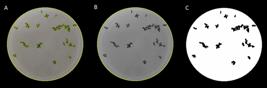
Model to quantify the surface coverage area (%) of L. minor. The digital images were captured at the beginning (day 0) and end (day 7) of the bioassay and were processed in ImageJ® software, converted to 8-bit format, and analyzed with the Threshold tool to binarize the image. Exemplifying (A) original image, in (B) 8-bit image, and (C) final image after treatment with “Threshold”.
After obtaining the final fresh biomass for each treatment, dry biomass was quantified by weighing the L. minor specimens on the seventh day of each treatment. The process of removing excess surface water was performed using absorbent paper, with five repetitions of two minutes each, until no moisture marks appeared on the paper. Subsequently, a forced circulation thermoelectric oven was used at 45°C for 25 h to dry the biomass. The mass was then determined on a precision analytical balance (Kern PFB 300-3, accuracy: 0.001 g) to obtain the final dry biomass weight.
To evaluate the specific growth rate (SGR), the increase in the number of fronds (leaves) over time was observed throughout the experiment on the initial day and the final day of the test using Equation 1.
For the morphological parameter, a visual analysis of the leaves was used, established using scoring criteria defined by a comparative description of the observations in relation to the control group. Changes in the shape, color and texture of the leaves were visually observed throughout the period, assigning scores from 1 to 5 for each experimental unit (Table 1).
2.4 Statistical analysis
The data were analysed using R statistical software. Normality and homogeneity of variances were assessed with the Shapiro-Wilk and Levene tests, respectively. As the assumptions were not met (p < 0.05), the nonparametric Kruskal-Wallis test was used to compare treatments. Differences between means were identified using Dunn's multiple comparisons test with Bonferroni correction (p < 0.05) to control experimental error. Statistical analyses were conducted to evaluate the effects of treatments on the parameters evaluated. For leaf number and area coverage, average values between the measurement days were used. For specific growth rate, the number of leaves obtained at the beginning and end of the experiment was used to calculate the values with the equation. For dry biomass, the values obtained at the end of the experiment were used. Principal Component Analysis (PCA) was performed on the variables leaf number, area coverage, specific growth rate, and dry biomass to explore patterns of multivariate variation among samples by reducing the dataset's dimensionality. A Permutational Multivariate Analysis of Variance (PERMANOVA) was conducted using the adonis2 function of the vegan package to assess significant differences in the multivariate composition of the variables among treatments. The analysis tested the effects of the factors concentration, treatments, and their interaction, concentration and treatments on the multivariate variation. Euclidean distance was used as a measure of dissimilarity between samples, and the significance of the effects was determined through 999 random permutations. The envfit function was applied to fit vectors of the physicochemical parameters, pH, and electrical conductivity, to the ordination space generated by PCA. Statistical significance was determined through 999 random permutations. All analyses were conducted using R software Version 4.1.3.
Morphological parameters used for visual analysis of L. minor grown using seaweed-based biostimulants (SBB) at concentrations of 0, 0.5, and 2.0 mg/L, either alone or in combination with Hoagland and Arnon nutrient solution or with NaCl (2.5 g/L). The scoring criteria were established qualitatively by comparing the observations directly with the control group, with scores ranging from 1 to 5.
3. RESULTS
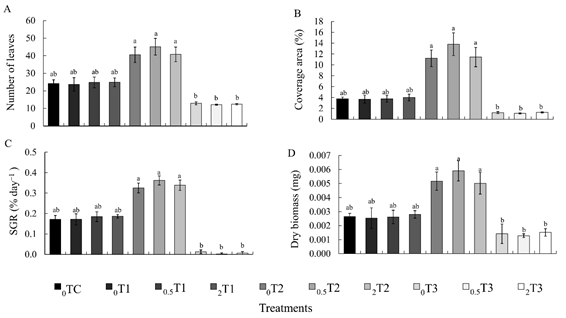
The findings showed that the growth of L. minor was significantly influenced by treatments with nutrient medium, irrespective of the SBB concentration. Additionally, L. minor experienced rapid mortality under salt stress conditions, regardless of the SBB concentration. There were significant differences (p < 0.05) among treatments in groups T2 and T3, but no significant differences (p > 0.05) were found among treatments in groups T2 and T1 (Figure 2).
3.1. Growth parameters
The number of leaves of L. minor was significantly different (p < 0.05) among treatments. Treatments in group T2, with different doses of biostimulant + Hoagland and Arnon nutrient solution, resulted in a significantly greater number of leaves (p < 0.05) compared to treatments in group T3. Specifically, in group T2, the concentration of 0.5 mg/L of the biostimulant (0.5T2) presented the highest absolute values, with 45.13 ± 2.3 leaves, followed by treatments without biostimulant 0T2 (40.53 ± 1.8) and 2T2 (40.76 ± 2.1), but with no significant differences among them. Similarly, the coverage area showed significant differences (p < 0.05) among the treatments. Treatments in group T2 had significantly higher cover (p < 0.05) compared to treatments in group T3, but no significant difference compared to treatments in group T1. The highest absolute percentages of coverage area were observed in treatments in group T2, with 14.0 ± 1.2% for 0.5T2, 11.0 ± 0.8% for 0T2, and 11.5 ± 0.9% for 2T2. Treatments in groups T1, T3, and the control group (TC0) had intermediate values that were not statistically different. However, treatments in group T3 had lower cover percentages (1.0 ± 0.2%), indicating the negative impact of salt stress on the growth of L. minor (Figure 2).
Regarding SGR, the treatments in group T2 showed significantly higher growth rates (p < 0.05) than those observed in treatments T3, being 0.37 ± 0.02% day⁻1 for 0.5T2, 0.34 ± 0.01% day⁻1 for 0T2 and 0.35 ± 0.02% day⁻1 for 2T2. Dry biomass followed the same pattern as the other parameters. Group T2 treatments exhibited significantly higher dry biomass (p < 0.05) than group T3 treatments, with no significant differences (p > 0.05) compared to the remaining treatments. Treatment 0.5T2, in absolute terms, displayed superior efficiency compared to the other concentrations and treatments, indicating a synergistic effect of the Hoagland and Arnon nutrient solution with SBB on the growth of L. minor (Figure 2).

Growth parameters of L. minor using seaweed-based biostimulants (SBB) at concentrations of 0, 0.5, and 2.0 mg/L, either alone or in combination with Hoagland and Arnon nutrient solution or with NaCl (2.5 g/L), along with a control group, for evaluation and validation of the use of SBB in hydroponic cultures. (A) The number of leaves. (B) the cover area. (C) specific growth rate (SGR). (D) dry biomass. Different letters indicate significant differences (p < 0.05) among treatments.
3.2. Morphological variations and visual alterations in L. minor
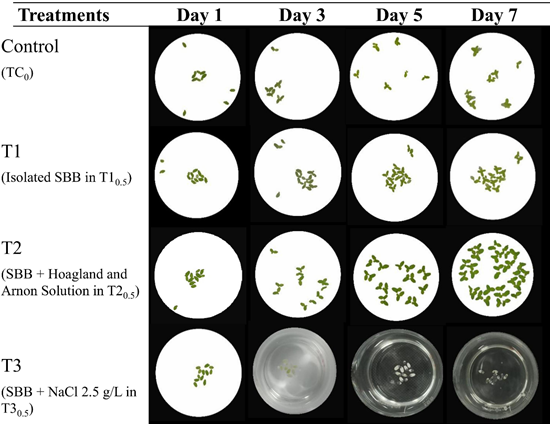
Analysis of the images obtained by GIMP software on the first and seventh days to measure the coverage area revealed visually detectable morphological differences. L. minor in the T2 treatments developed leaves with more intense green coloration, larger size, and improved leaf appearance, which possibly resulted in superior coverage area results. The T1 and control treatments exhibited normal morphology, but with less intense green coloration, while the T3 treatments exhibited morphological changes indicative of severe stress, including marginal chlorosis, necrosis, and eventual plant death, confirming the deleterious effects of salt stress unmitigated by the biostimulant at the tested concentrations (Figure 3). Visual analysis, according to the established methodological criteria, demonstrated that the T2 treatments resulted in better physiological conditions in L. minor (Table 2).
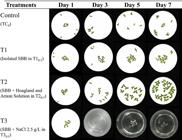
Morphological records of L. minor using seaweed-based biostimulants (SBB) at concentrations of 0, 0.5, and 2.0 mg/L, either alone or in combination with Hoagland and Arnon nutrient solution or with NaCl (2.5 g/L), along with a control group, for evaluation and validation of the use of SBB in hydroponic cultures. Qualitative records are related to the treatment groups that used SBB at 0.5 mg/L concentrations over the seven-day period.
General descriptive records of morphological variations and visual alterations in L. minor grown using seaweed-based biostimulants (SBB) at concentrations of 0, 0.5, and 2.0 mg/L, either alone or in combination with Hoagland and Arnon nutrient solution or with NaCl (2.5 g/L), along with a control group.
3.3. Integrated analysis of parameters
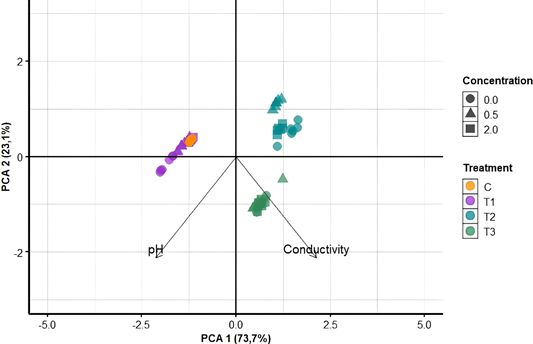
PERMANOVA applied to the Principal Component Analysis (PCA) data matrix showed that treatments were more decisive than concentrations (R² = 0.92; p = 0.001). Treatments in group T2 were clearly separated from the others. However, the lack of a clear correlation with electrical conductivity in treatment T3 suggests that factors other than salinity could be influencing the results. For concentration and the interaction between concentration and treatment, this was not significant (p > 0.001). These findings suggest that the multivariate structure of the analyzed data was more influenced by the combination of biostimulant and nutrient solution rather than the concentrations alone.
In the PCA (Figure 4), the proportion of variation explained by the first two axes accounted for 96.8% of the total combined variation of the variables analyzed by the model. Axis 1 (PCA 1) explained 73.7% of the data variability and was positively associated with the treatments of Group T1 (only SBB at 0.5 and 2.0 mg/L), the control, and pH. The highest pH values observed in these treatments were, respectively, 6.92 for 0.5T1, 6.59 for 2T1, and 6.64 for 0TC (control). Furthermore, the analysis indicates a strong positive relationship between this axis and the variables SGR, leaf number, dry biomass, and cover area. These variables demonstrated a positive association together but exhibited a negative relationship with pH. In contrast, treatment T3, which showed a positive relationship with the variables SGR, leaf number, biomass, and cover, was negatively projected onto axis 1. Treatment T3 obtained the highest electrical conductivity values due to the presence of sodium chloride at 2.5 g/L; however, the relationship demonstrated by PCA was not evident (Figure 4).

Principal Component Analysis (PCA) of the growth parameters of L. minor, along with pH and conductivity variables, using seaweed-based biostimulants (SBB) at concentrations of 0, 0.5, and 2.0 mg/L. The SBB treatments were applied either alone or in combination with Hoagland and Arnon nutrient solution or with NaCl (2.5 g/L), in addition to a control group.
4. DISCUSSION
The present study proposed a model for evaluating Seaweed-based biostimulants (SBB) in hydroponic crops, an area where their effects are still little explored. Hydroponic systems are increasingly vital for the commercial cultivation of leguminous and vegetable plants (Niu and Masabni, 2022), mainly due to the possibility of using organic nutrient sources in the hydroponic solution (Park and Williams, 2024). The findings of the present study indicate that the growth of L. minor was primarily influenced by the Hoagland and Arnon solution than by the varying concentrations of SBB. This highlights the importance of nutrient solutions in hydroponic systems. However, there is a possibility of a synergistic interaction between the SBB and the Hoagland and Arnon solution, as evidenced by the superior performance, in absolute terms, of L. minor growth in the treatment with 0.5 mg/L within the T2 group, compared to other treatments, including 0T2, which only had the Hoagland and Arnon solution.
Previous research has shown that biostimulants work best in conjunction with proper nutrition rather than as a replacement. Additionally, biostimulants are most effective when used in low concentrations and may become harmful at high concentrations (Du Jardin, 2015; Rouphael and Colla, 2020). However, the concentrations used in the present study did not allow such confirmation, requiring further investigation involving different SBB concentrations in future tests with L. minor. Additionally, extending the experimental duration would probably provide a clearer illustration of this potential synergistic impact.
The substitution of hydroponic nutrient solution with seaweed extracts should be assessed individually, as it may have negative effects in inappropriate proportions. This was demonstrated by Oñez et al. (2025) in their study on the impact of different ratios of Sargassum polycystum seaweed extract mixed with a commercial hydroponic nutrient solution on the growth and yield of green lettuce (Lactuca sativa L.) in a hydroponic system. The researchers found significant improvements in plants treated with up to 50% seaweed extract compared to those treated with 100% hydroponic nutrient solution. However, they cautioned against exceeding the 50% substitution level, as it could be harmful.
Dasgan et al. (2023) studied the impact of three biofertilizers (Chlorella vulgaris microalgae, rhizobacteria, and fungi) in a floating hydroponic system with a 50% decrease in mineral fertilizer on lettuce yield and quality. The researchers found that the rhizobacteria treatment led to the most significant growth outcomes. Additionally, combinations of 100% mineral fertilizer and rhizobacteria resulted in the highest lettuce yield, likely due to the increased nutrient availability from the rhizobacteria. Similarly, Jung and Kim (2020) suggested that a blend of mackerel and brown seaweed (Undaria pinnatifida) wastewater could serve as a high-quality biofertilizer in open-flow lettuce hydroponics. The researchers noted that the biofertilizer met the required content levels for nitrogen, phosphorus, potassium, and heavy metals, and one-month-old lettuce plants exhibited a notably higher growth rate compared to the control group, along with increased chlorophyll and carotenoid levels and enhanced antioxidant activity.
The positive effects of SBB on plants may be due to a synergistic interaction between SBB and the nutrient solution, as seaweed extracts can enhance plant uptake and utilization of nutrients through various mechanisms (Oñez et al., 2025). Indeed, seaweed extracts contain a diverse array of bioactive compounds, such as sulfated polysaccharides, amino acids, vitamins, phytohormones, and micronutrients (Battacharyya et al., 2015, Boa Ventura et al., 2025), which work together to optimize key physiological processes like photosynthesis, protein synthesis, and nutrient uptake (Calvo et al., 2014; Moraes et al., 2025). In the current study, it was noted that under restrictive nutritional conditions, the effectiveness of the biostimulant was limited, as there were no significant differences between the control group and the treatments in the T1 group that only received the biostimulant. This indicates that L. minor did not respond well to the bioactive compounds in the SBB when the nutrient solution was absent. This finding is crucial for understanding how biostimulants work and emphasizes that these products should be viewed as supplements rather than replacements for mineral nutrition (Du Jardin, 2015; Rouphael and Colla, 2020).
Recent research has indicated that the effectiveness of biostimulants is closely linked to the nutritional status of plants (Yakhin et al., 2017; Rouphael and Colla, 2020; Boutahiri et al., 2024). In situations of nutrient deficiency, such as when there is no nutrient medium present (control group and T3 treatments), the mechanisms through which biostimulants work may be compromised due to a lack of essential cofactors, decreased metabolic energy, and alterations in gene expression (Battacharyya et al., 2015; Rouphael and Colla, 2020). This can limit the synergistic effects and evidence of biostimulant impacts on plant growth, as observed in the current research. Therefore, it is crucial to recognize that biostimulants can serve as enhancers of plant physiology within existing cultivation practices and are unlikely to fully replace essential nutrients in hydroponic crops.
In the present study, we found that SBB was not effective in alleviating salt stress in L. minor at the concentrations tested. This suggests that the stress intensity or SBB concentrations used may not have been sufficient to demonstrate a protective effect, despite the osmoregulatory properties of A. nodosum extracts (Khan et al., 2009). A previous study assessing growth parameters in L. minor using sodium chloride as a reference substance found that total frond area was the most sensitive parameter to salt stress, with a mean effective concentration (EC50) of 2.74 ± 0.25 g/L. Fresh weight and number of fronds had EC50 values of 3.15 ± 0.46 g/L and 3.98 ± 0.24 g/L, respectively (Godoy et al., 2017). Therefore, it is crucial to consider the sensitivity of the test organism, as factors like seasonality and external influences can impact the observed sensitivity levels. To further investigate this, we recommend conducting a dose-response curve for salt sensitivity in L. minor using lower NaCl concentrations combined with varying doses of SBB.
The aquatic plant L. minor is well-known as a valuable model organism for ecotoxicological and bioactivity research because of its distinct characteristics (Utami et al., 2018). It is favored for its fast growth, ability to reproduce asexually for genetic consistency, sensitivity to various chemical substances, and simple cultivation following globally accepted protocols like the OECD guidelines (OECD, 2006; Radić et al., 2010; Chakrabarti et al., 2018). In this context, the results obtained in this study support the potential of L. minor as a model organism for biostimulant screening. The species showed sufficient sensitivity to differentiate the various treatments and responded quickly to changes in bioassay conditions. The correlation between the different growth parameters assessed (leaf number, area coverage, SGR, and dry biomass) further validates the use of these plants for future bioassays.
Comparative research has shown a correlation between responses observed in L. minor and other plant species (Cardoso et al., 2021; Klein et al., 2025). This similarity indicates that the results from duckweed bioassays can be reliably applied to commercial crops and serve as an initial assessment of biostimulant effects. The methodology presented in this study can be adjusted to assess various biostimulants, concentrations, and stress conditions. However, incorporating additional analyses such as photosynthetic activity, chlorophyll content, and antioxidant enzymes (Radić et al., 2010; Zezulka et al., 2013) could enhance the comprehensive evaluation of biostimulant effects. Despite the limitations identified in this study and the potential for future research, the findings suggest the need for refining protocols for SBB evaluation in future studies.
5. CONCLUSION
Based on the findings of this study, it is recommended that additional research be carried out to investigate the suitability of L. minor in evaluating the effects of SBB from A. nodosum on hydroponic crops. The method described offers a straightforward, consistent, and replicable initial model that fulfills the essential requirements for a quick and cost-effective preliminary bioassay, enabling the verification of the efficacy of bio-inputs prior to field trials.
6. DATA AVAILABILITY STATEMENT
Data availability not informed.
7. ACKNOWLEDGEMENTS
The authors would like to acknowledge the financial support provided by the Coordenação de Aperfeiçoamento de Pessoal de Nível Superior (CAPES), Brazil - Financing Code 001; the Conselho Nacional de Desenvolvimento Científico e Tecnológico (CNPq) through the INCT Nanotechnology for Sustainable Agriculture (INCTNanoAgro, grant #405924/2022-4) and MEC-CAPES INCTNanoAgro (#88887.953443/2024-00). The authors further acknowledge the Fundação de Amparo à Pesquisa do Estado de São Paulo (FAPESP) for financial support through research grant (#2024/21456-7). Additionally, support from the CETMA and ECOhostel projects (#008.00000373/2025-21).
8. REFERENCES
-
BATTACHARYYA, D.; BABGOHARI, M. Z.; RATHOR, P.; PRITHIVIRAJ, B. Seaweed extracts as biostimulants in horticulture. Scientia Horticulturae, v. 196, p. 39-48. 2015. https://doi.org/10.1016/j.scienta.2015.09.012
» https://doi.org/10.1016/j.scienta.2015.09.012 -
BOA VENTURA, T. F.; ESPÍRITO SANTO, L. A.; ALVES SILVA, B.; SACRAMENTO NETO, B.; DE MORAES, C. M.; BITTENCOURT, S. N. D. S. et al Liquid extract of Kappaphycus alvarezii enhances growth and metabolic responses in in vitro cultivated explants of this same species. Journal of Applied Phycology, v. 37, p. 2147-2156. 2025. https://doi.org/10.1007/s10811-025-03484-2
» https://doi.org/10.1007/s10811-025-03484-2 -
BOUTAHIRI, S.; BENRKIA, R.; TEMBENI, B.; IDOWU, O. E.; OLATUNJI, O. J. Effect of biostimulants on the chemical profile of food crops under normal and abiotic stress conditions. Current Plant Biology, v. 40, p. 100410. 2024. https://doi.org/10.1016/j.cpb.2024.100410
» https://doi.org/10.1016/j.cpb.2024.100410 -
BÖTTCHER, T.; SCHROLL, R. The fate of isoproturon in a freshwater microcosm with Lemna minor as a model organism. Chemosphere, v. 66, n. 4, p. 684-689. 2007. https://doi.org/10.1016/j.chemosphere.2006.07.087
» https://doi.org/10.1016/j.chemosphere.2006.07.087 -
BOG, M.; SREE, K. S.; FUCHS, J.; HOANG, P. T.; SCHUBERT, I.; KUEVER, J. et al A taxonomic revision of Lemna sect. Uninerves (Lemnaceae). Taxon, v. 69, n. 1, p. 56-66. 2020. https://doi.org/10.1002/tax.12188
» https://doi.org/10.1002/tax.12188 -
BRAIN, R. A.; HANSON, M. L.; SOLOMON, K. R.; BROOKS, B. W. Aquatic Plants Exposed to Pharmaceuticals: Effects and Risks. In: WHITACRE, D. M. (eds) Reviews of Environmental Contamination and Toxicology. New York: Springer, 2008. https://doi.org/10.1007/978-0-387-71724-1_3
» https://doi.org/10.1007/978-0-387-71724-1_3 -
CALVO, P.; NELSON, L.; KLOEPPER, J. W. Agricultural uses of plant biostimulants. Plant and Soil, v. 383, n. 1, p. 3-41. 2014. https://doi.org/10.1007/s11104-014-2131-8
» https://doi.org/10.1007/s11104-014-2131-8 -
CARDOSO, L. H. D.; DOERRIER, C.; GNAIGER, E. Magnesium Green for fluorometric measurement of ATP production does not interfere with mitochondrial respiration. Bioenergetics Communications, v. 2021, p. 1-1. 2021. https://doi.org/10.26124/bec:2021-0001
» https://doi.org/10.26124/bec:2021-0001 -
CHAKRABARTI, R.; CLARK, W. D.; SHARMA, J. G.; GOSWAMI, R. K.; SHRIVASTAV, A. K.; TOCHER, D. R. Mass production of Lemna minor and its amino acid and fatty acid profiles. Frontiers in Chemistry, v. 6, p. 479. 2018. https://doi.org/10.3389/fchem.2018.00479
» https://doi.org/10.3389/fchem.2018.00479 -
DASGAN, H. Y.; YILMAZ, D.; ZIKARIA, K.; IKIZ, B.; GRUDA, N. S. Enhancing the yield, quality and antioxidant content of lettuce through innovative and eco-friendly biofertilizer practices in hydroponics. Scientia Horticulturae, v. 9, n. 12, p. 1274. 2023. https://doi.org/10.3390/horticulturae9121274
» https://doi.org/10.3390/horticulturae9121274 -
DU JARDIN, P. Plant biostimulants: Definition, concept, main categories and regulation. Scientia Horticulturae, v. 196, p. 3-14. 2015. https://doi.org/10.1016/j.scienta.2015.09.021
» https://doi.org/10.1016/j.scienta.2015.09.021 -
EKPERUSI, A. O.; SIKOKI, F. D.; NWACHUKWU, E. O. Application of common duckweed (Lemna minor) in phytoremediation of chemicals in the environment: State and future perspective. Chemosphere, v. 223, p. 285-309. 2019. https://doi.org/10.1016/j.chemosphere.2019.02.025
» https://doi.org/10.1016/j.chemosphere.2019.02.025 -
GANDHI, G.; BISWAS, K.; VAGHELA, P.; NAYAK, J.; NAIR, A.; MORADIYA, K. et al In-depth metabolite characterization of seaweed-based plant biostimulants: Insights into bioactive components. Algal Research, v. 81, n. 103574. 2024. https://doi.org/10.1016/j.algal.2024.103574
» https://doi.org/10.1016/j.algal.2024.103574 -
GODOY, A. A.; CARVALHO, L. B. D.; KUMMROW, F.; PAMPLIN, P. A. Z. Sodium chloride as a reference substance for the three growth endpoints used in the Lemna minor L. (1753) test. Revista Ambiente & Água, v. 12, p. 08-16. 2017. https://doi.org/10.4136/ambi-agua.1986
» https://doi.org/10.4136/ambi-agua.1986 -
HÄDER, D. P. Ecotoxicological monitoring of wastewater. In: HÄDER, D. P.; ERZINGER, G. S. (eds) Bioassays - Advanced Methods and Applications. Elsevier, 2018. p. 369-386. https://doi.org/10.1016/B978-0-12-811861-0.00018-8
» https://doi.org/10.1016/B978-0-12-811861-0.00018-8 - HOAGLAND, D. R.; ARNON, D. I. The water-culture method for growing plants without soil. California Agricultural Experiment Station Circular, v. 347, n. 2, p. 1-32, 1950.
-
JUNG, H. Y.; KIM, J. K. Complete reutilisation of mixed mackerel and brown seaweed wastewater as a high-quality biofertiliser in open-flow lettuce hydroponics. Journal of Cleaner Production, v. 247, p. 119081. 2020. https://doi.org/10.1016/j.jclepro.2019.119081
» https://doi.org/10.1016/j.jclepro.2019.119081 -
KHAN, W.; RAYIRATH, U. P.; SUBRAMANIAN, S.; JITHESH, M. N.; RAYORATH, P.; HODGES, D. M. et al Seaweed extracts as biostimulants of plant growth and development. Journal of Plant Growth Regulation, v. 28, n. 4, p. 386-399, 2009. https://doi.org/10.1007/s00344-009-9103-x
» https://doi.org/10.1007/s00344-009-9103-x -
KLEIN, J.; APPENROTH, K. J.; SREE, K. S. Duckweeds: Model organisms for research on plant sterols and steroids. Plant Biology, 2025. https://doi.org/10.1111/plb.70095
» https://doi.org/10.1111/plb.70095 -
LI, J.; VAN GERREWEY, T.; GEELEN, D. A meta-analysis of biostimulant yield effectiveness in field trials. Frontiers in Plant Science, v. 13, p. 836702. 2022. https://doi.org/10.3389/fpls.2022.836702
» https://doi.org/10.3389/fpls.2022.836702 -
MARKETS AND MARKETS. Biostimulants Market. Apr. 2025. Available: Available: https://www.marketsandmarkets.com/Market-Reports/biostimulant-market-1081.html Access: Sep. 2025.
» https://www.marketsandmarkets.com/Market-Reports/biostimulant-market-1081.html -
MORAES, V. C.; RUIVO, L. B.; DA SILVA BATISTA, J. S.; VIEIRA, M. C.; LOPES, R. G.; OWATARI, M. S. et al Aqueous extracts of Tetradesmus obliquus and Chlorella vulgaris microalgae enhanced the yield of common bean (Phaseolus vulgaris): A field study. Journal of Applied Phycology, p. 1-14. 2025. https://doi.org/10.1007/s10811-025-03622-w
» https://doi.org/10.1007/s10811-025-03622-w -
MORDOR INTELLIGENCE. Biofertilizers Market: growth, trends, COVID-19 impact, and forecasts (2022-2027) . 2022. Available in: Available in: https://www.marketresearch.com/Mordor-Intelligence-LLP-v4018/Global-Biological-Seed-Treatment-Growth-31853638/ Access: Sep. 2025.
» https://www.marketresearch.com/Mordor-Intelligence-LLP-v4018/Global-Biological-Seed-Treatment-Growth-31853638/ -
MUGHUNTH, R. J.; VELMURUGAN, S.; MOHANALAKSHMI, M.; VANITHA, K. A review of seaweed extract's potential as a biostimulant to enhance growth and mitigate stress in horticulture crops. Scientia Horticulturae, v. 334, p. 113312. 2024. https://doi.org/10.1016/j.scienta.2024.113312
» https://doi.org/10.1016/j.scienta.2024.113312 -
NAUMANN, B.; EBERIUS, M.; APPENROTH, K. J. Growth rate based dose-response relationships and EC-values of ten heavy metals using the duckweed growth inhibition test (ISO 20079) with Lemna minor L. clone St. Journal of Plant Physiology, v. 164, n. 12, p. 1656-1664. 2007. https://doi.org/10.1016/j.jplph.2006.10.011
» https://doi.org/10.1016/j.jplph.2006.10.011 -
NIU, G.; MASABNI, J. Hydroponics. In: KOZAI, T.; NIU, G.; MASABNI, J. (eds.). Plant factory basics, applications and advances. Academic Press, 2022. p. 153-166. https://doi.org/10.1016/B978-0-323-85152-7.00023-9
» https://doi.org/10.1016/B978-0-323-85152-7.00023-9 - OECD. Test No. 221: Lemna sp. growth inhibition test. Paris: OECD Publishing, 2006
-
OÑEZ, L. J. P.; CATUBIS, K. M. L.; CABILLO, R. A.; PASCUAL, P. R. L. Improved morphological and yield responses of green lettuce (Lactuca sativa L.) grown with seaweed extract as a hydroponic nutrient solution. Journal of Plant Nutrition, v. 48, n. 4, p. 658-669. 2025. https://doi.org/10.1080/01904167.2024.2411402
» https://doi.org/10.1080/01904167.2024.2411402 -
PARK, Y.; WILLIAMS, K. A. Organic hydroponics: A review. Scientia Horticulturae, v. 324, p. 112604. 2024. https://doi.org/10.1016/j.scienta.2023.112604
» https://doi.org/10.1016/j.scienta.2023.112604 -
POMONI, D. I.; KOUKOU, M. K.; VRACHOPOULOS, M. G.; VASILIADIS, L. A review of hydroponics and conventional agriculture based on energy and water consumption, environmental impact, and land use. Energies, v. 16, n. 4, p. 1690, 2023. https://doi.org/10.3390/en16041690
» https://doi.org/10.3390/en16041690 -
RADIĆ, S.; BABIĆ, M.; ŠKOBIĆ, D.; ROJE, V.; PEVALEK-KOZLINA, B. Ecotoxicological effects of aluminum and zinc on growth and antioxidants in Lemna minor L. Ecotoxicology and Environmental Safety, v. 73, n. 3, p. 336-342. 2010. https://doi.org/10.1016/j.ecoenv.2009.10.014
» https://doi.org/10.1016/j.ecoenv.2009.10.014 -
RAMOS, G.; RUSSI, P. M.; DA NÓBREGA SOUZA, G.; ALVES, V. M.; BOAS, B. G. V.; DERNER, R. B. et al Effects of crude extract from the macroalgae Kappaphycus alvarezii on the common bean (Phaseolus vulgaris) crops. Brazilian Journal of Animal and Environmental Research, v. 8, n. 1, p. e76538-e76538, 2025. https://doi.org/10.34188/bjaerv8n1-021
» https://doi.org/10.34188/bjaerv8n1-021 -
RENGASAMY, K. R.; KULKARNI, M. G.; PAPENFUS, H. B.; VAN STADEN, J. Quantification of plant growth biostimulants, phloroglucinol and eckol, in four commercial seaweed liquid fertilizers and some by-products. Algal Research, v. 20, p. 57-60. 2016. https://doi.org/10.1016/j.algal.2016.09.017
» https://doi.org/10.1016/j.algal.2016.09.017 -
ROUPHAEL, Y.; COLLA, G. Biostimulants in agriculture. Frontiers in Plant Science, v. 11, p. 40, 2020. https://doi.org/10.3389/fpls.2020.00040
» https://doi.org/10.3389/fpls.2020.00040 -
SHUKLA, P. S.; MANTIN, E. G.; ADIL, M.; BAJPAI, S.; CRITCHLEY, A. T.; PRITHIVIRAJ, B. Ascophyllum nodosum-based biostimulants: Sustainable applications in agriculture for the stimulation of plant growth, stress tolerance, and disease management. Frontiers in Plant Science, v. 10, p. 462648, 2019. https://doi.org/10.3389/fpls.2019.00655
» https://doi.org/10.3389/fpls.2019.00655 -
THINGUJAM, D.; PAJEROWSKA-MUKHTAR, K. M.; MUKHTAR, M. S. Duckweed: Beyond an efficient plant model system. Biomolecules, v. 14, n. 6, p. 628, 2024. https://doi.org/10.3390/biom14060628
» https://doi.org/10.3390/biom14060628 -
UTAMI, D.; KAWAHATA, A.; SUGAWARA, M.; JOG, R. N.; MIWA, K.; MORIKAWA, M. Effect of exogenous general plant growth regulators on the growth of the duckweed Lemna minor Frontiers in Chemistry, v. 6, p. 251, 2018. https://doi.org/10.3389/fchem.2018.00251
» https://doi.org/10.3389/fchem.2018.00251 -
VAN DYCK, I.; VANHOUDT, N.; BATLLE, J. V.; HOREMANS, N.; NAUTS, R.; VAN GOMPEL, A. et al Effects of environmental parameters on Lemna minor growth: An integrated experimental and modelling approach. Journal of Environmental Management, v. 300, p. 113705, 2021. https://doi.org/10.1016/j.jenvman.2021.113705
» https://doi.org/10.1016/j.jenvman.2021.113705 -
YAKHIN, O. I.; LUBYANOV, A. A.; YAKHIN, I. A.; BROWN, P. H. Biostimulants in plant science: a global perspective. Frontiers in Plant Science, v. 7, p. 2049, 2017. https://doi.org/10.3389/fpls.2016.02049
» https://doi.org/10.3389/fpls.2016.02049 -
YANG, T.; SAMARAKOON, U.; ALTLAND, J.; LING, P. Photosynthesis, biomass production, nutritional quality, and flavor-related phytochemical properties of hydroponic-grown arugula (Eruca sativa Mill.) ‘standard’under different electrical conductivities of nutrient solution. Agronomy, v. 11, n. 7, p. 1340, 2021. https://doi.org/10.3390/agronomy11071340
» https://doi.org/10.3390/agronomy11071340 -
ZEZULKA, Š.; KUMMEROVÁ, M.; BABULA, P.; VÁŇOVÁ, L. Lemna minor exposed to fluoranthene: growth, biochemical, physiological and histochemical changes. Aquatic Toxicology, v. 140, p. 37-47, 2013. https://doi.org/10.1016/j.aquatox.2013.05.011
» https://doi.org/10.1016/j.aquatox.2013.05.011 -
ZIEGLER, P.; ADELMANN, K.; ZIMMER, S.; SCHMIDT, C.; APPENROTH, K. J. Relative in vitro growth rates of duckweeds (Lemnaceae)-the most rapidly growing higher plants. Plant Biology, v. 17, p. 33-41, 2015. https://doi.org/10.1111/plb.12184
» https://doi.org/10.1111/plb.12184
Edited by
-
Editor-in-Chief:
Nelson Wellausen Dias https://orcid.org/0000-0002-9507-9211