
 Morphophysiology of tomato crop under saline stress in different environments
Abstract
The use of brackish water can cause severe effects and irreversible damage to the growth and physiological indices of agricultural crops. Thus, the agricultural environment emerges as an alternative to mitigate saline stress in tomato hybrids (Solanum lycopersicum L.). This study evaluated the gas exchange and growth of tomato hybrids irrigated with brackish water in different environments. The study was carried out in Aratuba, Ceará, Brazil. The experimental design was a randomized block design with split-split plots. The main plots consisted of two environments (protected environment and full sun); the subplots consisted of five levels of irrigation water electrical conductivity (ECw) (1.0, 1.7, 2.4, 3.1, and 3.8 dS m-1) and the sub-subplots consisted of two tomato hybrids (Itaipava and BS DI0014), with five replicates. Salt stress reduced CO2 assimilation rate and instantaneous carboxylation efficiency rates more intensely in the full sun environment, while the use of low electrical conductivity in the protected environment promoted greater stomatal conductance in tomato hybrids. The BS DI0014 hybrid was more tolerant to salt stress in terms of transpiration in the protected environment and in full sun than the Itaipava F1 hybrid. The Itaipava F1 and BS DI0014 hybrids grown in a protected environment had higher internal CO2 concentrations.
Keywords:
protected cultivation; salinity; Solanum lycopersicum L
Resumo
O uso de água salobra pode provocar efeitos severos e danos irreversíveis no crescimento e nos índices fisiológicos das culturas agrícolas. Assim, a ambiência agrícola surge como alternativa para mitigar o estresse salino em híbridos de tomate (Solanum lycopersicum L.). Neste sentido, objetivou-se avaliar as trocas gasosas e o crescimento de híbridos de tomate submetida a irrigação com água salobra, em diferentes ambientes. O estudo foi desenvolvido em Aratuba, Ceará, Brasil. O delineamento experimental utilizado foi em blocos ao acaso, em parcelas subsubdivididas, sendo as parcelas formadas por dois ambientes (ambiente protegido e pleno sol), as subparcelas por cinco níveis de condutividade elétrica da água de irrigação (CEa) (1,0; 1,7; 2,4; 3,1 e 3,8 dS m-1) e as subsubparcelas pelos dois híbridos de tomate (Itaipava e BS DI0014), com cinco repetições. O estresse salino reduziu negativamente as taxas fotossintéticas, a condutância estomática, a concentração interna de CO2 e a eficiência do uso da água, porém com menor intensidade no ambiente protegido. O híbrido BS DI0014 foi mais tolerante ao estresse salino quanto a transpiração no ambiente protegido e a pleno sol em relação ao híbrido Itaipava F1. Os híbridos Itaipava F1 e BS DI0014 cultivados em ambiente protegido apresentam maior concentração interna de CO2.
Palavras-chave:
cultivo protegido; salinidade;
Solanum lycopersicum L
1. INTRODUCTION
The tomato (Solanum lycopersicum L.) is a plant species belonging to the Solanaceae family and is one of the main vegetables produced and marketed worldwide. It can be eaten fresh or processed and has nutritional functions that are beneficial to human nutrition (Li et al., 2022; Alenazi and Khandaker, 2024).
In tropical regions with a hot climate characterized by low rainfall, such as the semiarid, the use of full irrigation is necessary to meet the water demand of agricultural crops and ensure food security. Among the strategies employed to enable agricultural production in this region, the use of brackish water stands out, a practice that has been employed due to the limited availability of better quality water resources (Roque et al., 2022; Sousa et al., 2024).The use of irrigation with water containing high salt levels can restrict the uptake of water and nutrients by plants and, consequently, the water consumption of plants, affecting metabolism, cell expansion, and the production of photoassimilates, which results in reduced tomato growth, limiting physiological indices, such as transpiration, CO2 assimilation, and stomatal conductance (Taiz et al., 2017; Sousa et al., 2021).
Modulating the agricultural environment, especially in protected systems, combined with the use of tolerant hybrids, constitutes an efficient strategy for mitigating the effects of saline stress. In these environments, factors such as temperature and luminosity can be controlled, thus reducing direct radiation favors an increase in CO2 concentration and possibly the accumulation of phytochemicals in tomato plants (Alshami et al., 2023). Studies by Rodrigues et al. (2024) found that tomato plants subjected to salinity under high temperature conditions resulted in plants with lower chlorophyll and carotenoid content, decreased leaf area, and lower yield. El-Mogy et al. (2018) observed that under protected environment conditions and moderate saline stress, it is possible to satisfactorily produce plants without a significant reduction in productivity.
This study is based on the hypothesis that the agricultural environment can mitigate the effects of saline stress on the morphophysiology of tomato hybrids. Accordingly, the study evaluated the gas exchange and growth of tomato hybrids irrigated with brackish water in different environments.
2. MATERIAL AND METHODS
The research was conducted at Sítio Flexeiras, Aratuba, Ceará, Brazil (4°07'48.6” S; 38°49' 30.6” W; altitude 830 m). The region's climate is classified as Tropical Sub-Humid, with average temperatures of 24 to 26ºC (Alvares et al., 2013). The daily average temperature and relative humidity data were monitored by a humidity sensor (HO-BO® U12-012 Temp/RH/Light/Ext), shown in Figure 1.
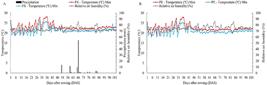
Data related to mean values of temperature, precipitation, and relative humidity of the air in full sun (A) and protected environment (B) during the experimental period (August to December 2022). FS - Full sun; PE - Protected environment.
The experimental design used was a randomized complete block design in split plots, with the plots consisting of two environments (protected environment and full sun), the subplots consisted of five levels of electrical conductivity of the irrigation water (ECw) (1.0, 1.7, 2.4, 3.1, and 3.8 dS m-1) and the sub-subplots consisted of two tomato hybrids (Itaipava and BS DI0014), with five replicates. The electrical conductivities of water used were based on the threshold salinity (2.5 dS m-1) proposed by Maas and Hoffman (1977), that is, two levels below and two above the threshold.
The crop used in the study was tomato (Solanum lycopersicum L.), hybrids Itaipava Topseed Premium® and BS DI0014 Blueseeds®. Sowing was carried out in a polypropylene tray with 200 cells of 40 cm3 in volume, where each cell received a seed placed 2 cm deep. Transplanting took place 25 days after sowing (DAS) into 49 dm3 pots in a protected environment with a 50% shade screen and in full sun.
The material used to compose the substrate was obtained from a mixture of a Red-Yellow Argisol + goat manure + washed sand in a 3:1:1 (v/v) ratio, respectively, whose physicochemical analysis (Table 1) was carried out in the soil laboratory of the Federal University of Ceará (UFC), following the methodologies described by Teixeira et al. (2017).
To prepare the irrigation water, the salts NaCl, CaCl2.2H2O, and MgCl2.6H2O were used to obtain the desired ECw in a 7:2:1 equivalent ratio, following the relationship between ECw and its concentration (mmolc L-1 = EC × 10) (Rhoades et al., 2000). Irrigation was carried out following the methodology of Bernardo et al. (2019), based on the principle of the drainage lysimeter on a daily basis, applying a 15% leaching fraction.
The irrigation system used was drip irrigation with drippers with a discharge rate of 8 L h-1. The irrigation time was quantified according to the volume to be applied in each irrigation event, determined according to Equation 1.
Where: VI - volume of water to be applied in the irrigation (mL); Vp - volume of water applied in the previous irrigation (mL); Vd - volume of water drained (mL); and, FL - leaching fraction of 0.15, applied in each irrigation event.
The brackish water treatments began 15 days after transplanting (DAT), and the following physiological indices were assessed at 30 DAT: CO2 assimilation rate (A, μmol CO2 m-2 s-1), stomatal conductance (gs, mol m-1 s-1), transpiration rate (E, mmol m-2 s-1), and internal CO2 concentration (Ci, μmol CO2 mol-1). These data were then used to calculate the instantaneous water use efficiency (WUE, [(μmol CO2/mmol H2O m-2 s-1)-1]) and instantaneous carboxylation efficiency (iCE, μmol CO2 m2 s-1/μmol CO2 mol-1 air).
The measurements were carried out using an infrared gas analyzer (IRGA - LI 6400 XT, LICOR), in an open system, with an air flow of 300 μmol s-1, on the limb of the first leaf below the inflorescence. The measurements were made between 08 and 10 a.m., using an artificial radiation source (around 1,200 μmol m-2 s-1), and under ambient temperature and CO2 concentration conditions.
During this same period, the following growth variables were assessed: plant height (PH, cm), measured from the base to the apex of the plant with a graduated ruler, stem diameter (SD, mm), measured 2 cm above the substrate with a digital caliper, and leaf area (LA, cm2), estimated by the ratio between leaf width and length, using a correction factor of 0.59, (Reis et al., 2013), according to Equation 2.
Where: LA - leaf area, cm2; C - leaf length, cm; L - leaf width, cm; and, f - shape factor (0.59).
Data regarding gas exchange and growth variables were analyzed using the Kolmogorov-Smirnov test (p ≤ 0.05) to assess normality. After verifying normality, the data were subjected to analysis of variance using the F-test. In cases of significance, for electrical conductivity, regression analysis was performed, while data on tomato hybrids and environments were subjected to the Tukey test (p ≤ 0.05), using the Assistat 7.7 Beta software (Silva and Azevedo, 2016).
3. RESULTS AND DISCUSSION
Based on the results obtained, there was a triple interaction between the factors studied, cultivation environment, brackish water and tomato hybrids only for the transpiration variable (Table 2). There was also an interaction between the factors brackish water and growing environment for the variables CO2 assimilation rate, stomatal conductance, and instantaneous water use efficiency. There was also an isolated effect for the growing environment factor for leaf temperature.
Summary of analysis of variance of CO2 assimilation rate (A), stomatal conductance (gs), transpiration (E), internal carbon concentration (Ci), and instantaneous water use efficiency (WUE) of tomato hybrids under different electrical conductivities of irrigation water and growing environments.
The decreasing linear model was the best fit, reducing the CO2 assimilation rate by 13.04% from the lowest to the highest electrical conductivity of the irrigation water for the full sun environment (Figure 2A). For the protected environment, the quadratic polynomial model was the best fit, with a maximum CO2 assimilation rate of 23.24 μmol m-2 s-1 with an electrical conductivity of 1.4 dS m-1. It is noteworthy that saline stress in plants grown in a full-sun environment provided greater CO2 assimilation rate. This effect possibly promoted physiological acclimatization, partially relieving heat stress and excess light, reducing the translocation of toxic ions to the leaves and favoring CO2 assimilation in the biochemical phase (Alshami et al., 2023; Jiang et al., 2024).

CO2 assimilation rate - A (A) and stomatal conductance - gs (B) of tomato hybrid plants irrigated with brackish water in a protected environment (■) and in full sun (▲), Transpiration - E (C e D) of tomato hybrid plants (● Itaipava F1) and (♦ BS DI0014), Internal CO2 concentration - Ci (E), and instantaneous water use efficiency - WUE (F) of tomato hybrid plants irrigated with brackish water in a protected environment (■) and in full sun (▲).
This negative effect of saline stress in a protected environment may be associated with lower light reaching the plants, reducing transpiration and increasing partial closure of stomata, thus promoting oxidative stress with harmful effects on lipid peroxidation, membrane degradation and lower chlorophyll concentrations and consequently lower CO2 assimilation rate (Jiang et al., 2024). Roque et al. (2022) also showed a decline in the CO2 assimilation rate of tomato crops subjected to high saline concentrations in a protected environment. The salt stress linearly reduced the stomatal conductance of the tomato crop grown in full sun, reducing 42% from the lowest to the highest electrical conductivity of water. As for the protected environment, the quadratic polynomial model was the one that best fitted the data, obtaining a maximum of (0.81 mol m-1 s-1) for the electrical conductivity of 1.2 dS m-1. This behavior can be attributed to the lower light intensity within the protected environment, which favored greater interaction between water below the threshold salinity, evidencing greater stomatal regulation and water transport within cells, increasing cell turgidity and resulting in greater stomatal opening (Taiz et al., 2017). However, higher saline levels reduced gs, promoting partial closure of stomata, since the osmotic effect triggered by saline stress reduces cell turgidity, promoting ostiole closure (Roque et al., 2022). Corroborating this study, Batista et al. (2021) showed a reduction in the stomatal conductance of tomato plants grown in a protected environment and subjected to irrigation with brackish water in a nutrient solution.
Rising salt levels in irrigation water led to a reduction in transpiration of the tomato hybrids Itaipava F1 and BS DI0014 in the protected environment (Figure 2C) and in full sun (Figure 2D). The superiority of the BS DI0014 hybrid compared to the Itaipava F1 in the protected environment at the highest salt levels may be related to an acclimatization mechanism of this hybrid, which possibly reduced the water potential gradient between the soil and the roots, decreasing stomatal conductance and consequently the transpiration rate.
This result may be related to the fact that salinity triggers processes such as an increase in abscisic acid, which is a hormonal signal of stressful conditions. This increase in ABA concentration promotes stomatal closure and consequently a decrease in perspiration (Pei et al., 2024). It is worth noting that the agricultural environment can promote improved tomato cultivation as a response mechanism for water retention, thus maintaining the water potential for easy absorption and regulating the amount of water absorbed as a response mechanism to minimize water loss (Batista et al., 2021; Alshami et al., 2023). A similar trend to this study was reported by Roque et al. (2022) when irrigating tomato crops with brackish water in a protected environment.
The model for internal carbon concentration was the quadratic polynomial, with a maximum of 277.342 μmol mol-1 at an electrical conductivity of 1.73 dS m-1 in the protected environment and a decreasing linearity in full sun (Figure 2E). The protected environment relieved saline stress and provides a higher internal concentration of CO2 compared to full sun, increasing stomatal conductance, positively interfering in the photosynthesis process, as it raises the partial pressure of this gas in the intracellular spaces (Sousa et al., 2024).
The data described in this study reveal that the water deficit induced by the increase in salinity of irrigation water caused stomatal closure, which limits the increase in internal CO2 concentration in the plant. A similar trend was reported by Rodríguez-Ortega et al. (2019), who found that the internal CO2 concentration decreased with increasing salinity in a protected environment. The authors emphasize that these responses may be related to stomatal behavior, but may also be metabolic factors, which vary according to tomato varieties.
The instantaneous water use efficiency showed a linear decrease with saline stress in the protected environment and in full sun, with a reduction of 23.95 and 21.95% from the lowest to the highest salinity, respectively (Figure 2F). This result describes that saline stress showed a reduction in water availability for plants, evidencing partial closure of stomata, restricting the entry of water and photosynthetic pigments, which limits the absorption of CO2 in the leaf mesophyll cells, consequently lower instantaneous water use efficiency (Fatima et al., 2024).
This behavior may be linked to the plant's ability to reduce evapotranspiration as a defense mechanism, since a reduction in water consumption implies a reduction in the absorption of specific ions, avoiding toxic effects on the plants (Lessa et al., 2022). Similarly, Oliveira et al. (2022) also showed greater instantaneous water use efficiency in sugar beet crops irrigated with lower salinity water under protected growing conditions.
The summary data from the analysis of variance for initial growth are shown in Table 3. It can be seen that there was a significant effect for the interaction between the factors growing environment, salinity and tomato hybrids for the variable plant height at p ≤ 0.05. There was an interaction between the factors growing environment and tomato hybrids for the leaf area variable and an isolated effect for the brackish water factor (p ≤ 0.01 and ≤ 0.05). In the stem diameter variable, there was an interaction between the salinity and tomato hybrid factors and an isolated effect for the growing environment factor (p ≤ 0.01 and ≤ 0.05).
For the data presented in Figure 3A, it can be seen that the quadratic polynomial model was the one that best adjusted the data for plant height in the protected environment, obtaining a maximum height of 82.49 cm for the Itaipava hybrid in an ECw of 2.65 dS m-1 and for the BS DI0014 of 73.91 cm in an ECw of 1.90 dS m-1. Similarly, the model that best adjusted the data for the full sun environment (Figure 3B) was also the quadratic polynomial with a maximum plant height value of 61.81 cm for the Itaipava hybrid in an ECw of 1.93 dS m-1 and for the BS DI0014 of 60.22 cm in an ECw of 1.60 dS m-1.
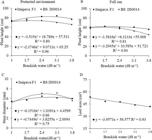
Plant height of tomato hybrid plants (● Itaipava F1) and (♦ BS DI0014), irrigated with brackish water in a protected environment (A) and in full sun (B), Stem diameter (C) of two tomato hybrids, and leaf area (D) irrigated with brackish water.
The results presented in Figure 3A are in agreement with the data described by Santiago et al. (2018). These authors report that cultivation in a protected environment reduces the incidence of radiation due to shading screens, influencing the interior radiation flow and consequently the morphophysiological dynamics of crops. Corroborating the present study, El-Mogy et al. (2018), observed a 12.1% increase in height of tomato plants under salt stress and grown in a protected environment.
The greater reduction in plant height under saline stress and growth in full sun (Figure 3B) may be associated with the ionic and osmotic effects triggered by salinity, which reduce cell expansion and impair photochemical processes and carbon metabolism, contributing to reduced plant growth (Zhang et al., 2022). Similar to the present study, Zhang et al. (2017) found a reduction in the height of tomato plants subjected to increasing electrical conductivity of irrigation water.
Regarding stem diameter, the quadratic polynomial model best fitted the data in the two tomato hybrids when subjected to the salinity of irrigation water (Figure 3C). The maximum diameter observed was 6.24 and 6.92 mm for the Itaipava and BS DI0014 hybrids, at electrical conductivities of 3.42 and 2.56 dS m-1, respectively. According to Oliveira et al. (2022), the salinity causes a reduction in osmotic potential in the root zone, which limits the absorption of water and nutrients, causing a delay in crop development. Corroborating the results of this study, El-Mogy et al. (2018) found that increased salinity of irrigation water caused a reduction in the stem diameter of tomato plants. Souza et al. (2019) also found a decrease in the stem diameter of tomato plants under the effect of saline stress.
The leaf area decreased by 21.78% from the lowest to the highest electrical conductivity of irrigation water, regardless of the genotype and cultivation environment (Figure 3D). The increase in the concentration of salts in irrigation water results in an increase in osmotic pressure in the root zone, inhibiting the water absorption process, which directly interferes with cell elongation (Rodriguez-Ortega et al., 2019). Similar trends were observed by Huang et al. (2016), who found a reduction in the leaf area of tomato plants under salt stress. El-Mogy et al. (2018), when evaluating tomato cultivation irrigated with brackish water, concluded that increasing the concentration of salts in irrigation water reduced leaf area.
4. CONCLUSIONS
Salt stress reduced CO2 assimilation rate and instantaneous carboxylation efficiency rates more intensely in the full sun environment, while the use of low electrical conductivity water in the protected environment promoted greater stomatal conductance in tomato hybrids.
The BS DI0014 hybrid was more tolerant to salt stress in terms of transpiration in the protected environment and in full sun than the Itaipava F1 hybrid.
The Itaipava F1 and BS DI0014 hybrids grown in a protected environment had higher internal CO2 concentrations.
5. DATA AVAILABILITY STATEMENT
Data availability not informed.
6. REFERENCES
-
ALENAZI, M. M.; KHANDAKER, M. M. Responses of tomato hybrid cultivars to soil application of humic acid under greenhouse conditions. Brazilian Journal of Biology, v. 84, n. 1, 252573, 2024. https://doi.org/10.1590/1519-6984.252573
» https://doi.org/10.1590/1519-6984.252573 -
ALSHAMI, A. K.; EL-SHAFEI, A.; AL-OMRAN, A. M.; ALGHAMDI, A. G.; LOUKI, I.; ALKHASHA, A. Responses of tomato crop and water productivity to deficit irrigation strategies and salinity stress in greenhouse. Agronomy, v. 13, n. 12, 3016, 2023. https://doi.org/10.3390/agronomy13123016
» https://doi.org/10.3390/agronomy13123016 -
ALVARES, C. A.; STAPE, J. L.; SENTELHAS, P. C.; GONÇALVES, J. D. M.; SPAROVEK, G. Köppen’s climate classification map for Brazil. Meteorologische Zeitschrift, v. 22, n. 6, p. 711-728, 2013. https://doi.org/10.1127/0941-2948/2013/0507
» https://doi.org/10.1127/0941-2948/2013/0507 -
BATISTA, M. C.; NASCIMENTO, R.; MAIA JÚNIOR, S. O.; NASCIMENTO, E. C. S.; BEZERRA, C. V. C.; LIMA, R. L. Physiology and production of cherry tomato cultivars in a hydroponic system using brackish water. Revista Brasileira de Engenharia Agrícola e Ambiental, v. 2, n. 4, p. 219-227, 2021. https://doi.org/10.1590/1807-1929/agriambi.v25n4p219-227
» https://doi.org/10.1590/1807-1929/agriambi.v25n4p219-227 - BERNARDO, S.; MANTOVANI, E. C.; SILVA, D. D. DA; SOARES, A. A. Manual de irrigação. 9. ed. Viçosa: UFV, 2019. 545p.
-
EL-MOGY, M. M.; GARCHERY, C.; STEVENS, R. Irrigation with salt water affects growth, yield, fruit quality, storability and marker-gene expression in cherry tomato. Acta Agriculturae Scandinavica, v. 68, p. 727-737, 2018. https://doi.org/10.1080/09064710.2018.1473482
» https://doi.org/10.1080/09064710.2018.1473482 -
FATIMA, R. T.; NÓBREGA, J. S.; LIMA, G. S.; SOARES, L. A. A.; PEREIRA, M. B.; RIBEIRO, J. E. S. et al Seaweed extract biofertilizer modulates scarlet eggplant tolerance to salt stress. Arid Land Research and Management, v. 38, p. 46-61, 2024. https://doi.org/10.1080/15324982.2023.2224272
» https://doi.org/10.1080/15324982.2023.2224272 -
HUANG, C. H.; PENG, F.; YOU, Q. G.; XUE, X.; WANG, T.; LIAO, J. Growth, yield and fruit quality of cherry tomato irrigated with saline water at different developmental stages. Acta Agriculturae Scandinavica, v. 66, p. 317-324, 2016. https://doi.org/10.1080/09064710.2015.1111931
» https://doi.org/10.1080/09064710.2015.1111931 -
JIANG, W.; LIU, J.; GONG, Z.; GAO, Y.; LI, Z.; ZHANMING, T. Slightly saline water improved physiology, growth, and yield of tomato plants in yellow sand substrate. Agronomy, v. 14, n. 10, 2315, 2024. https://doi.org/10.3390/agronomy14102315
» https://doi.org/10.3390/agronomy14102315 -
LESSA, C. I. N.; SOUSA, G. G.; SOUSA, H. C.; SILVA, F. D. B.; GOMES, S. P.; VIANA, T. V. A. Agricultural ambience and salt stress in production of yellow passion fruit seedlings. Comunicata Scientiae, v. 13, p. 1-8, 2022. https://doi.org/10.14295/cs.v13.3703
» https://doi.org/10.14295/cs.v13.3703 -
LI, D.; WAN, S.; LI, W.; KANG, Y.; HAN, X. Effect of water-salt regulation drip irrigation with saline water on tomato quality in an arid region. Agricultural Water Management, v. 261, 107347, 2022. http://dx.doi.org/10.1016/j.agwat.2021.107347
» http://dx.doi.org/10.1016/j.agwat.2021.107347 - MAAS, E. V.; HOFFMAN, G. J. Crop salt tolerance current assessment. Journal of the Irrigation Drainage Division of ASCE, v. 103, p. 115-134, 1977.
-
OLIVEIRA, F. R.; SOUSA, G. G.; SOUSA, J. T. M; LEITE, K. N.; GUILHERME, J. M. S.; NOGUEIRA, R. S. Physiological responses of the beet crop under agricultural environment and saline stress. Revista Ambiente & Água, v. 17, n. 6, 2868, 2022. https://doi.org/10.4136/ambi-agua.2868
» https://doi.org/10.4136/ambi-agua.2868 - PEI, S. Y.; CAO, H. X.; ZHANG, Z. Y.; ZHAO, F. Y.; LI, Z. J. Physiological Response of Potted Tomatoes to NaCl and Na2SO4 Brackish Water Irrigation. Scientia Agricultura Sinica, v. 57, n.3, p. 570-583, 2024. https://doi.org/10.3864/j.issn.0578-1752.2024.03.011
-
REIS, L. S.; AZEVEDO, C. A.; ALBUUQUERQUE, A. W.; SILVA JÚNIOR, J. F. Índice de área foliar e produtividade do tomate sob condições de ambiente protegido. Revista Brasileira de Engenharia Agrícola e Ambiental, v. 16, n. 4, p. 386-391, 2013. https://doi.org/10.1590/S1415-43662013000400005
» https://doi.org/10.1590/S1415-43662013000400005 - RHOADES, J. P.; KANDIAH, A.; MASHALI, A. M. The use of saline waters for crop production. Campina Grande: UFPB, 2000. 117p.
-
RODRIGUES, F.; SOUSA, B.; SOARES, C.; MOREIRA, D.; PEREIRA, C.; PEREIRA, J. M. et al. Are tomato plants co-exposed to heat and salinity able to ensure a proper carbon metabolism? - An insight into the photosynthetic hub. Plant Physiology and Biochemistry, v. 206, e108270, 2024. https://doi.org/10.1016/j.plaphy.2023.108270
» https://doi.org/10.1016/j.plaphy.2023.108270 -
RODRÍGUEZ-ORTEGA, W. M.; MARTÍNEZ, V.; NIEVES, M.; SIMÓN, I.; LIDÓN, V.; FERNANDEZ -ZAPATA, J. C. et al Agricultural and physiological responses of tomato plants grown in different soilless culture systems with saline water under greenhouse conditions. Scientific Reports, v. 9, 6733, 2019. https://doi.org/10.1038/s41598-019-42805-7
» https://doi.org/10.1038/s41598-019-42805-7 -
ROQUE, I. A.; SOARES, L. A. A.; LIMA, G. S.; LOPES, I. P.; SILVA, L. A.; FERNANDES, P. D. Biomass, gas exchange and production of cherry tomato cultivated under saline water and nitrogen fertilization. Revista Caatinga, v. 35, n. 3, p. 686-696, 2022. https://doi.org/10.1590/1983-21252022v35n320rc
» https://doi.org/10.1590/1983-21252022v35n320rc -
SANTIAGO, E. J. P.; OLIVEIRA, G. M.; LEITÃO, M. M. V. B. R; ROCHA, R. C.; PEREIRA, A. V. A. Yield characteristics of cherry tomato cultivated with and without shading screen at different irrigation levels. Pesquisa Agropecuária Tropical, v. 48, n. 4, p. 374-381, 2018. https://doi.org/10.1590/1983-40632018v4853064
» https://doi.org/10.1590/1983-40632018v4853064 -
SILVA, F. A. S.; AZEVEDO, C. A. V. The Assistat software version 7.7 and its use in the analysis of experimental data. African Journal of Agricultural Research, v. 11, n. 39, p. 3733-3740, 2016. http://dx.doi.org/10.5897/AJAR2016.11522
» http://dx.doi.org/10.5897/AJAR2016.11522 -
SOUSA, G. G. DE.; COSTA, F. H. R.; SOUSA, J. T. M.; ALMEIDA, M. S.; GOMES, S. P.; LACERDA, C. F. et al Efficiency of nitrogen fertilization in millet irrigated with brackish water. Nitrogen, v. 5, p. 455-467, 2024. https://doi.org/10.3390/nitrogen5020029
» https://doi.org/10.3390/nitrogen5020029 -
SOUSA, H. C.; SOUSA, G. G.; LESSA, C. I. N.; LIMA, A. F. S.; RIBEIRO, R. M. R.; RODRIGUES, F. H. C. Growth and gas exchange of corn under salt stress and nitrogen doses. Revista Brasileira de Engenharia Agrícola e Ambiental, v. 25, n. 3, p. 174-181, 2021. https://doi.org/10.1590/1807-1929/agriambi.v25n3p174-181
» https://doi.org/10.1590/1807-1929/agriambi.v25n3p174-181 -
SOUZA, M. V. P.; REBOUÇAS, M. O.; SOUSA, G. G.; AZEVEDO, B. M.; GOES, G. F.; MAGALHÃES, C. L. Estresse salino e uso de biofertilizante bovino na cultura do tomate. Revista Brasileira de Agricultura Irrigada, v. 13, n. 4, p. 3524-3532, 2019. http://dx.doi.org/10.7127/RBAI.V13N4001071
» http://dx.doi.org/10.7127/RBAI.V13N4001071 - TAIZ, L.; ZEIGER, E.; MOLLER, I. M.; MURPHY, A. Fisiologia e desenvolvimento vegetal. 6. ed. Porto Alegre: ArtMed, 2017. 864p.
- TEIXEIRA, P. C.; DONAGEMMA, G. K.; FONTANA, A.; TEIXEIRA, W. G. Manual de métodos de análise de solo. 3. ed. Brasília: Embrapa, 2017. 574p.
-
ZHANG, P.; SENGE, M.; DAI, Y. Effects of salinity stress at different growth stages on tomato growth, yield, and water-use efficiency. Communications in Soil Science and Plant Analysis, v. 48, p. 624-634, 2017. http://dx.doi.org/10.1080/00103624.2016.1269803
» http://dx.doi.org/10.1080/00103624.2016.1269803 -
ZHANG, Y.; KAISER, E.; LI, T.; MARCELIS, L. F. NaCl affects photosynthetic and stomatal dynamics by osmotic effects and reduces photosynthetic capacity by ionic effects in tomato. Journal of Experimental Botany, v. 73, p. 3637-3650, 2022. https://doi.org/10.1093/jxb/erac078
» https://doi.org/10.1093/jxb/erac078
Edited by
-
Editor-in-Chief:
Nelson Wellausen Dias https://orcid.org/0000-0002-9507-9211


