 Golden but not precious: first quali-quantitative data on golden mussels bioinvasion in the Amazon
Abstract
Abstract The invasive bivalve mollusk Limnoperna fortunei (Dunker 1857), commonly known as the “golden mussel”, was recently recorded in the Amazon region, in August 2023 on the Tocantins River (State of Pará). Native to Southeast Asia, L. fortunei has been present in Brazilian waters since the 1990s and, due to its biological and ecological characteristics, found an environment favorable to its proliferation in the country. Numerous records of the species and the significant environmental and economic impacts it causes are well-documented in the scientific literature. Here, we present the first qualitative and quantitative data on the bioinvasion of L. fortunei in the Brazilian Amazon region. Sampling was conducted in October 2024 in three sites at the Pedral do Lourenço, a rock formation in the Tocantins River located between the municipalities of Marabá and Tucuruí (State of Pará). The specimens exhibited an average total length of 12.22±4.19 mm, with average population density of mussels found of 11,940 ind.m2, with sizes between 1.92 mm and 22.10 mm, with records reaching 15,849 ind.m2. This study represents the first preliminary data on the population structure of L. fortunei for the Amazon region. The results suggest a recent settlement in the Tocantins River, with evidence of at least one reproductive cycle already completed. Monitoring a broader area of the Tocantins River and its tributaries will provide a better diagnosis of the invasion.
Keywords:
Amazon; bivalve mollusc; invasive species; Limnoperna fortunei
Resumo
Resumo O molusco bivalve invasor Limnoperna fortunei (Dunker 1857), conhecido popularmente por “mexilhão-dourado”, recentemente foi registrado na região Amazônica, em agosto de 2023 no rio Tocantins (Estado do Pará). Nativo do sudeste asiático, L. fortunei está presente em águas brasileiras desde a década de 1990 e, devido suas características biológicas e ecológicas, encontrou no país um ambiente favorável à sua proliferação. Diversos registros da espécie são documentados na literatura científica, assim como os inúmeros impactos ambientais e econômicos causados por esse invasor. Aqui, apresentamos os primeiros dados quali-quantitativos da bioinvasão de L. fortunei para a região Amazônica brasileira. A amostragem ocorreu outubro de 2024 em três pontos sobre o Pedral do Lourenço, que é uma formação rochosa disposta no rio Tocantins situada entre os municípios de Marabá e Tucuruí (Estado do Pará). Encontrou-se um comprimento médio de 12,22±4,19 mm de comprimento total, variando de 1,92 mm e o máximo de 22,10 mm, com densidade populacional média de 11.940 ind.m2 e máxima de 15.849 ind.m2. Este é o primeiro estudo contendo dados preliminares da estrutura populacional de L. fortunei para a região amazônica. Os resultados indicam um assentamento recente no Rio Tocantins, com indícios de ao menos um ciclo de reprodução já efetuado. Um monitoramento em uma ampla área do rio Tocantins e seus afluentes, possibilitará um melhor diagnóstico da invasão.
Palavras-chave:
Amazônia; molusco bivalve; espécie invasora; Limnoperna fortunei
The Amazon region is known worldwide for its many ecological roles and its high biodiversity (Albert et al., 2011; Ribas et al., 2025). However, the intense transport activity in the region also favors the exploitation of its resources, which can lead to the introduction of invasive species. In this context, the invasion of molluscs (bivalves and gastropods) in the Amazon region is a serious problem, mainly due to the numerous freshwater species already recorded for the region (Pimpão & Martins, 2008; Barros et al., 2020) and the impact caused by them. Among the species of invasive molluscs is the bivalve Limnoperna fortunei (Dunker 1857), commonly known as “golden mussel”, which is a freshwater species belonging to the Mytilidae family and which was recently recorded in the Amazon region (Chagas et al., 2025a; Honda et al., 2025).
The golden mussel is a species native to the Pearl River Basin, China, located in the southeast region of the Asian continent, but it has invasive status in several parts of the world. The introduction of the golden mussel into South America occurred in 1991, through the estuary of the Rio de La Plata, in Argentina, caused by transoceanic ships that traded with Southeast Asia (Pastorino et al., 1993). Recently, Miyahira et al. (2024) carried out a literature review on water bodies in South America and indicated occurrences of L. fortunei in Argentina, Bolivia, Brazil, Paraguay and Uruguay. In Brazil, the first record of L. fortunei occurred in the 1990s in the Guaiba basin, Rio Grande do Sul (Mansur et al., 1999).
Currently, L. fortunei is considered one of the main invasive species recorded in the South American region (Lucía et al., 2022). This prominence of the golden mussel is due to its biological (e.g., high reproduction rate) and ecological (e.g., decrease in native benthic fauna) characteristics (IBAMA, 2020; Lucía et al., 2022). These characteristics allowed the species to find an environment favorable to its proliferation in South American countries (Bertão et al., 2021). Furthermore, these characteristics allow the species to develop in both natural and artificial substrates (e.g. pipes and reservoir installations, sites, boat hulls, etc.), and can reach high population densities (Boltovskoy et al., 2022; Lucía et al., 2022).
Records of L. fortunei in Brazilian waters are well documented in the scientific literature (Miyahira et al., 2024; Chagas et al., 2025a) mainly about its environmental and economic impacts caused by the species (Ayroza et al., 2019; Santos & Souza, 2022; Miyahira et al., 2024). In this context, several mitigation and population control methodologies for the species were developed (Bertão et al., 2021; Santos & Souza, 2022) and their new records are constantly reported (Miyahira et al., 2024; Chagas et al., 2025a; Honda et al., 2025). Thus, Brazilian environmental agencies (state and federal) use this information available in the literature to monitor the species through the establishment of control measures, such as Portaria Ibama nº 3.639/2018 which approved the Plano Nacional de Prevenção, Controle e Monitoramento do Mexilhão-dourado (Limnoperna fortunei) no Brasil (IBAMA, 2020). Thus, it is worth noting that the golden mussel is one of the few exotic species that have specific legislation, mainly due to its economic impacts caused by its high population density (Faria et al., 2022).
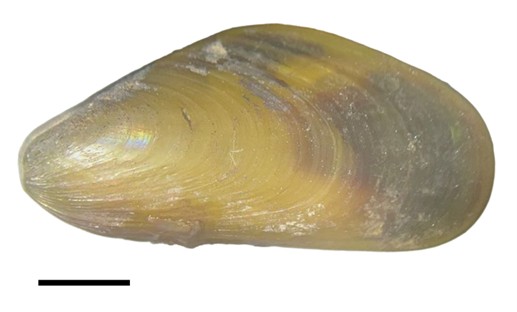
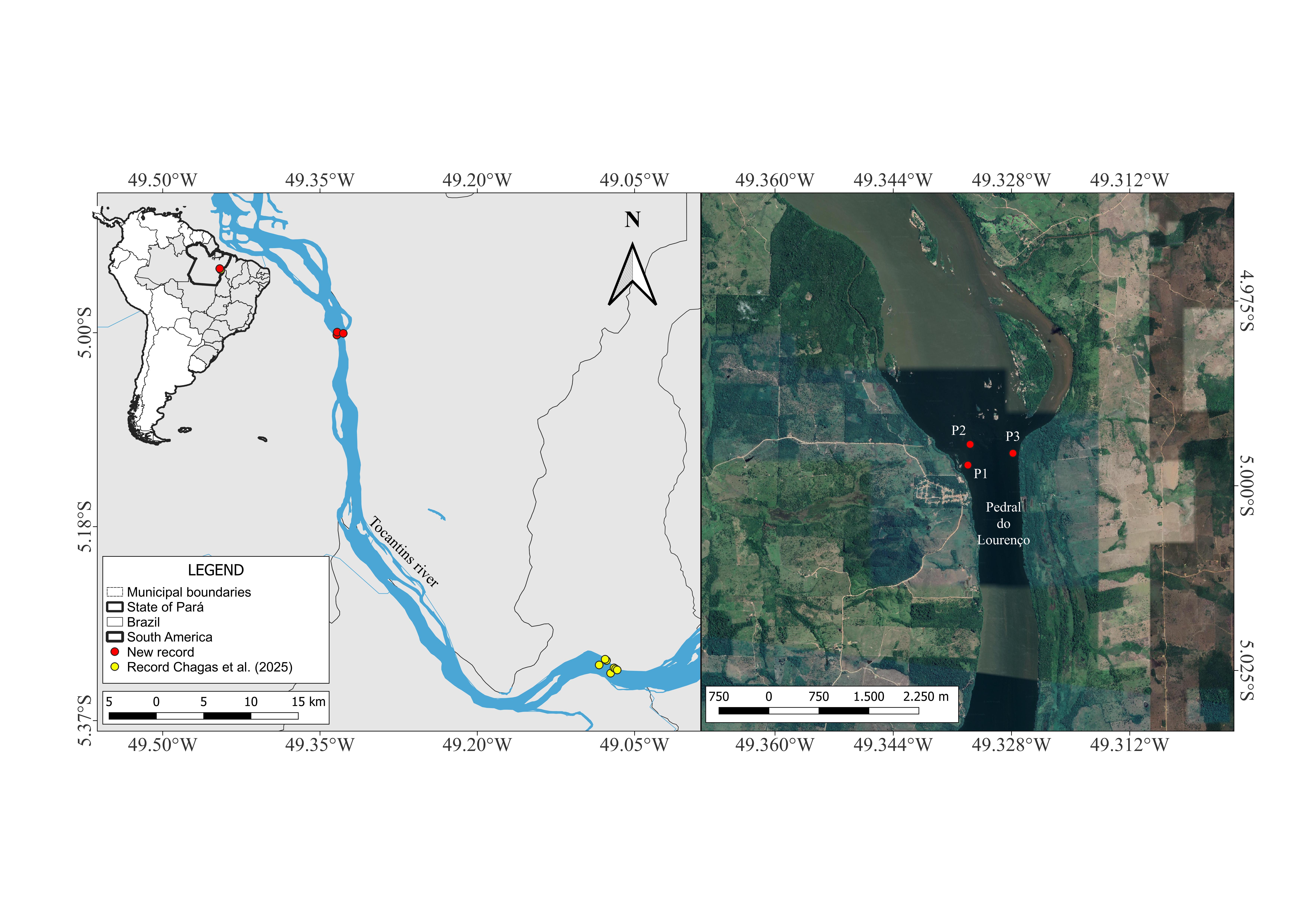
In this context, the present study presents the first qualitative and quantitative data on the invasion of the golden mussel Limnoperna fortunei (Figure 1) into the Amazon region. The study area was delimited by Pedral do Lourenço, which is a rock formation located in the municipality of Itupiranga, between the municipalities of Marabá and Tucuruí, in the Southeast region of Pará (Figure 2). Sampling was carried out at three sites (Site 1: -49.3339, -4.9972; Site 2: -49.3336, -4.9944; Site 3: -49.3278, -4.9956) on Pedral do Lourenço, visually characterized by a large, intermediate and small infestation of mussels. Scraping was carried out with a spatula, fixing the samples in 70% alcohol and sending them to the Laboratório de Conservação da Biodiversidade no Centro Nacional de Pesquisa e Conservação da Biodiversidade Marinha do Norte - CEPNOR/ICMBio.
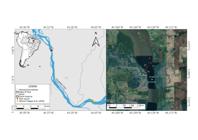
Location map of the occurrence of the golden mussel Limnoperna fortunei in the Tocantins River, Pará, Eastern Amazon (a), indicating the river flow (dotted arrows) and the location of the points in this study (red dots) (b).
In the laboratory, preliminary screening was initially carried out, which consisted of separating the biological material (e.g. mussels and associated fauna) from the portion of sediment present in the sample. This procedure was carried out in low-pressure running water and sieved through a 500 µm mesh. Both the mussels and the associated fauna extracted were stored in glass jars and preserved in 70% ethanol for later analysis.
Subsequently, the taxonomic identification of the golden mussel was carried out using morphological characters based on specific literature about the species, comparing with the specimens available in Malacological Collection of Museu de Zoologia da Universidade Federal Rural da Amazônia (MZ-UFRA), referring to the first individuals recorded in the Amazon region by Chagas et al. (2025a). The individuals in the current registry were deposited in the MZ-UFRA under the vouchers MZ-UFRA Moll1506, MZ-UFRA Moll1507 and MZ-UFRA Moll1508.
Population density refers to the number of individuals collected per square meter (m2) of sampled area. Biometric characterization was performed by measuring the anteroposterior length of the mussels. The average population density of mussels found was 11,940 individuals m2, with site three (P3) presenting the lowest density, with 4,255 individuals m2, and site two (P2) presenting the highest density, with 15,849 individuals m2 (Table 1). The density of mussels found was much higher than that found by Chagas et al. (2025a) in 2023, of 88 ind.m2, being a strong indication that the species has already adapted to local conditions.
Biometric data of golden mussels found at three sampling sites in the Tocantins River, Pará, Eastern Amazon.
Mussel population density is one of the main indicators of the development of the species, with several studies addressing density in an annual comparison (Mansur et al., 2003; Oliveira et al., 2006; Lucía et al., 2022). Among the studies that also compared population density after one year of sampling, Darrigran & Pastorino (1995), recording a population density that increased from 31,222 ind.m2 in 1992, to 82,151 ind.m2 in 1993 in Bagliardi, Argentina. In Brazil, Mansur et al. (2003) found mussel population densities ranging from 27,275 ind.m2 in 2000 to 63,700 ind.m2 in 2001, reaching a maximum density of 143,500 ind.m2. The average densities found by these authors are well below those found by Darrigran et al. (2003), of up to 150,000 ind./m2, of 200,000 ind.m2 by Boltovskoy et al. (2006) and 291,028 ind.m2 by Santos & Souza (2022). However, high densities are sometimes estimated based on small areas. Therefore, density estimates should also be considered considering the sampled area.
Regarding the biometrics of the mussels, the minimum total length was 1.92 mm and the maximum was 22.10 mm, with an average length of 12.22±4.19 mm (Table 1), with morphometric data available at Chagas et al. (2025b). This average and length is higher than that found by Chagas et al. (2025a) in the Tocantins River in 2023, with an average length of 8.20±2.27 mm, ranging from 4.40 to 14.20 mm. The total length found in the present study is similar to that found by Mansur et al. (2008) with an average length value of 22.44 ± 0.25 mm, ranging between 3.57 and 39.96 mm in total length and Pareschi et al. (2008) with a total length ranging between 3.0 and 20 mm.
Although adults usually reach 30 to 35 mm in total length (Boltovskoy & Cataldo, 1999; Boltovskoy et al., 2022), the scientific literature records a maximum shell length of 45 mm (Darrigran, 2002) and 50 mm (Boltovskoy et al., 2022). Dei Tos et al. (2016) mention that the species reaches the length of first maturity (L50) at 10 mm. Such information is important for monitoring the species, since from the first to the second year, mussel shells can reach up to 30 mm in total length (Boltovskoy & Cataldo, 1999). Because this study presents tiny individuals next to individuals of reproductive age (>10mm) (Figure 3) is an indication that they belong to a previous generation, as observed by Mansur et al. (2003).

Biometric size-distribution variation of golden mussels found at three sampling sites in the Tocantins River, Pará, Eastern Amazon.
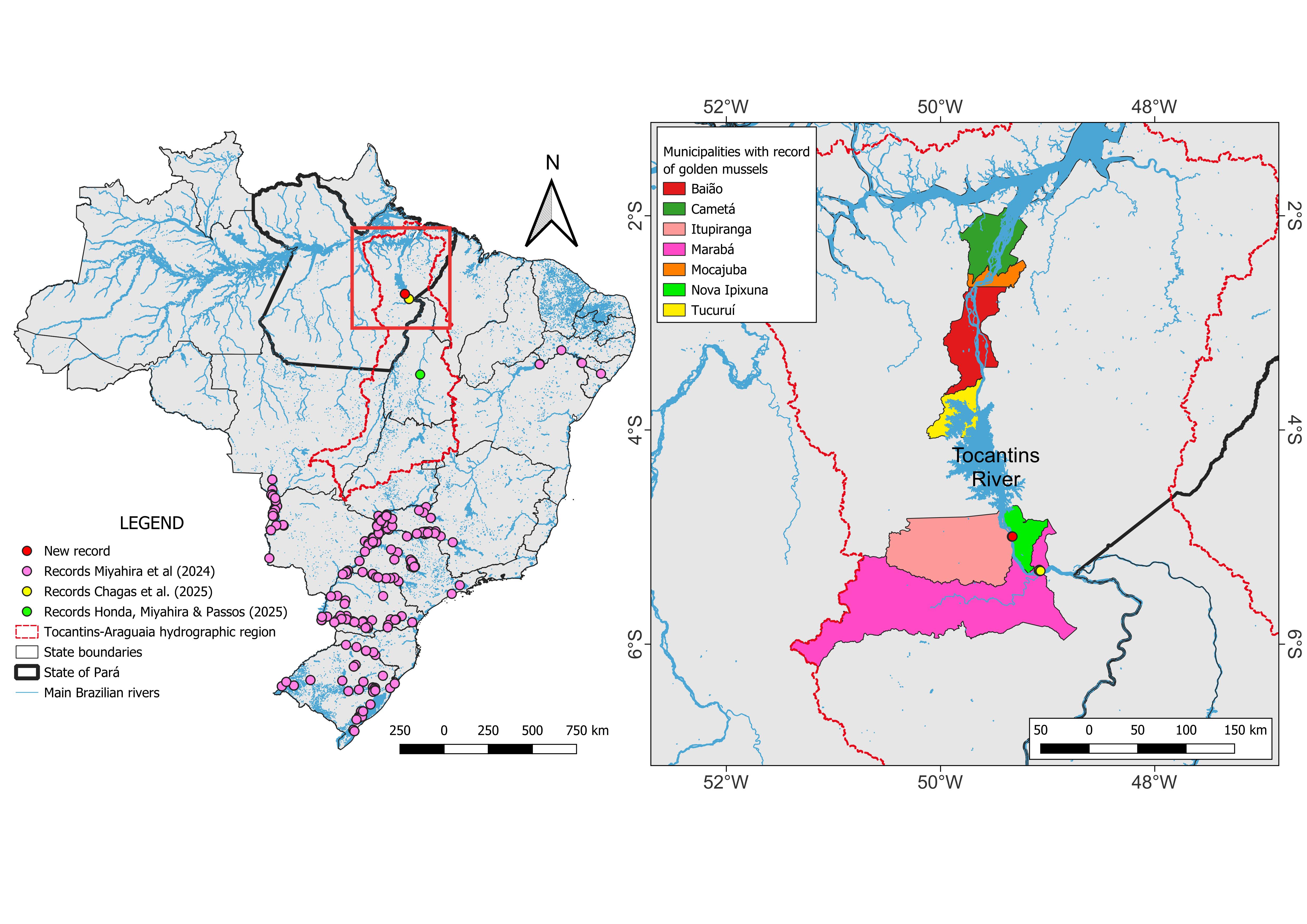
When Chagas et al. (2025a) recorded the first occurrence of the golden mussel in the Tocantins River basin, in the Amazon region, there was a hiatus in the occurrence of mussels in the central-west region, indicating the dispersion of the invasion of the species from the South-Southeast region (or Northeast) to the North region. The authors indicated that the lack of information on the golden mussel in the central region of Brazil does not reflect reality and that the species was probably already present, but with underestimated or undocumented records. This theory was confirmed with the recent publication of Honda et al. (2025) who recorded golden mussels in an aquaculture enterprise in the state of Tocantins, in a portion farther down the Tocantins River (Figure 4a).
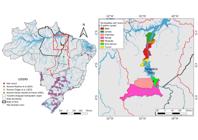
(a) Distribution of records of the golden mussel in Brazilian waters and municipalities where the species has already been recorded in the state of Pará; (b) The Tocantins-Araguaia river basin stands out (red line).
In this context, with the record of Chagas et al. (2025a), added to the present study and the survey of the presence of the species through social media (e.g., reports on television or private online channels and publications on social networks) we indicate the municipalities of the state of Pará along the river in which the species has already been observed (Figure 4b).
The presence or high densities of mussels causes a series of significant environmental impacts, which are widely documented in the scientific literature. Among the main ones, changes in aquatic habitats stand out, which unbalance the populations of macrophytes, benthic fauna, ichthyofauna, water quality and, consequently, the entire trophic chain (Oliveira et al., 2006; Bertão et al., 2021; Santos & Souza, 2022; Miyahira et al., 2024). In addition, mussels generate considerable economic impacts. They affect sectors such as energy generation and reservoirs, water collection and treatment, aquaculture and fishing, navigation and waterways, irrigation and tourism (Ayroza et al., 2019; Lucía et al., 2022; Santos & Souza, 2022). In this context, although several golden mussel dispersal vectors associated with human activities (e.g., navigation, aquaculture and biological sampling) or natural activities (e.g., migratory fish, connectivity between basins, macrophytes and birds) are known, the effective contribution of each one is still poorly understood.
Although several methodologies for preventing and monitoring mussels are known (IBAMA, 2020), the scientific literature does not indicate any effective measures to eradicate this invasive species. Therefore, it is crucial to study its distribution, invasion potential, environmental tolerance, and biological characteristics, since the most important control actions focus on monitoring the species since its first record in a specific basin (Ribolli et al., 2021). Thus, documenting mussel occurrences and data on its population structure are essential, as this information allows predicting and monitoring new infestations, in addition to assessing the potential impacts caused by its presence.
This is the second record of golden mussels in the Amazon region, and the first one that contains preliminary data on population structure. The results indicate that the Tocantins River is a recent settlement, with evidence of at least one reproduction cycle already completed. Extensive monitoring is recommended in the area of the Tocantins River and its tributaries, as this will allow for a better diagnosis of the invasion, enabling the application of mitigating measures.
Acknowledgements
The authors would like to thank the scientific initiation students at Cepnor/ICMBIO for their assistance with biometrics and typing of the mussels' biometric data. The promoter of Justiça Agrária of the municipality of Marabá and the Instituto de Desenvolvimento Florestal e da Biodiversidade (Ideflor-Bio).
Data availability
All research data analyzed in the research is available in Chagas et al. (2025b) in Zenodo. Access is open to the public. It can be accessed in https://doi.org/10.5281/zenodo.15627903.
-
Cite as:
Chagas, R.A. et al. Golden but not precious: first quali-quantitative data on golden mussels bioinvasion in the Amazon. Acta Limnologica Brasiliensia, 2025, vol. 37, e29. https://doi.org/10.1590/S2179-975X4925
References
-
Albert, J.S., Carvalho, T.P., Petry, P., Holder, M.A., Maxime, E.L., Espino, J., Corahua, I., Quispe, R., Rengifo, B., Ortega, H., & Reis, R.E., 2011. Aquatic biodiversity in the Amazon: habitat specialization and geographic isolation promote species richness. Animals 1(2), 205-241. PMid:26486313. http://doi.org/10.3390/ani1020205
» http://doi.org/10.3390/ani1020205 -
Ayroza, D.M.M.R., Carmo, C.F., Camargo, A.F.M., Oliveira, M.D., & Petesse, M.L., 2019. Net cages enhance golden mussel (Limnoperna fortunei) larval density and condition factor. Freshw. Biol. 64(9), 1593-1602. http://doi.org/10.1111/fwb.13355
» http://doi.org/10.1111/fwb.13355 -
Barros, M.R.F., Chagas, R.A., Santos, W.C.R., & Herrmann, M., 2020. Novo registro de Melanoides tuberculata (Mollusca: Thiaridae) na Amazônia Oriental. Res. Soc. Dev. 9(7), e774974461. http://doi.org/10.33448/rsd-v9i7.4461
» http://doi.org/10.33448/rsd-v9i7.4461 -
Bertão, A.P.S., Leite, R.V.V., Horodesky, A., Pie, M.R., Zanin, T.L., Netto, O.S.M., & Ostrensky, A., 2021. Ecological interactions between invasive and native fouling species in the reservoir of a hydroelectric plant. Hydrobiologia 848(21), 5169-5185. http://doi.org/10.1007/s10750-021-04706-7
» http://doi.org/10.1007/s10750-021-04706-7 -
Boltovskoy, D., & Cataldo, D.H., 1999. Population dynamics of Limnoperna fortunei, an invasive fouling mollusc, in the lower Parana river (Argentina). Biofouling 14(3), 255-263. http://doi.org/10.1080/08927019909378417
» http://doi.org/10.1080/08927019909378417 -
Boltovskoy, D., Correa, N., Cataldo, D., & Sylvester, F., 2006. Dispersion and Ecological Impact of the Invasive Freshwater Bivalve Limnoperna fortunei in the Río de la Plata Watershed and Beyond. Biol. Invasions 8(4), 947-963. http://doi.org/10.1007/s10530-005-5107-z
» http://doi.org/10.1007/s10530-005-5107-z -
Boltovskoy, D., Paolucci, E., MacIsaac, H.J., Zhan, A., Xia, Z., & Correa, N., 2022. What we know and don’t know about the invasive golden mussel Limnoperna fortunei. Hydrobiologia 852(5), 1275-1322. http://doi.org/10.1007/s10750-022-04988-5
» http://doi.org/10.1007/s10750-022-04988-5 - Chagas, R.A., Barros, M.R.F., Montelo, D.J., & Santos, W.J.P., 2025a. New bioinvasion in the Amazon: first record of the golden mussel Limnoperna fortunei (Dunker 1857) in the Tocantins River (Eastern Amazon). Actapesca 22(1), 55-61.
-
Chagas, R.A., Mendes, M.E.T.S., Barbosa, A.R.G., Marques, K.E.A., Brito Junior, S.C., Carvalho, V.S., Freitas, Y.C.D.A., Barros, M.R.F., Santos, W.J.P., Santos, W.C.R., & Sousa, E.B., 2025b. Morphometric dataset of the golden mussel Limnoperna fortunei collected in the Tocantins River, Pará State (Eastern Amazon). Genève: Zenodo. http://doi.org/10.5281/zenodo.15627903
» http://doi.org/10.5281/zenodo.15627903 - Darrigran, G., & Pastorino, G., 1995. The recente introduction of a freshwater asiatic bivalve, Limnoperna fortunei (Mytilidae) into South America. Veliger 38(2), 171-175.
-
Darrigran, G., 2002. Potential impact of filter-feeding invaders on temperate inland freshwater environments. Biol. Invasions 4(1-2), 145-156. http://doi.org/10.1023/A:1020521811416
» http://doi.org/10.1023/A:1020521811416 - Darrigran, G., Damborenea, C., Penchaszadeh, P., & Taraborelli, C., 2003. Adjustments of Limnoperna fortunei (Bivalvia: Mytilidae) after ten years of invasion in the Americas. J. Shellfish Res. 22(1), 141-146.
-
Dei Tos, C., Quagio-Grassiotto, I., & Mazzoni, T.S., 2016. Cellular development of the germinal epithelium during the gametogenic cycle of the golden mussel Limnoperna fortunei (Bivalvia: Mytilidae). Rev. Biol. Trop. 64(2), 521-536. PMid:29451752. http://doi.org/10.15517/rbt.v64i2.18837
» http://doi.org/10.15517/rbt.v64i2.18837 -
Faria, L., Carvalho, B.M., Carneiro, L., Miiller, N.O.R., Pedroso, C.R., Occhi, T.V.T., Tonella, L.H., & Vitule, J.R.S., 2022. Invasive species policy in Brazil: a review and critical analysis. Environ. Conserv. 50(1), 67-72. http://doi.org/10.1017/S0376892922000406
» http://doi.org/10.1017/S0376892922000406 -
Honda, R.T., Miyahira, I.C., & Passos, F.D., 2025. At the doors of the Amazonian region: occurrence of Limnoperna fortunei (Dunker, 1857) (Mollusca, Bivalvia, Mytilidae) in the Tocantins River. Check List 21(2), 248-254. http://doi.org/10.15560/21.3.248
» http://doi.org/10.15560/21.3.248 - Instituto Brasileiro do Meio Ambiente e dos Recursos Naturais Renováveis – IBAMA, 2020. Plano nacional de prevenção, controle e monitoramento do mexilhão-dourado (Limoneperna fortunei) no Brasil Brasília: IBAMA.
-
Lucía, M., Darrigran, G., & Gutiérrez Gregoric, D.E., 2022. The most problematic freshwater invasive species in South America, Limnoperna fortunei (Dunker, 1857), and its status after 30 years of invasion. Aquat. Sci. 85(1), 1. http://doi.org/10.1007/s00027-022-00907-x
» http://doi.org/10.1007/s00027-022-00907-x -
Mansur, M.C.D., Figueiró, H., Santos, C.P.S., Glock, L., Bergonci, P.E.A., & Pereira, D., 2008. Variação espacial do comprimento e do peso úmido total de Limnoperna fortunei (Dunker, 1857) no delta do rio Jacuí e lago Guaíba (RS, Brasil). Biotemas 21(4), 49-54. http://doi.org/10.5007/2175-7925.2008v21n4p49
» http://doi.org/10.5007/2175-7925.2008v21n4p49 - Mansur, M.C.D., Richinitti, L.M.Z., & Santos, C.P., 1999. Limnoperna fortunei (Dunker, 1857) molusco bivalve invasor na bacia do Guaíba, Rio Grande do Sul, Brasil. Biociencias 7(2), 147-149.
-
Mansur, M.C.D., Santos, C.P., Darrigran, G., Heydrich, I., Callil, C.T., & Cardoso, F.R., 2003. Primeiros dados quali-quantitativos do mexilhão-dourado, Limnoperna fortunei (Dunker), no Delta do Jacuí, no Lago Guaíba e na Laguna dos Patos, Rio Grande do Sul, Brasil e alguns aspectos de sua invasão no novo ambiente. Rev. Bras. Zool. 20(1), 75-84. http://doi.org/10.1590/S0101-81752003000100009
» http://doi.org/10.1590/S0101-81752003000100009 -
Miyahira, I.C., Neves, R.A.F., Rocha, R.J.S., Branco, C.W.C., & Santos, L.N., 2024. A new basin, a new river, a new home: the introduction of Limnoperna fortunei (Dunker, 1857) in Paraíba do Sul basin and its potential consequences to the most important basin for water supply in Southeast Brazil. BioInvasions Rec. 13(3), 799-814. http://doi.org/10.3391/bir.2024.13.3.18
» http://doi.org/10.3391/bir.2024.13.3.18 -
Oliveira, M.D., Takeda, A.M., Barros, L.F., Barbosa, D.S., & Resende, E.K., 2006. Invasion by Limnoperna fortunei (Dunker, 1857) (Bivalvia, Mytilidae) of the Pantanal Wetland, Brazil. Biol. Invasions 8(1), 97-104. http://doi.org/10.1007/s10530-005-0331-0
» http://doi.org/10.1007/s10530-005-0331-0 -
Pareschi, D.C., Matsumura-Tundisi, T., Medeiros, G.R., Luzia, A.P., & Tundisi, J.G., 2008. First occurrence of Limnoperna fortunei (Dunker, 1857) in the Rio Tietê watershed (São Paulo State, Brazil). Braz. J. Biol. 68(4, Suppl.), 1107-1114. PMid:19197480. http://doi.org/10.1590/S1519-69842008000500017
» http://doi.org/10.1590/S1519-69842008000500017 - Pastorino, G., Darrigan, G., Martin, S., & Lunaschi, L., 1993. Limnperna fortunei (Dunker, 1857) (Mytilidae), nuevo bivalvo invasor en aguas del río de La Plata. Neotropica 39(101-102), 34.
-
Pimpão, D.M., & Martins, D.S., 2008. Ocorrência do molusco asiático Corbicula fluminea (Müller, 1774) (Bivalvia, Corbiculidae) no baixo rio Negro, Amazônia central. Acta Amazon. 38(3), 589-592. http://doi.org/10.1590/S0044-59672008000300026
» http://doi.org/10.1590/S0044-59672008000300026 -
Ribas, C.C., Sawakuchi, A.O., Almeida, R.P., Pupim, F.N., Rego, M.A., Batista, R., & Knowles, L.L., 2025. The role of rivers in the origin and future of Amazonian biodiversity. Natl. Rev. 1(1), 14-31. http://doi.org/10.1038/s44358-024-00001-0
» http://doi.org/10.1038/s44358-024-00001-0 -
Ribolli, J., Cassol, S., Silva, S.H., Zaniboni Filho, E., Zacchi, F.L., Mattos, J.J., Cardoso, G.F.M., & Nuñer, A.P.O., 2021. Optimized and validated protocol to the detection of the invasive bivalve Limnoperna fortunei from eDNA plankton samples. Acta Limnol. Bras. 33, e201. http://doi.org/10.1590/s2179-975x7620
» http://doi.org/10.1590/s2179-975x7620 -
Santos, A.M.E.S., & Souza, R.F.M., 2022. Limnoperna fortunei: impactos e medidas de controle no abastecimento de água no sertão alagoano. Rev. Ibero-Am. Ciênc. Ambient. 13(4), 108-117. http://doi.org/10.6008/CBPC2179-6858.2022.004.0010
» http://doi.org/10.6008/CBPC2179-6858.2022.004.0010
Edited by
-
Associate Editor:
Andre Andrian Padial.