 Potential impacts of sea-level rise on fish communities in coastal lakes and lagoons of the Tramandaí River Hydrographic System, southern Brazil
Abstract
Abstract Climate changes are predicted to strongly affect aquatic communities and consequences in coastal lakes and lagoons might be worsened by the tendency of salinization due to sea-level rise.
Aim This study aims to evaluate potential fish community changes caused by a potential increase in salinity in a system formed by 41 interconnected lakes/lagoons.
Methods We modeled the occurrence and abundance of 12 fish species under two scenarios of salinity change via marine water intrusion through the estuary of the Tramandaí river, in south Brazil, based on their contribution to β diversity. This was determined by the difference between the average number of recorded individuals and the salinity condition using ANOVA and Tukey's test, followed by generalized linear models with the estuarine connection projected for two future climate scenarios. In addition, we evaluated the effects of increased salinity on endemic species and the consequences of this environmental change on their endangered status.
Results According to our results, salinity increases will lead to reductions in the distribution of freshwater fish species, which would become restricted to fewer lakes/lagoons (a 10 to 60% reduction in habitat area within the study region). These reductions in geographic distributions are even more concerning for the endemic species.
Conclusions Our results demonstrate the need to assess vulnerability to climate change and that these criteria should be more clearly incorporated into species assessment protocols, such as those of the IUCN.
Keywords:
coastal ecosystems; endangered species; global change; salinity
Resumo
Resumo Mudanças climáticas devem afetar fortemente as comunidades aquáticas. Para as lagoas costeiras isso pode ser agravado pela tendência à salinização pela elevação do nível do mar.
Objetivo Este estudo objetiva avaliar alterações nas comunidades de peixes provocadas por potencial aumento na salinidade em um sistema formado por 41 lagos e lagoas interconectadas.
Métodos Nós modelamos a ocorrência e abundância de 12 espécies de peixes em dois cenários de alteração da salinidade, via intrusão de água marinha pelo estuário do rio Tramandaí, no sul do Brasil, com base em sua contribuição para a diversidade beta. Esta foi determinada pela diferença entre o número médio de indivíduos registados e a condição de salinidade, utilizando ANOVA e o teste de Tukey, seguidos de modelos lineares generalizados com a ligação estuarina projetada para dois cenários climáticos futuros. Adicionalmente, avaliamos os efeitos do aumento da salinidade nas espécies endémicas e as consequências desta alteração ambiental no seu estado de ameaça.
Resultados De acordo com nossos resultados, aumentos de salinidade levarão à redução na abundância de espécies de água doce que tendem a se limitar a um número reduzido de lagoas (redução de 10 a 60% na área de habitat dentro da região estudada). Essas reduções na distribuição geográfica são ainda mais preocupantes para as espécies endêmicas.
Conclusões Nossos resultados demonstram a necessidade de avaliar a vulnerabilidade às mudanças climáticas e que esses critérios devem ser incorporados de forma mais clara aos protocolos de avaliação de espécies, como os da IUCN.
Palavras-chave:
ecossistemas costeiros; espécies ameaçadas; mudanças globais; salinidade
1. Introduction
Several effects of climate change, including changes in rainfall patterns, increasing ocean temperatures and sea levels rise, may compromise the functioning and ecosystem services of coastal lagoons (Pérez-Ruzafa et al., 2019). Coastal lakes and lagoons are ecotones between continental and marine ecosystems, being characterized by high productivity and ecological importance for several organisms (Pérez-Ruzafa et al., 2007). Because marine intrusion may change the balance between freshwater and saline water supply, the rise of sea level might be particularly relevant for freshwater species (Cruz et al., 2018; Jarić et al., 2019; Santos et al., 2023). In addition to other anthropogenic factors, salinity increases may affect the distribution of several species in space and time, as well as contribute to population declines or even local extinctions (Mantyka-Pringle et al., 2014; Kuczynski et al., 2018).
Projections made by the Intergovernmental Panel on Climate Change (IPCC) indicate that by the year 2100 the average sea level will rise to 0.41 m (0.28–0.55 m) in an optimistic scenario (SSP1-1.9) of warming up to 1.5°C as long as a drastic reduction in emissions of CO2 occur (IPCC, 2023). In a worst-case scenario (SSP5-8.5), the projected sea-level rise of 0.82 m (likely range: 0.63 - 1.01 m) would increase marine intrusion into coastal environments, potentially affecting not only surface water bodies but also groundwater and soils (Colombani et al., 2015, 2016; IPCC, 2023). Therefore, the integrity of continental coastal waters such as estuaries, rivers, lakes and lagoons may be compromised by increase in saline water, both directly (through elevated salinity) and indirectly (via altered environmental conditions that affect biological interactions) (Castillo et al., 2018; Bray et al., 2019). Salinization of coastal water bodies may occur in different ways, simultaneously or not, depending on their spatial configuration in relation to the coastline (Carrasco et al., 2016). For example, higher sea levels may disrupt natural barriers that separate lakes from the sea, leading to their complete disappearance or may breach the sandbar of coastal lakes/lagoons more frequently (Wit, 2011; Câmara et al., 2018), or may increase saline intrusion in lagoons that remain, due to enhanced connectivity with the sea (either through groundwater or estuaries) (Colombani et al., 2016; da Silva et al., 2022; IPCC, 2023). The increase in water extraction for irrigation and public supply combined with the reduction in rainfall amounts can also trigger salinization processes (Cañedo-Argüelles et al., 2013; Dugan et al., 2017; Kaushal et al., 2018; Rodrigues et al., 2021).
Water salinity plays a central role in the dynamics of fish communities in coastal lakes and lagoons, as the capacity to withstand wide ranges of salinity involves physiological and behavioral requirements of the organisms (Whitfield, 2015; Franco et al., 2019; Santos et al., 2023). Physiological stress caused by increased salinity may reduce the fitness of organisms and promote the dominance of better adapted species (Whitfield, 2015; García-Seoane et al., 2016; Castillo et al., 2018). Thus, the increase in frequency of salinization events predicted to from sea levels may lead to the reduction of some fish populations or even to their local extinction (Valesini et al., 2017; dos Santos et al., 2023). In this context, conservation planning relies on identifying the species and environments most vulnerable to climate change. To understand and project future impacts, β diversity as a component of regional diversity provides a useful framework for decision-making reflects how much local communities differ from each other (Socolar et al., 2016). Analytical approaches have considered the local contribution to β diversity (Local Contribution to Beta Diversity - LCBD), where large LCBD values indicate locations with unique species combinations and are, therefore, of greater conservation value (Tan et al., 2019; Vasconcelos & Prado, 2019).
The main goal of this study was to evaluate the influence of salinity changes expected to occur with sea level rise on the fish community of a complex of interconnected lakes/lagoons in southern Brazil. We examined the potential effects of sea level rise in converting seasonally saline lakes/lagoons into permanently saline environments. In this context, we sought to identify which fish species and lakes/lagoons are most vulnerable to salinization. Additionally, we expected to find contractions in the distribution ranges of endemic species under future scenarios, which may result in a reassessment of their conservation status according to IUCN criteria (IUCN, 2001).
2. Methods
2.1. Study area
The Tramandaí River Hydrographic System (TRHS) consists of 41 lakes/lagoons that have a unique connection to the sea through the Tramandaí estuary (Figure 1). Despite being geologically recent [ca. 5.000 years B.P. (Schwarzbold & Schäfer, 1984)], the TRHS presents more than one hundred freshwater fish species, four of which are endemics and occur exclusively in some lakes/lagoons (Malabarba et al., 2013). The TRHS lakes/lagoons are predominantly freshwater and, although there is no information on paleosalinity for all of them, freshwater conditions were established at least for 1000 years ago (García-Rodríguez, 2006; Lima & Parise, 2020).

Hydrographic network of the Tramandaí River Hydrographic System (TRHS), RS – Brazil, and its 41 coastal lakes/lagoons and the estuary (19). The 34 lagoons included in this study are identified by numbers.
This study includes 34 of the 41 lagoons located within the Tramandaí River Hydrographic System (TRHS), coastal plain, RS, Brazil (Figure 1), which covers an area of approximately 2700 km2. The TRHS can be divided into two subsystems, one southern and another northern from the Tramandaí lagoon (Schwarzbold & Schäfer, 1984). In the southern subsystem, Custódias and Gentil lagoons experience salinity fluctuations and exhibit temporary estuarine characteristics along the year (Schwarzbold & Schäfer, 1984). The discharge of the Três Forquilhas and Maquiné rivers prevents salinity in the lagoons of the northern subsystem (Schwarzbold & Schäfer, 1984). This holocenic coastal plain results from the deposition of sediments from marine transgressions and regressions that created barriers isolating water bodies (Schwarzbold & Schäfer, 1984). The human population density in the region is increasing since 1995 and the occupation process has been intensified by the establishment of numerous horizontal housing developments (Lopes et al., 2018). Rice cultivation is an important economic activity in the region, and due to its high water-demand, it compromises water quality and increases soil and water salinization (Carmona et al., 2011).
2.2. Fish communities
Data on fish communities from the 34 lagoons were obtained from 22 sampling expeditions conducted in the TRHS lakes/lagoons between April 2009 and September 2012 (SISBIO registration 11174-1 and UFRGS Ethics Committee 15044). In each lake/lagoon a littoral fish community sampling was conducted at two sites along the shoreline, using a beach-seine net (10 m length × 1.5 m height, 15 mm mesh) with a sampling effort of three hauls per site. The water bodies were sampled during two seasonal periods: warmer months (from October to April) and colder months (from May to September). For lagoons sampled more than once, the number of individuals per species was averaged over the sampling expeditions. Due to the small size, belonging to a shoreline community and to the difficulty in differentiating juveniles, fishes of the genus Mugil (M. liza and M. curema) were grouped as Mugil sp.
2.3. Endemic species and extinction risk
Occurrence data of endemic species were supplemented with records from scientific collections (speciesLink, 2025) to better characterize their current distribution and predict future changes. Currently, Gymnogeophagus lacustris Reis & Malabarba, 1988; Odontesthes ledae Malabarba & Dyer, 2002 and O. piquava Malabarba & Dyer, 2002 are classified as Near Threatened (NT) on the Red List of Threatened Species of the state of Rio Grande do Sul (Decree RS 51797, 2014). Odontesthes bicudo Malabarba & Dyer, 2002 is listed as Endangered (EN) both in the state and national lists (Decree RS 51797, 2014; MMA Ordinance 148/2022), due to its restricted distribution area and declining population.
2.4. Individual contributions of lakes/lagoons and species to beta diversity in the TRHS
To assess individual contributions of lakes/lagoons and species to β diversity, we used the method proposed by Legendre & De Cáceres (2013), which partitions β diversity into contributions from individual species and sampling units. This method calculates a variation matrix of species composition (and/or abundance data) by summing the mean deviations of the community composition matrix transformed using the Hellinger index. If all values in column j of the variation matrix are zero, for example, it indicates that all sampling units have the same abundance for species j. The relative contribution of each sampling unit to β diversity is called “Local Contribution to Beta Diversity (LCBD)”. Ecologically, LCBD represents the uniqueness of a sampling unit in terms of species composition; its significance is tested by permutation analysis (999 iterations) against the null hypothesis of random species distribution across sampling units. The relative contribution of species is termed “Species Contributions to Beta Diversity (SCBD),” representing variation in individual species across the study area. The sum of all columns in the variation matrix (SS_total) yields the total β diversity value (BD_total), defined as the total variation of the community divided by the number of sampling units minus one. For further methodological details, see Legendre & De Cáceres (2013).
2.5. Lagoon salinity
Due to the lack of quantitative salinity data for all lakes/lagoons and, when available, being qualitative (presence or absence of salinity influence), we used estuarine connectivity (EC) (sensuGuimarães et al., 2014) to model lagoon salinity. EC considers the cost-distance from each lagoon to the estuary, accounting for travel friction depending on the connection type. A friction value of 1 was assigned to lakes/lagoons and waterways wide and deep enough for vessel passage, and friction 2 to waterways where vessel passage depends on higher water volumes from highlands (Serra Geral) via the Tramandaí and Três Forquilhas rivers. Since the water volume discharge hinders saltwater intrusion into the northern lagoon subsystem, resistance for these lakes/lagoons was assigned a cost twice that of the southern subsystem. All other interlagoon connections without sufficient water volume for boat passage were assigned a friction value of 7, assuming minimal water exchange. EC is inversely proportional to the cost-distance (CD) to the Tramandaí River estuary, calculated as EC = 1/log(CD). Considering that salinity influence is seasonal in Custódia and Gentil lakes, their EC values were used as thresholds for seasonal salinity influence in future scenarios. CD and EC analyses were conducted using ArcGIS Pro 3.3.1 (ESRI, 2024) and hydrological shapefiles from the continuous cartographic base of Rio Grande do Sul (Hasenack & Weber, 2010).
2.6. Projected scenarios of lagoon vulnerability to salinization
Climate change projections from WorldClim (Poggio et al., 2018; WorldClim, 2025) in annual precipitation for the TRHS region is expected to increase by 2050 and 2070. This increase is accompanied by greater annual variability in precipitation, i.e., more frequent short extreme rainfall events. Conversely, IPCC projections (IPCC, 2023) estimate sea level rise of approximately 0.29 m and 1.01 m by 2050 and 2090, respectively, under the most pessimistic scenario (SSP5-8.5). These projections are corroborated by local studies in the coastal region of Rio Grande do Sul. Figueiredo (2013) forecasts up to 1.10 m sea level rise by 2100, potentially inundating up to 800 m of the continental area. Despite this sea level is unlikely to submerge the freshwater lakes/lagoons of the TRHS, it may increase marine water intrusion through the Tramandaí River estuary and also through water table salinization. The freshwater lake closest to the coastline (excluding Tramandaí) is Simão (approximately 1400 m from the coastline). Therefore, even with increased rainfall, sea level rise may sufficiently increase salinity in coastal lakes/lagoons.
If sea level rises alone drives lagoon salinization, we propose two hypothetical EC scenarios to evaluate effects on fish community composition. In Scenario 1 (EC1), lakes/lagoons that currently are seasonally saline will become permanently saline, and EC was recalculated accordingly. Those lakes/lagoons that reach the threshold of saline influence (observed in the current EC calculation) are now considered seasonally saline. In this scenario, Lagoa do Passo is permanently saline because in the study by Loitzenbauer & Mendes (2012), an increase in salinity was proposed for this lagoon due to a decrease in freshwater flow and increased irrigation, among other factors. In Scenario 2 (EC2), lakes/lagoons that are seasonally saline in EC1 become permanently saline, and EC was recalculated for the remaining lakes/lagoons.
2.7. Data analysis
To assess whether the local contribution to β diversity was associated with variation in species richness, a linear regression was performed between LCBD (local loading distribution coefficient) values and freshwater fish species richness. This analysis aimed to determine whether lakes/lagoons with higher LCBD values exhibited lower species richness, suggesting that local contributions to β diversity are influenced by species with restricted spatial distributions.
For species identified as individually important to β diversity (twelve species), differences in mean individual counts under varying salinity conditions (freshwater, seasonally saline, and saline) were evaluated using analysis of variance (ANOVA), followed by Tukey tests for pairwise comparisons when significant differences were detected. For these species, the relationship between species abundance and current EC was analyzed using linear regression, with abundance as the response variable and EC as a continuous predictor. Given that salinity may influence species occurrence, species presence/absence was further analyzed using binomial generalized linear models (GLMs) with a logit link function, including EC as a predictor. For species exhibiting significant relationships with EC, the fitted models were used to predict occurrence probabilities under projected scenarios EC1 and EC2, allowing assessment of potential changes in species distribution under altered salinity conditions.
For endemic species, regardless of their importance to β diversity, occurrence-EC relationships were assessed using binomial GLMs. The total lagoon area currently occupied by these species was quantified and compared with projected areas under the EC1 and EC2 scenarios to estimate area loss and assess threat status for each species based on geographic range (IUCN, 2001). According to IUCN, Critically Endangered (CR) species have an extent of occurrence of less than 100 km2 and/or an area of occupancy of less than 10 km2, with at least two of the following: severe fragmentation, continuous decline, or fluctuations. Endangered (EN) species meet CR criteria but have an extent of occurrence of up to 5000 km2 and an area of occupancy of up to 500 km2 (in up to five locations). Vulnerable (VU) species have an extent of occurrence up to 20000 km2, an area of occupancy at least 2000 km2, and occur in up to ten locations.
3. Results
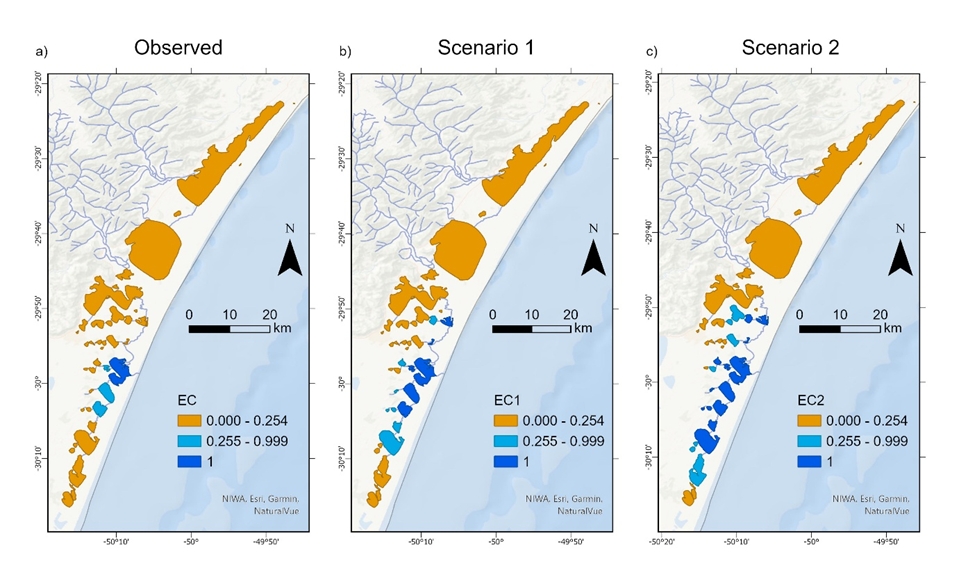
The EC values currently observed and in projected scenarios 1 and 2, in which seasonally saline lakes/lagoons become permanently saline, indicate an increase in the number of lakes/lagoons influenced by salinity (Figure 2). In scenario EC1, four lakes shift from freshwater to seasonally saline conditions: Caieira, Tapera Sul, Manuel Nunes, and Fortaleza (Figure 2b). In scenario EC2, this influence extends to eight additional lakes: Traíra, Lessa, Veados, Emboaba, Prainha, Suzana, Tapera Sul, and Cidreira (Figure 2c).

Estuarine connectivity gradient (EC) along the Tramandaí River Hydrographic System (RS – Brazil). EC values below 0.255, illustrated in yellow, represent freshwater lakes. EC values between 0.255 and 0.999, shown in light blue, represent lakes/lagoons seasonally influenced by salinity. Dark blue, representing a value of 1, indicates lakes/lagoons with permanent saline influence. (a) EC values under current connectivity conditions with the estuary; (b) Expected EC1 values representing permanent salinization of lakes/lagoons that currently are only seasonally saline; (c) Expected EC2 values representing lakes/lagoons influenced by salinity of Scenario 2.
3.1. Contribution of lakes/lagoons to beta diversity
The total variation in the fish community matrix (SStotal = 16.92) indicates substantial heterogeneity in species composition among sampling sites, and this variation corresponds to a moderate level of β diversity in the TRHS (BDtotal = 0.51), reflecting detectable spatial differentiation in fish assemblage structure across the system. The relative contribution of lakes/lagoons to community β diversity (LCBD) ranged from 0.009 to 0.068. LCBD presented a weak negative relationship with freshwater fish species richness (R2 = 0.14; P = 0.03), indicating that high LCBD values tend to be related to a small number of species with restricted distribution (Figure 3). Five lakes/lagoons showed significant LCBD: Lake B, Tramandaí, Cerquinha Sul, Traíra, and Simão, but only B and Traíra change their salinity under the proposed scenarios.

Map of the Tramandaí River Hydrographic System (RS – Brazil) showing (a) the contribution of each lake/lagoon to β diversity (LCBD), and (b) the species richness recorded in each sampled lagoon. (c) Linear relationship between species richness and LCBD. See Figure 1 for lake/lagoon identification.
3.2. Species: contribution to beta diversity
A total of 48 species were recorded (Supplementary Material Table MS 1, Guimarães et al., 2026), including four endemics to the TRHS (Supplementary Material Table MS 2, Guimarães et al., 2026): Gymnogeophagus lacustris, Odontesthes bicudo, O. ledae, and O. piquava.
SCBD varied between 0.0002 and 0.1887, with a mean of 0.0208. Twelve species contributed more to β diversity than the average of all 48 species (Table 1), among them, the endemics G. lacustris and O. ledae.
Current individual contribution values of the 12 most important species to β diversity (SCBD) of the Tramandaí River Hydrographic System (RS, Brazil).
Diapoma alburnum, Hyphessobrycon luetkenii, Hyphessobrycon igneus, Jenynsia multidentata, and Mugil sp. were recorded in all lakes/lagoons, and significant differences in abundance across environments were observed only for D. alburnum (Table 1; Figure 4). Cheirodon ibicuhiensis and Platanichthys platana were recorded only in freshwater environments and showed no relationship with EC (Table 1; Figure 4).

Variation in abundance of the twelve species with the greatest contribution to β diversity in the Tramandaí River Hydrographic System (RS, Brazil), across different lagoon salinity conditions. FH = freshwater lakes/lagoons; SS = seasonally influenced by salinity; PS = permanently saline. Abundance data was log-transformed [log(x+1)]. (a) Diapoma alburnum; (b) Mugil sp. juveniles; (c) Hyphessobrycon luetkenii; (d) Cheirodon ibicuhiensis; (e) Hyphessobrycon igneus; (f) Jenynsia multidentata; (g) Odontesthes ledae; (h) Astyanax eigenmanniorum; (i) Platanichthys platana; (j) Geophagus brasiliensis; (k) Corydoras paleatus; (l) Gymnogeophagus lacustris.
All species, except Mugil sp. juveniles, tend to occur mostly in freshwater lakes and to reduce their abundance in lakes/lagoons under seasonally or permanent saline conditions (Figure 4). Mugil sp. juveniles had the second highest SCBD value (0.161), and although there were no significant differences in the mean number of individuals recorded among freshwater, seasonally saline, and permanently saline lakes/lagoons, a trend toward increasing abundance in lakes/lagoons with greater saline influence was observed (Figure 4).This trend is confirmed by the models when evaluating the occurrence of Mugil sp. juveniles as a function of EC (GLM explaining 48.13% of variance; P = 0.025; ESC = 74.03), predicting an expansion of its current area of occurrence in EC1 and EC2 (Figure 5). The same trend is observed when abundance and EC are analyzed (R2 = 0.31; P < 0.001; ESC = 6.3). Occurrence projections for Mugil sp. based on this model suggest that both range expansion and abundance will also increase (Figure 5).

Observed and expected occurrence of Mugil sp. under two scenarios of increased salinity in the Tramandaí River Hydrographic System (RS, Brazil). Blue symbols represent the current distribution (EC), red symbols represent the distribution under Scenario 1 salinization (EC1), and yellow symbols represent the distribution under Scenario 2 (EC2).
The abundances of H. luetkenii and G. brasiliensis also showed a relationship with EC (Table 1), but with an opposite trend than Mugil sp. The models indicate a decline in the abundance of these species with increasing EC in both scenarios (EC1 and EC2), and they also predict local extinction in some lakes/lagoons (Figure 6).

Observed and expected distribution of Hyphessobrycon luetkenii and Geophagus brasiliensis under two scenarios of increased salinity in the Tramandaí River Hydrographic System (RS, Brazil). Blue symbols represent the current distribution (EC), red symbols represent the distribution under Scenario 1 salinization (EC1), and yellow symbols represent the distribution under Scenario 2 (EC2).
3.3. Endemic species and their classification under IUCN threat criteria
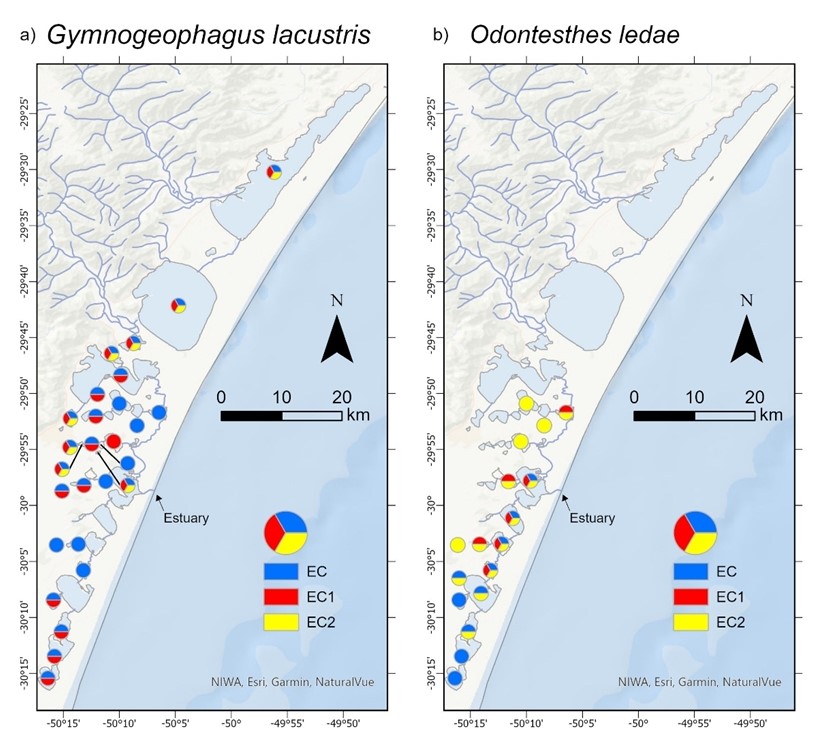
Among the endemic species, only G. lacustris and O. ledae showed a significant relationship with EC (Table 1). The occurrence of G. lacustris decreased from 27 to 20 lakes/lagoons in EC1 (a 6% decrease from the current area of 370.24 km2 to 346.49 km2) and to 9 in EC2 (a 30.78% reduction, dropping to 256.27 km2) (Figure 7). The reduction in G. lacustris occurrence in EC2 would reclassify its conservation status from Near Threatened (NT) to Vulnerable (VU), if considering only the nine lakes/lagoons with possible species presence, or to Endangered (EN) if the total projected area of occupancy is considered (< 500 km2).

Observed and expected distribution of Gymnogeophagus lacustris and Odontesthes ledae under two scenarios of increased salinity in the Tramandaí River Hydrographic System (RS, Brazil). Blue symbols represent the current distribution (EC), red symbols represent the distribution under Scenario 1 salinization (EC1), and yellow symbols represent the distribution under Scenario 2 (EC2).
For O. ledae, that has a restricted distribution to lakes/lagoons in the southern portion of the TRHS, the loss of area represented approximately 50% in EC1 (from 87.68 to 44.68 km2), and a reduction in its occurrence from ten to seven lakes/lagoons. Similarly to G. lacustris, the conservation status of O. ledae would shift to Endangered (EN) due to area loss and reduced number of occurrences already in EC1. In EC2, the model predicted an expansion of its occurrence to lakes/lagoons north of the TRHS. If these lakes/lagoons are disregarded, given that O. ledae is restricted to the subsystem south of Tramandaí estuary (because of the salinity barrier to dispersion), a redistribution is expected with expansion into three other lakes/lagoons while disappearing from three lakes/lagoons. This rearrangement represents a loss of area from 87.68 km2 (current scenario) to 78.53 km2.
Since O. bicudo and O. piquava showed no relationship with EC, it was not possible to model their distributions for the possible salinization scenarios of the studied system. However, since these species do not occur in saline environments, it is possible to infer that their distributions will be reduced from nine and six lakes/lagoons currently to eight and five in EC1, and to eight and four in EC2, respectively (Supplementary Material Table MS 2, Guimarães et al., 2026).
4. Discussion
Our results point to a potential change in fish species composition and distribution due to increased salinity inferred from climate change projections in a complex coastal lagoon system. The effects of climate change on fish species distribution are generally related to the impacts of rising temperatures (Jeppesen et al., 2010; Logez et al., 2012). Herein, we add the importance of considering the effects of increasing salinity, which is a key factor for the distribution of freshwater organisms (Garcia et al., 2003; Pérez-Ruzafa et al., 2007; Sosa-López et al., 2007; Castillo et al., 2018; Franco et al., 2019). Changes in salinity are natural phenomena in these coastal lakes/lagoons that took approximately 1,000 to 5,000 years to establish themselves as freshwater systems (García-Rodríguez, 2006; Lima & Parise, 2020). During a slow and gradual sea-level rise, as occurred in the past, some lakes/lagoons could have naturally shifted inland (Wit, 2011). However, the contemporary salinization process occurs much more rapidly, and it is likely that several lakes/lagoons will become saline within 50 to 80 years (IPCC, 2023). Furthermore, this inland movement would depend on geomorphological conditions and could be hindered by human-built structures designed to protect land from erosion and/or flooding (Wit, 2011; Guimarães et al., 2021). With the acceleration of salinization, it is probable that some freshwater fish populations will not have enough time to adapt and disperse to new environments (Colombani et al., 2016). The consequent species losses are described in our results, since projected salinity results in scenarios of abundance reduction in freshwater species that become restricted to a reduced number of lakes/lagoons. These reductions are even more concerning when endemic species are considered.
Estuarine connectivity proved to be a useful tool to infer salinity effects, although locally measured salinity data could help refine species prediction models. Our results show that even in a complex lacustrine system, the effects of sea-level rise can impact aquatic biodiversity, even though these lakes/lagoons are not subject to marine flooding events or sandbar breaches caused by storm surges (Figueiredo, 2013). It is important to highlight that the salinization process does not depend solely on marine intrusion. Increased water extraction for human consumption and irrigation, mining activities, and removal of native vegetation are factors that affect the water table and consequently the salt concentration of surface waters (Loitzenbauer & Mendes, 2012; Cañedo-Argüelles et al., 2013; Dugan et al., 2017). Therefore, our species distribution models for salinization scenarios may underestimate the situation by considering only lakes and lagoons salinization via marine intrusion. More robust models that include other anthropogenic factors, such as urbanization and agriculture, would increase the reliability of projections. Even including the projection of increased salinity through saltwater intrusion, our results highlight a likely scenario of loss of some species important to the system’s β diversity.
High LCBD values indicate sites with strong differentiation in species composition and may have high conservation value (Legendre & De Cáceres, 2013). In our study area, two of the five lakes/lagoons with significant LCBD showed a change from freshwater to saline conditions under salinity change scenarios 1 and 2. Although these lakes/lagoons do not have high species richness (Traíra and lagoon B with nine and six species, respectively), they have significant uniqueness in their species composition, and a loss in their biodiversity could negatively impact the system’s overall β diversity. In fact, we observed that sites with high LCBD values are not necessarily the most species-rich, a trend also found elsewhere (Maloufi et al., 2016; Vilmi et al., 2017; Rocha et al., 2023). However, this is not a general or obligatory relationship, as in other ecosystems a high LCBD may indicate sites with rare species combinations deserving further study (Legendre & De Cáceres, 2013). In a pessimistic scenario of an 800 m sea advance (Figueiredo, 2013), the Tramandaí lagoon (with significant LCBD), would lose its lagoon characteristics and could turn into a bay, having its limnological and ecological features completely altered, as well as the immediately neighboring lakes.
Regarding SCBD, its value alone is insufficient to indicate conservation value of species (Vilmi et al., 2017). We used SCBD only to select species showing high variation across the study area and contributing to the overall β diversity of the TRHS. Using this approach, we selected 12 of the 48 recorded species as important and evaluated their relationships with salinity presence and EC values observed and projected. We observed that Mugil sp. tends to expand into other lakes/lagoons and increase its abundance with increasing salinity. However, this expansion must be analyzed cautiously. Mugil sp. represents two diadromous species entering the lagoon system to develop. Both M. liza and M. curema (two species that occur in the Tramandaí System) are commercially important and listed as overexploited or threatened by overexploitation (MMA, Normative Instruction 5/2004). Additionally, studies point to a population decline due to fishing pressure (Haimovici & Cardoso, 2017). The same may occur with other larger species, not sampled in this study, such as the catfish genus Genidens, where some species are also listed as threatened and are also important for local fishing (Gilio-Dias et al., 2020). Among freshwater species, only H. luetkenii and G. brasiliensis showed a relationship with EC, and their distributions were modeled under scenarios 1 and 2. In both situations, their abundances decreased, and the models suggest a reorganization in their distribution, with some occurrence losses and others gained (Figure 6). Under a climate change scenario with rising temperatures, many species may migrate and establish in new geographic distributions compatible with their physiological requirements (Kuczynski et al., 2018). Therefore, it is plausible to expect that such rearrangements also occur regarding increasing salinity in the hydrologically interconnected system represented by southern Brazilian coastal lakes/lagoons, as evidenced by our models.
As pointed out by Whitfield et al. (2023), one common aspect to many estuarine and coastal regions is the lack of baseline understanding of the biology of many fish species, including their environmental tolerances, in this case salinity gradients. Some species have a wide tolerance to salinity levels, such as Lycengraulis grossidens, which can explore and reproduce in freshwater to estuarine waters (Mai et al., 2014). Unfortunately, we do not know the physiological salinity tolerance levels for most of the species sampled in this study, but we can group them into primary freshwater species (like Characiformes) or secondary freshwater species (like Perciformes), as Garcia et al. (2003) did along the Patos Lagoon. Passos et al. (2013) already used a grouping system between marine, estuarine, and freshwater species along a gradient salinity in the Paranaguá Bay Estuarine, further north of TRHS. In our study area, Guimarães et al. (2014) allocated each fish species to one of the following groups: freshwaters (with very low or no tolerance to brackish waters – the primary freshwater species by Garcia et al., 2003), estuarine-freshwaters species (species that tolerate both freshwater and brackish waters), and estuarine species (species that tolerate only saline waters, including occasional marine visitors). Based on the results obtained in this study, both primary freshwater species, such as H. luetkenii (characid) and secondary freshwater species, such as G. brasiliensis (cichlid), will be impacted by models predicting changes in estuarine connectivity. Specifically, G. brasiliensis has a wide tolerance to salinity levels, as it can tolerate both freshwater and marine environments (Gutierre et al., 2014), probably better rearranging its distribution in TRHS.
Endemic species are particularly sensitive to environmental changes because their distributions are generally more restricted. Habitat degradation and losses increase endemic species vulnerability to extinction at a much higher rate than non-endemic species (Işik, 2011). Our models for the endemics G. lacustris and O. ledae (both secondary freshwater species, according to Garcia et al. (2003) and Passos et al. (2013) show a reorganization and reduction in their distributions. The reduction in Scenario 1 would be sufficient to change O. ledae’s threat category from “Near Threatened” to “Threatened”. For G. lacustris, Scenario 2 would be the most severe, placing the species in the “Threatened” category. Gymnogeophagus lacustris and O. ledae were among the twelve species with the highest importance for the β diversity of TRHS. As mentioned earlier, SCBD alone cannot be used for conservation purposes, but when combined with other rarity and/or endemism information, it makes conservation approaches more successful (Vilmi et al., 2017; Rocha et al., 2023).
In summary, projected climate-driven salinization is likely to reorganize fish assemblages in the TRHS, reducing the abundance and spatial extent of freshwater species while favoring some estuarine or diadromous taxa. These impacts are spatially heterogeneous and may disproportionately affect lakes/lagoons with high LCBD, resulting in losses of regional β diversity. Endemic species stand out as particularly vulnerable, with predicted distributional contractions severe enough to alter their conservation status. National assessment criteria for threatened species underestimate or inadequately consider climate change as a threat factor. Our results demonstrate the need to assess vulnerability to climate change and that these criteria should be more clearly incorporated into species assessment protocols, such as those of the IUCN (Jarić et al., 2019). The consequences of climate change should not be viewed as predictions for a distant future. The intensity of global change and biodiversity loss is increasingly evident, and projections are approaching the present.
Acknowledgments
We thank the Programa de Pós-Graduação em Ecologia at UFRGS and NUPEM/UFRJ, for research support. We thank Sandra C. Müller, Clarice B. Fialho, Érica M. P. Caramaschi and Tiago Carvalho for several suggestions. This study was financed in part by the Coordenação de Aperfeiçoamento de Pessoal de Nível Superior - Brazil (CAPES) - Finance Code 001. Part of the data was obtained under a CNPq grant to FGB (Process 483873/2007-1 357). SMH and ACP received research grants from CNPq (Processes 305549/2018-9; 315924/2023-3).
Data availability
The Supplementary Material is available in https://doi.org/10.5061/dryad.cjsxksnmp. Access is free.
-
Cite as:
Guimarães, T.F.R. et al. Potential impacts of sea-level rise on fish communities in coastal lakes and lagoons of the Tramandaí River Hydrographic System, southern Brazil. Acta Limnologica Brasiliensia, 2026, vol. 38, e7. https://doi.org/10.1590/S2179-975X5125
References
-
Bray, J.P., Reich, J., Nichols, S.J., Kon Kam King, G., Mac Nally, R., Thompson, R., O’Reilly-Nugent, A., & Kefford, B.J., 2019. Biological interactions mediate context and species-specific sensitivities to salinity. Philos. Trans. R. Soc. Lond. B Biol. Sci. 374(1764), 20180020. PMid:30509919. https://doi.org/10.1098/rstb.2018.0020
» https://doi.org/10.1098/rstb.2018.0020 -
Câmara, E.M., Caramaschi, É.P., Di Dario, F., & Petry, A.C., 2018. Short-term changes in two tropical coastal lagoons: effects of sandbar openings on fish assemblages. J. Coast. Res. 341, 90-105. https://doi.org/10.2112/JCOASTRES-D-16-00026.1
» https://doi.org/10.2112/JCOASTRES-D-16-00026.1 -
Cañedo-Argüelles, M., Kefford, B.J., Piscart, C., Prat, N., Schäfer, R.B., & Schulz, C.J., 2013. Salinisation of rivers: an urgent ecological issue. Environ. Pollut. 173, 157-167. PMid:23202646. https://doi.org/10.1016/j.envpol.2012.10.011
» https://doi.org/10.1016/j.envpol.2012.10.011 -
Carmona, F.C., Anghinoni, I., Holzschuh, M.J., & Martins, A.P., 2011. Attributes of irrigated rice as affected by soil sodicity and potassic fertilizer application. Rev. Bras. Ciênc. Solo 35(3), 889-897. https://doi.org/10.1590/S0100-06832011000300023
» https://doi.org/10.1590/S0100-06832011000300023 -
Carrasco, A.R., Ferreira, O., & Roelvink, D., 2016. Coastal lagoons and rising sea level: a review. Earth Sci. Rev. 154, 356-368. https://doi.org/10.1016/j.earscirev.2015.11.007
» https://doi.org/10.1016/j.earscirev.2015.11.007 -
Castillo, A.M., Sharpe, D.M., Ghalambor, C.K., & De Léon, L.F., 2018. Exploring the effects of salinization on trophic diversity in freshwater ecosystems: a quantitative review. Hydrobiologia 807(1), 1-17. https://doi.org/10.1007/s10750-017-3403-0
» https://doi.org/10.1007/s10750-017-3403-0 -
Colombani, N., Mastrocicco, M., & Giambastiani, B.M.S., 2015. Predicting Salinization trends in a lowland coastal aquifer: Comacchio (Italy). Water Resour. Manage. 29(2), 603-618. https://doi.org/10.1007/s11269-014-0795-8
» https://doi.org/10.1007/s11269-014-0795-8 -
Colombani, N., Osti, A., Volta, G., & Mastrocicco, M., 2016. Impact of climate change on salinization of coastal water resources. Water Resour. Manage. 30(7), 2483-2496. https://doi.org/10.1007/s11269-016-1292-z
» https://doi.org/10.1007/s11269-016-1292-z -
Cruz, L.R., Santos, L.N., & Santos, A.F., 2018. Changes of fish trophic guilds in Araruama Lagoon, Brazil: what can be inferred about functioning and structure of hipersaline laggons? Estuar. Coast. Shelf Sci. 211, 90-99. https://doi.org/10.1016/j.ecss.2017.11.024
» https://doi.org/10.1016/j.ecss.2017.11.024 -
Dugan, H.A., Bartlett, S.L., Burke, S.M., Doubek, J.P., Krivak-Tetley, F.E., Skaff, N.K., Summers, J.C., Farrell, K.J., McCullough, I.M., Morales-Williams, A.M., Roberts, D.C., Ouyang, Z., Scordo, F., Hanson, P.C., & Weathers, K.C., 2017. Salting our freshwater lakes. Proc. Natl. Acad. Sci. USA 114(17), 4453-4458. PMid:28396392. https://doi.org/10.1073/pnas.1620211114
» https://doi.org/10.1073/pnas.1620211114 - Environmental Systems Research Institute – ESRI, 2024. ArcGIS pro: release 3. Redlands: ESRI.
-
Figueiredo, S.A.D.E., 2013. Modelling climate change effects in southern Brazil. J. Coast. Res. 65, 1933-1938. https://doi.org/10.2112/SI65-327.1
» https://doi.org/10.2112/SI65-327.1 -
Franco, T.P., Neves, L.M., & Araújo, F.G., 2019. Better with more or less salt? The association of fish assemblages in coastal lagoons with different salinity ranges. Hydrobiologia 828(1), 83-100. https://doi.org/10.1007/s10750-018-3804-8
» https://doi.org/10.1007/s10750-018-3804-8 -
Garcia, A.M., Raseira, M.B., Vieira, J.P., Winemiller, K.O., & Grimm, A.M., 2003. Spatiotemporal variation in shallow-water freshwater fish distribution and abundance in a large subtropical coastal lagoon. Environ. Biol. Fishes 68(3), 215-228. https://doi.org/10.1023/A:1027366101945
» https://doi.org/10.1023/A:1027366101945 -
García-Rodríguez, F., 2006. Inferring paleosalinity trends using the chrysophyte cyst to diatom ratio in coastal shallow temperate/subtropical lagoons influenced by sea level changes. J. Paleolimnol. 36(2), 165-173. https://doi.org/10.1007/s10933-006-0011-9
» https://doi.org/10.1007/s10933-006-0011-9 -
García-Seoane, E., Dolbeth, M., Silva, C.L., Abreu, A., & Rebelo, J.E., 2016. Changes in the fish assemblages of a coastal lagoon subjected to gradual salinity increases. Mar. Environ. Res. 122, 178-187. PMid:27836187. https://doi.org/10.1016/j.marenvres.2016.10.005
» https://doi.org/10.1016/j.marenvres.2016.10.005 -
Gilio-Dias, S.M., Machado, R., Miranda, T.M., & Kubo, R.R., 2020. Artisanal fisherfolk’s local ecological knowledge on catfish and fishing legislations: a necessary dialog. Ambiente Soc. 23, 1-20. https://doi.org/10.1590/1809-4422asoc20180333r2vu2020l6ao
» https://doi.org/10.1590/1809-4422asoc20180333r2vu2020l6ao -
Guimarães, T.D.F.R., Hartz, S.M., & Becker, F.G., 2014. Lake connectivity and fish species richness in southern Brazilian coastal lakes. Hydrobiologia 740(1), 207-217. https://doi.org/10.1007/s10750-014-1954-x
» https://doi.org/10.1007/s10750-014-1954-x -
Guimarães, T.D.F.R., Petry, A.C., Hartz, S.M., & Becker, F.G., 2021. Influence of past and current factors on the beta diversity of coastal lagoon fish communities in South America. J. Biogeogr. 48(3), 639-649. https://doi.org/10.1111/jbi.14029
» https://doi.org/10.1111/jbi.14029 -
Guimarães, T.F.R., Becker, F.G., Petry, A.C., & Hartz, S.M., 2026. Data from: Potential impacts of sea-level rise on fish communities in coastal lagoons of the Tramandaí river hydrographic system, southern Brazil (Online). Dryad. Retrieved in 2025, June 25, from https://datadryad.org/dataset/doi:10.5061/dryad.cjsxksnmp
» https://datadryad.org/dataset/doi:10.5061/dryad.cjsxksnmp -
Gutierre, S.M., Vitule, J.R., Freire, C.A., & Prodocimo, V., 2014. Physiological tools to predict invasiveness and spread via estuarine bridges: tolerance of Brazilian native and worldwide introduced freshwater fishes to increased salinity. Mar. Freshw. Res. 65(5), 425-436. https://doi.org/10.1071/MF13161
» https://doi.org/10.1071/MF13161 -
Haimovici, M., & Cardoso, L.G., 2017. Long-term changes in the fisheries in the Patos Lagoon estuary and adjacent coastal waters in Southern Brazil. Mar. Biol. Res. 13(1), 135-150. https://doi.org/10.1080/17451000.2016.1228978
» https://doi.org/10.1080/17451000.2016.1228978 - Hasenack, H., & Weber, E., 2010. Base cartográfica vetorial contínua do Rio Grande do Sul - escala 1:50.000. Porto Alegre: Centro de Ecologia, UFRGS.
-
Intergovernmental Panel on Climate Change – IPCC, 2023. AR6 synthesis report: climate change 2023 (Online). Geneva: IPCC. Retrieved in 2025, June 25, from https://www.ipcc.ch/report/ar6/syr/
» https://www.ipcc.ch/report/ar6/syr/ - International Union for Conservation of Nature – IUCN, 2001. IUCN red list categories and criteria: version 3.1. Gland.
-
Işik, K., 2011. Rare and endemic species: why are they prone to extinction? Turk. J. Bot. 35, 411-417. https://doi.org/10.3906/bot-1012-90
» https://doi.org/10.3906/bot-1012-90 -
Jarić, I., Lennox, R.J., Kalinkat, G., Cvijanović, G., & Radinger, J., 2019. Susceptibility of European freshwater fish to climate change: species profiling based on life-history and environmental characteristics. Glob. Change Biol. 25(2), 448-458. PMid:30417977. https://doi.org/10.1111/gcb.14518
» https://doi.org/10.1111/gcb.14518 -
Jeppesen, E., Meerhoff, M., Holmgren, K., González-Bergonzoni, I., Teixeira-de Mello, F., Declerck, S.J., De Meester, L., Søndergaard, M., Lauridsen, T.L., Bjerring, R., Conde-Porcuna, J.M., Mazzeo, N., Iglesias, C., Reizenstein, M., Malmquist, H.J., Liu, Z., Balayla, D., & Lazzaro, X., 2010. Impacts of climate warming on lake fish community structure and potential effects on ecosystem function. Hydrobiologia 646(1), 73-90. https://doi.org/10.1007/s10750-010-0171-5
» https://doi.org/10.1007/s10750-010-0171-5 -
Kaushal, S.S., Likens, G.E., Pace, M.L., Utz, R.M., Haq, S., Gorman, J., & Grese, M., 2018. Freshwater salinization syndrome on a continental scale. Proc. Natl. Acad. Sci. USA 115(4), E574-EE583. PMid:29311318. https://doi.org/10.1073/pnas.1711234115
» https://doi.org/10.1073/pnas.1711234115 -
Kuczynski, L., Legendre, P., & Grenouillet, G., 2018. Concomitant impacts of climate change, fragmentation and non-native species have led to reorganization of fish communities since the 1980s. Glob. Ecol. Biogeogr. 27(2), 213-222. https://doi.org/10.1111/geb.12690
» https://doi.org/10.1111/geb.12690 -
Legendre, P., & De Cáceres, M., 2013. Beta diversity as the variance of community data: dissimilarity coefficients and partitioning. Ecol. Lett. 16(8), 951-963. PMid:23809147. https://doi.org/10.1111/ele.12141
» https://doi.org/10.1111/ele.12141 -
Lima, L.G., & Parise, C.K., 2020. Holocene coastal evolution of the transition from transgressive to regressive barrier in southern Brazil. Catena 185, 104263. https://doi.org/10.1016/j.catena.2019.104263
» https://doi.org/10.1016/j.catena.2019.104263 -
Logez, M., Bady, P., & Pont, D., 2012. Modelling the habitat requirement of riverine fish species at the European scale: sensitivity to temperature and precipitation and associated uncertainty. Ecol. Freshwat. Fish 21(2), 266-282. https://doi.org/10.1111/j.1600-0633.2011.00545.x
» https://doi.org/10.1111/j.1600-0633.2011.00545.x -
Loitzenbauer, E., & Mendes, C.A.B., 2012. Salinity dynamics as a tool for water resources management in coastal zones: an application in the Tramandaí River basin, southern Brazil. Ocean Coast. Manage. 55, 52-62. https://doi.org/10.1016/j.ocecoaman.2011.10.011
» https://doi.org/10.1016/j.ocecoaman.2011.10.011 -
Lopes, E.B., Ruiz, T.C.D., & dos Anjos, F.A., 2018. A ocupação urbana no Litoral Norte do Rio Grande do Sul, Brasil, e suas implicações no turismo de segunda residência. Urbe. Rev. Bras. Gest. Urbana 10(2), 426-441. https://doi.org/10.1590/2175-3369.010.002.ao03
» https://doi.org/10.1590/2175-3369.010.002.ao03 -
Mai, A.C., Condini, M.V., Albuquerque, C.Q., Loebmann, D., Saint’Pierre, T.D., Miekeley, N., & Vieira, J.P., 2014. High plasticity in habitat use of Lycengraulis grossidens (Clupeiformes, Engraulididae). Estuar. Coast. Shelf Sci. 141, 17-25. https://doi.org/10.1016/j.ecss.2014.01.014
» https://doi.org/10.1016/j.ecss.2014.01.014 - Malabarba, L.R., Carvalho Neto, P., Bertaco, V.A., Carvalho, T.P., Santos, J.F., & Artioli, L.G.S., 2013. Guia de identificação dos peixes da bacia do Rio Tramandaí. Porto Alegre: Via Sapiens, 140 p.
-
Maloufi, S., Catherine, A., Mouillot, D., Louvard, C., Couté, A., Bernard, C., & Troussellier, M., 2016. Environmental heterogeneity among lakes promotes hyper β-diversity across phytoplankton communities. Freshw. Biol. 61(5), 633-645. https://doi.org/10.1111/fwb.12731
» https://doi.org/10.1111/fwb.12731 -
Mantyka-Pringle, C.S., Martin, T.G., Moffatt, D.B., Linke, S., & Rhodes, J.R., 2014. Understanding and predicting the combined effects of climate change and land-use change on freshwater macroinvertebrates and fish. J. Appl. Ecol. 51(3), 572-581. https://doi.org/10.1111/1365-2664.12236
» https://doi.org/10.1111/1365-2664.12236 -
Passos, A.C., Contente, R.F., Abbatepaulo, F.V., Spach, H.L., Vilar, C., Joyeux, J.C., Cartagena, B.F., & Fávaro, L.F., 2013. Analysis of fish assemblages in sectors along a salinity gradient based on species, families and functional groups. Braz. J. Oceanogr. 61(4), 251-264. https://doi.org/10.1590/S1679-87592013000400006
» https://doi.org/10.1590/S1679-87592013000400006 -
Pérez-Ruzafa, A., Mompeán, M.C., & Marcos, C., 2007. Hydrographic, geomorphologic and fish assemblage relationships in coastal lagoons. Hydrobiologia 577(1), 107-125. https://doi.org/10.1007/s10750-006-0421-8
» https://doi.org/10.1007/s10750-006-0421-8 -
Pérez-Ruzafa, A., Pérez-Ruzafa, I.M., Newton, A., & Marcos, C., 2019. Coastal lagoons: environmental variability, ecosystem complexity, and goods and services uniformity, coasts and estuaries. Amsterdam: Elsevier. https://doi.org/10.1016/B978-0-12-814003-1.00015-0
» https://doi.org/10.1016/B978-0-12-814003-1.00015-0 -
Poggio, L., Simonetti, E., & Gimona, A., 2018. Enhancing the WorldClim data set for national and regional applications. Sci. Total Environ. 625, 1628-1643. PMid:29996459. https://doi.org/10.1016/j.scitotenv.2017.12.258
» https://doi.org/10.1016/j.scitotenv.2017.12.258 -
Rocha, M.P., Morris, T.J., Cottenie, K., & Schwalb, A.N., 2023. Limitations of beta diversity in conservation site selection. Ecol. Indic. 154, 110732. https://doi.org/10.1016/j.ecolind.2023.110732
» https://doi.org/10.1016/j.ecolind.2023.110732 -
Rodrigues, M., Rosa, A., Cravo, A., Jacob, J., & Fortunato, A.B., 2021. Effects of climate change and antrhopogenic pressures in the water quality of a coastal lagoon (Ria Formosa, Portugal). Sci. Total Environ. 780, 146311. PMid:33765468. https://doi.org/10.1016/j.scitotenv.2021.146311
» https://doi.org/10.1016/j.scitotenv.2021.146311 -
Santos, A.V.L., Felice, B.C., Ortega, J.C.G., Figueiredo-Barros, M.P., Souza-Menezes, J., & Petry, A.C., 2023. Drought drives fish disassembling in a Neotropical coastal plain. Hydrobiologia 850(20), 4589-4608. https://doi.org/10.1007/s10750-023-05298-0
» https://doi.org/10.1007/s10750-023-05298-0 - Schwarzbold, A., & Schäfer, A., 1984. Gênese e Morfologia das Lagoas Costeiras do Rio Grande do Sul - Brasil. Amazoniana 9, 87-104.
-
Silva, V.E.L., Assis, I.O., Campos-Silva, J.V., Paulino, G.V.B., & Fabré, N., 2022. Relative importance of habitats mosaics for fish guilds in the northeastern cost of Brazil. Reg. Stud. Mar. Sci. 50, 102145. https://doi.org/10.1016/j.rsma.2021.102145
» https://doi.org/10.1016/j.rsma.2021.102145 -
Socolar, J.B., Gilroy, J.J., Kunin, W.E., & Edwards, D.P., 2016. How should beta-diversity inform biodiversity conservation? Trends Ecol. Evol. 31(1), 67-80. PMid:26701706. https://doi.org/10.1016/j.tree.2015.11.005
» https://doi.org/10.1016/j.tree.2015.11.005 -
Sosa-López, A., Mouillot, D., Ramos-Miranda, J., Flores-Hernandez, D., & Chi, T.D., 2007. Fish species richness decreases with salinity in tropical coastal lagoons. J. Biogeogr. 34(1), 52-61. https://doi.org/10.1111/j.1365-2699.2006.01588.x
» https://doi.org/10.1111/j.1365-2699.2006.01588.x -
speciesLink (Online), 2025. Retrieved in 2025, June 25, from http://splink.cria.org.br
» http://splink.cria.org.br -
Tan, L., Fan, C., Zhang, C., & Zhao, X., 2019. Understanding and protecting forest biodiversity in relation to species and local contributions to beta diversity. Eur. J. For. Res. 138(6), 1005-1013. https://doi.org/10.1007/s10342-019-01220-3
» https://doi.org/10.1007/s10342-019-01220-3 -
Valesini, F.J., Cottingham, A., Hallett, C.S., & Clarke, K.R., 2017. Interdecadal changes in the community, population and individual levels of the fish fauna of an extensively modified estuary. J. Fish Biol. 90(5), 1734-1767. PMid:28164280. https://doi.org/10.1111/jfb.13263
» https://doi.org/10.1111/jfb.13263 -
Vasconcelos, T.S., & Prado, V.H.M., 2019. Climate change and opposing spatial conservation priorities for anuran protection in the Brazilian hotspots. J. Nat. Conserv. 49, 118-124. https://doi.org/10.1016/j.jnc.2019.04.003
» https://doi.org/10.1016/j.jnc.2019.04.003 -
Vilmi, A., Karjalainen, S.M., & Heino, J., 2017. Ecological uniqueness of stream and lake diatom communities shows different macroecological patterns. Divers. Distrib. 23(9), 1042-1053. https://doi.org/10.1111/ddi.12594
» https://doi.org/10.1111/ddi.12594 -
Whitfield, A.K., 2015. Why are there so few freshwater fish species in most estuaries? J. Fish Biol. 86(4), 1227-1250. PMid:25739335. https://doi.org/10.1111/jfb.12641
» https://doi.org/10.1111/jfb.12641 -
Whitfield, A.K., Gillanders, B.M., & Able, K.W., 2023. Climate change effects on fish populations. In: Kennish, M., Paerl, H., & Crosswell, J. eds Climate change and estuaries. Boca Raton: CRC Press, 1 ed. https://doi.org/10.1201/9781003126096-26
» https://doi.org/10.1201/9781003126096-26 -
Wit, R. 2011 Biodiversity of Coastal Lagoon ecosystems and their vulnerability to global change. In: Grillo, O., & Venora, G., eds. Ecosystems biodiversity. Croacia: InTech, 29-40. https://doi.org/10.5772/24995
» https://doi.org/10.5772/24995 -
WorldClim, 2025. WorldClim: maps, graphs, tables, and data of the global climate (Online). Retrieved in 2025, June 25, from http://worldclim.org/
» http://worldclim.org/
Edited by
-
Guest Editors:
Guilherme Garcia de Oliveira, Lucia Helena Ribeiro Rodrigues, Ng Haig They.